
Life, 1906-09-06 · page 23 of 40
Life — September 6, 1906 — page 23: what you’re looking at
What you’re looking at
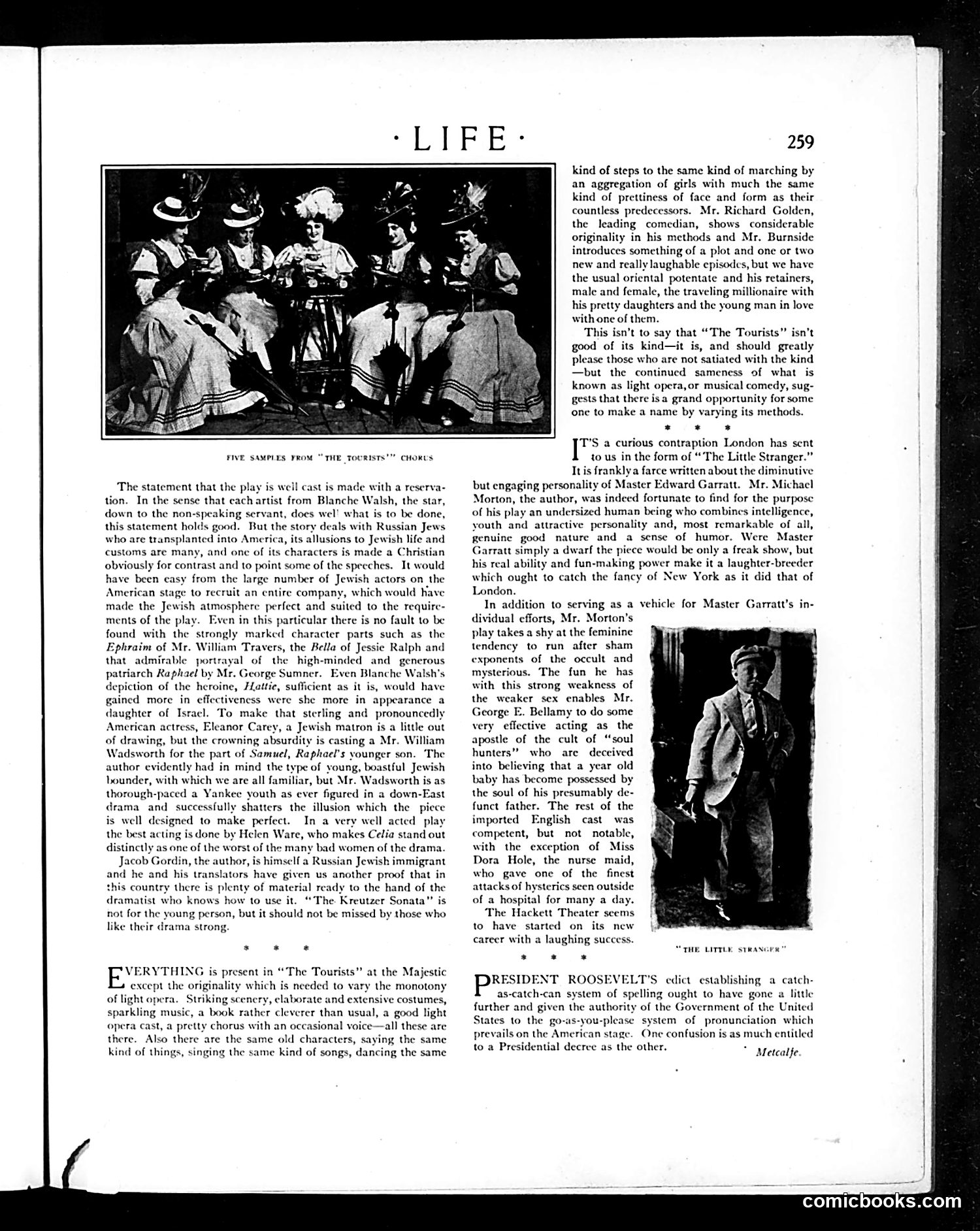
This page reviews a light opera called "The Tourists" at the Majestic Theatre. The photograph shows the chorus line from the show. The critic praises the **cast and production values** (scenery, costumes, music) but criticizes the **formulaic plot**: it features the standard operetta characters — an Oriental potentate, traveling millionaires with daughters, a young romantic lead — repeated endlessly with "the same kind of prettiness" and dance routines. The review also faults the **casting choices for authenticity**. Since the story involves Russian Jewish immigrants in America, the critic argues the producers should have hired Jewish actors throughout for proper atmosphere. Instead, they cast non-Jewish actors (notably William Wadsworth as the young Jewish man Samuel), which "shatters the illusion" the play attempts to create. The point: spectacle cannot substitute for originality. Someone could gain fame by actually **varying light opera's tired formulas** rather than repeating them mechanically.
📄 Transcribed text from this page (OCR, searchable)
Machine-transcribed from the original scan — historical spelling and the odd misread are preserved.
259 kind of steps to the same kind of marching by an aggregation of girls with much the same kind of prettiness of face and form as their countless predecessors. Mr. Richard Golden, the leading comedian, shows considerable originality in his methods and Mr. Burnside introduces something of a plot and one or two new and really laughable episodes, but we have the usual oriental potentate and his retainers, male and female, the traveling millionaire with his pretty daughters and the young man in love with one of them. This isn’t to say that “The Tourists” isn’t good of its kind—it is, and should greatly please those who are not satiated with the kind —but the continued sameness of what is known as light opera,or musical comedy, sug- gests that there isa grand opportunity for some ‘one to make a name by varying its methods. * 28 8 FIVE SAMPLES FROM “THE TooRISTS'” cHoK’s ‘The statement that the play is well cast is made with a reserva- tion. In the sense that each artist from Blanche Walsh, the star, down to the non-speaking servant, does wel’ what is to be done, this statement holds good. But the story deals with Russian Jews who are transplanted into America, its allusions to Jewish life and customs are many, and one of its characters is made a Christian obviously for contrast and to point some of the speeches. It would have been easy from the large number of Jewish actors on the American stage to recruit an entire company, which would have made the Jewish atmosphere perfect and suited to the require- ments of the play. Even in this particular there is no fault to be found with the strongly marked character parts such as the Ephraim of Mr. William Travers, the Bella of Jessie Ralph and that admirable portrayal of the high-minded and generous patriarch Raphael by Mr. George Sumner. Even Blanche Walsh’s depiction of the heroine, FLattie, sufficient as it is, would have gained more in effectiveness were she more in appearance a daughter of Isracl. To make that sterling and pronouncedly American actress, Eleanor Carey, a Jewish matron is a little out of drawing, but the crowning absurdity is casting a Mr. William Wadsworth for the part of Samuel, Raphael's younger son. The author evidently had in mind the type of young, boastful Jewish Lounder, with which we are all familiar, but Mr. Wadsworth is as thorough-paced a Yankee youth as ever figured in a down-East drama and successfully shatters the illusion which the piece is well designed to make perfect. In a very well acted play the best acting isdone by Helen Ware, who makes Celia stand out distinctly as one of the worst of the many bad women of the drama. Jacob Gordin, the author, is himself a Russian Jewish immigrant and he and his translators have given us another proof that in country there is plenty of material ready to the hand of the dramatist who knows how to use it. “The: Kreutzer Sonata” is not for the young person, but it should not be missed by those who like their drama strong. * # « VERYTHING is present in “The Tourists” at the Majestic except the originality which is needed to vary the monotony of light opera. Striking scencry, elaborate and extensive costumes, sparkling music, a book rather cleverer than usual, a good light opera cast, a pretty chorus with an occasional voice—all these are there. Also there are the same old characters, saying the same kind of things, singing the same kind of songs, dancing the same 'T’S a curious contraption London has sent to us in the form of “The Little Stranger.” Tris frankly a farce written about the diminutive but engaging personality of Master Edward Garratt. Mr. Michael Morton, the author, was indeed fortunate to find for the purpose of his play an undersized human being who combines intelligence, youth and attractive personality and, most remarkable of all, genuine good nature and a sense of humor. Were Master Garratt simply a dwarf the piece would be only a freak show, but his real ability and fun-making power make it a laughter-breeder which ought to catch the fancy of New York as it did that of London. In addition to serving as a vehicle for Master Garratt’s in- dividual efforts, Mr. Morton's play takes a shy at the feminine tendency to run after sham exponents of the occult and mysterious. The fun he has with this strong weakness of the weaker sex enables Mr. George E. Bellamy to do some very effective acting as the apostle of the cult of “soul hunters” who are deceived into believing that a year old baby has become possessed by the soul of his presumably de- funct father. The rest of the imported English cast was competent, but not notable, with the exception of Miss Dora Hole, the nurse maid, who gave one of the finest attacks of hysterics seen outside of a hospital for many a day. ‘The Hackett Theater seems to have started on its new career with a laughing suc SOTHE LITTLE: STRANGE ” . 8 # RESIDENT ROOSEVELT’S edict establishing a catch- as-catch-can system of spelling ought to have gone a little further and given the authority of the Government of the United States to the go-as-you-please system of pronunciation which prevails on the American stage. One confusion is as much entitled to a Presidential decree as the other. Metcalfe comicbooks.com