
A complete issue · 46 pages · 1906
Life — March 1, 1906
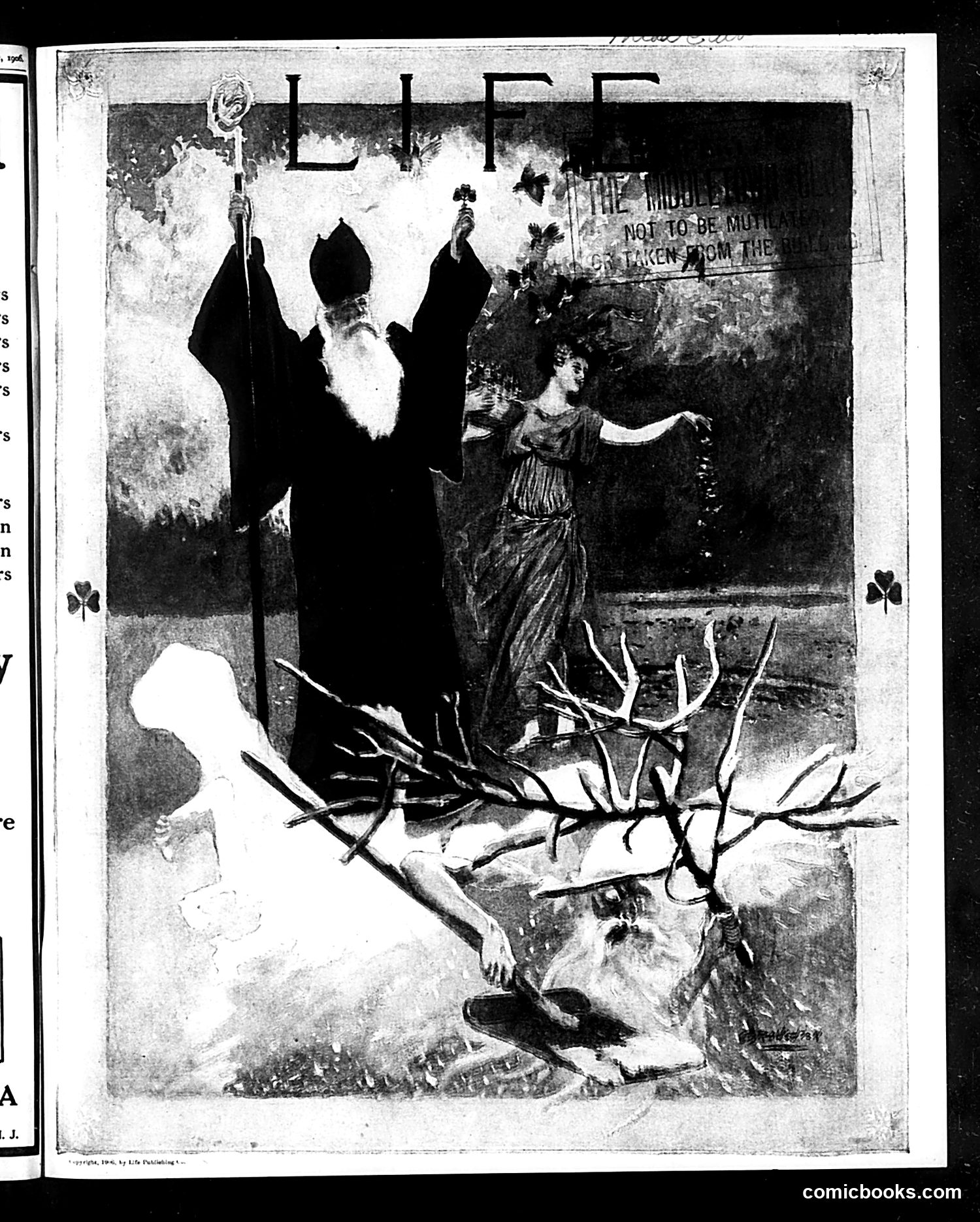
This appears to be a satirical illustration depicting figures in medieval or religious robes (likely bishops or clergy based on the tall mitres/hats) interacting with elaborately dressed women in what seems to be a theatrical or allegorical scene. A bare-branched tree dominates the foreground, and there's text visible in the upper right that appears to reference something "not to be moved" or "taken from." Without clearer OCR text or identifying captions, I cannot definitively identify the specific political figures or historical event being satirized. The imagery suggests commentary on clerical authority and perhaps women's social roles or morality, common Life magazine satirical themes. The archaic costumes and theatrical staging indicate this is likely allegorical social commentary rather than depicting a specific contemporary event. The exact meaning remains unclear without additional context.
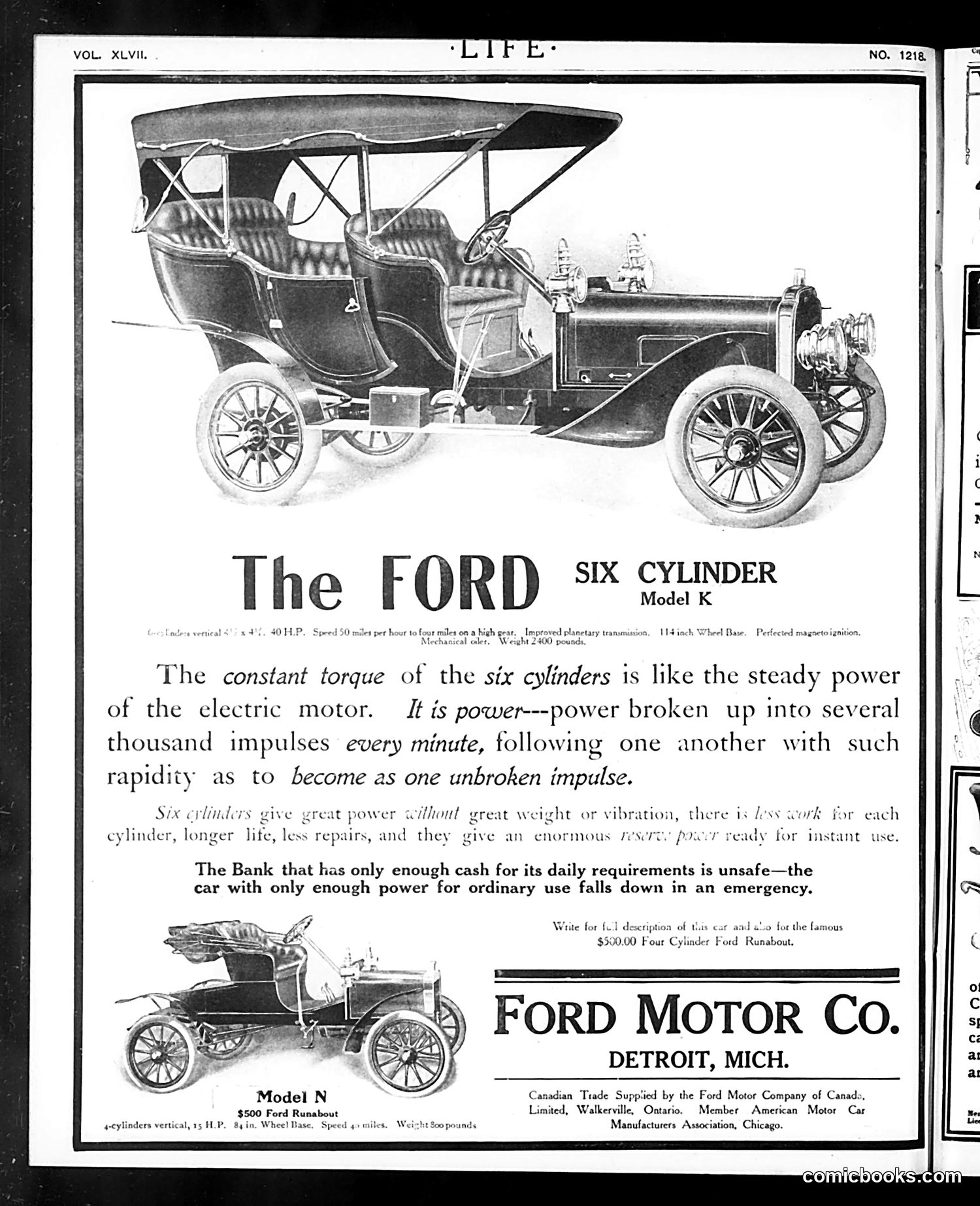
This page is **primarily an automobile advertisement**, not a political cartoon. It showcases Ford Motor Company's Model K six-cylinder automobile, positioned as a premium vehicle compared to their Model N. The ad uses a financial metaphor for persuasion: "The Bank that has only enough cash for its daily requirements is unsafe—the car with only enough power for ordinary use falls down in an emergency." This compares adequate financial reserves to engine power, arguing that six cylinders provide necessary reserve capacity for reliability. The advertisement includes two vehicle illustrations and technical specifications. There is no political satire or caricature present—this is straightforward early automotive marketing from the 1910s era, appealing to consumers' desire for dependable, powerful vehicles.
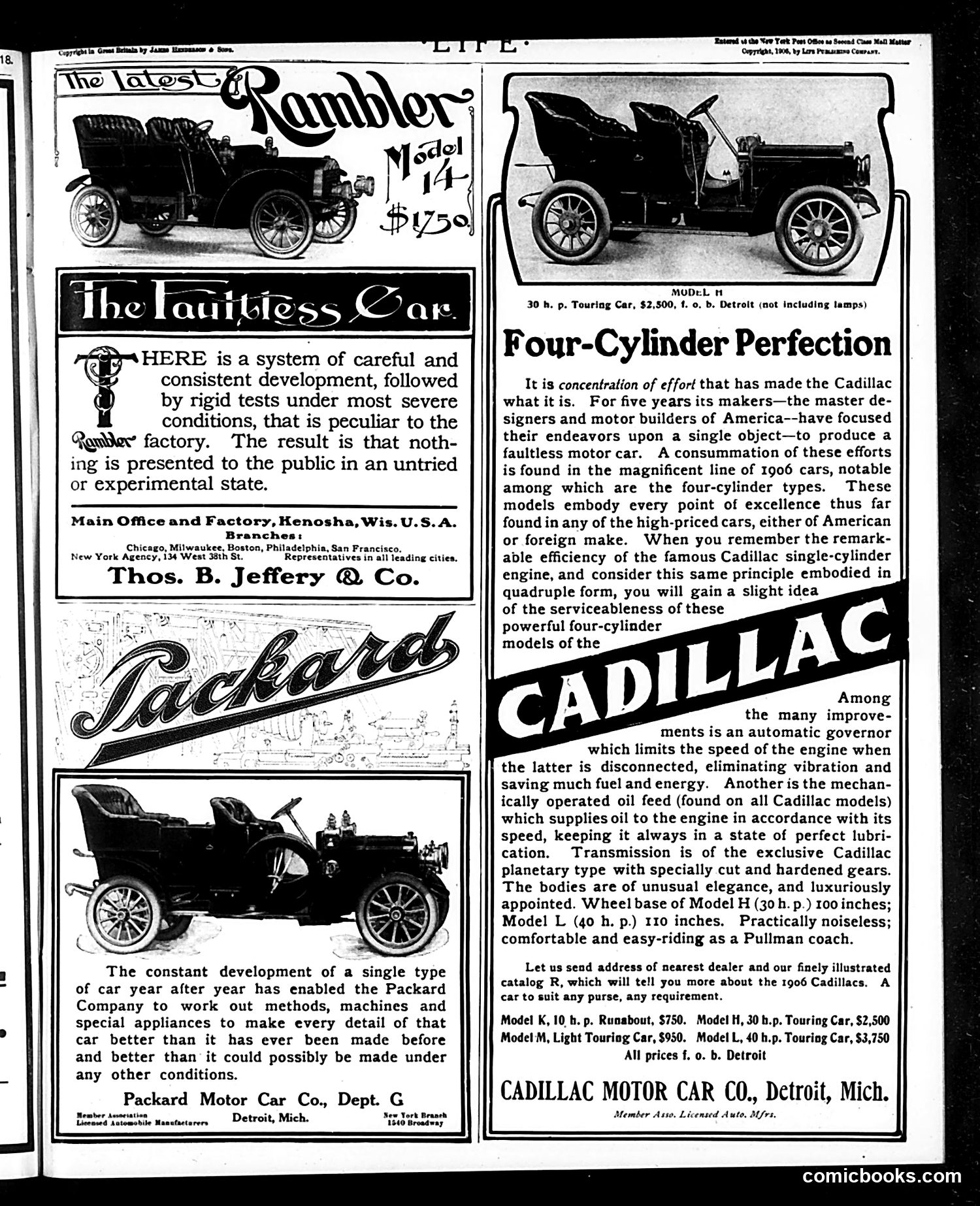
This page is **primarily automobile advertising**, not satire or political commentary. It contains three major car advertisements from circa 1906: 1. **Rambler** (top left) - promoting Model 14 at $750 2. **Cadillac** (right) - emphasizing their four-cylinder engine innovation and various models with prices ranging from $750-$3,750 3. **Packard** (bottom left) - highlighting consistent single-type development and manufacturing excellence The **"Faultless Car"** text refers to the Rambler's marketing claim about rigorous testing. Cadillac's ad emphasizes engineering superiority, specifically their automatic governor and planetary transmission as competitive advantages. There is **no political cartoon or satire** on this page—it's a straightforward commercial advertisement section showcasing early automotive technology and pricing during the automobile industry's rapid expansion.
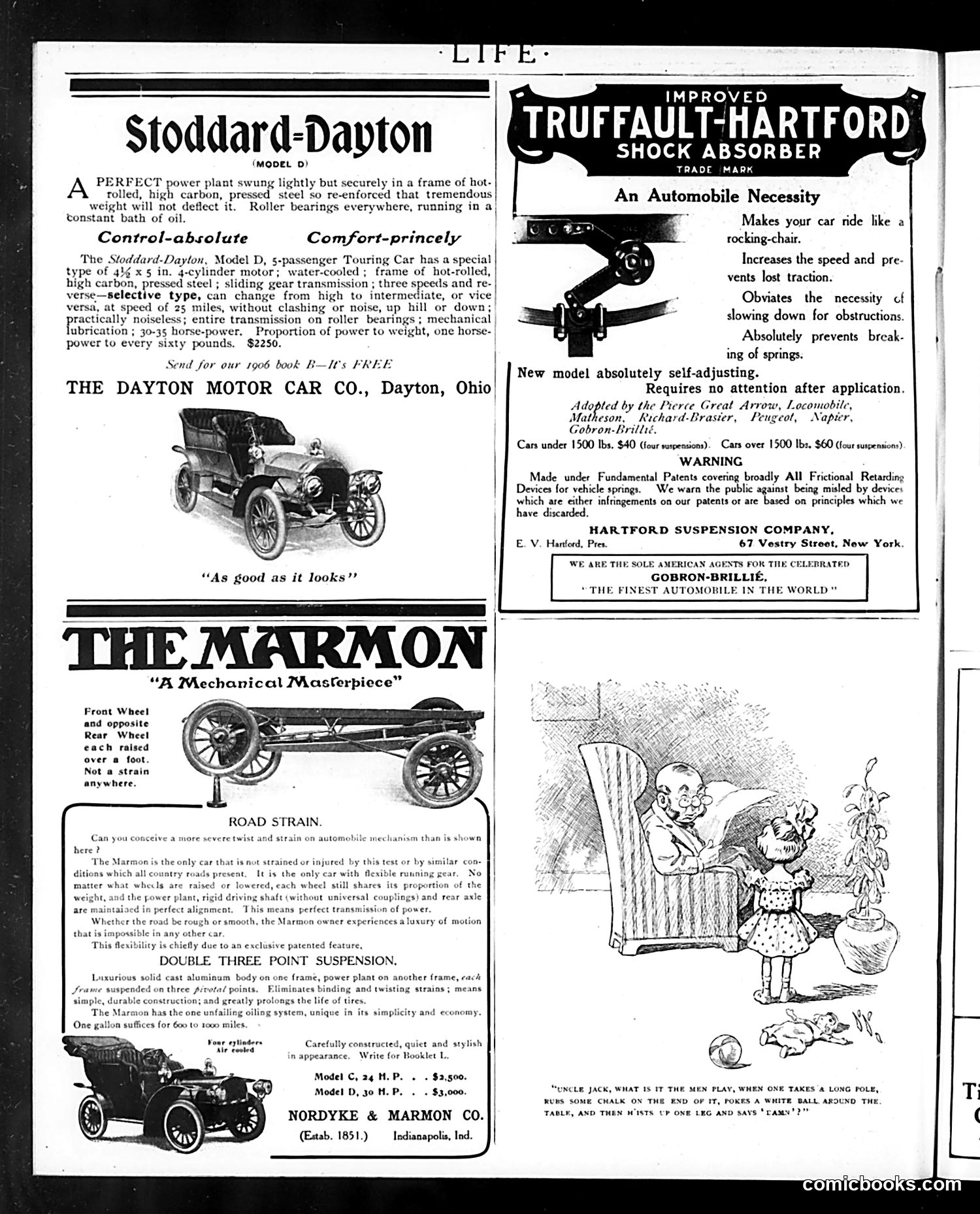
This page is **primarily automobile advertisements** from the early 1900s, with one small cartoon at bottom right. The cartoon depicts a child asking an adult (labeled "Uncle Jack") about a children's game involving a long pole, chalk ball, table, and hoop. The joke's wordplay is unclear from the image alone, but the caption suggests Uncle Jack is explaining or misunderstanding the game's rules—likely a simple pun or play on words typical of Life magazine's light humor. The advertisements showcase period cars (Stoddard-Dayton, Marmon, Truffault-Hartford shock absorber), emphasizing mechanical innovations like suspension systems and smooth rides—major selling points for early automobiles when road travel remained rough and uncomfortable. The cartoon is incidental to the page's commercial purpose.
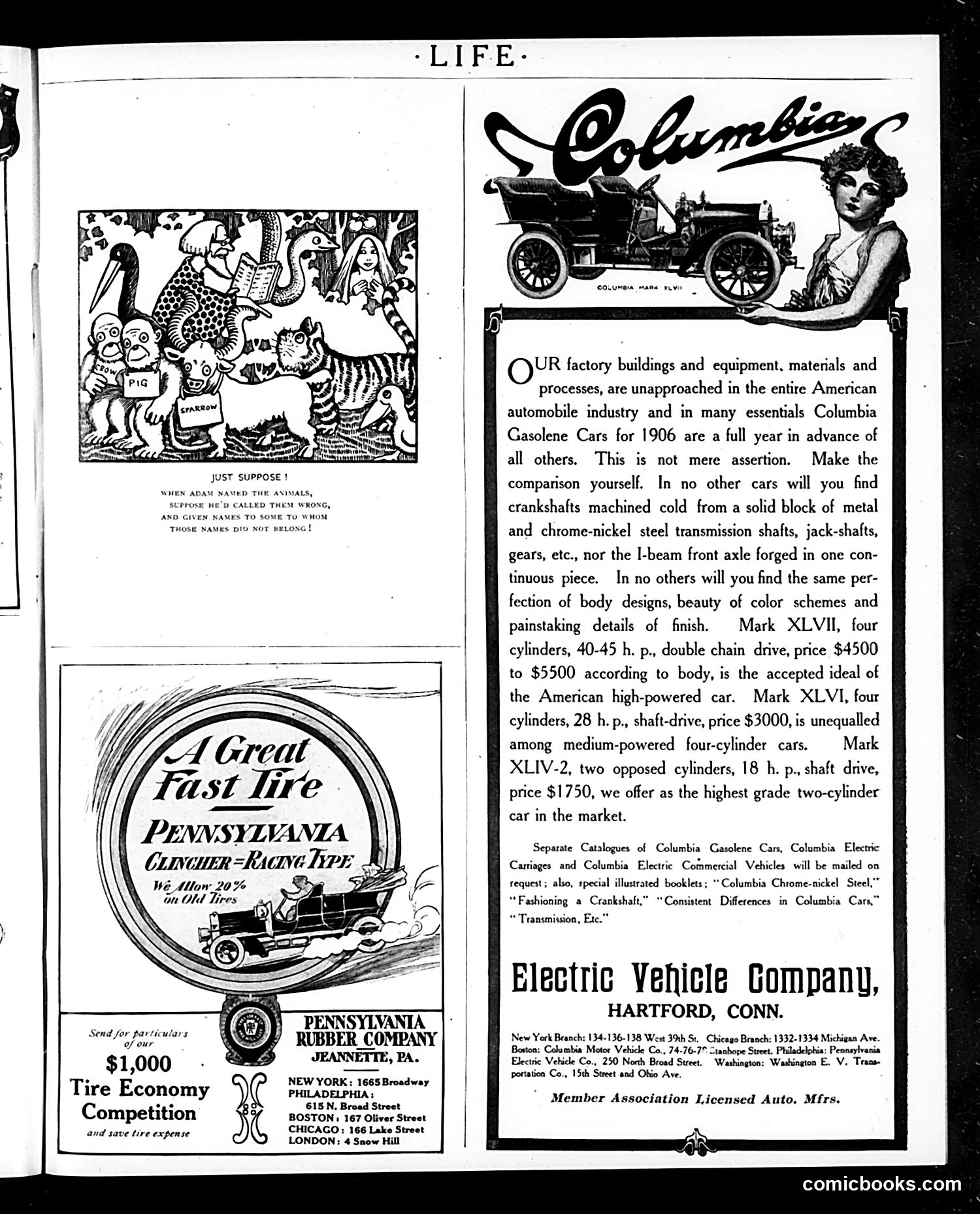
The left page features a satirical cartoon titled "Just Suppose!" depicting animals—a pig, cow, and other creatures—wearing name tags. The joke plays on naming conventions: it imagines what would happen if Adam, when naming animals in the Biblical creation story, had given them humorous or unexpected names instead of their actual ones. This is gentle absurdist humor about language and tradition. Below this is an advertisement for Pennsylvania Rubber Company's tire economy competition. The right page is dominated by a Columbia automobiles advertisement, promoting their 1906 gasoline cars as superior to competitors in engineering and design. This page mixes editorial humor with commercial advertising—typical of early 20th-century Life magazine's format.
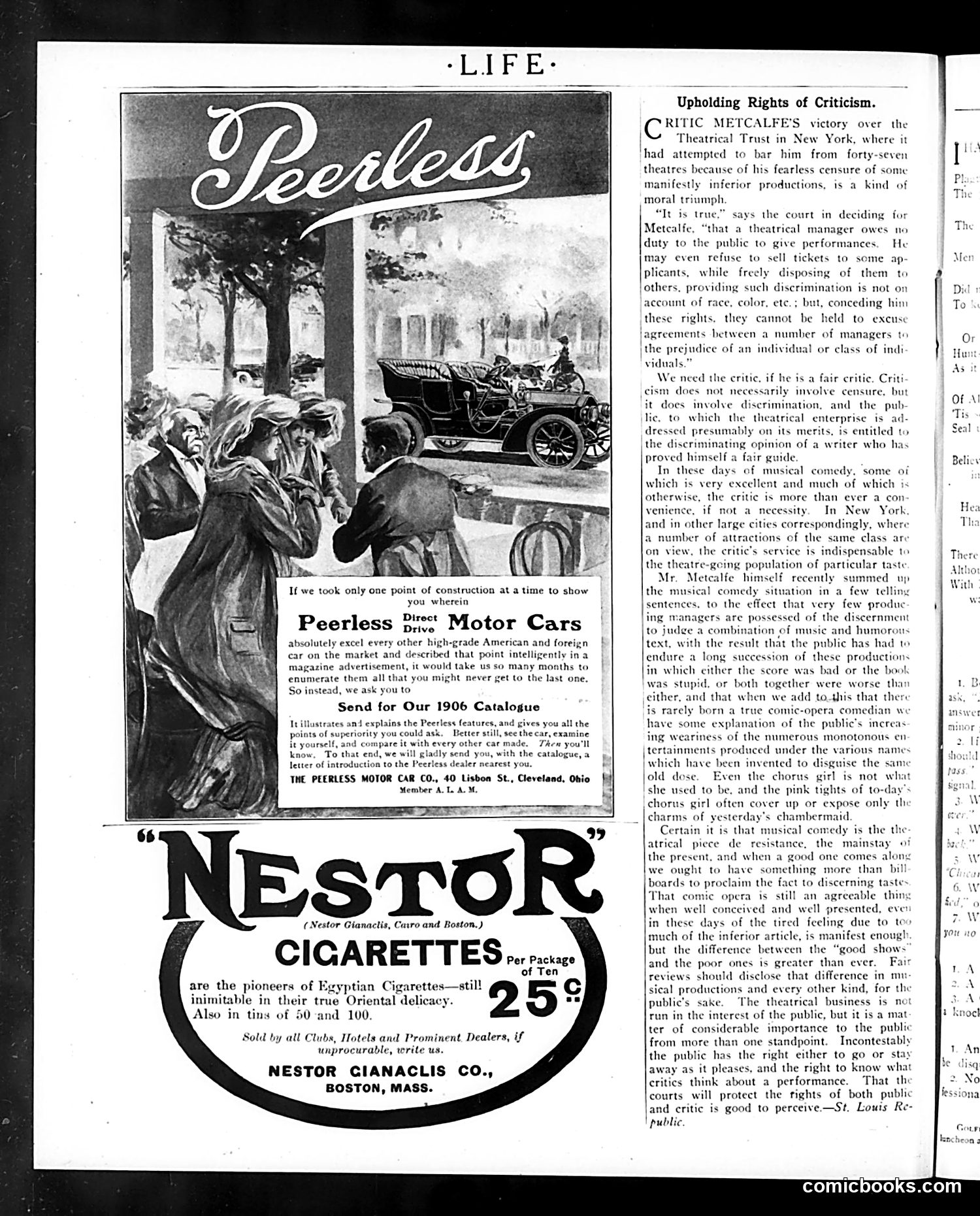
This page contains **two advertisements** rather than political cartoons. The upper ad features the **Peerless Direct Motor Cars** (1906), showing an early automobile in an idyllic park scene with pedestrians. The copy emphasizes the car's superior engineering, inviting readers to request a catalog from the Cleveland, Ohio manufacturer. The lower ad promotes **Nestor Cigarettes** (25¢ per package), marketed as "pioneers of Egyptian Cigarettes" with "true Oriental delicacy." The ad notes availability in tins of 50 and 100, sold through clubs, hotels, and prominent dealers. The right column contains an editorial piece titled "Upholding Rights of Criticism," discussing critic Metcalfe's legal victory against New York's Theatrical Trust, arguing for critics' right to fair judgment without censorship or discrimination.
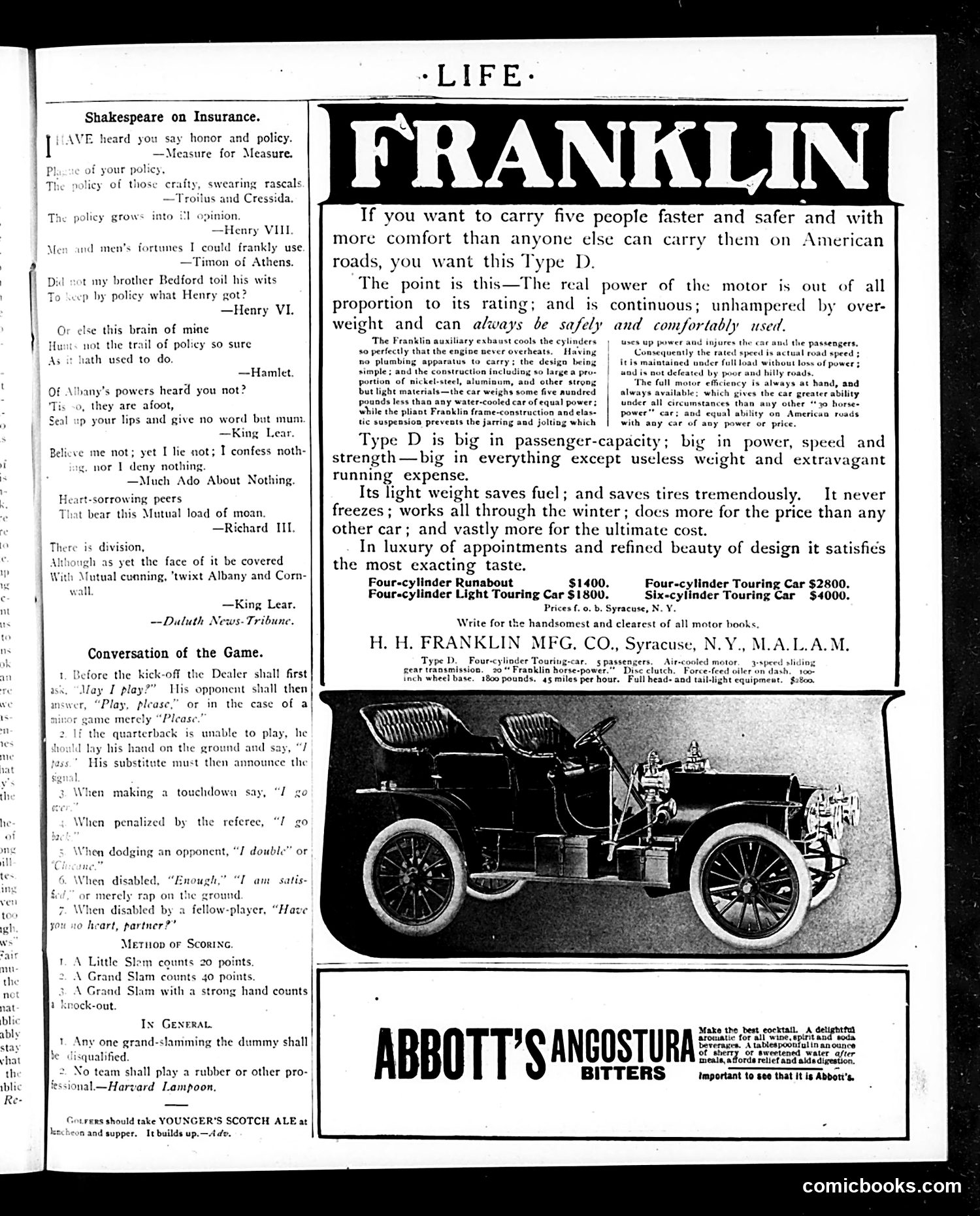
This page is primarily **advertising and miscellaneous content** rather than political satire or comics. The main features are: 1. **Left column**: Shakespeare quotations about insurance and policy, followed by "Conversation of the Game" (football rules) and "Method of Scoring"—likely humor about football terminology. 2. **Center/Right**: Large Franklin automobile advertisement highlighting the Type D model's power, safety features, and pricing ($1,400-$4,000 depending on configuration). The ad emphasizes the car's lightweight efficiency and year-round performance. 3. **Bottom**: Abbott's Angostura Bitters advertisement promoting cocktail-making. The page contains no identifiable political cartoons or caricatures. The Shakespeare quotes appear to be decorative editorial filler rather than satirical commentary.
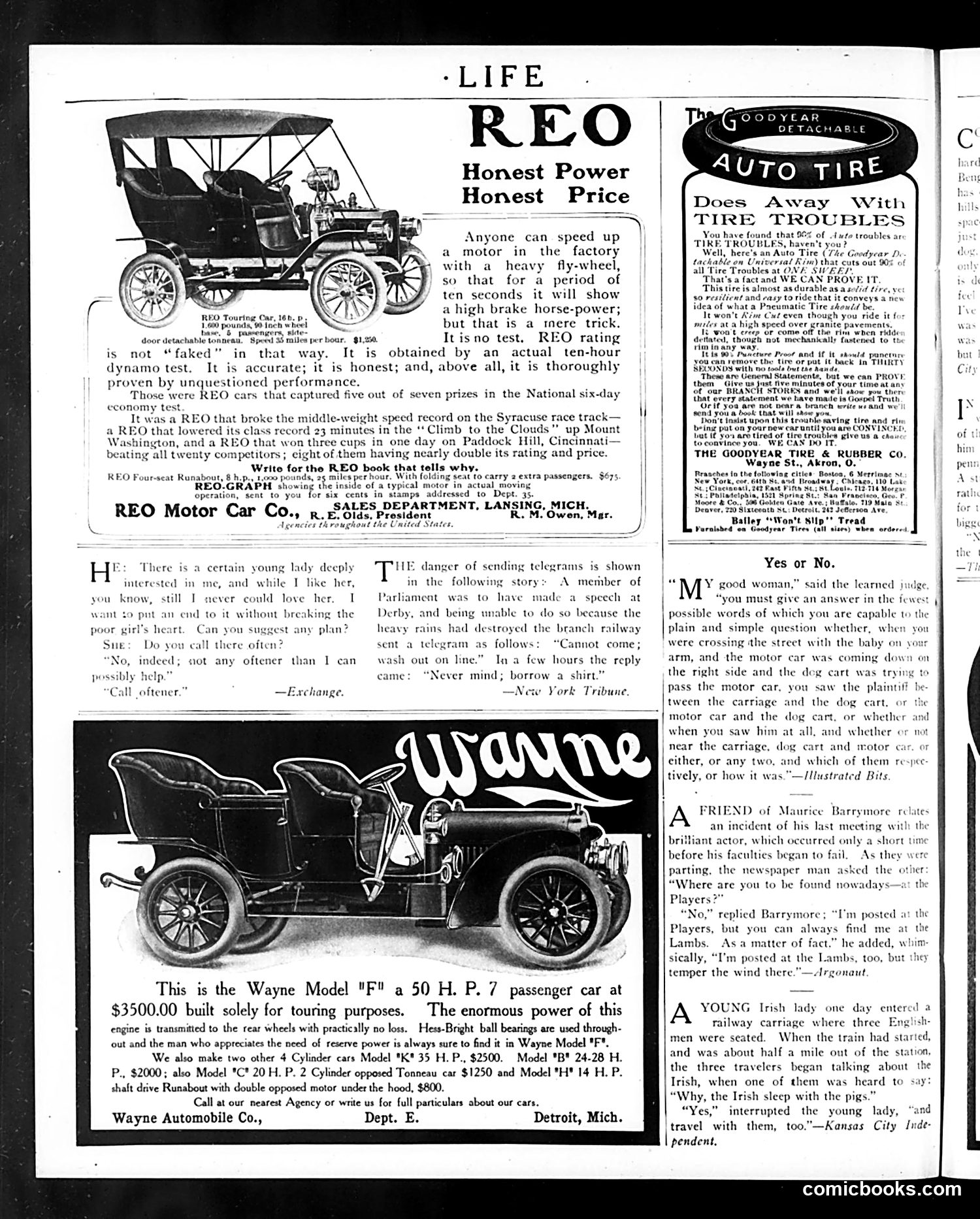
This page is primarily **advertising**, not satire or political commentary. It contains three automobile advertisements (REO, Wayne, and Goodyear tire brand) and several brief humorous anecdotes in the "Yes or No" column. The ads emphasize early 1910s automotive marketing claims: the REO highlights "honest power" and racing performance; Wayne promotes a high-horsepower touring car; Goodyear touts tire reliability. The short jokes concern mundane social situations—a young lady difficult to reach by phone, parliamentary miscommunication, a street-crossing incident—typical light humor of the era. The Maurice Barrymore anecdote and Irish travelers' commentary are gentle ethnic/social humor common to period magazines. The page reflects early automotive culture's novelty and the era's genteel humor conventions rather than substantive satire.
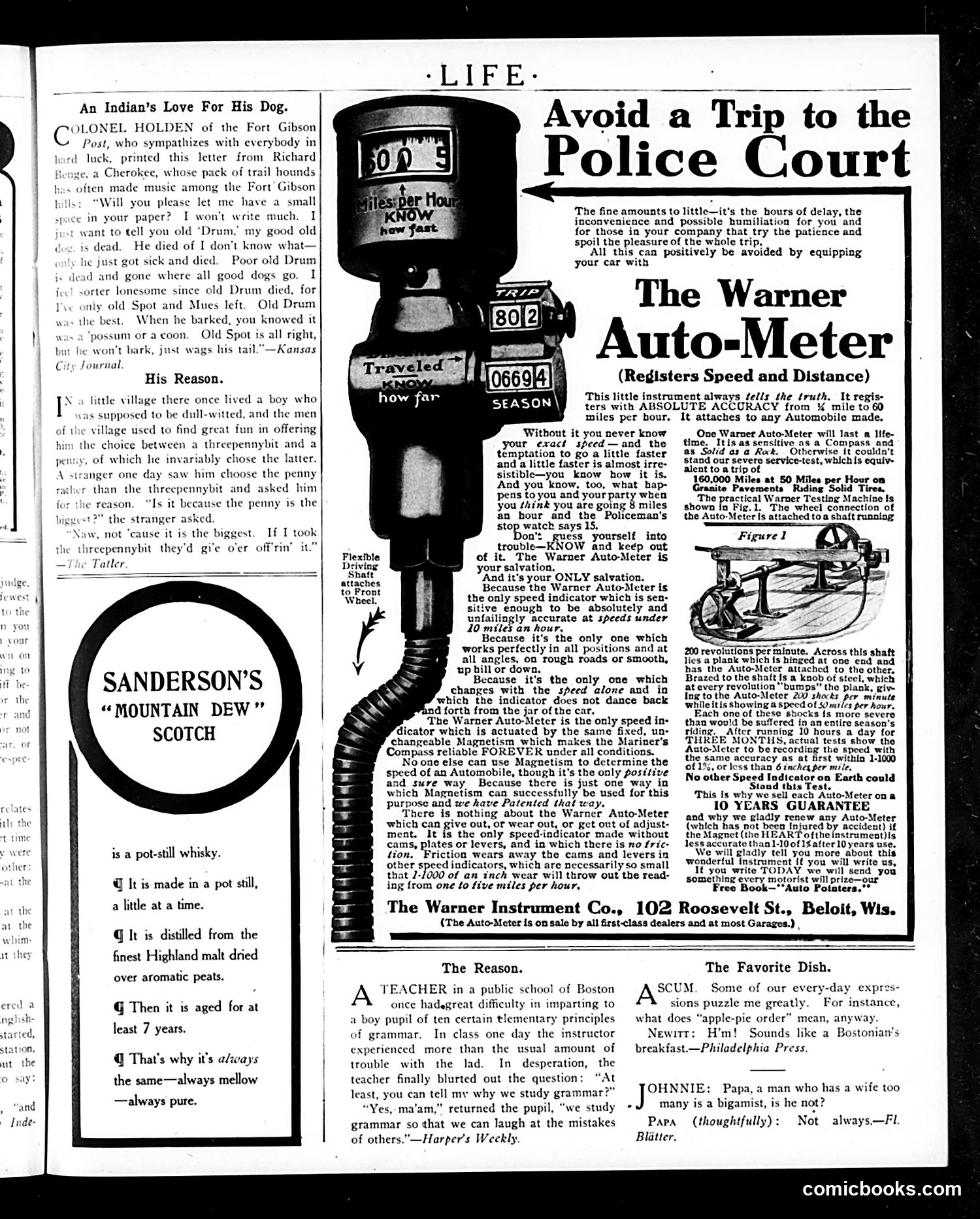
This page is primarily **advertising and humor content**, not political satire. The top half features a large advertisement for the **Warner Auto-Meter**, a early automotive speed and distance gauge. The ad emphasizes the device's accuracy and claims it helps drivers avoid speeding tickets and police court appearances—a practical concern for early motorists when speed limits were new and enforcement common. The left side contains **Sanderson's "Mountain Dew" Scotch whisky advertising** with poetic copy about its production. The bottom sections are **humorous anecdotes**: "An Indian's Love for His Dog," "His Reason" (about a boy choosing a penny over a threepenny bit), and brief joke exchanges ("The Reason," "The Favorite Dish"). These represent typical *Life* magazine content from the early automotive era, blending product ads with light satirical humor rather than political commentary.
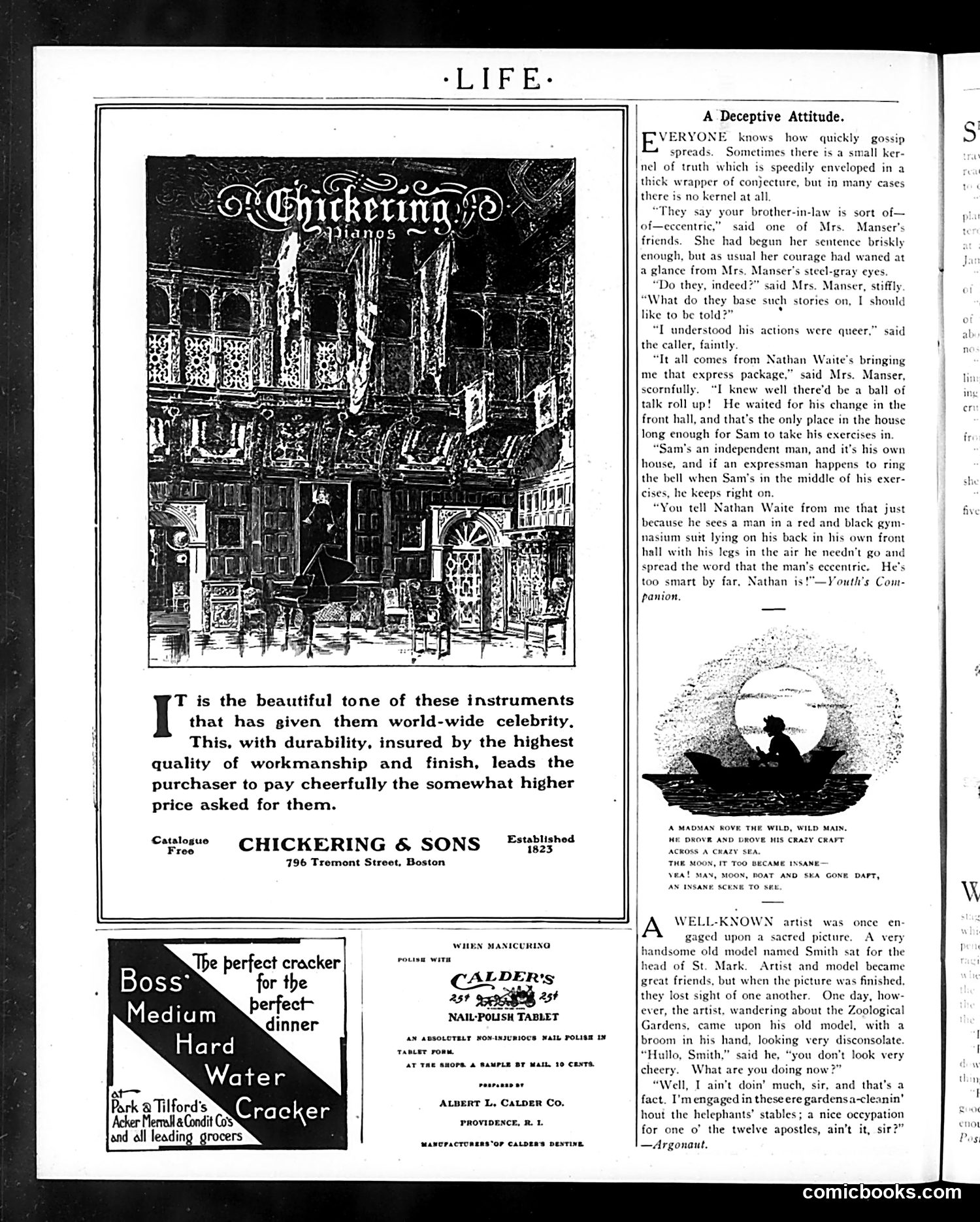
This page is primarily **advertising and fiction**, not political satire. The left side features a **Chickering & Sons piano advertisement** (established 1823), emphasizing quality craftsmanship to justify higher prices. Below that is a **Boss Cracker advertisement** by Park & Tilford's, marketing it as "the perfect cracker for the perfect dinner." The right side contains a short story titled **"A Deceptive Attitude"** about Mrs. Manser gossiping about her brother-in-law Nathan Waite's eccentric behavior—he practices gymnastics in his front hall. The accompanying illustration shows a figure in a boat, relating to the story's final line mentioning the Zoological Gardens. This page reflects early 20th-century Life magazine content: a mix of upscale consumer goods advertising and genteel satirical fiction aimed at middle-class readers.
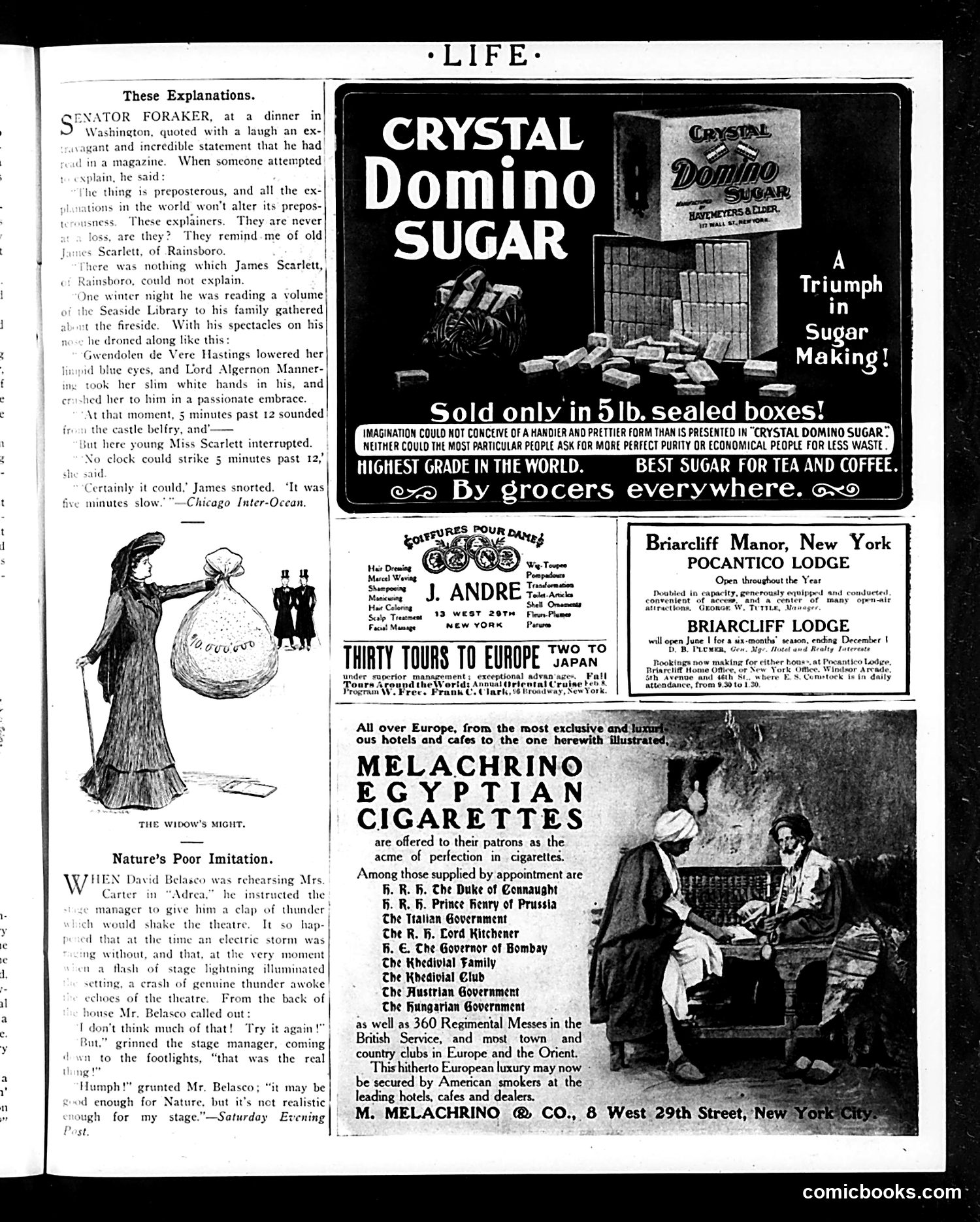
This page is primarily **advertisements and light fiction** rather than political satire. The main content includes: **"The Widow's Might"** — an illustrated story about a widow holding a large globe, likely a humorous piece about feminine power or influence (text unclear). **"Nature's Poor Imitation"** — anecdote about theater director David Belasco requesting realistic thunder effects during a rehearsal, with a stage manager's pragmatic response about theatrical limitations versus actual nature. **Large advertisements** dominate: Crystal Domino Sugar (emphasizing purity and economic value), J. Andre's hair products, European tours, Briarcliff Lodge resort in New York, and Melachrino Egyptian cigarettes (marketed to wealthy Europeans and nobility). The page reflects early 20th-century consumer culture and theatrical world rather than political commentary.
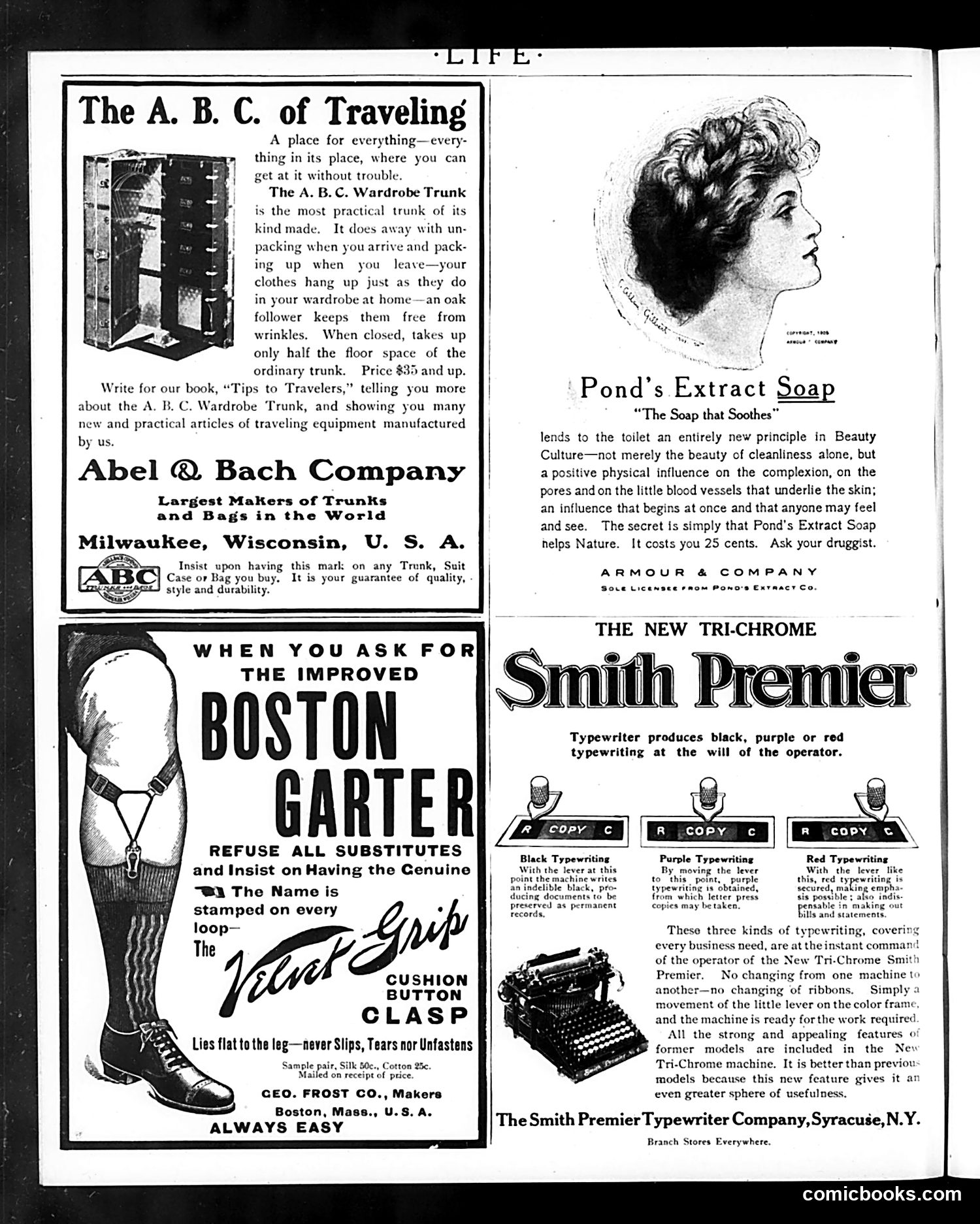
This page consists entirely of **period advertisements** (circa 1910s-1920s), not political cartoons or satire. The ads promote: 1. **A.B.C. Wardrobe Trunk** – a traveling case from Abel & Bach Company (Milwaukee), emphasizing practical organization for travelers 2. **Pond's Extract Soap** – marketed as improving complexion and skin health, not merely for cleanliness 3. **Boston Garter** – an elastic garter clasp, advertised with an illustration of a leg, emphasizing that it "lies flat to the leg" and doesn't slip 4. **Smith Premier Typewriter** – featuring "tri-chrome" capability to produce black, purple, or red text by moving a lever These are straightforward commercial advertisements reflecting early 20th-century consumer goods and marketing approaches, with no satirical content.
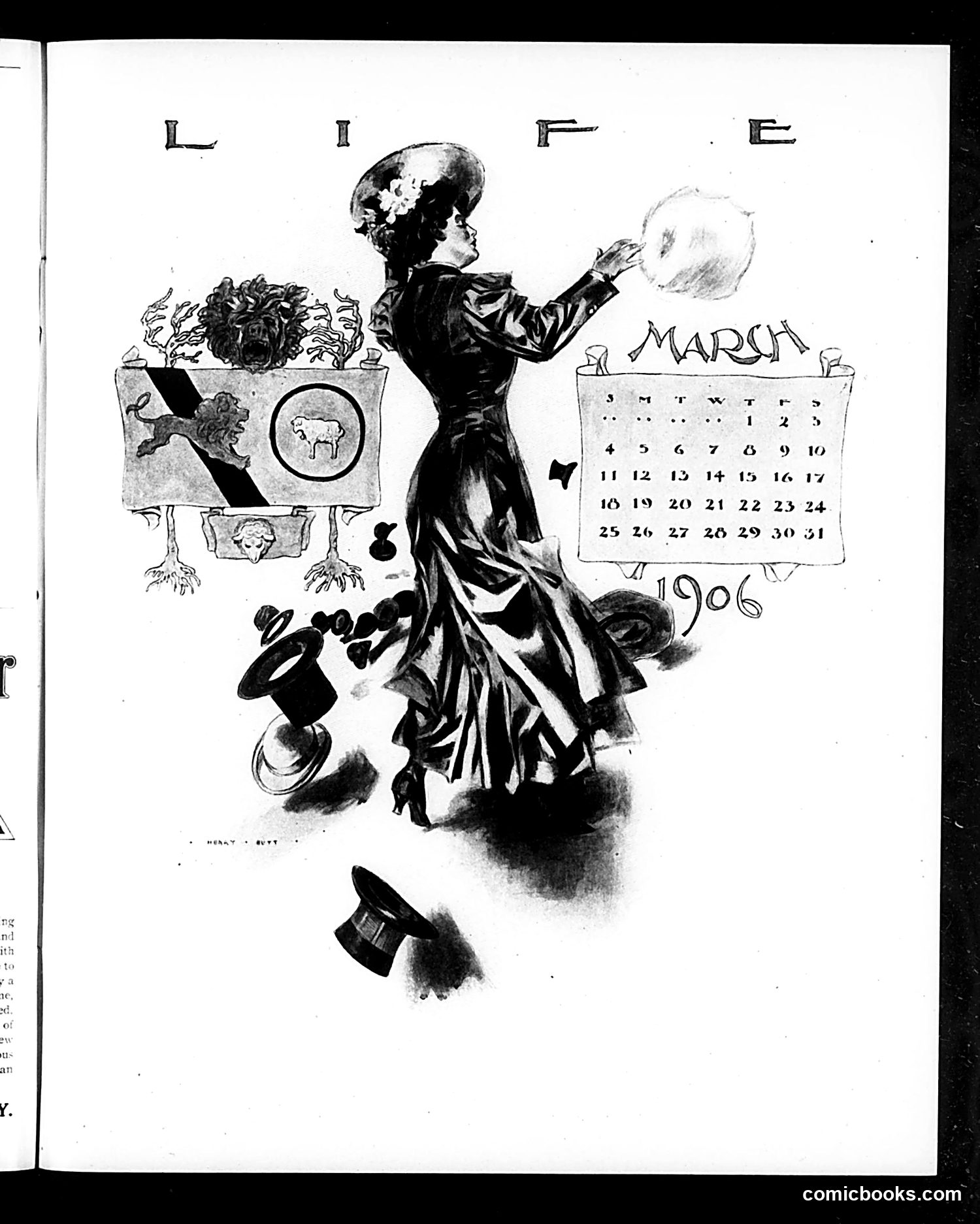
This is a calendar page for March 1906 featuring a stylized illustration of a fashionable woman in an elegant black dress juggling various objects of leisure and domesticity. She balances a potted plant, a mirror or reflective object, a calendar itself, and tosses what appears to be a globe or balloon skyward while simultaneously holding a top hat. The satire likely comments on the "New Woman" of the Edwardian era—the increasingly independent, educated woman navigating multiple social roles and modern expectations. The juggling act suggests the challenge of maintaining traditional domestic responsibilities (plants, fashion) while engaging with contemporary leisure, travel, and intellectual pursuits (the globe). This reflects early 1900s anxieties and celebrations around changing women's roles in American society.
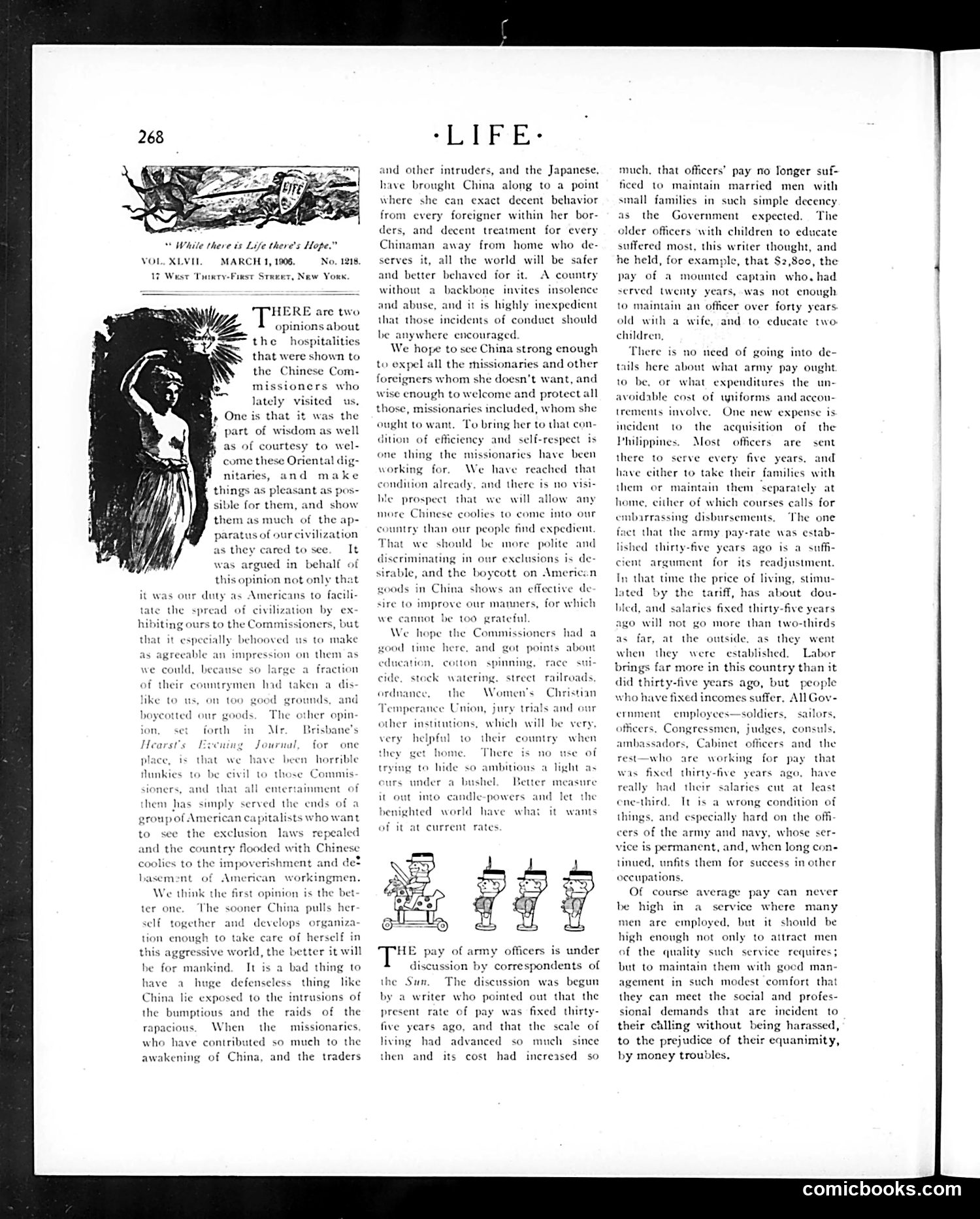
## The Cartoon The illustration depicts a figure labeled "White there is Life there's Hope"—likely representing China or Chinese interests—shown as a vulnerable, kneeling Oriental figure. This visual accompanies discussion of Chinese Commissioners' recent visit to America. ## The Context The article debates two opposing views on hospitality shown to visiting Chinese officials. One faction (including publisher William Randolph Hearst) argued that welcoming them served capitalist interests seeking to repeal Chinese Exclusion laws and flood America with cheap labor. The other view held that strengthening China's independence and "backbone" through exposure to Western civilization ultimately benefited everyone. ## The Satire The cartoon sardonically illustrates China's vulnerable position—exposed to exploitation by missionaries, traders, and foreign powers. The debate itself reflects Progressive-era tensions between pro-business interests and labor protectionists over immigration policy during the height of Chinese exclusion enforcement.
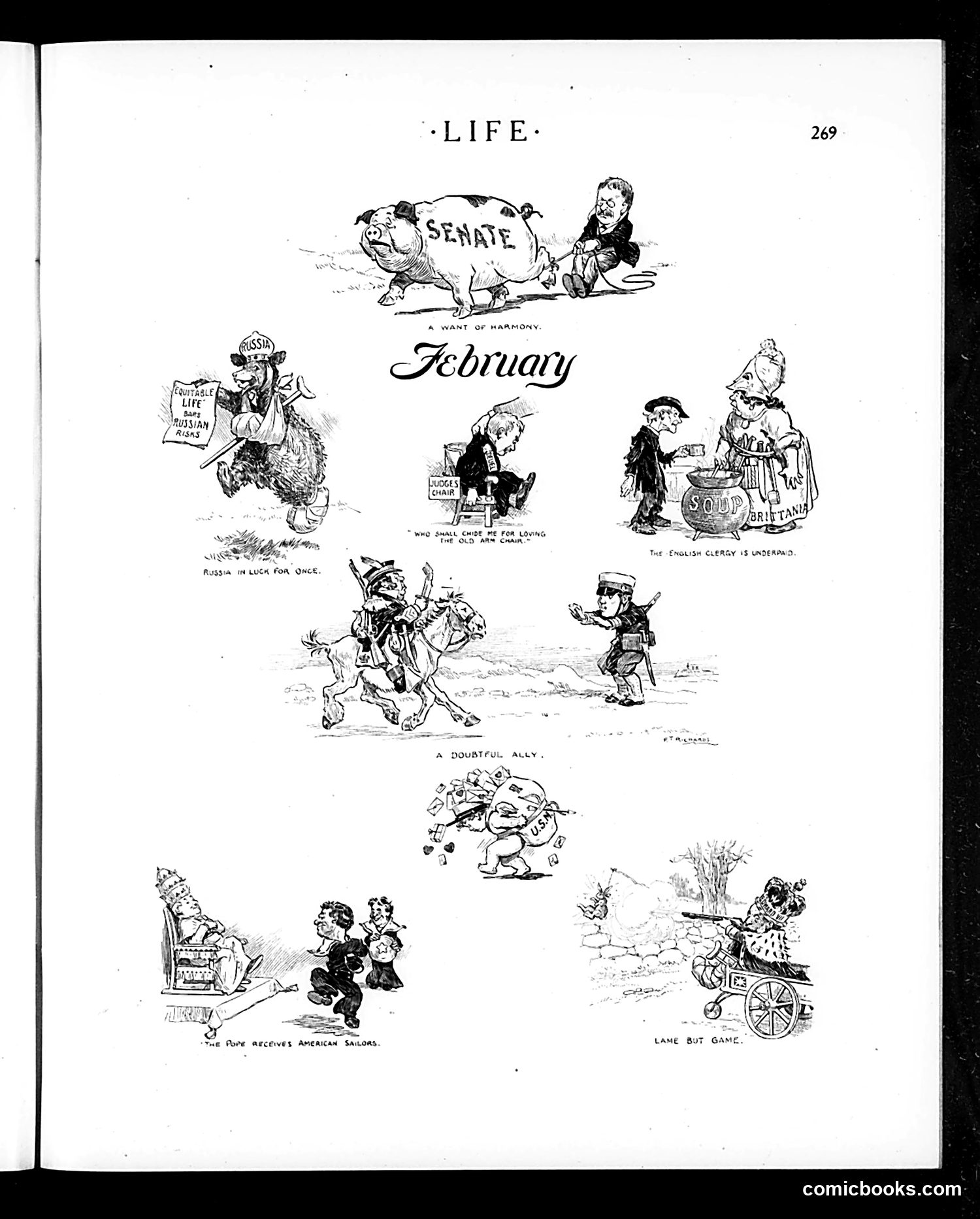
This page presents several political cartoons satirizing early 20th-century international relations. The top cartoon, "A Want of Harmony," depicts a bloated pig labeled "Senate" with two figures pulling in opposite directions—likely commenting on Senate discord over foreign policy or military matters. Other visible cartoons reference Russia's fortunes ("Russia in Luck for Once"), diplomatic concerns ("A Doubtful Ally"), and military/naval issues. The bottom cartoon, "The Pope Receives American Sailors," appears to mock either diplomatic protocol or American military presence abroad. These cartoons use anthropomorphism and exaggeration typical of Life's satirical style, targeting governmental incompetence, international tensions, and American military interventions—though the specific historical context of these particular political disputes requires additional research to fully interpret the intended criticism.
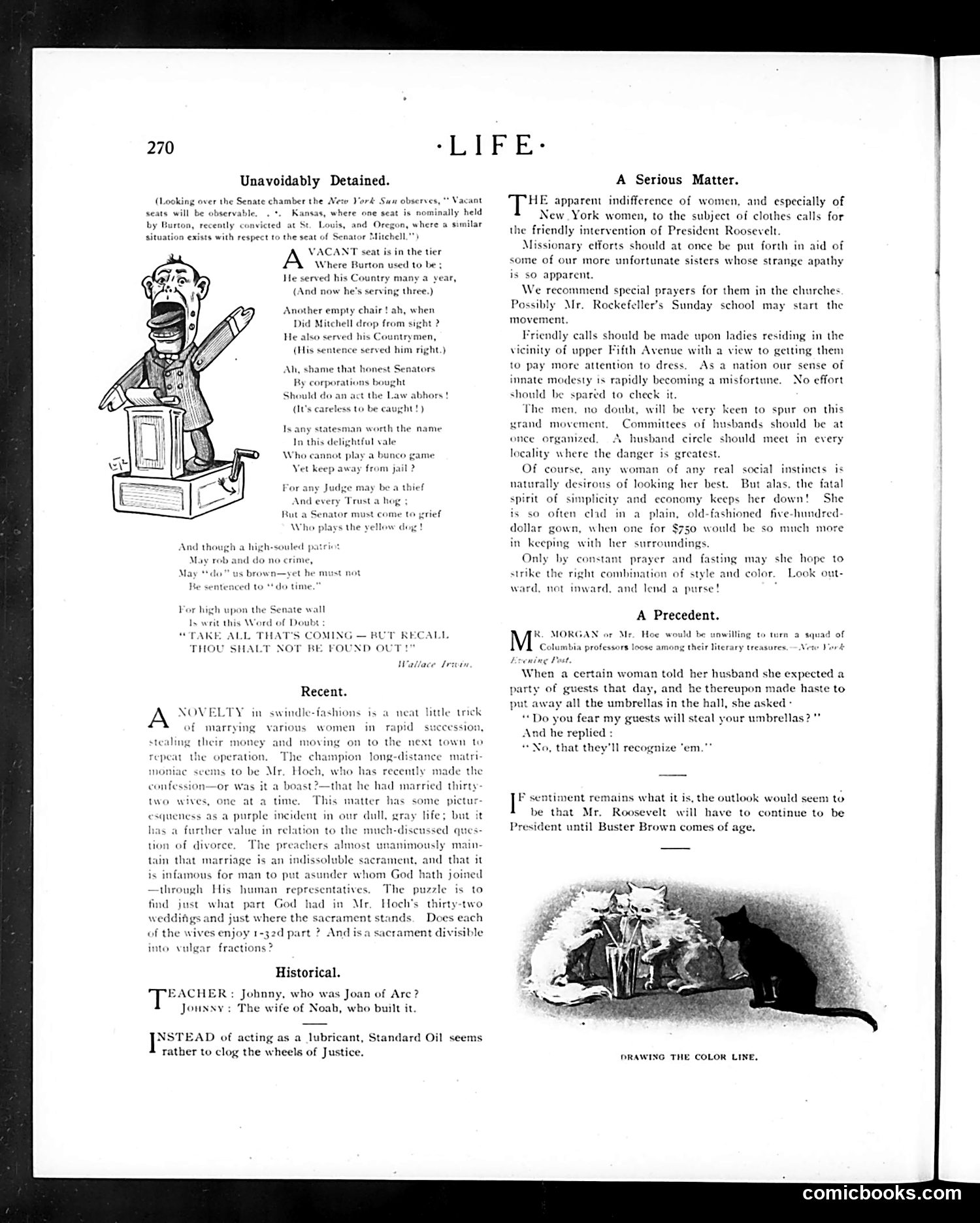
This satirical page targets political corruption and social hypocrisy in early 1900s America. **"Unavoidably Detained"** mocks absent U.S. Senators Burton and Mitchell, both imprisoned for crimes. The cartoon depicts an empty Senate chair as a caricatured figure—visual commentary on absent corrupt politicians. The verse ridicules how senators play "bunco games" (fraud) while avoiding jail, concluding with sardonic advice: "Take all that's coming—but recall thou shalt not be found out!" **"Recent"** comments on Mr. Hoch, a serial bigamist who married 32 women. Life sardonically questions whether marriage constitutes an indivisible sacrament when divided across multiple wives—mocking both Hoch's crimes and religious hypocrisy about divorce. **"A Serious Matter"** ironically demands President Roosevelt and wealthy philanthropists (Rockefeller) intervene to force New York women into expensive fashion, lampooning conspicuous consumption and women's supposed "apathy" toward dress as a moral crisis requiring masculine intervention. The page collectively satirizes elite corruption, religious duplicity, and absurd social priorities among America's wealthy and powerful.
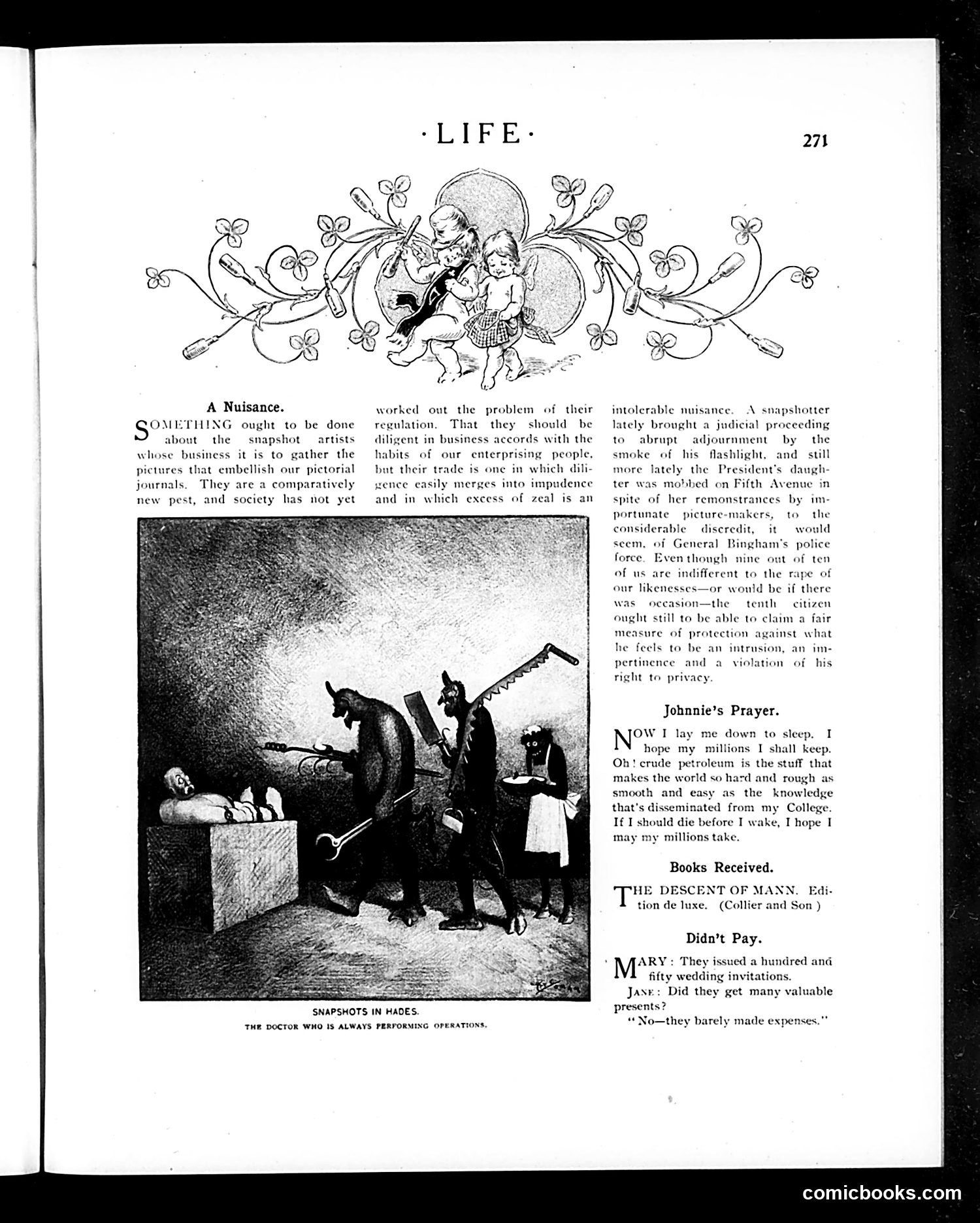
This article satirizes the emerging problem of **street photographers** (snapshot artists) who pursued prominent people for candid pictures to sell to newspapers and magazines. The complaint is that while their trade began as diligent enterprise, it has devolved into harassment—described as an invasion of privacy and intrusion on citizens' rights. The text references a specific incident where a snapshotter disrupted a court proceeding with his camera flash, and another where President Theodore Roosevelt's daughter was mobbed by picture-makers on Fifth Avenue despite her protests. General Bingham (NYC Police Commissioner) is criticized for failing to protect citizens from this "intolerable nuisance." The accompanying illustration ("Snapshots in Hades") appears to be a satirical cartoon showing a doctor performing operations—likely a metaphor for the invasive, aggressive nature of these photographers' work. This reflects early-20th-century tensions over emerging media technology and celebrity privacy.
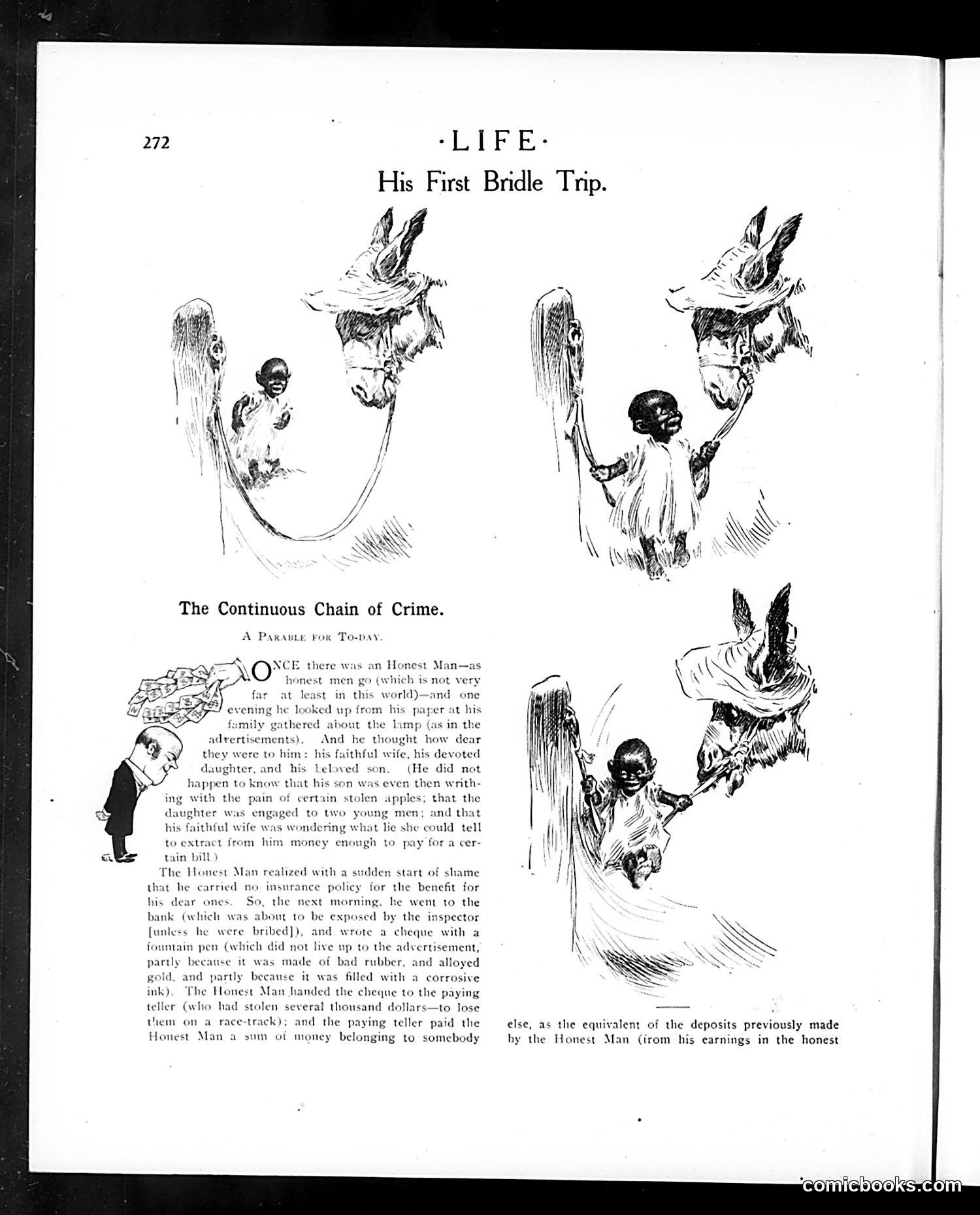
This page presents a cynical morality tale mocking widespread dishonesty in early 20th-century American society. The "Honest Man" represents an ordinary citizen attempting to do right by his family through life insurance. However, the satire reveals that virtually everyone around him—his son (stealing apples), daughter (engaged to two men), wife (planning deception), bank inspector (takes bribes), pen manufacturer (false advertising), and bank teller (stealing thousands for gambling)—is engaged in petty or serious crime. The joke's bitter point: the "honest man" participates unknowingly in this "continuous chain of crime" simply by conducting normal business transactions. His money passes through corrupt institutions and hands. The illustrations show donkeys—suggesting foolishness—representing this cascade of moral compromise. Life magazine satirizes that dishonesty has become so systemic and normalized that true honesty is impossible.
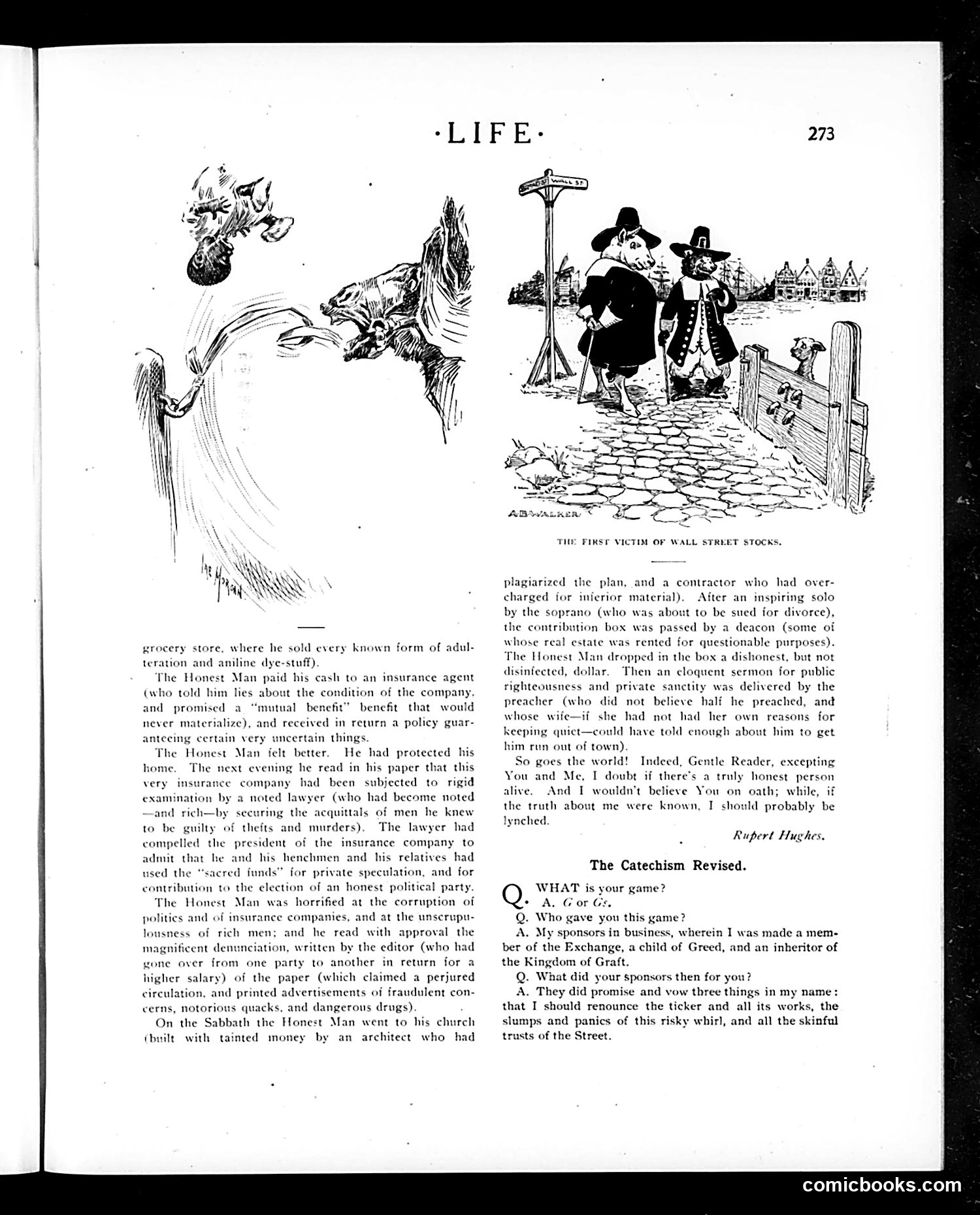
This page contains two satirical pieces by Rupert Hughes attacking widespread hypocrisy across American institutions. **"The First Victim of Wall Street Stocks"** (the cartoon depicts a ruined man) is a lengthy narrative mockery showing how an "Honest Man" is surrounded by corruption at every level: the grocer adulterates goods, the insurance agent lies, the lawyer defending criminals exposes fraud, the newspaper editor who denounces corruption is himself corrupt, and even his church is built with tainted money by dishonest contractors, with a preacher who doesn't believe his own sermons. The point: there are no truly honest people in society—everyone profits from or participates in graft. **"The Catechism Revised"** parodies religious catechism to mock Wall Street corruption, replacing spiritual vows with admissions about stock-market scheming and "the Kingdom of Graft." Both pieces satirize Gilded Age institutional rot—insurance fraud, stock manipulation, journalistic dishonesty, and clerical hypocrisy—suggesting corruption is universal and inescapable.
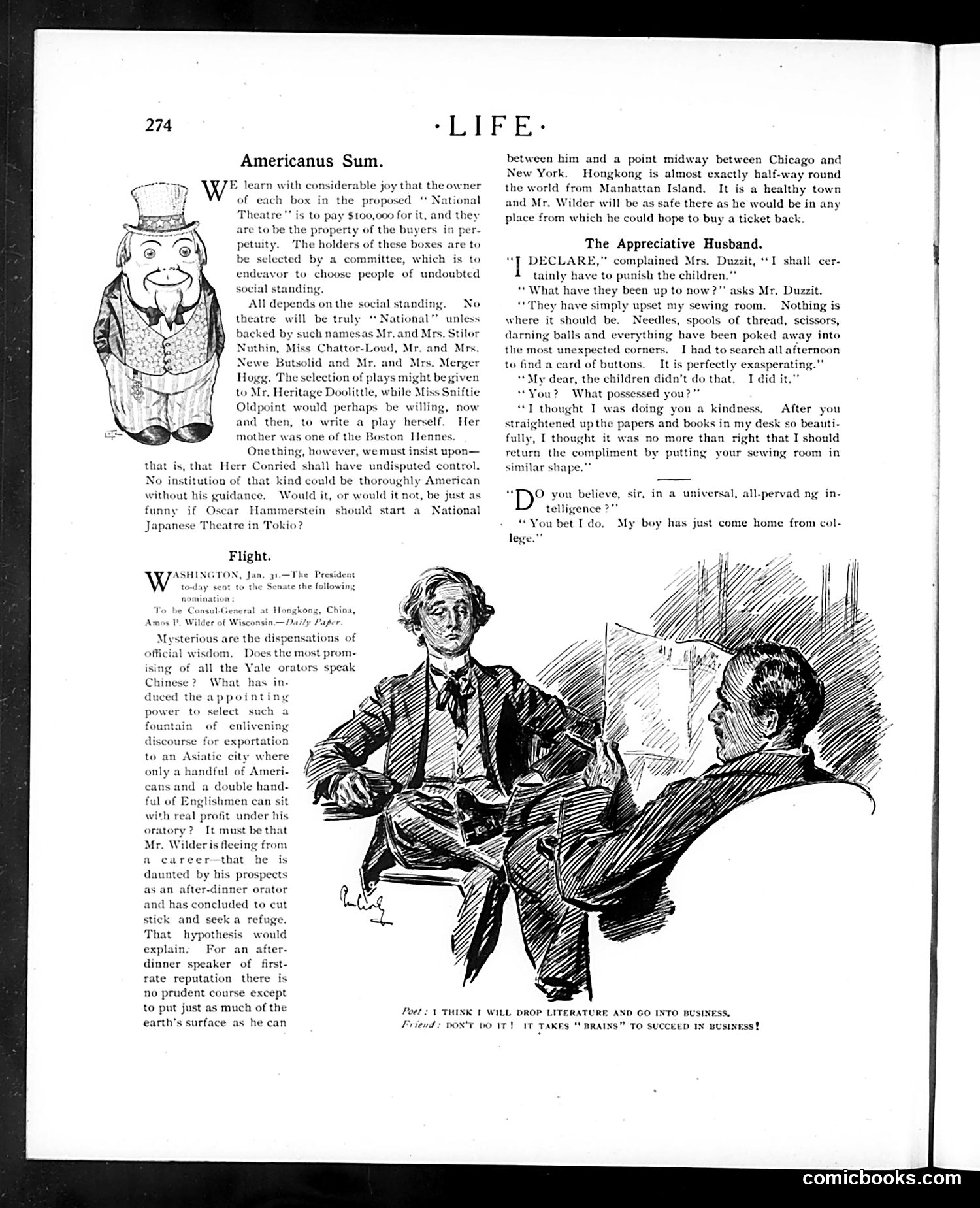
This Life magazine page contains three satirical pieces mocking American social pretension and career decisions: **"Americanus Sum"** ridicules the proposed National Theatre's box-holder selection process. The text mocks wealthy patrons with absurdly fake names (Mr. and Mrs. "Stilor Nuthin," "Newe Butsolid," "Merg Hogg") to satirize how such institutions select members based purely on "social standing" rather than merit. The joke is that America's cultural institutions are controlled by the vapid rich. **"Flight"** targets President Roosevelt's appointment of Ames F. Wilder as Consul General to Hongkong. The satire suggests Wilder, a Yale orator and after-dinner speaker, is actually *fleeing* his career by accepting the distant post—that he's putting geographical distance between himself and his failed prospects. The cartoonist questions why such an unqualified person received this diplomatic position. **"The Appreciative Husband"** shows a husband who reorganized his wife's sewing room uninvited, thinking he was helping. When she objects, he praises her for "kindness." The caption punchline mocks the husband's "universal intelligence" while his college-aged son exemplifies that real success requires actual brains—a family trait apparently lacking.
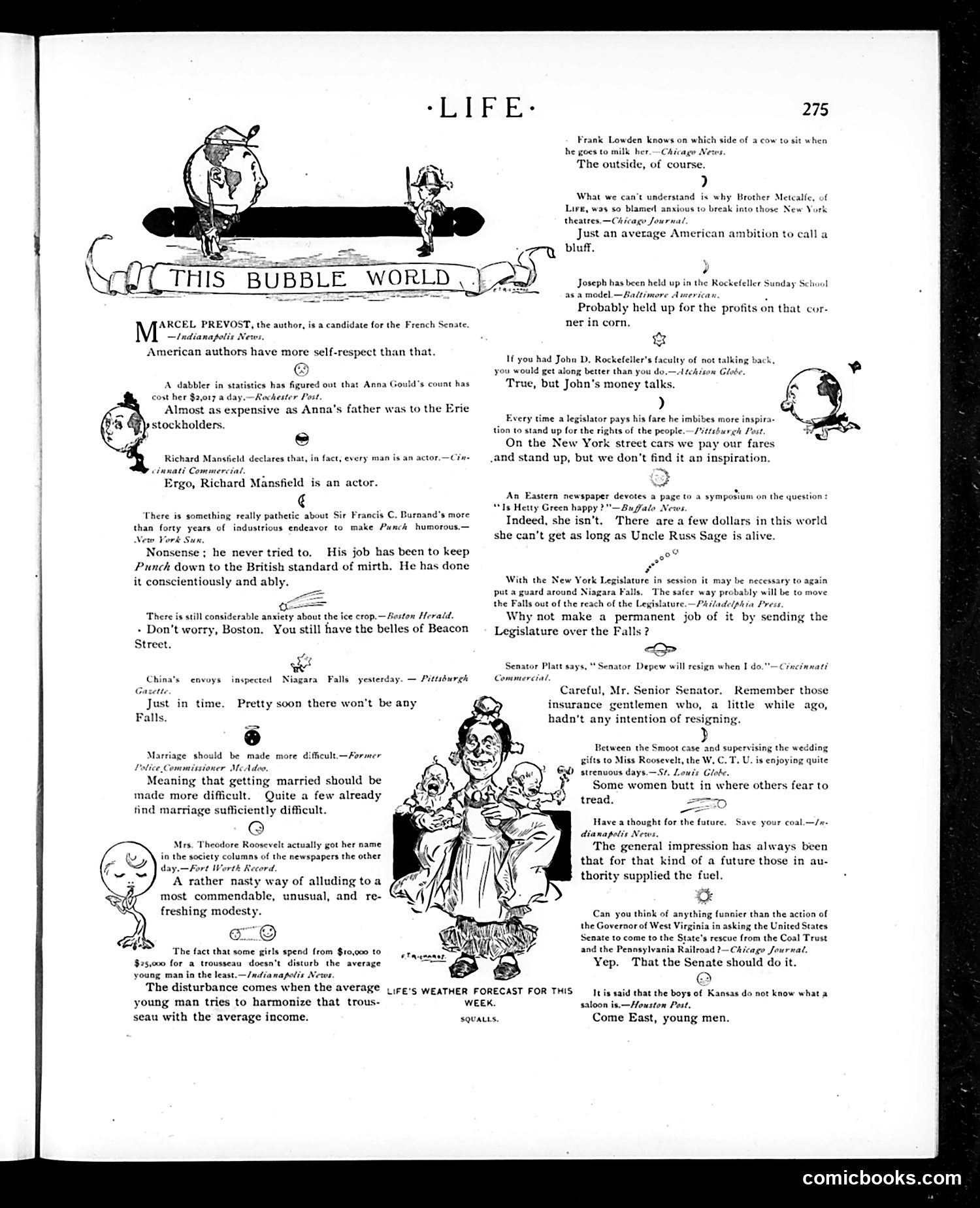
This page contains brief satirical quips on contemporary politics and society, typical of Life's format. Key targets include: **Political figures**: Frank Lowden (Illinois governor candidate), Senator Platt and Senator Depew (New York politicians engaged in power struggles), and references to President Theodore Roosevelt and his wife. **Social commentary**: Jabs at wealth disparity (Anna Gould's expensive lifestyle, Hetty Green's obsession with money), the Erie Railroad scandals, and the New York Legislature's ineffectiveness. **Recurring jokes**: The impossibility of average men affording elaborate trousseaus, concerns about Niagara Falls' commercial exploitation, and skepticism about political reform efforts. **The cartoons** (small illustrations) reinforce verbal jokes through exaggerated facial expressions and situations—typical of Life's blend of text and visual humor. The overall tone is cynical about corruption, wealth inequality, and politicians' empty promises—characteristic of Gilded Age American satire.
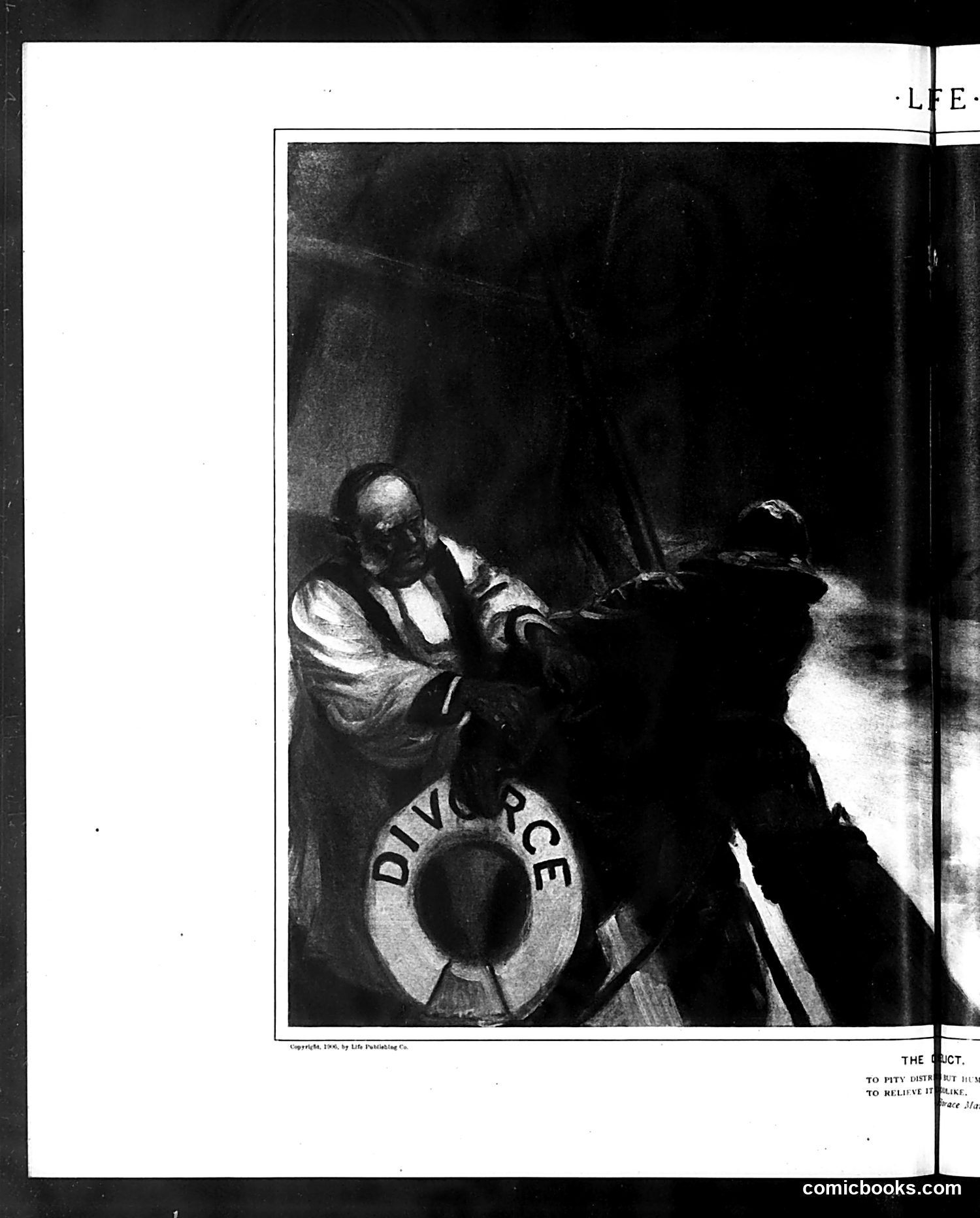
This appears to be a LIFE magazine page from 1906 (copyright visible). The central image shows a dramatic scene with two figures near a lifeboat marked "DIVORCE." One figure appears distressed or elderly, while another figure is positioned nearby. The partially visible text at bottom reads "TO PITY DISTRESS / TO RELIEVE IT," suggesting this is satirical commentary on divorce as a social issue. The lifeboat imagery implies divorce is presented as a "rescue" vessel—likely mocking the idea that divorce solves marital problems, or alternatively critiquing the ease with which people abandon marriages. The darkly dramatic illustration style emphasizes the gravity with which LIFE treated this subject. Without clearer text or identifying caricature details, the specific individuals or precise satirical target remain unclear.
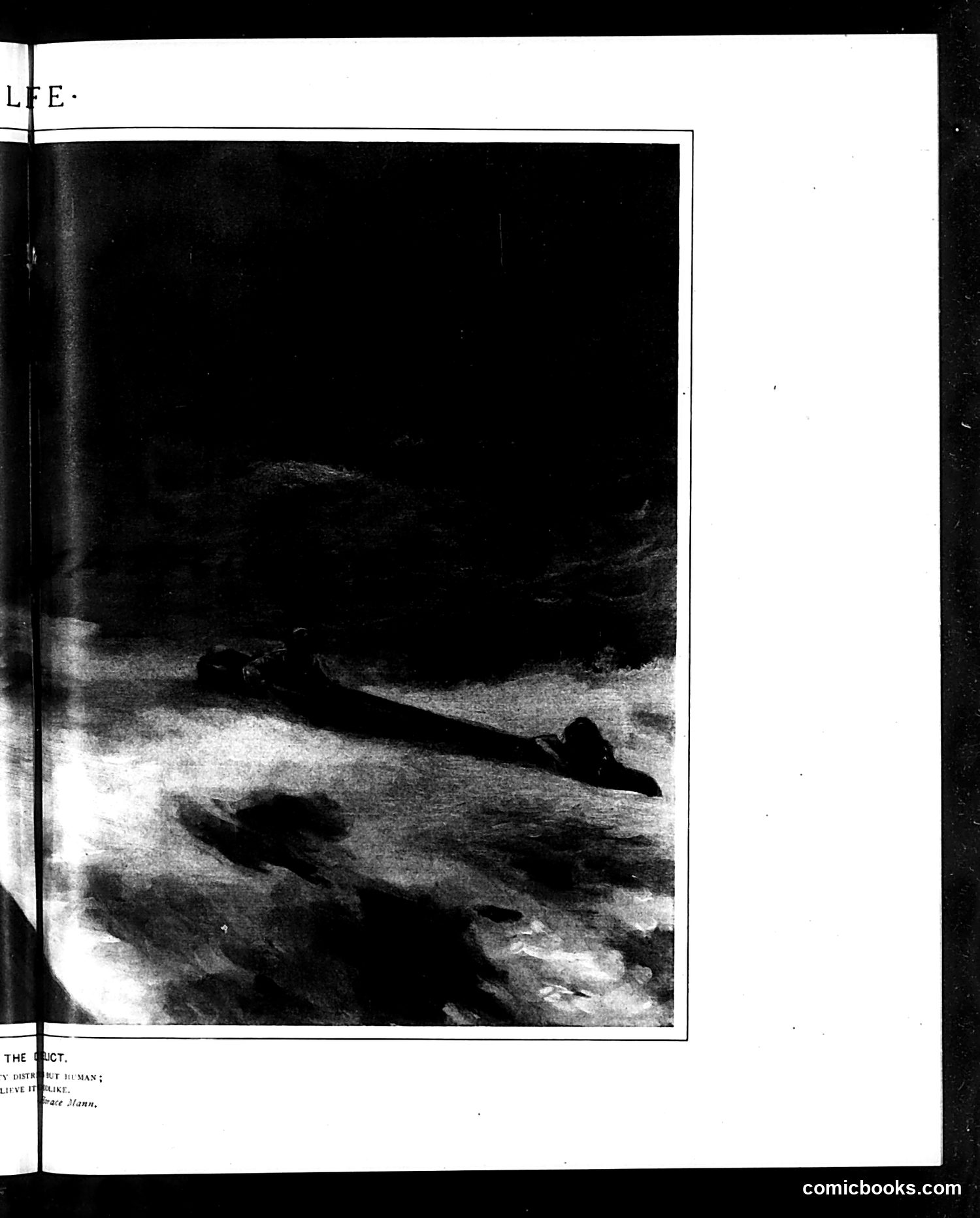
This page appears to be from Life magazine and contains a black and white photograph or illustration showing what looks like a natural landscape or geological formation with rocky terrain and sand. The image quality is grainy and quite dark, making precise details difficult to discern. The OCR text is largely illegible or fragmentary ("IUMAN 5," "reve ITBUKe," "race Mann"), which prevents clear identification of the subject matter or satirical intent. Without readable text or clearer visual details, I cannot reliably identify specific figures, political references, or the cartoon's intended joke for a modern reader. The page may be partially obscured or heavily damaged in the source material provided.
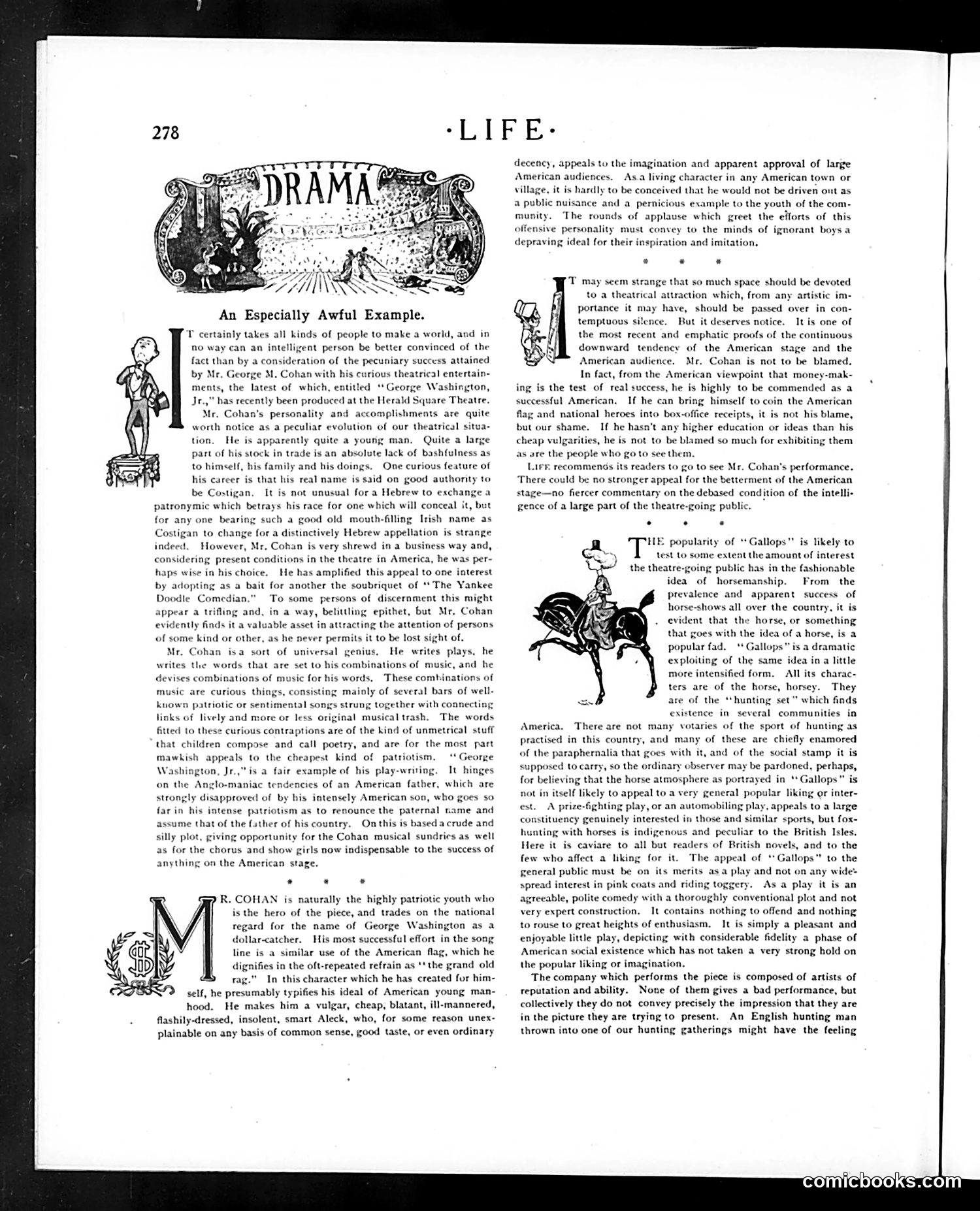
This is a scathing drama review attacking George M. Cohan's theatrical success and artistic merit. The critic identifies several targets: **The Main Subject**: Cohan's play "George Washington, Jr." at the Herald Square Theatre, which the reviewer considers poorly constructed and artistically worthless. **The Satirical Points**: - Cohan allegedly changed his Irish surname "Costigan" to a Jewish-sounding name for commercial advantage - His plays cynically exploit patriotic sentiment and the American flag rather than genuine artistry - His music consists of recognizable patriotic songs strung together with "musical trash" - His protagonist is deliberately vulgar and obnoxious—a "flashily-dressed, insolent, smart Aleck"—yet inexplicably appeals to audiences - The reviewer finds it baffling that such low-quality entertainment succeeds financially **The Core Complaint**: Life's critic argues that Cohan's enormous success demonstrates how American audiences reward cheap patriotic appeals and lack of taste over genuine theatrical merit. The satire targets both Cohan's cynicism and the public's gullibility.
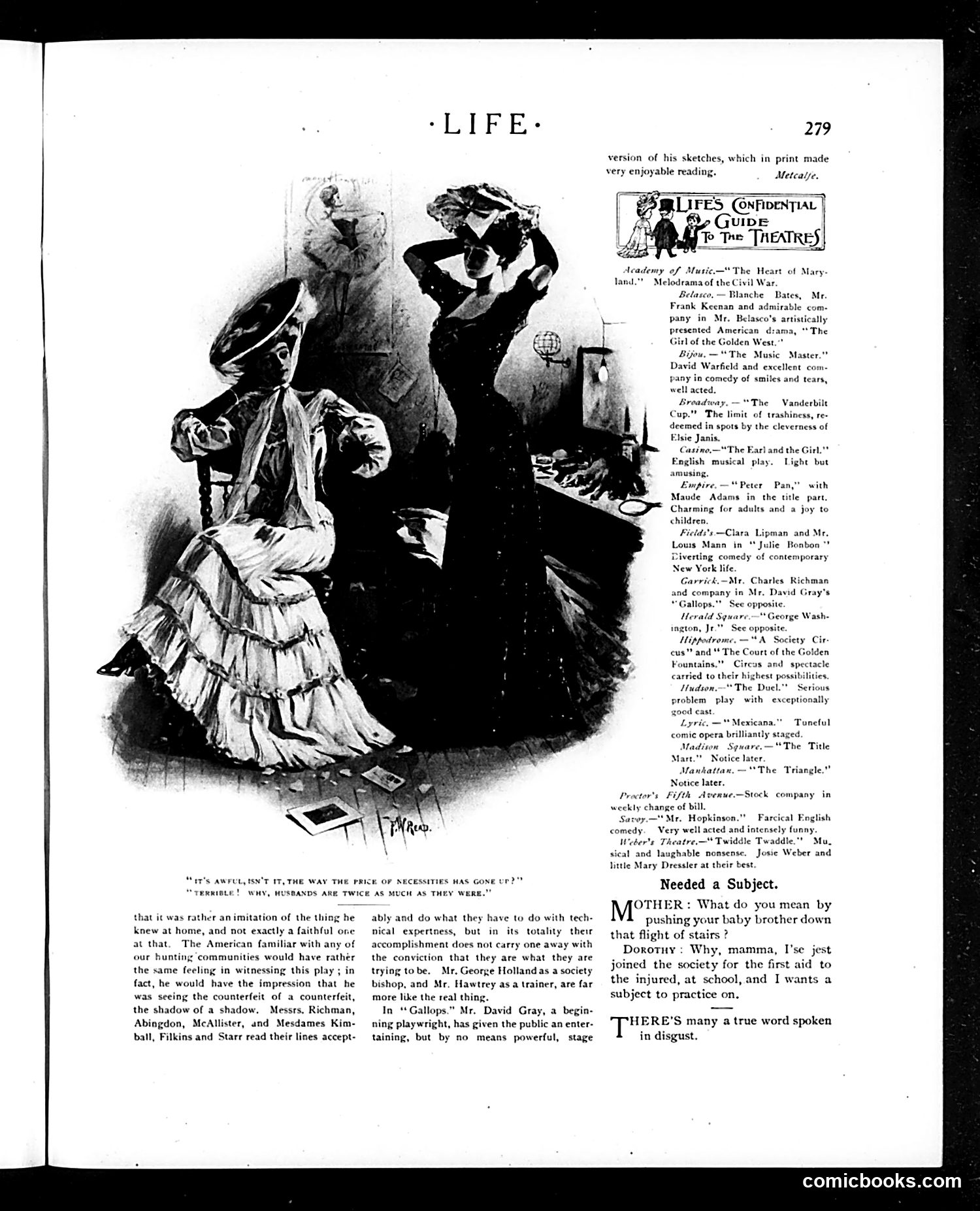
This page combines theatrical reviews with a satirical cartoon and joke about rising costs of living. **The Main Cartoon:** The illustration depicts a domestic quarrel where a husband and wife argue over household expenses. The caption reads: "It's awful, isn't it, the way the price of necessities has gone up!" with the wife's response: "Why, husbands are twice as much as they were." **The Satire:** This is a joke about marriage costs and male value. The wife implies that husbands themselves have become more expensive to maintain—a double meaning suggesting both literal inflation and a commentary on men's increased financial burden to wives or, alternatively, a cutting remark about husbands' diminished worth relative to their cost. **Context:** Published during a period of economic inflation, this reflects early 20th-century concerns about rising living expenses and domestic economics, with gender-based humor typical of the era's satirical magazine tradition. **Supporting Content:** The page also includes theater reviews and a children's joke about a girl practicing first aid on her baby brother—dark humor for the period.
This is a book review section from *Life* magazine's satirical arts criticism. The page features reviews of contemporary novels, presented with characteristic wit and intellectual snobbery typical of the era's literary journalism. The reviews discuss books on diverse topics: George H. Warner's *The Jewish Spectre* (described as provocative and argumentative), Frances Davidge's *The Game and the Caudle* (a romantic comedy about Convention versus Common Sense), Nelson Lloyd's society satire about Mrs. Radigan's social campaigns, and Grace Macgowan Cooke's *The Grapple* (about a mine owner opposing unionization). The critics employ *Life*'s signature approach: clever wordplay, gentle mockery of sentimental fiction, and praise for authors who balance sentiment with humor or insight. The tone is urbane and directed at educated readers who appreciate irony—typical of the magazine's intellectual middle-class audience.
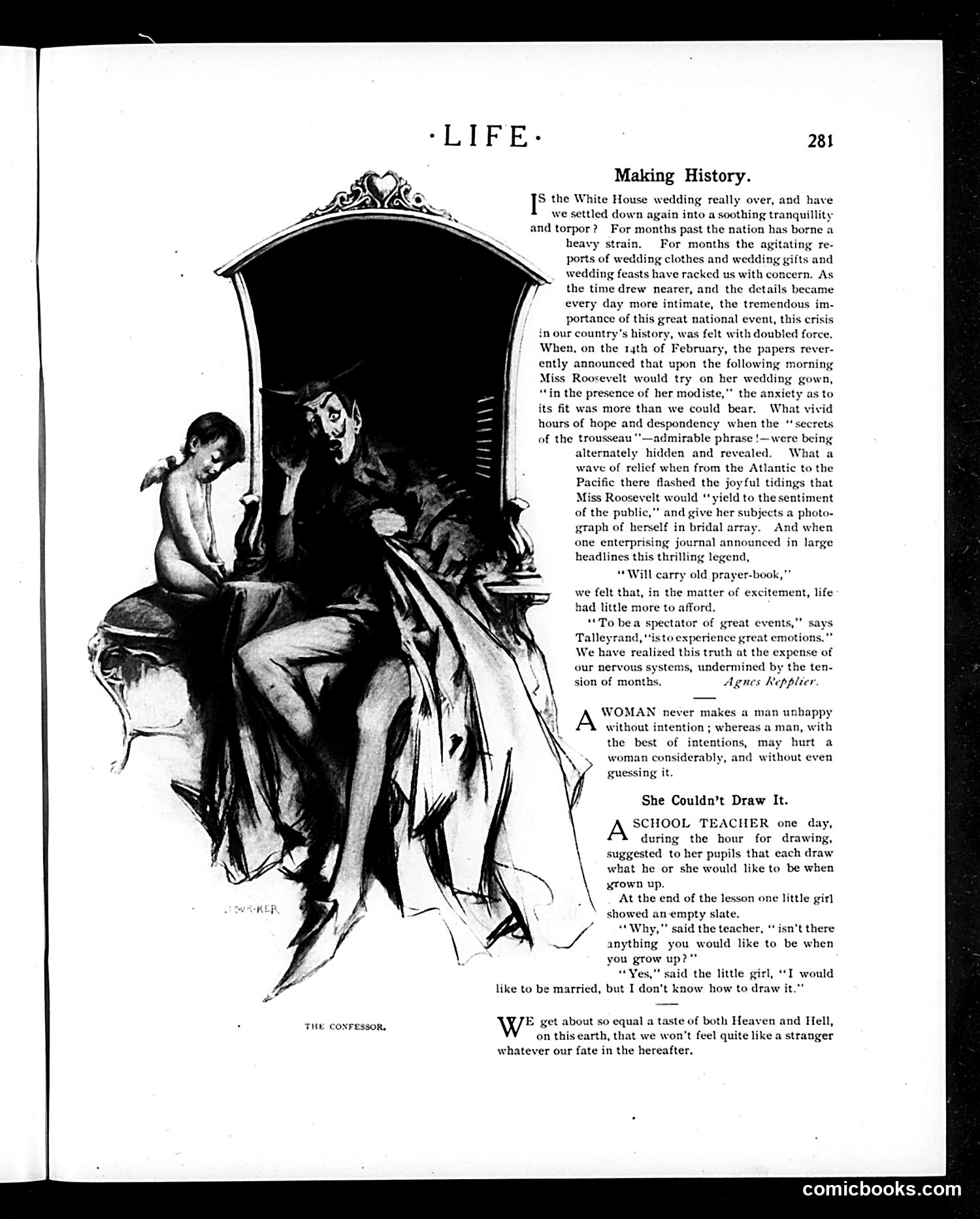
This page satirizes America's obsessive media coverage of Miss Roosevelt's (likely Alice Roosevelt's) White House wedding in February. The main article "Making History" mocks the nation's overwrought anxiety about wedding details—the gown fitting, trousseau secrets, and bridal photograph—treating trivial domestic events as matters of national crisis. Writer Agnes Repplier uses exaggerated language to criticize how the press transformed a private occasion into exhausting public spectacle. The illustration "The Confessor" (left) depicts a priest hearing confession from a female penitent, visually reinforcing themes of moral judgment. Below, "She Couldn't Draw It" presents a humorous anecdote: when a schoolteacher asks pupils what they'd like to become, one girl says she wants to be married but "can't draw it"—a joke about marriage's indefinability and the impossibility of illustrating such an abstract aspiration, while subtly critiquing society's singular focus on female marriage.
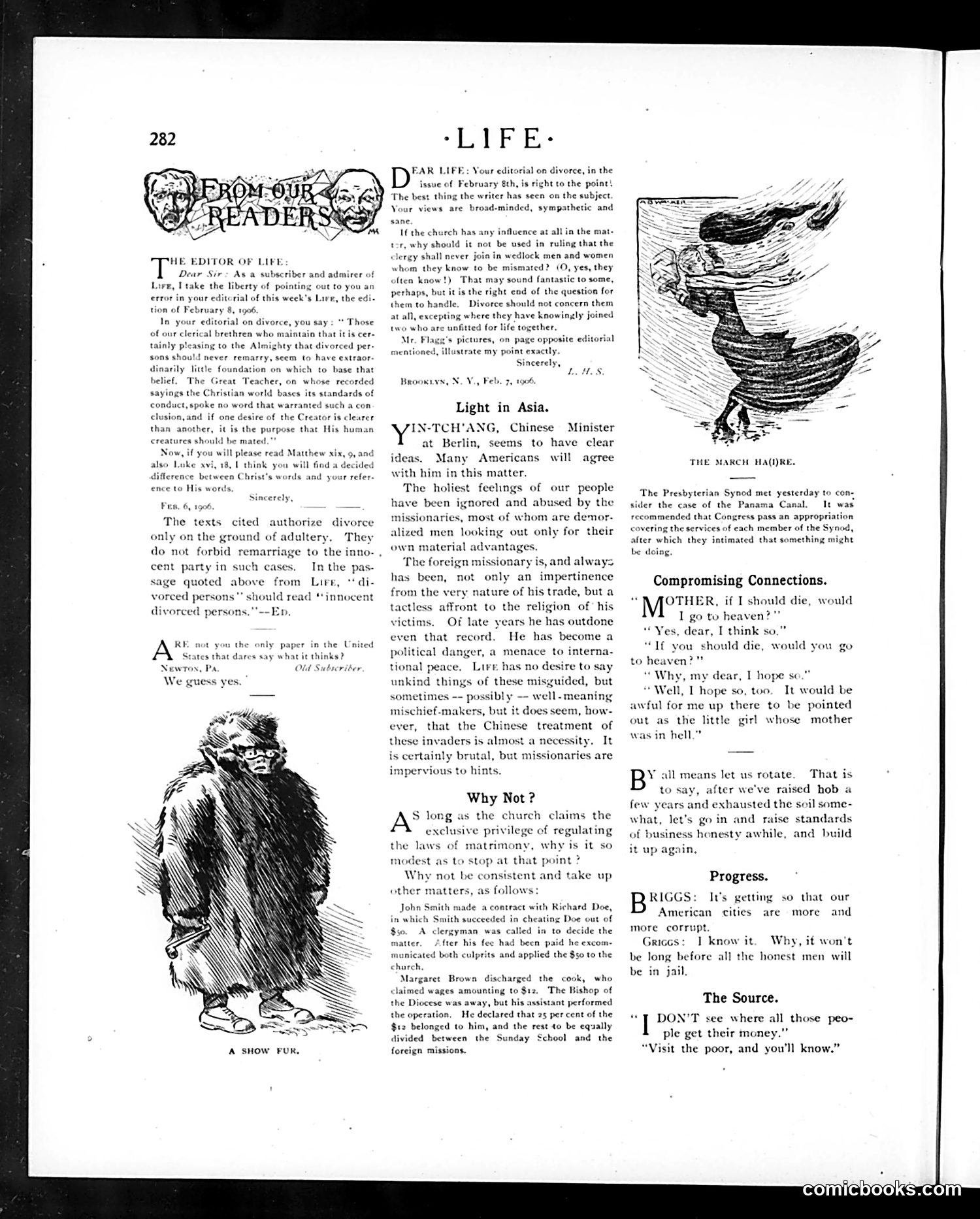
This page contains reader letters defending Life's editorial stance on divorce, plus satirical commentary on related social issues. **"A Show Fur" cartoon**: Depicts a shabbily dressed figure—likely representing poverty or the working poor—commenting on wealth distribution. The satire criticizes hypocrisy around charitable giving. **Main satire ("Why Not?")**: Mocks the Catholic Church's claim to regulate marriage while ignoring broader moral authority. The examples describe clergy interfering in secular financial disputes (cheating, wage disputes) and claiming church profits from compensation—absurdly extending religious jurisdiction beyond matrimony. The satirist argues if the church regulates one civil matter (marriage), why not all? **"Light in Asia"** section: References Chinese Minister Yin-Tch'ang's criticism of foreign missionaries in Asia, characterizing them as self-interested and culturally offensive. Life appears sympathetic to anti-missionary sentiment. The page exemplifies *Life* magazine's turn-of-century progressive stance: questioning clerical authority, supporting secular governance, and critiquing imperial missionary enterprises.
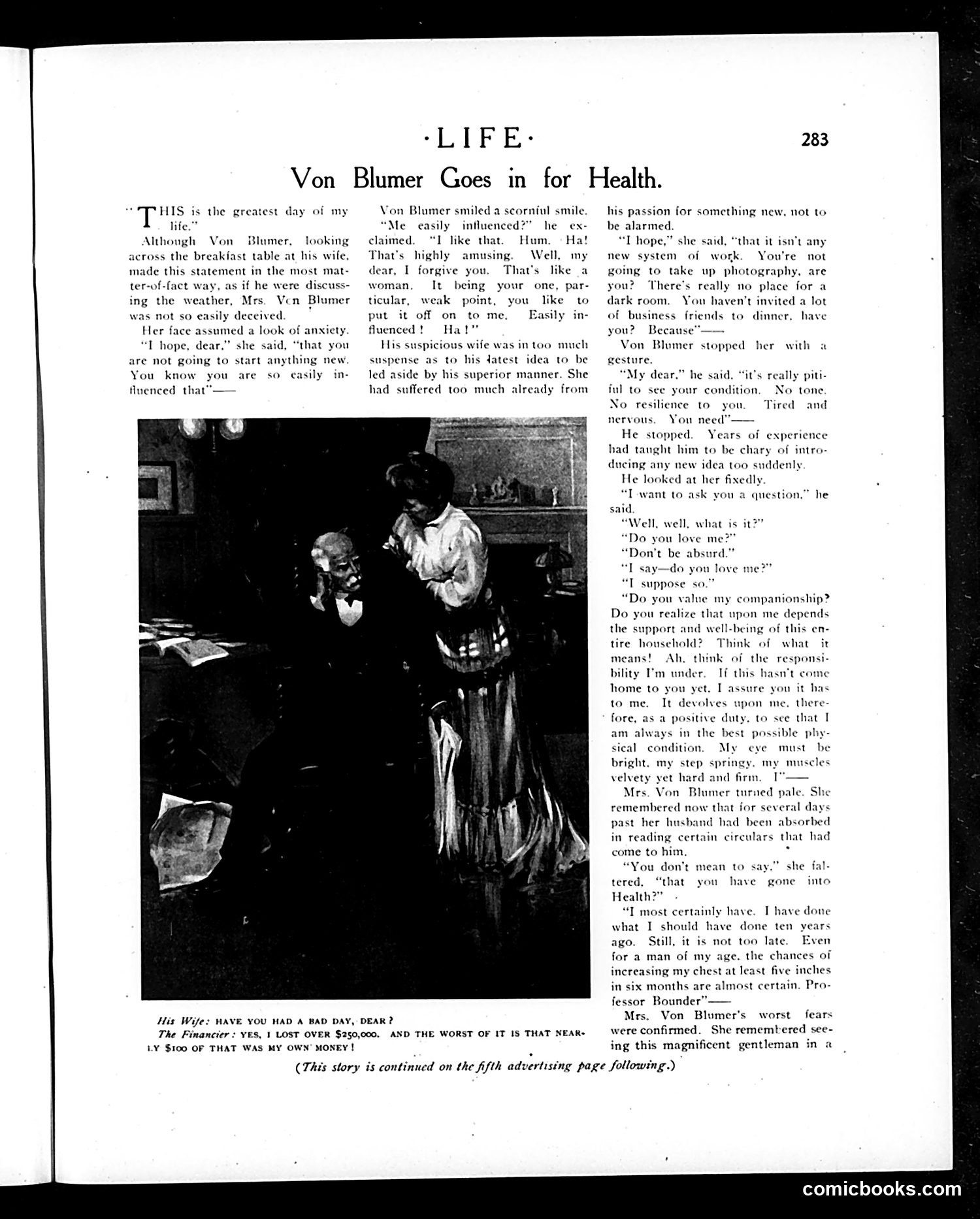
This is a humorous domestic story satirizing the gullibility of wealthy men toward self-improvement schemes. Von Blumer, a financier, announces he's adopting a new health regimen based on circulars (advertisements) he's received—likely promising chest expansion and physical transformation. The satire targets two things: First, the vanity of aging men susceptible to dubious health products claiming miraculous results ("increasing my chest at least five inches in six months"). Second, the irony that Von Blumer prides himself on not being easily influenced while simultaneously proving himself completely susceptible to marketing. Mrs. Von Blumer's anxiety is the joke's emotional core—she knows her husband's history of adopting ridiculous fads, and she's right to worry. The reference to "Professor Bounder" (likely a made-up or fraudulent expert name) reinforces that these are quack schemes targeting the wealthy and vain.
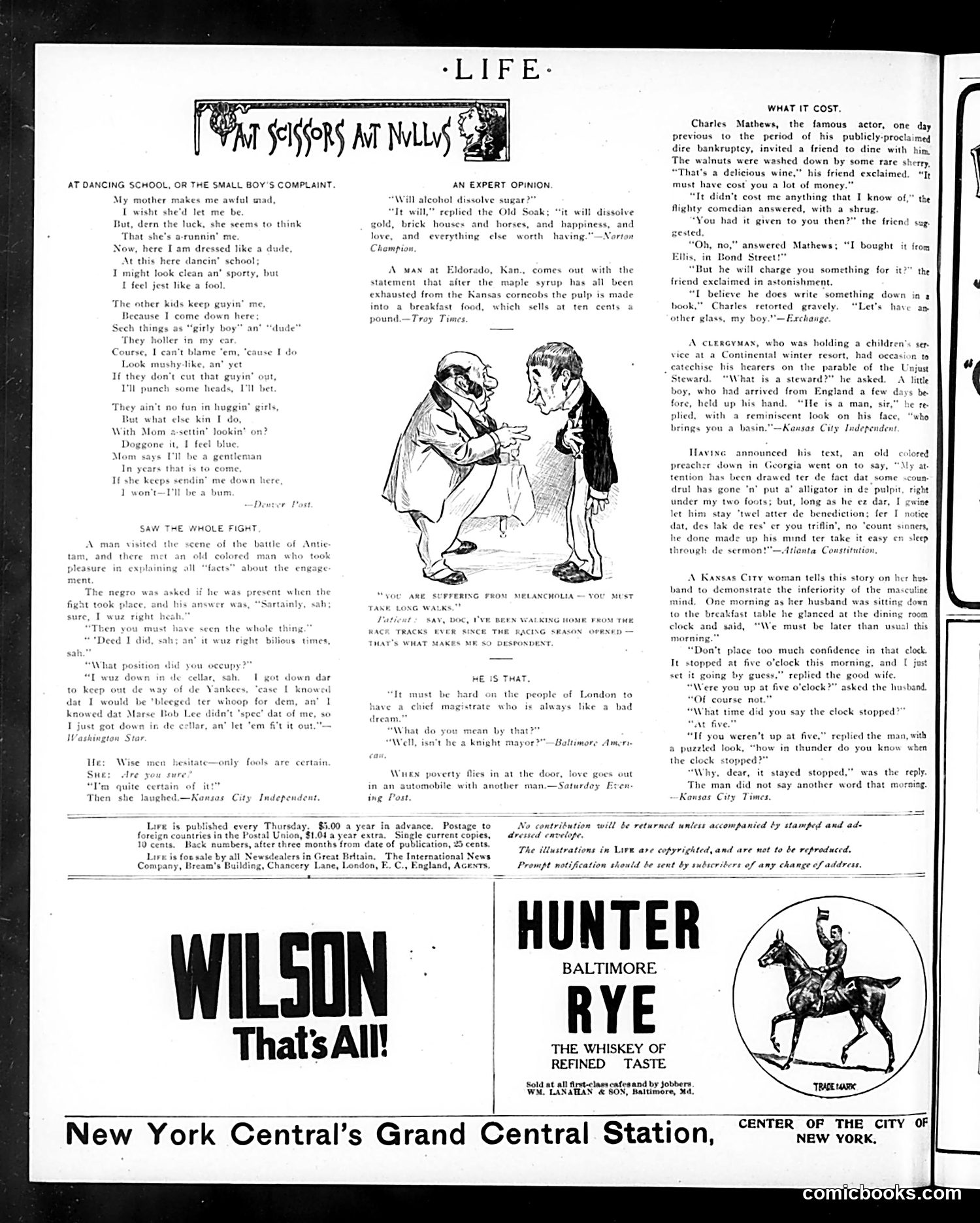
This page from *Life* magazine contains multiple brief humorous anecdotes and a cartoon titled "Scissors at Nullus" (likely "At Dancing School, or the Small Boy's Complaint"). ## The Main Cartoon The illustration shows two figures in conversation—an adult and a small boy at a dancing school. The accompanying poem presents a boy's complaint about being forced to attend dancing lessons where he must dance with girls, describing it as embarrassing and unpleasant. His mother insists he'll become a gentleman, but he resents the "mushy" physical proximity and threatens to punch other boys who mock him. ## Anecdotes The page includes four separate joke items mocking human nature: an actor claiming to acquire expensive wine without paying, a preacher's misunderstanding of biblical stewardship, a wife's confused logic about a stopped clock, and commentary on how poverty and love dissolve human pretensions. **Overall theme**: These pieces satirize Victorian-era social pretensions, marital dynamics, religious hypocrisy, and childhood reluctance toward "civilizing" institutions like dance school—typical satirical targets for early 20th-century *Life* magazine.
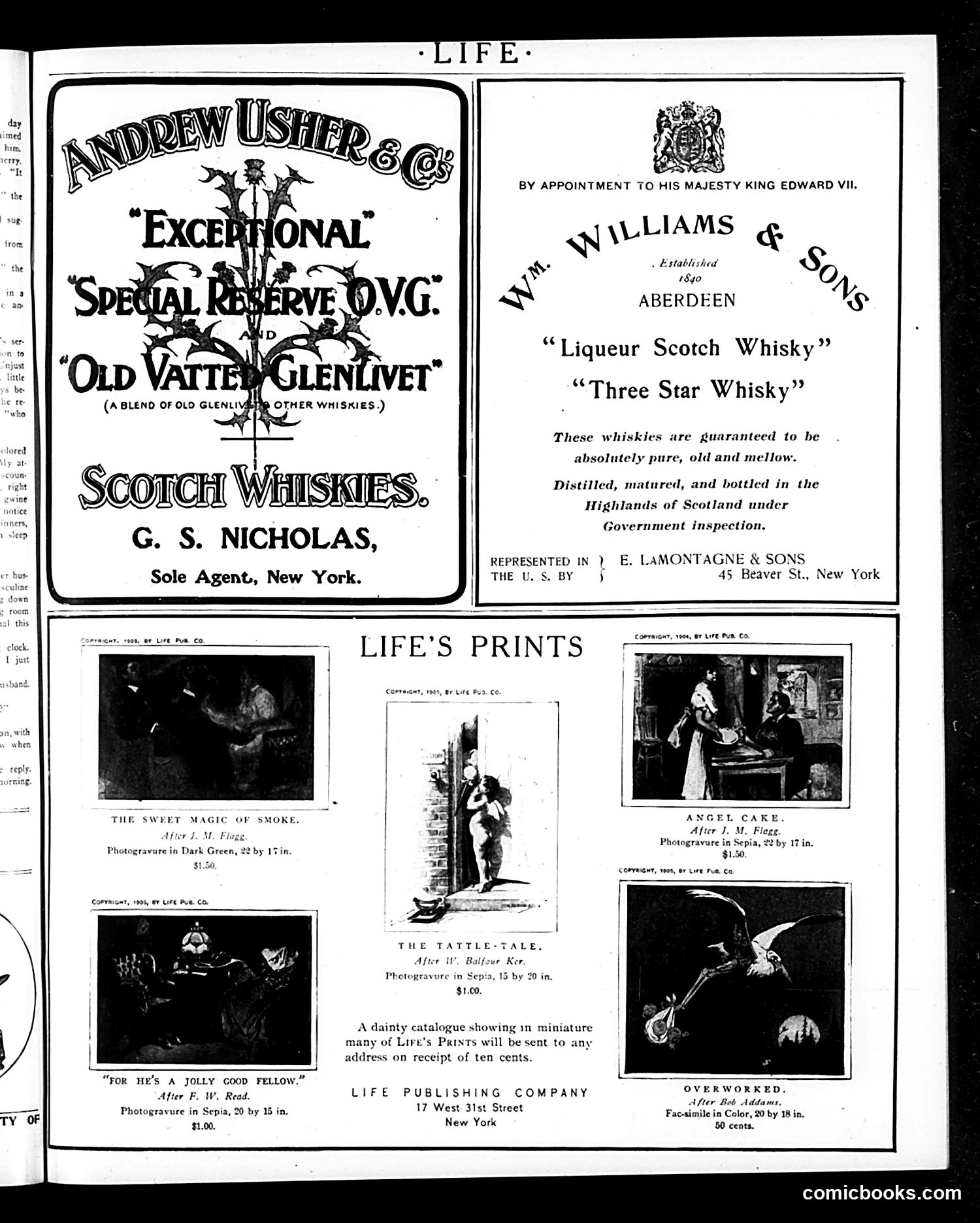
This is primarily an **advertising and art print sales page**, not a political cartoon page. The content consists of: **Top half:** Two whisky advertisements—Andrew Usher & Co.'s Scotch whiskies (sold through New York agent C.S. Nicholas) and Williams & Sons of Aberdeen, appointed purveyor to King Edward VII. Both emphasize purity and Highland Scottish origin, typical of period luxury goods marketing. **Bottom half:** "Life's Prints"—reproductions of artwork available for purchase, including photogravures titled "The Sweet Magic of Smoke," "Angel Cake," "The Tattle-Tale," "For He's a Jolly Good Fellow," and "Overworked." These appear to be genre scenes or sentimental illustrations typical of early 1900s popular art, priced between 50 cents and $1.50. The page reflects Life's dual business model: combining satirical editorial content (elsewhere in the magazine) with profitable advertising and merchandise sales to its affluent readership.
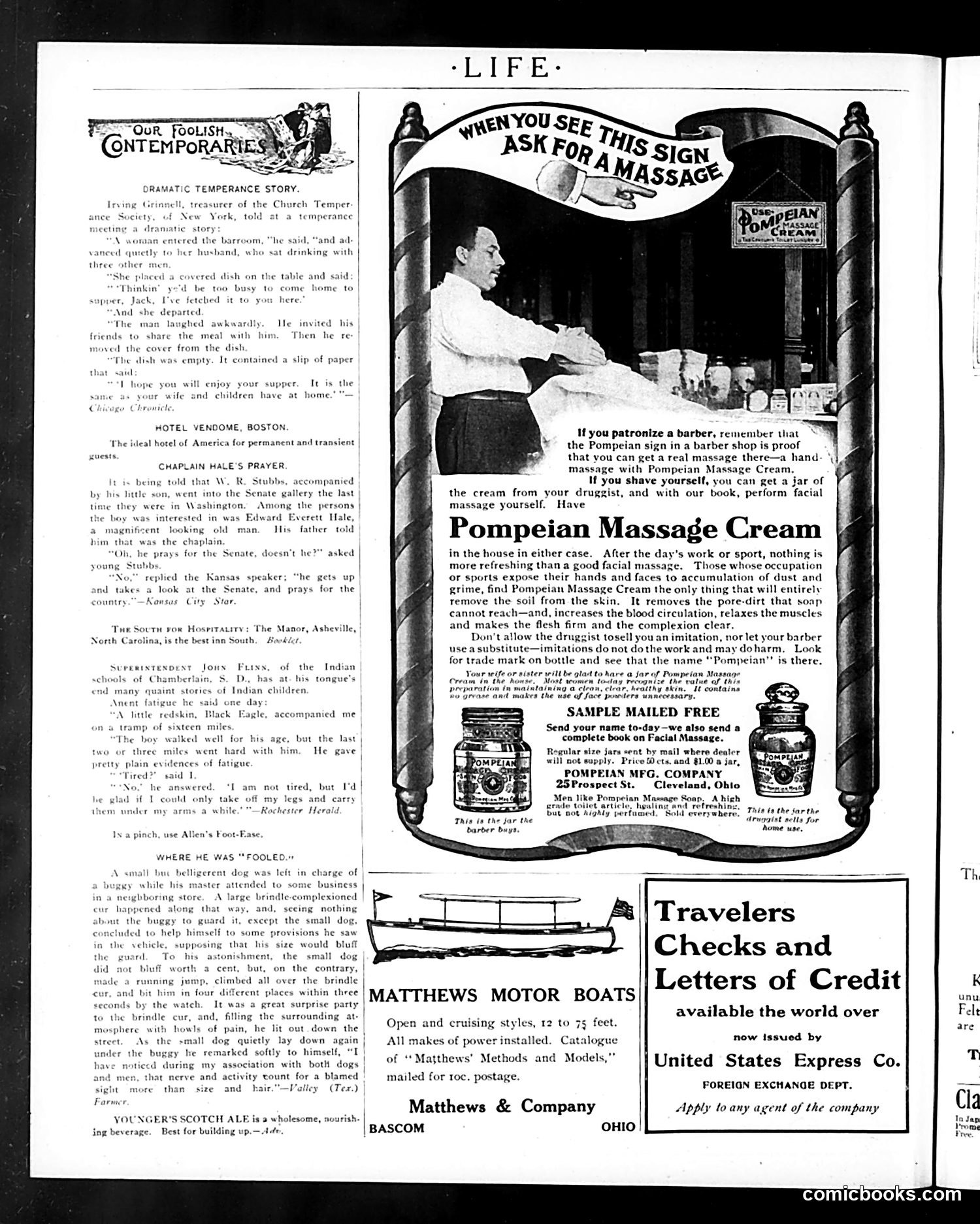
This page from *Life* magazine contains satirical anecdotes rather than political cartoons. The humor relies on early-20th-century social commentary: **"Dramatic Temperance Story"**: A wife delivers an empty dish to her drinking husband at a bar, with only a note saying he's too busy to come home. The joke critiques male drinking culture and marital neglect—the wife's silent protest against her husband prioritizing alcohol over family. **"Chaplain Hale's Prayer"**: A senator prays *for* the Senate rather than to it, implying the institution needs divine intervention. This satirizes Congressional dysfunction. **"Where He Was 'Fooled'"**: A small dog outwits a large one guarding provisions, reversing expectations about size and power—gentle satire on underestimation. These anecdotes mock drinking habits, institutional incompetence, and social pretensions typical of *Life*'s editorial voice. The page is otherwise dominated by period advertisements (Pompeian Massage Cream, motor boats, travelers' checks).
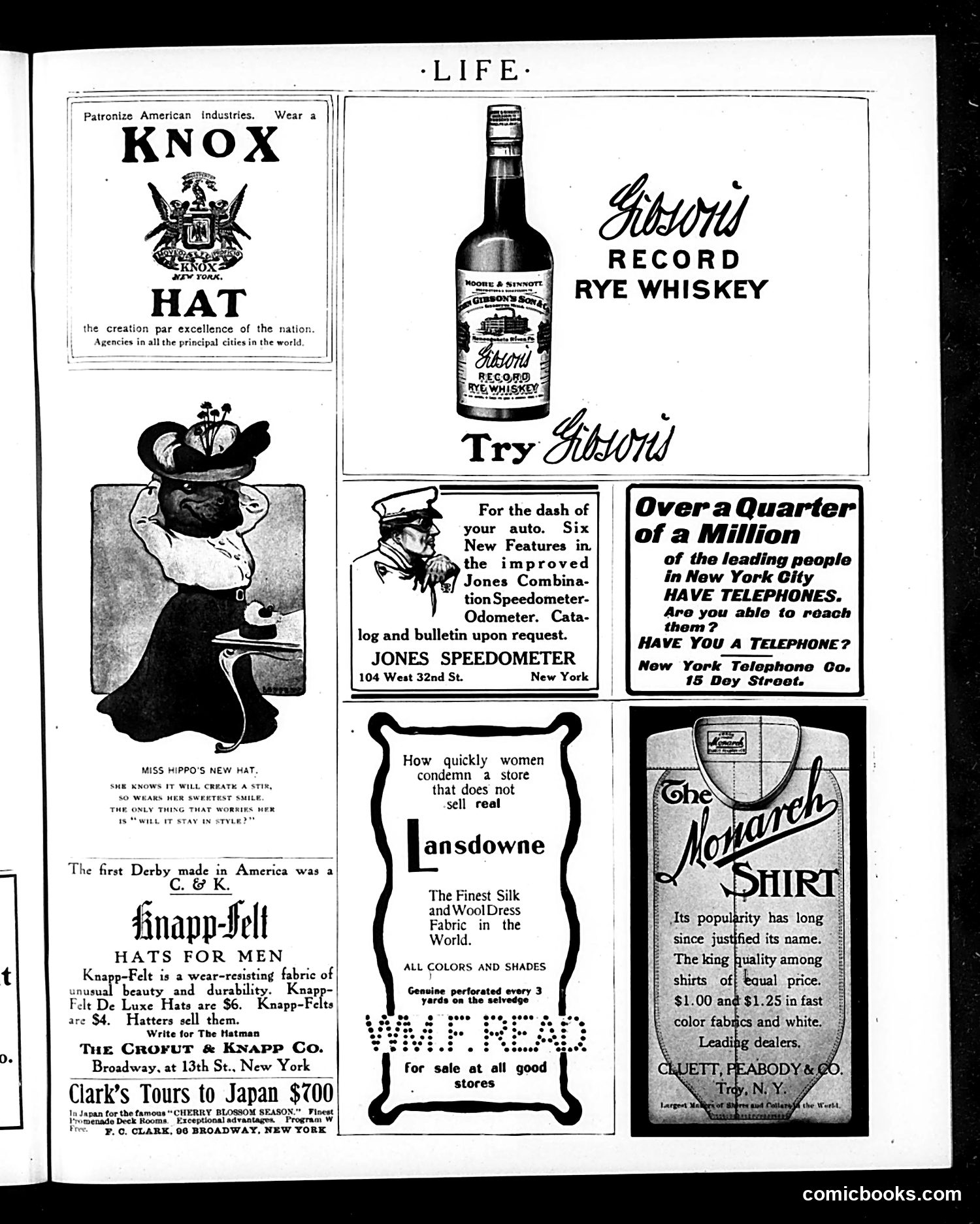
This is primarily an **advertising page** with one satirical cartoon element. The cartoon—"Miss Hippo's New Hat"—is the page's only editorial content. It depicts a hippopotamus wearing an elaborate hat, captioned that she knows it will "create a stir" and worries only about staying stylish. This is gentle satire mocking fashion vanity: the joke is that even a hippo cares about fashionable appearance, exaggerating how absurdly concerned society is with following hat trends. The remaining content consists of period advertisements for American goods: Knox hats, Knapp-Felt hats, Gilboni rye whiskey, Jones speedometers, telephones, silk fabric, and "The Monarch" shirt. The Knox hat ad emphasizes patriotism ("Patronize American Industries"), reflecting early-20th-century economic nationalism. The page reflects Life's dual identity as both satirical commentary and upscale advertising vehicle for middle-class consumer goods.
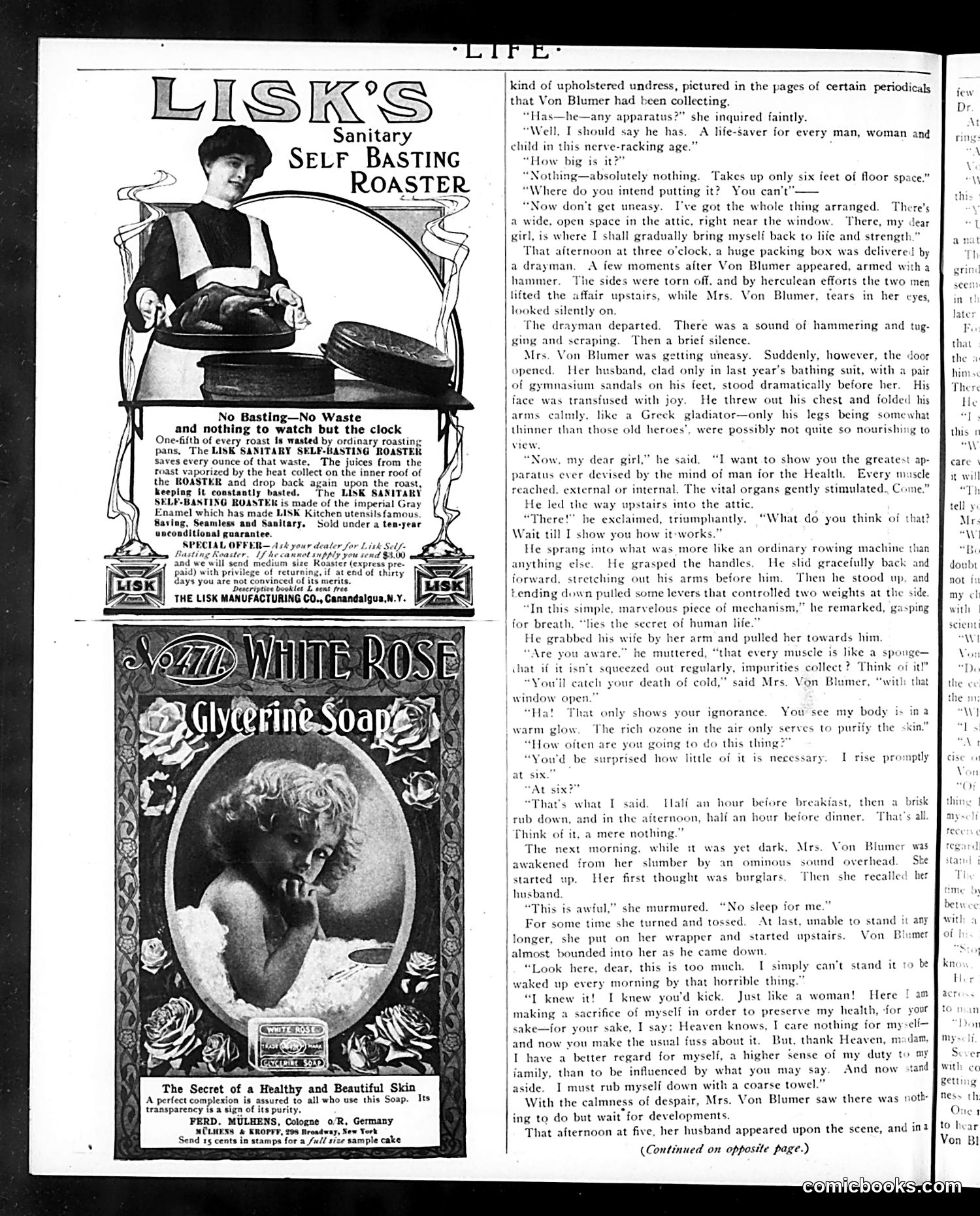
This page contains two advertisements and a serialized story (continued from another page). **The Advertisements:** - **Lisk Self-Basting Roaster**: A kitchen product ad emphasizing labor-saving and waste reduction—appeals to early 20th-century homemakers. - **White Rose Glycerine Soap**: Uses a classical bust image to suggest purity and beauty; marketed to women concerned with complexion. **The Story Content:** The narrative excerpt depicts a husband, Von Blumer, who has purchased a "life-saver" apparatus—apparently a rowing machine or exercise device—promising health benefits. The satire lies in the gap between his grandiose health claims ("the secret of human life") and the mundane reality: it's simply exercise equipment taking up attic space. His wife's skeptical reactions ("Has—he—any apparatus?" asked faintly) suggest contemporary anxiety about unproven health gadgets and "nerve-racking" modern life. The humor targets both the husband's gullible enthusiasm for dubious wellness products and the period's fascination with mechanical solutions to health problems.
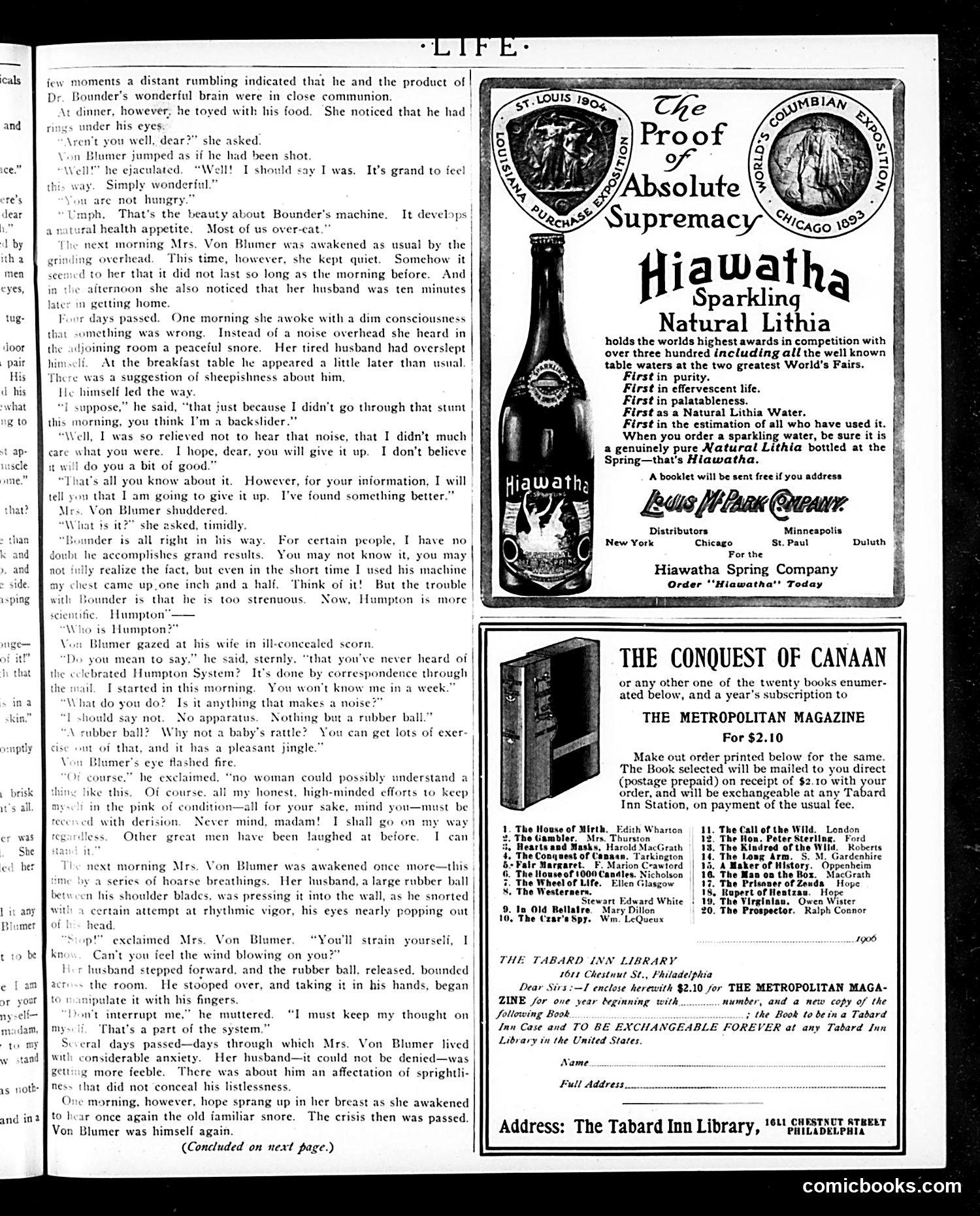
This page contains a serialized short story titled "Life" (continuation from previous issue) about Mr. Von Blumer, a husband obsessed with physical fitness systems. The narrative satirizes the era's **fad health crazes and pseudoscientific exercise regimens**. Von Blumer abandons Dr. Bounder's machine (which he initially praised) for the "Humpton System"—a correspondence-course program requiring only a rubber ball, which he uses compulsively and irrationally. The satire targets: - **Gullible men chasing dubious fitness trends** without evidence - **Marital conflict** over these obsessions (his wife's skepticism contrasts his enthusiasm) - **Snake-oil marketing** through mail correspondence - Male stubbornness and defensiveness when questioned The humor derives from Von Blumer's escalating absurdity: he violently exercises with a rubber ball, loses sleep, strains himself, yet insists his wife "wouldn't understand" when she questions the scheme. The page also contains period advertisements, including one for "Hiawatha Sparkling Natural Lithia" water, a real patent-medicine product of that era—ironically reinforcing the page's satirical context about dubious health products.
This page satirizes the New Thought movement and emerging self-help philosophies of the early 20th century. Von Blumer, a self-absorbed husband, adopts various "systems" for self-improvement—citing modern stress, physical weakness, and the need for mental discipline. He conducts amateur experiments on himself while dismissing his patient wife's concerns. The satire peaks when Von Blumer announces he's discovered the secret: he's become a Christian Scientist, believing "All is mind." The joke targets the period's proliferation of pseudoscientific wellness movements and mental-healing philosophies. Von Blumer represents the credulous man who adopts trendy doctrines without real understanding, then expects unquestioning support from his wife. The humor lies in his pompous self-importance contrasted with his wife's gentle skepticism—she tolerates his obsessions while recognizing their absurdity. Life magazine ridicules both the faddish nature of these movements and the domestic friction they create.
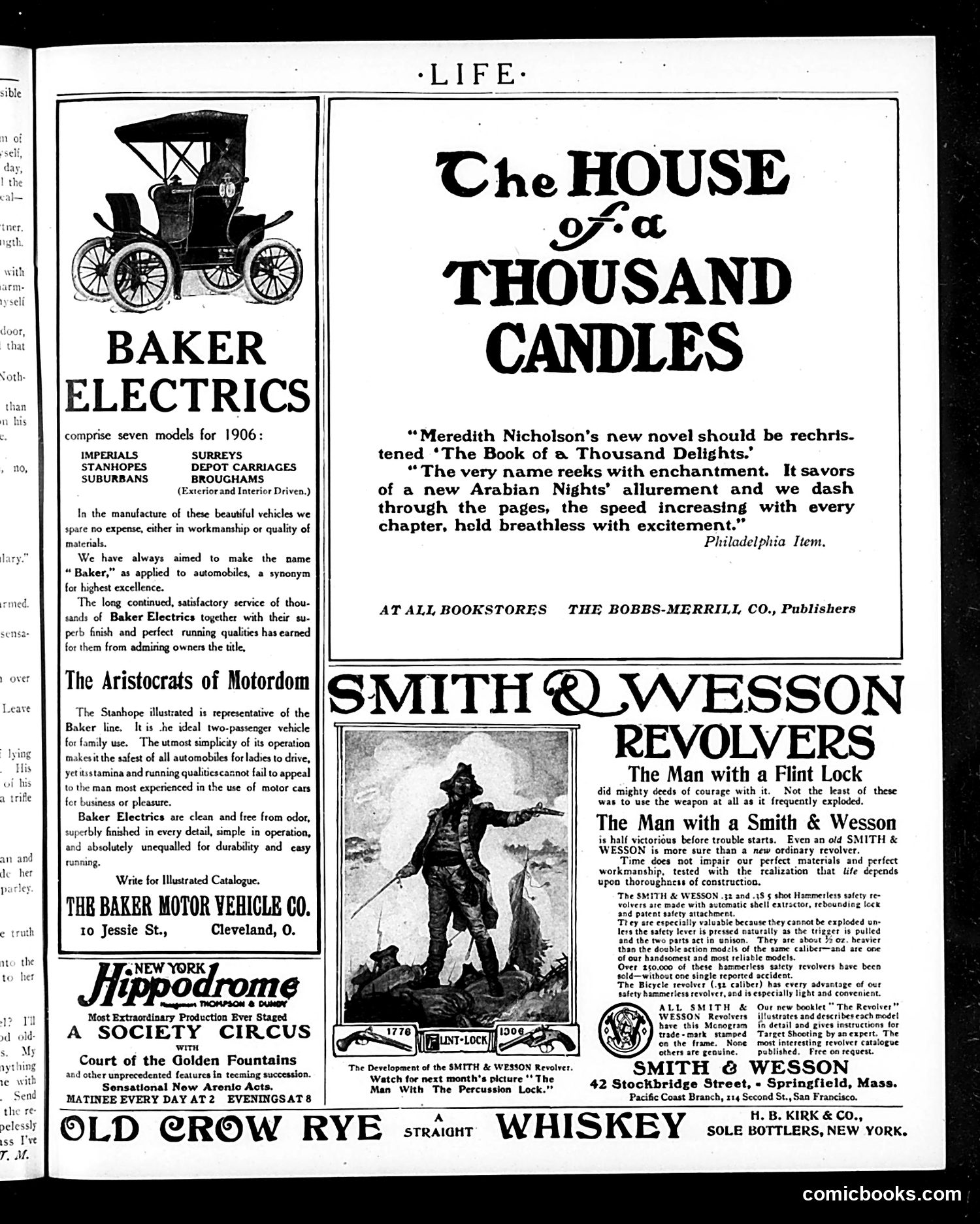
This is primarily an **advertising page** from Life magazine (circa 1906), not a political cartoon. The page contains six distinct advertisements with minimal satirical content. The main advertisements feature: 1. **Baker Electrics** – Early electric automobiles marketed as luxury vehicles for the wealthy 2. **"The House of a Thousand Candles"** – A novel by Meredith Nicholson, promoted as an exciting adventure story 3. **Smith & Wesson Revolvers** – Firearms advertised with historical imagery (a figure labeled "1776" and "1906") implying continuity from Revolutionary War-era weapons to modern models 4. **Hippodrome circus** and **Old Crow Rye whiskey** – Additional commercial promotions The Smith & Wesson ad's juxtaposition of historical and modern revolvers appears designed to suggest reliability and patriotic American tradition, though this is advertisement rather than satire. The page reflects early 1900s consumer culture targeting upper-class readers.
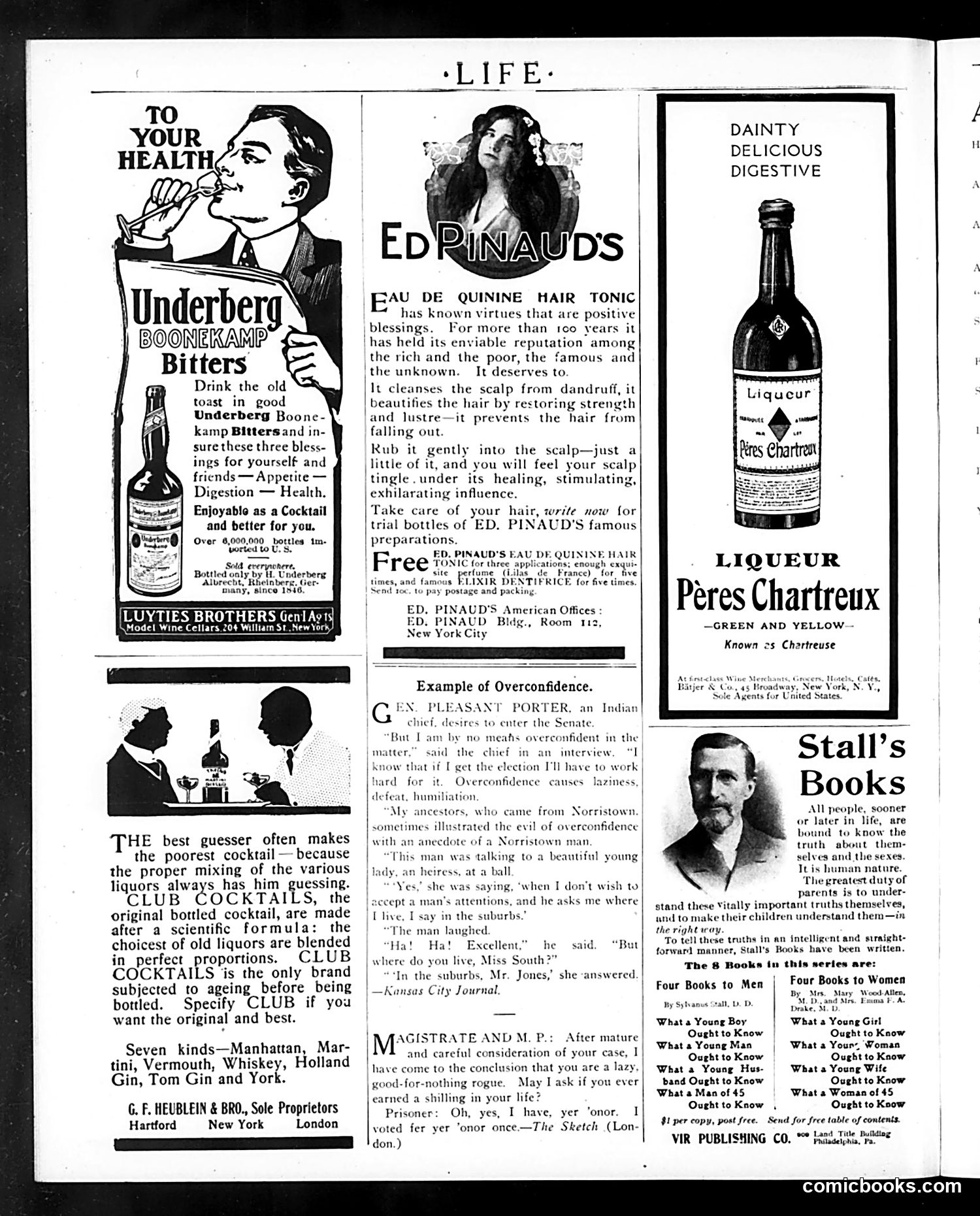
This is primarily an **advertisement page** from Life magazine, circa early 1900s. The content is almost entirely commercial rather than satirical. The notable exception is a small **humor section** titled "Example of Overconfidence," featuring two brief jokes: 1. A Native American chief named "Gen Pleasant Porter" seeks Senate entry but claims no overconfidence—a joke playing on stereotypes about Native Americans and political ambition. 2. Two magistrate/prisoner exchanges about laziness and voting, typical period courtroom humor. The bulk of the page advertises **patent medicines and liqueurs** (Underberg Bitters, Ed Pinaud's hair tonic, Club Cocktails, Liqueur Peres Chartreux) and **self-help books** (Stall's Books on sex education). These reflect common early-20th-century consumer products and the era's approach to health and propriety. The page demonstrates how Life functioned as both satirical publication **and** advertising vehicle for its revenue model.
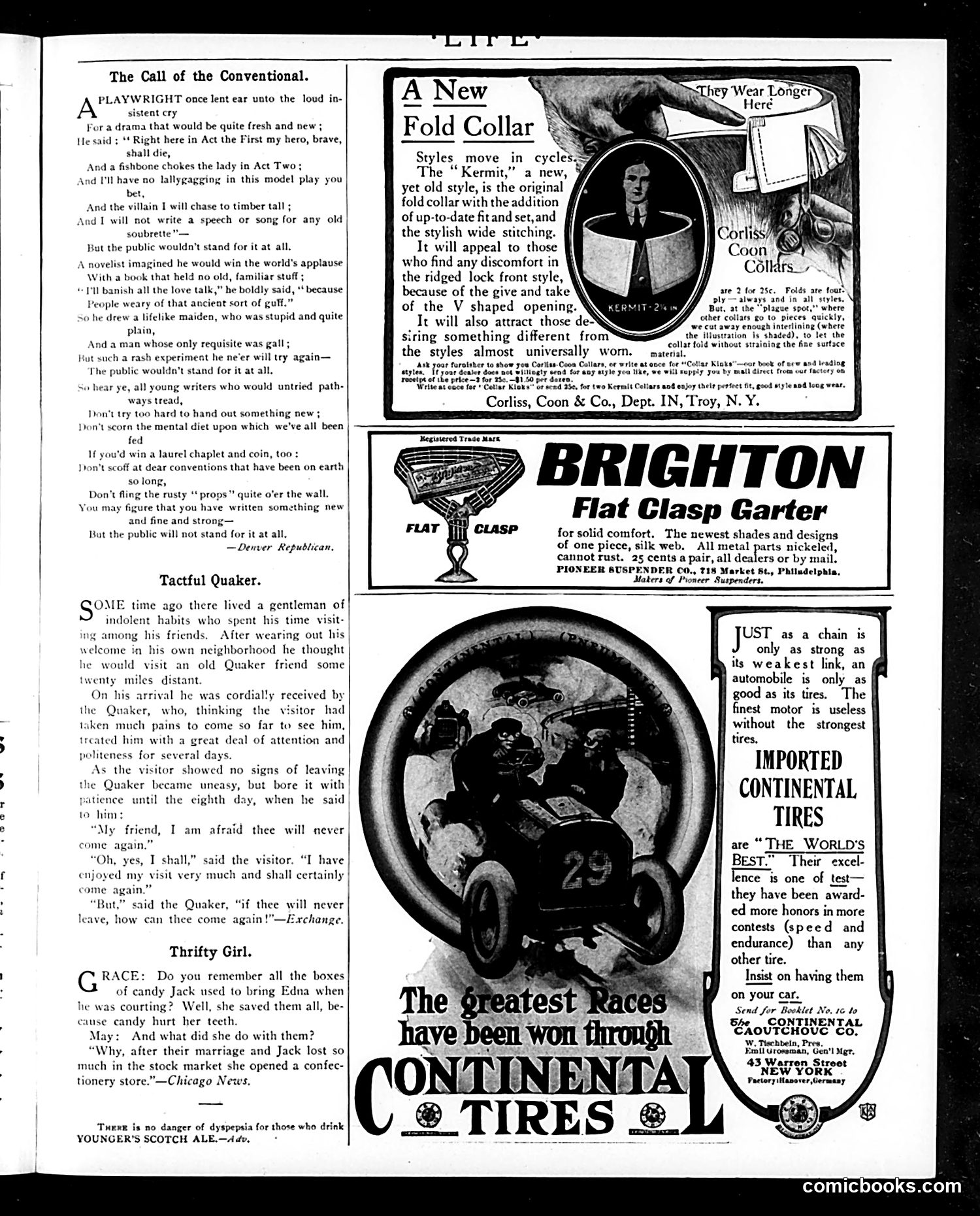
This page features three satirical pieces mocking conventional attitudes toward art and literature. **"The Call of the Conventional"** (main poem) ridicules the public's resistance to innovation. It describes a playwright and novelist who each attempted radical departures—eliminating love stories, creating unconventional characters—only to fail because audiences rejected anything unfamiliar. The satire targets not the artists but the conservative public taste that demands predictable, formulaic entertainment. **"Tactful Quaker"** is a brief humorous anecdote about a polite Quaker who must hint repeatedly that his overstaying guest should leave—finally resorting to the backhanded suggestion that the visitor will never return, implying he shouldn't come back. **"Thrifty Girl"** is a one-liner joke: a woman saves unused candy boxes from her courting days, later opening a confectionery store with them after her husband loses money in the stock market. The remainder is period advertising for collars, garters, and Continental tires—typical of Life's commercial content.
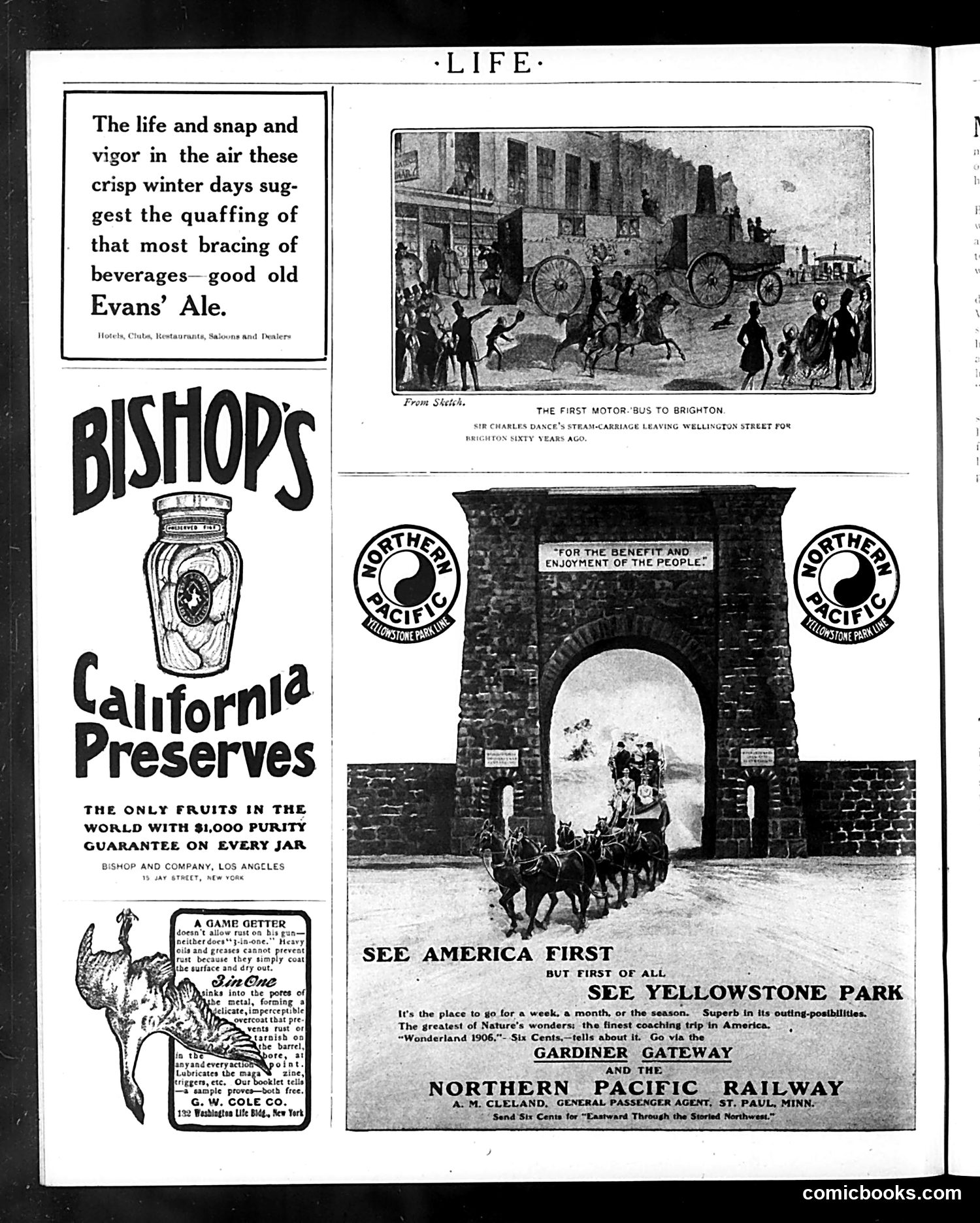
This is primarily an **advertising page** from Life magazine, not a satirical cartoon page. It contains four separate advertisements: 1. **Evans' Ale** — a winter beverage ad appealing to the "bracing" effects of cold weather drinking 2. **Bishop's California Preserves** — fruit preserves marketed with a "purity guarantee" 3. **G.W. Cole Co.** — gun lubricant advertised to sportsmen ("game getter") 4. **Northern Pacific Railway** — promoting Yellowstone Park tourism with a historical engraving labeled "The First Motor-Bus to Brighton" (Sir Charles Dance's steam-carriage from 60 years prior) The Yellowstone ad uses patriotic messaging—"See America First"—reflecting early 1900s tourism promotion and nationalist sentiment. The historical image contrasts primitive steam transportation with modern rail travel, implying progress. There is **no political satire or cartoon commentary** on this page; it's straightforward period advertising demonstrating consumer products and leisure travel aimed at affluent readers.
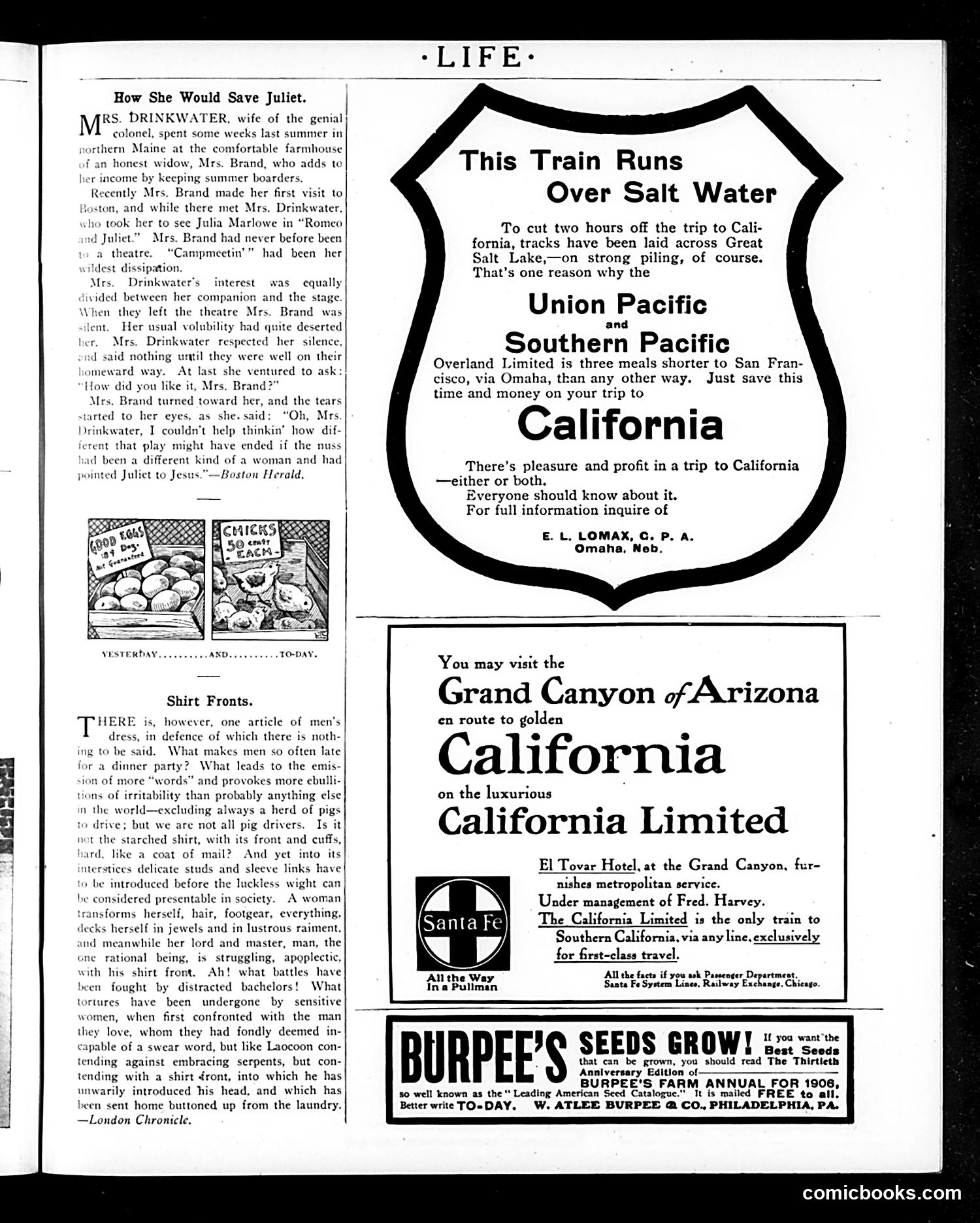
This page contains two distinct editorial pieces and multiple advertisements (typical of Life magazine from this era). ## "How She Would Save Juliet" A brief humorous anecdote mocking rural or unsophisticated sensibilities. A farm widow, Mrs. Brand, attends her first theatrical performance—Shakespeare's *Romeo and Juliet*—and the satire lies in her practical reaction: she suggests that had Juliet consulted a nurse figure (implied to be a morally conscientious woman), the tragic ending could have been prevented. The joke targets the collision between high culture and practical, conventional morality—the widow's common-sense inability to appreciate theatrical tragedy. ## "Shirt Fronts" A satirical essay about men's formal dress, specifically the aggravation of starched shirt fronts with studs and cufflinks. The author complains that while women effortlessly transform themselves for formal occasions, men suffer absurd indignity wrestling with inflexible starched fabric. It's a gender-commentary piece mocking masculine frustration with fashion requirements. The remainder consists of period railroad and commercial advertising.
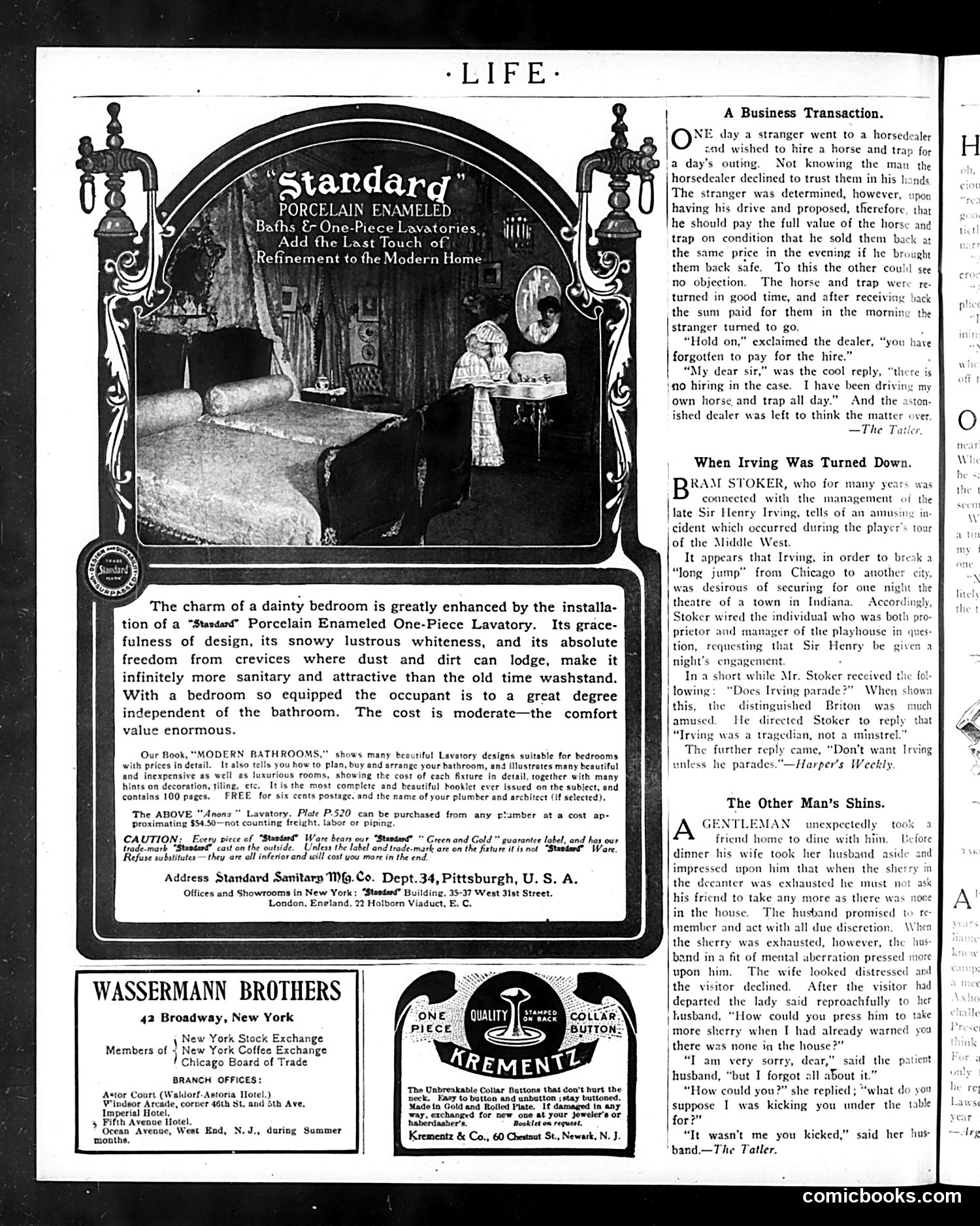
This page contains three humorous anecdotes typical of *Life* magazine's satirical humor: **"A Business Transaction"** mocks a clever con artist who rents a horse and trap, then claims he's merely "driven his own" all day, refusing to pay the hire fee. The joke plays on literal interpretation of contract language—a scam dependent on the dealer's confusion. **"When Irving Was Turned Down"** references Sir Henry Irving, a famous 19th-century Shakespearean actor. The anecdote (attributed to Bram Stoker) describes Irving being rejected by a theater manager who wanted entertainment ("minstrel"), not serious drama. The punchline mocks Irving's tragic pretensions. **"The Other Man's Shins"** (text incomplete in image) appears to be another social comedy about propriety and discretion at dinner. The page is primarily **advertising**: a large "Standard" porcelain bathroom fixture advertisement dominates the upper half, flanked by smaller ads for Wassermann Brothers (stockbrokers) and Kirementi collar buttons. The anecdotes fill remaining space—typical magazine layout of the era.
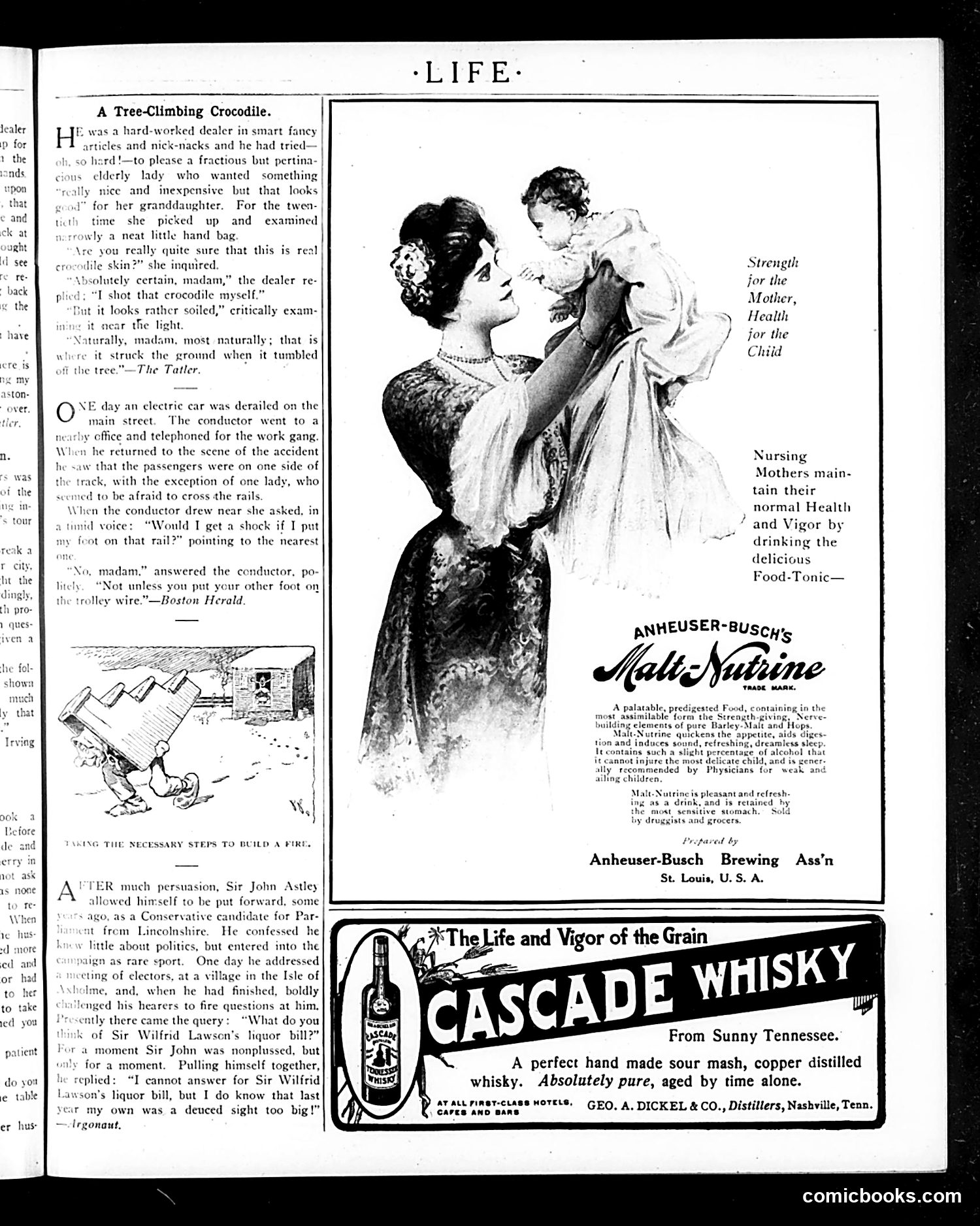
This page contains three separate humorous anecdotes typical of early 20th-century satirical magazines: **"A Tree-Climbing Crocodile"** mocks a shopkeeper's dubious claim about a crocodile-skin handbag. The joke hinges on the absurd excuse that the crocodile is "soiled" because it "struck the ground when it tumbled out of the tree"—implying crocodiles climb trees, which they don't. It satirizes commercial dishonesty and the gullibility of wealthy customers. **The Electric Car anecdote** jokes about a fearful female passenger who asks the conductor if she'll get shocked touching a rail. His response—that she'd only be shocked if she simultaneously touched the trolley wire—mocks her illogical thinking while gently satirizing women's perceived anxieties about modern technology. **Sir John Astley's story** ridicules a Conservative political candidate who admits his own liquor expenses exceeded what he could justify criticizing others for—a hypocritical stance that undercuts his political authority. The page is otherwise dominated by advertisements for alcoholic beverages (Anheuser-Busch Malt Nutrine and Cascade Whisky), revealing period attitudes toward alcohol marketing and health claims.
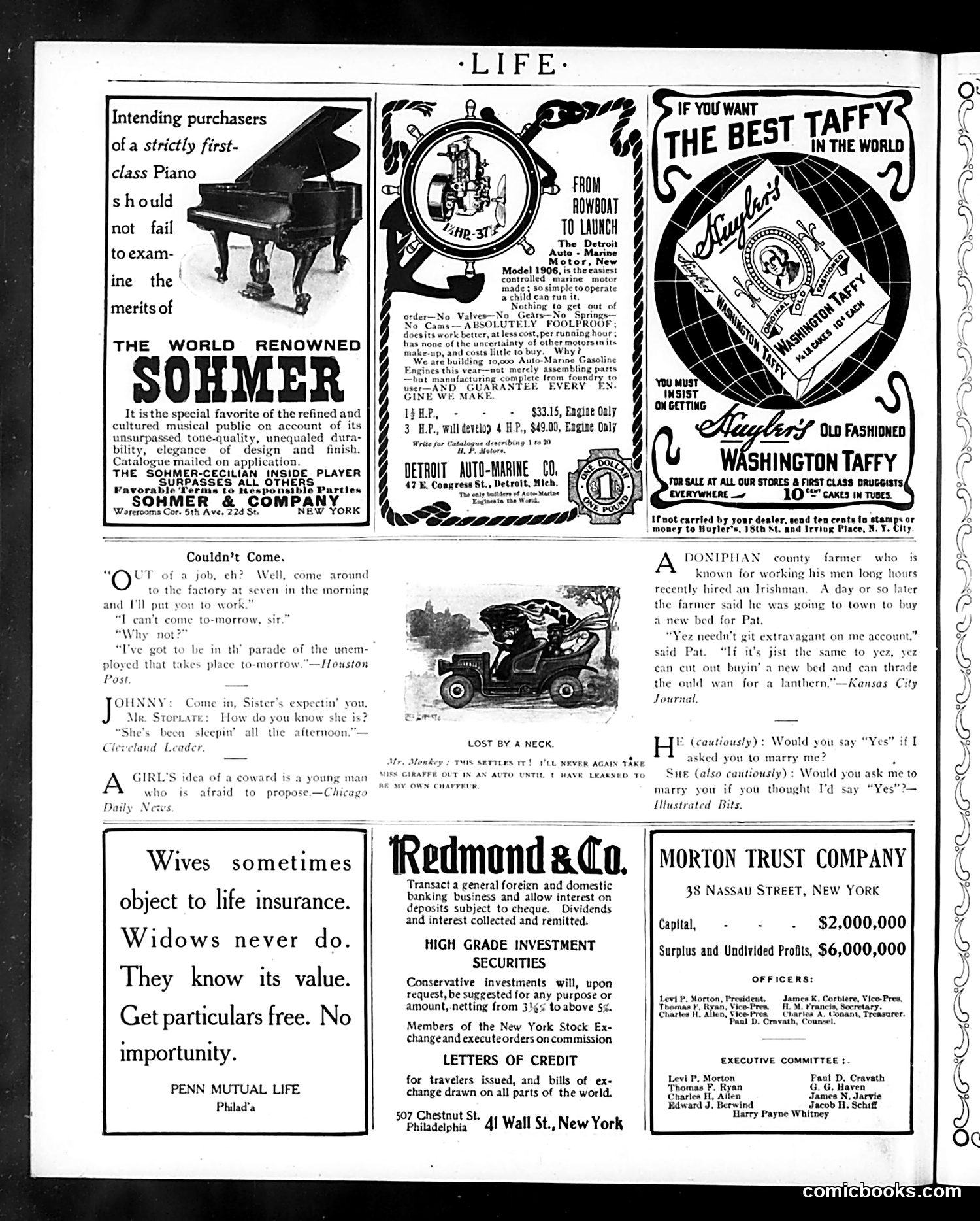
This page from *Life* magazine is primarily **advertisements and humorous short anecdotes**, not political cartoons. The humor pieces mock contemporary social situations: unemployed workers forced into "parades of the unemployed" (referencing economic hardship); an Irish farmworker's indifference to comfort; and awkward courtship exchanges. One brief illustrated gag shows a giraffe's long neck causing a car accident—pure slapstick. The advertisements reveal period concerns: piano manufacturers emphasizing quality for "refined" audiences; marine motors; and notably, **life insurance ads** contrasting wives' objections to widows' approval—darkly humorous commentary on marriage and mortality. Banks and financial firms dominate the lower third, reflecting the era's investment culture. The taffy ad references "Old Fashioned Washington Taffy," appealing to nostalgia. Overall, this page captures early-1900s American middle-class preoccupations: consumer goods, financial security, employment anxiety, and courtship conventions—with gentle, non-confrontational humor typical of *Life*'s satirical approach.
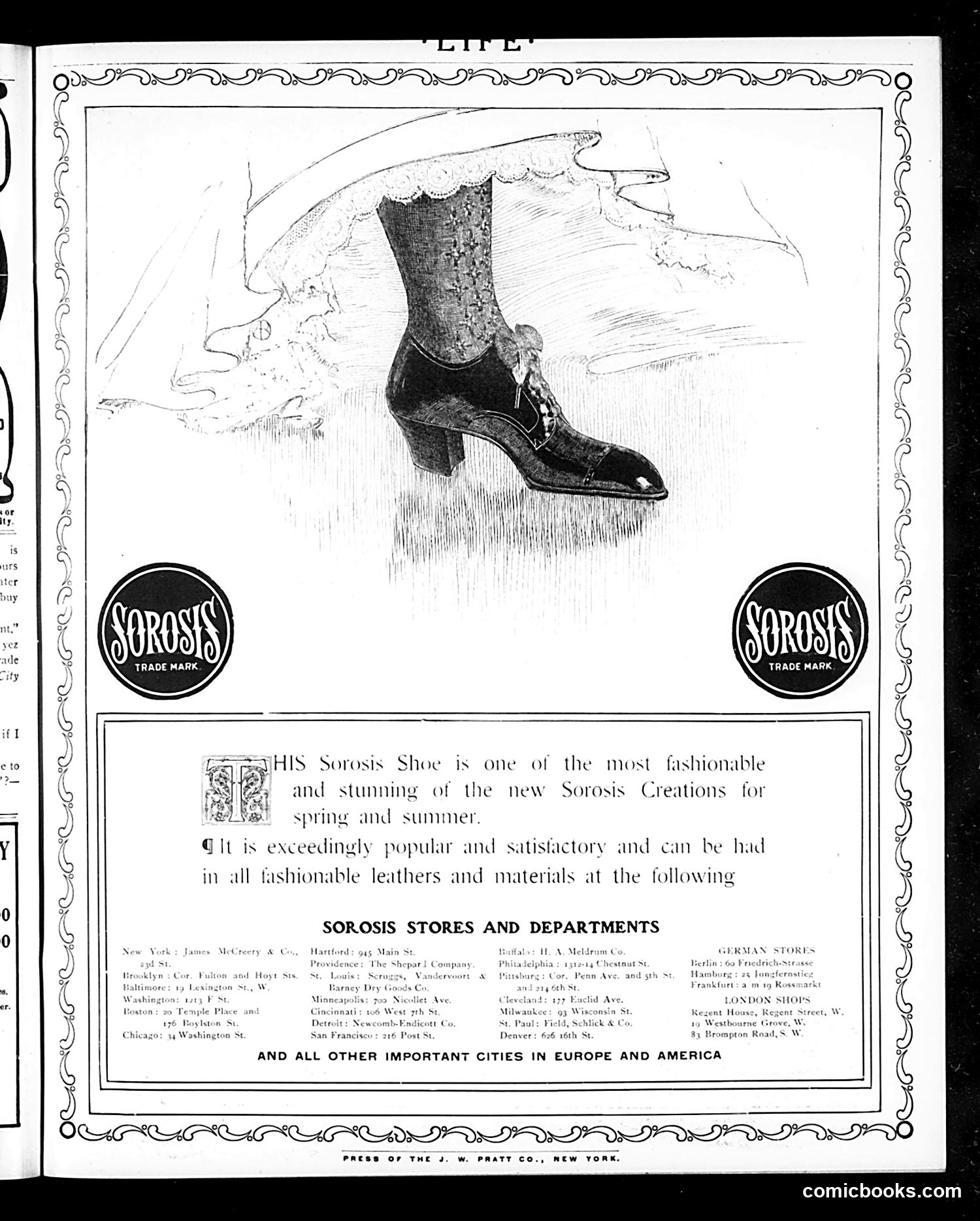
This page is **not a political cartoon or satirical content**—it's a **full-page advertisement** for Sorosis brand shoes, a women's footwear company. The image shows an elegantly illustrated women's shoe with a dark leather upper and heel, rendered in the refined artistic style typical of early 20th-century fashion advertising. The Sorosis trademark (circular logo) appears twice. The text describes the shoe as "fashionable and stunning" for "spring and summer," emphasizing it's "exceedingly popular and satisfactory." It then lists numerous retail locations across major American cities and European capitals where the shoes could be purchased. There is **no satire, political commentary, or hidden meaning** to decode—this is straightforward commercial promotion placed in *Life* magazine, which, while known for humor and satire, also carried advertisements. The ornate decorative border was standard magazine design of the era.
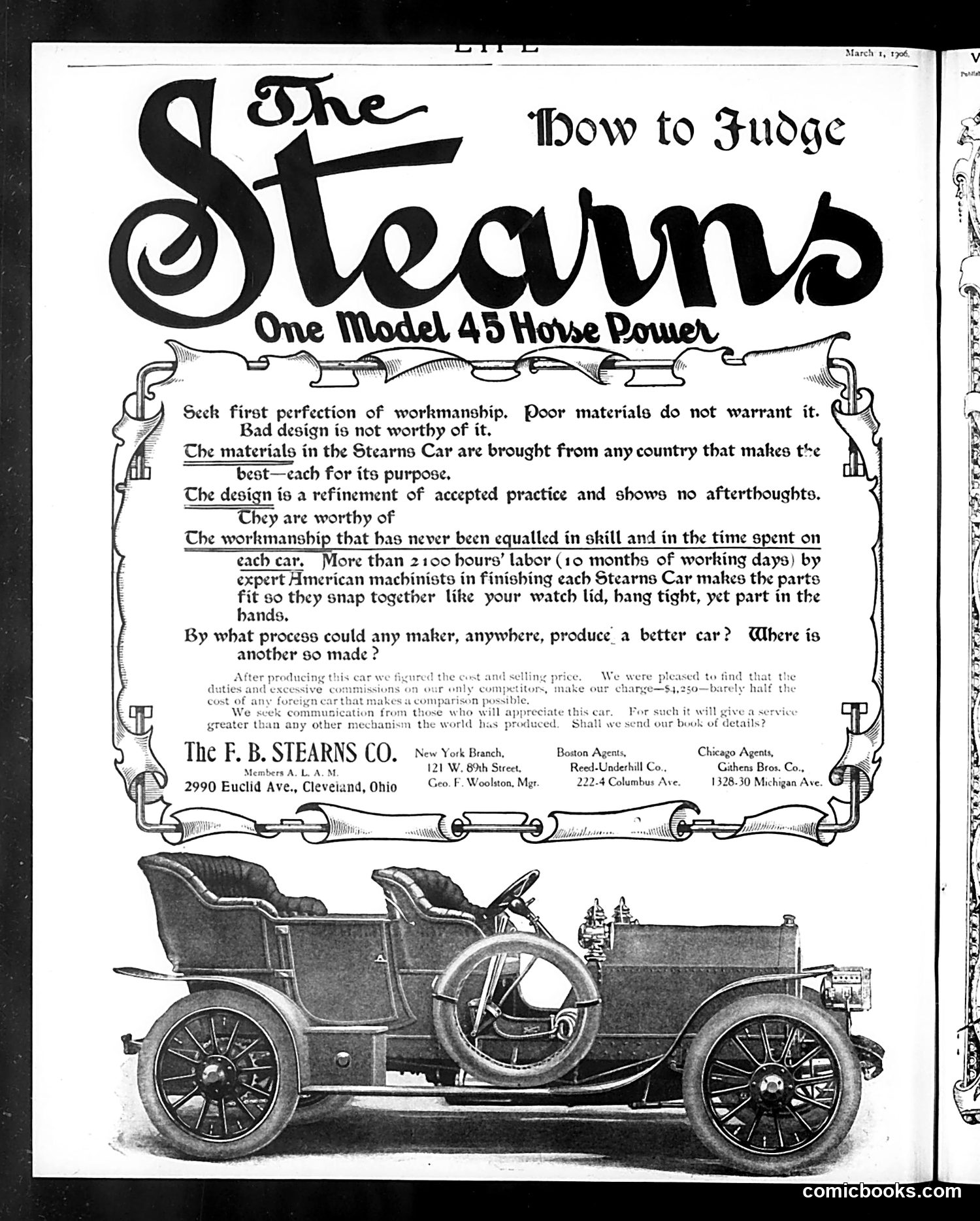
This is **not a cartoon or satire**—it's a straightforward **automobile advertisement** for the F.B. Stearns Company (Cleveland, Ohio), dated March 1, 1906. The page advertises a "One Model 45 Horse Power" automobile by emphasizing American craftsmanship and quality. The text boasts that Stearns cars use premium materials sourced globally, employ refined design, and require over 2,100 hours of skilled labor per vehicle—parts fitting together with precision "like your watch lid." The rhetorical question "By what process could any maker, anywhere, produce a better car? Where is another so made?" is a sales pitch claiming superior manufacturing, not satire. The vehicle image shows an early 1900s touring car with open seating, large spoked wheels, and exposed engine—typical luxury automobile design of the era. **Context for modern readers:** This reflects the early automotive industry's emphasis on handcrafted quality and American manufacturing pride, before mass production became standard.