
Life, 1906-03-01 · page 24 of 46
Life — March 1, 1906 — page 24: what you’re looking at
What you’re looking at
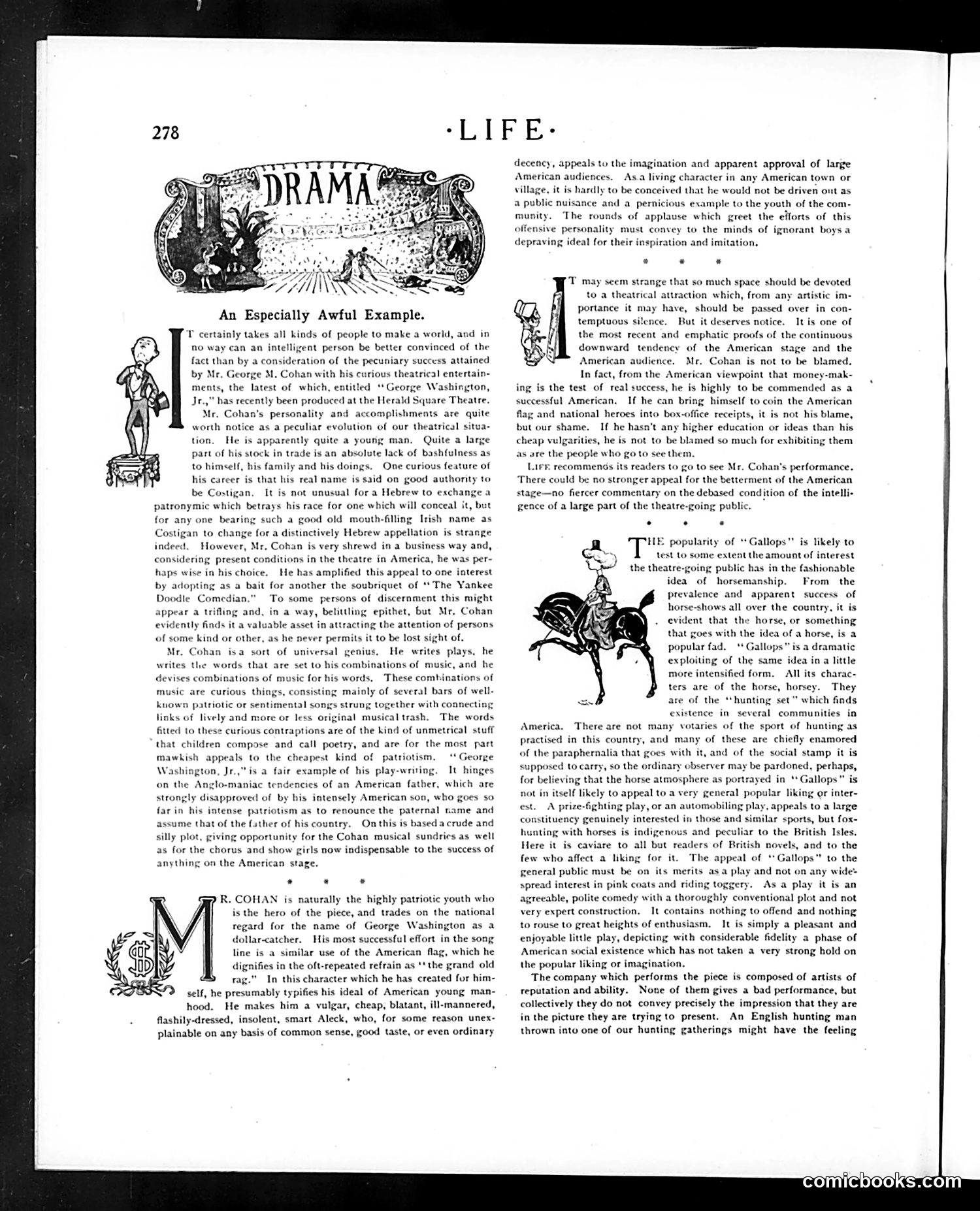
This is a scathing drama review attacking George M. Cohan's theatrical success and artistic merit. The critic identifies several targets: **The Main Subject**: Cohan's play "George Washington, Jr." at the Herald Square Theatre, which the reviewer considers poorly constructed and artistically worthless. **The Satirical Points**: - Cohan allegedly changed his Irish surname "Costigan" to a Jewish-sounding name for commercial advantage - His plays cynically exploit patriotic sentiment and the American flag rather than genuine artistry - His music consists of recognizable patriotic songs strung together with "musical trash" - His protagonist is deliberately vulgar and obnoxious—a "flashily-dressed, insolent, smart Aleck"—yet inexplicably appeals to audiences - The reviewer finds it baffling that such low-quality entertainment succeeds financially **The Core Complaint**: Life's critic argues that Cohan's enormous success demonstrates how American audiences reward cheap patriotic appeals and lack of taste over genuine theatrical merit. The satire targets both Cohan's cynicism and the public's gullibility.
📄 Transcribed text from this page (OCR, searchable)
Machine-transcribed from the original scan — historical spelling and the odd misread are preserved.
*LILF B* An Especially Awful Example. T certainly takes all kinds of people to make a world, and in no way can an intelligent person be better convinced of the fact than by a consideration of the pecuniary success attained by Mr. George M. Cohan with his curious theatrical entertain ments, the latest of which, entitled “George Washington, Jr," has recently been produced at the Herald Square Theatre. Mr. Cohan’s personality and accomplishments are quite worth notice as a peculiar evolution of our theatrical situa- tion, He is apparently quite a young man. Quite a large part of his stock in trade is an absolute lack of bashfulness as to himself, bis family and his doings. One curious feature of his career is that his real name is said on good authonty to be Costigan. It is not unusual fora Hebrew to exchange a patronymic which betrays his race for one which will conceal it, but for any one bearing such a good old mouth-filling Irish name as Costigan to change for a distinctively Hebrew appellation is strange indeed. However, Mr. Cohan is very shrewd in a business way and, considering present conditions in the theatre in America, he was per- haps wise in his choice. He has amplified this appeal to one interest by adopting as a bait for another the soubriquet of The Yankee Doodle Comedian.” To some persons of discernment this might appear a trifling and, in a way, belittling epithet, but Mr. Cohan evidently finds it a valuable asset in attracting the attention of persons of some kind or other, as he never permits it to be lost sight of. He writes plays, he writes the words that are set to his combinations of music, and he devises combinations of music for his words, These combinations of music are curious things, consisting mainly of several bars of well- kuown patriotic or sentimental songs strung together with connecting links of lively and more or less original musical trash, The words fitted to these curious contraptions are of the kind of unmetrical stuff that children compose and call poetry, and are for the most part mawkish appeals to the cheapest kind of patriotism, Washington, Jr.,""is a fair example of his play-writing. on the Anglo-maniac ten: Mr. Cohan isa sort of universal genius, “George It hinges cies of an American father, which are disapproved of by bis intensely American son, who goes so far in his intense patriotism as to renounce the paternal name and assume that of the father of his country. On this is based a crude and silly plot, giving opportunity for the Cohan musical sundries as well as for the chorus and show girls now indispensable to the success of anything on the American stage. strong! R. COHAN is naturally the highly patriotic youth who is the hero of the piece, and trades on the national regard for the name of George Washington as a dollar-catcher. His most successful effort in the song line is a similar use of the American flag, which he dignifies in the oft-repeated refrain as ‘the grand old "In this character which he has created for him- self, he presumably typifies his ideal of American young man- hood, He makes him a vulgar, cheap, blatant, ill-mannered, flashily-dressed, insolent, smart Aleck, who, for some reason unex- plainable on any basis of common sense, good taste, or even ordinary rag decency, appeals to the imagination and apparent approval of large American audiences. As.a living character in any American town or village, it is hardly to be conceived that he would not be driven out as a public nuisance and a pernicious example to the youth of the com- munity. The rounds of applause which greet the efforts of this offensive personality must convey to the minds of ignorant boys a depraving ideal for their inspiration and imitation, . « * ‘T may seem strange that so much space should be devoted to a theatrical attraction which, from any artistic im- portance it may have, should be passed over in con- temptuous silence. But it deserves notice. It is one of the most recent and emphatic proofs of the continuous downward tendency of the American stage and the American audience. Mr. Cohan is not to be blamed, In fact, from the American viewpoint that money-mak- ing is the test of real success, he is highly to be commended as a successful American. If he can bring himself to coin the American flag and national heroes into box-office receipts, it is not his blame, but our shame. If he hasn't any higher education or ideas than his cheap vulgarities, he is not to be blamed so much for exhibiting them, as are the people who go to see them. Lier recommends its readers to go to see Mr. Cohan’s performance. There could be no stronger appeal for the betterment of the American stage—no fiercer commentary on the debased condition of the intelli gence of a large part of the theatre-going public. HIE popularity of “Gallops" is likely to test Lo some extent the amount of interest the theatre-going public has in the fashionable idea of horsemans! From the prevalence and apparent success of horse-shows all over the country, it is evident that the horse, or something that goes with the idea of a horse, is a popular fad.“ Gallops” is a dramatic exploiting of the same idea in a little more intensified form, All its charac- ters are of the horse, horsey. They are of the “hunting set” which finds existence in several communities in America, There are not many votaries of the sport of hunting as practised in this country, and many of these are chiefly enamored of the paraphernalia that goes with it, and of the social stamp it is supposed to carry, so the ordinary observer may be pardoned, perhaps, for believing that the horse atmosphere as portrayed in **Gallops” is not in itself likely to appeal to a very general popular liking or inter- est. A prize-fighting play, or an automobiling play, appeals to a large constituency genuinely interested in those and similar sports, but fox- hunting with horses is indigenous and peculiar to the British Isles, Here it is caviare to all but readers of British novels, and to the few who affect a liking for it. The appeal of *Gallops” to the general public must be on its merits asa play and not on any wide= spread interest in pink coats and riding toggery. As a play it is an agreeable, polite comedy with a thoroughly conventional plot and not very expert construction. It contains nothing to offend and nothing to rouse to great heights of enthusiasm, It is simply a pleasant and enjoyable little play, depicting with considerable fidelity a phase of American social existence which has not taken a very strong hold on the popular liking or imagination, The company which performs the piece is composed of artists of reputation and ability. None of them gives a bad performance, but collectively they do not convey precisely the impression that they are in the picture they are trying to present. An English hunting man thrown into one of our hunting gatherings might have the feeling