
Life, 1906-03-01 · page 18 of 46
Life — March 1, 1906 — page 18: what you’re looking at
What you’re looking at
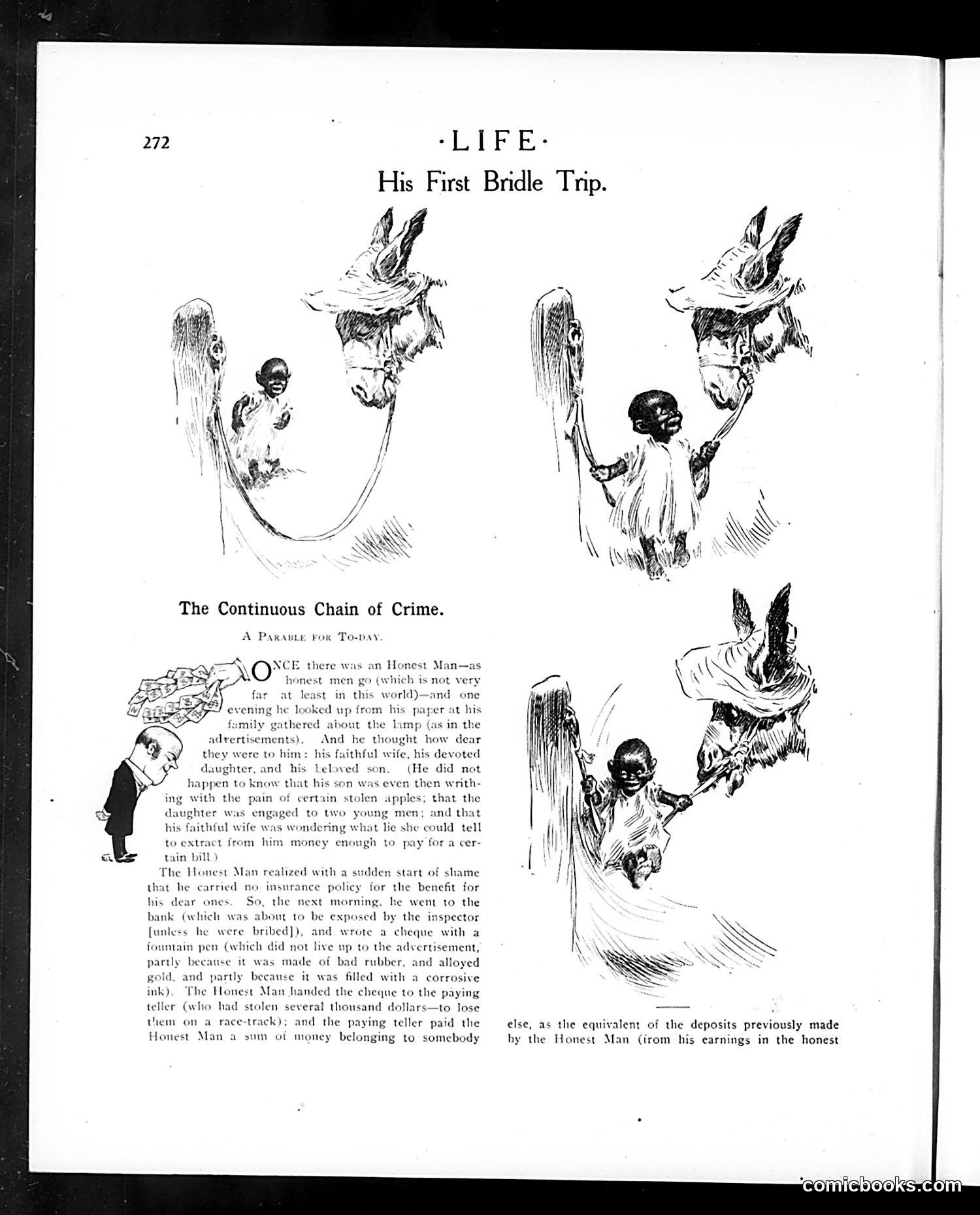
This page presents a cynical morality tale mocking widespread dishonesty in early 20th-century American society. The "Honest Man" represents an ordinary citizen attempting to do right by his family through life insurance. However, the satire reveals that virtually everyone around him—his son (stealing apples), daughter (engaged to two men), wife (planning deception), bank inspector (takes bribes), pen manufacturer (false advertising), and bank teller (stealing thousands for gambling)—is engaged in petty or serious crime. The joke's bitter point: the "honest man" participates unknowingly in this "continuous chain of crime" simply by conducting normal business transactions. His money passes through corrupt institutions and hands. The illustrations show donkeys—suggesting foolishness—representing this cascade of moral compromise. Life magazine satirizes that dishonesty has become so systemic and normalized that true honesty is impossible.
📄 Transcribed text from this page (OCR, searchable)
Machine-transcribed from the original scan — historical spelling and the odd misread are preserved.
-LIFE- His First Bridle Trp. The Continuous Chain of Crime. A Pakauce FoR To-pay there was an Honest Man—as nest men go (which is not very at least in this world)—and one ¢ looked up from his paper at his hered about the lamp (as in the And he thought how dear his faithful wife, his devoted daughter, and his beloved son. (He did not appen to know that his son was even then writh- ing with the pain of certain stolen apples; that the daughter was engaged to two youn, : and that his faithful wife was wondering what lie she could tell to extract from him money enough to pay for a cer- tain bill) The Honest Man realized with a sudden start of shame that he carried no insurance policy for the benefit for his dear ones. So, the next morning, he went to the bank (which was about to be exposed by the inspector advertisements) they were to him: [unless he were bribed fountain pen (which did not live up to the advertisement, partly becatise it. was made of bad rubber, and alloyed gold, and partly because it was filled with a corrosive ink). The Honest Man handed the cheque to the paying . and wrote a cheque with a teller (who had stolen several thousand dollars—to lose them on a race-track); and the paying teller paid the Honest Man a sum oi money belonging to somebody else, as the equivalent of the deposits previously made by the Honest Man (irom his earnings in the honest