
Life, 1906-03-01 · page 26 of 46
Life — March 1, 1906 — page 26: what you’re looking at
What you’re looking at
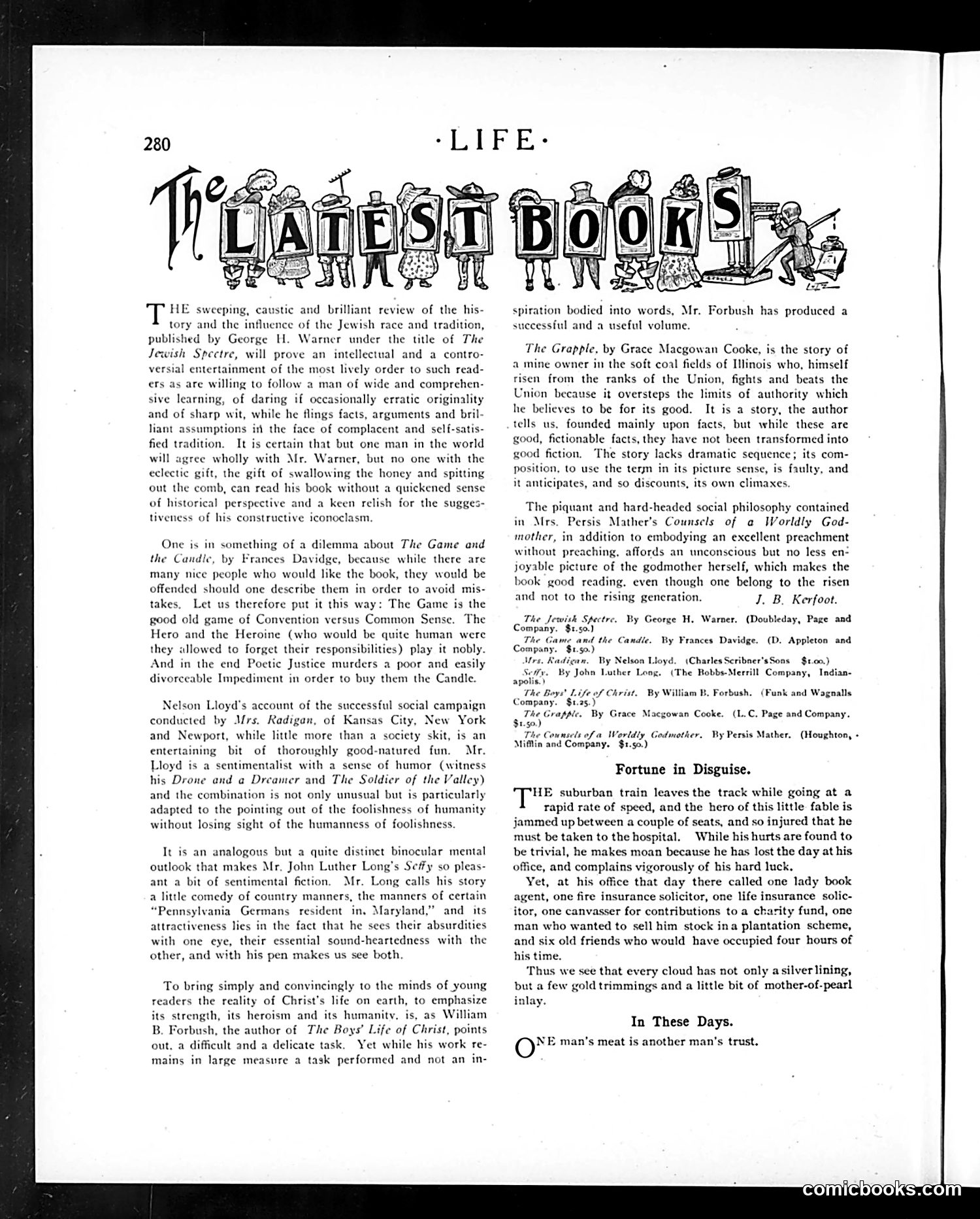
This is a book review section from *Life* magazine's satirical arts criticism. The page features reviews of contemporary novels, presented with characteristic wit and intellectual snobbery typical of the era's literary journalism. The reviews discuss books on diverse topics: George H. Warner's *The Jewish Spectre* (described as provocative and argumentative), Frances Davidge's *The Game and the Caudle* (a romantic comedy about Convention versus Common Sense), Nelson Lloyd's society satire about Mrs. Radigan's social campaigns, and Grace Macgowan Cooke's *The Grapple* (about a mine owner opposing unionization). The critics employ *Life*'s signature approach: clever wordplay, gentle mockery of sentimental fiction, and praise for authors who balance sentiment with humor or insight. The tone is urbane and directed at educated readers who appreciate irony—typical of the magazine's intellectual middle-class audience.
📄 Transcribed text from this page (OCR, searchable)
Machine-transcribed from the original scan — historical spelling and the odd misread are preserved.
tory and the influence of the Jewish race and tradition, published by George H. Warner under the title of The Jewish Spectre, will prove an intellectual and a contro- ertainment of the most lively order to such read- ers as are willing to follow a man of wide and comprehen- sive learning, of daring if occasionally erratic originality and of sharp wit, while he flings facts, arguments and bril- liant assumptions inl the face of complacent and self-satis- fied tradition. It is certain that but one man in the world will agree wholly with Mr. Warner, but no one with the eclectic gift, the gift of swallowing the honey and spitting out the comb, can read his book without a quic! of historical perspective and a keen relish for the sugges tiveness of his constructive iconoclasm. One is in something of a dilemma about The Game and the Caudle, by Frances Davidge, because while there are many nice people who would like the book, they would be offended should one describe them in order to avoid mis- takes, Let us therefore put it this way: The Game is the good old game of Convention versus Common Sense. The Hero and the Heroine (who would be quite human were they allowed to forget their responsibilities) play it nobly. And in the end Poetic Justice murders a poor and easily divorceable Impediment in order to buy them the Candle. Nelson Lloyd's account of the successful social campaign conducted by Mrs. Radigan, of Kansas City, New York and Newport, while little more than a society skit, is an entertaining bit of thoroughly good-natured fun. Mr. Lloyd is a sentimentalist with a sense of humor (witness his Drone and a Dreamer and The Soldier of the Valley) and the combination is not only unusual but is particularly adapted to the pointing out of the foolishness of humanity without losing sight of the humanness of foolishness. It is an analogous but a quite distinct binocular mental outlook that makes Mr. John Luther Long's ant a bit of sentimental fiction yey so pleas- Mr. Long calls his story a little comedy of country manners, the manners of certain “Pennsylvania Germans resident in, Maryland,” and its attractiveness lies in the fact that he sees their absurdities with one eye, their essential sound-heartedness with the other, and with his pen makes us see both. To bring simply and convincingly to the minds of young readers the reality of Christ’s life on earth, to emphasize its strength, its heroism and its humanity, is, as Will B. Forbush, the author of The Boys’ Life of Christ, points out. a difficult and a delicate task. Yet while his work re- mains in large measure a task performed and not an in- spiration bodied into words, Mr. Forbush has produced a successful and a useful volume. The Grapple, by Grace Macgowan Cooke, is the story of a mine owner in the soft coal fields of Illinois who, himself risen from the ranks of the Union, fights and beats the Union because it oversteps the limits of authority which he believes to be for its good. It is a story, the author tells us, founded mainly upon facts, but while these are good, fictionable facts, they have not been transformed into good fiction. The story lacks dramatic sequence; its com- position, to use the term in its picture sense, is faulty, and it anticipates, and so discounts, its own climaxes. The piquant and hard-headed social philosophy contained in Mrs. Persis Mather’s Counsels of a Worldly God- mother, in addition to embodying an excellent preachment without preaching, affords an unconscious but no less en- joyable picture of the godmother herself, which makes the book good reading. even though one belong to the risen and not to the rising generation. J. B. Kerfoot. sk Spectre. By George H, Warner, (Doubleday, Page and $1.50.) me and the Candie. By Frances Davidge. (D. Appleton and $1.90.) Mrs, Radigan, By Nelson Lloyd. (Charles Scribner'sSons $1.00.) Seffy. By John Luther Long. (The Bobbs-Merrill Company, Indian- apolis.) The Boys' Life of Christ. By William B. Forbush. (Funk and Wagnalls Company. $1.25.) giZis Crephie. By Grace Macgowan Cooke. (L.C. Page and Company. 1.50.) The Counsels of a Werldly Godmother, Wy Persis Mather. (Houghton, Mimlin and Company. $1.99.) Fortune in Disguise. HE suburban train leaves the track while going at a rapid rate of speed, and the hero of this little fable is jammed up between a couple of seats, and so injured that he must be taken to the hospital. While his hurts are found to be trivial, he makes moan because he has lost the day at his office, and complains vigorously of his hard luck, Yet, at his office that day there called one lady book agent, one fire insurance solicitor, one life insurance solic- itor, one canvasser for contributions to a charity fund, one man who wanted to sell him stock ina plantation scheme, and six old friends who would have occupied four hours of his time. ‘Thus we see that every cloud has not only asilver lining, but a few gold trimmings and a little bit of mother-of-pearl inlay. In These Days. O* E man’s meat is another man's trust.