
A complete issue · 28 pages · 1906
Life — January 18, 1906
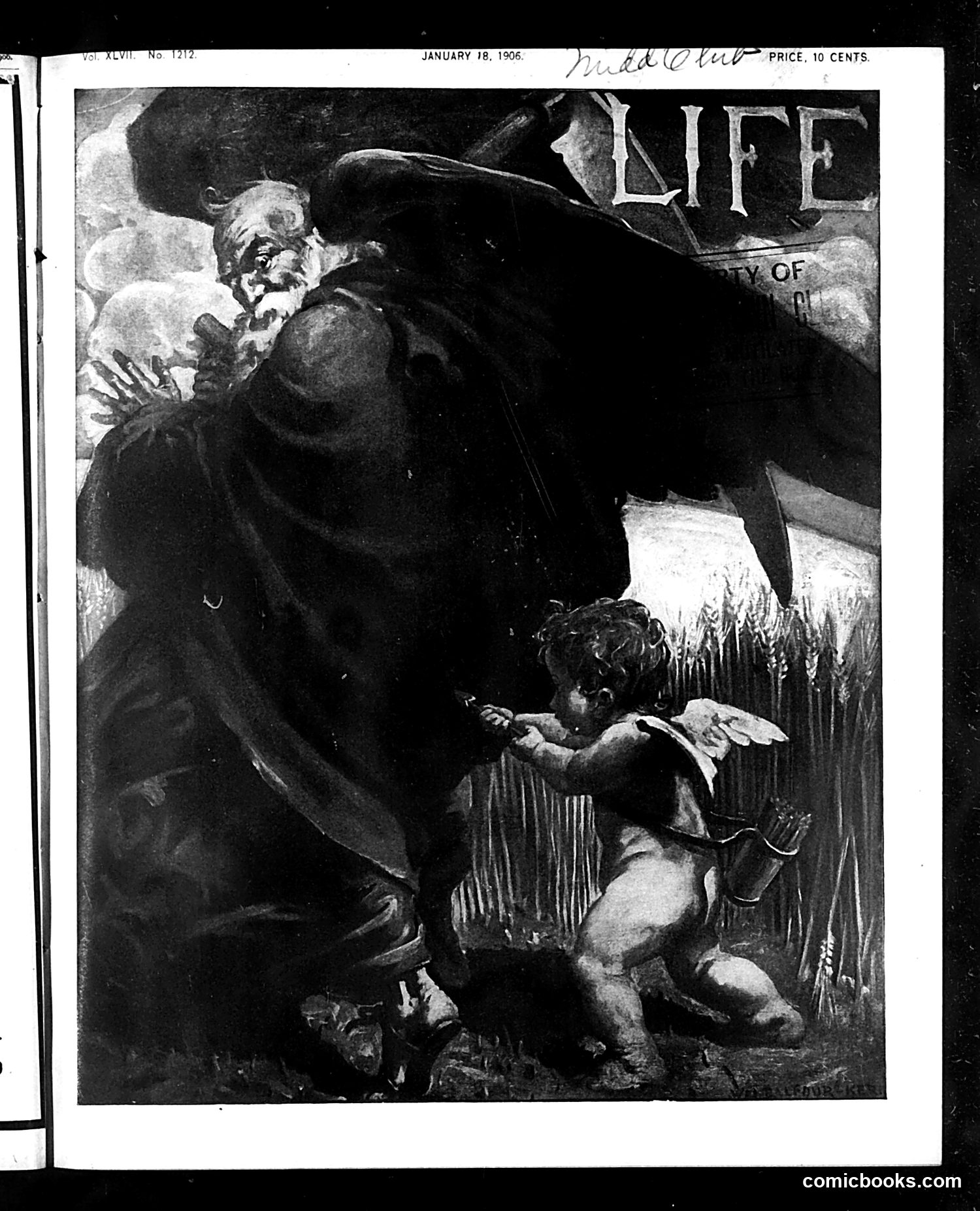
This appears to be an allegorical illustration rather than a specific political cartoon. The image depicts a dark, threatening figure (possibly representing Death, Fate, or a malevolent force) looming over a cherub or child figure in a pastoral setting with wheat or grain visible. The visual language—the ominous shadowed figure contrasted with innocence—suggests commentary on mortality, danger to the young, or societal threats. Without clearer text identifying the specific subject, the exact political or social reference is uncertain. The elaborate allegorical style was common to Life magazine's editorial illustrations of this era, often addressing broad themes rather than specific current events. The "10 CENTS" price and "Vol. XLVII" designation confirm the publication details.
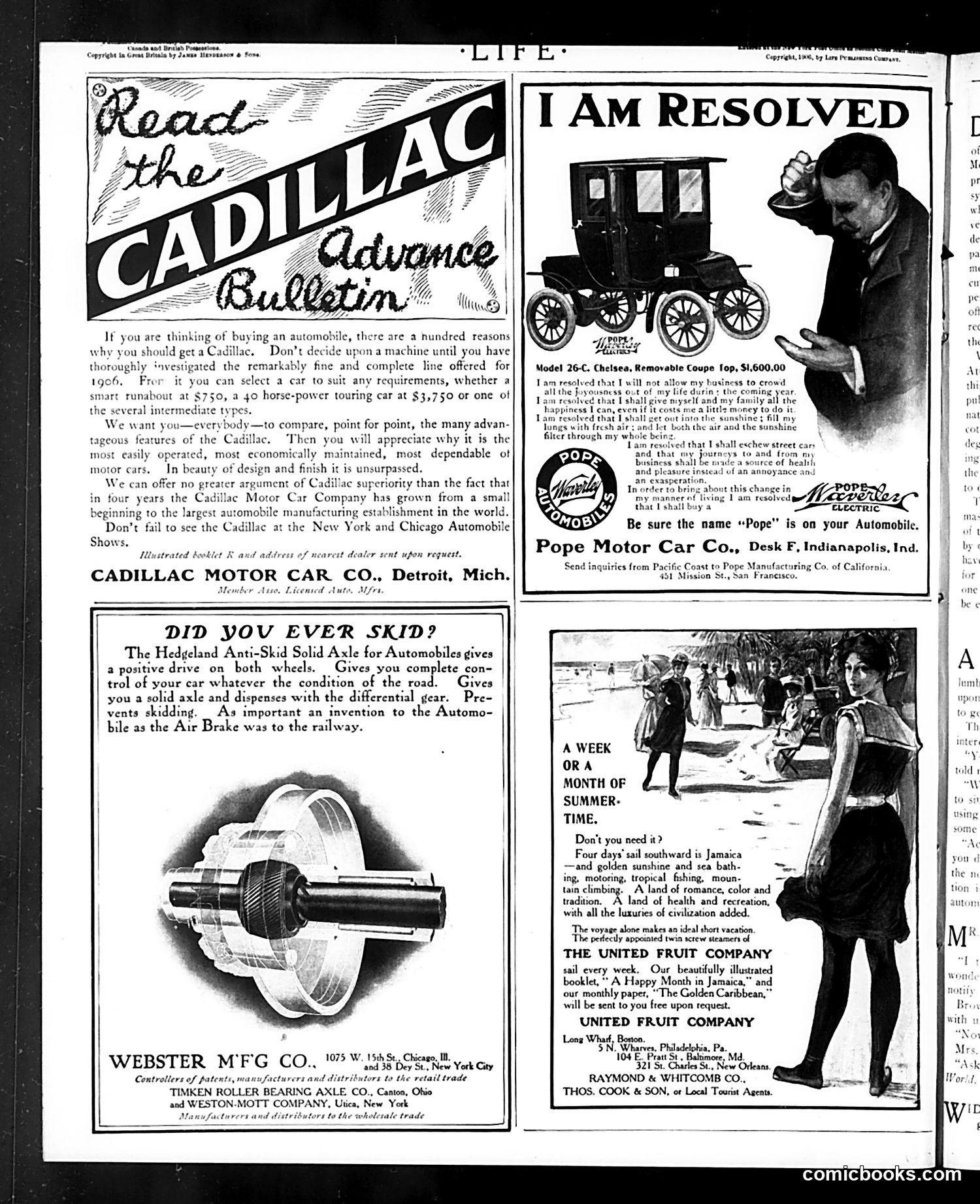
This page consists primarily of **advertisements, not satire or political cartoons**. The content includes: 1. **Cadillac Motor Car advertisement** (top left): Urges readers to investigate Cadillac's features before purchasing any automobile, emphasizing superiority and value. 2. **Pope Motor Car advertisement** (top right): Features a man making a resolution about owning a Pope automobile, with testimonial-style copy. 3. **Webster Manufacturing advertisement** (bottom left): Promotes the Hedgeland Anti-Skid Solid Axle for automobiles with technical diagrams. 4. **United Fruit Company advertisement** (right side): Promotes Jamaica vacations and travel literature. These are straightforward commercial advertisements typical of *Life* magazine's revenue model, lacking satirical intent or political commentary. The page demonstrates early 1900s automotive and travel marketing.
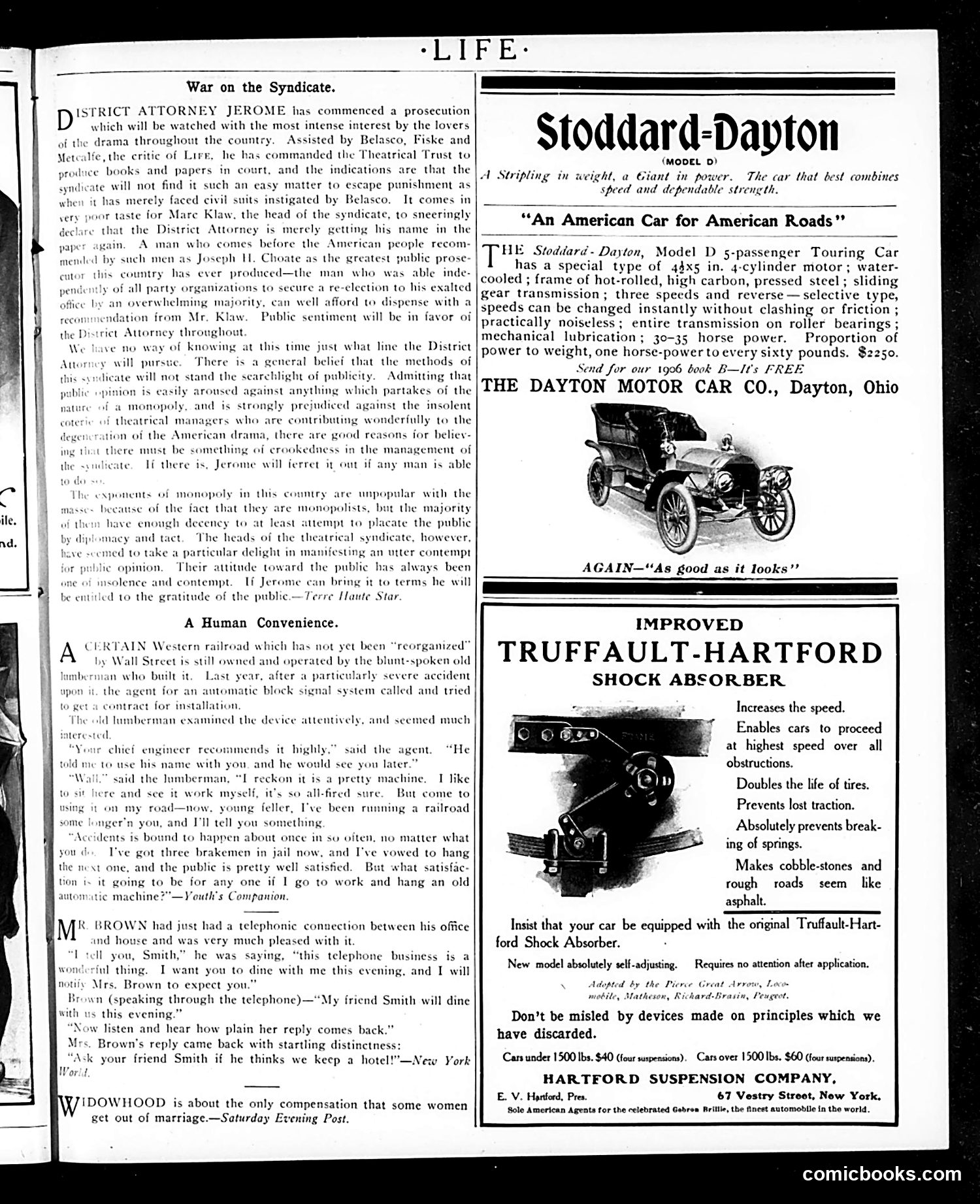
This page is primarily **advertising**, not political cartoons. The left column contains three brief humorous anecdotes ("War on the Syndicate," "A Human Convenience," and others) typical of Life's satirical content. These mock theatrical syndicates, railroad inefficiency, and telephone mishaps—everyday frustrations of early 1900s American life. The right side features **automobile advertisements** for the Stoddard-Dayton and Truffault-Hartford shock absorber, reflecting the era's rapid automotive innovation. The humor targets institutional incompetence and bureaucratic absurdity rather than specific political figures. These short pieces represent Life's role as a satirical magazine critiquing American society through witty observations about contemporary business practices and modern conveniences.
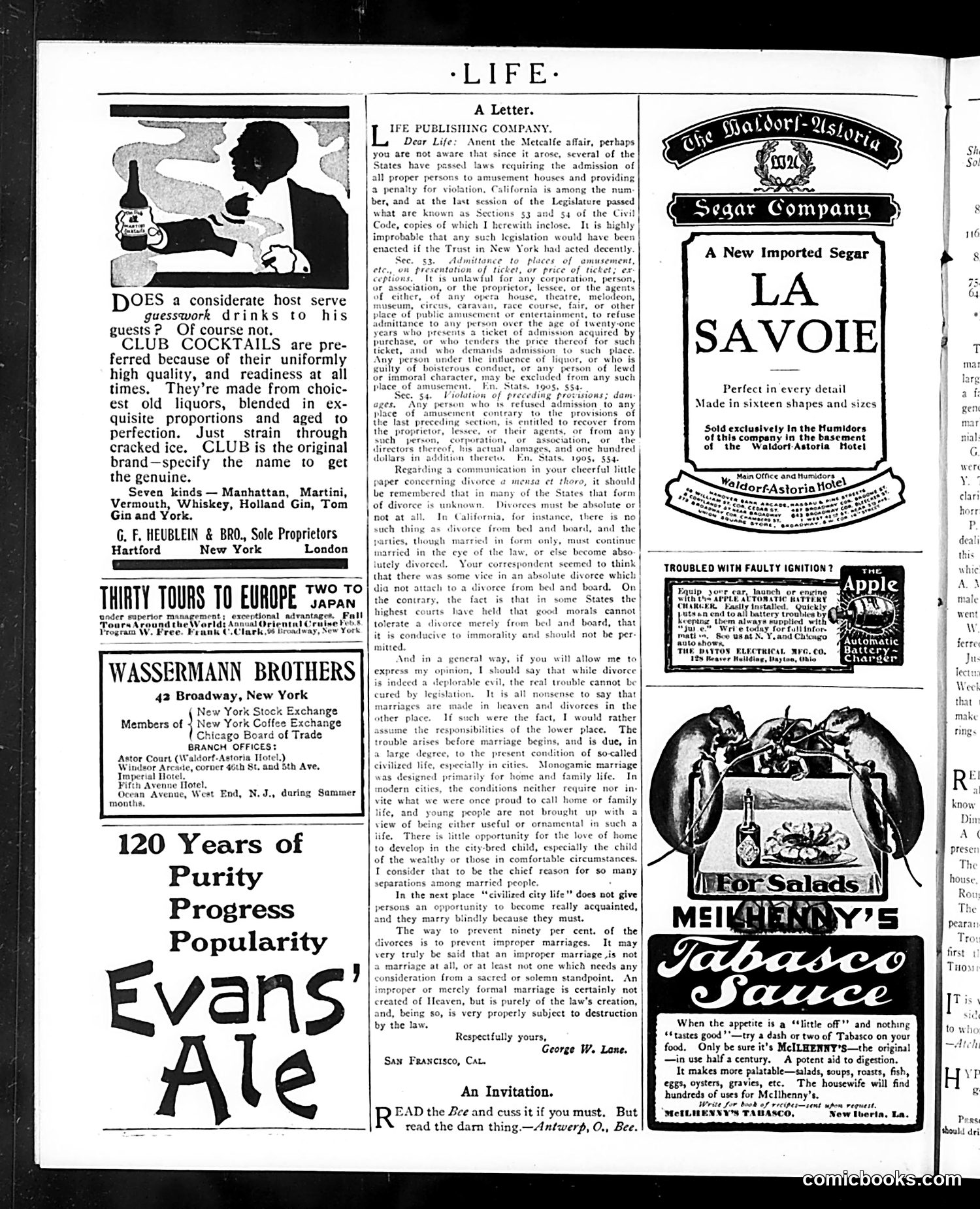
This page is primarily **advertisements and letters to the editor**, not political satire. The main cartoon shows a silhouetted figure serving drinks to guests, illustrating an advertisement for Club Cocktails. The "Letter" section contains a lengthy response about divorce law and morality, discussing how some states treat divorce differently. The writer argues against the notion that divorce itself causes immorality, suggesting instead that poor legislation and social conditions contribute to marriage failures. The remaining content consists of commercial advertisements for Evans Ale, sugar products, stock brokers, European tours, and condiments. There is **no clear political cartoon with identifiable figures or caricatures** on this page—it's primarily a commercial vehicle with an advice column addressing contemporary concerns about marriage and divorce law.
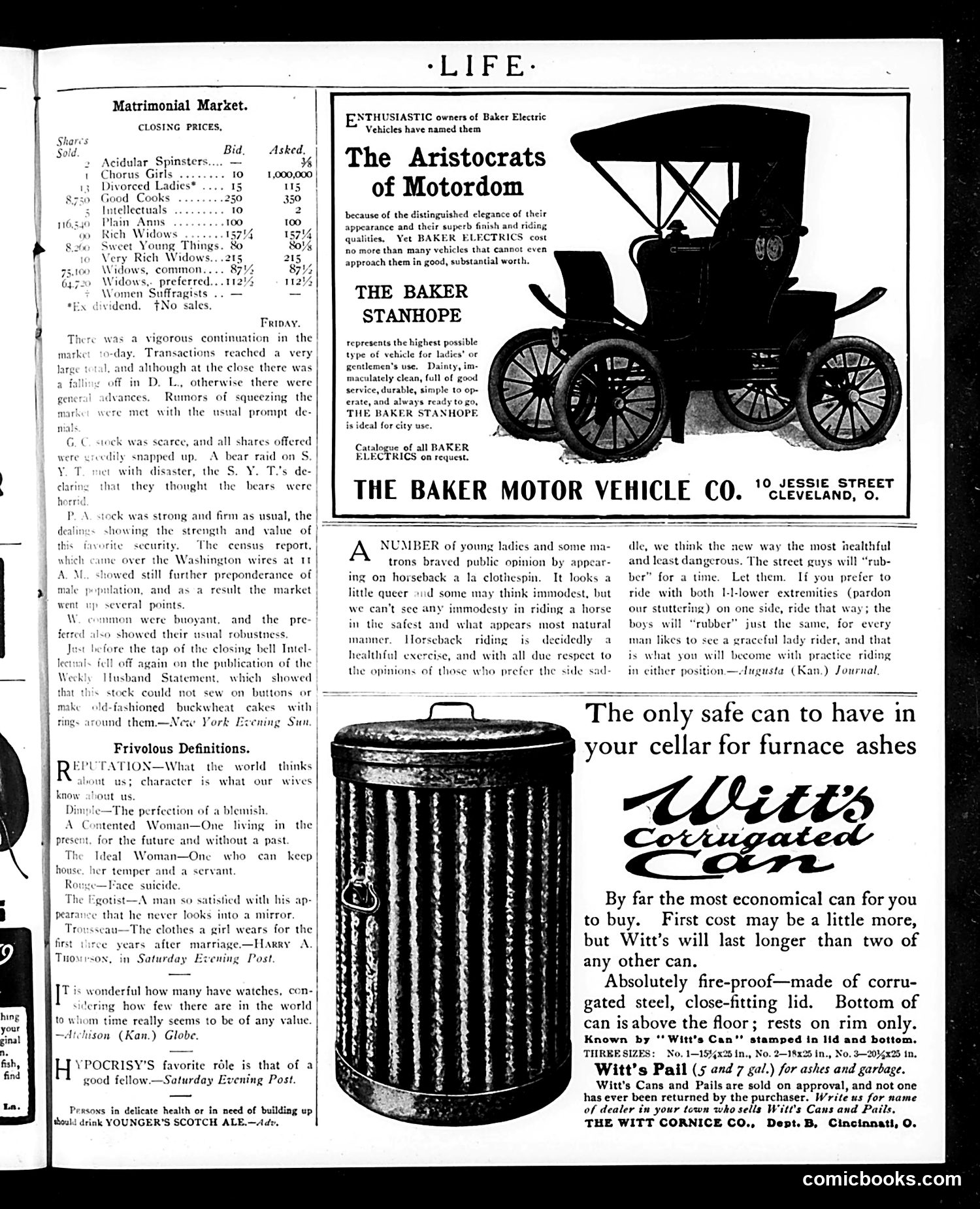
This page from *Life* magazine is primarily **advertising and market reporting**, not political satire. The left column contains stock market closing prices ("Matrimonial Market") and financial commentary about market activity on what appears to be a Friday. The text discusses market trends, stock strength, and a bell-ringing ceremony at an exchange. The main content features advertisements for Baker Motor Vehicles (with illustrations of early automobiles) and Witt's Corrugated Cans for furnace ash storage. A small "Frivolous Definitions" section offers light humor about reputation, women, and character—typical of the era's genteel wit, not political commentary. The page reflects early 1900s concerns: stock trading, emerging automobile technology, and domestic housekeeping products. There are no identifiable political figures or satirical cartoons present.
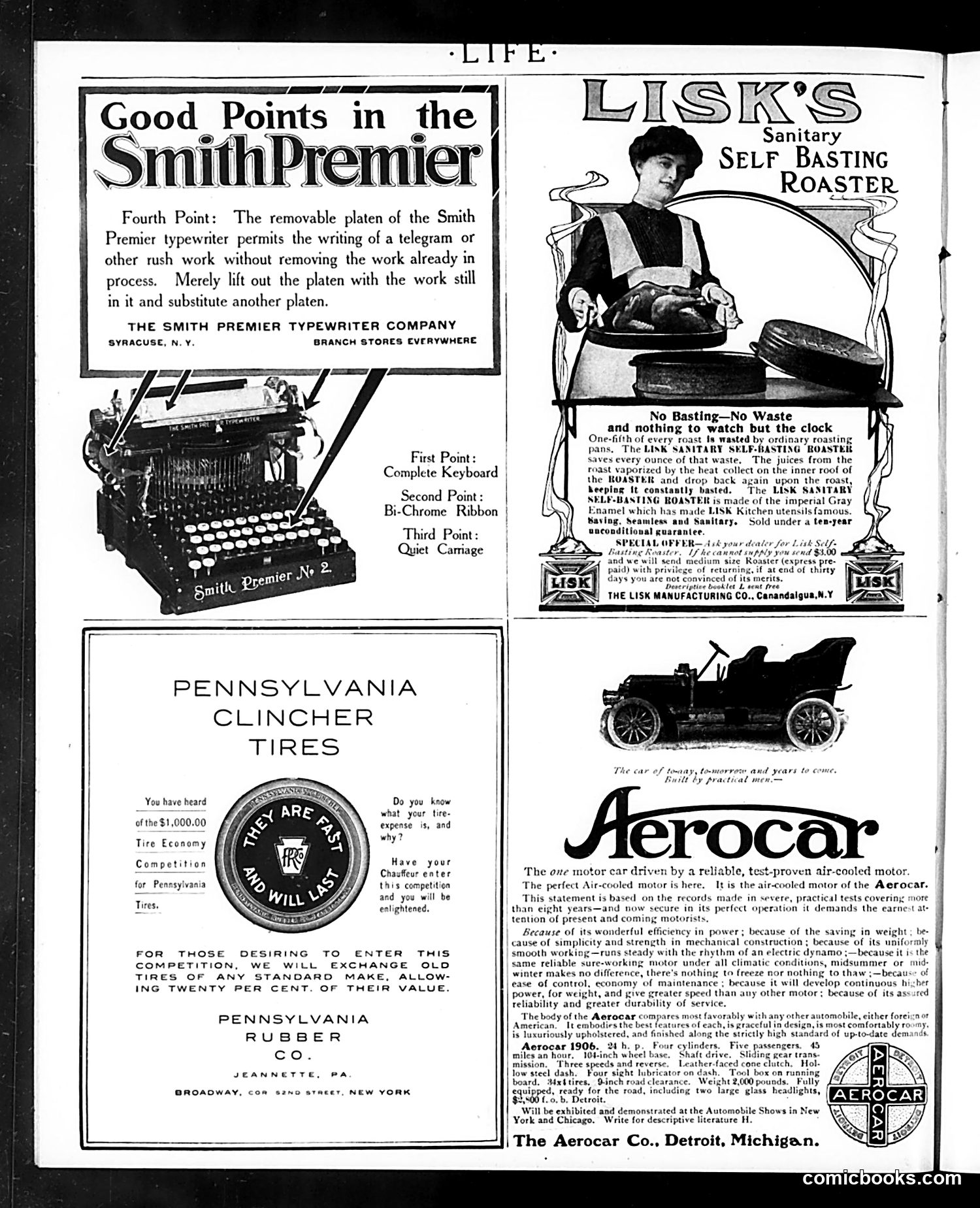
This page is primarily **advertising**, not political satire or editorial cartoons. The advertisements showcase early 20th-century consumer products: the Smith Premier typewriter (emphasizing its removable platen feature), Lisk's Self-Basting Roaster (a kitchen innovation), Pennsylvania Clincher Tires (promoting economy and durability), and the Aerocar automobile (highlighting its air-cooled motor as a practical innovation). Each ad uses period-typical marketing strategies: product demonstrations, celebrity endorsements (the woman with the roaster), technical specifications, and comparative claims about superiority. The Aerocar ad particularly emphasizes reliability and efficiency—selling practical virtue rather than luxury. There is no political commentary or satirical intent visible. This reflects Life magazine's mixed editorial-advertising business model typical of early 1900s publications.
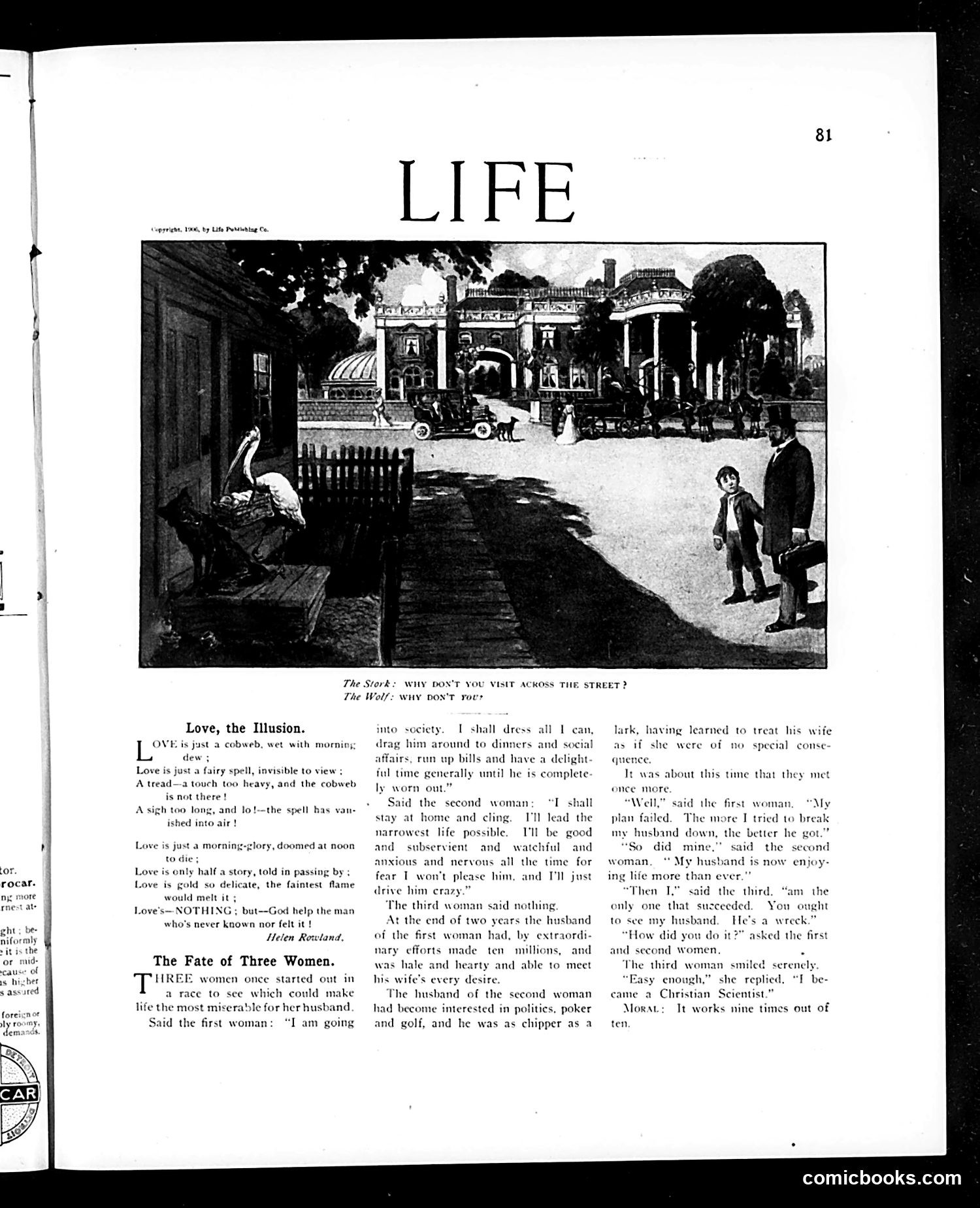
This page presents a satirical narrative titled "The Fate of Three Women," accompanied by an illustration showing an elegant estate with automobiles and well-dressed figures. The story mocks romantic ideals by contrasting three women's outcomes after marriage. The first woman pursues social climbing and materialism ("drag him around to dinners and social affairs"). The second seeks traditional domesticity ("stay at home and cling"). The third remains silent, ultimately proving most successful through restraint. The satire critiques early 20th-century gender expectations and marriage dynamics. The "Christian Scientist" reference suggests contemporary religious movements. The underlying joke: all three women's strategies fail or complicate their marriages, but silent acceptance paradoxically "works nine times out of ten"—mocking both female agency and marital success itself.
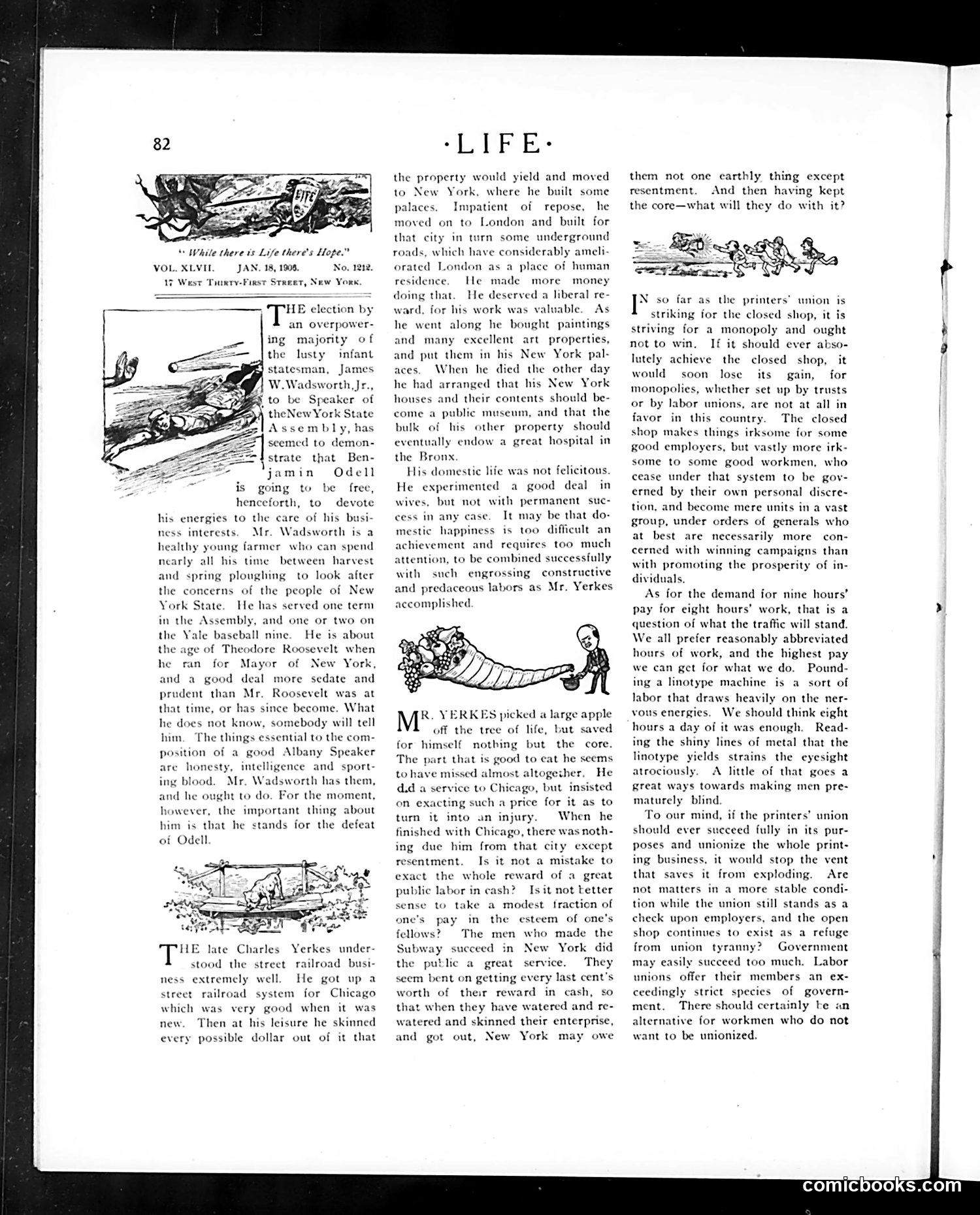
This page discusses labor issues, specifically addressing the printers' union's campaign for a "closed shop" (union-only workplaces). The text argues against closed shops, claiming they would harm competent non-union workers and reduce employers' flexibility. The accompanying illustrations appear to be decorative vignettes rather than political cartoons—they show figures in various scenes but lack clear caricature or identifying markers. The article references **James W. Wadsworth Jr.** as Speaker of the New York State Assembly, and mentions **Charles Yerkes**, a Chicago railroad magnate, as an example of successful business management. The piece advocates for open shops and questions whether eight-hour workdays are economically sustainable. The overall tone is anti-union, typical of early 20th-century business-oriented publications.
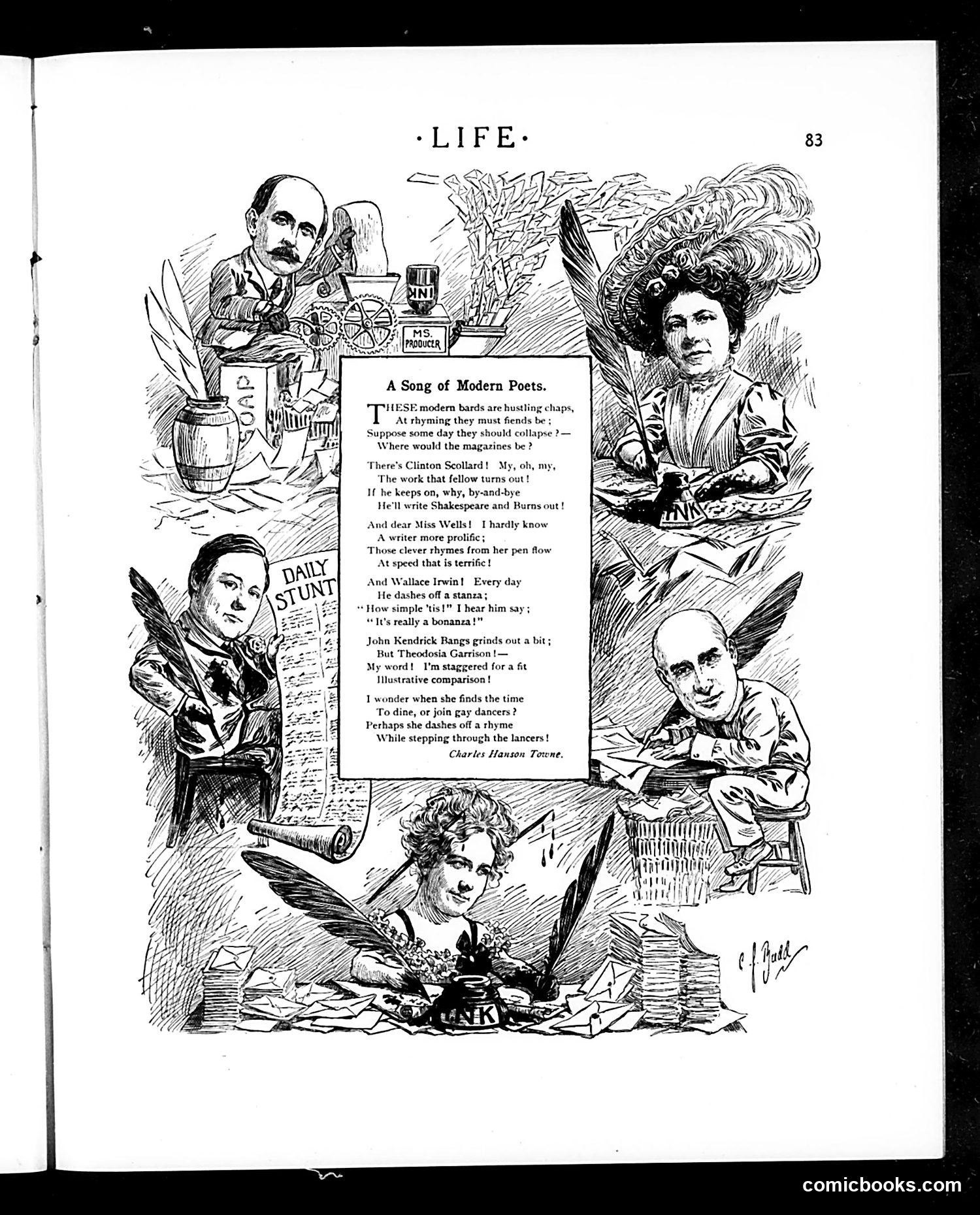
This satirical poem by Charles Hanson Towne mocks prolific early 20th-century writers through caricature. The illustration shows winged figures of various authors at their desks, depicted as frantically productive. The poem ridicules specific named writers—Clinton Scollard, Miss Wells, Wallace Irwin, John Kendrick Bangs, and Theodosia Garrison—for churning out excessive verse and stories at unsustainable rates. The satire suggests these poets produce quantity over quality, with references to their work appearing everywhere ("Where would the magazines be?"). The imagery of angel wings combined with industrious desk work humorously frames contemporary literary output as both heavenly and relentless factory production. The overall joke: these writers are so prolific they're practically superhuman—and possibly ridiculous for it.
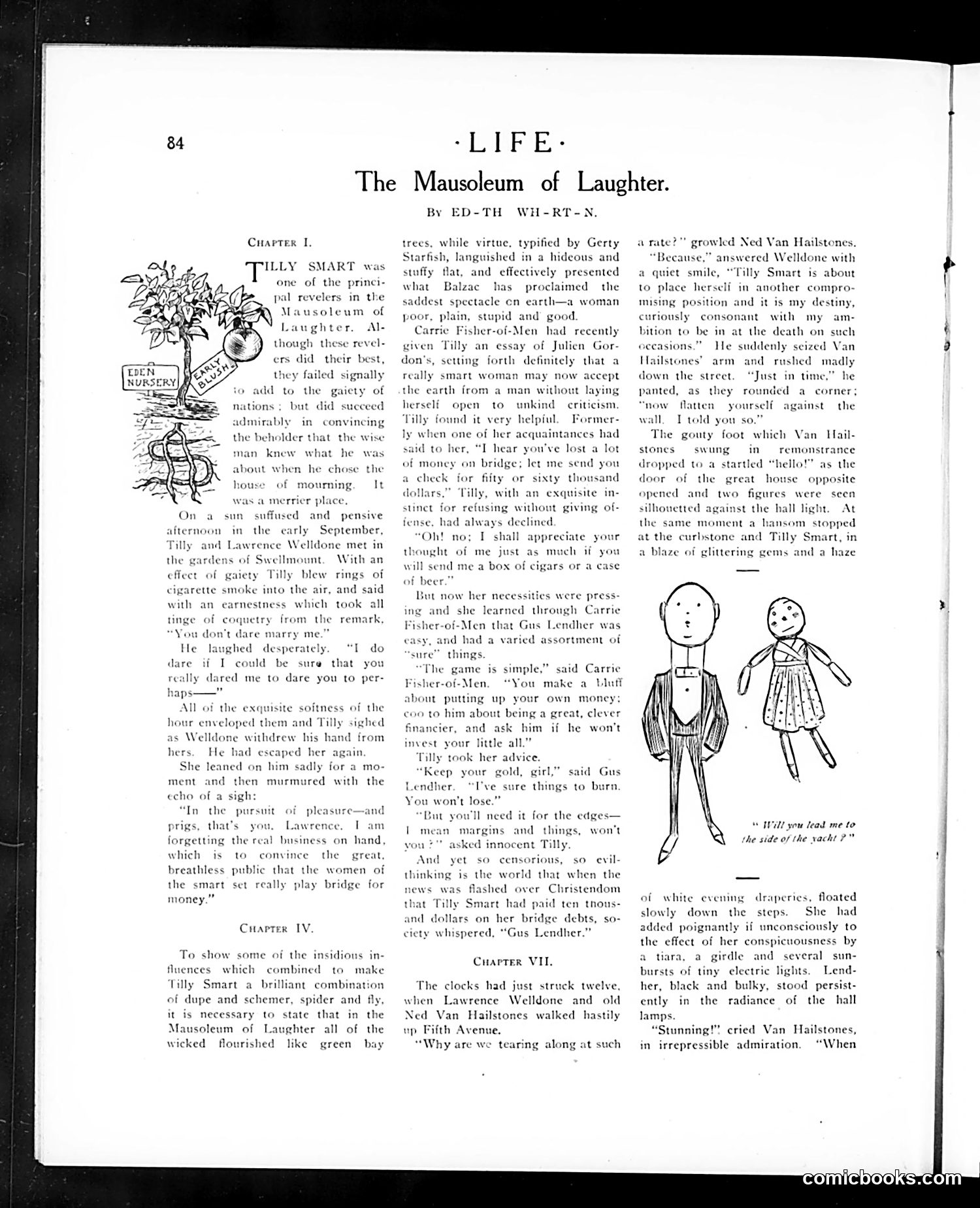
This page contains the opening of a serialized story by "Ed-Th Wh-rt-n" (likely Edith Wharton, with letters obscured). The narrative satirizes wealthy American society through characters like **Tilly Smart**, a woman criticized for her financial irresponsibility and social pretensions. The two simple stick-figure drawings illustrate the story's characters in conversation. The text mocks the leisured elite's frivolous behavior—particularly women playing bridge for money and living beyond their means—while praising those who accumulate and guard wealth. The satire targets **Gilded Age excess and financial foolishness** among the upper classes, presenting moralistic criticism of profligacy as entertainment. This reflects early 20th-century American anxieties about wealth, women's independence, and social responsibility.
This page consists primarily of serialized fiction narrative (Chapters L and LXIV), describing romantic and social entanglements among characters named Tilly, Lawrence Welldone, Bertha Corset, and others. The text focuses on domestic drama, marriage prospects, and social propriety—typical serialized fiction content for Life magazine. At the bottom right is a small cartoon illustration labeled "Mrs. Wilson Woodrow" showing two figures in a physical altercation or comedic struggle. This appears to be a satirical reference, likely a political joke about a public figure of the era, though the specific context requires knowledge of contemporary 1910s-1920s politics to fully interpret. The cartoon's caption suggests wordplay on the name "Wilson Woodrow" (possibly referencing President Woodrow Wilson).
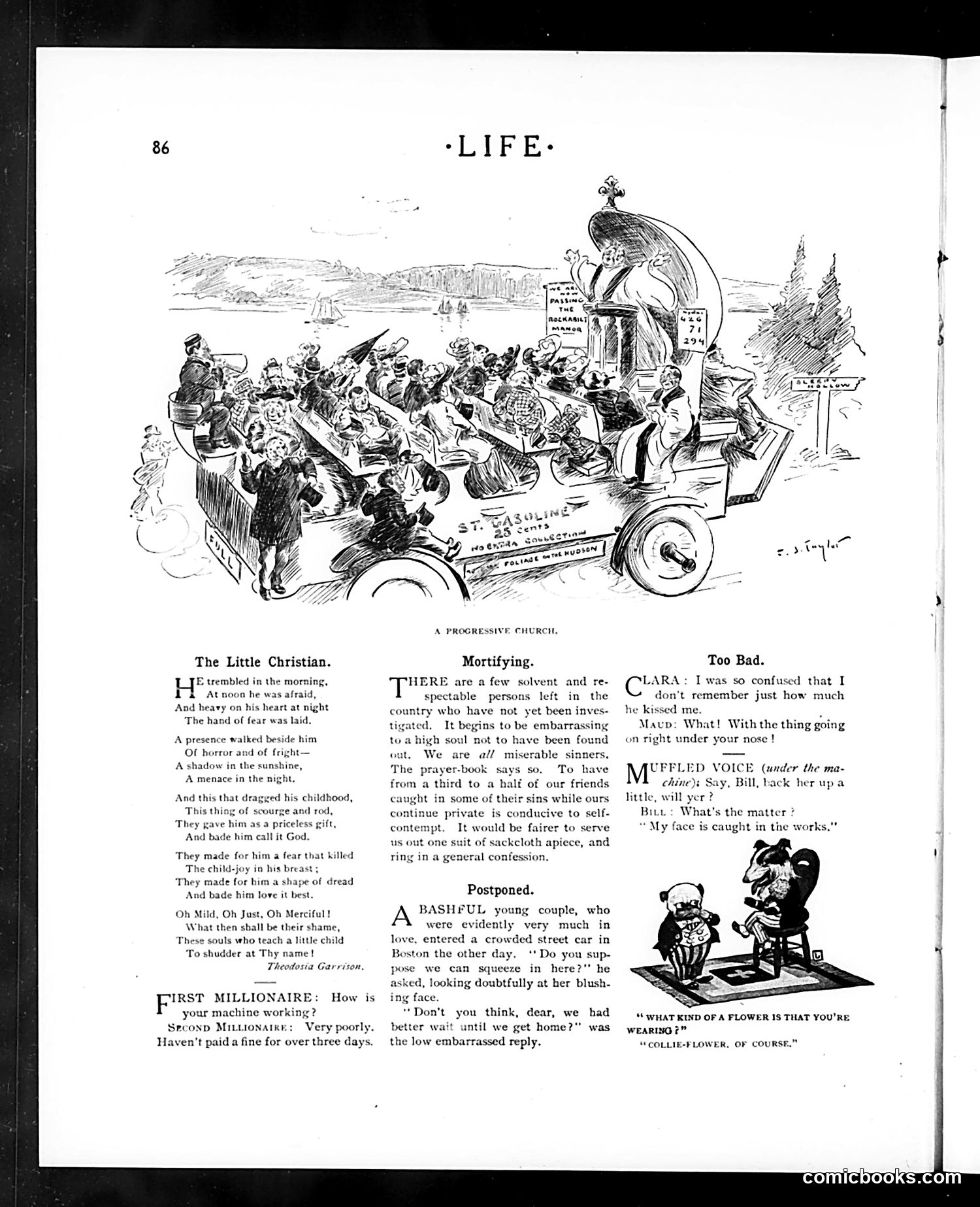
This satirical page from *Life* magazine contains several unrelated humor pieces mocking early-20th-century social situations. **Top cartoon** ("A Progressive Church"): Depicts a large, ornate vehicle packed with people, satirizing modern churches that have become entertainment spectacles rather than spiritual institutions. The "progressive" label suggests criticism of churches abandoning traditional piety for trendy, commercialized attractions. **Text pieces** include: - "The Little Christian": A sentimental poem about childhood innocence corrupted - "Mortifying": Jokes about social embarrassment - "Too Bad": A domestic humor exchange about kissing - "First Millionaire": A brief comic exchange about a poorly-functioning machine - "Postponed": A joke about an embarrassed couple on public transport The overall theme mocks both institutional hypocrisy and everyday social awkwardness of the era.
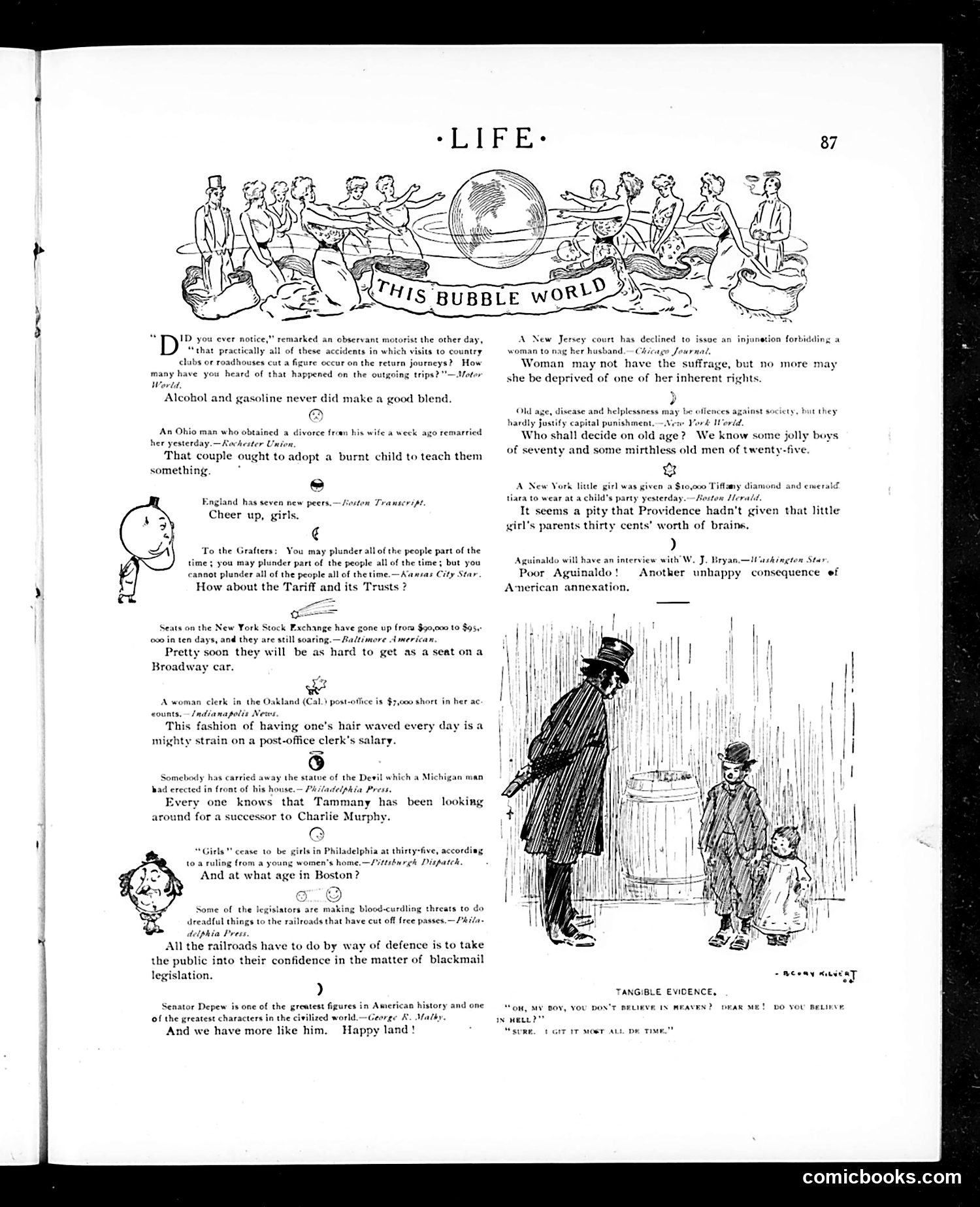
This page presents satirical commentary on contemporary social issues. The header illustration depicts figures supporting a large bubble, representing fragile society. The text includes critiques of: - **Women's rights**: A New Jersey court's injunction against a woman controlling her own husband; commentary that women lack suffrage but shouldn't lose "inherent rights" - **Wealth inequality**: A child given a $10,000 Tiffany diamond, highlighting parental excess - **Labor/economics**: Stock Exchange seat prices rising; difficulty obtaining Broadway theater seats; railroad defense against blackmail legislation - **Gender norms**: Daily hair-waving as "mighty strain on a post-office clerk's salary" The accompanying cartoon ("Tangible Evidence") shows a well-dressed woman and child in rain, with dialogue about belief in heaven—likely satirizing hypocrisy between professed values and actual behavior. The satire targets upper-class contradictions and social pretense.
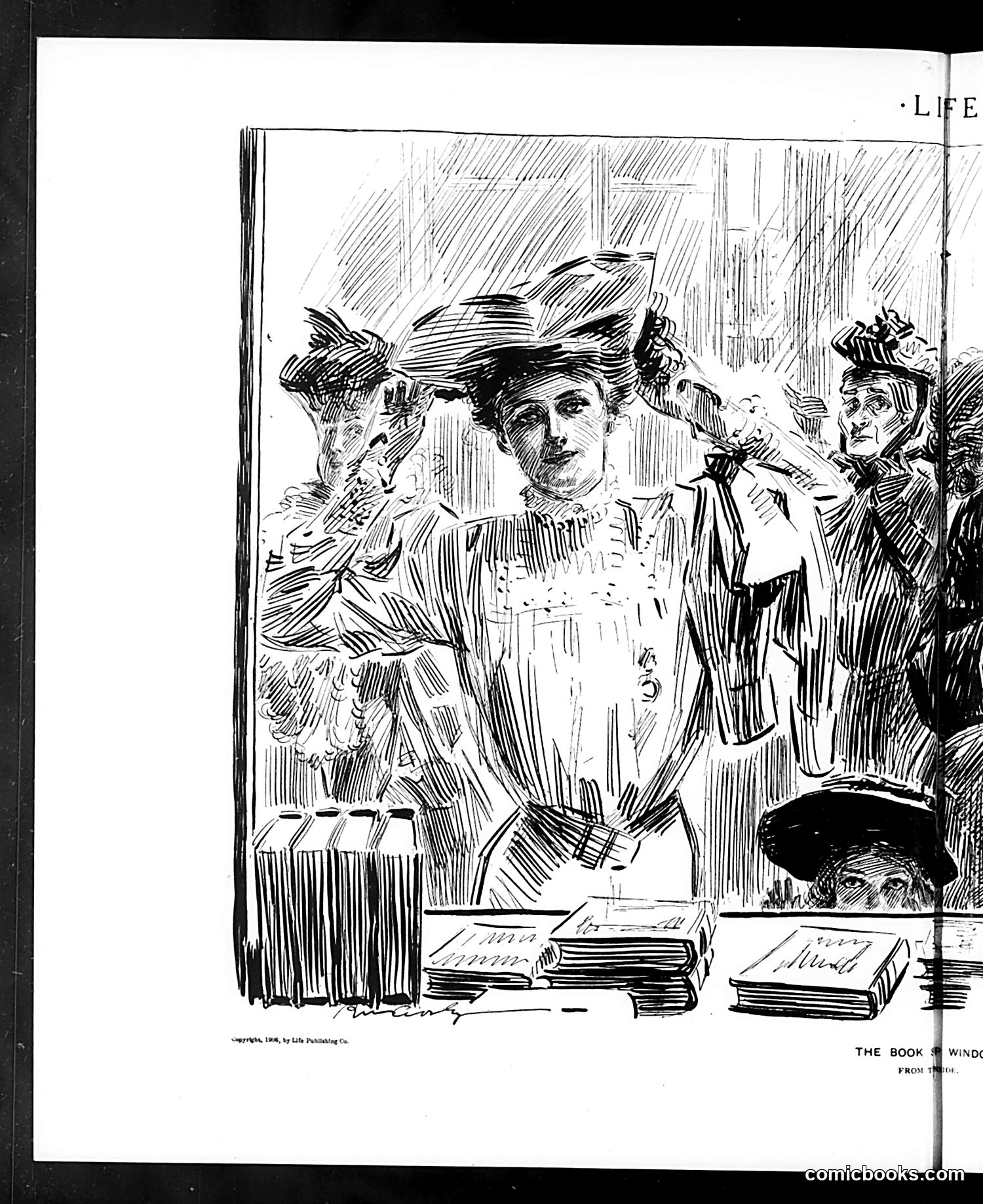
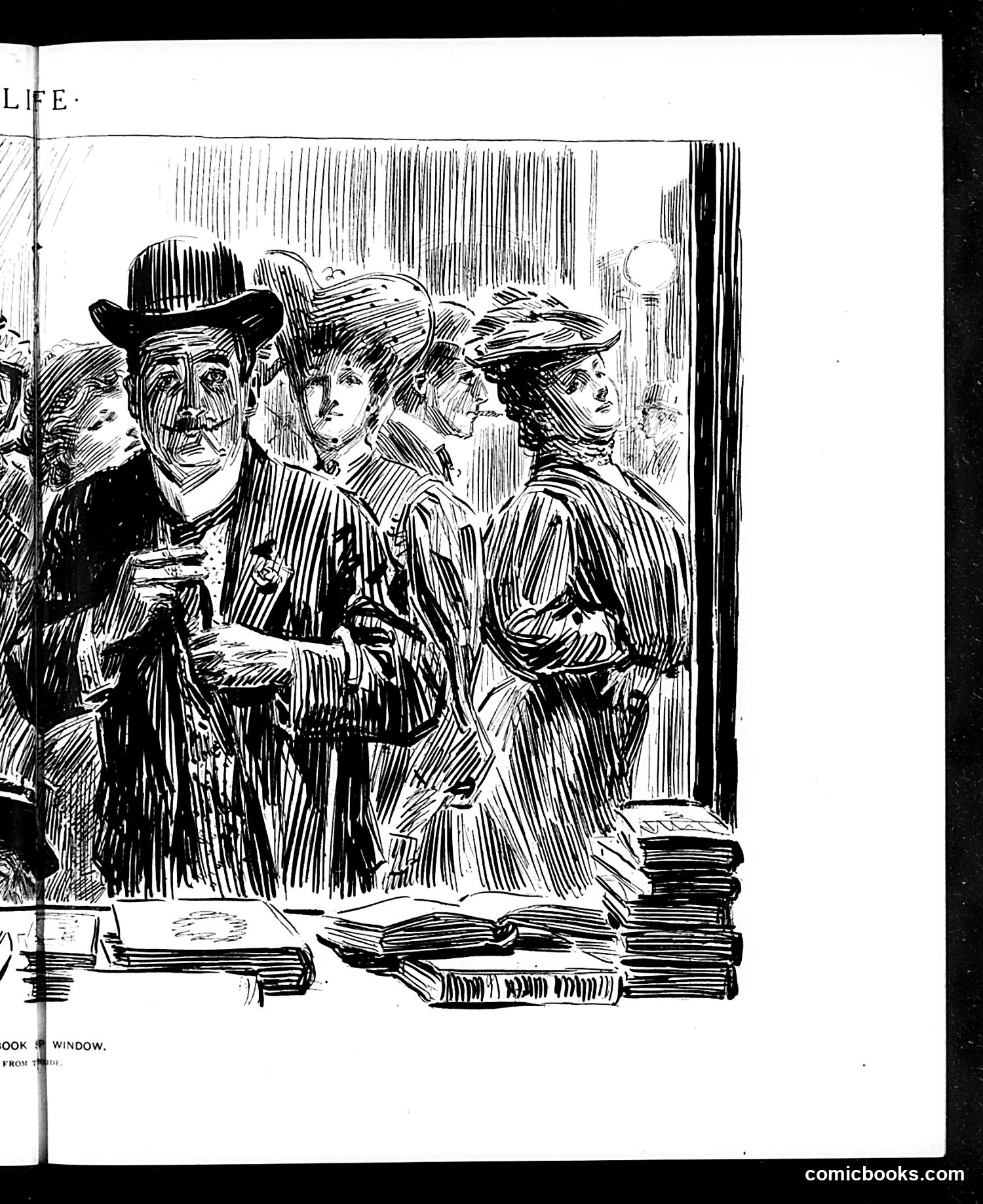
This sketch depicts a woman at what appears to be a book signing or public event, surrounded by admirers and onlookers. The title references "The Book of Windso" (likely "Windsor," though partially cut off). The cartoon appears to satirize public fascination with a celebrity or notable figure, possibly related to the British royal family given the "Windsor" reference—likely alluding to the Duke and Duchess of Windsor (formerly King Edward VIII). The crowded scene with people eagerly gathering suggests mockery of mass celebrity worship and public obsession with royalty or high-profile figures. The sketch's style and the "Life" magazine context indicate this is early-to-mid 20th century American satire commenting on transatlantic celebrity culture.
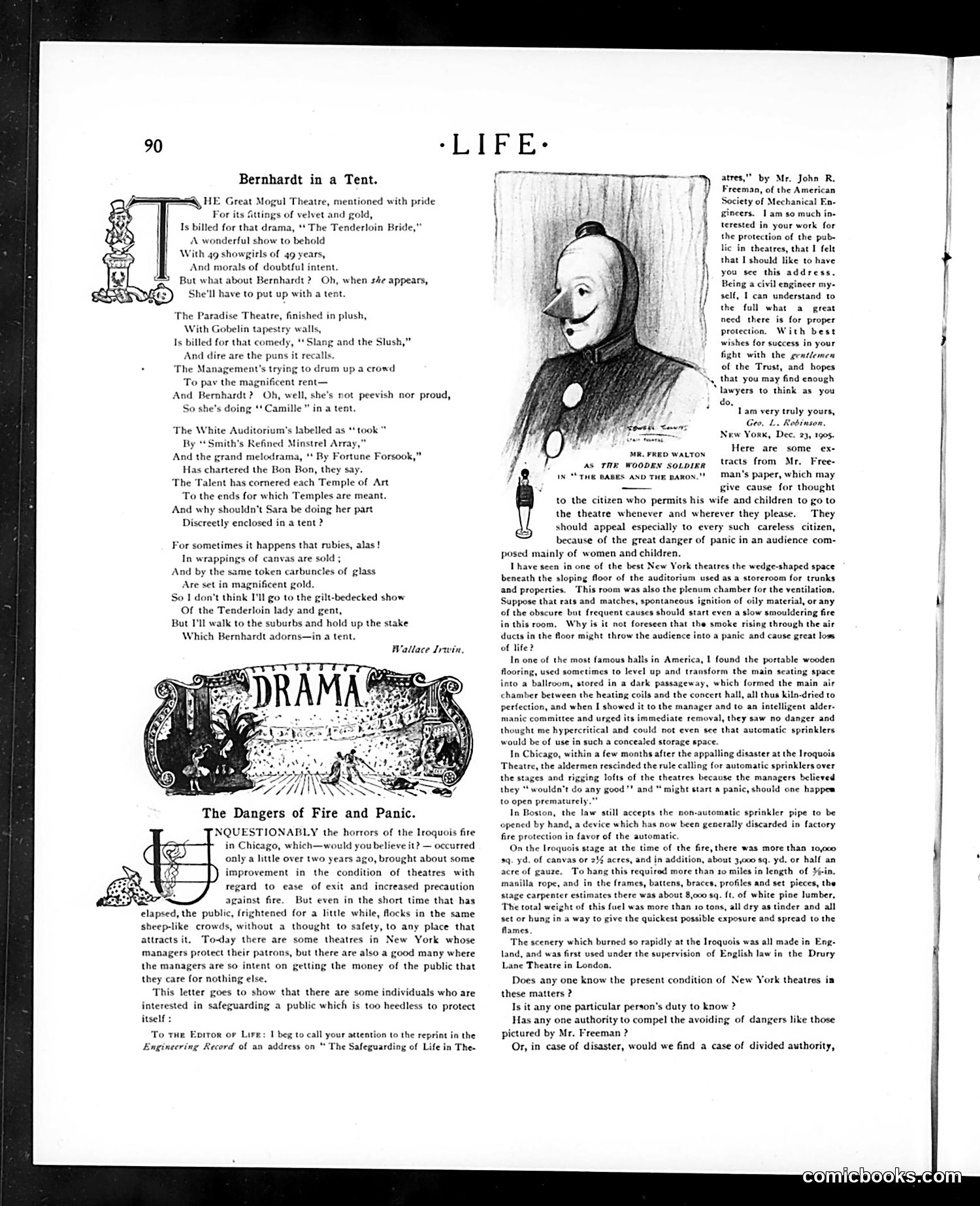
This *Life* magazine page (page 90) contains two distinct pieces: **"Bernhardt in a Tent"** (poem by Wallace Irwin): A satirical jab at Sarah Bernhardt, the famous French actress, performing in New York. The joke: while luxurious theaters (The Great Mogul, Paradise Theatre, White Auditorium) host inferior productions with gaudy décor and mediocre talent, the celebrated Bernhardt must perform "Camille" in a modest tent. The satire mocks both theater managers' misplaced priorities and New York's theatrical landscape—equating fancy velvet and tapestries with worthlessness, while genuine artistry goes unhoused. "Camille" was Bernhardt's signature role. **"The Dangers of Fire and Panic"** (editorial section): Discusses theater safety following the Iroquois Theatre fire in Chicago (1903—the text says "two years ago"). The piece criticizes theater managers who ignore fire safety to maximize profits, contrasting responsible owners with negligent ones. It includes a letter from an engineer advocating for automatic sprinklers and proper ventilation, highlighting the real hazard of panic in crowds of women and children—a contemporary safety concern reflecting early 20th-century attitudes about theater liability.
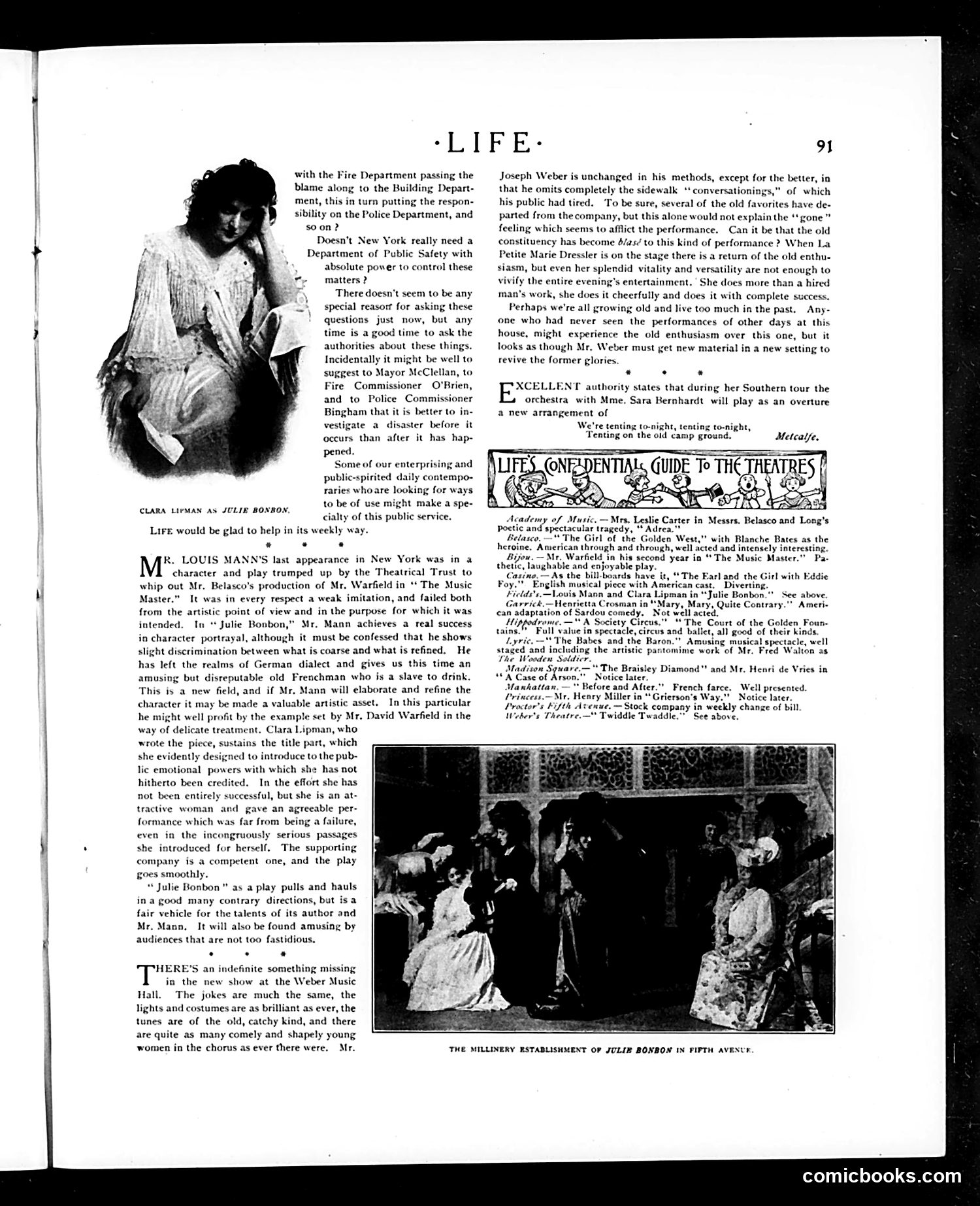
This page critiques New York City governance and reviews theatrical performances. The political content addresses **municipal bureaucratic dysfunction**: the author satirizes how the Fire, Building, and Police Departments blame each other for disasters, suggesting Mayor McClellan, Fire Commissioner O'Brien, and Police Commissioner Bingham need a unified Department of Public Safety. The satire implies government incompetence and finger-pointing after crises. The theatrical reviews discuss **Louis Mann** in "Julie Bonbon" (a character play about a drunken Frenchman) and **Clara Lipman** performing in the same production. The critic praises Mann's character work while noting the play's tonal inconsistencies. A separate review mentions **Marie Dressler** at Weber Music Hall, crediting her vitality for salvaging an otherwise stale show where even Joseph Weber's comedy routines feel dated. The commentary subtly suggests audiences are aging out of vaudeville entertainment.
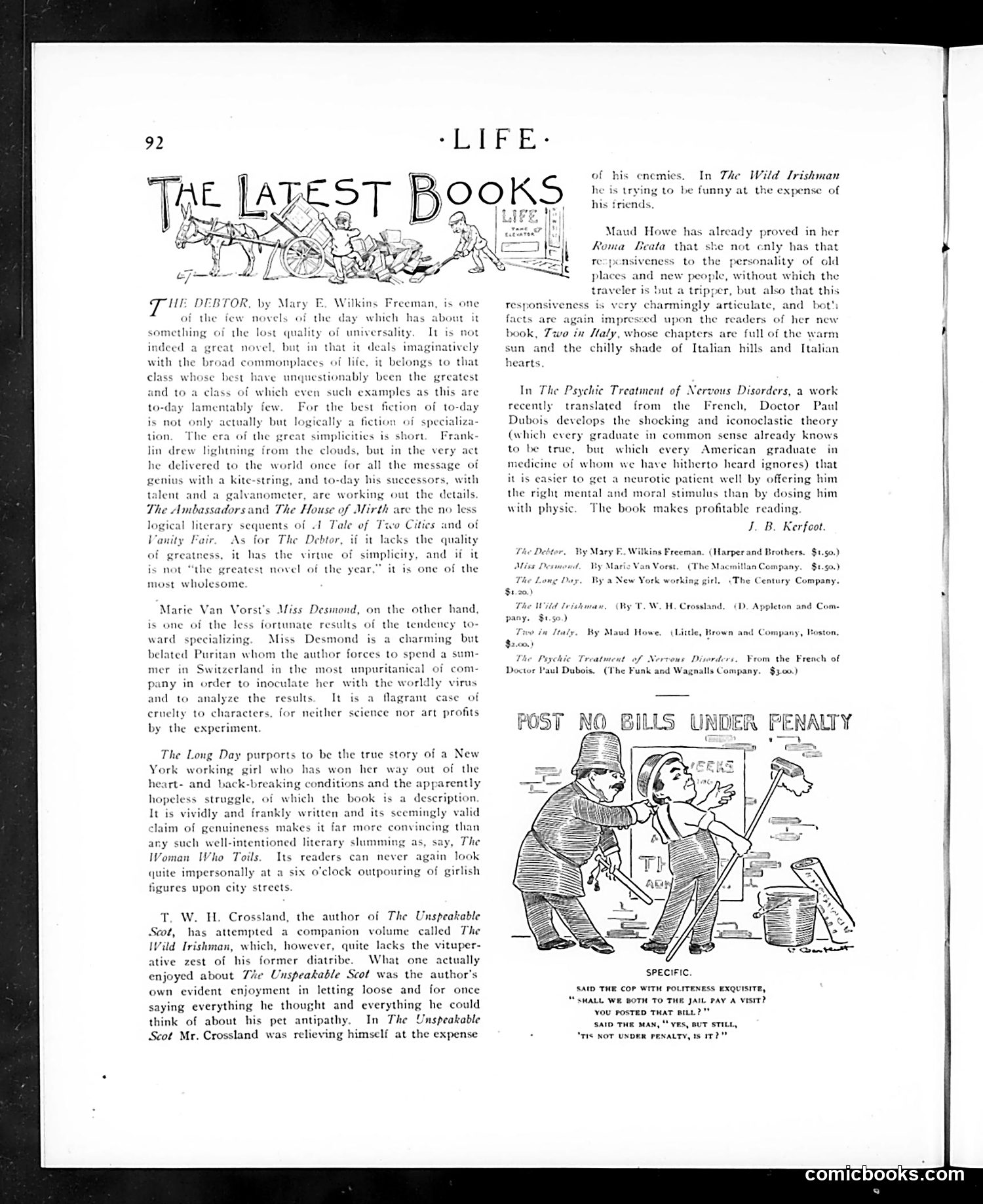
This cartoon satirizes petty municipal enforcement and bureaucratic absurdity. It depicts a police officer confronting a man about posting bills illegally on a wall. The joke hinges on the officer's pedantic literalism: he's arresting someone for posting a bill that reads "POST NO BILLS UNDER PENALTY"—the very warning sign itself. The humor targets how authorities enforce rules mechanically without common sense. The officer treats the warning placard as itself a violation, missing the obvious irony that the sign *is* the law's instruction, not an infraction of it. This reflects early-20th-century American frustration with rigid bureaucratic enforcement and the gap between rule-makers' intent and street-level implementation. The cartoon uses exaggeration to mock officials who follow the letter of law while ignoring its spirit.
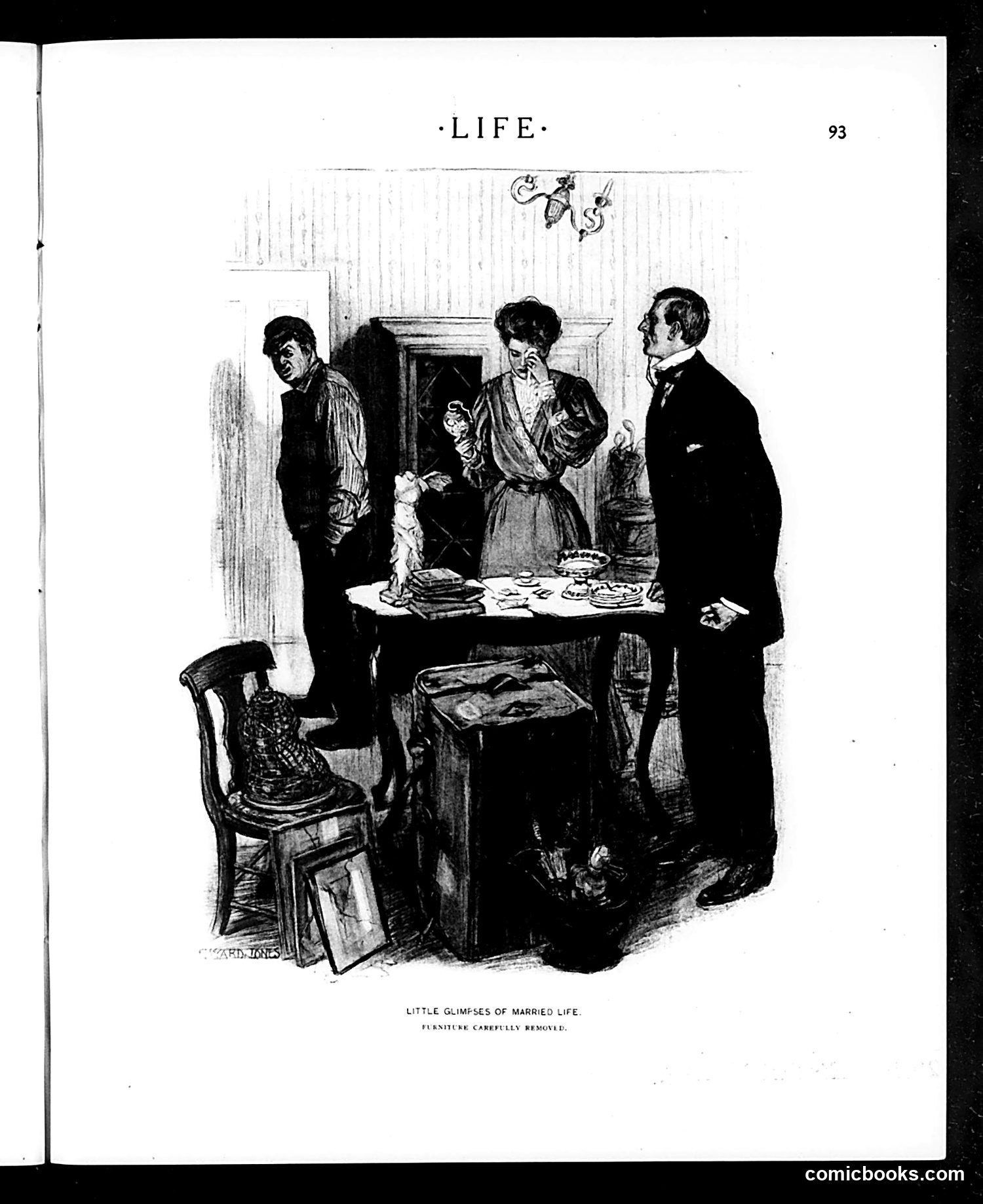
This satirical cartoon from *Life* magazine depicts a domestic scene titled "Little Glimpses of Married Life," credited to Fletcher Carstairs (Renoudie—OCR unclear). The image shows three well-dressed men and a woman in what appears to be a modest home interior. A child sits alone on a chair in the foreground. The composition suggests social discomfort or tension: the woman appears to be serving food while the men stand awkwardly, observing rather than participating warmly. The satire likely critiques Victorian-era married life and domestic dynamics—possibly mocking stiff social conventions, the emotional distance between spouses, or the woman's isolated domestic role. The child's isolated position may emphasize family disconnection. Without additional context, the specific social critique remains somewhat unclear, though the overall tone suggests ironic commentary on contemporary marriage and family relations.
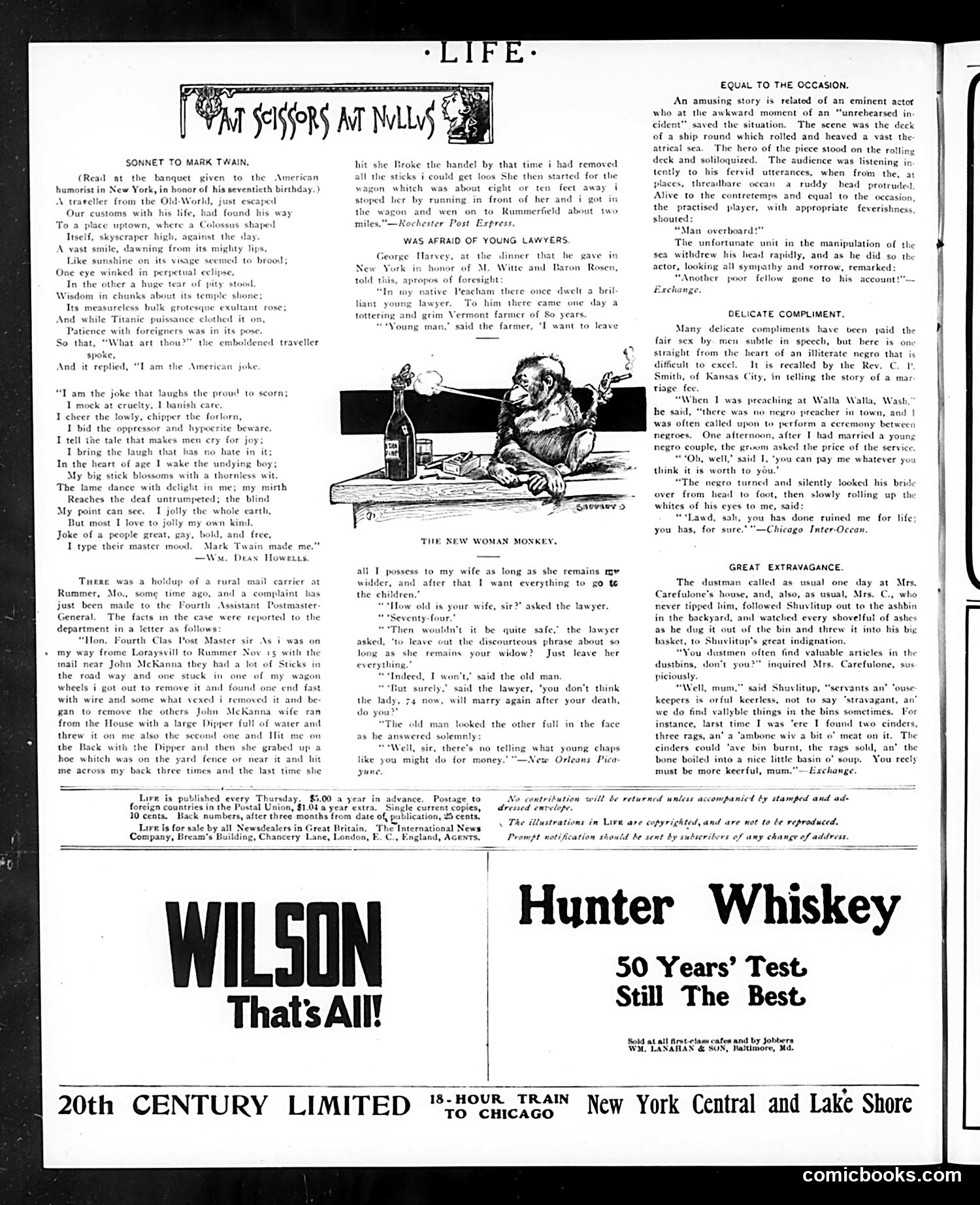
This page combines literary and humorous content typical of *Life* magazine's satirical format. **"Sonnet to Mark Twain"** celebrates the American humorist as embodying the national character—a figure who laughs at pride, mocks hypocrisy, and brings joy to all classes. The poem is reverential, positioning Twain as representing American democratic values and wit. **The cartoon "The New Woman Monkey"** (center) appears to satirize evolving gender roles, likely critiquing women's independence or "new woman" ideals gaining traction in the early 20th century, though specifics are unclear from the image quality. **Three short anecdotes** follow, each illustrating humor through unexpected moments: an actor ad-libbing when interrupted; a young lawyer intimidating a farmer (playing on class anxieties); and a Black preacher's reaction to a couple's marital arrangement, presented as folk-wisdom humor. The page reflects *Life's* focus on American character, social observation, and gentle satire of contemporary manners and pretensions.
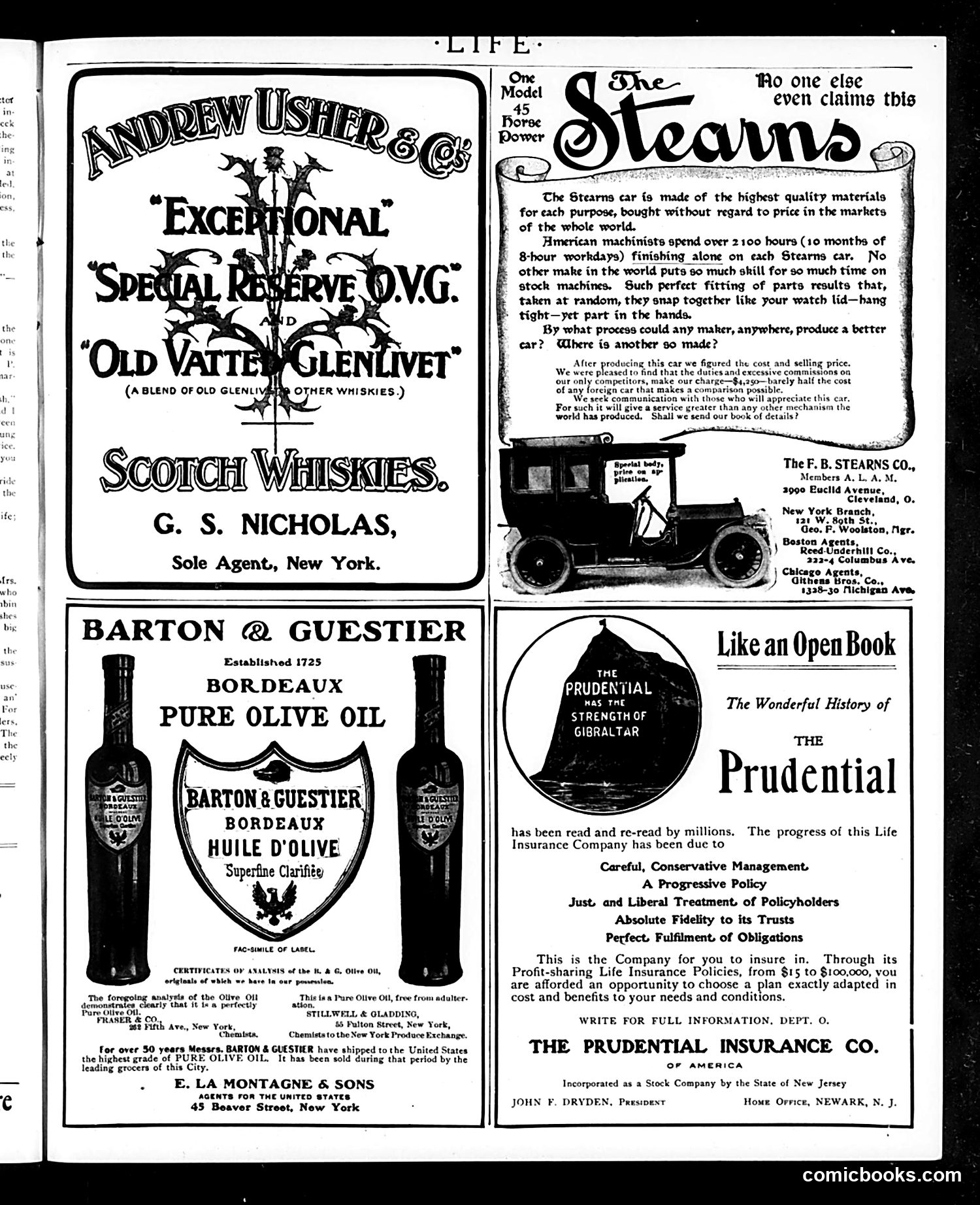
This is primarily an **advertising page** from Life magazine, not a satirical cartoon page. It contains four full-page advertisements with no political satire. The ads promote: 1. **Andrew Usher Scotch Whisky** - highlighting brand prestige and distribution 2. **F.B. Stearns automobiles** - emphasizing meticulous American craftsmanship; the copy argues their $4,250 price is reasonable compared to foreign competitors burdened by tariffs and commissions 3. **Barton & Guestier olive oil** - a French product marketed for 50+ years to American grocers 4. **Prudential Insurance** - using "Strength of Gibraltar" as a metaphor for reliability The **only satirical element** appears subtle: the Stearns auto ad's claim that American-made cars offer superior value when accounting for foreign tariffs suggests contemporary protectionist debates, but this reads more as marketing argument than satire. Overall, this reflects early 20th-century advertising conventions and consumer goods marketing rather than political commentary.
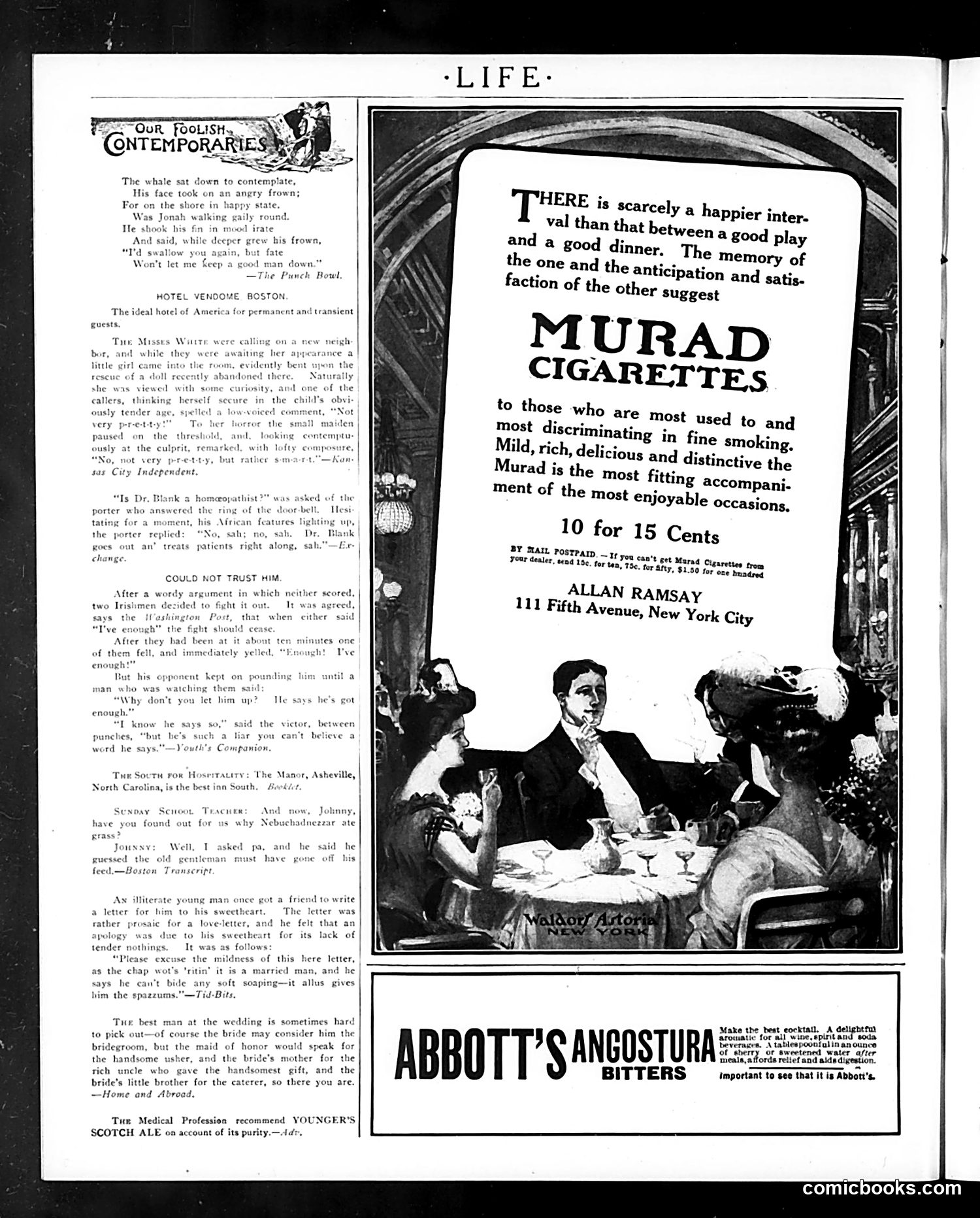
This page contains several brief humorous anecdotes typical of Life magazine's satirical format, plus advertisements. **The cartoons/jokes:** - "Our Foolish Contemporaries" features a poem about a whale contemplating life, mocking sentimental verse - Several short prose jokes mock social pretension and hypocrisy: a child's rude honesty about a guest's appearance; a man who won't stop fighting despite losing; confusion about why Nebraska grass grows **The advertisements:** The page is dominated by two product ads: - **Murad Cigarettes**: Appeals to sophisticated diners, positioning cigarettes as essential to refined social occasions - **Abbott's Angostura Bitters**: Advertises as essential for cocktails and digestion **Context for modern readers:** These ads casually promote cigarettes and alcohol-based tonics as health/lifestyle products—practices now recognized as harmful and heavily regulated. The satirical tone throughout reflects early 20th-century American humor targeting middle-class pretension and social convention.
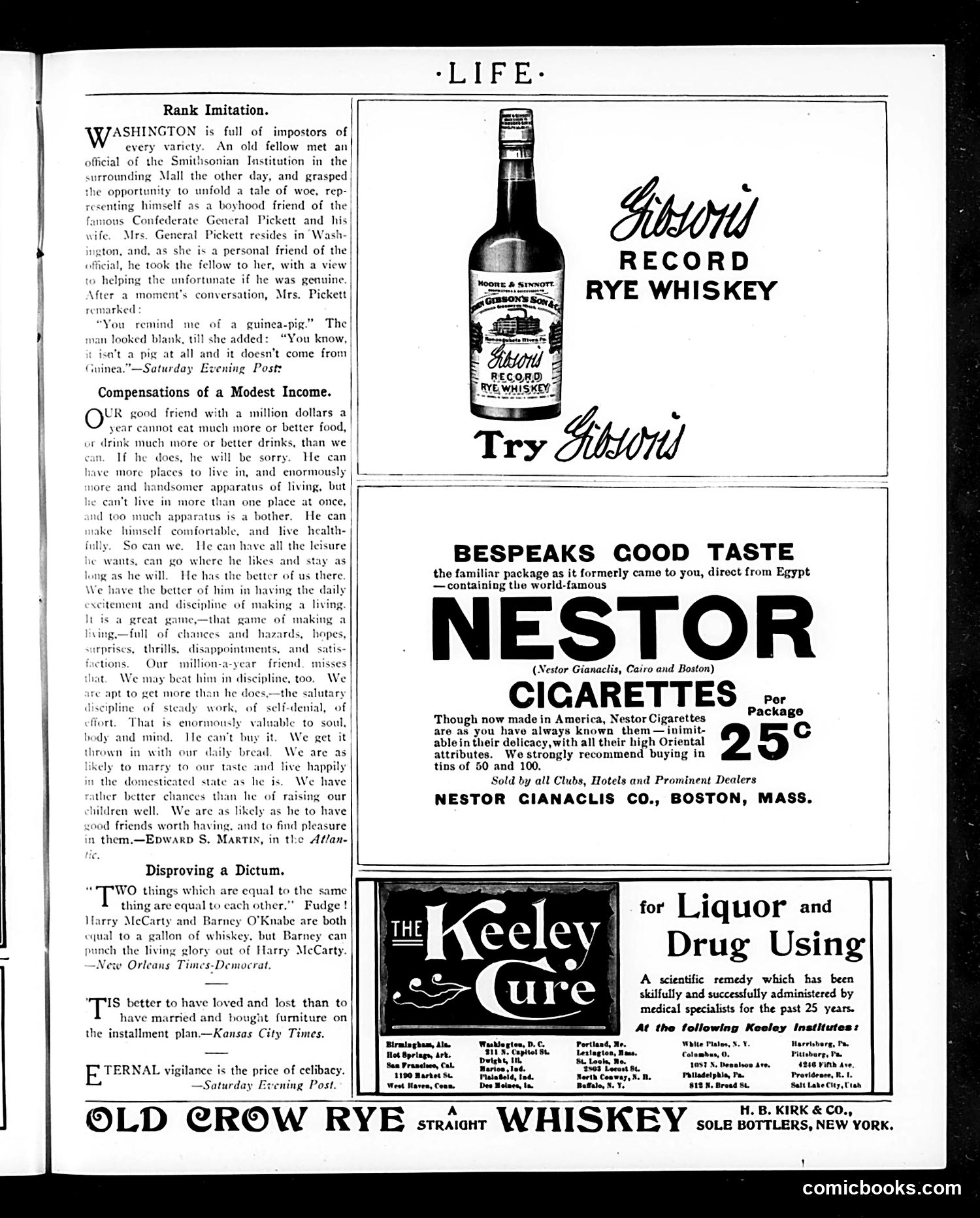
This page is **primarily advertising**, not satirical cartoons. The advertisements dominate the layout. The page contains several short humorous anecdotes in the upper left ("Rank Imitation," "Compensations of a Modest Income," "Disproving a Dictum") typical of Life's satirical commentary. These brief pieces mock social pretension and logical fallacies rather than specific political figures. **Key advertisements:** - **Gilbori's Record Rye Whiskey** (top right) - **Nestor Cigarettes** (center) — marketed as Egyptian cigarettes now made in America - **The Keeley Cure** (lower right) — a commercial "scientific remedy" for alcohol and drug addiction, with multiple Institute locations listed - **Old Crow Rye Whiskey** (bottom) — ironically placed below an addiction treatment ad The juxtaposition of liquor advertisements with a substance abuse cure advertisement is notable, reflecting early 1900s American attitudes toward commerce and remedial treatments. The page reflects the pre-Prohibition era when such products were openly advertised in mainstream publications.
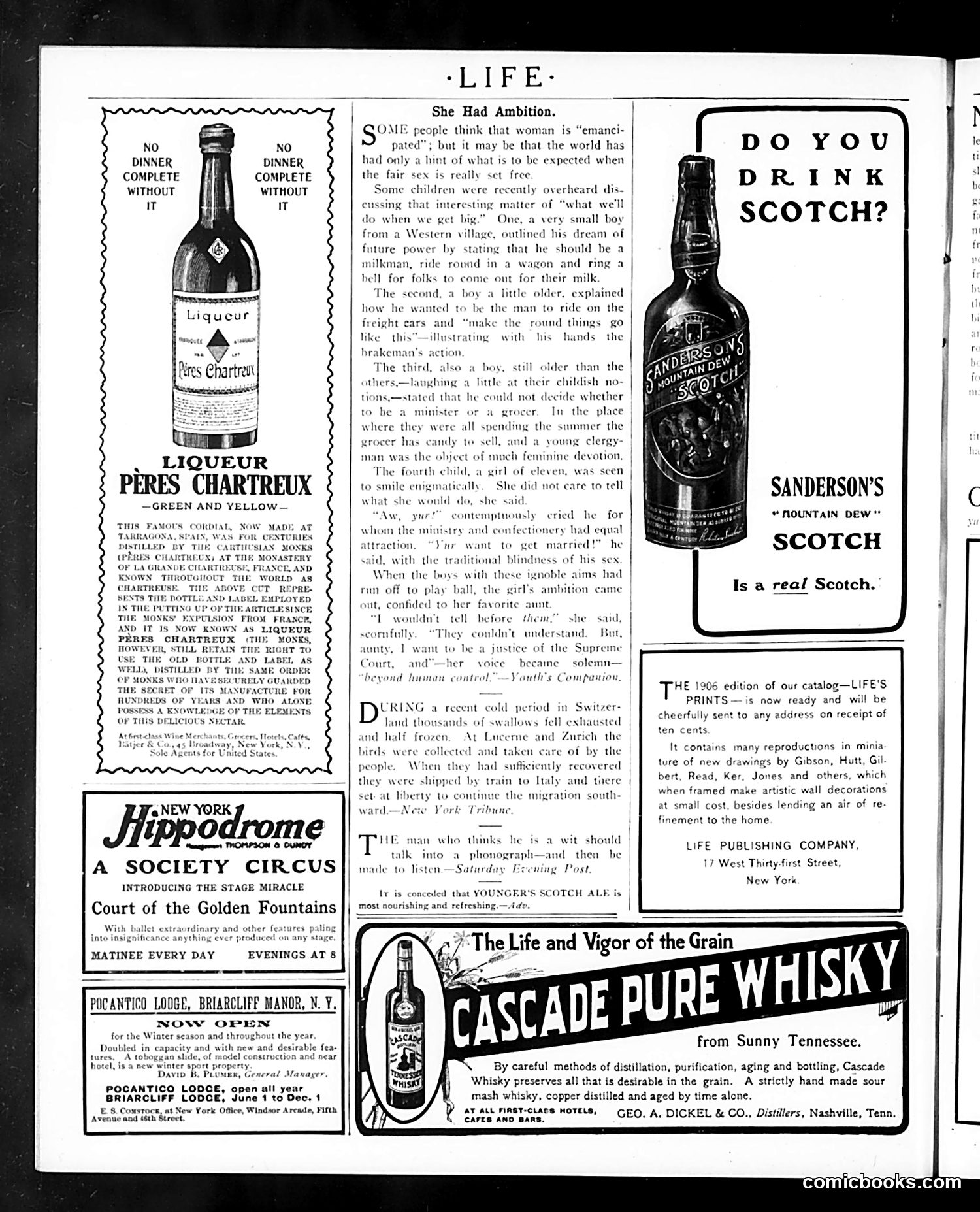
This is primarily a **advertising page** from Life magazine (circa 1906), not a political cartoon. The page contains: **Main Content:** - A short satirical story titled "She Had Ambition" about children discussing future careers. A girl aspires to become a Supreme Court justice—an audacious ambition for a young woman in 1906, when women couldn't vote and had extremely limited professional opportunities. The boys' dismissive reaction ("You're gonna get married!") reflects period sexism. The story gently mocks outdated gender expectations. **Advertisements:** Multiple liquor and leisure ads (Liqueur Peres Chartreux, Sanderson's Scotch, Cascade Whisky), a circus performance notice, and a winter resort lodge advertisement. **Life Publishing Announcement:** Promoting their 1906 catalog of art prints featuring cartoonists Gibson, Hutt, and others. The satire is mild social commentary on women's limited aspirations—not sharp political critique. It's representative of turn-of-century American attitudes toward gender roles.
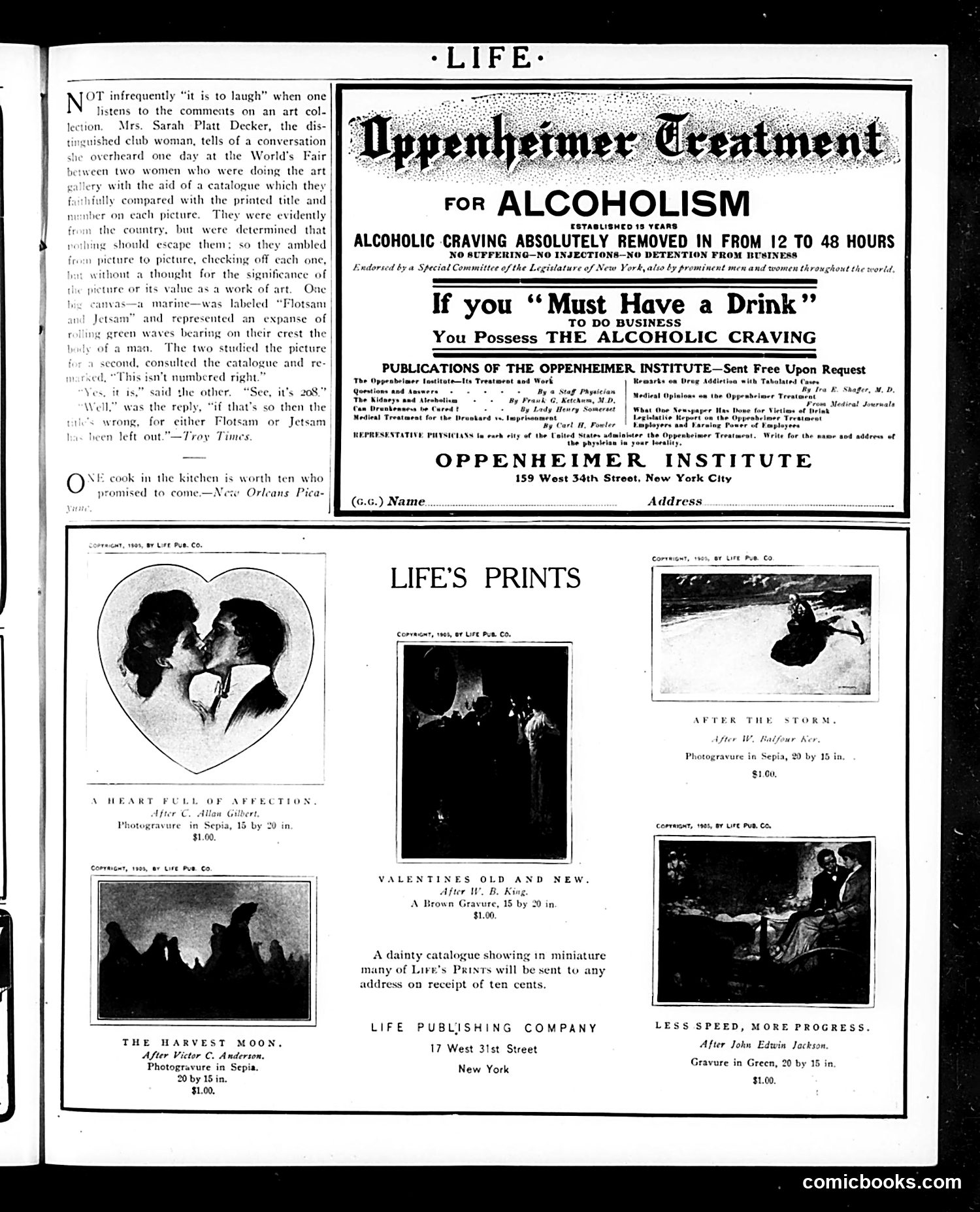
This page mixes satirical editorial content with advertising and art sales. ## The Cartoon/Satire (Top Left) The opening anecdote mocks unsophisticated museum-goers—specifically two women from the countryside attending the World's Fair. They mechanically check off artworks against a catalogue without genuine engagement, confuse titles ("Flotsam" and "Jetsam"), and complain that a painting isn't numbered correctly rather than appreciating it as art. The satire targets middle-class pretension: people who perform cultural sophistication through mere checklist completion rather than actual understanding. ## The Advertisements & Other Content The bulk of the page advertises the "Oppenheimer Treatment" for alcoholism—a dubious medical remedy promising to eliminate "alcoholic craving" in 12-48 hours with "no detention from business." This reflects early 20th-century patent medicine culture. Below are art prints for sale from Life Publishing Company, featuring photogravures priced at $1.00 each. The page is primarily commercial, with the cartoon serving as editorial filler around advertisements.
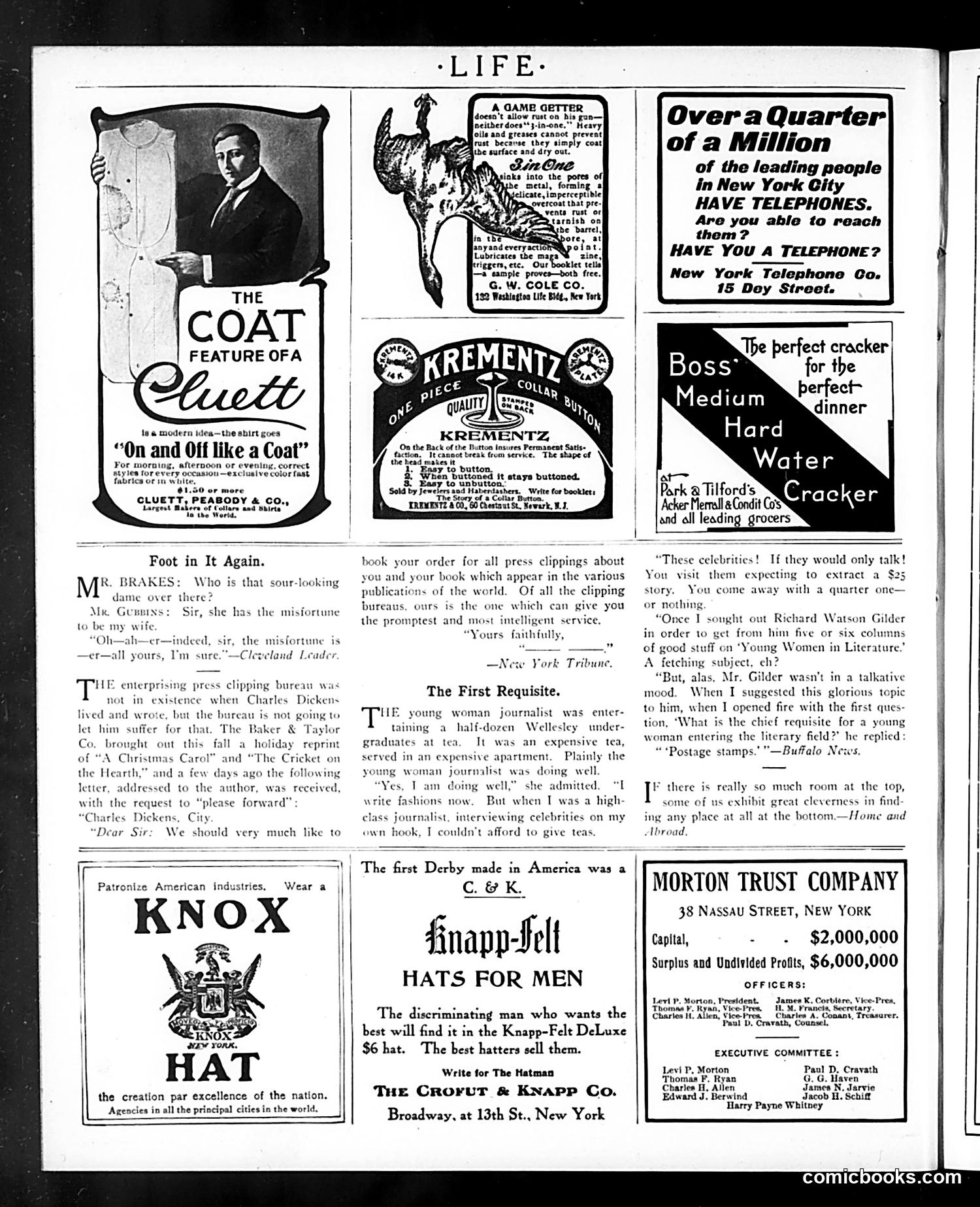
This page is primarily **advertising**, with two notable humor pieces: ## "Foot in It Again" (top left) A brief joke from *Cleveland Leader* mocking marriage: A man comments on a sour-looking woman; her husband replies she's "the misfortune to be my wife"—then adds he's "er—all yours, I'm sure," sarcastically suggesting the other man take her instead. The humor trades on period attitudes treating wives as liabilities. ## "The First Requisite" (center) A satire on young female journalists' ambitions. A Wellesley-educated woman journalist proudly entertains undergraduates over expensive tea, claiming success interviewing celebrities. The punchline: when she asked famous literary figure Richard Watson Gilder what's essential for women entering literature, he dismissively replied: "Postage stamps"—implying women writers belonged in obscurity, not in serious journalism. The satire mocks both the woman's social climbing and the condescension she faces from male literary gatekeepers. The remaining content is advertisements for hats, telephones, banks, and clothing typical of *Life*'s era.
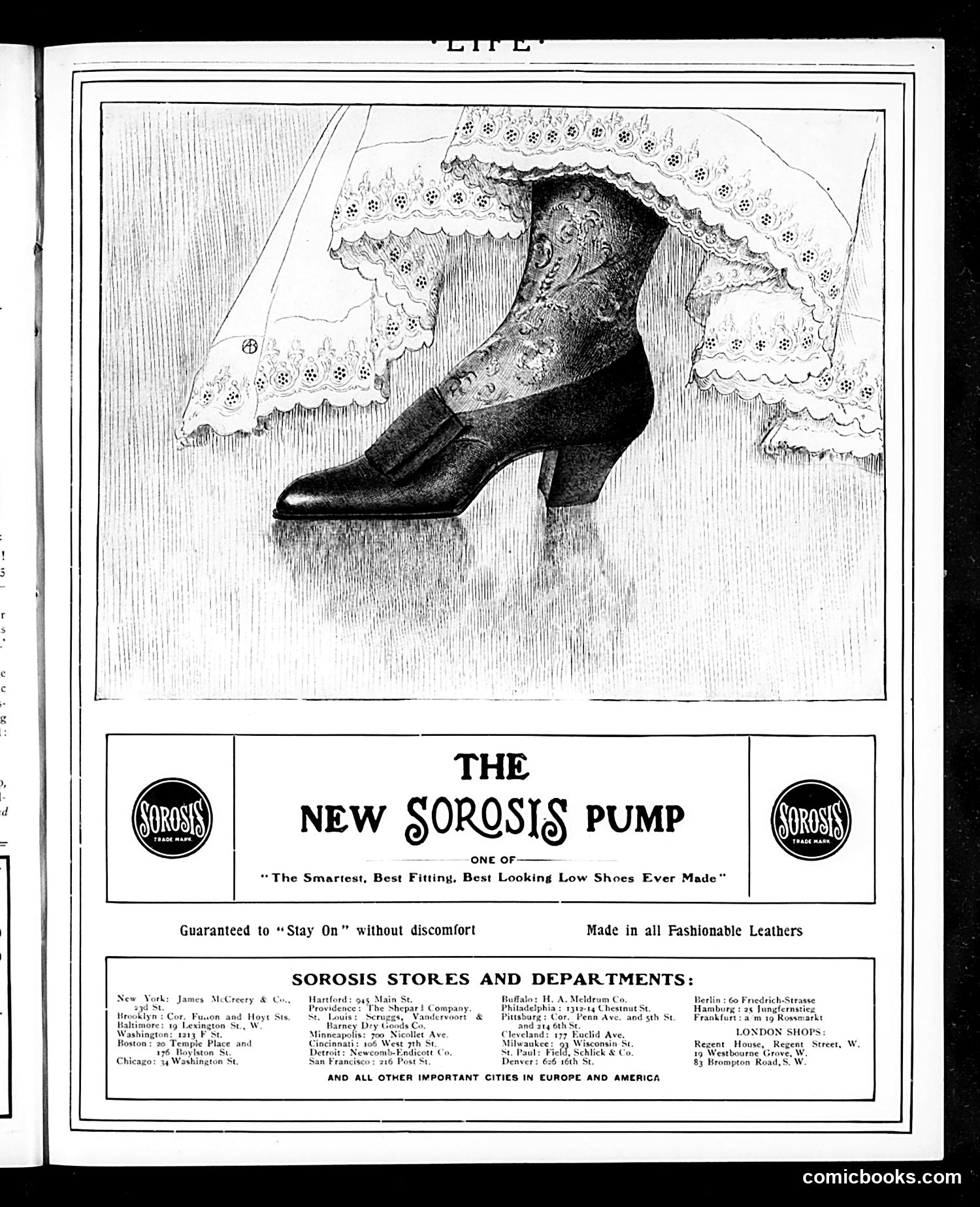
This is primarily **a Sorosis shoe advertisement**, not political satire. The page shows an illustrated women's shoe (a pump/low heel) with decorative lace trim at the top, drawn in elegant line-art style. The humor, if any, is subtle and product-focused: the shoe is anthropomorphized with a woman's leg and foot, posed somewhat coquettishly. The tagline promises the shoe will "Stay On" without discomfort—a practical selling point presented with gentle wit. The text emphasizes Sorosis as a premium brand ("Smartest, Best Fitting, Best Looking Low Shoes Ever Made"), highlighting their international presence across major American and European cities. This reflects early 20th-century department-store advertising strategy, targeting middle-to-upper-class women. There is **no political cartoon or satire** on this page—it's straightforward commercial promotion typical of *Life* magazine's advertising content during this era.
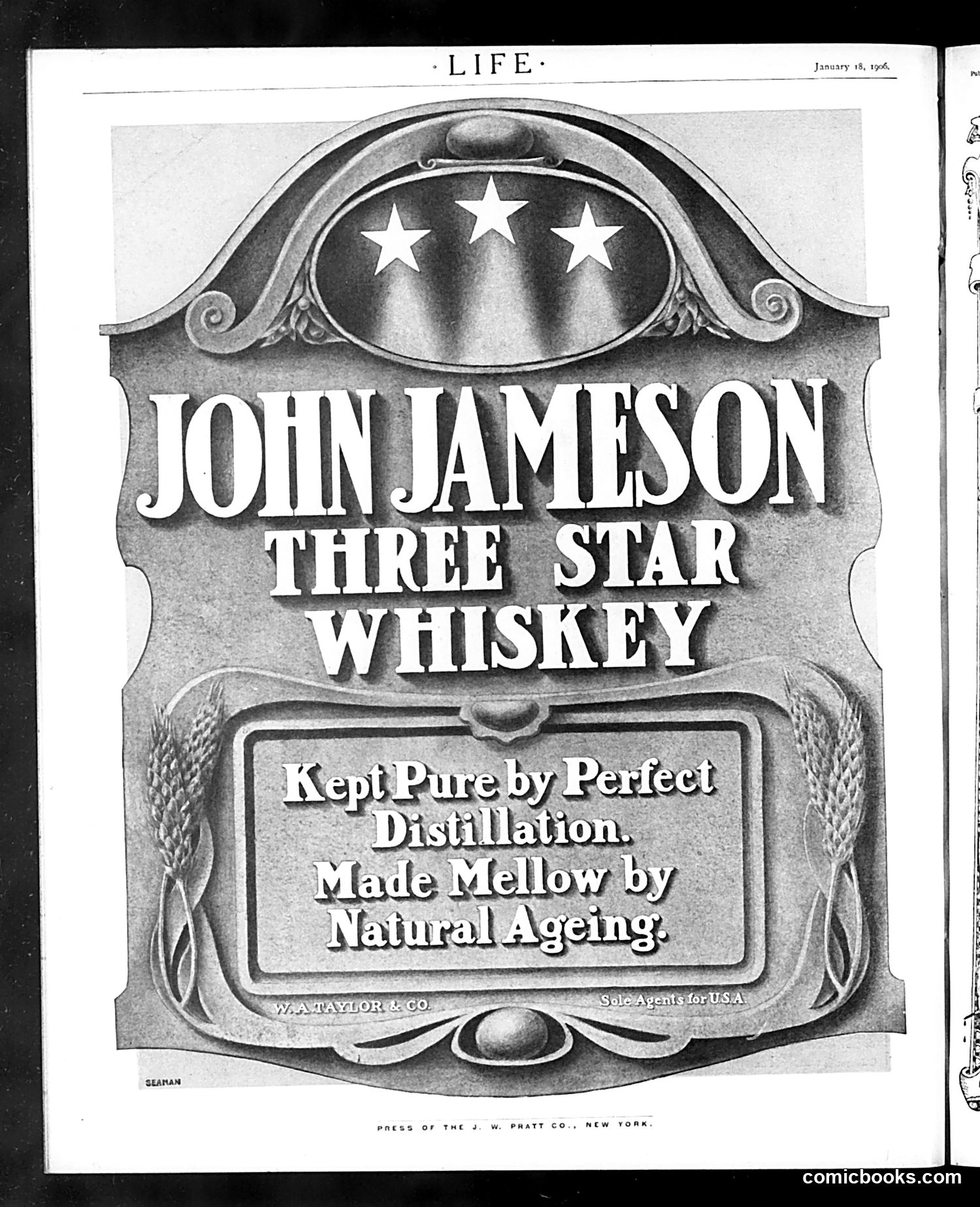
This is a **full-page advertisement**, not a political cartoon. It promotes John Jameson Three Star Whiskey, featuring an ornate label design with three stars and decorative scrollwork typical of early 20th-century product packaging. The ad's claims—"Kept Pure by Perfect Distillation" and "Made Mellow by Natural Ageing"—represent typical marketing language of the era. W.A. Taylor & Co. is listed as the distributor, with "Sole Agents for U.S.A." noted. This appeared in *Life* magazine on January 18, 1906, during the pre-Prohibition era when alcohol advertising was commonplace in mainstream publications. The page demonstrates how premium imported spirits were marketed to American consumers through prominent magazines.