
Life, 1906-01-18 · page 8 of 28
Life — January 18, 1906 — page 8: what you’re looking at
What you’re looking at
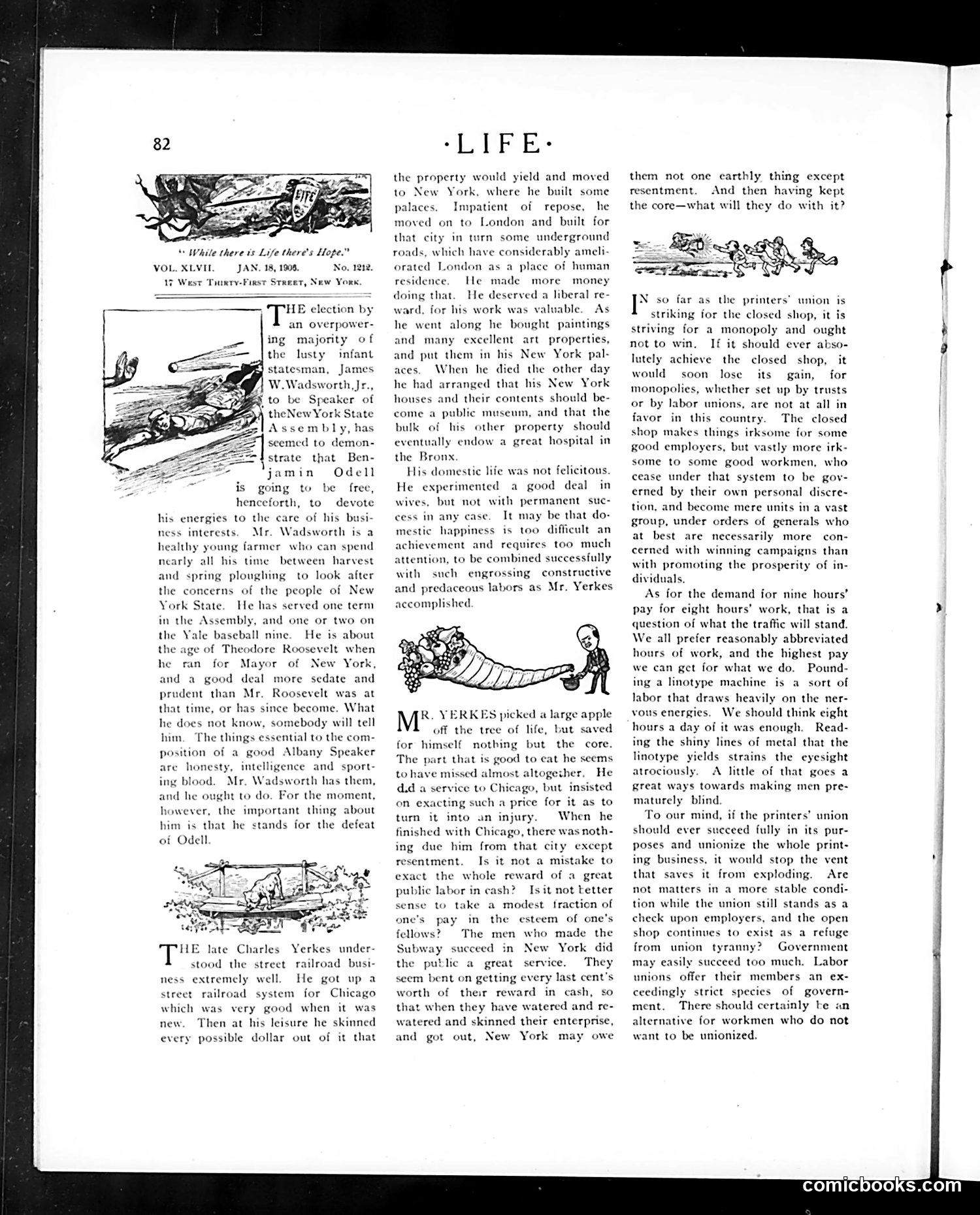
This page discusses labor issues, specifically addressing the printers' union's campaign for a "closed shop" (union-only workplaces). The text argues against closed shops, claiming they would harm competent non-union workers and reduce employers' flexibility. The accompanying illustrations appear to be decorative vignettes rather than political cartoons—they show figures in various scenes but lack clear caricature or identifying markers. The article references **James W. Wadsworth Jr.** as Speaker of the New York State Assembly, and mentions **Charles Yerkes**, a Chicago railroad magnate, as an example of successful business management. The piece advocates for open shops and questions whether eight-hour workdays are economically sustainable. The overall tone is anti-union, typical of early 20th-century business-oriented publications.
📄 Transcribed text from this page (OCR, searchable)
Machine-transcribed from the original scan — historical spelling and the odd misread are preserved.
‘While there ts Life there's Hope.” VOL. XLVI JAN, 18, 1908. . 1212. 17 West Trunry. ee T! y an overpower- ing majority of the lusty infant statesman, James W.Wadsworth,Jr., to be Speaker of theNewYork State Assembly, has seemed to demon- strate that Ben- jamin Odell is going to be free, henceforth, to devote his energies to the care of his busi- Qn Mr. Wadsworth is a healthy young farmer who can spend nearly all his time between harvest and spring ploughing to look after the concerns of the people of New York State. He has served one term in the Assembly, and one or two on the Yale baseball nine. He is about the age of Theodore Roosevelt when he ran for Mayor of New York, and a good deal more sedate and prudent than Mr. Roosevelt was at that time, or has since become. What he does not know, somebody will tell him. The things essential to the com- position of a good Albany Speaker are honesty, intelligence and sport- ing blood. Mr. Wadsworth has them, and he ought to do. For the moment, however, the important thing about him is that he stands for the defeat of Odell. ss interests. HE under- stood Yerkes railroad busi- Charles the street ness extremely well. He street railroad system for which was very good when it was new. Then at his leisure he skinned every possible dollar out of it that late got up a Chicago -LIFE: the property would yield and moved to New York, where he built some palaces. Impatient of repose, he moved on to London and built for that city in turn some underground roads, which have considerably ameli- orated London as a place of human residence. He money doing thi He deserved a liberal re- ward, for his work was valuable. As he went along he bought paintings and many excellent art properties, and put them in his New York pal- When he died the other day he had arranged that his New York houses and their contents should be- come a public museum, and that the bulk of his other property should eventually endow a great hospital in the Brons His domestic life was not felicitous He experimented a good deal in wives, but not with permanent. suc- It may be that do- mestic happiness is too difficult an made more aces. cess in any case. achievement and requires too much attention, to be combined successfully with such engrossing constructive and predaceous labors as Mr. Yerkes accomplished R. YERKES picked a large apple off the tree of life, but saved for himself nothing but the core. The part that is good to cat he seems tohave missed almost altogesher, He did a service to Chicago, but insisted on exacting such a price for it as to turn it into an injury. When he finished with Chicago, there was noth- ing duc him from that city except resentment. Is it not a mistake to exact the whole reward of a great h? Isit not tetter public labor in ca sense to take a modest traction of one’s pay in the esteem of one's fellows? The men who made the Subway succeed in New York did the public a great service. They seem bent on getting every last cent’s worth of their reward in cash, so that when they have watered and re- watered and skinned their enterprise, and got out, New York may owe them not one earthly thing except resentment. And then having kept the core—what will they do with it? N so far as the printers’ union is striking for the closed shop, it is striving for a monopoly and ought not to win, If it should ever abso- lutely achieve the closed shop, it would soon lose its gain, for monopolies, whether set up by trusts or by labor unions, are not at all in favor in this country. The closed shop makes things irksome for some good employers, but vastly more irk- some to some good workmen, who cease under that system to be gov- erned by their own personal discre- tion, and become mere units ina vast group, under orders of generals who at best are necessarily more con- cerned with winning campaigns than with promoting the prosperity of in- dividuals, As for the demand for nine hours’ pay for eight hours’ work, that is a question of what the traffic will stand. We all prefer reasonably abbreviated hours of work, and the highest pay we can get for what we do. Pound- ing a linotype machine is a sort of labor that draws heavily on the ner- vous energies. We should think eight hours a day of it was enough. Read- ing the shiny lines of metal that the linotype yields strains the eyesight atrociously. A little of that goes a great ways towards making men pre- maturely. blind To our mind, if the printers’ union should ever succeed fully in its pur- poses and unionize the whole print- ing business, it would stop the vent that saves it from exploding. Are not matters in a more stable condi- tion while the union still stands as a check upon employers, and the open shop continues to exist as a refuge from union tyranny? Government may easily succeed too much. Labor unions offer their members an ex- ceedingly strict species of govern- ment. There should certainly te an alternative for workmen who do not want to be unionized.