
Life, 1906-01-18 · page 11 of 28
Life — January 18, 1906 — page 11: what you’re looking at
What you’re looking at
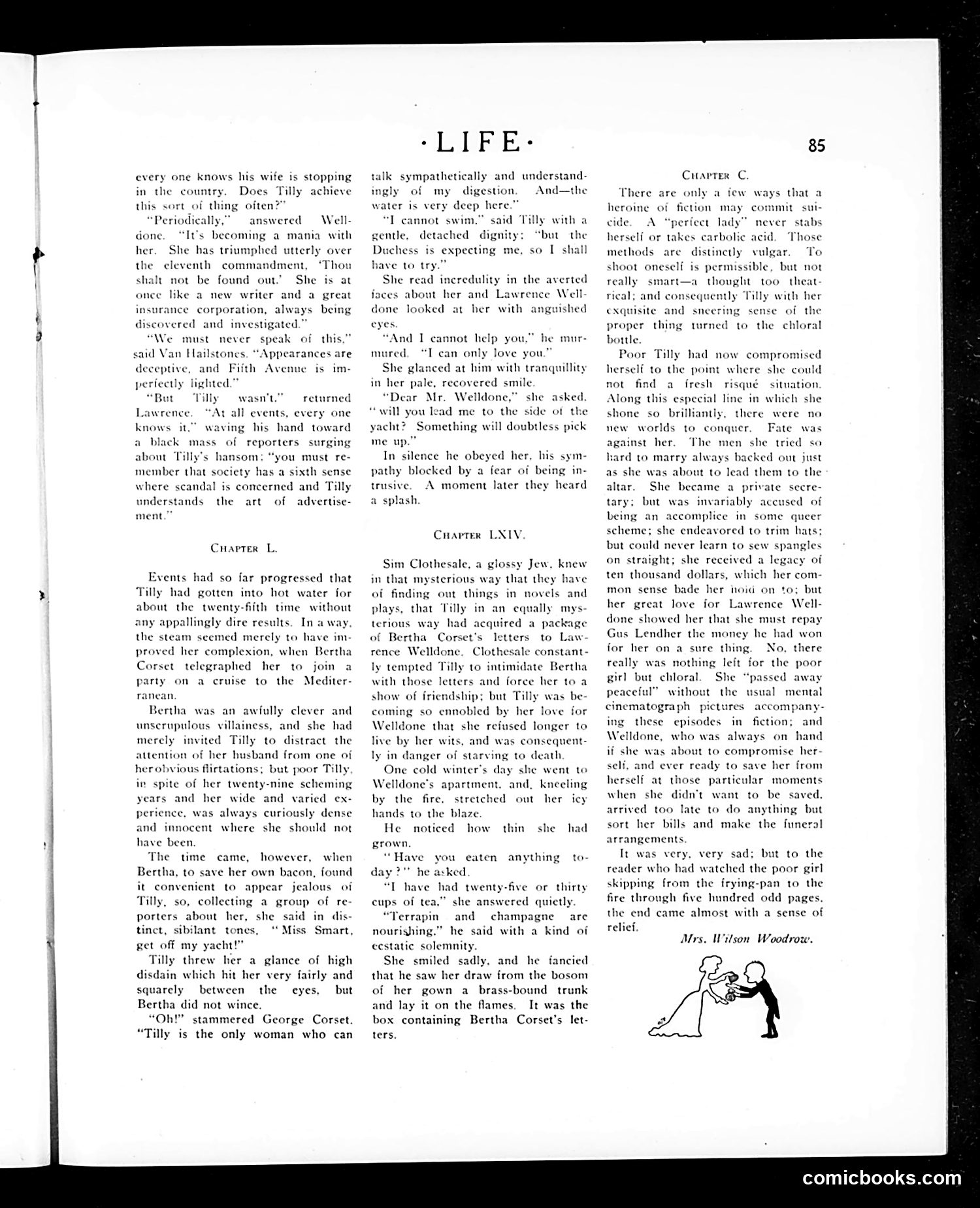
This page consists primarily of serialized fiction narrative (Chapters L and LXIV), describing romantic and social entanglements among characters named Tilly, Lawrence Welldone, Bertha Corset, and others. The text focuses on domestic drama, marriage prospects, and social propriety—typical serialized fiction content for Life magazine. At the bottom right is a small cartoon illustration labeled "Mrs. Wilson Woodrow" showing two figures in a physical altercation or comedic struggle. This appears to be a satirical reference, likely a political joke about a public figure of the era, though the specific context requires knowledge of contemporary 1910s-1920s politics to fully interpret. The cartoon's caption suggests wordplay on the name "Wilson Woodrow" (possibly referencing President Woodrow Wilson).
📄 Transcribed text from this page (OCR, searchable)
Machine-transcribed from the original scan — historical spelling and the odd misread are preserved.
a 4s ] every one knows his wife is stopping in the country. Does Tilly achieve this sort of thing often “Periodically,” answered ~— Well- done, “It’s becoming a mania with her, She has triumphed utterly over the cleventh commandment, ‘Thou shalt not be found out’ She is at once like a new writer and a great insurance corporation, always bei discovered and investigated.” “We must never speak of this.” said Van Hailstones. “Appe neces are deceptive, and Fifth Avenue is im- perieetly lighted.” “But Tilly wasn't.” returned Lawrence. knows it, ‘At all events, every one waving his hand toward a black mass of reporters surging about Tilly's hansom: “you must re member that society has a sixth sense where scandal is concerned and Tilly understands the art of advertise- ment.” Crarter L. Ivents had so far progressed that Tilly had gotten into hot water for about the twenty-fifth time without any appallingly dire results. In awa the steam seemed merely to have im- proved her complexion, when Bertha Corset telegraphed her to join a party on a cruise to the Mediter- ranean Bertha was an awiully clever and unscrupulous villainess, and she had merely invited Tilly to distract the attention of her husband from one of her obvious flirtations; but poor Tilly in spite of her twenty-nine scheming years and her wide and varied ex- always curiously dense and innocent where she should not ce, Wa pe have been. The time came, however, when Bertha, to save her own bacon, found it convenient to appear jealous of Tilly, so, collecting a group of re- porters about her, she said in dis- tinct, sibilant tones, ‘Miss Smart, get off my yacht!” Tilly threw her a glance of high disdain which hit her very fairly and squarely between the eyes, but Bertha did not wince. “Oh!” stammered George Corset. “Tilly is the only woman who can ‘LIFE: talk sympathetically and understand- ingly of my digestion. And—the water is very deep here.” T cannot swim,” said Tilly with a gentle, detached dignity: “but the Duchess is expecting me, so I shall have to try.” She read incredulity in the averted iaces about her and Lawrence Well Jone looked at her with anguished eyes. “And I cannot help you,” he mur- mured. “I can only love you.” She glanced at him with tranquillity in her pale, recovered smile “Dear Mr. Welldone,” she asked. “will you lead me to the side of the cht? Something will doubtless pick me up. In silence he obeyed her, his sym- pathy blocked by a fear of being in- trusive. A moment later they heard a splash. Cuarter LXV Sim Clothesale, a glossy Jew, knew in that mysterious way that they have of finding out things in novels and plays, that Tilly in an equally mys- terious way had acquired a package of Bertha Corset’s letters to Law- rence Welldone, Clothesale constant- ly tempted Tilly to intimidate Bertha with those letters and force her to a show of friendship; but Tilly was be- ming so ennobled by her Welldone that she refused longer to ove for live by her wits, and was consequent- ly in danger of starving to death. One cold winter's day she went to Welldone’s apartment, and, kneeling by the fire, stretched out her icy hands to the 1 He noticed how thin) she had grown, “ Have day?" he asked I have had twenty-five or thirty cups of tea.” she answered quietly. Terrapin and champagne are nourishing.” he said with a kind of cestatic solemnity. She smiled sadly, and he fancied that he saw her draw from the bosom of her gown a brass-bound trunk and lay it on the flames. It was the box containing Bertha Corset’s let- ters. €. hing to- ten any 85 Cuarter C. There are only a iew ways that a heroine of fiction may commit. sui- cide. A “perfect | rbol methods are distinctly vulgar. To never stabs herseli or takes c cid. Those shoot oneseli is permissible, but not really a thought too theat rical; and consequently Tilly with he exquisite and sneering sense of the proper thing turned to the chloral bottle. Poor Tilly had now compromised herself to the point where she could not find a fresh risqué sit 1tiOn. Along this especial line in which she shone so brilliantly, there were no er, F nst her. ‘The men she tried so rd to marry always backed out just as she was about to lead them to the altar, She became tary; but was invariably ace being an ac scheme; © was new worlds to conq ag private secre. ed of omplice in some queer she endeavored to trim hats; but could never learn to sew spangles on straight; she received a legacy of ten thousand dollars, which her com- mon sense bade her noid on to; but her great love for Lawrence Well- done showed her that she must repay Gus Lendher the money he had won ior her on a sure thing. No, there really was nothing left for the poor girl but chloral. She “passed away peaceful” without the tsual mental cinematograph pictures accompany ing these episodes in fiction; and Welldone, who was always on hand if she was about to compromise her- and ever ready to save her from herself at those particular moments when she didn't want to be saved. arrived too late to do anything but sort her bills and make the funeral arrangements seli, Tt was very, very sad; but to the reader who ha 1 watched the poor girl skipping from the frying-pan to the fire through five hundred odd pages. the end came almost with a sense of relief. Mrs, Wilson Woodrow. comicbooks.com