
Life, 1906-01-18 · page 16 of 28
Life — January 18, 1906 — page 16: what you’re looking at
What you’re looking at
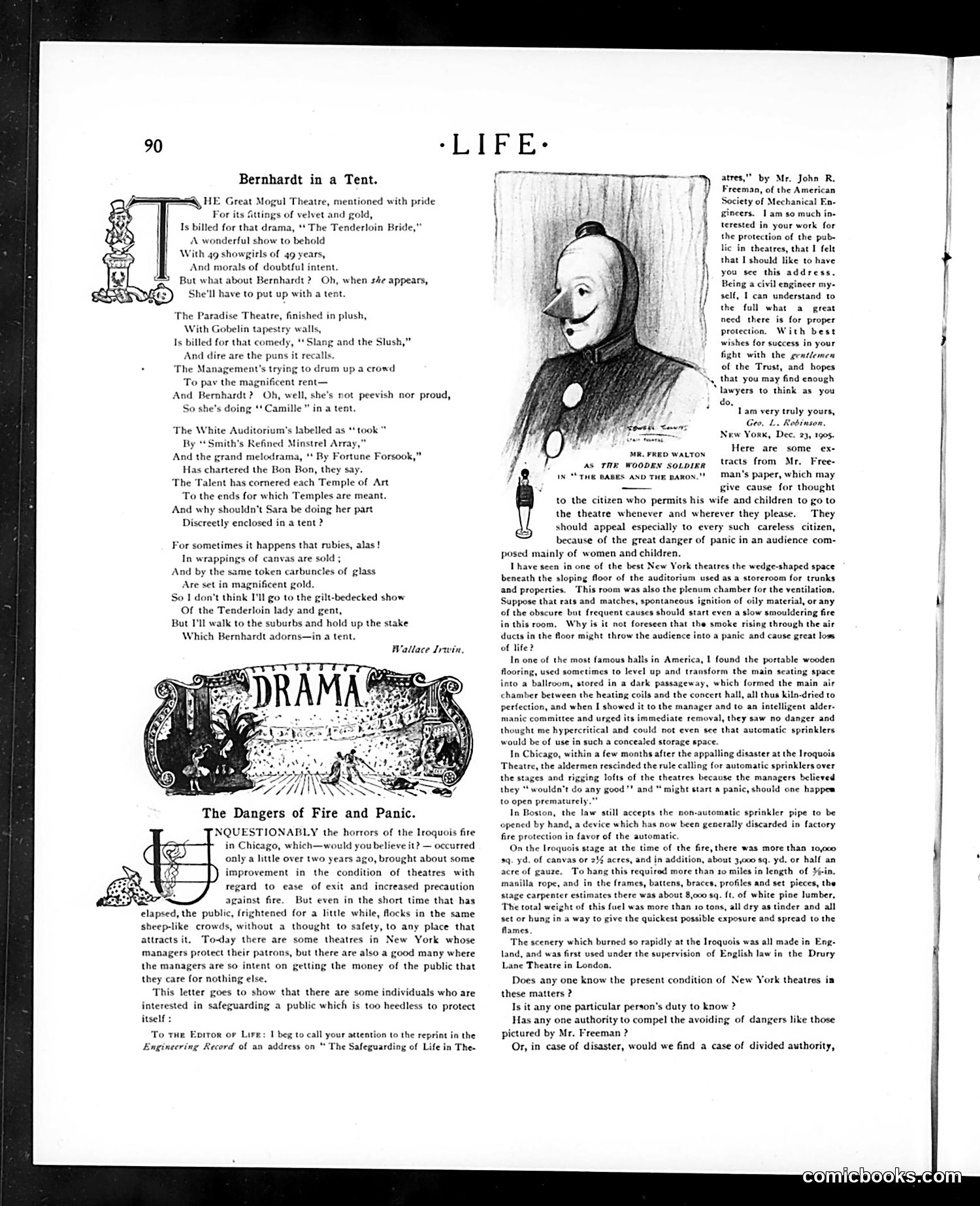
This *Life* magazine page (page 90) contains two distinct pieces: **"Bernhardt in a Tent"** (poem by Wallace Irwin): A satirical jab at Sarah Bernhardt, the famous French actress, performing in New York. The joke: while luxurious theaters (The Great Mogul, Paradise Theatre, White Auditorium) host inferior productions with gaudy décor and mediocre talent, the celebrated Bernhardt must perform "Camille" in a modest tent. The satire mocks both theater managers' misplaced priorities and New York's theatrical landscape—equating fancy velvet and tapestries with worthlessness, while genuine artistry goes unhoused. "Camille" was Bernhardt's signature role. **"The Dangers of Fire and Panic"** (editorial section): Discusses theater safety following the Iroquois Theatre fire in Chicago (1903—the text says "two years ago"). The piece criticizes theater managers who ignore fire safety to maximize profits, contrasting responsible owners with negligent ones. It includes a letter from an engineer advocating for automatic sprinklers and proper ventilation, highlighting the real hazard of panic in crowds of women and children—a contemporary safety concern reflecting early 20th-century attitudes about theater liability.
📄 Transcribed text from this page (OCR, searchable)
Machine-transcribed from the original scan — historical spelling and the odd misread are preserved.
Bernhardt in a Tent. & HE Great Mogul Theatre, mentioned with pride For its fittings of velvet and gold, Is billed for that drama, ** The Tenderloin Bride,” A wonderful show to behold With 49 showgirls of 49 years, And morals of doubtful intent. But what about Bernhardt? Oh, when se appears, She'll have to put up with a tent. The Paradise Theatre, finished in plush, With Gobelin tapestry walls, Is billed for that comedy, ** Slang and the Slush,” And dire are the puns it recalls, + ‘The Management's trying to drum up a crowd To pav the magnificent rent— And Bernhardt? Oh, well, she’s not peevish nor proud, So she’s doing Camille” in a tent. The White Auditorium’s labelled as * took” By “Smith's Refined Minstrel Array,” And the grand melodrama, ‘* By Fortune Forsook,” Has chartered the Bon Bon, they say. The Talent has cornered each Temple of Art To the ends for which Temples are meant, And why shouldn't Sara be doing her part Discreetly enclosed in a tent ? For sometimes it happens that rubies, alas! In wrappings of canvas are sold ; And by the same token carbuncles of glass Are set in magnificent gold. So I don’t think I'll go to the gilt-bedecked show Of the Tenderloin lady and gent, But I'll walk to the suburbs and hold up the stake Which Bernhardt adorns—in a tent. Wallace Irwin, The Dangers of Fire and Panic. NQUESTIONABLY the horrors of the Iroquois fire in Chicago, which—would you believe it? — occurred only a little over two years ago, brought about some improvement in the condition of theatres with regard to ease of exit and increased precaution against fire. But even in the short time that has elapsed, the public, frightened for a little while, flocks in the same sheep-like crowds, without a thought to safety, to any place that attracts it. To-day there are some theatres in New York whose managers protect their patrons, but there are also a good many where the managers are so intent on getting the money of the public that they care for nothing else. This letter goes to show that there are some individuals who are terested in safeguarding a public which is too heedless to protect itself : To tHe Eprror or Lire: I beg to call your attention to the reprint in the Engineering Record of an address on “ The Safeguarding of Life in The- atres," by Mr, John R. Freeman, of the American Society of Mechanical En- gincers. 1am so much ins terested in your work for the protection of the pub- i lic in theatres, that I felt { SY | that I should like to have | you see this address. } Being a civil engineer my- j] self, T can understand to y the full what a great «\ need there is for proper } protection, With best wishes for success in your fight with the gentlemen of the Trust, and hopes a, that you may find enough lawyers to think as you | do, Tam very truly yours, Geo, L. Robinson, se a Naw Vork, Dec. 23, 1905. win. yano wacron _-Hete are some exe as rim woopen sonpinn ‘acts from Mr. Free- IN THE HADES AND THE BARON.” Man's paper, which may give cause for thought to the citizen who permits his wife and children to go to the theatre whenever and wherever they please. They should appeal especially to every such careless citizen, because of the great danger of panic in an audience com- posed mainly of women and children. Thave seen in one of the best New Vork theatres the wedge-shaped space beneath the sloping floor of the auditorium used asa storeroom for trunks and properties. This room was also the plenum chamber for the ventilation, Suppose that rats and matches, spontaneous ignition of oily material, or any of the obscure but frequent causes should start even a slow smouldering fire in this room, Why is it not foreseen that the smoke rising through the air ducts in the floor might throw the audience into a panic and cause great low of life? In one of the most famous halls in America, I found the portable wooden flooring, used sometimes to level up and transform the main seating space into a ballroom, stored in a dark passageway, which formed the main chamber between the heating coils and the concert hall, all thus kilo-dried to perfection, and when I showed it to the manager and to an intelligent alder- manic committee and urged its immediate removal, they saw no danger and thought me hypercritical and could not even see that automatic sprinklers would be of use in such a concealed storage space. In Chicago, within a few months after the appalling disaster at the Iroquois Theatre, the aldermen rescinded the rule calling for automatic sprinklers over the stages and rigging lofts of the theatres because the managers believed they "wouldn't do any good"? and “ might start a panic, should one happew to open prematurely.”” In Boston, the law still accepts the non-automatic sprinkler pipe to be opened by hand, a device which has now been generally discarded in factory fire protection in favor of the autom: On the Iroquois stage at the time of the fire, there was more than 10/000 sq. yd. of canvas of 284 acres, and in addition, about 3,000 $q. yd, or half an acre of gauze, To hang this required more than 10 miles in length of S¢-in. manilla rope, and in the frames, battens, braces, profiles and set pieces, the stage carpenter estimates there was about 8,000 sq. ft, of white pine lumber. The total weight of this fuel was more than 10 tons, all dry as tinder and all set or bung in a way to give the quickest possible exposure and spread to the flames. The scenery which burned so rapidly at the Iroquois was all made in Eng. land, and was first used under the supervision of English law in the Drury Lane Theatre in London. Does any one know the present condition of New York theatres in these matters ? Is it any one particular person's duty to know ? Has any one authority to compel the avoiding of dangers like those pictured by Mr. Freeman ? Or, in case of disaster, would we find a case of divided authority, wes u