
Life, 1906-01-18 · page 10 of 28
Life — January 18, 1906 — page 10: what you’re looking at
What you’re looking at
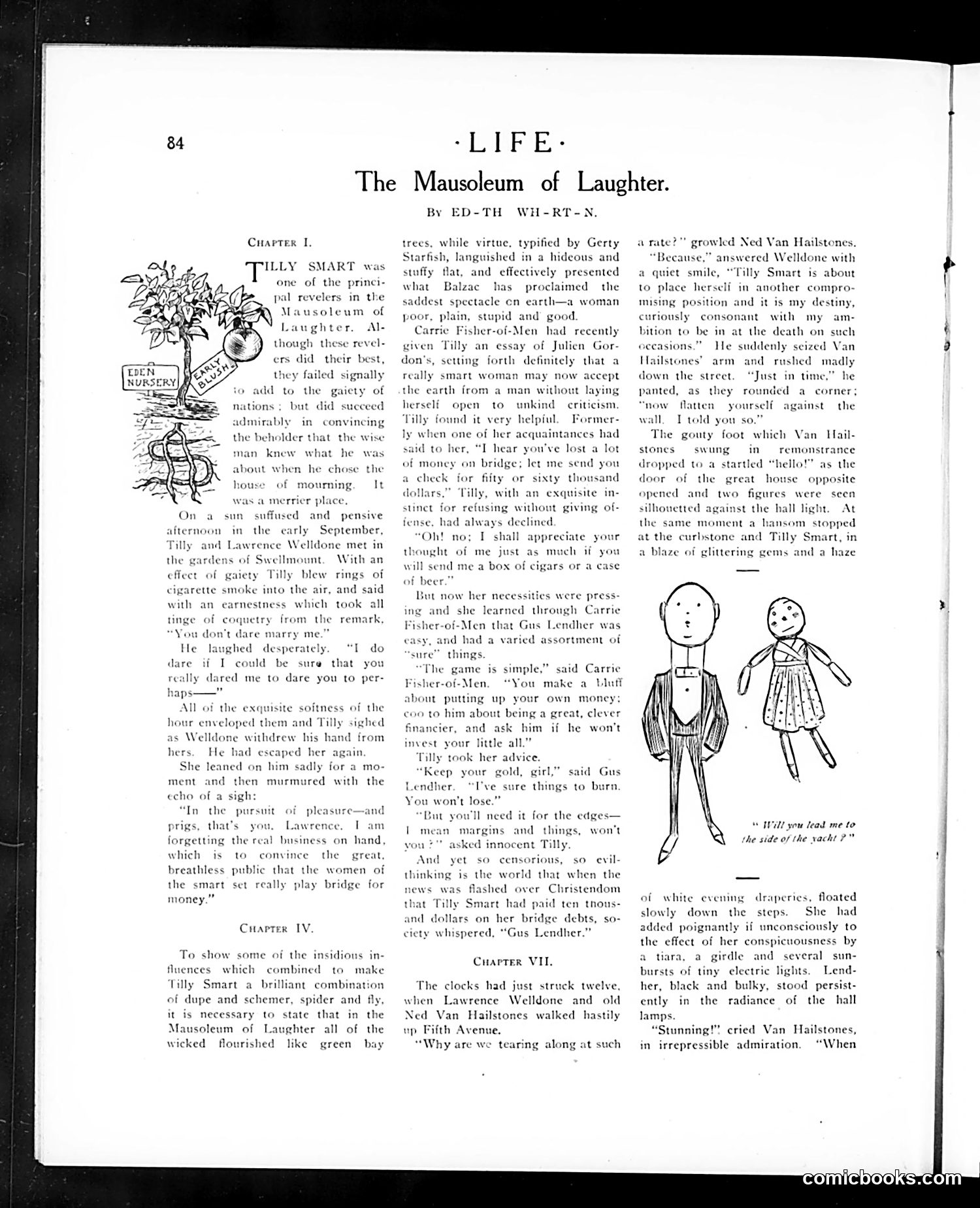
This page contains the opening of a serialized story by "Ed-Th Wh-rt-n" (likely Edith Wharton, with letters obscured). The narrative satirizes wealthy American society through characters like **Tilly Smart**, a woman criticized for her financial irresponsibility and social pretensions. The two simple stick-figure drawings illustrate the story's characters in conversation. The text mocks the leisured elite's frivolous behavior—particularly women playing bridge for money and living beyond their means—while praising those who accumulate and guard wealth. The satire targets **Gilded Age excess and financial foolishness** among the upper classes, presenting moralistic criticism of profligacy as entertainment. This reflects early 20th-century American anxieties about wealth, women's independence, and social responsibility.
📄 Transcribed text from this page (OCR, searchable)
Machine-transcribed from the original scan — historical spelling and the odd misread are preserved.
-LIFE- The Mausoleum of Laughter. Cuarter I. TILLY SMART was one of the princi- pal revelers in the Mausoleum of Laughter. Al though these revel- ers did their best, (Eiken they failed signally » add to the gaiety of nations ; but did succeed admirably in convincing the beholder that the wise man knew what he was about when he chose the house of mourning. It was a merrier place, On a sun suffused and pensive tember, afternoon in the early Se awrence Welldone met in mount. With a Tilly and I the gardens of Sw cffe ly blew rings of cigarette smoke into the air, and said with an earnestness which took all remark, of gaiety Ti retry from ou don’t dare marry me He laughed desperately. “I do dare if I could be sure that you really dared me to dare you to per- haps——" All of the exquisite softness of the hour enveloped them and Tilly sighed as Welldone withdrew his hand from hers. He had escaped her again She leaned on him sadly for a mo- ment and then murmured with the echo of a sigh: “In the pursuit of pleasure—and prigs, that’s you. Lawrence, [am forgetting the real business on hand, which is to convince the great breathless public that the women of the smart set really play bridge for money.” Crtapter IV. To show some oi the insid in- fluences which combined to make Tilly Smart a. brillig of dupe and schemer, spider and fly, nt combination it is necessary to state that in the Mausoleum of Laughter all of the wicked flourished like green bay By ED-TH WH-RT- trees, while virtue, typified by Gerty Starfish, languished in a hideous and stuffy flat, and effectively presented what Balzac has proclaimed the saddest spectacle en earth—a woman , ain, stupid and good -Men had recently given Tilly an essay of Julien Gor- don’s, setting forth definitely that a really smart woman may now accept poor, 7 Ti Fisher-c the earth from a man without laying herselé. open to unkind criticism Tilly: fe en one of her acquaintances had to her, “I hear you've lost a lot of money on bridge; let me send you fifty or sixty thousand and it very helpiul. Former- check Hars.” ‘Tilly, with an exquisite in- stinet for refusing without giving of- fense, had always declined “Oh! no; I shall appreciate your thought of me just as much if you will send me a box of cigars or a case of beer.” But now her necessities were press ing and she learned through Carrie Fisher-of-Men that Gus Lendher wa assortment of and had a vari easy, sure” things The game is simple,” said Carrie Fisher-of-Men. “You make a Ulutl about putting up your own money: coo to him about being a great, clever financier, and ask him if he won't invest your little all.” Tilly took her advice. “Keep your gold, girl,” said Gus ¢ things to burn Lendher I've You won't lose.” “But you'll need it for the edges— margins and things, won't 1 innocent Tilly I me as you And yet so censorious, so evil- thinking is the world that when the news was flashed over Christendom that Tilly Smart had paid ten thous- and dollars on her bridge debts, so- ciety whispered, “Gus Lendher.” Cuarter VII. The clocks had just struck twelve. when Lawrence Welldone and old Ned Van Hailstones walked hastily up Fifth Avenue. “Why are we tearing along at such growled Ned Van Hailstones. ause,” answered Welldone with smile, “Tilly Smart is about ¢ herself in another compro- mising position and it is my destiny, curiously consonant with my am- bition to be in at the death on such oceasions.” He suddenly seized Van Hailstones’ arm and rushed madly down the street Just in time,” he anted, as they rounded a corner; “now flatten yourselé against the wall, I told you so. The gouty foot which Van Hail- stones swung in remonstrance dropped to a startled “hello!” as the door of the great house opposite opened and wo figures were seen silhouetted against the hall light. At the same moment a han at the curbstone and Tilly Smart, in m_ stopped a blaze of glittering gems and a haze “Will you lead me to the side of the yacht ?” of white evening draperies, floated slowly down the steps. She had added poignantly if unconsciously to the effect of her conspicuousness by a tiara, a girdle and several sun- bursts of tiny. electric lights. Lend- her, black and bulky, stood persist- ently in the radiance of the hall lamps. “Stunning!” cried Van Hailstones, in irrepressible admiration. “When —— > ¢