
Life, 1906-01-18 · page 7 of 28
Life — January 18, 1906 — page 7: what you’re looking at
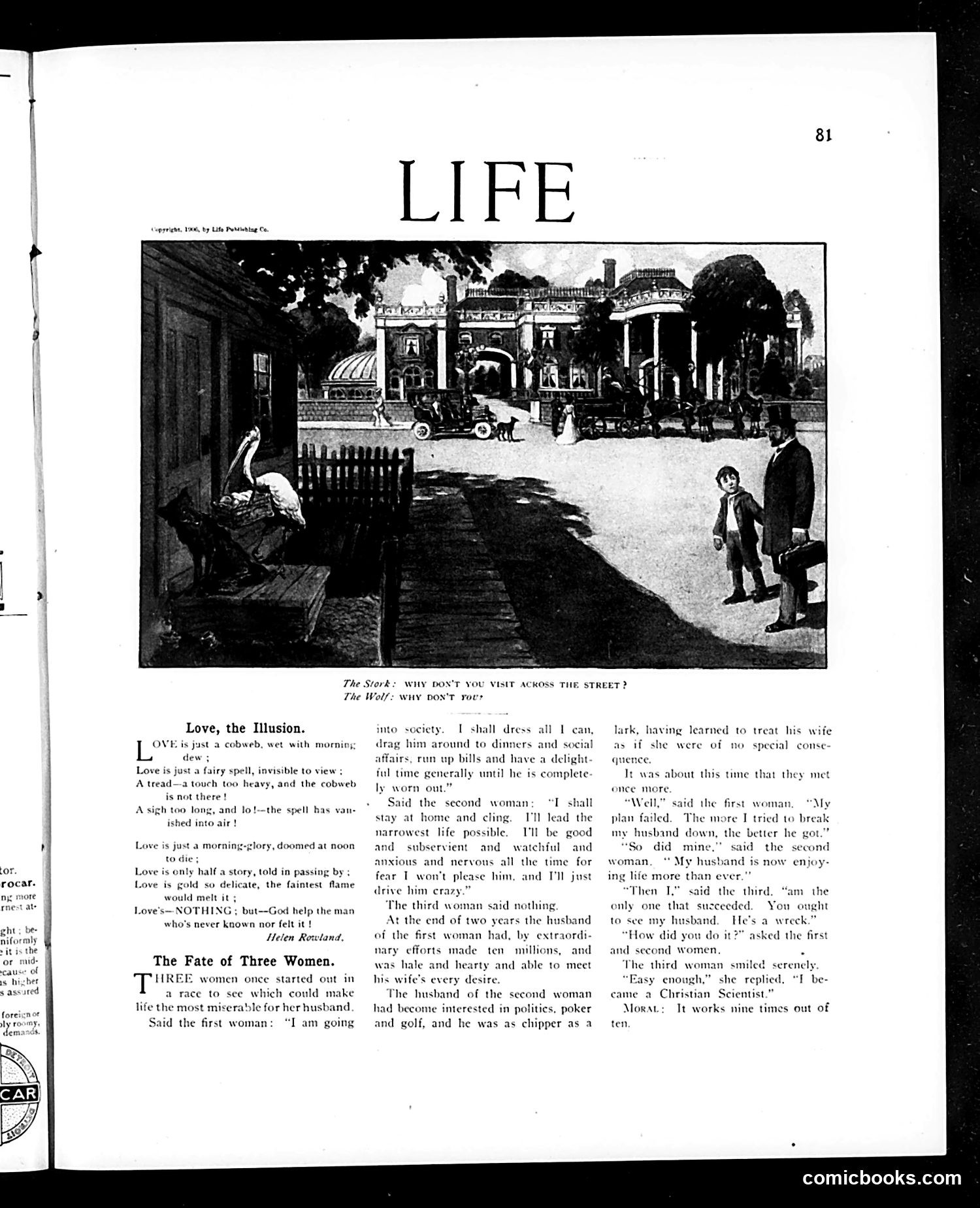
What you’re looking at
This page presents a satirical narrative titled "The Fate of Three Women," accompanied by an illustration showing an elegant estate with automobiles and well-dressed figures. The story mocks romantic ideals by contrasting three women's outcomes after marriage. The first woman pursues social climbing and materialism ("drag him around to dinners and social affairs"). The second seeks traditional domesticity ("stay at home and cling"). The third remains silent, ultimately proving most successful through restraint. The satire critiques early 20th-century gender expectations and marriage dynamics. The "Christian Scientist" reference suggests contemporary religious movements. The underlying joke: all three women's strategies fail or complicate their marriages, but silent acceptance paradoxically "works nine times out of ten"—mocking both female agency and marital success itself.
📄 Transcribed text from this page (OCR, searchable)
Machine-transcribed from the original scan — historical spelling and the odd misread are preserved.
or. rocar. nyg more ght niformly sit is the or muid- cause of s hizber | sassired J foreiinot ly roomy demands. Copyright, 1906, by Life Pouentng Co 81 The Stork: WUY DOX'T YOU VISIT ACKOSS THE STREET ? The Wolf: wuy dON'T your Love, the Illusion. OVE is just a cobweb, wet with morning Li dew ; Love is just a fairy spell, invisible to view ; A tread—a touch too heavy, and the cobweb is not there! A sigh too long, and | © spell has van- ished into air! Love is just a morning-glory, doomed at noon to die ; Love is only half a story, told in passing by : Love is gold so delicate, the faintest flame would melt it; Love's—NOTHING ; but--God help the man who's never known nor felt it ! Helen Rowland, The Fate of Three Women. women once started out in THRE a race to see which could make life the most miserable for her husband Said the first woman: “I am going into society. I shall dress all 1 can, drag him around to dinners and social affairs, run up bills and have a delight ful time generally until he is complete ly worn out.” Said the second woman; “I shall stay at home and cling. I'll lead the narrowest life possible. ll be good and subservient) and watchful and anxious and nervous all the time for fear T won't please him, and I'll just drive him crazy.” The third woman said nothing. At the end of two years the husband of the first woman had, by extraordi- 'y efforts made ten millions, and was hale and hearty and able to meet his wife’s every desire. The husband of the second woman had become interested in polities, poker and golf, and he was as chipper as a ni lark, having learned to treat his wite as if she were of no special conse- quence. It was about this time that they met once more. “Well,” said the first woman, “My plan failed. The more I tried to bre: my husband down, the better he got.” “So did mine,” said the second woman, “ My husband is now enjoy: ing life more than ever.’ “Then 1" said the third, “am the only one that succeeded. You my husband. He's a wrec “How did you do it?” asked the first 10 se and second women, . The third woman smiled serene! ‘asy enough,” she replied, “I be- came a Christian Scientist.” Morat: It works nine times out of ten. comicbooks.com