
Life, 1906-01-18 · page 18 of 28
Life — January 18, 1906 — page 18: what you’re looking at
What you’re looking at
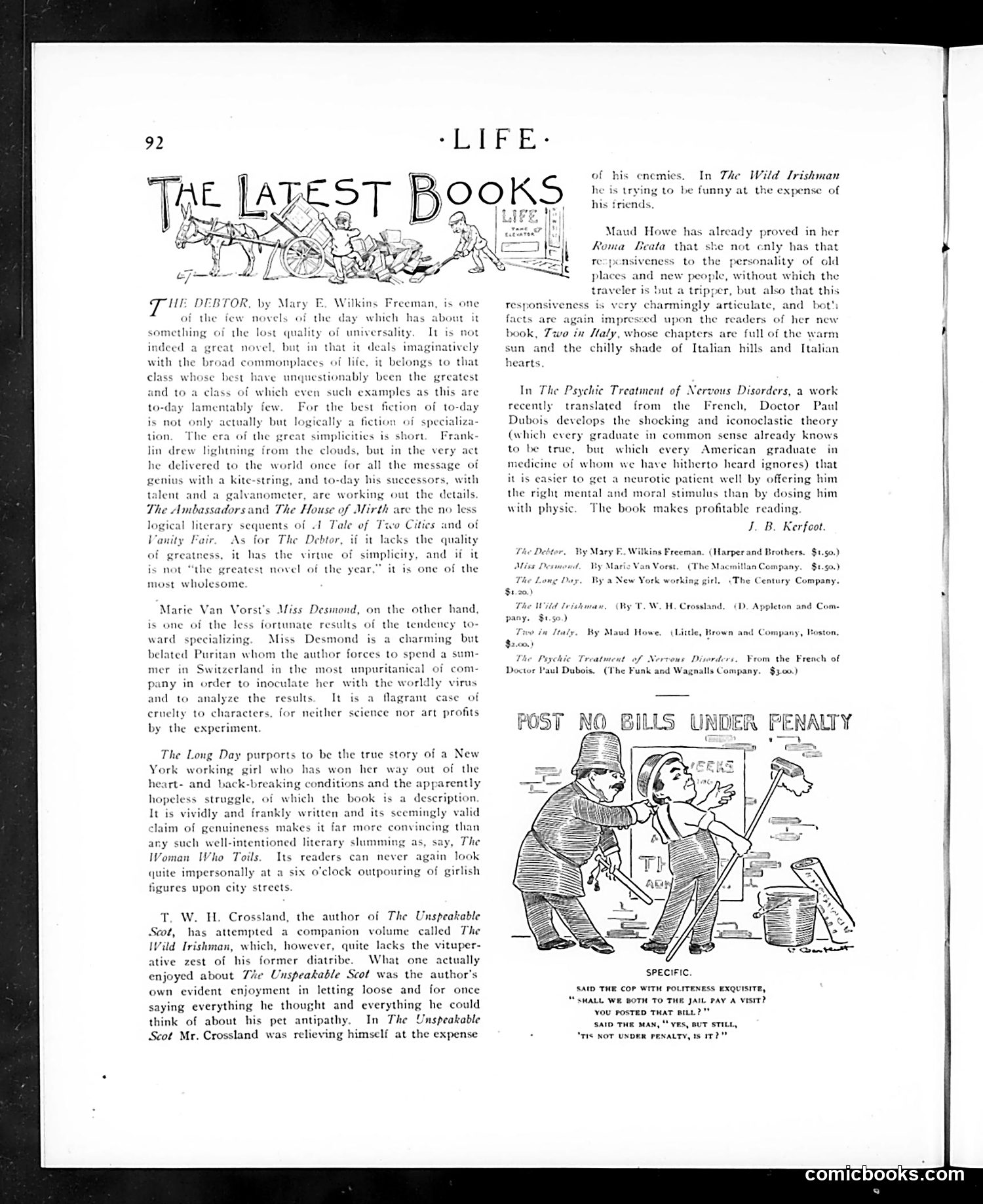
This cartoon satirizes petty municipal enforcement and bureaucratic absurdity. It depicts a police officer confronting a man about posting bills illegally on a wall. The joke hinges on the officer's pedantic literalism: he's arresting someone for posting a bill that reads "POST NO BILLS UNDER PENALTY"—the very warning sign itself. The humor targets how authorities enforce rules mechanically without common sense. The officer treats the warning placard as itself a violation, missing the obvious irony that the sign *is* the law's instruction, not an infraction of it. This reflects early-20th-century American frustration with rigid bureaucratic enforcement and the gap between rule-makers' intent and street-level implementation. The cartoon uses exaggeration to mock officials who follow the letter of law while ignoring its spirit.
📄 Transcribed text from this page (OCR, searchable)
Machine-transcribed from the original scan — historical spelling and the odd misread are preserved.
Tite DEBTOR, by Mary Wilkins Freem: of the jew novels of the day which has about it something of the lost quality of universality. It is not indeed it novel. with the class whe in that it deals imaginatively hat st es of life, belo} dd commonpla Dest have unquestionably been the great and to a class of which even such examples as this a vr the best fiction of to-day to-day is not « a fiction actually but logical specializ tion. The era of the great simplicities is short. Frank- lin drew lightning from the clouds, but in the very act ¢ delivered to the world once for all the messaj genius with a kite-string, and to-day his successors, with lent and a ga king out the details The Ambassadors and The House of Mirth are the no less logical literary sequents of «1 Tale of Two Cities and of As for The Debtor, if it lacks the quality ss. it has the virtue of simplicity, and if it rit is one of the Ivanc eter, are WC Vanity Fe of gre is not “the g most wholesome. est novel of the yea Marie Van Vorst’s Miss Desmond, on the other hand, is one of the less fortunate results of the tendency to- ward specializing. Miss Desmond is a charming but belated Puritan whom the author forces to spend a sum- mer in Switzerland in the most unpur} 1 of com- pany in order to inoculate her with the worldly virus and to analyze the results. It is a flagrant case of cruelty to el . for neither science nor art profits by the experiment. rac The Long Day purports to be the true story of a New York working girl who has won her way out of the heart- and bac king conditions and the apparently cless struggle, of which the book is a description It is vividly and frankly written and its seemingly valid -bre claim of genuineness makes it far more convincing than he any such well-intentioned literary slummir y. Woman Who Toils. Its readers can never again look jock outpouring of girlish quite impersonally at a six figures upon city streets T. W. H. Crossland, the author of The Unspeakable Scot, has attempted a companion volume called The Wild Irishman, which, however, quite lacks the vituper- ative zest of his former diatribe. What one actually enjoyed about Tue Unspeakable Scot was the author's own evident enjoyment in letting loose and for once saying everything he thought and everything he could think of about his pet antipathy. In The Unspeakable Scot Mr. Crossland was relieving himself at the expense of his enemies. In The Wild Irishman he is trying to be funny at riends, b expense of Maud Howe has already proved in her Roma Beata that she not cnly has that re <nsiveness to the personality of old places and new people, without which the traveler is but a tripper, but also that this responsiveness is very charmingly articulate, and bot’: impressed upon the readers of her new book, Two in Maly, whose chapters are full of the warm sun and the chilly shade of Italian hills and Italian hearts facts are a: In The Psychic Treatment of Nervous Disorders, a work recently translated from the French, Doctor Paul Dubois develops the shocking and iconoclastic theory (which every graduate in common sense already knows to be truc, but which every American graduate in medicine of whom we have hitherto heard ignores) that it is easier to get a neurotic patient well by offering him the right mental and moral stimulus than by dosing him with physic. The book makes profitable reading J. B. Kerfoot. The Debtor, Vy Mary F.. Wilkins Freeman. (Harper and Brothers. $1.50.) y Maric Van Vorst. (The Macmillan Co The Long Day. Wy a New York w 1. The ¢ $1.20.) The Witd Irishn Miss Desmoudl. ) ay. $ Company. rr) Ry T.W.H, Cross! (D. Appleton » in Italy, By Maud Howe, (Little, Brown and Company, Hoston, Doctor Haul Dubois. (The Funk and Wagnalls Company. $3.00.) From the French of SPECIFIC. SAID THE COP WITH POLIT “SMALL WE BOTH TO THE JA\ YoU POSTED THAT BILL? SAID THE MAN, “YRS, BUT STILL, ‘TIS NOT UNDER PENALTY, 18 IT?" SS EXQUISITE, PAY A visit? comicbooks.com °