
A complete issue · 44 pages · 1905
Life — October 5, 1905
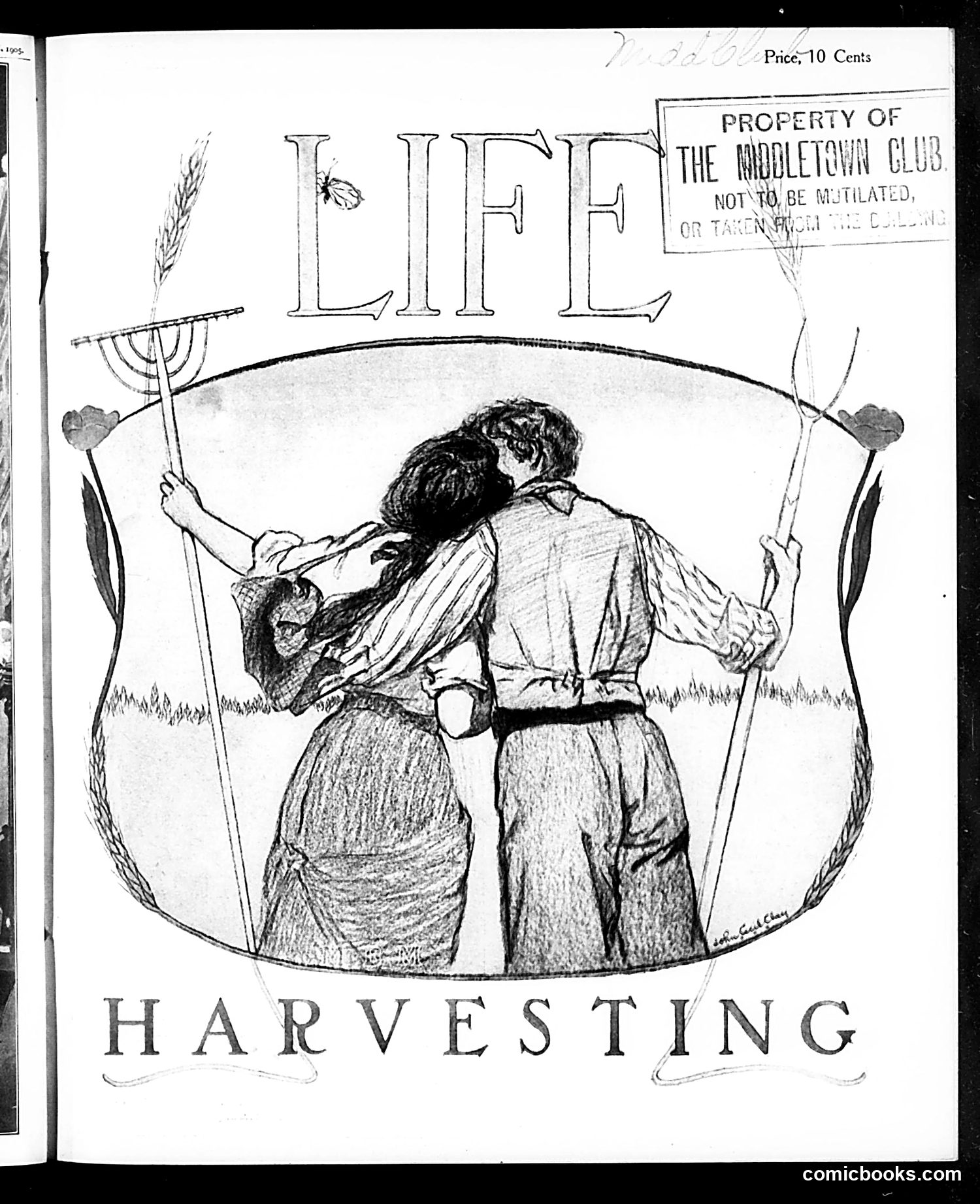
This appears to be a cover from *Life* magazine (price 10 cents) titled "Life Harvesting." The illustration shows two figures in a field holding farming tools—a scythe and rake—facing away from the viewer. The artistic style and composition suggest this is satirical commentary on labor, agricultural work, or possibly social/economic conditions. Without additional context clues (dates, names, or contemporary references visible in the image), I cannot definitively identify the specific historical event, political figures, or social issue being referenced. The "harvesting" metaphor could relate to labor movements, harvest season conditions, or broader economic commentary typical of *Life* magazine's satirical approach during the early-to-mid 20th century.
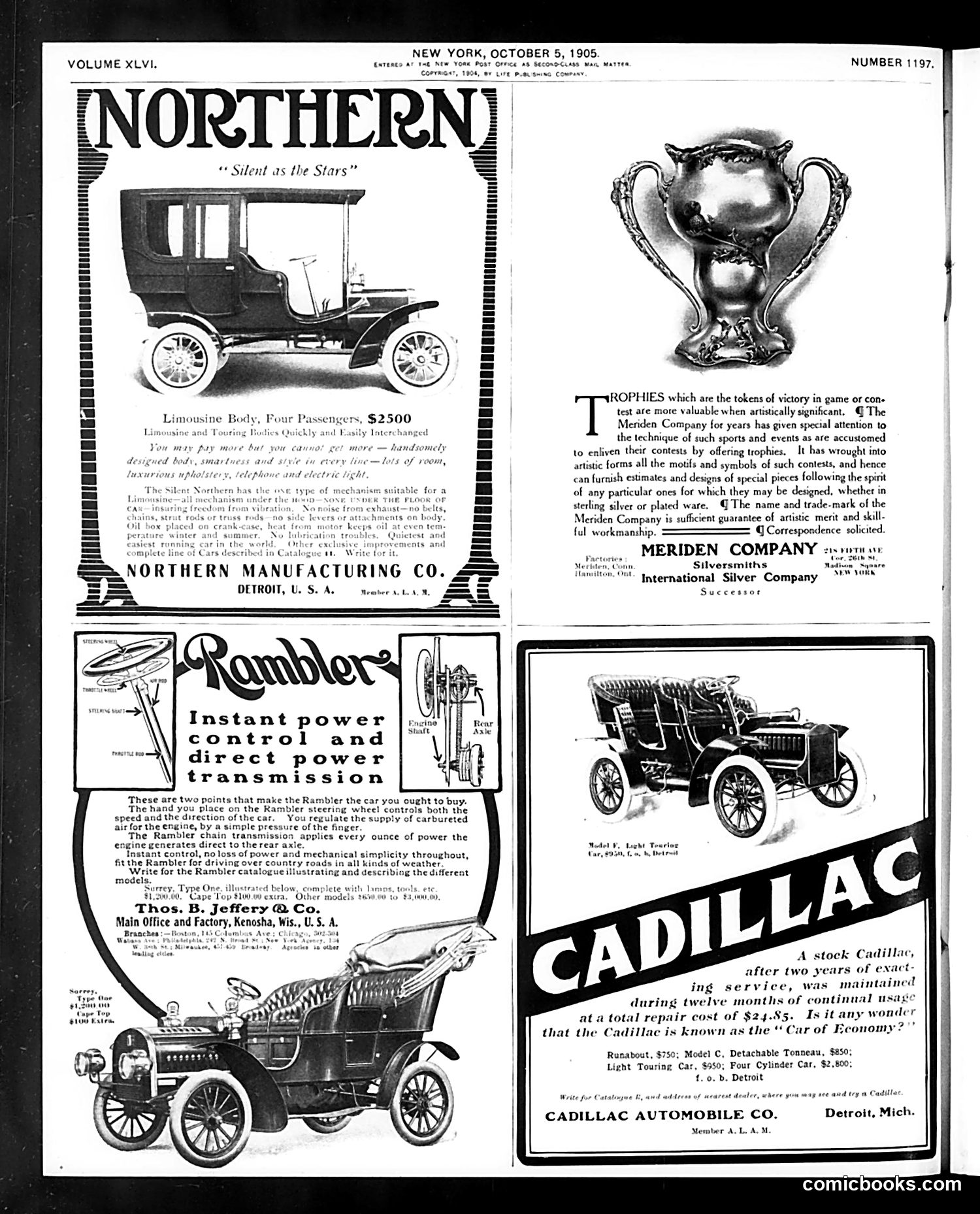
This page contains **automobile advertisements rather than political cartoons or satire**. It dates to October 5, 1905, and features four car ads: 1. **Northern Manufacturing Co.** (Detroit) - promotes a limousine body priced at $2,500 2. **Meriden Company** - advertises silver trophies for sporting contests 3. **Rambler** (Thos. B. Jeffery Co.) - highlights "instant power control and direct power transmission" 4. **Cadillac Automobile Co.** - showcases a light touring car, emphasizing reliability through a repair-cost case study ($24.85 for two years' use) The advertisements target wealthy early-automobile buyers, emphasizing luxury features, mechanical innovation, and durability. There is no political satire present on this page—it represents commercial content typical of *Life* magazine's revenue model during the early automotive era.
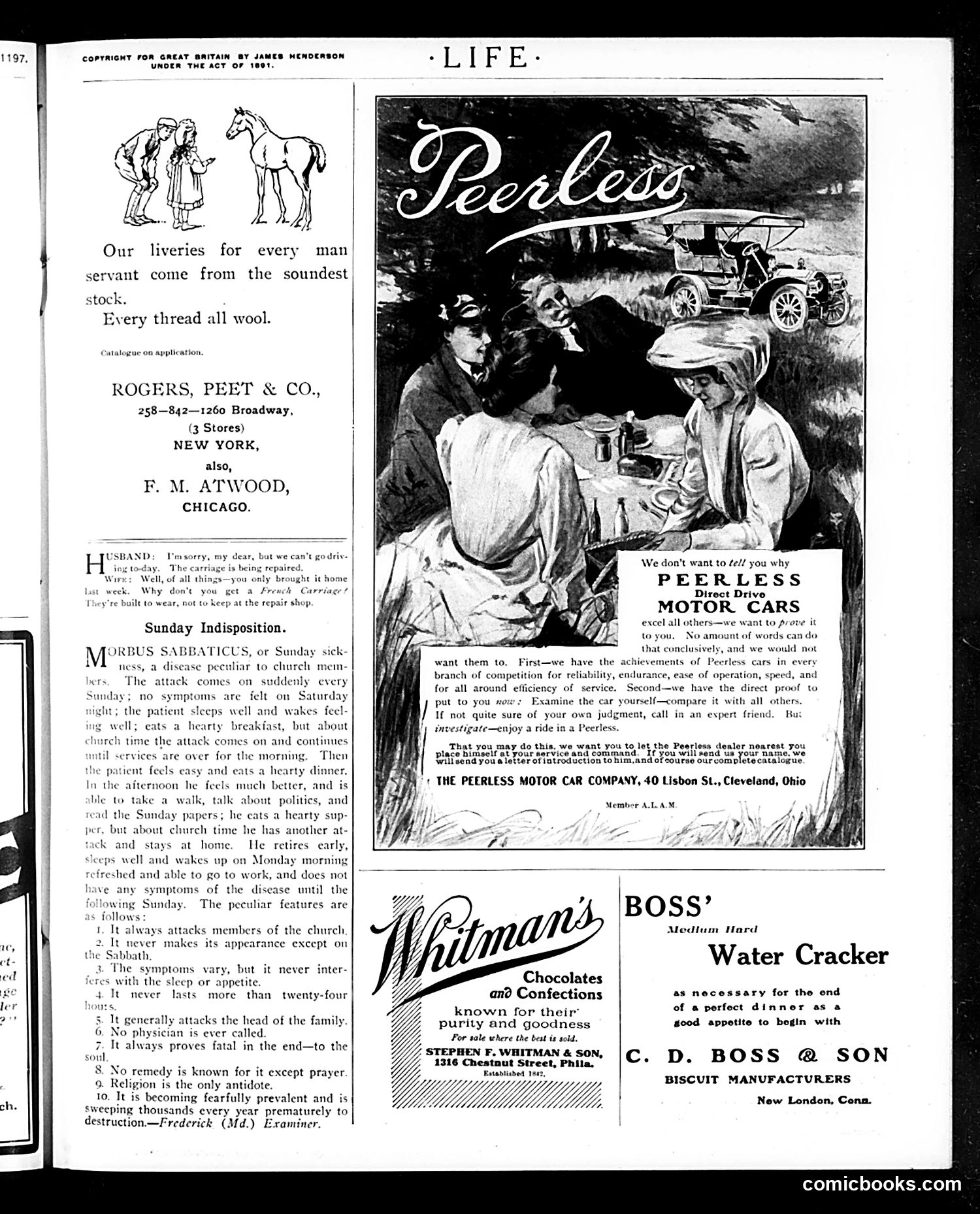
This page is primarily **advertising** rather than political satire. The main content includes: 1. **Rogers, Peet & Co.** (top left): A clothing advertisement emphasizing wool liveriesavailable from their Broadway stores. 2. **Peerless Motor Cars** (center): A large advertisement showing a social scene—people on a picnic with an automobile in background. The text argues Peerless cars excel in reliability and efficiency, inviting readers to examine and compare them to competitors. 3. **Whitman's Chocolates** and **Boss Water Cracker** (bottom): Additional product advertisements. A brief **medical article** titled "Sunday Indisposition" discusses a supposed Sunday illness affecting church members, presented with mock-scientific detail—likely satirizing hypochondria or religious hypocrisy rather than making specific political commentary. The page reflects early 1900s American consumer culture and advertising practices.
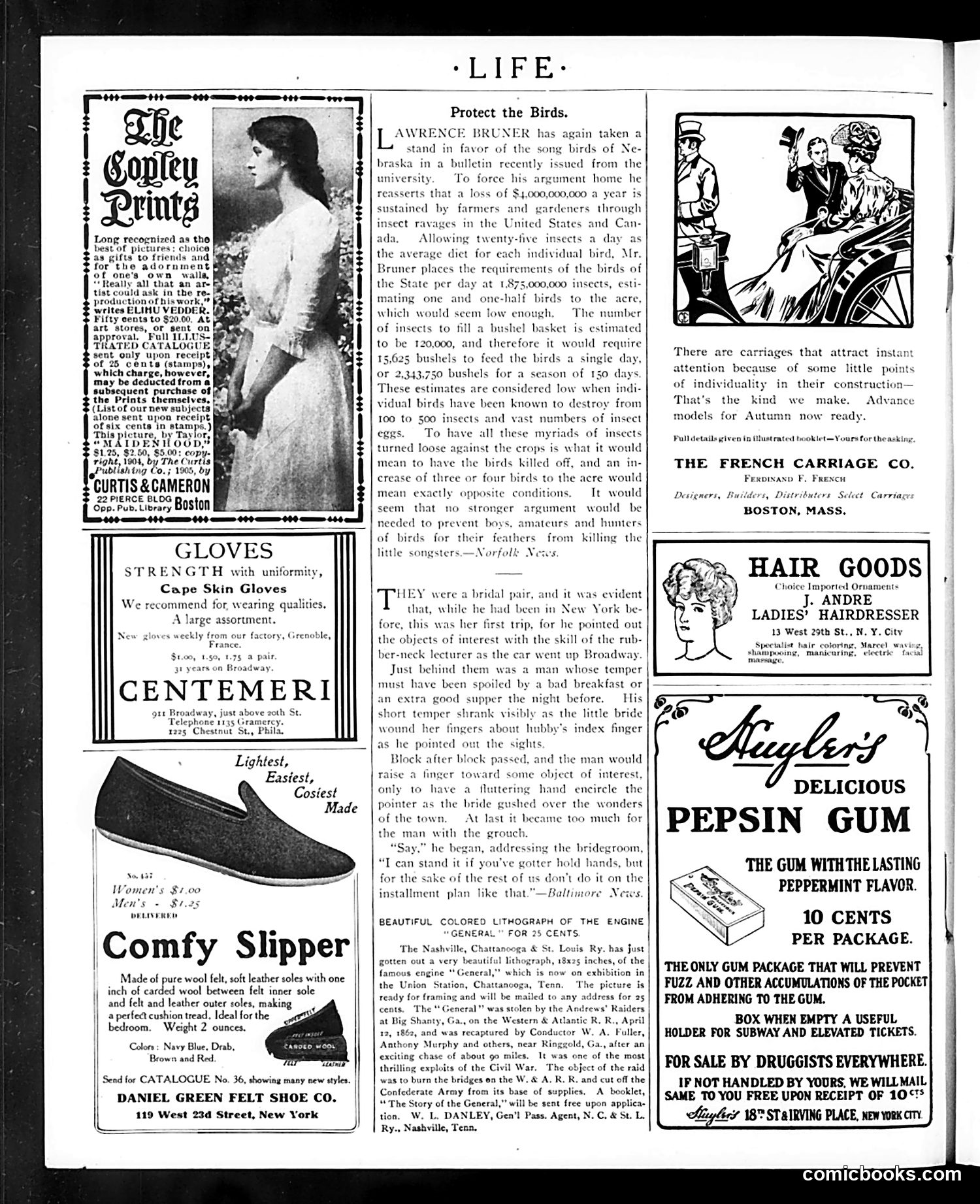
This page is **primarily advertising** with one significant editorial article. The main content is Lawrence Bruner's argument to "Protect the Birds." Bruner advocates for songbird conservation by quantifying economic losses—$1 billion annually from insect damage—and noting that birds consume massive quantities of insects. He argues that protecting even three or four birds per acre would offset crop damage, making bird preservation economically sensible, not merely sentimental. The piece targets farmers and gardeners as the intended audience. The remainder of the page contains period advertisements for gloves, slippers, hair goods, and pepsin gum—typical early 20th-century commercial content with no satirical intent. There are no political cartoons or caricatures visible on this page.
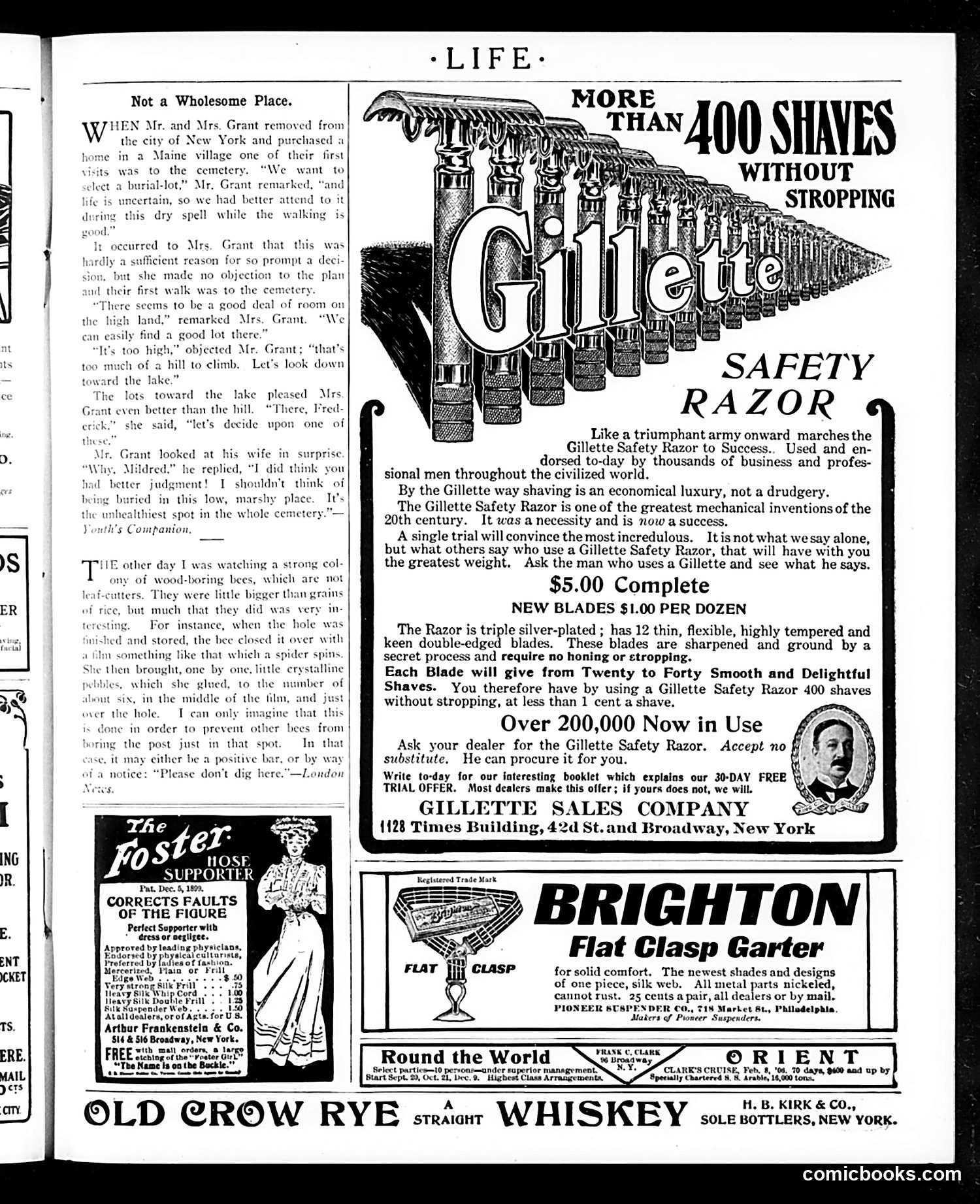
This page is primarily **advertising rather than political satire**. The dominant content is a large Gillette Safety Razor advertisement claiming "more than 400 shaves without stropping" and promoting the razor as a mechanical innovation. The ad emphasizes the product's superiority and includes testimonial language ("Ask the man who uses a Gillette"). The smaller cartoon titled "Not a Wholesome Place" appears to be a humorous domestic anecdote about Mr. and Mrs. Grant choosing a cemetery plot, with no apparent political commentary—just gentle satire about an ordinary couple's anxieties about burial location. The remaining content consists of additional product advertisements (Foster corset supporter, Brighton garter, Old Crow whiskey, and a cruise line), with no significant political or social commentary visible.
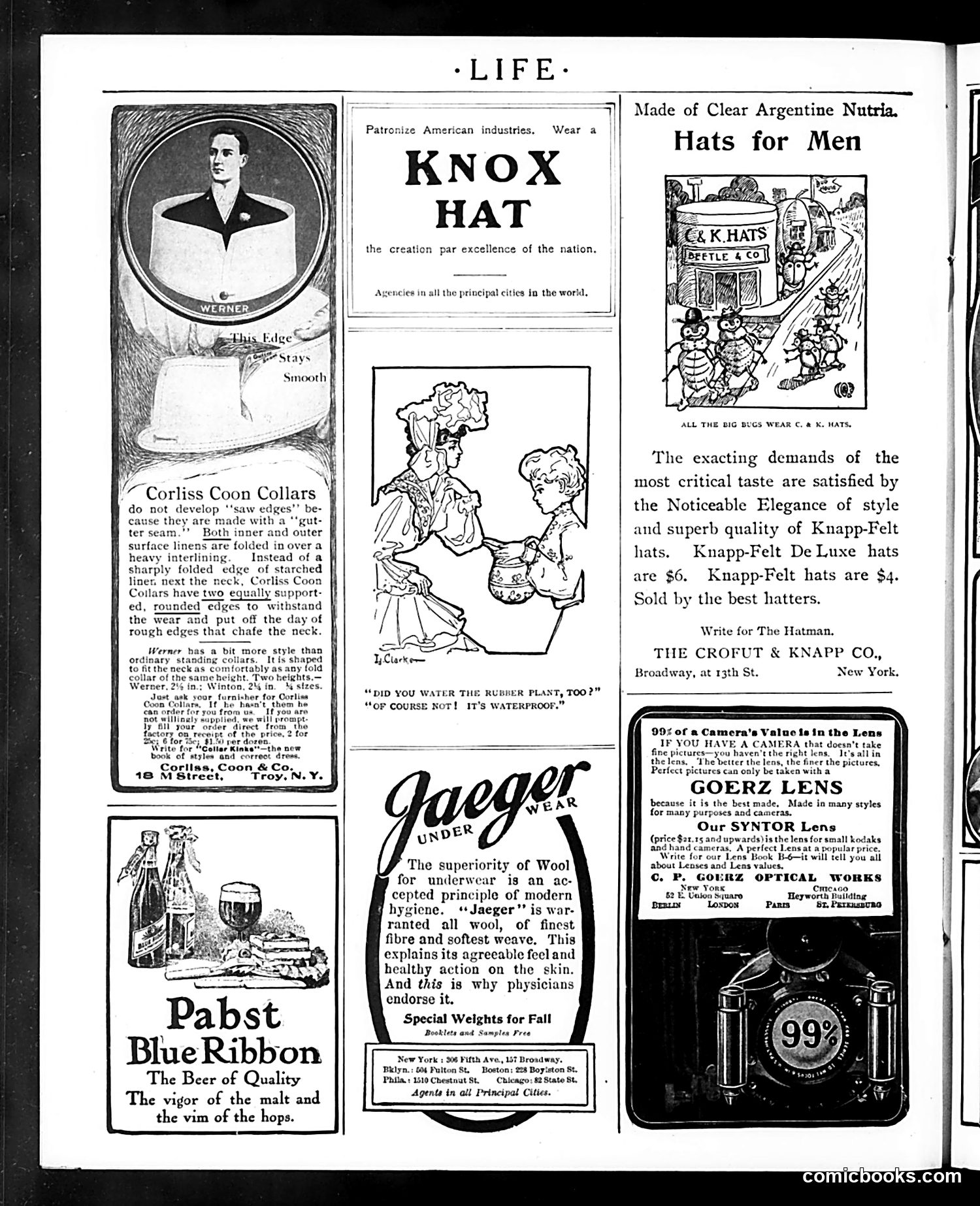
This page is **primarily advertising**, not political satire. It contains four distinct product advertisements: 1. **Corliss Coon Collars** - promotes men's collars claiming they don't develop "saw edges" from wear 2. **Knox Hat** - advertises men's hats as "the creation par excellence of the nation" 3. **Jaeger Underwear** - emphasizes wool undergarments for health and hygiene, with a small cartoon showing two figures discussing waterproofing 4. **Pabst Blue Ribbon Beer** and **Goerz Lens** camera equipment round out the page The only minor satirical element is the small Jaeger cartoon labeled "DID YOU WATER THE RUBBER PLANT, TOO?" / "OF COURSE NOT! IT'S WATERPROOF" — a mild joke about waterproof clothing. Otherwise, this reflects early 20th-century consumer advertising focused on quality menswear and household products.
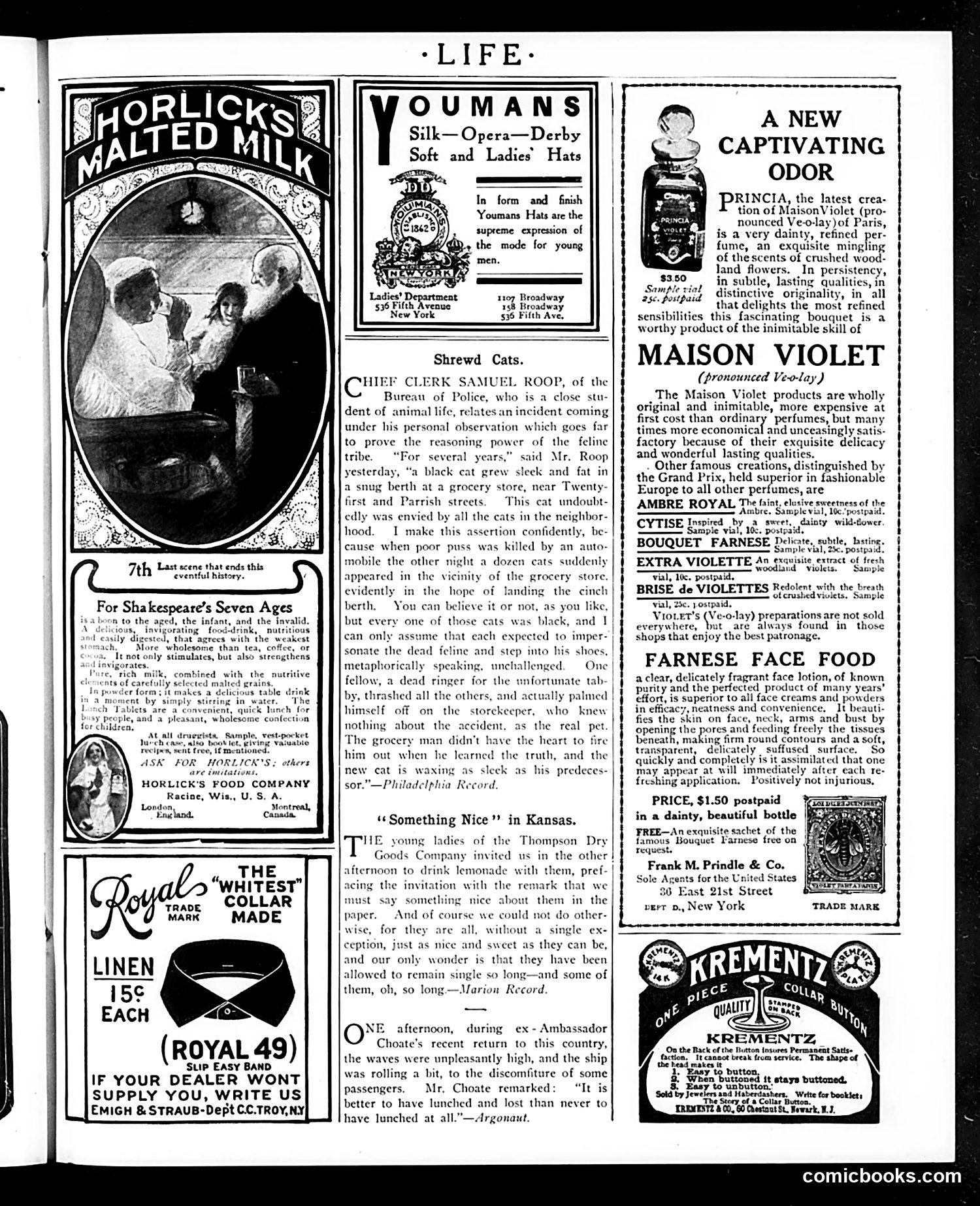
This page is primarily **advertisements and commercial content**, not political satire. The visible items include: - **Horlicks Malted Milk** ad featuring a woman and child - **Youmans Silk Opera and Derby Hats** advertisement - **Maison Violet perfume** promotion for "Prinicia" fragrance - **Farnese Face Food** cosmetic product - **Royal "Whitest" Collar** linen product (15¢ each) - **Krementz collar button** advertisement The page also contains short humorous anecdotes titled "Shrewd Cats" and "Something Nice in Kansas," which are light social commentary rather than political satire—typical filler content for the era's magazines. This appears to be a standard early 20th-century magazine page mixing advertisements with brief entertainment pieces; it contains **no identifiable political cartoons or significant social commentary**.
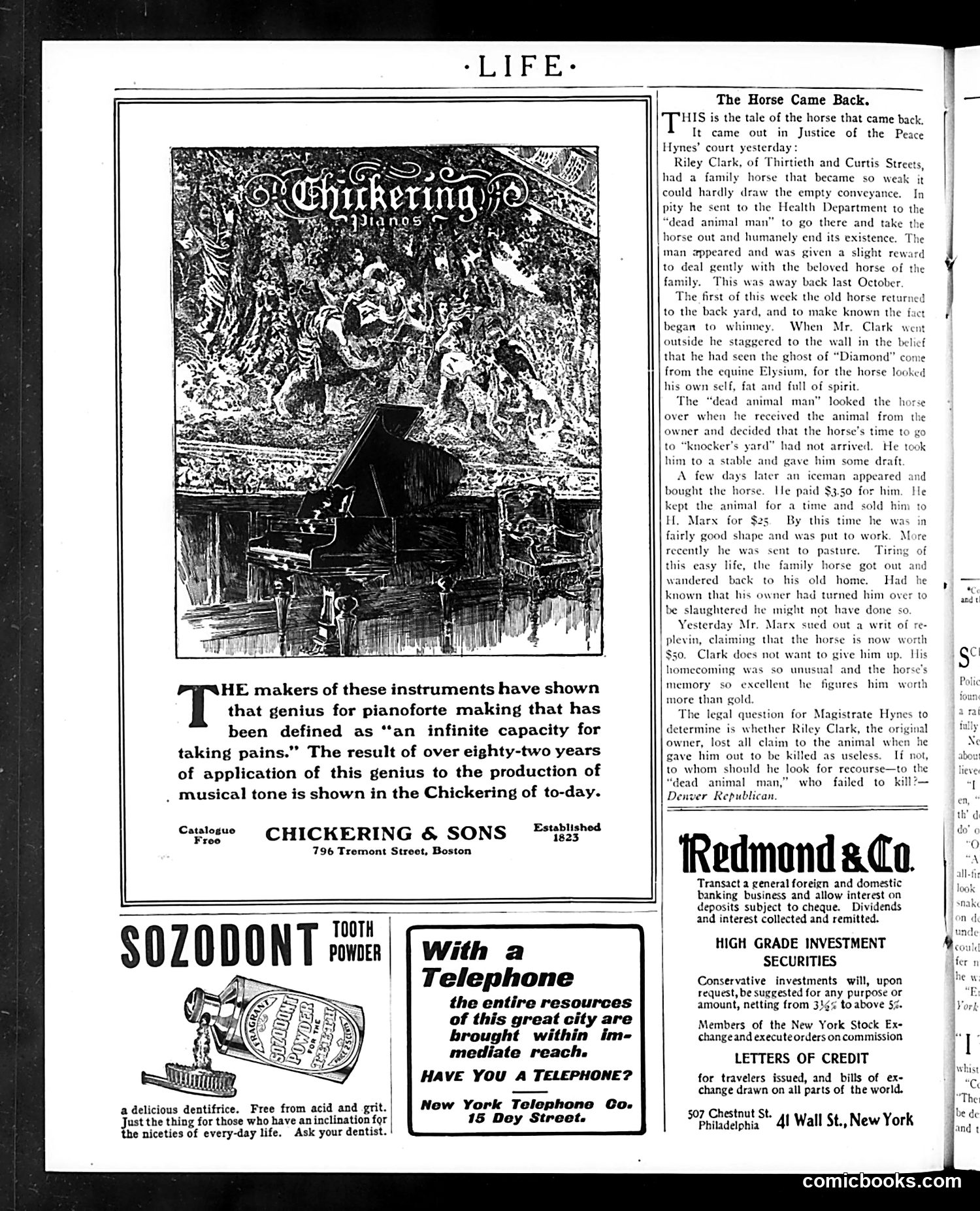
This page presents a short story rather than political satire. "The Horse Came Back" recounts a sentimental narrative: Riley Clark of Justice Court owned a family horse that became too weak to work. He sent it to be humanely euthanized, but the horse mysteriously returned to his yard weeks later—apparently having been sold instead. The animal had regained health and spirit. Clark's legal claim to recover the horse was challenged in court, ultimately succeeding when the "dead animal man" who failed to kill it couldn't prove ownership. The accompanying illustration shows a pianist at a grand piano with decorative tapestry backdrop, advertising Chickering & Sons pianos—unrelated to the story text. The page mixes editorial content with multiple advertisements typical of the era.
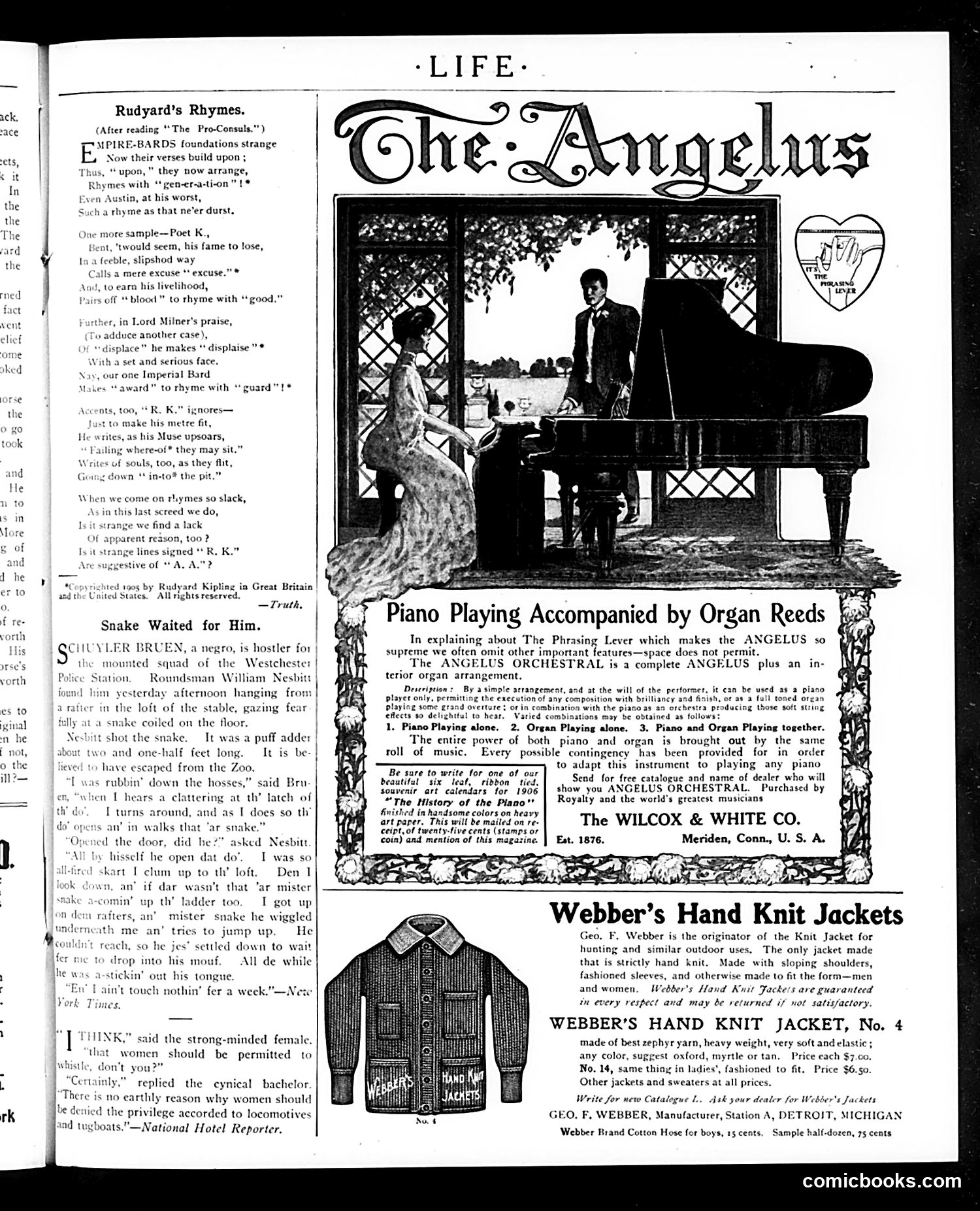
This page is primarily **advertising and light editorial content**, not political satire. The main visual features "The Angelus Orchestral" — an advertisement for a piano with organ reed accompaniment made by Wilcox & White Co. The illustration shows a couple in a parlor, with the man at the piano and woman listening, depicting a genteel domestic music scene. Below is an advertisement for **Weber's Hand Knit Jackets**, showing a knitted garment. The left column contains "Rudyard's Rhymes" (poetry commentary) and "Snake Waited for Him" (a humorous anecdote about a black stable worker named Schuyler Bruen who encounters a snake). The story relies on period dialect and racial stereotypes common to early 1900s humor magazines. There is **no significant political cartoon** on this page.
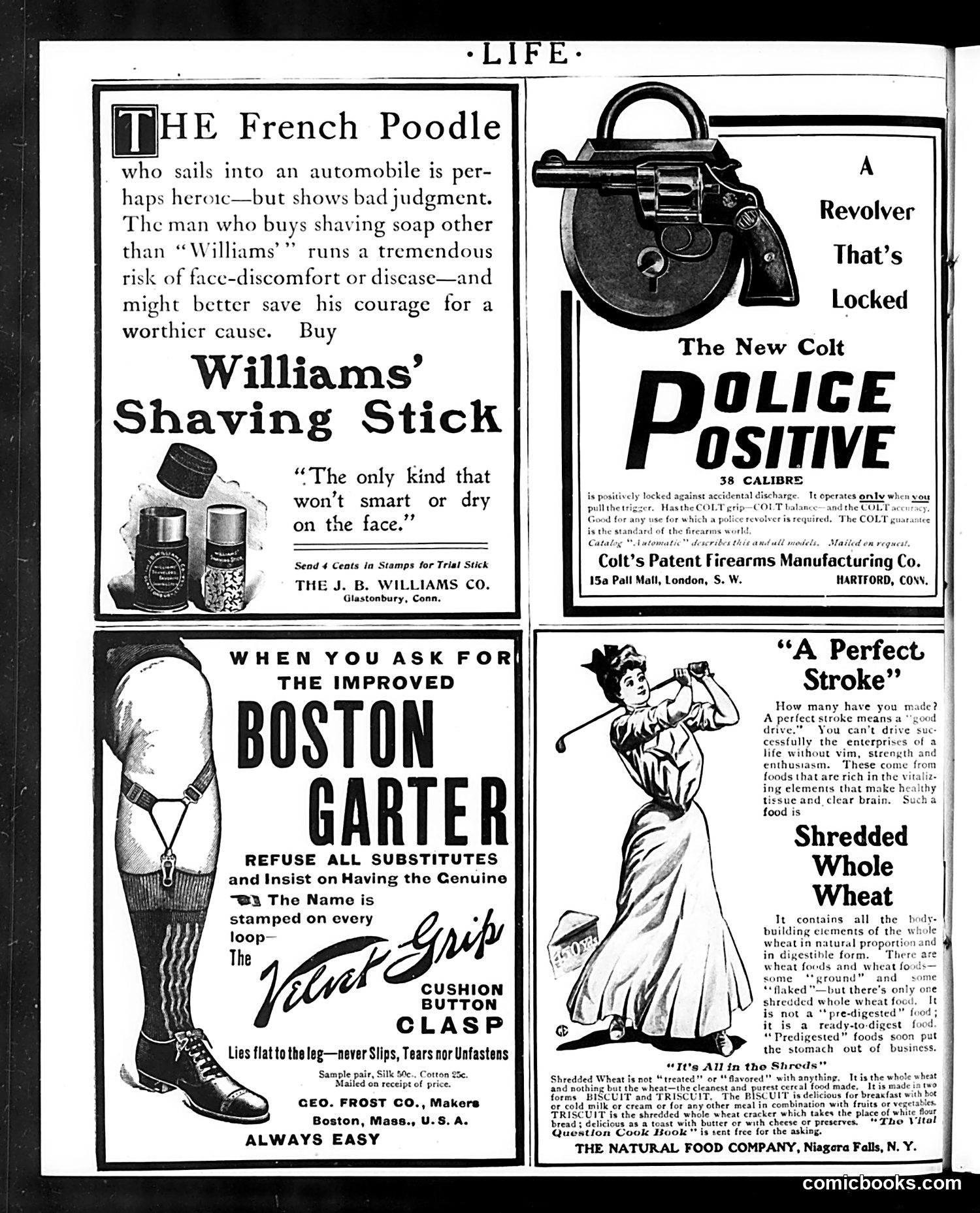
This page consists entirely of **period advertisements** from what appears to be an early 20th-century Life magazine issue. There are no political cartoons or satirical content to analyze. The four ads promote: 1. **Williams' Shaving Stick** — positioning the product as superior to alternatives, with humorous copy suggesting men who use other brands risk "face-discomfort or disease" 2. **Colt Police Positive revolver** — marketed as a security device with a safety lock feature 3. **Boston Garter** — a men's garter (sock supporter) emphasizing quality and fit 4. **Shredded Whole Wheat** — a breakfast cereal touting nutritional benefits These ads reflect early 1900s consumer culture and marketing approaches, emphasizing product superiority and brand loyalty. No satirical content or identifiable figures are present.
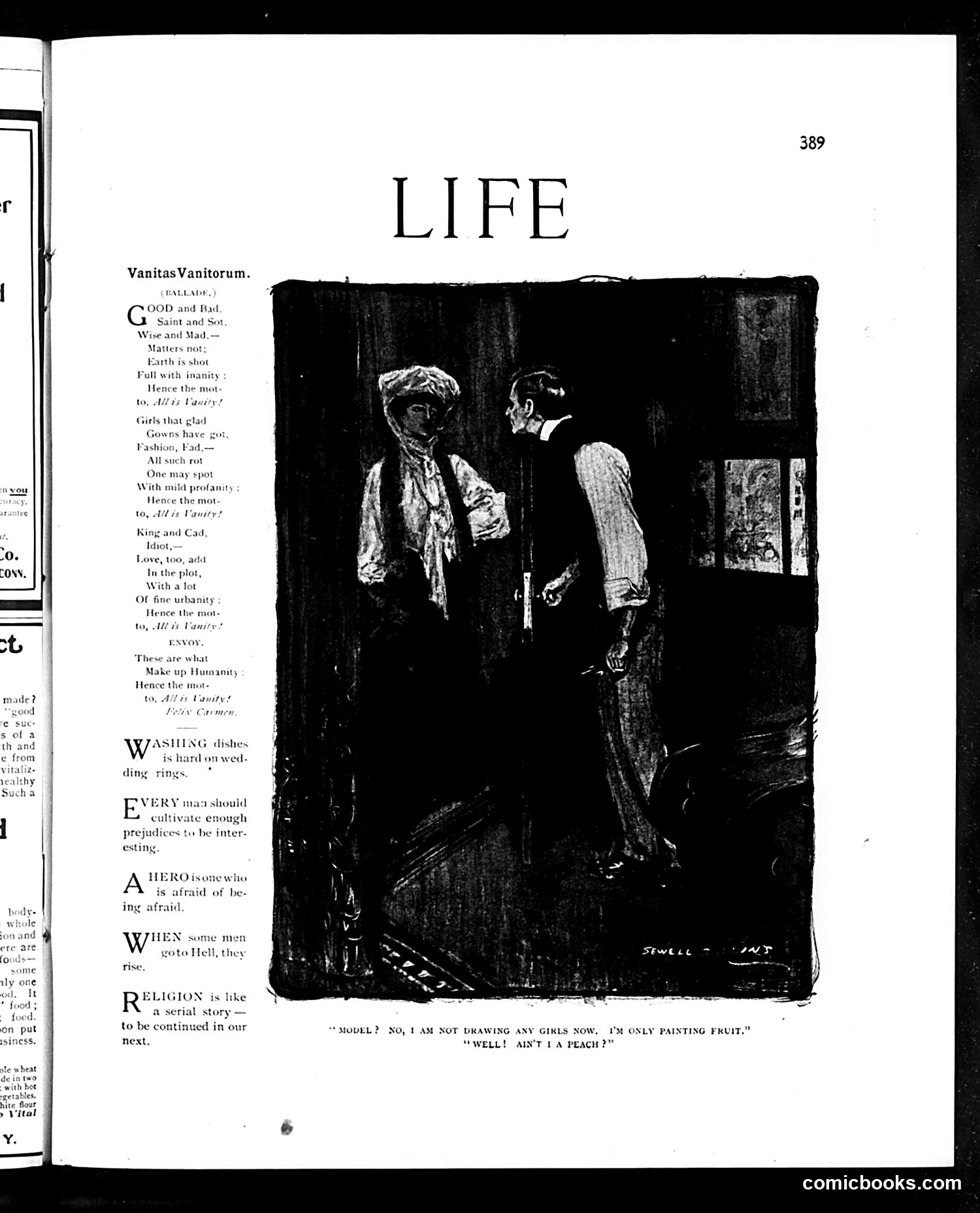
This page contains a single cartoon by Swell and Jap showing two men in what appears to be an artist's studio. One man, dressed formally, addresses another who is working—the dialogue reads: "Model? No, I am not drawing any girls now. I'm only painting fruit." The second man responds: "Well! Ain't I a peach?" The joke relies on a double meaning: the artist claims to paint only fruit, but his companion suggests he himself qualifies as "a peach"—using the slang term for an attractive person. It's a flirtatious or suggestive joke playing on the ambiguity between literal fruit and the slang use of "peach" to describe someone attractive. The cartoon appears to be purely humorous rather than political or socially critical.
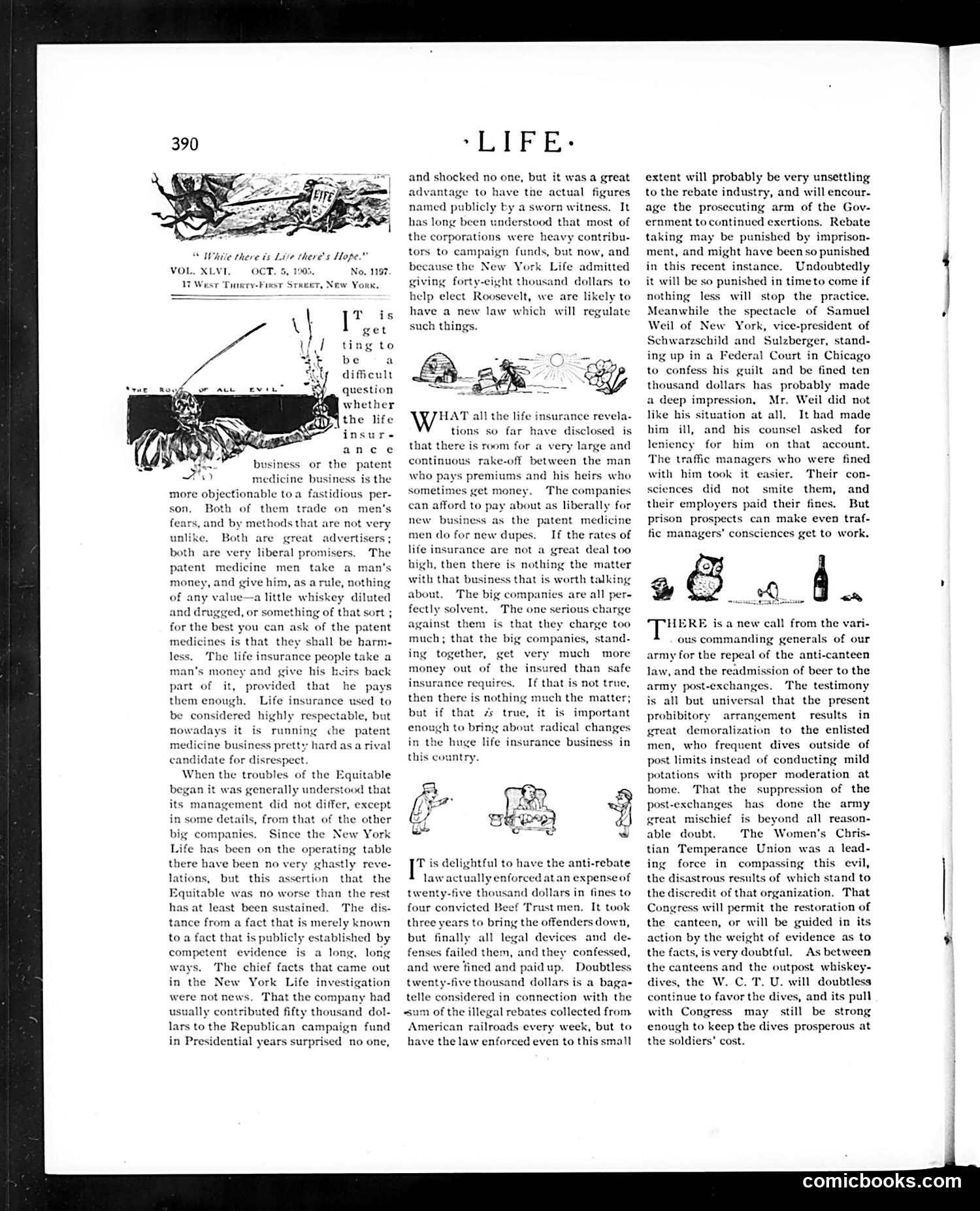
This page contains satirical commentary on life insurance and patent medicine industries rather than a political cartoon. The text criticizes life insurance companies for collecting premiums liberally while resisting payouts, and attacks patent medicine manufacturers for false advertising and selling ineffective products. The illustrated vignettes (small cartoon figures) appear to mock patent medicine practices—showing various dubious remedies and their typical consumers. The page also discusses enforcement of anti-rebate laws against insurance companies, mentioning a specific case involving "Schwarzschild and Sulzberger" who confessed to illegal practices. The overall satirical thrust targets corporate malfeasance in insurance and medicine—industries exploiting public trust through deception and financial manipulation. This reflects Progressive Era (early 1900s) concerns about corporate accountability and consumer protection.
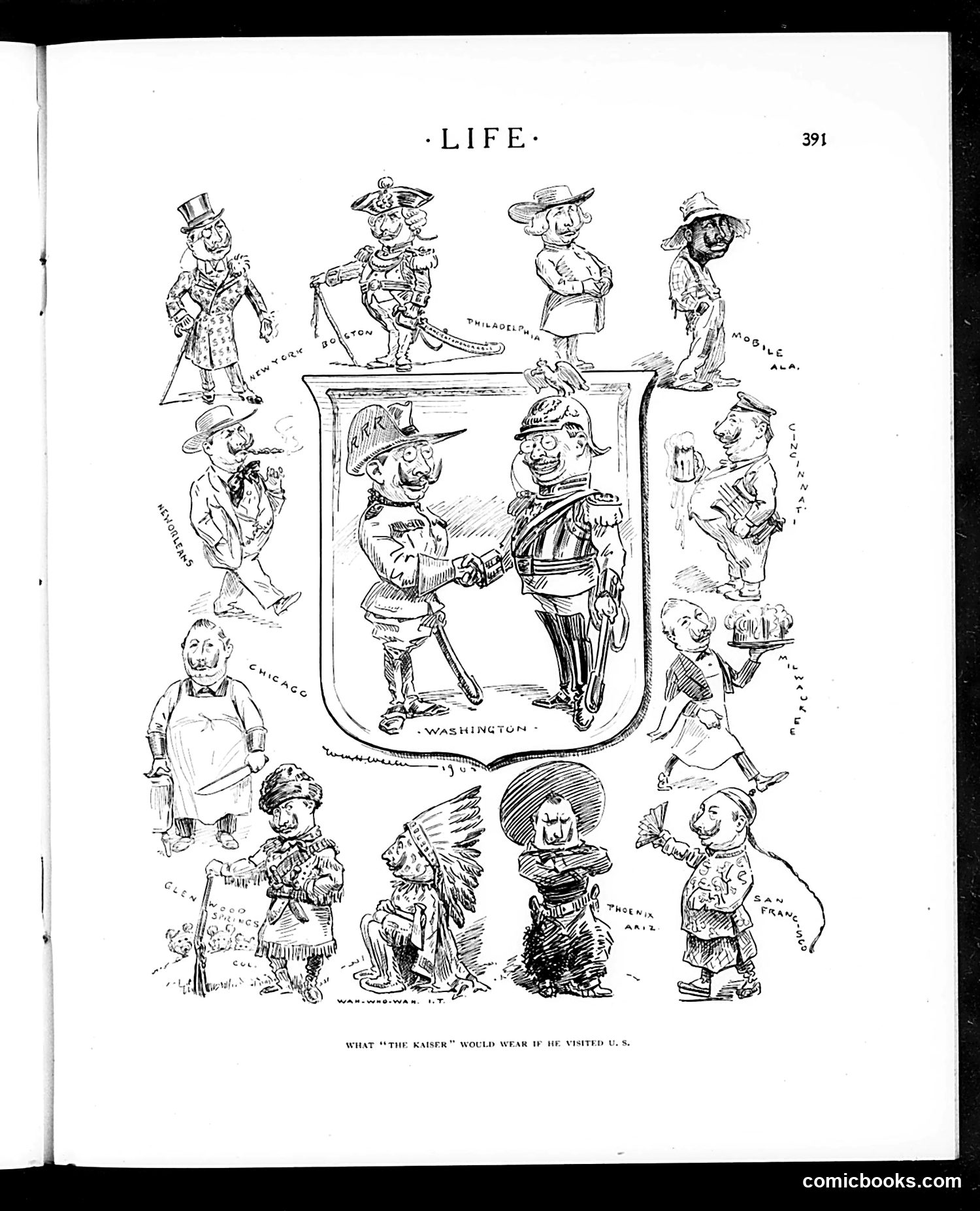
This satirical cartoon from *Life* magazine depicts "What 'The Kaiser' Would Wear If He Visited U.S." The central panel shows two military figures shaking hands labeled "Washington"—likely representing Kaiser Wilhelm II of Germany meeting with American leadership during World War I era. Surrounding them are caricatured figures representing various American cities: New York (top left), Philadelphia, Mobile (Alabama), Chicago, and others, each wearing different regional or occupational attire. The satire mocks how the German Kaiser might be received or transformed by American culture if he visited. The cartoon suggests American regional diversity and commercial character would "dress" or transform even a foreign military leader. This reflects contemporary American ambivalence toward Germany during the WWI period.
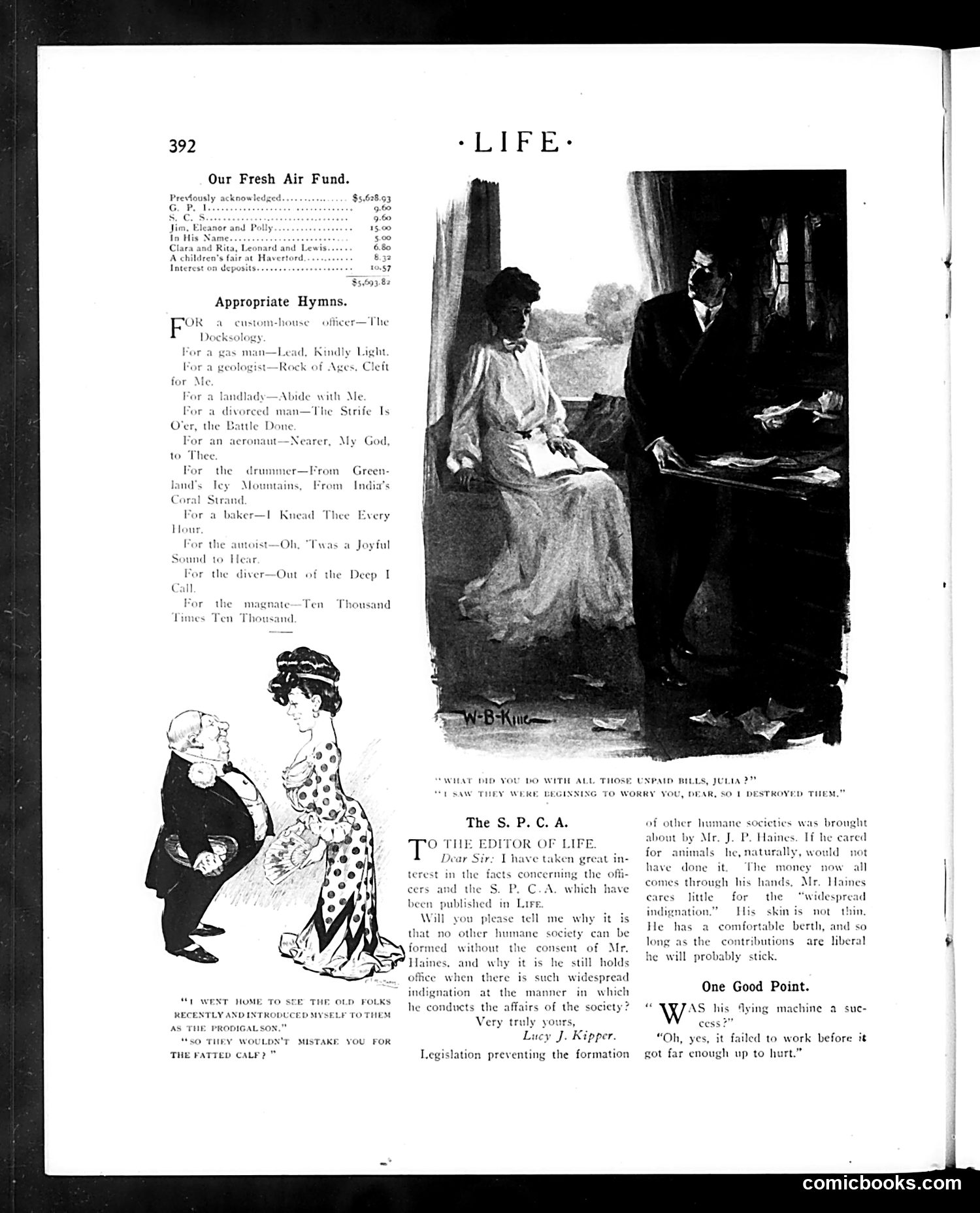
This page contains multiple satirical pieces typical of early 20th-century *Life* magazine: **"Our Fresh Air Fund"** lists donations to a charity providing outdoor relief for poor children, with humorous "Appropriate Hymns" matched to various professions (a geologist gets "Rock of Ages," a diver gets "Out of the Deep," etc.)—mocking both charitable pretension and occupational stereotypes. **Two cartoon jokes**: One depicts a prodigal son's homecoming; another shows a woman who destroyed her husband's unpaid bills to spare his worry—satirizing both biblical references and domestic financial folly. **"The S.P.C.A." letter** criticizes the Society for the Prevention of Cruelty to Animals for allegedly mishandling donations meant for animal welfare, suggesting the organization's leadership pockets funds while neglecting actual animal care. **"One Good Point"** is a brief joke about a failed flying machine whose only merit was that it crashed before causing serious injury. The page satirizes charity hypocrisy, domestic comedy, and institutional mismanagement—common *Life* targets of the era.
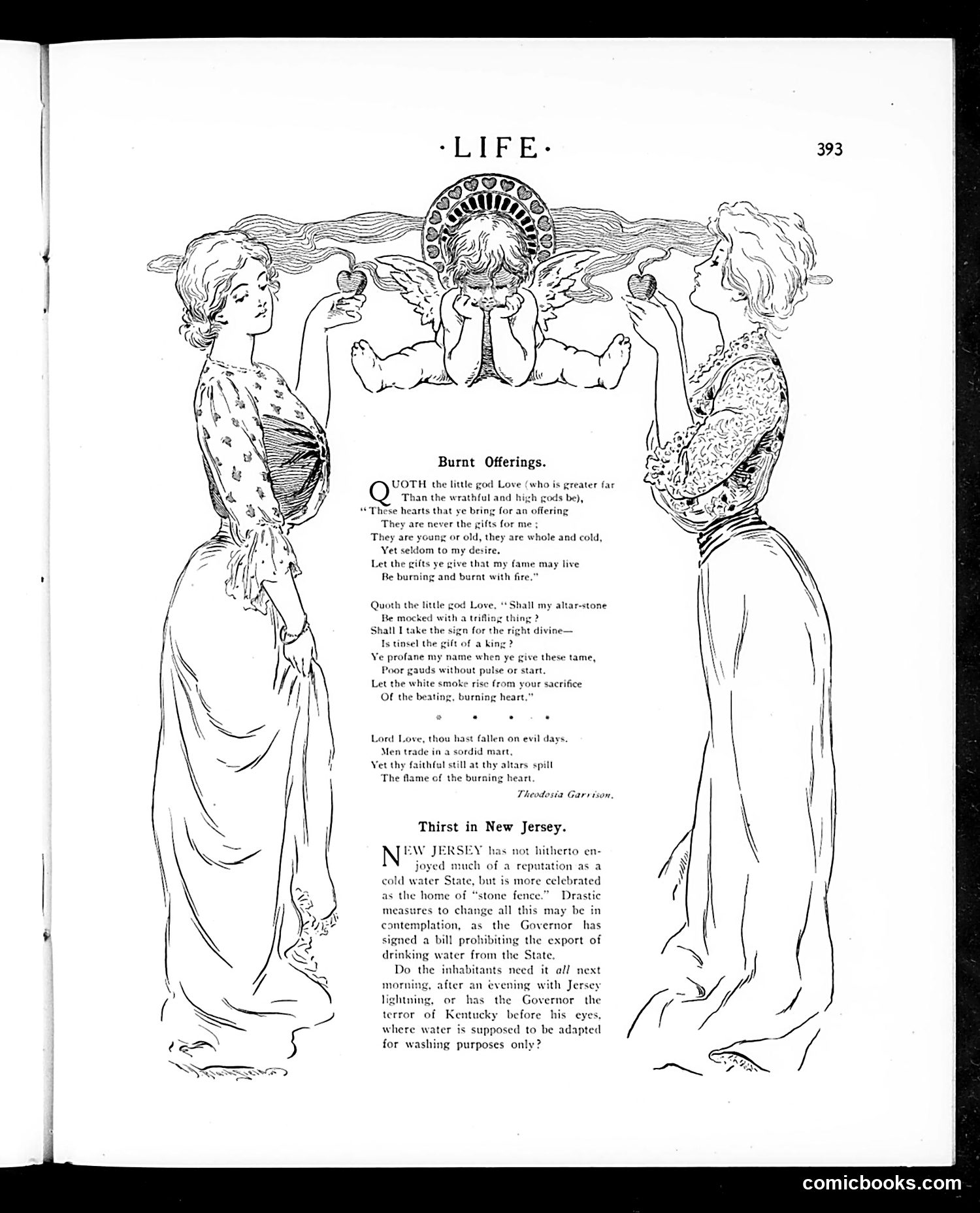
This page contains two distinct pieces of satirical content: **"Burnt Offerings"** is a poem by Theodosia Garrison personifying the god of Love complaining that mortals offer inadequate sacrifices. The accompanying illustration shows two women flanking winged cherubs, with Love demanding genuine passion ("burning and burnt with fire") rather than empty, cold gestures. The satire mocks superficial romantic gestures—people giving "tame" gifts without genuine emotion or commitment. **"Thirst in New Jersey"** is a humorous commentary on New Jersey legislation prohibiting water export from the state. The author satirizes this law as absurd, sarcastically questioning whether New Jersey residents truly need all their water after "an evening with Jersey lightning" (thunderstorms), or whether the Governor fears some catastrophic scenario. The piece ridicules the protectionist measure as overreaction, implying the bill is either unnecessary or based on irrational fears. Both pieces use wit to critique human behavior—one emotional superficiality, the other governmental overreach.
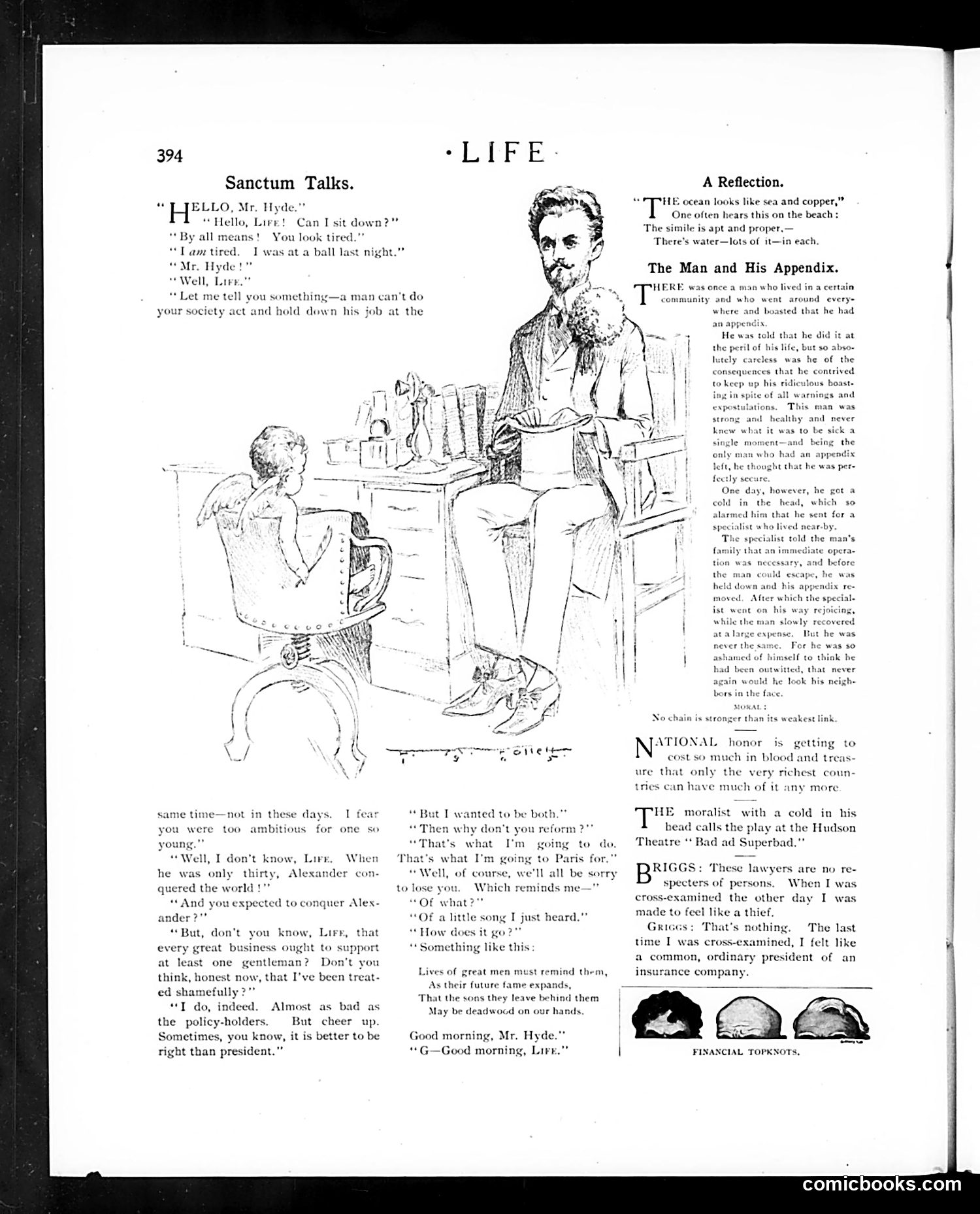
This page contains satirical commentary on American business and social life, likely from the early 1900s. **"Sanctum Talks"** (left) depicts a conversation between "Mr. Hyde" and "Life" (the magazine's personification). Hyde appears to be a businessman complaining about overwork—he claims he's been treated shamefully despite sacrificing himself for his job. Life sardonically suggests that sometimes "it is better to be right than president," implying Hyde's ambitions have left him exhausted and unfulfilled. The dialogue mocks corporate culture's demands on workers. **"The Man and His Appendix"** (right) is a moral fable about a boastful man who brags everywhere about his appendix—until he develops a cold and must have it surgically removed. Humiliated by his dependence on a specialist, he can never face his neighbors again. The moral: "No chain is stronger than its weakest link"—pride precedes a fall. The **"Financial Topknots"** cartoon at bottom appears to mock insurance company executives as mere figureheads. Overall, the page satirizes business excess, worker exploitation, and false pride.
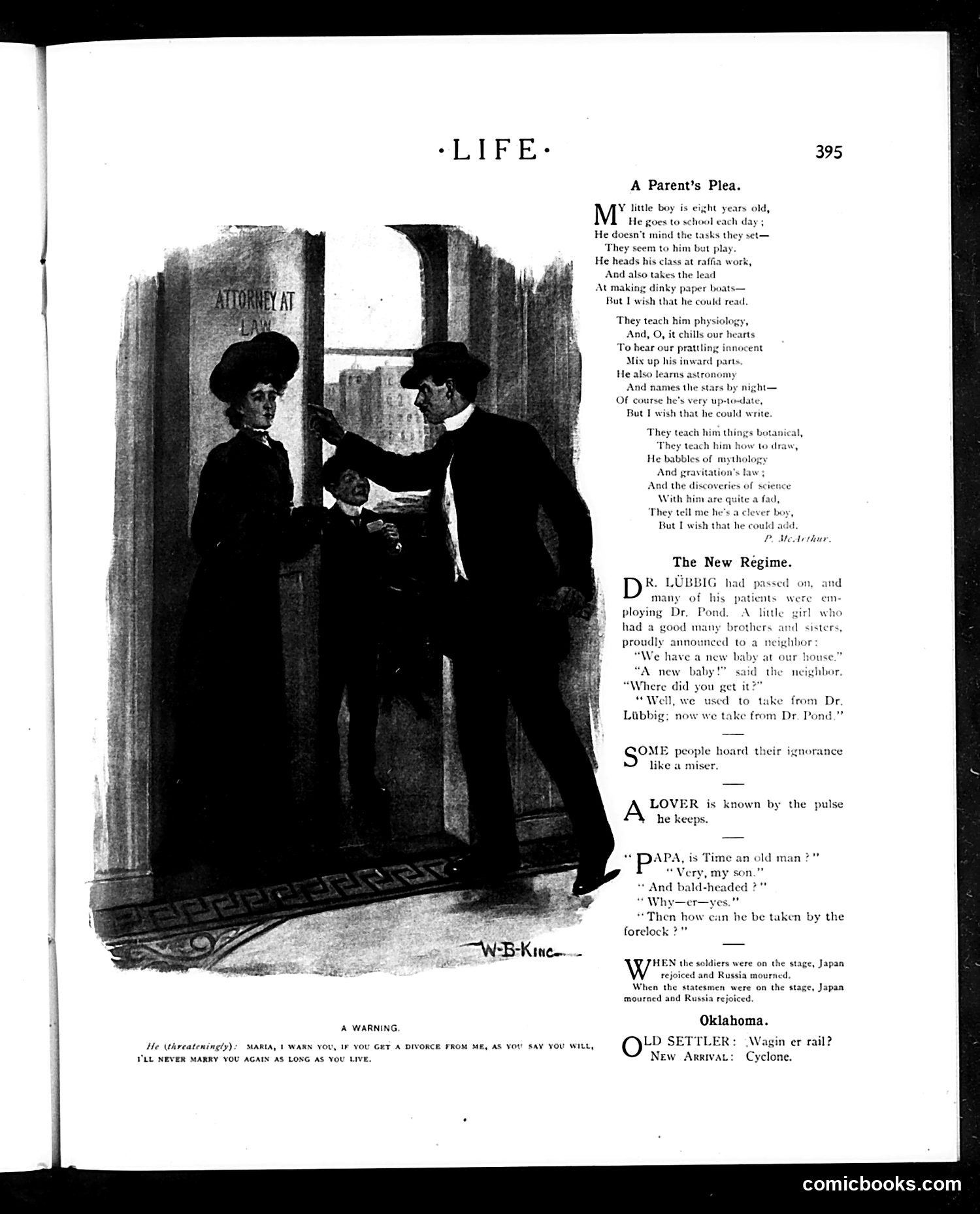
This page contains several satirical pieces satirizing early 1900s American society: **"A Parent's Plea"** (poem): A father laments his 8-year-old son's modern education. The boy excels at practical crafts (raffia work, paper boats), learns science and astronomy, but cannot read or write. The satire mocks progressive education trends that emphasized manual skills and scientific knowledge while neglecting basic literacy—suggesting schools prioritized fashionable subjects over fundamentals. **"The New Régime"**: A brief anecdote about families switching from Dr. Lubbig to Dr. Pond for delivering babies, implying casual consumerism toward medical care. **"A Warning"** (bottom cartoon): A man threatens his wife that if she divorces him, he'll never remarry her—absurd logic presented as marital "wisdom." The page also includes brief aphorisms and a joke about Oklahoma weather (tornado/cyclone). The overall tone satirizes contemporary American anxieties about education reform, medical practice, and domestic relations circa 1900s-1910s.
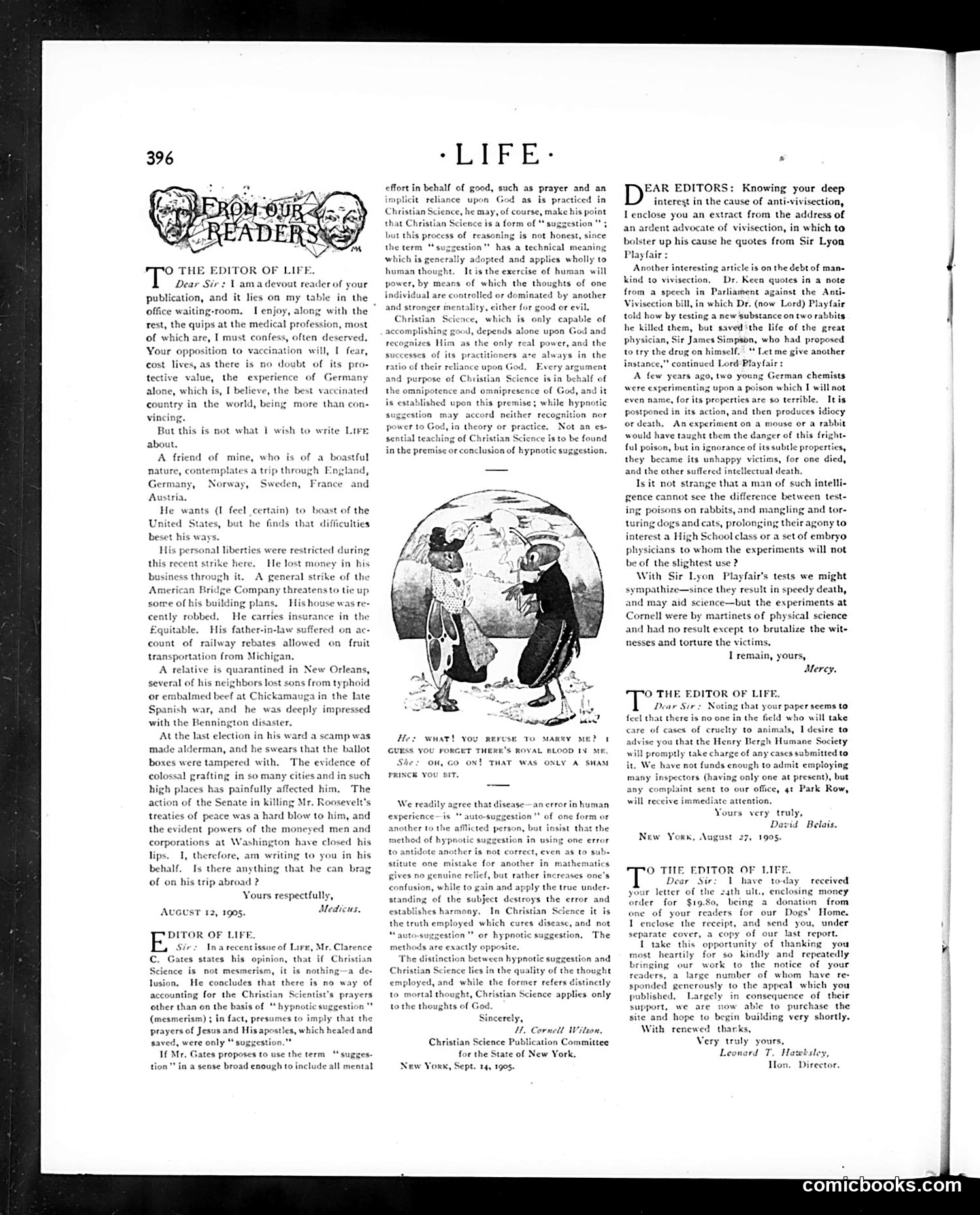
This page consists primarily of letters to the editor addressing contemporary controversies, with one small cartoon. **The Cartoon:** The modest illustration shows a couple in conversation. The man says "What! You refuse to marry me? I guess you forget there's royal blood in me." The woman replies sarcastically, "Oh, go on! That was only a sham prince you bit." **The Satire:** This jokes about the period's fascination with European aristocracy and American heiresses marrying foreign nobles. The cartoon mocks American social climbers who boasted of connections to dubious European "nobility"—suggesting such claims were fraudulent ("sham prince"). The humor targets American snobbery about royal lineage. **Letters:** The substantive content debates Christian Science, vaccination, and the writer's friend's misfortunes (business strikes, family quarantines, election fraud). These reflect genuine Progressive-era anxieties about labor unrest, medical disputes, and political corruption.
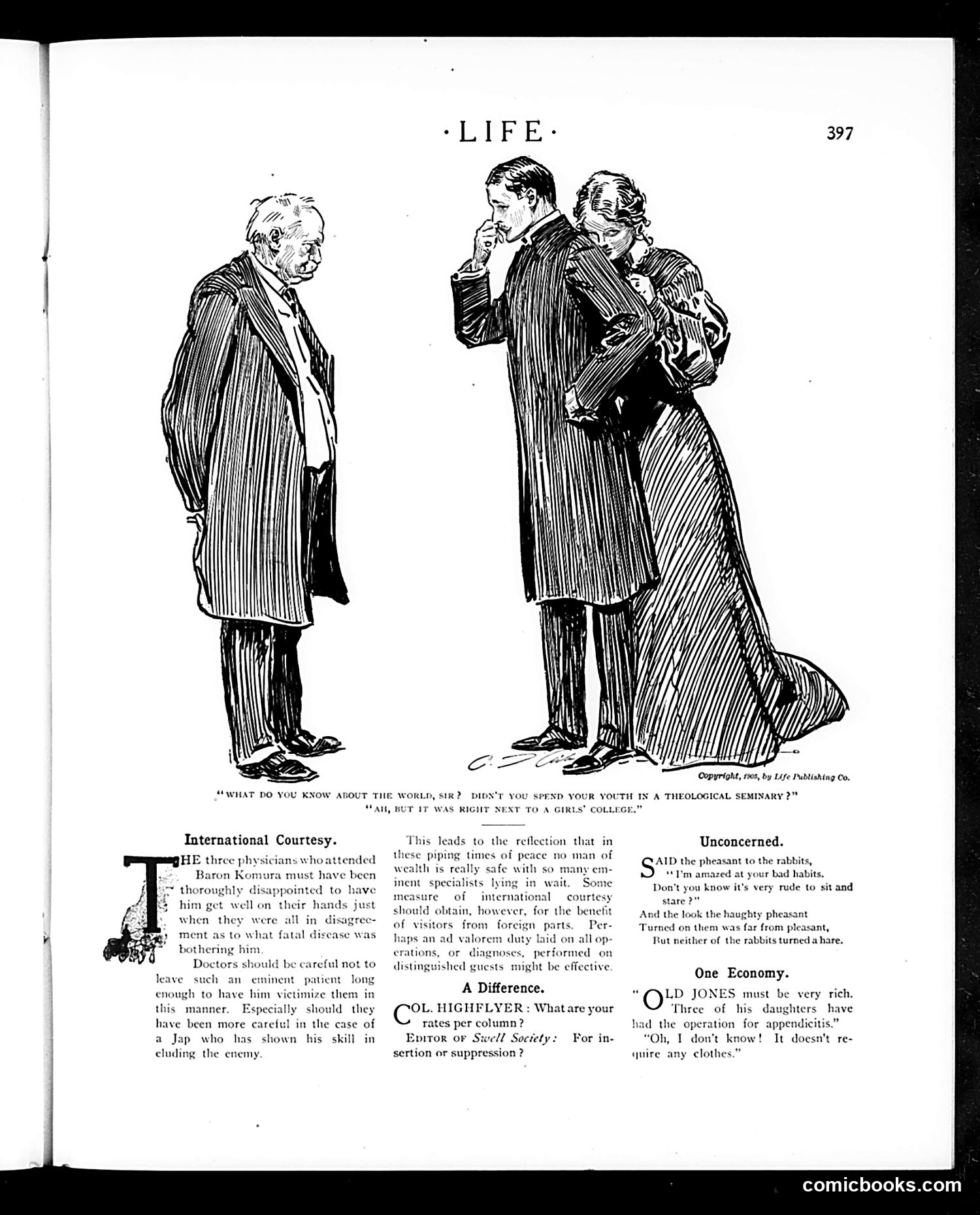
This page contains three separate satirical pieces typical of *Life* magazine's humor: 1. **Top cartoon**: A joke about a clergyman's worldly knowledge despite seminary education. The humor relies on the implication that proximity to a girls' college provided practical education superior to theological training—a risqué double entendre about sexual experience that would resonate with early 20th-century readers. 2. **"International Courtesy"**: References Baron Komura (Japanese diplomat), apparently discussing medical ethics when treating prominent foreign patients. The "Jap" reference suggests contemporary awareness of Japan's rising international status post-Russo-Japanese War. 3. **"A Difference"**: A joke about a gossip columnist's dual rates—one for publishing society news, another for suppressing it (blackmail implications). 4. **"One Economy"**: Joke about Old Jones's wealthy daughters undergoing appendix surgery without requiring new clothes for recovery. These pieces reflect 1905 preoccupations: gender relations, international diplomacy, media corruption, and wealthy eccentricity.
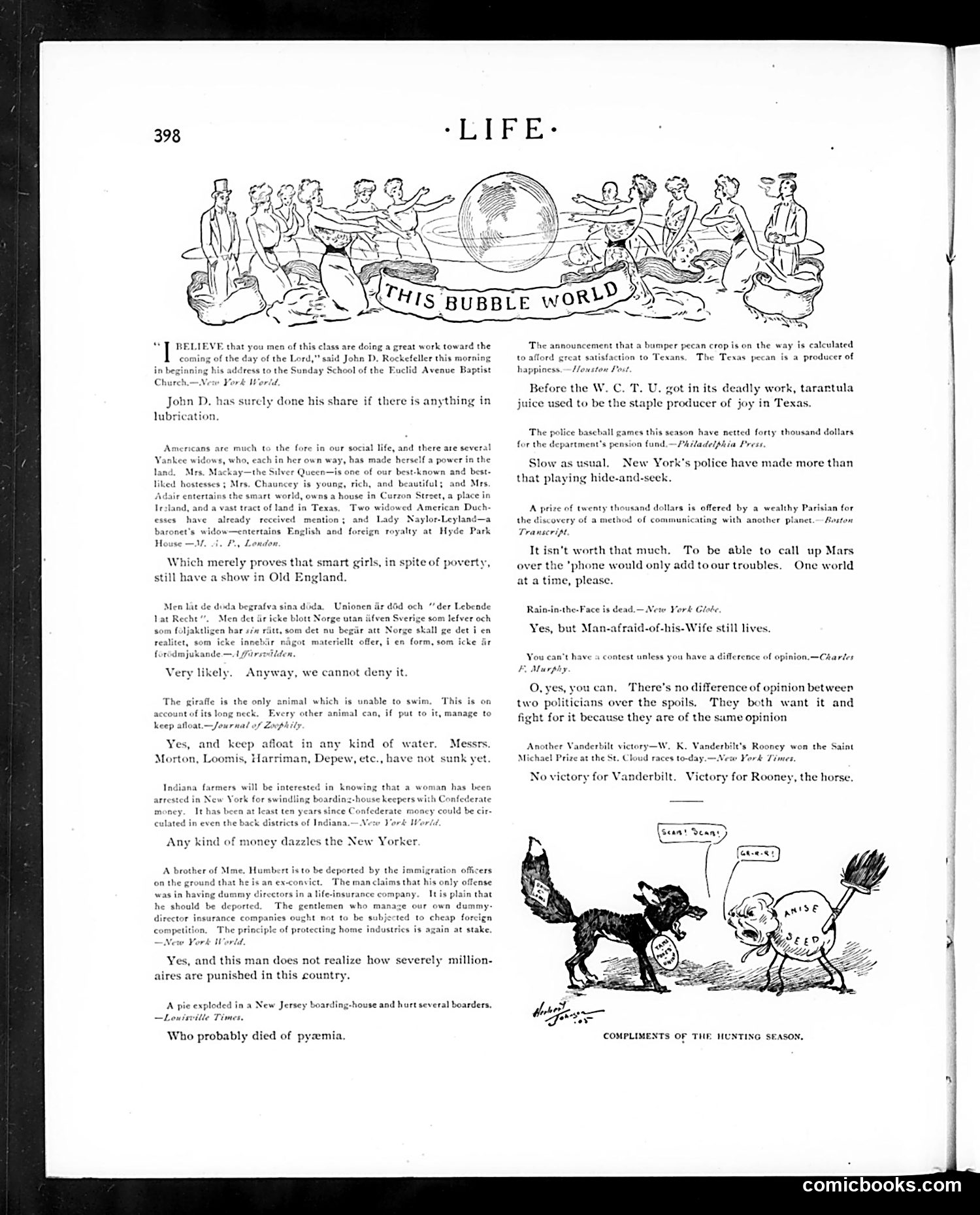
This page contains multiple satirical snippets typical of Life's format. The main cartoon at bottom shows a dog and pig arguing over "seed" and "slop"—likely representing political rivals squabbling over spoils of office, with the caption "Compliments of the Hunting Season" (hunting season for political positions). The text snippets mock various contemporary issues: Rockefeller's Sunday school donations, Texas prohibition ("tarantula juice"), New York police baseball games raising pension funds, and police playing "hide-and-seek" rather than working. One joke references a Parisian offering money for Mars communication—dismissed as worthless. Another mocks "Man-afraid-of-his-Wife," a familiar domestic stereotype. References to W.C.T.U. (Woman's Christian Temperance Union) indicate prohibition advocacy. The giraffe joke about animals unable to swim appears unrelated wordplay filler. The overall tone is cynical about corruption, gender relations, and social reform movements of the era.
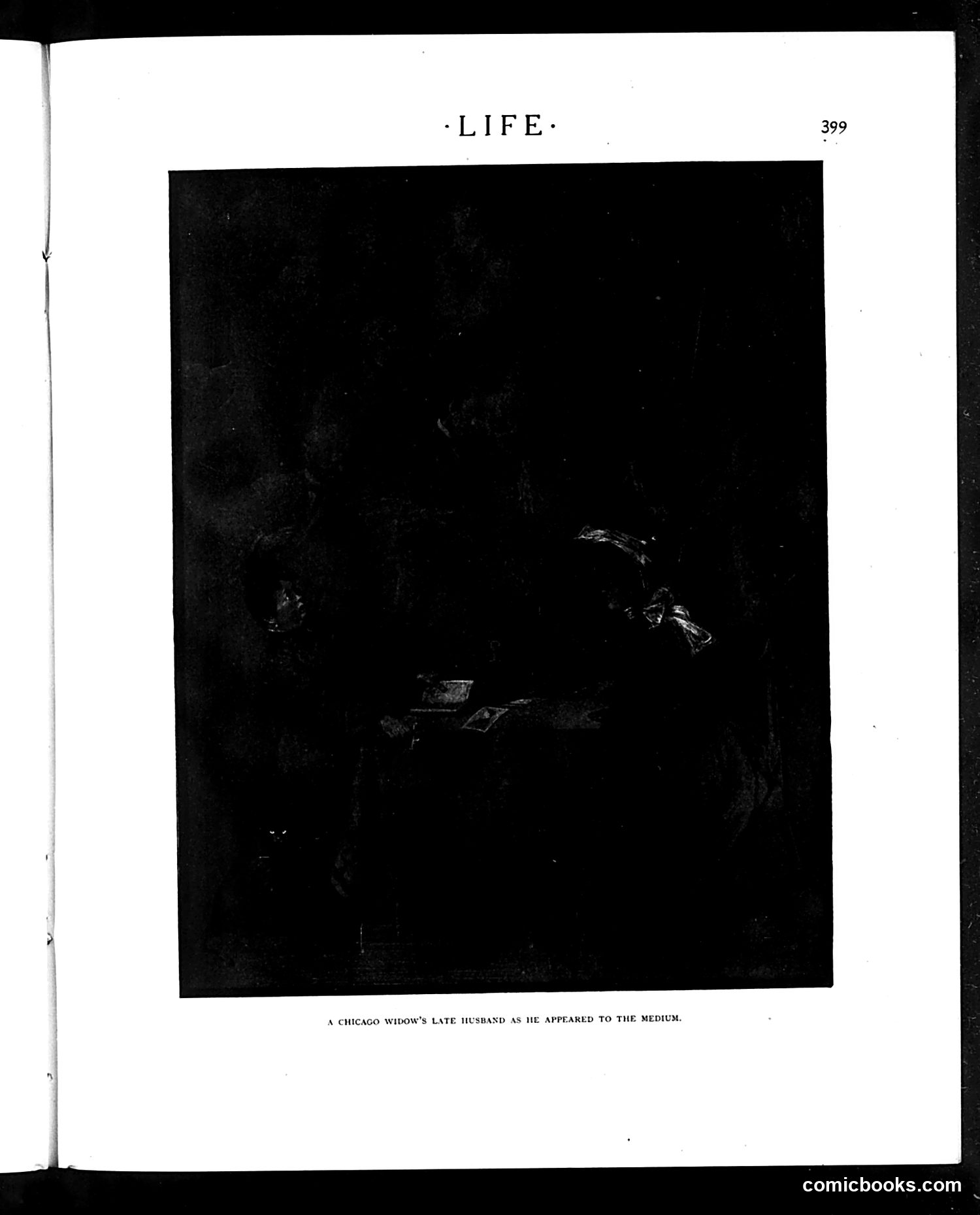
This satirical image mocks spiritualism and séances—popular but controversial practices in the early 20th century. A medium claimed to conjure the spirit of a deceased Chicago widow's husband during a séance session. The caption's ironic tone suggests skepticism about the "apparition" shown (barely visible spectral forms in the darkened image). Life magazine is ridiculing both the medium's dubious abilities and the widow's credulity in believing such supernatural claims. This reflects broader Progressive-era criticism of spiritualism as a con, exploiting grief-stricken people (particularly widows) through fraudulent séances. The dark, murky photograph itself parodies how mediums used poor lighting and vague imagery to convince believers they'd contacted the dead.
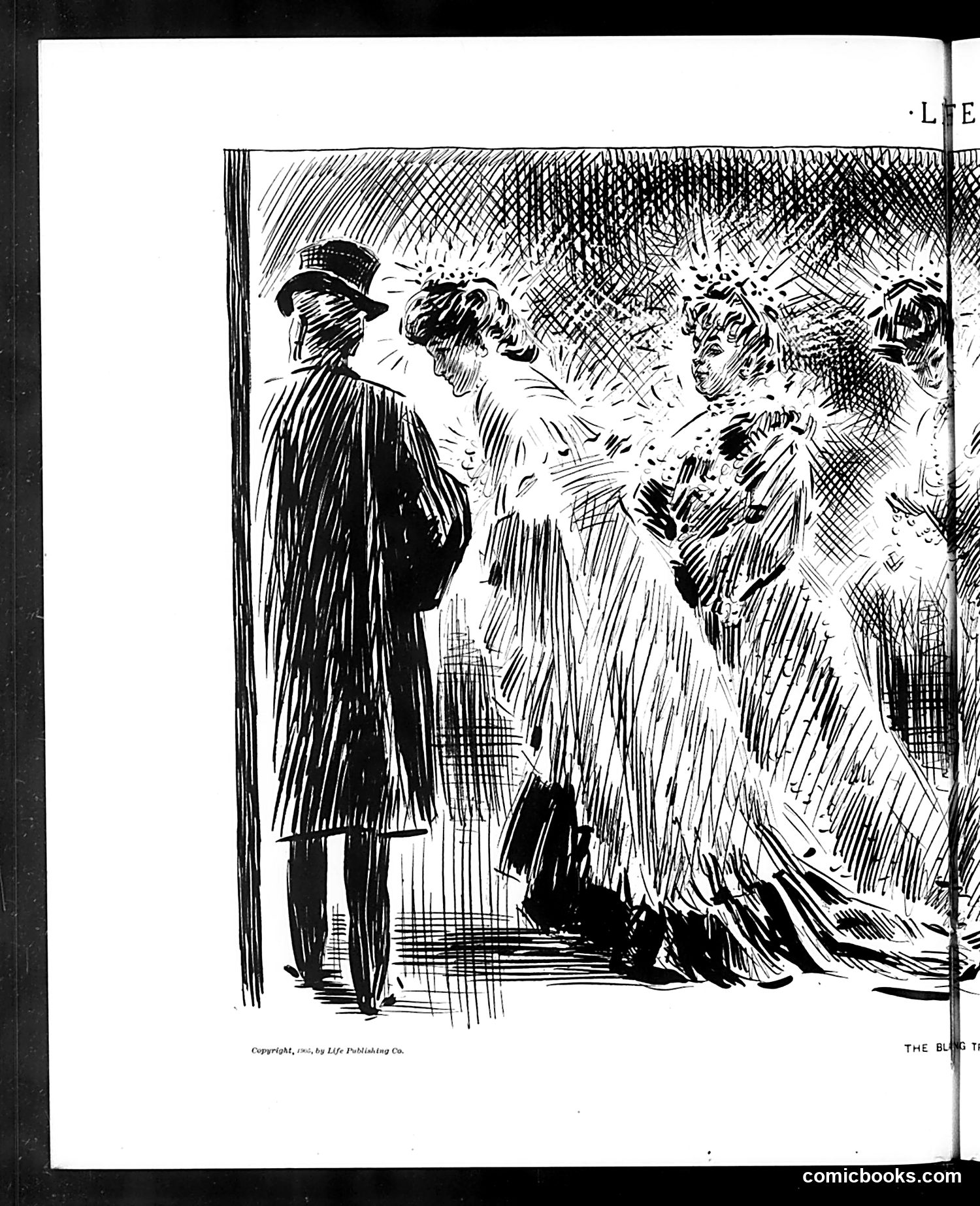
This appears to be a satirical illustration from *Life* magazine depicting a social scene, likely from the early 20th century based on the clothing and drawing style. The image shows a well-dressed man in a coat and hat observing a group of elegantly dressed women at what appears to be a formal social gathering or party. The satire likely comments on gender dynamics, social pretension, or romantic/courtship conventions of the era—common themes in *Life*'s humor. However, without a visible caption or title on this page fragment, I cannot definitively identify the specific social situation being mocked or which public figures, if any, are being caricatured. The OCR text only shows copyright information and a website reference, providing no contextual clues about the cartoon's specific subject matter or satirical target.
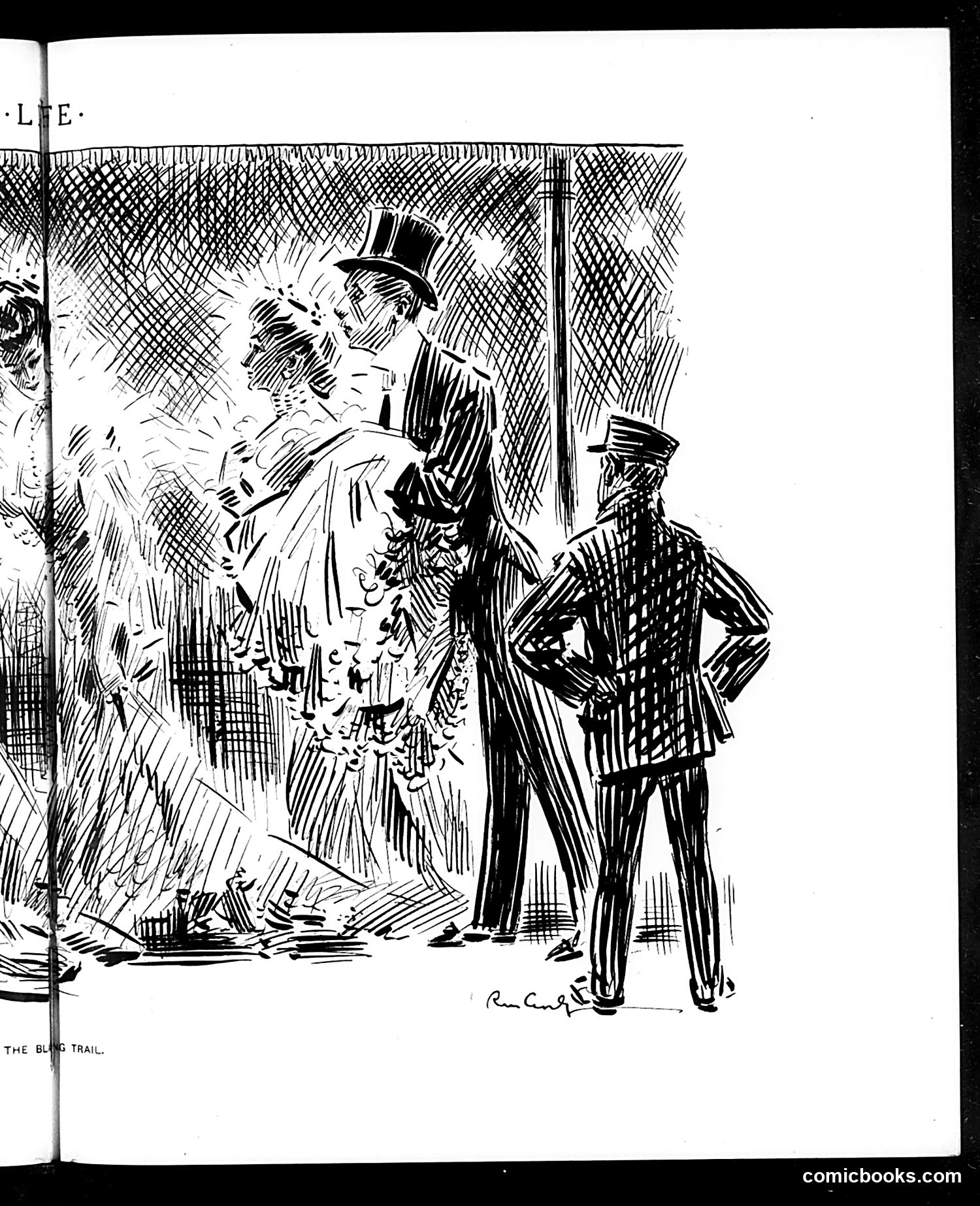
This cartoon depicts three men in formal dress (top hats and coats) standing before what appears to be a chaotic, explosive scene. The title "The Glass Trail" suggests a satirical reference to a path of destruction or consequences. The figures appear to be authority or political figures observing wreckage, likely commenting on industrial accidents, labor unrest, or corporate negligence of the era. The "glass trail" may reference broken windows or shattered promises. The composition—with well-dressed gentlemen calmly observing destruction—suggests satire about the indifference of the wealthy or powerful to suffering caused by their actions or policies. Without additional context or visible dates, the specific historical reference remains unclear, though this appears typical of *Life* magazine's turn-of-the-century social commentary.
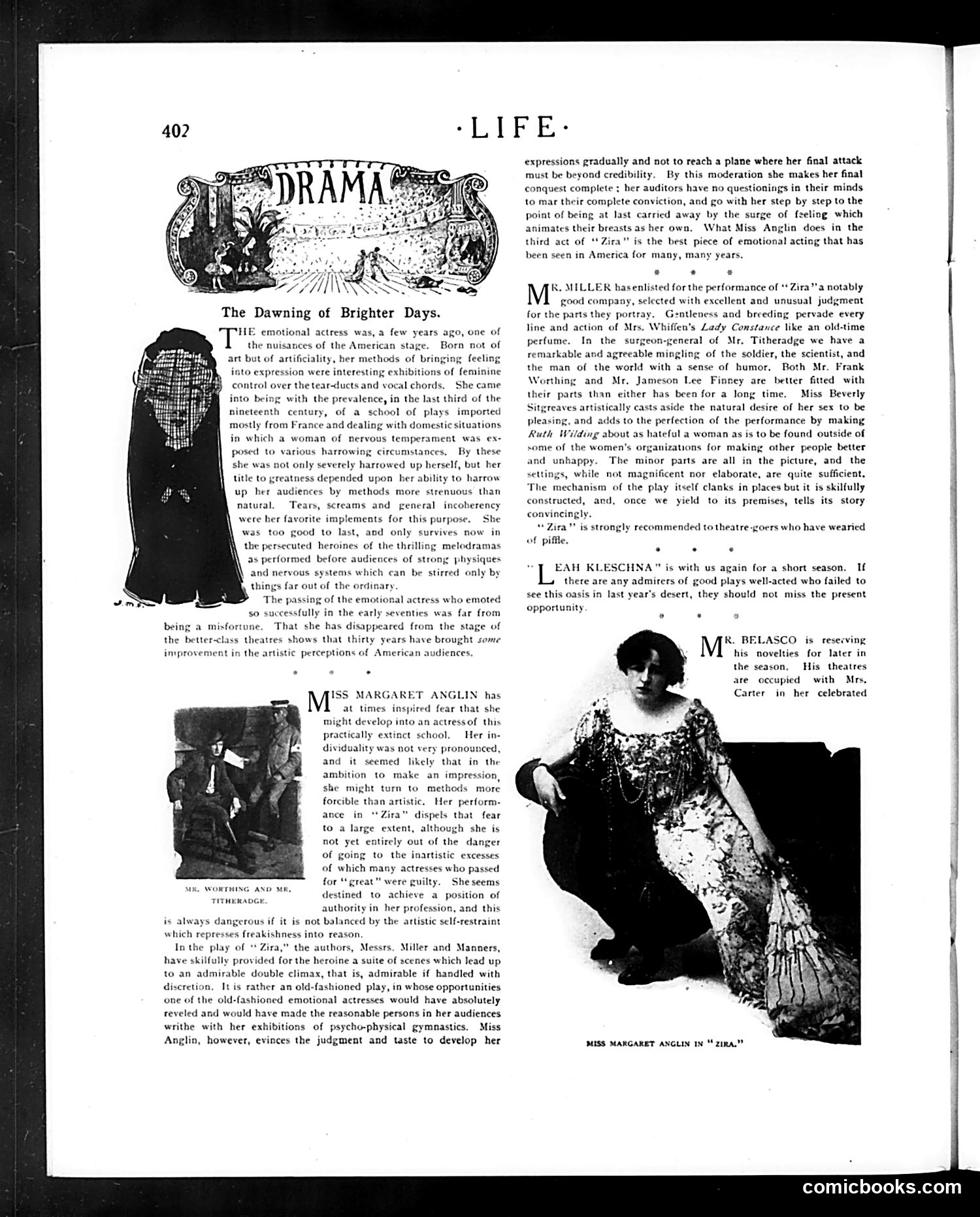
This page reviews actress Margaret Anglin's performance in the play "Zira," celebrating what the critic sees as a generational shift in American theater. **The satire's target:** The "emotional actress" of the 1870s-80s—a now-extinct style characterized by exaggerated histrionics: uncontrolled tears, screams, and overwrought "psycho-physical gymnastics" designed to manipulate audiences through raw melodrama rather than artistry. **The point:** Anglin represents theatrical *progress*. Though initially feared to follow this outdated tradition, her performance in "Zira" demonstrates artistic *restraint*—she builds emotional intensity gradually rather than erupting into implausible excess. This disciplined approach, the critic argues, actually moves audiences more effectively because it remains *credible*. The "brighter days" refer to improved American theatrical taste and sophistication—audiences no longer tolerate or reward overwrought emotional fakery. Anglin's success proves that subtle artistry, not exaggerated display, defines modern theater.
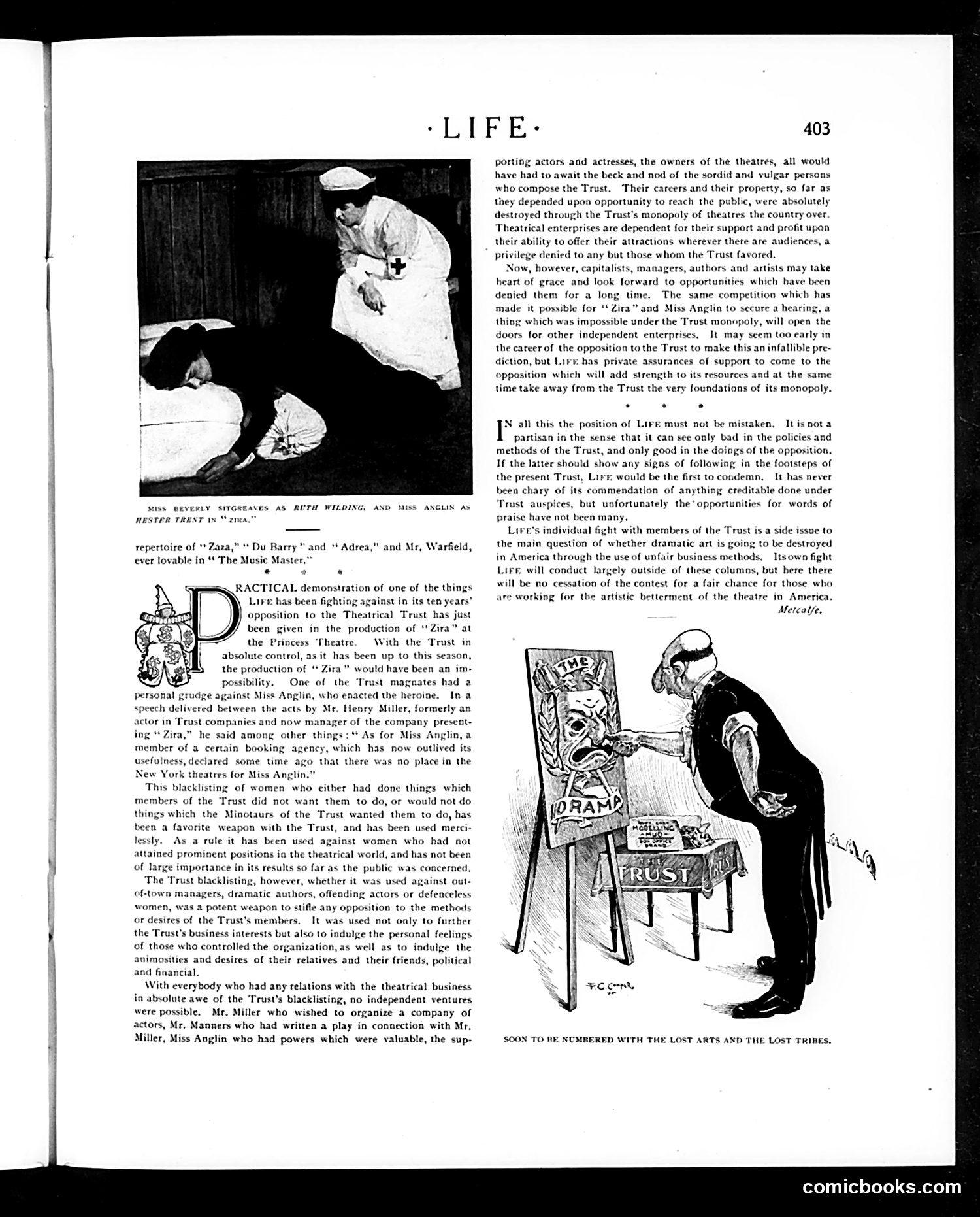
This *Life* magazine article attacks the **Theatrical Trust**—a monopoly controlling American theater distribution in the early 1900s. The piece celebrates the production of "Zira" at the Princess Theatre as a breakthrough because it succeeded *despite* Trust control. The Trust allegedly blacklisted actress **Miss Anglin** after she refused their demands. A Trust magnate had "personal grudge" against her, declaring "there was no place in the New York theatres for Miss Anglin." *Life* argues the Trust weaponized blacklisting against actors, managers, and theater owners who wouldn't comply, using it to crush competition and enforce obedience. The cartoon (right) depicts the Trust as a skeletal, oppressive figure crushing independent theater. *Life* celebrates this production as proof the Trust's monopoly is cracking, predicting future independent ventures will now flourish. The magazine positions itself as the ten-year champion of theatrical freedom against corporate tyranny.
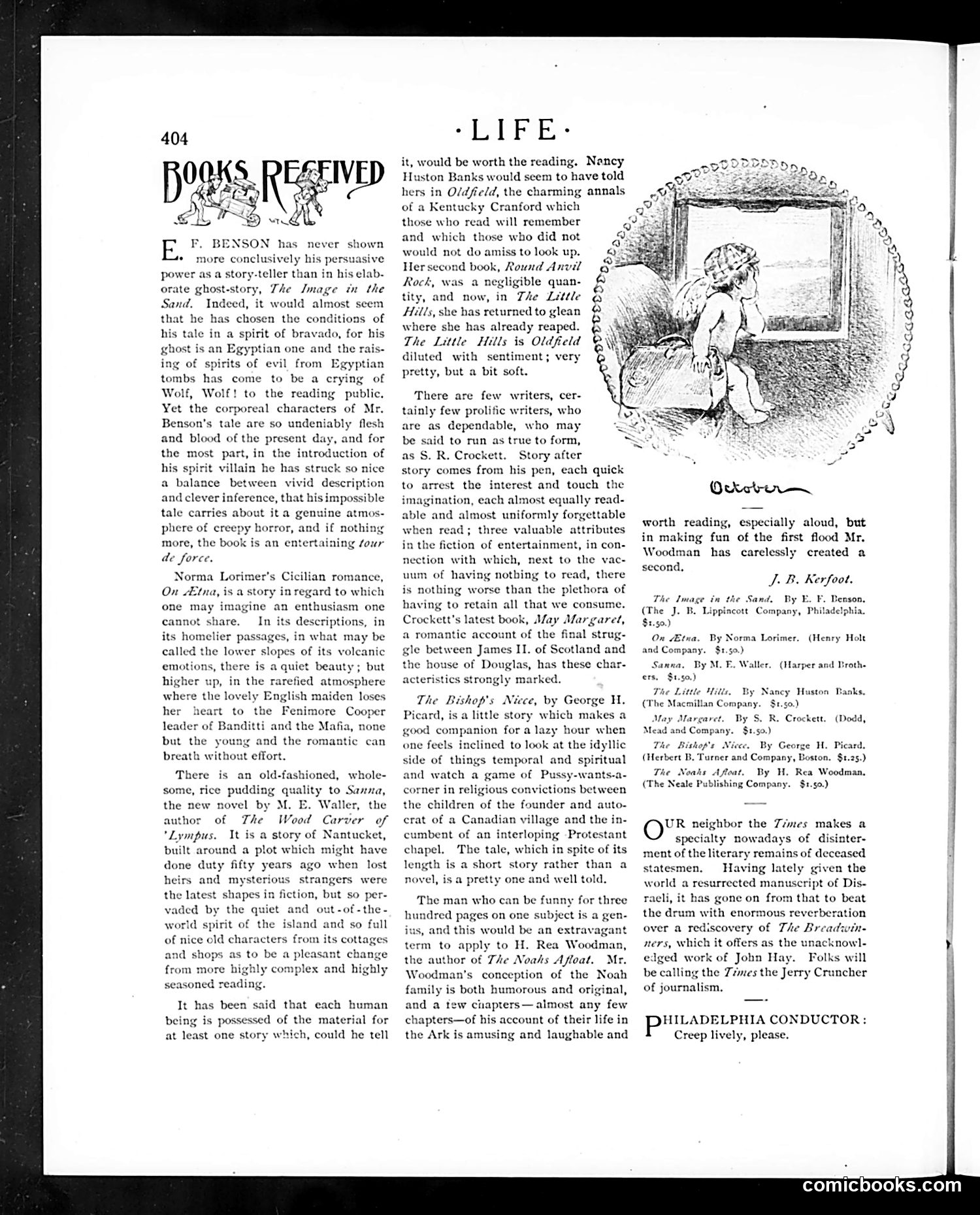
This page from *Life* magazine reviews contemporary books, primarily literary fiction from the late 19th/early 20th century. The small illustration shows a woman reading by a window—a typical domestic scene emphasizing the leisurely, entertainment-focused nature of the books discussed. The reviews are largely positive but somewhat condescending, treating these novels as pleasant diversions rather than serious literature. Notable critiques include dismissing S.R. Crockett's stories as "uniformly forgettable" despite being entertaining, and calling *The Little Hills* by Nancy Huston Banks "pretty, but a bit soft"—diluted compared to her earlier work *Oldfield*. The Egyptian ghost story by E.P. Benson (*The Image in the Sand*) is praised for balancing supernatural drama with realistic characters, though the reviewer notes that mummy-curse stories had become clichéd ("crying of Wolf, Wolf!"). The tone reflects genteel, upper-class literary taste—these are books for leisurely reading and intellectual amusement among educated readers.
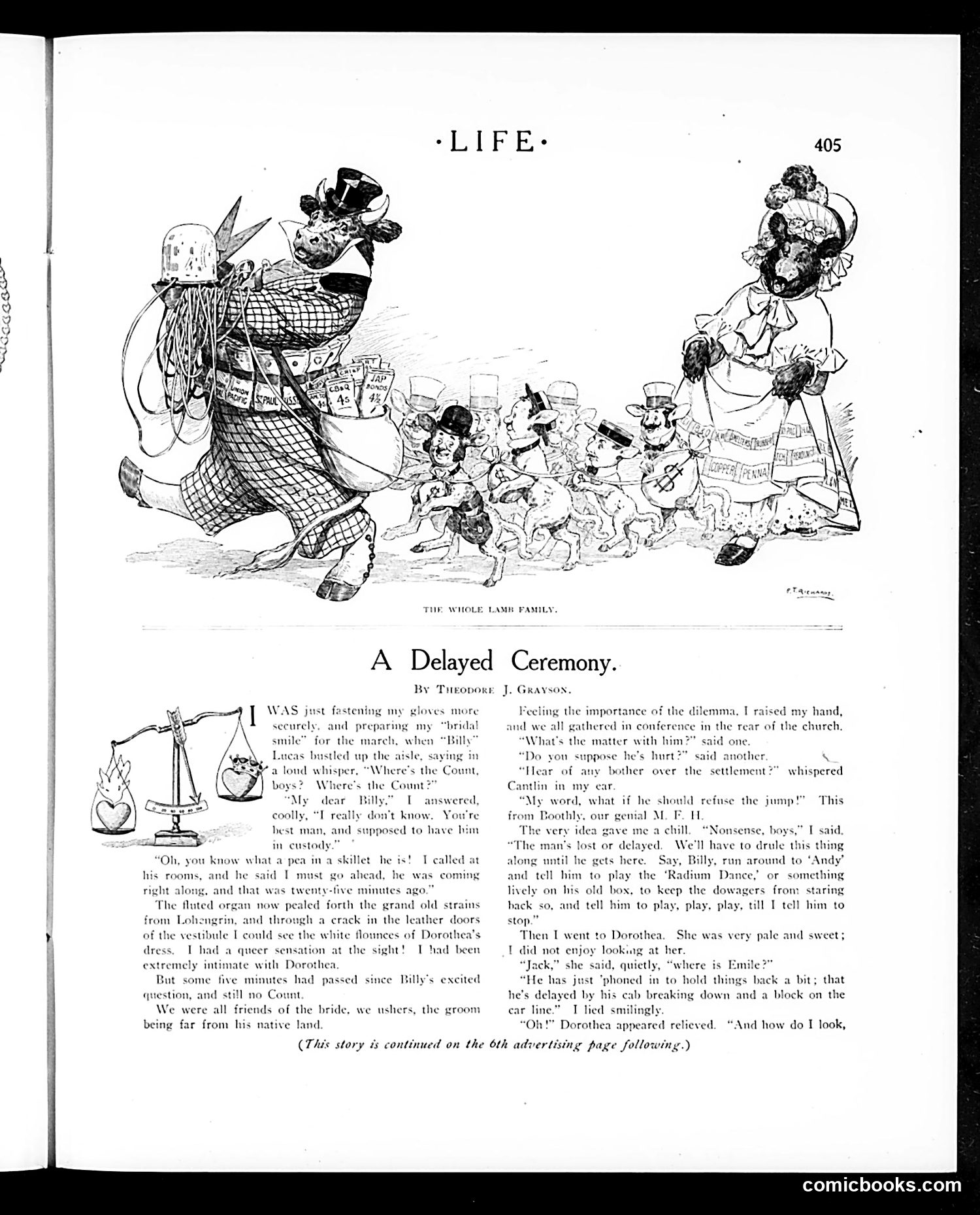
The top illustration shows "The Whole Lamb Family"—anthropomorphic sheep characters dressed in formal attire, likely a visual pun playing on the surname or a comment on the wedding party's character. Below is the opening of a comedic short story by Theodore J. Grayson about a wedding gone awry. The groom, referred to as "the Count," has gone missing shortly before his wedding to Dorothea. The narrator (an usher) and other groomsmen scramble to manage the crisis—initially considering whether he's been injured or might refuse the ceremony. They eventually learn the Count's cab broke down and blocked traffic, explaining the delay. The satire targets the social pretensions of the era: a foreign count marrying into what appears to be an American family, the theatrical hand-wringing over wedding propriety, and the comedic incompetence of the wedding party. The humor derives from mild domestic chaos and romantic anxiety rather than sharp political commentary.
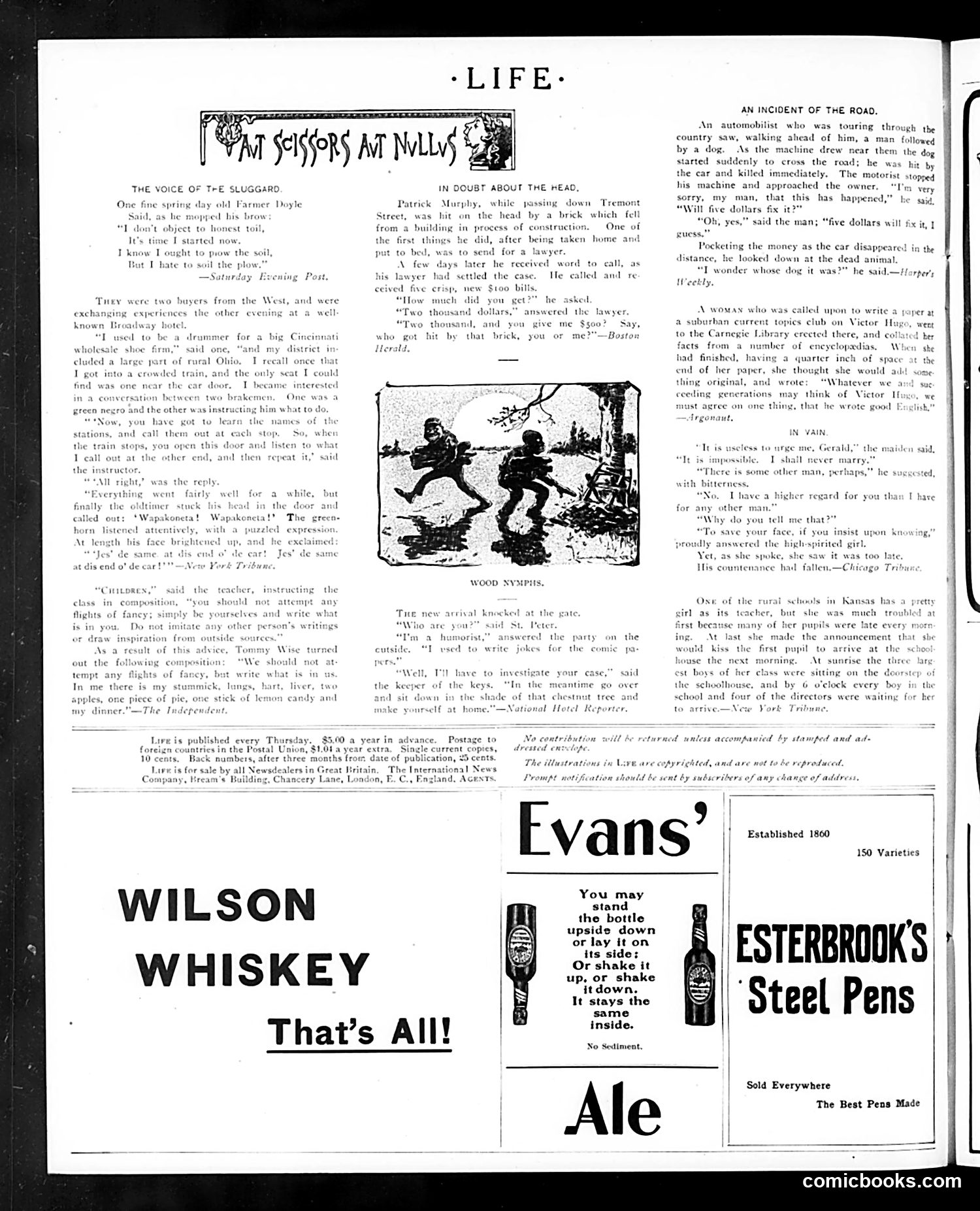
This page contains several humorous anecdotes typical of Life's satirical style: **"An Incident of the Road"** depicts a rural man's opportunism: after his dog is killed by an automobile, he accepts $5 from the motorist. When a lawyer hears this, he pursues the case and wins $2,000 in damages—keeping $1,500 for himself. The joke satirizes both rural naïveté and lawyer greed. **"Wood Nymphs"** shows a humorous misunderstanding between a humorist and a park keeper, poking fun at pretension and miscommunication. Additional shorter pieces mock writing composition ("I got into a crowded train..."), a woman's attempt to plagiarize Victor Hugo scholarship, and a schoolteacher's promise that backfires. The page is primarily **advertising and humor content** rather than political satire. The advertisements for Wilson Whiskey, Evans' Ale, and Esterbrook's Steel Pens are era-typical. The humor targets universal human flaws—greed, vanity, foolishness—rather than specific political figures or events.
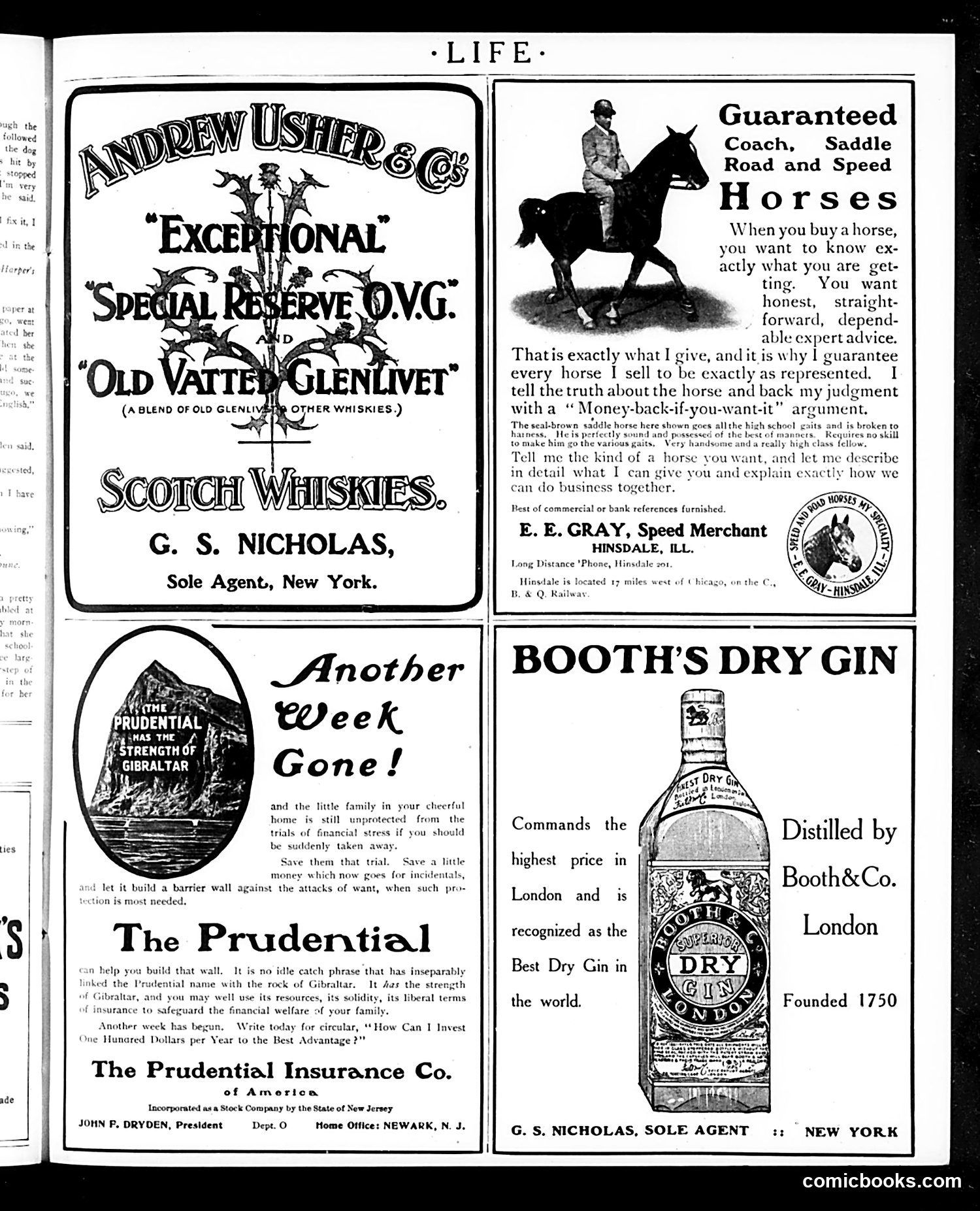
This is primarily an **advertising page**, not satirical content. It features four distinct ads: 1. **Andrew Usher Scotch Whisky** — A product advertisement for "Old Vattie Glenlivet" with G.S. Nicholas as the New York agent. 2. **E.E. Gray's Horses** — A merchant selling guaranteed coach and saddle horses from Hinsdale, Illinois, emphasizing honest representation and money-back guarantees. 3. **The Prudential Insurance Company** — An ad using the Rock of Gibraltar metaphor (their famous symbol) to suggest financial security for families against unexpected hardship or death. 4. **Booth's Dry Gin** — A London gin distillery advertisement (founded 1750) claiming to offer "the Best Dry Gin in the world," also via G.S. Nicholas. The page reflects early 20th-century American consumer culture, with luxury goods (whisky, gin) and emerging services (insurance) marketed to middle-class readers. The ads emphasize trustworthiness and expert judgment as selling points.
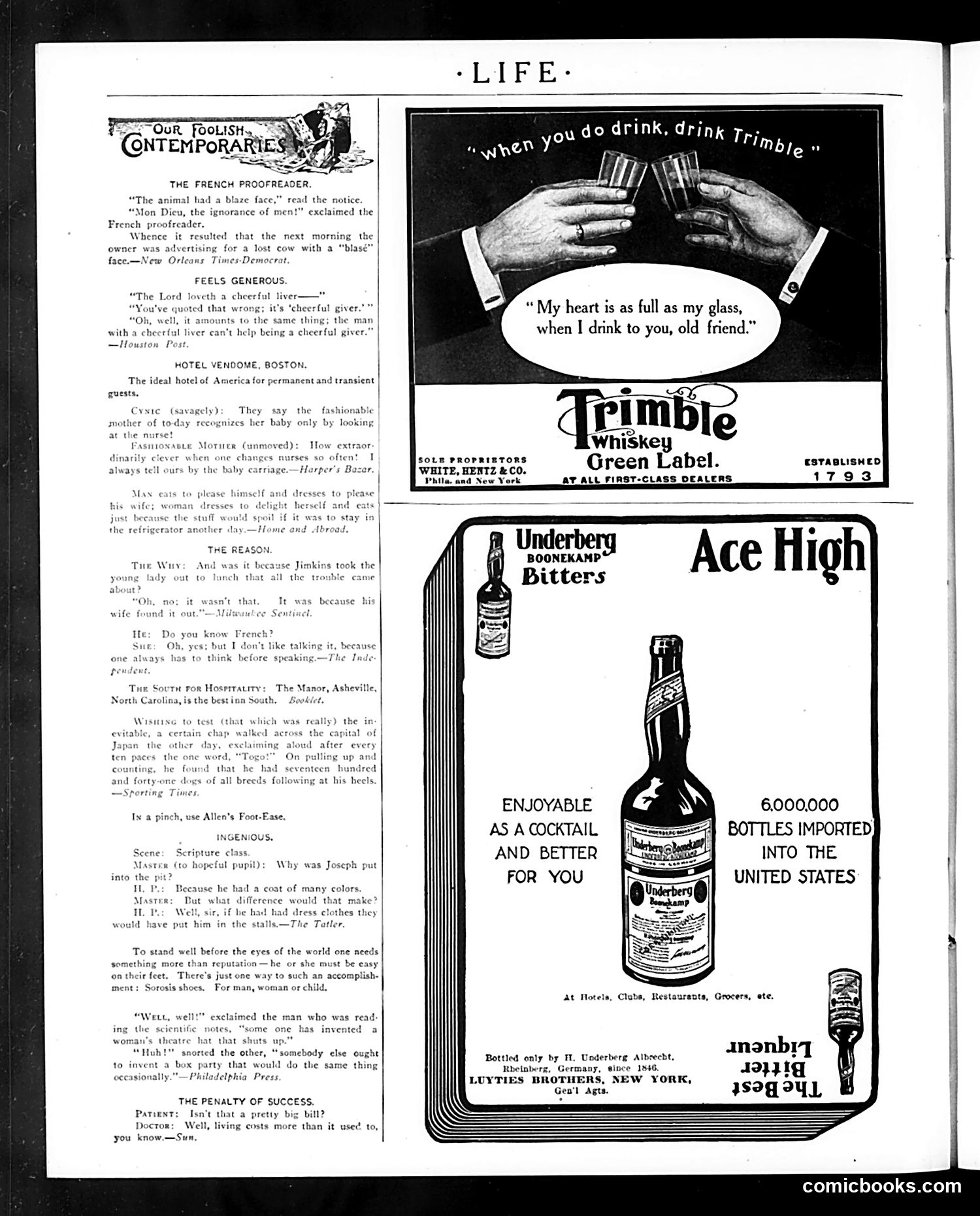
This page combines humor columns with period alcohol advertisements. The left side features brief satirical anecdotes—typical of Life magazine's "Our Foolish Contemporaries" section—poking fun at everyday absurdities: a French proofreader's literal misreading of "blaze face" (a horse marking), fashion-obsessed mothers, and a doctor's expensive bill. The right side contains two full-page liquor ads: **Trimble Whiskey** (showing toasting hands with the phrase "My heart is as full as my glass") and **Underberg Bitters** (a German digestive liqueur claiming 6 million bottles imported). The crucial context: this appears pre-Prohibition (the ads' unapologetic prominence suggests early 20th century). The ads market alcohol as both social bonding and health tonic—Underberg explicitly claims superiority "as a cocktail and better for you," reflecting era-specific medical claims about bitters as digestive aids. The juxtaposition of humor and alcohol advertising reflects America's pre-1920 drinking culture.
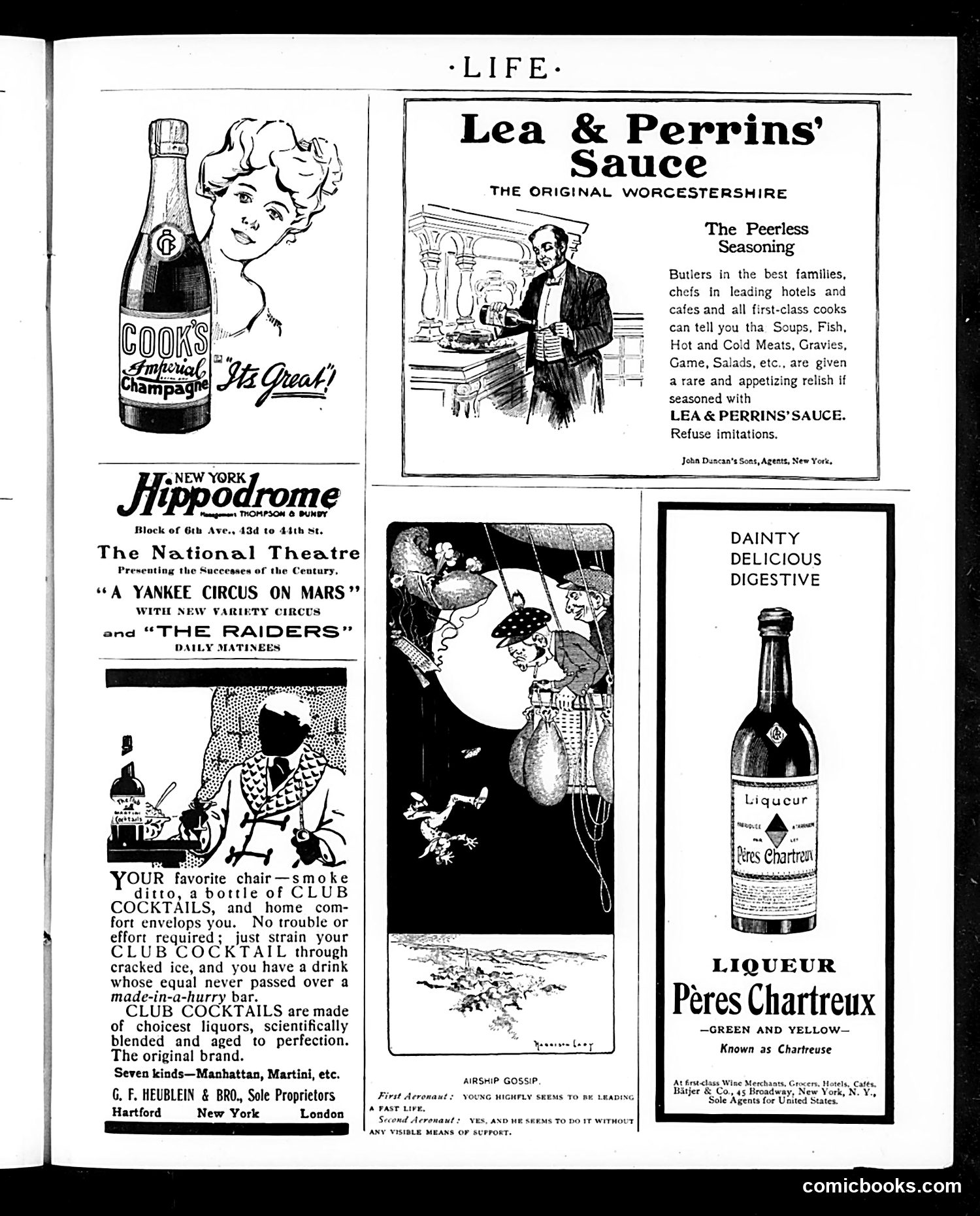
This page is primarily **advertising**, typical of early 20th-century magazines. The main content includes: **"Airship Gossip"** (center cartoon): A satirical joke about early aviation. Two aeronauts debate whether a third pilot is "leading a fast life" or succeeding "without any visible means of support"—wordplay mocking both the precarious nature of early flight and society's scrutiny of unconventional livelihoods. The humor depends on understanding that aviation was experimental and dangerous. **Other advertisements** promote luxury goods: Cooks Imperial Champagne, Club Cocktails (emphasizing home comfort and relaxation), Lea & Perrins Worcestershire Sauce (for refined cooking), and Pères Chartreux liqueur. These ads target affluent readers and reflect early 1900s consumer culture. The **National Theatre** advertisement promotes theatrical entertainment. The page reflects Edwardian-era concerns: nascent aviation technology as novelty, cocktail culture gaining acceptance, and culinary sophistication among the wealthy.
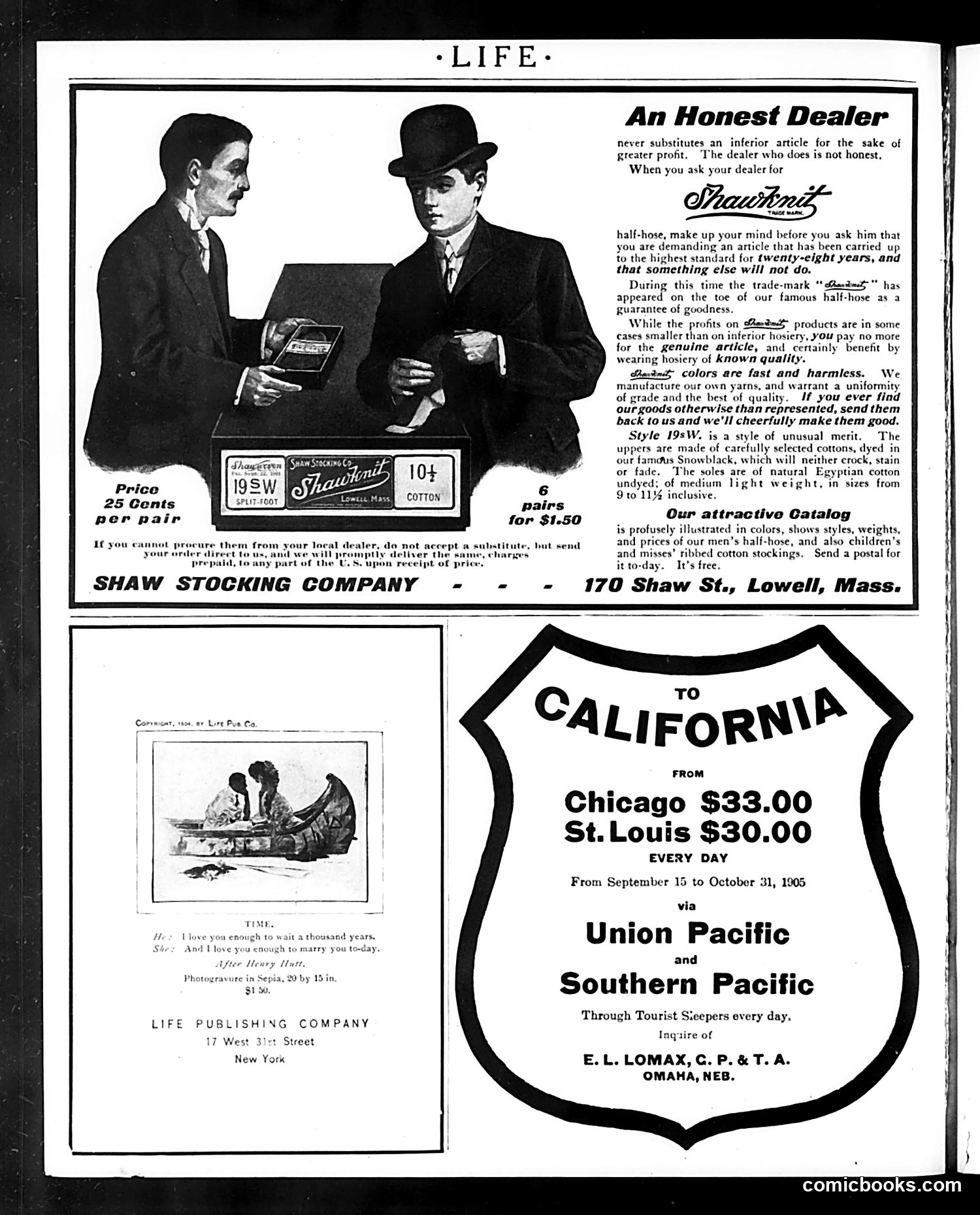
This page consists primarily of **advertisements rather than editorial cartoons**. The top ad shows two men in business attire examining Shaw brand half-hose (socks), illustrating the concept of "An Honest Dealer." The advertisement emphasizes product quality and integrity—that genuine Shaw hosiery maintains consistent standards over 28 years, with a distinctive trademark guarantee. It appeals to consumer confidence by contrasting honest dealing against cheaper substitutes. The lower portion contains two separate ads: one for a Life Publishing Company photograph titled "TIME" (depicting figures, priced at $1.50), and a prominent travel advertisement promoting California rail service via Union Pacific and Southern Pacific railroads at set prices from Chicago ($33) and St. Louis ($30), valid September-October 1905. The page reflects early 20th-century advertising strategies emphasizing brand loyalty, product reliability, and leisure travel—with no political satire present.
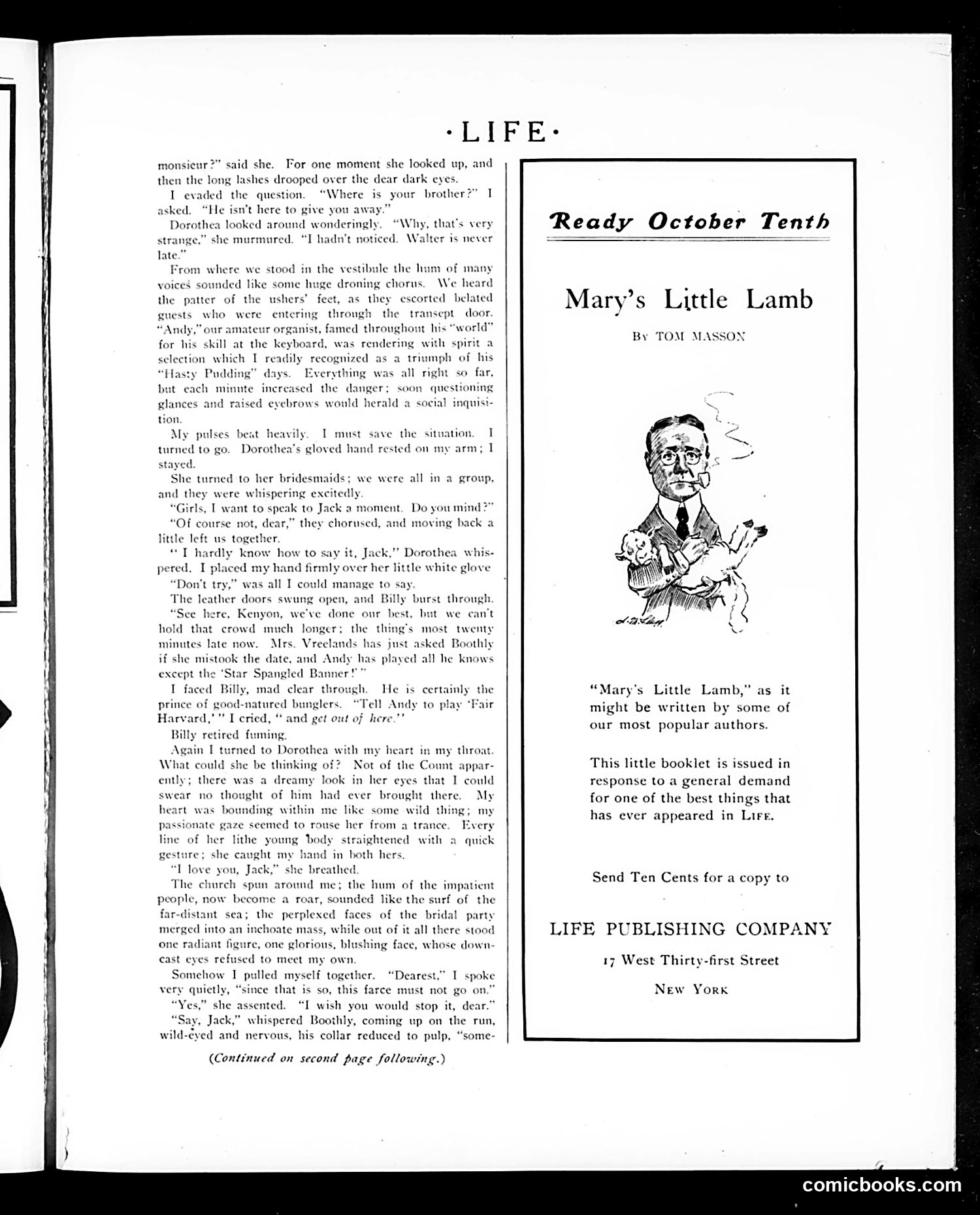
This page contains two distinct elements: **Left side:** A serialized romantic fiction story (continued from a previous issue) about a wedding day drama. The narrator must prevent his beloved Dorothea from marrying "the Count" when she confesses her true love for him instead. The narrative tension—guests growing restless, the organist running out of pieces to play, social embarrassment mounting—creates melodramatic comedy typical of early 20th-century magazine fiction. **Right side:** An advertisement for an upcoming publication: a humorous parody booklet titled "Mary's Little Lamb" by Tom Masson, written "as it might be written by some of our most popular authors." This was a common Life magazine format—satirizing famous contemporary writers by having them reimagine familiar children's content in their distinctive styles. Readers could order it for ten cents from Life Publishing Company. The crude caricature sketch shows an exaggerated male face, likely representing one of the parodied authors, though the specific identity isn't labeled here.
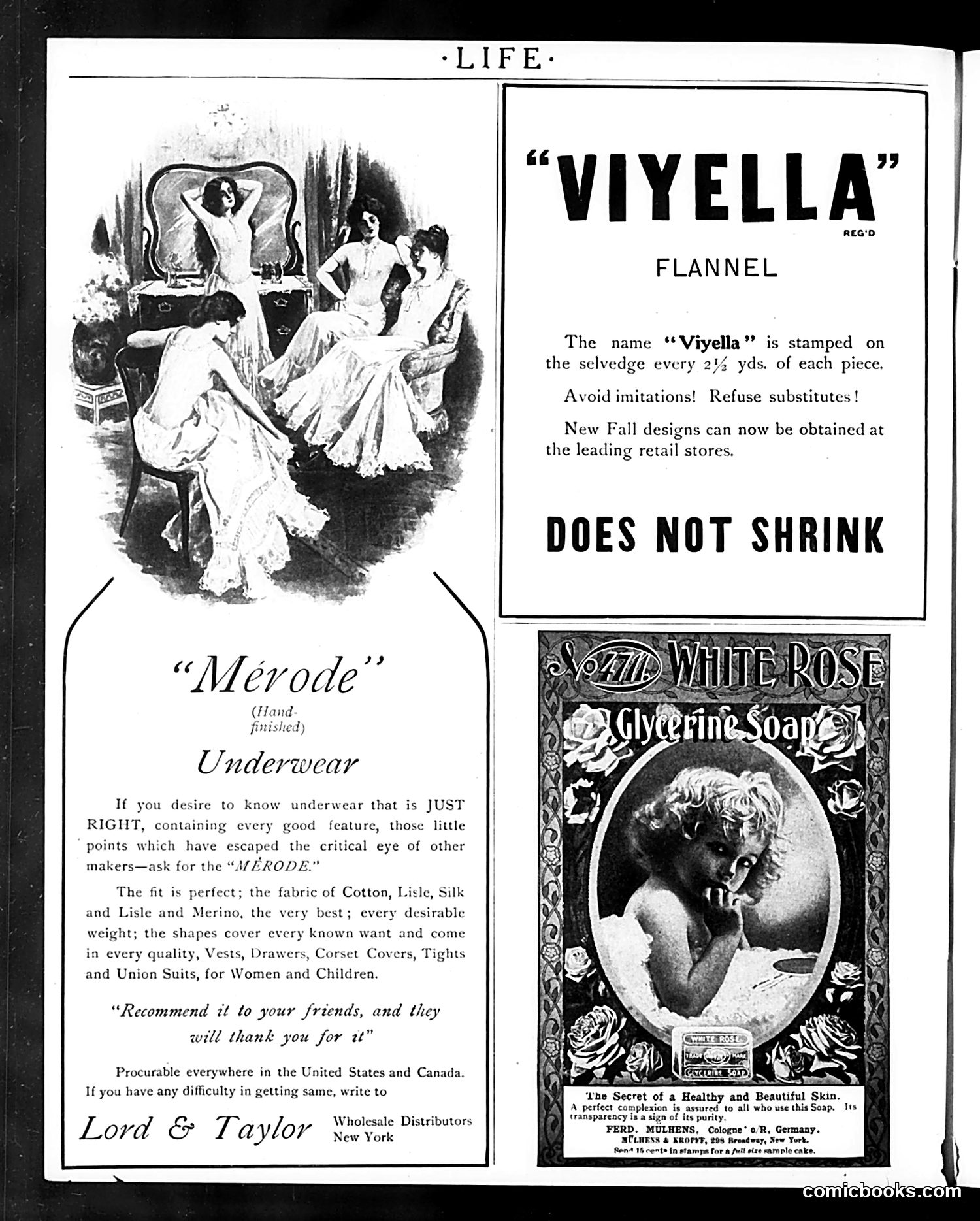
This is primarily a **product advertisement page** rather than satirical content. It features three unrelated commercial ads typical of early 20th-century Life magazine: 1. **"Viyella" flannel fabric** — emphasizes the brand name on selvage and that it "does not shrink," warning against imitations 2. **"Mérode" underwear** — positioned as premium women's undergarments (vests, drawers, corset covers) made from quality materials (cotton, silk, merino), distributed by Lord & Taylor in New York 3. **"White Rose Glycerine Soap"** — a beauty product claiming to produce a healthy complexion, with an ornate floral border design The page reflects **consumer marketing priorities of the era**: brand authenticity, fabric durability, quality materials, and beauty ideals. The decorative illustration accompanying Mérode shows fashionable women in period dress, typical of aspirational advertising imagery. There is **no satirical content or political commentary** visible—this is straightforward commercial promotion targeting affluent American consumers.
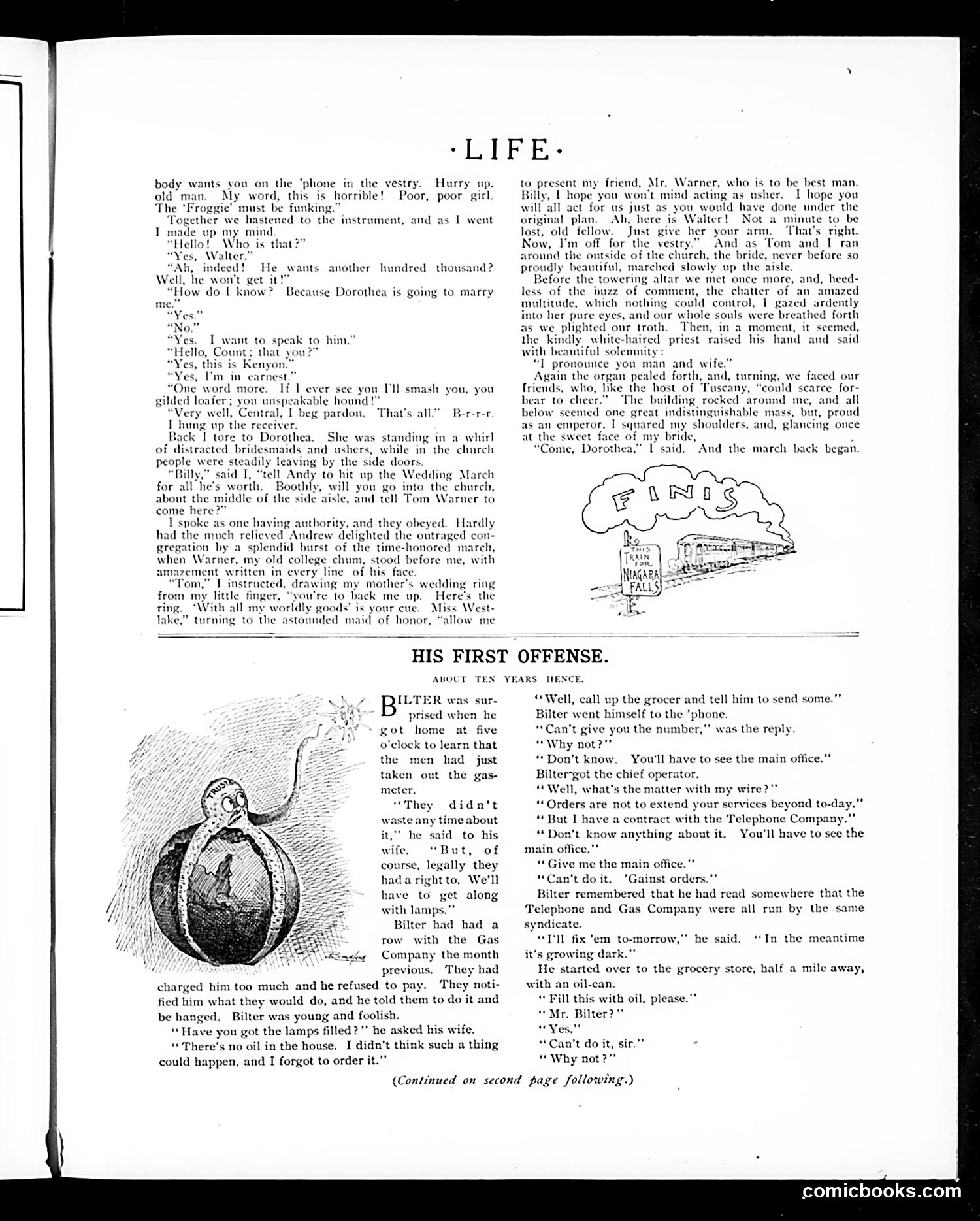
This page contains two distinct stories satirizing early 20th-century American life. The upper narrative depicts a wedding where the groom interrupts the ceremony via telephone to confront a rival suitor (Count Kenyon) pursuing the bride. The satire mocks romantic melodrama and the newly available telephone technology as an intrusive modern convenience that enables emotional outbursts. The lower story, "His First Offense," ridicules a man named Bilter who quarrels with his Gas Company over billing, refuses to pay, and tells them to disconnect him—not expecting they actually would. When they remove his gas meter, he's left without lighting and cannot order oil for lamps. The illustration shows a gas meter in a spherical balloon-like form. The satire targets masculine foolishness and the consequences of defying utility companies during an era when such services were becoming essential. The title implies this is his "first offense"—a mild consequence he'll learn from. Both stories humorously illustrate modern urban inconveniences and the clash between individual will and institutional authority.
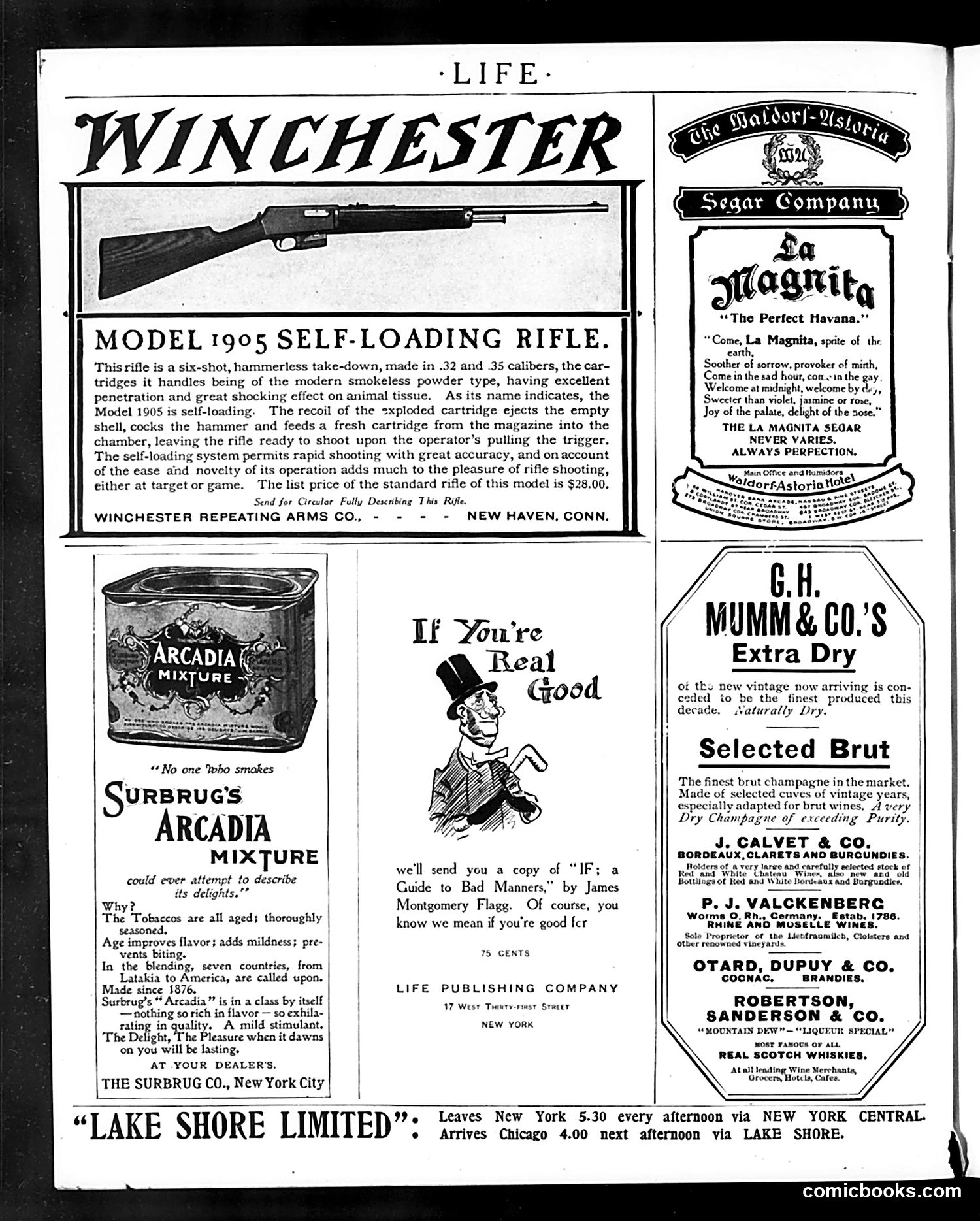
This page is primarily **advertising**, not satire or political commentary. It features product advertisements typical of early 1900s American commerce: **Main Advertisement:** Winchester Model 1905 self-loading rifle—a technological novelty marketed for hunting and sport shooting at $28. **Other Ads Include:** - La Magnita cigars ("The Perfect Havana") - Surbrug's Arcadia tobacco mixture - Multiple champagne and wine brands (Mumm, Calvet, Valckenberg, Otard Dupuy) - Scotch whisky - Lake Shore Limited railroad service **One Small Cartoon Element:** A James Montgomery Flagg illustration promoting a humorous etiquette guide ("If: a Guide to Bad Manners") by Flagg himself—a conditional joke about "if you're good for 75 cents." The page reflects turn-of-the-century consumer culture and leisure goods marketed to affluent readers. There is no apparent political satire or social commentary here—it's straightforward period advertising.
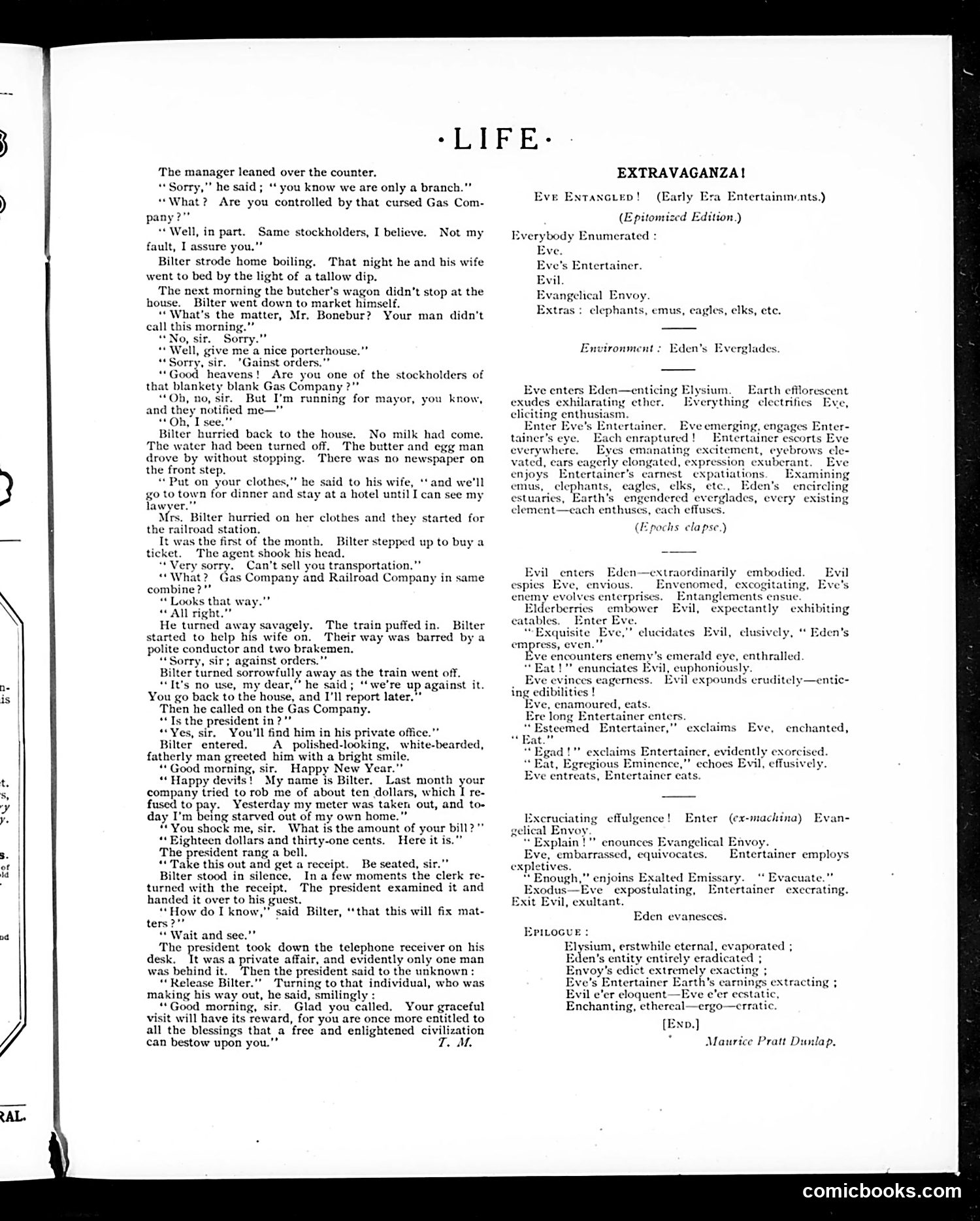
This page contains a story satirizing **monopolistic control by utility companies**, specifically gas companies, in early 20th-century America. The protagonist, Bilter, disputes a gas bill and is punished with systematic corporate retaliation: his milk, water, newspapers, and transportation are cut off—revealing how a single monopoly (or cartel of companies with shared stockholders) can control essential services. The butcher won't serve him because he's running for mayor and fears the Gas Company's influence. The satire's point: ordinary citizens are helpless against corporate power. Only when Bilter pays the disputed bill does the Gas Company president—portrayed as deceptively genteel and paternalistic—restore his access to basic necessities via a single telephone call. The joke is bitter: Bilter gains nothing except the "privilege" of being exploited again, celebrated as if granted a favor by "free and enlightened civilization." This reflects real Progressive Era concerns about utility monopolies and their stranglehold on American life.
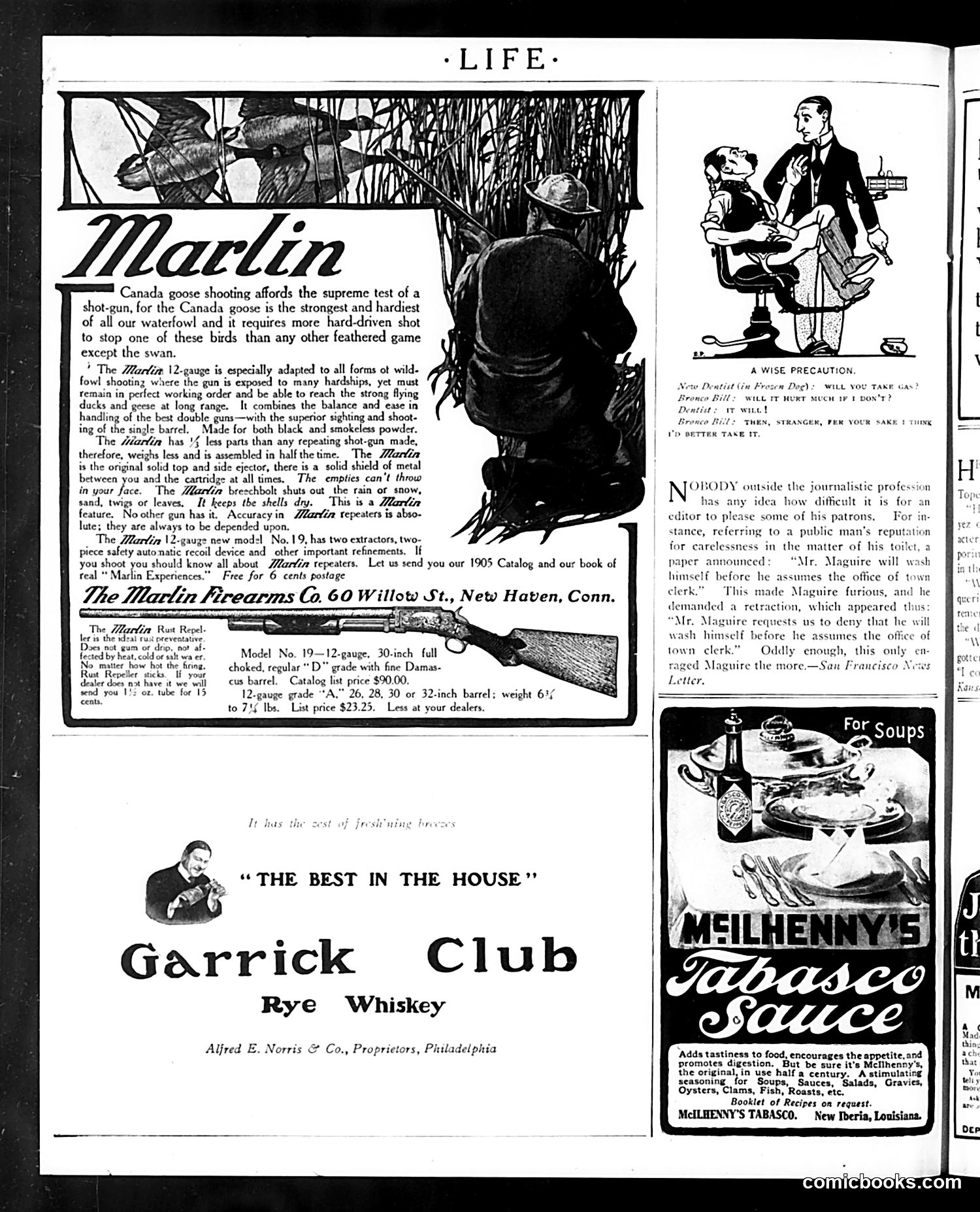
This page is primarily **advertising** for firearms and spirits, with one brief satirical cartoon. The small cartoon titled "A Wise Precaution" mocks small-town social pretension. A new dentist asks a patient if he wants gas; the patient declines, worried it might hurt. The dentist responds he should take it "for your sake"—implying the patient's appearance is so unpleasant that anesthesia is needed for *the dentist's* benefit, not the patient's. The accompanying article about a newspaper editor named Maguire extends this theme: when a paper printed that Maguire would "wash himself" before taking office (implying he was dirty), Maguire demanded a retraction. The paper's correction—denying he would wash—was even more insulting, suggesting he was irredeemably unclean. The humor relies on the absurdity of public humiliation through literal interpretation of careless wording. Both items lampoon small-town vanity and social anxiety.
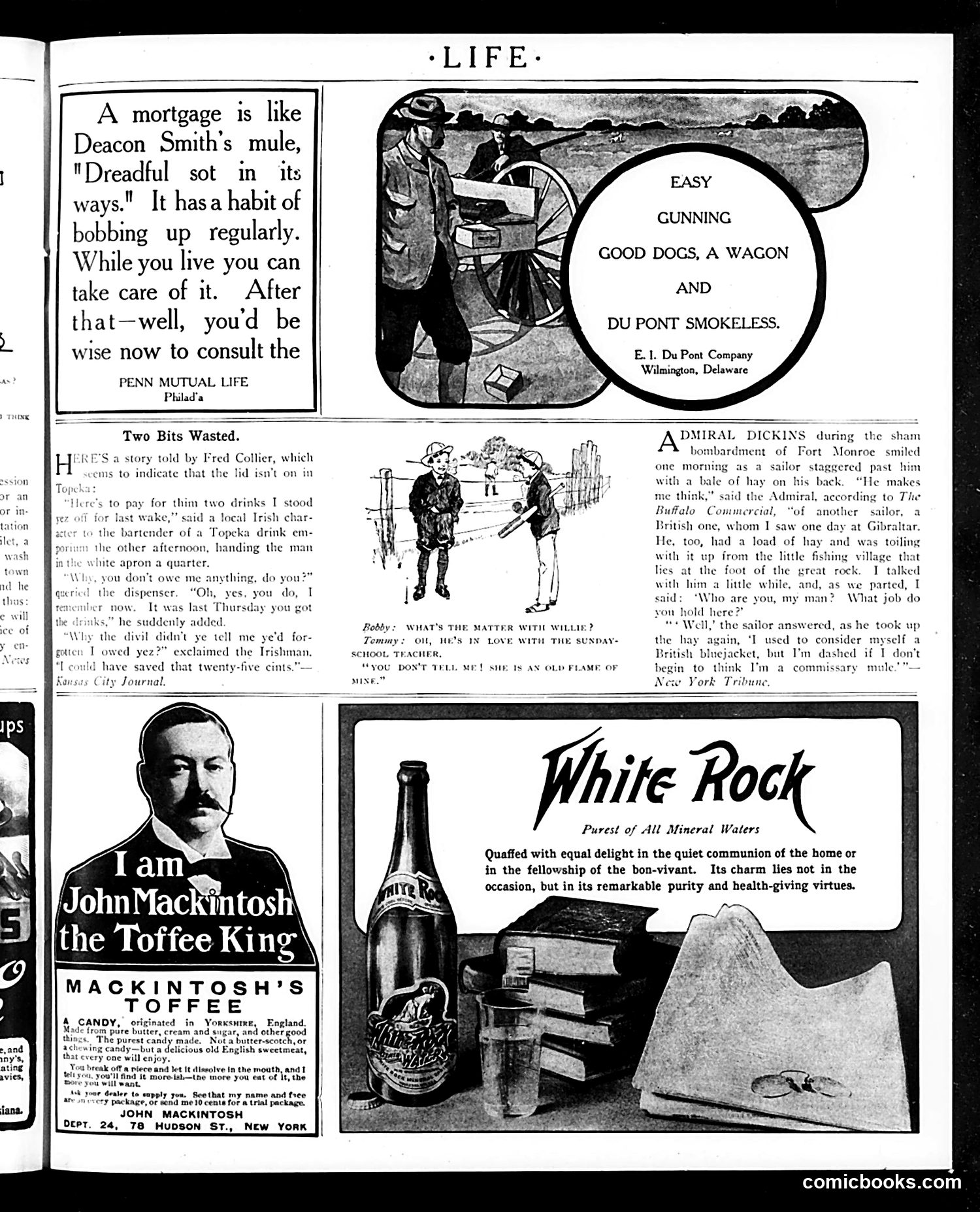
This page contains **advertisements and humor pieces** rather than political cartoons. **The ads include:** - Penn Mutual Life Insurance (with mortgage/mule comparison) - Du Pont Smokeless powder (hunting equipment) - Mackintosh's Toffee candy - White Rock mineral water **The humor pieces are:** 1. **"Two Bits Wasted"**: An Irish immigrant dialect joke about a drunk who forgot he'd already paid his bartender for drinks the previous Thursday—now he's overpaying. 2. **Admiral Dickins anecdote**: A brief story about Admiral Dickins observing a sailor hauling hay at Fort Monroe, recalling another British sailor similarly burdened. The punchline appears cut off but suggests the sailor's job is humble/amusing. 3. **Bobby and Tommy dialogue**: A brief comic exchange where Tommy mentions being "in love with the Sunday-school teacher," implied to be someone named Willie. The joke's full point is unclear from the visible text. The page reflects early 20th-century magazine humor emphasizing ethnic stereotypes and sentimental anecdotes alongside period advertising.
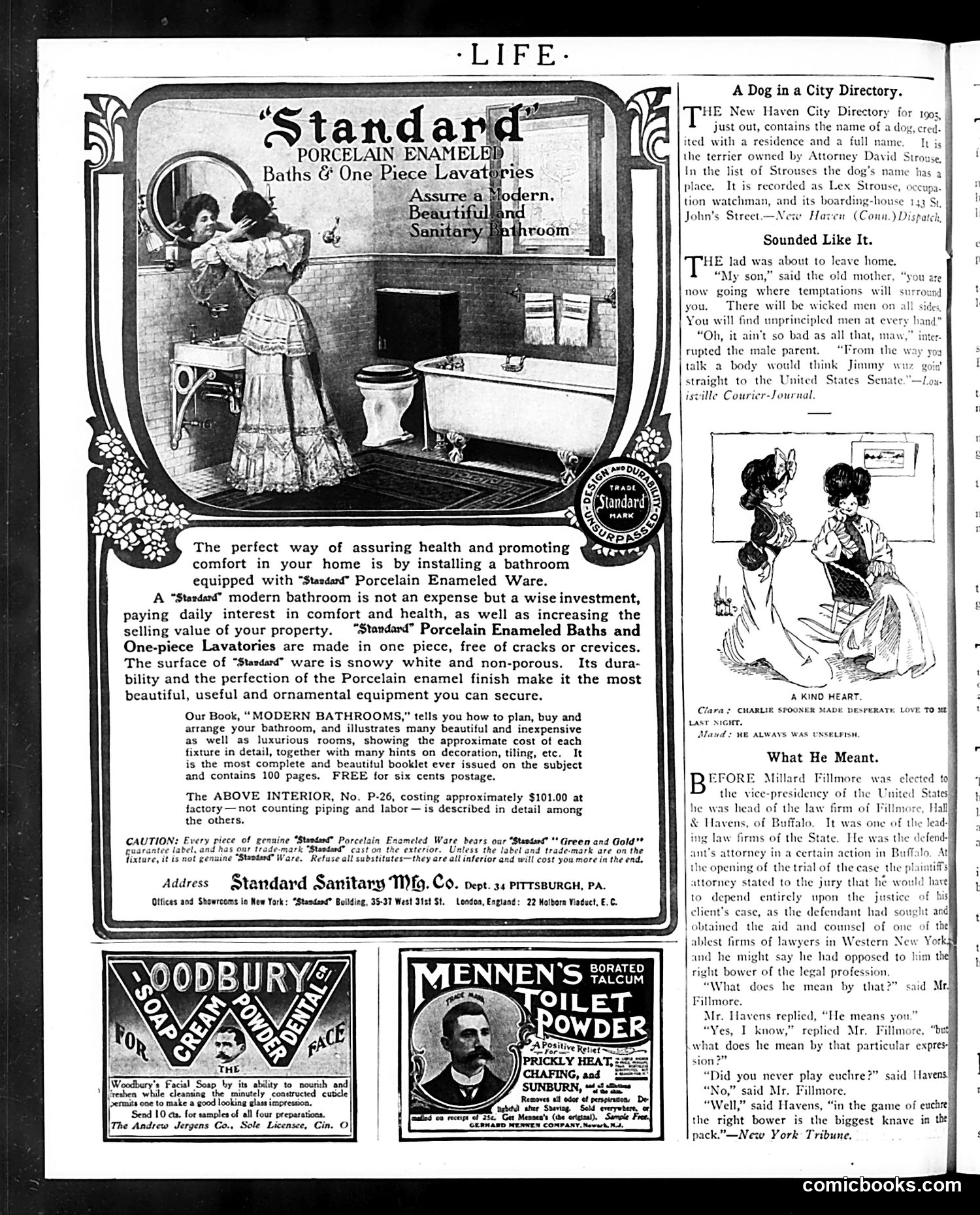
This page is primarily **advertising**, dominated by a large Standard Sanitary Manufacturing advertisement for porcelain bathroom fixtures (tubs, lavatories, toilets). The ad uses an illustrated woman in a modern bathroom to promote installing these products as a health and property-value investment. Below are three brief **humorous anecdotes**: 1. **"A Dog in a City Directory"**: A New Haven dog owned by attorney David Strouse was literally listed in the city directory with an occupation ("watchman"), treating the pet as a resident. 2. **"Sounded Like It"**: A mother warns her departing son about temptations and wicked men, to which his father sarcastically responds the warnings make it sound like the boy is going to the U.S. Senate. 3. **"What He Meant"**: A legal anecdote about Vice President Millard Fillmore. A plaintiff's attorney credits Fillmore's law partner Havens as the "right bower" (strongest player) opposing him, but Havens clarifies he meant Fillmore himself—a card-game reference Fillmore doesn't initially understand. These are light satirical pieces typical of Life's humor content.
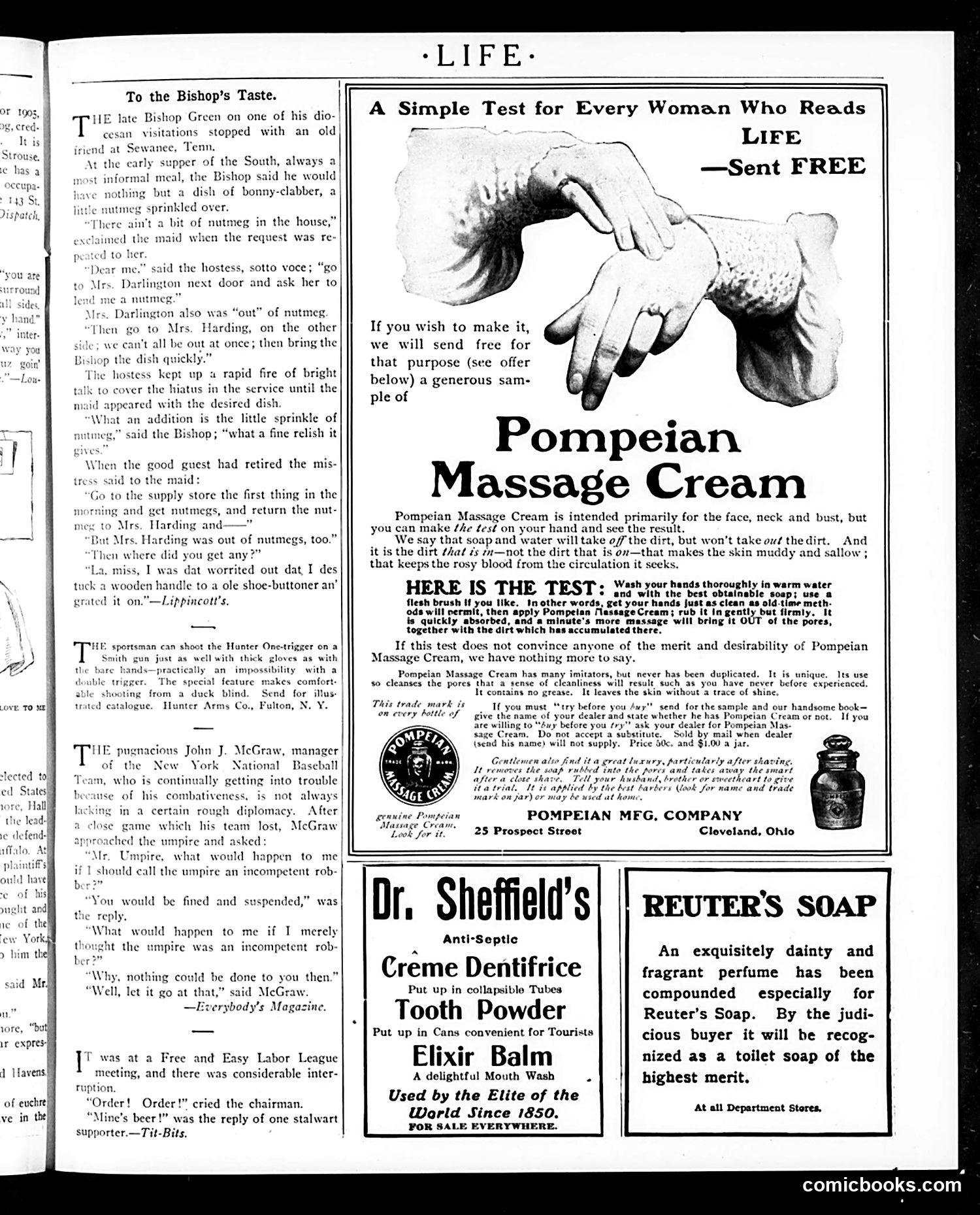
This page is primarily **advertising**, not satire or political commentary. The dominant content is a full-page advertisement for Pompeian Massage Cream, featuring illustrations of hands demonstrating the product's use. The smaller text items in the left column are humor pieces unrelated to the ads: - **"To the Bishop's Taste"**: A anecdote about a Southern bishop requesting bonny-clabber with nutmeg; the maid improvises by scraping a shoe-buttoner. The joke plays on rural Southern manners and resourcefulness. - **McGraw anecdote**: Baseball manager John J. McGraw questions an umpire about consequences of calling him incompetent—a mild joke about authority and diplomacy. - **Labor League joke**: A pun on "order" (parliamentary procedure vs. ordering beer). The page reflects early 20th-century advertising culture, promoting beauty products with pseudo-scientific "tests" to convince women readers of efficacy.
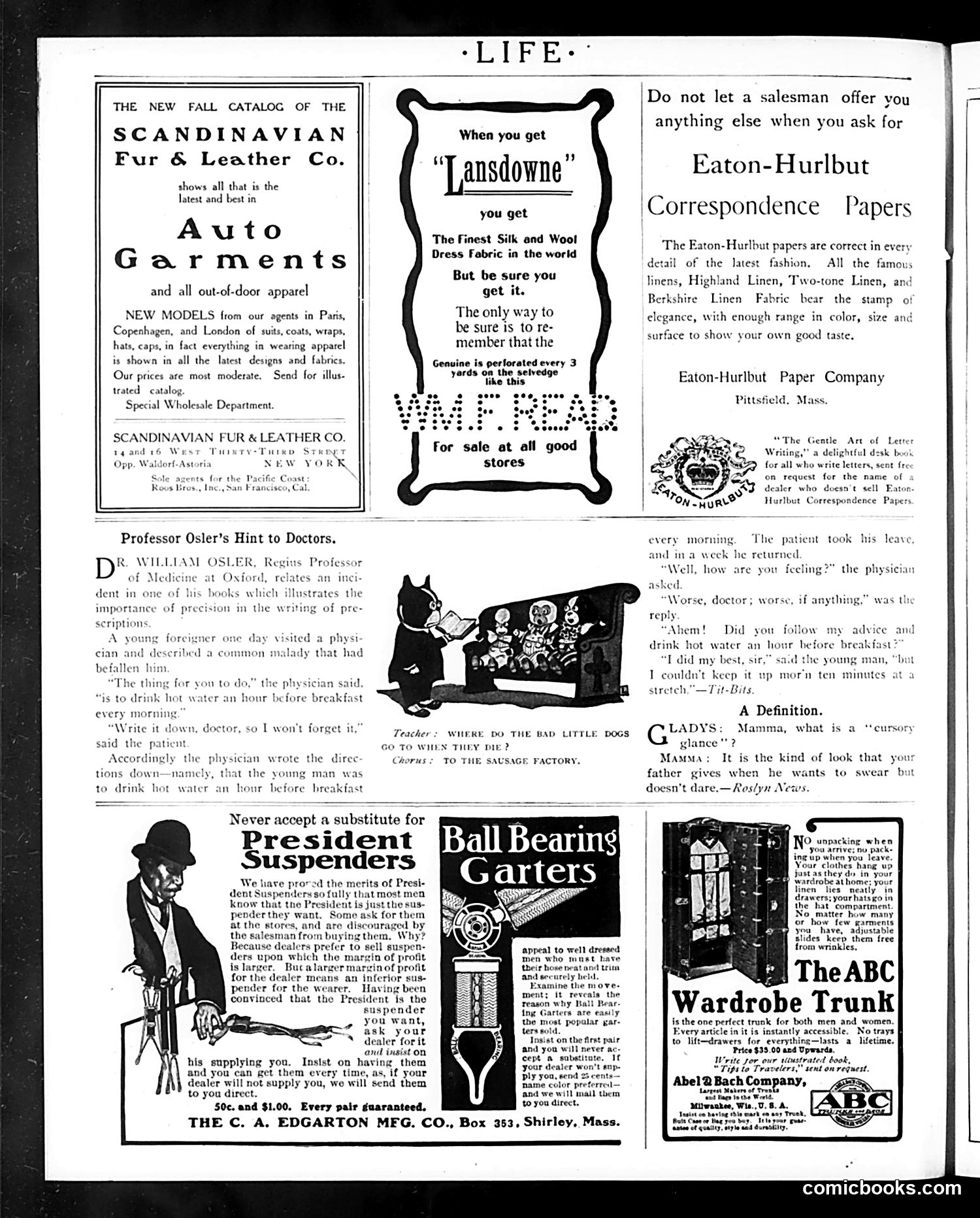
This page is primarily **advertisements and light satirical humor pieces**, typical of early 20th-century Life magazine. The main satirical content includes: **"Professor Osler's Hint to Doctors"**: A humorous anecdote about a physician who advises a foreign patient to drink hot water before breakfast. The joke plays on the patient's literal interpretation—he couldn't maintain the regimen for more than ten minutes, suggesting the advice was impractical rather than medically sound. **"A Definition"**: A brief joke where a child asks what "cursory glance" means; the mother defines it as the disapproving look fathers give when wanting to curse but restraining themselves. **"Never Accept a Substitute for President Suspenders"**: A satirical advertisement highlighting how salesmen push inferior suspender brands because they offer higher profit margins, encouraging consumers to specifically demand the President brand despite dealer resistance. The page otherwise contains standard product advertisements for fur garments, correspondence paper, ball bearings, and trunks—representative of early-1900s consumer marketing.
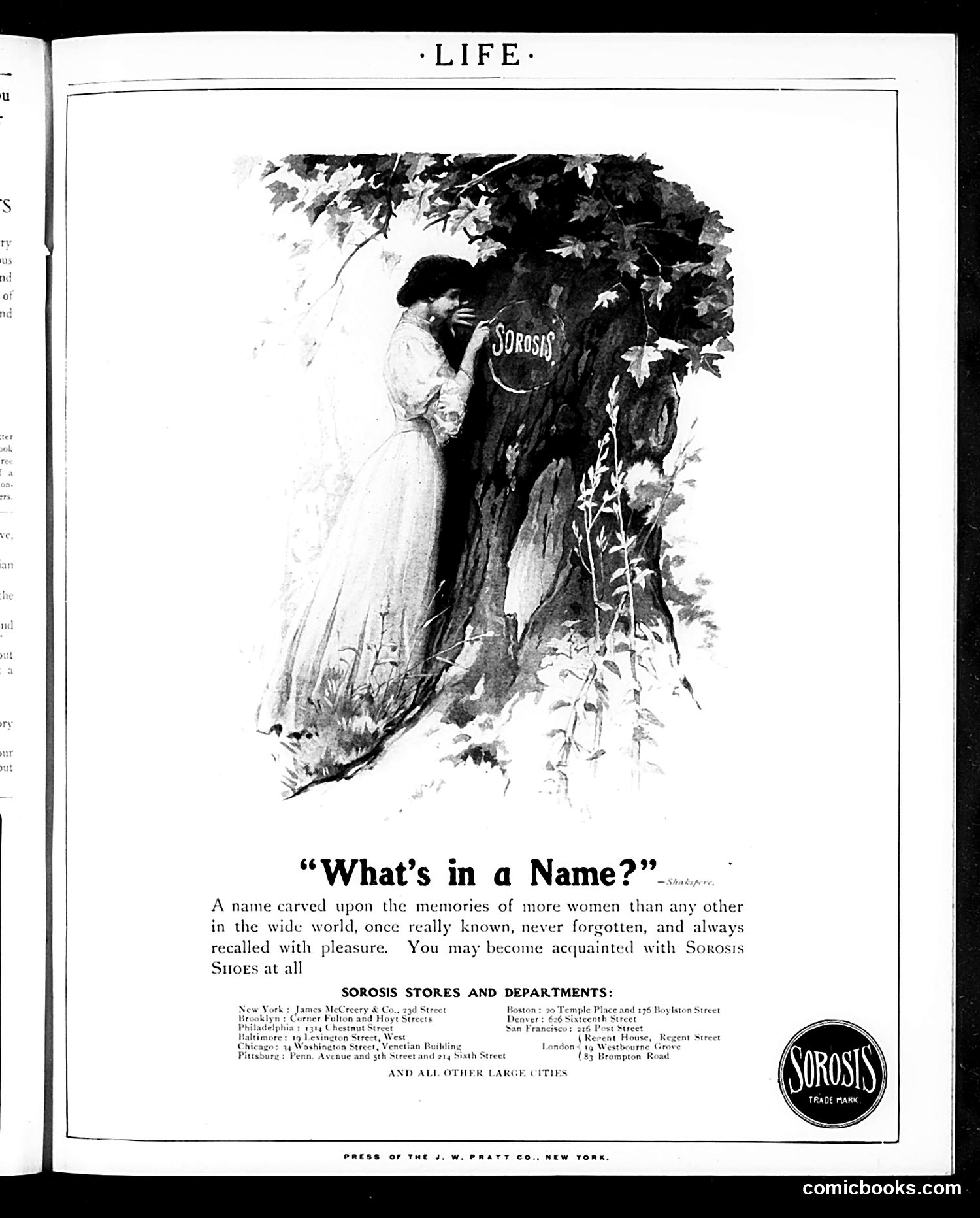
This is a **Sorosis Shoes advertisement**, not political satire. The page features an elegant illustration of a woman in classical dress carving a name into a tree trunk, evoking Shakespeare's "What's in a Name?" The ad claims Sorosis is "a name carved upon the memories of more women than any other in the wide world, once really known, never forgotten, and always recalled with pleasure." This is aspirational branding targeting female consumers—positioning the shoe brand as memorable and beloved. The romantic, literary imagery (the tree, the classical figure, the Shakespeare reference) was typical early-20th-century advertising strategy: associating commercial products with culture and emotion to appeal to women shoppers. The ad lists Sorosis stores across major American cities, emphasizing the brand's national reach and prestige. There is no political commentary or satire here—just vintage consumer advertising.
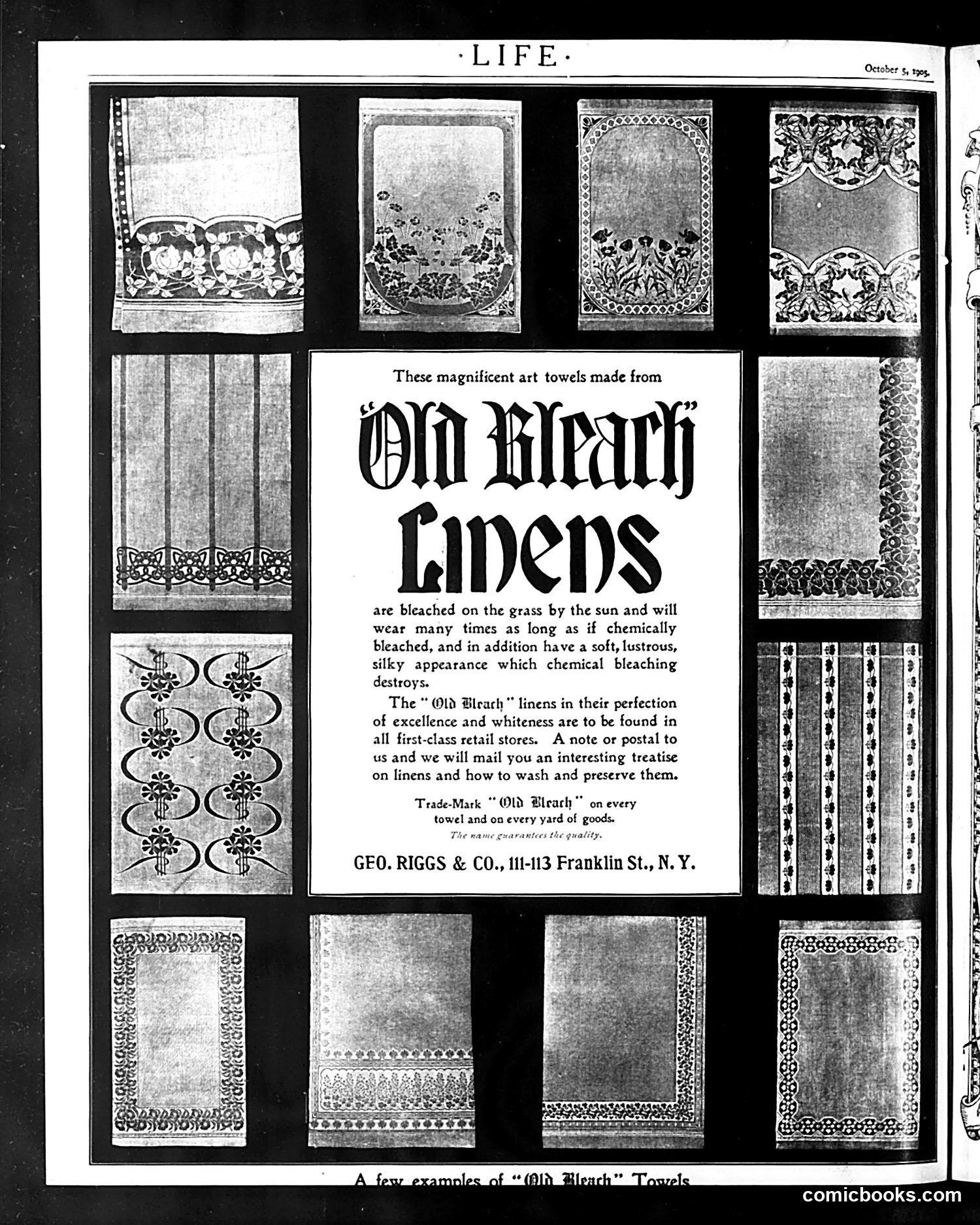
This is an advertisement, not a cartoon or satirical content. It promotes "Old Bleach" brand linens and art towels made by Geo. Riggs & Co. of New York. The ad emphasizes that these towels are bleached naturally on grass using sunlight rather than chemical bleaching, claiming they're softer, more lustrous, and more durable than chemically bleached alternatives. The page displays various decorative towel designs with ornamental borders and patterns surrounding the central advertisement text. There is no political satire or social commentary present—this is straightforward commercial advertising from an early 20th-century magazine, using product examples to showcase the quality and aesthetic appeal of their linens.