
Life, 1905-10-05 · page 35 of 44
Life — October 5, 1905 — page 35: what you’re looking at
What you’re looking at
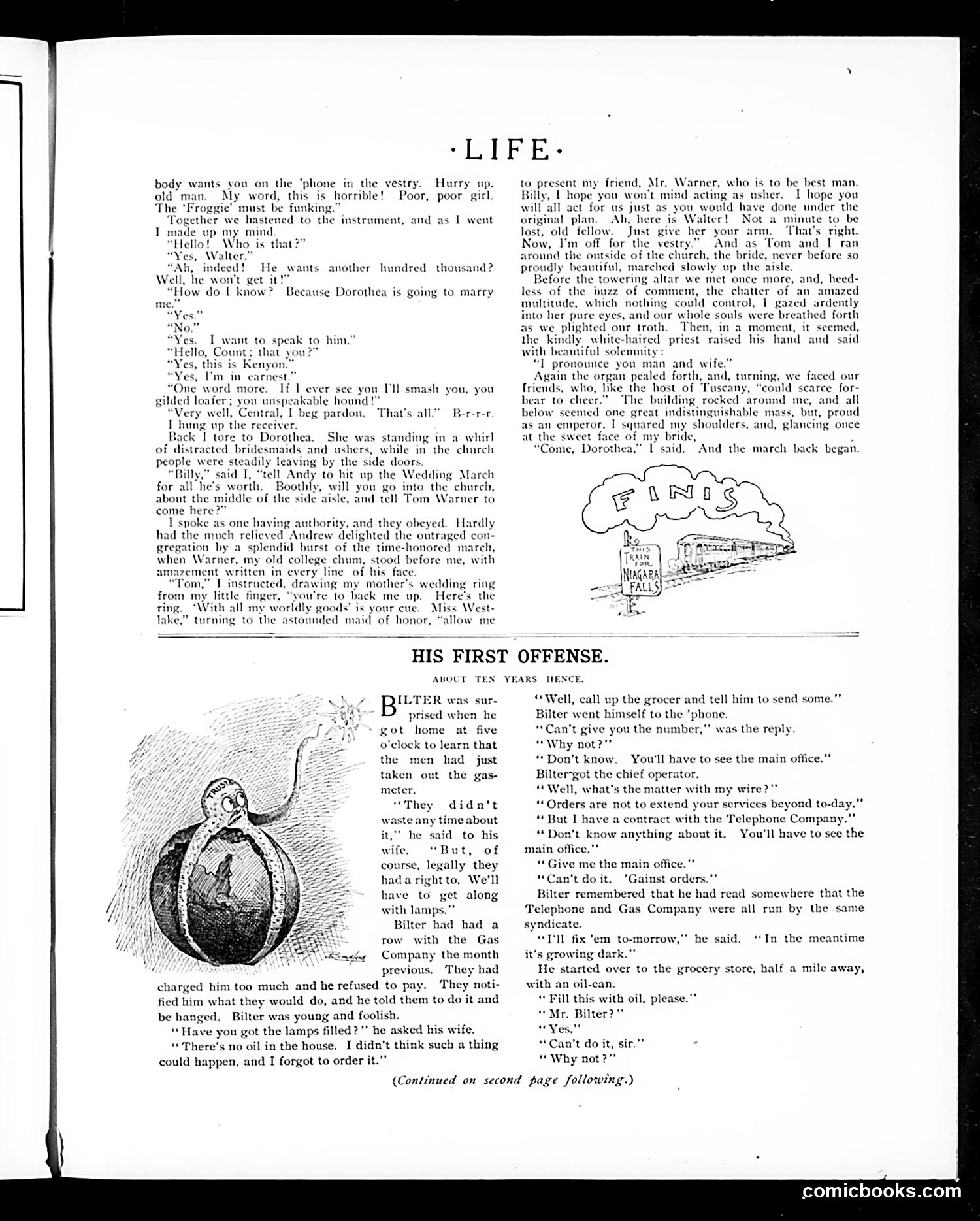
This page contains two distinct stories satirizing early 20th-century American life. The upper narrative depicts a wedding where the groom interrupts the ceremony via telephone to confront a rival suitor (Count Kenyon) pursuing the bride. The satire mocks romantic melodrama and the newly available telephone technology as an intrusive modern convenience that enables emotional outbursts. The lower story, "His First Offense," ridicules a man named Bilter who quarrels with his Gas Company over billing, refuses to pay, and tells them to disconnect him—not expecting they actually would. When they remove his gas meter, he's left without lighting and cannot order oil for lamps. The illustration shows a gas meter in a spherical balloon-like form. The satire targets masculine foolishness and the consequences of defying utility companies during an era when such services were becoming essential. The title implies this is his "first offense"—a mild consequence he'll learn from. Both stories humorously illustrate modern urban inconveniences and the clash between individual will and institutional authority.
📄 Transcribed text from this page (OCR, searchable)
Machine-transcribed from the original scan — historical spelling and the odd misread are preserved.
> abr body wants you on the ‘phone in the vestry. old man. My word, this is horrible! The ‘Froggie’ must be funking.” Together we hastened to the instrument, and as | went I made up my mind “Hello! Who is that?” “Yes, Walter.” Ah, indeed! He wants another Well, he won't get it!” “How do | know? Because Dorothea is going to marry Hurry up. Poor, poor girl hundred thousand? Yes. I want to speak to him.” “Hello, Count; that you?” Yes, this is Kenyon.” Yes, I'm in earnes One word more. If I ever see you I'l smash you, you gilded loafer; you unspeakable hound !” “Very well, Central, | beg pardon, That's all.” Ber-r-r. I hung up the receiver. Back I tore to Dorothea. She was standing in a whirl of dist ted bridesmaids and ushers, while in the church ere steadily leaving by the side doors y,” said I, “tell Andy to hit up the Wedding March for all he’s worth. Boothly, will you go into the church, about the middle of the side aisle, and tell Tom Warner to come here?” I spoke as one having authority, and they obeyed. Hardly had the much relieved Andrew delighted the outraged con- gregation by a splendid burst of the time-honored march, when Warner, my old college chum, stood before me, with cement written in every line of his face “Tom,” T instructed, drawing my mother's wedding ring from my little finger, “vou're to back me up. Here's the ring. ‘With all my worldly goods’ is your cue. Miss West- lake,” turning to the astounded maid of honor, “allow me AWOUT TEN ILTER was sur- prised when he * got home at five o'clock to learn that the men had just taken out the gas- meter, “They didn't waste time about he said to his “But, of course, legally they hada right to, We'll have to get along with lamps.” Bilter had had a row with the Gas Company the month previous. They had charged him too much and he refused to pay. They noti- fied him what they would do, and he told them to do it and be hanged. Bilter was young and foolish. “Have you got the lamps filled?" he asked his wife. “There's no oil in the house. I didn’t think such a thing could happen, and I forgot to order it.”” to present my friend, Mr. Warner, who is to be best man. Billy, | hope you won't mind acting as usher. I hope you will all act for us just as you would have done under the original plan. Ah, here is Walter! Not a minute to be lost, old fellow. Just give her your arm, ‘That's right. Now, I'm off for’ the vestry.” And as Tom and I ran around the outside of the church, the bride, never before so proudly beautiful, marched slowly up the aisl Before the towering altar we met once more, and, heed- less of the buzz of comment, the chatter of an amazed multitude, which nothing could control, | gazed ardently into her pure eyes, and our whole souls were breathed forth as we plighted our troth. Then, in a moment, it seemed, ndly white-haired priest raised his hand and. said vith beautiful solemnity ‘I pronounce you man and wife Again the organ pealed forth, and, turning, we faced our friends, who, like the host of Tuscany, “could scarce for- bear to cheer.” The building rocked around me, and all below seemed one great indistinguishable mass, but, proud as an emperor, I sqttared my shoulders, and, glancing once at the sweet bride, “Come, Dorothea,” [ said. And the march back began. HIS FIRST OFFENSE. YEARS HENCE, “Well, call up the grocer and tell him to send some." Bilter went himself to the "phone. “Can't give you the number,” was th “Why not?” “Don't know. You'll have to see the main office.” Bilter*got the chief operator. “Well, what's the matter with my wire?” “Orders are not to extend your services beyond to-day.”* “But I have a contract with the Telephone Company.”" “Don’t know anything about it. You'll have to sce the main office."” **Give me the main office.’ “Can't do it. ’Gainst orde: Bilter remembered that he had read somewhere that the Telephone and Gas Company were all run by the same syndicate. “T'll fix em to-morrow,” he said. it’s growing dark. He started over to the grocery store, half a mile away, with an oil-can. Fill this with oil, please."’ Mr. Bilter?”" “Yes,"" “Can't do i “ Why not?’ reply, “In the meantime (Continued on second page following.) comicbooks.com