
Life, 1905-10-05 · page 26 of 44
Life — October 5, 1905 — page 26: what you’re looking at
What you’re looking at
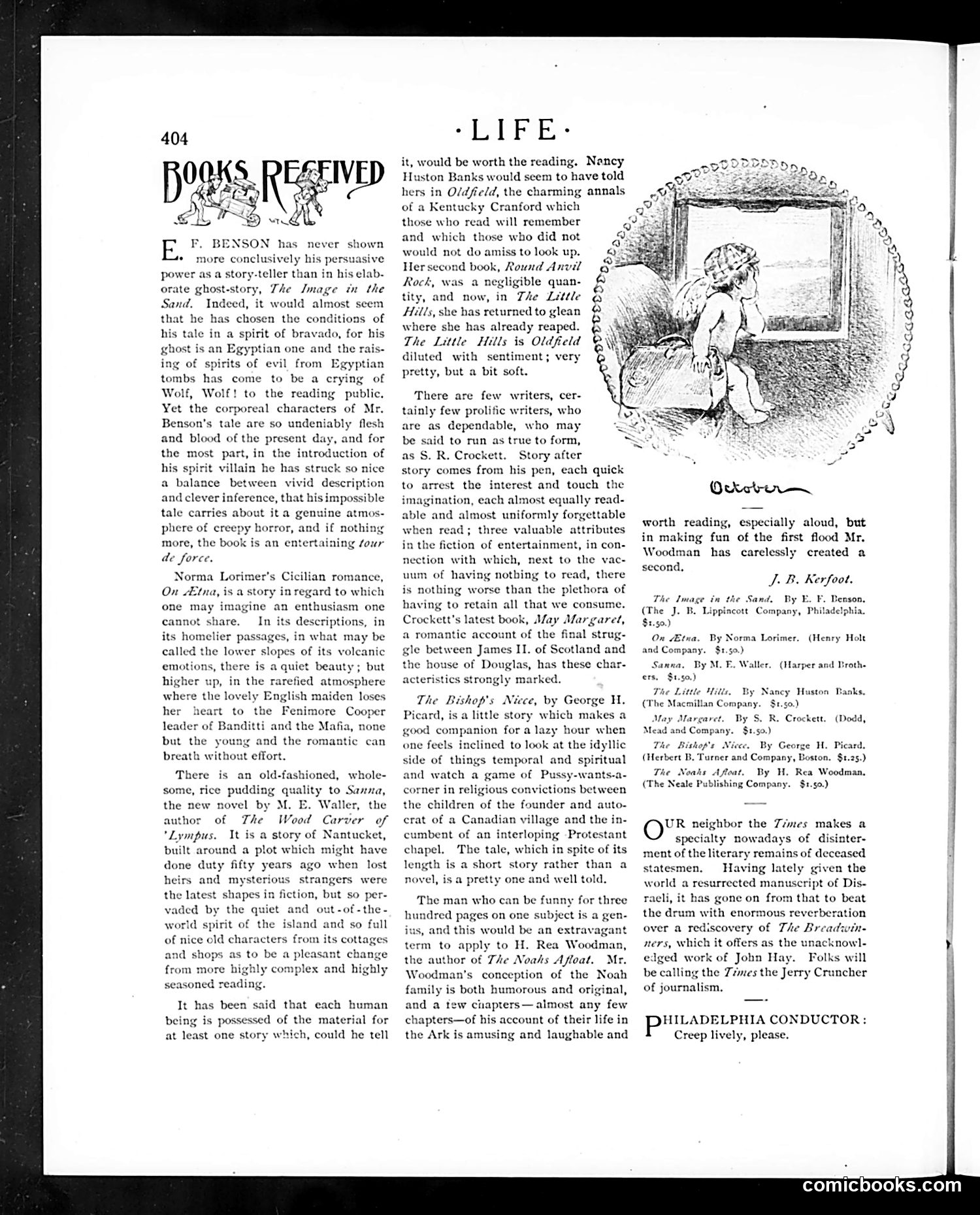
This page from *Life* magazine reviews contemporary books, primarily literary fiction from the late 19th/early 20th century. The small illustration shows a woman reading by a window—a typical domestic scene emphasizing the leisurely, entertainment-focused nature of the books discussed. The reviews are largely positive but somewhat condescending, treating these novels as pleasant diversions rather than serious literature. Notable critiques include dismissing S.R. Crockett's stories as "uniformly forgettable" despite being entertaining, and calling *The Little Hills* by Nancy Huston Banks "pretty, but a bit soft"—diluted compared to her earlier work *Oldfield*. The Egyptian ghost story by E.P. Benson (*The Image in the Sand*) is praised for balancing supernatural drama with realistic characters, though the reviewer notes that mummy-curse stories had become clichéd ("crying of Wolf, Wolf!"). The tone reflects genteel, upper-class literary taste—these are books for leisurely reading and intellectual amusement among educated readers.
📄 Transcribed text from this page (OCR, searchable)
Machine-transcribed from the original scan — historical spelling and the odd misread are preserved.
§, REAEIVED e y ga never shown more conclusively his persuasive story-teller than in his elab- orate ghost-story, The Image in the Sand. Indeed, it would almost seem that he has chosen the conditions of his tale in a spirit of bravado, for his ghost is an Egyptian one and the rais- of spirits of evil from Egyptian tombs has come to be a crying of Wolf, Wolf! to the reading public. Yet the corporeal characters of Mr. Benson's tale are so undeniably flesh and blood of the present day, and for the most p: n the introduction of his spirit villain he has struck so nice a balance between vivid description and clever inference, that his impossible tale carries about ita genuine atmos- phere of creepy horror, and if nothing more, the book is an entertaining four de force. Norma Lorim Cicilian romance, On Etna, is a story in regard to which m one one may in cannot share, its homelier passages, in w called the lower slopes of its vol ions, there is a quiet beauty; er up, in the rarefied atme where the lovely English maiden loses her heart to the Fenimore Cooper leader of ditti and the M but the yor and the roman breath without effort. 2, none ic can There is an old-fashioned, whole- some, rice pudding quality to Sana, the new novel by M. E. Waller, the author of The Wood Carver of mpus. It is a story of Nantucket, built around a plot which might have done duty fifty years ago when lost heirs and mysterious strangers were the latest shapes in fiction, but so per- ded by the quiet and out-of-the- world spirit of the island and so full of nice old chara rom its cottages and shops as to be a pleasant change from more highly complex and highly seasoned reading. cters It has been said that each human being is possessed of the material for at least one story which, could he tell TPE it, would be worth the reading. Nancy Huston Banks would seem to have told hers in O/dfield, the charming annals of a Kentucky Cranford which those who read will remember and which those who did not would not do amiss to look up. Hersecond book, Round Anvil Rock, was a negligible quan- tity, and now, in The Little Hills, she has returned to glean where she has already reaped. The Little Hills is Oldfield diluted with sentiment; very pretty, but a bit soft. There are few writers, cer- tainly few prolific writers, who are as dependable, who may be said to run as true to form, as S. R. Crockett. Story after story comes from his pen, each quick to arrest the interest and touch the imagination, each almost equally read- ble and almost uniformly forgettable when read; three valuable attributes in the fiction of entertainment, in con- nection with which, next to the vac- uum of having nothing to read, there is nothing worse than the plethora of having to retain all that we consume. Crockett’s latest book, May Margaret, a romantic account of the final strug- gle between James II. of Scotland and the house of Douglas, has these char- acteristics strongly marked. The Bishop's Niece, by George H. Picard, is a little story which makes a good companion for a lazy hour when one feels inclined to look at the idyllic side of things temporal and spiritual and watch a game of Pussy-want corner in religious convictions between the children of the founder and auto- crat of a Canadian village and the in- cumbent of an interloping Protestant chapel. ‘The tale, which in spite of its a short story rather than a one and well told. ‘The man who can be funny for three dred pages on one subject is a gen- us, and this would be an extravagant term to apply to H. Rea Woodman, the author of Tie Noahs Afloat. Mr. Woodman’s conception of the Noah family is both humorous and original, and a tew chapters—almost any few chapters—of his account of their life in the Ark is amusing and laughable and worth reading, especially aloud, but in making fun of the first flood Mr. Woodman has carelessly created a second, J. B. Kerfoot. Sand, Ry E. F, Denson, (The J. B. Lippincott Company, Philadelphia. $1.50.) The Image in On tna, By Norma Lorimer. (Henry Holt and Company. $1.50.) Sanna. By M.F. . (Harper and Broth. ers, $1.50.) The Little Wilts, By Nancy Huston Ranks, (The Macmillan Company. $1.50.) May Margaret. By S, R. Crockett, (Dodd, Mead and Company. $1.50.) The Bishop's Niece, By George H. Picard. (Herbert B, Turner and Company, Boston. $1.25.) The Noahs Aftoat. By H. Rea Woodman, (The Neale Publishing Company. $1.50.) ovr neighbor the 7mes mak: specialty nowadays of disinter- ment of the literary remains of deceased statesmen. Having lately given the world a resurrected manuscript of Dis- raeli, it has gone on from that to beat the drum with enormous reverberation over a rediscovery of The Breadwin- ners, which it offers as the unacknowl- edged work of John Hay. Folks will be calling the T/mes the Jerry Cruncher of journalism. HILADELPHIA CONDUCTOR: Creep lively, please. comicbooks.com