
Life, 1905-10-05 · page 12 of 44
Life — October 5, 1905 — page 12: what you’re looking at
What you’re looking at
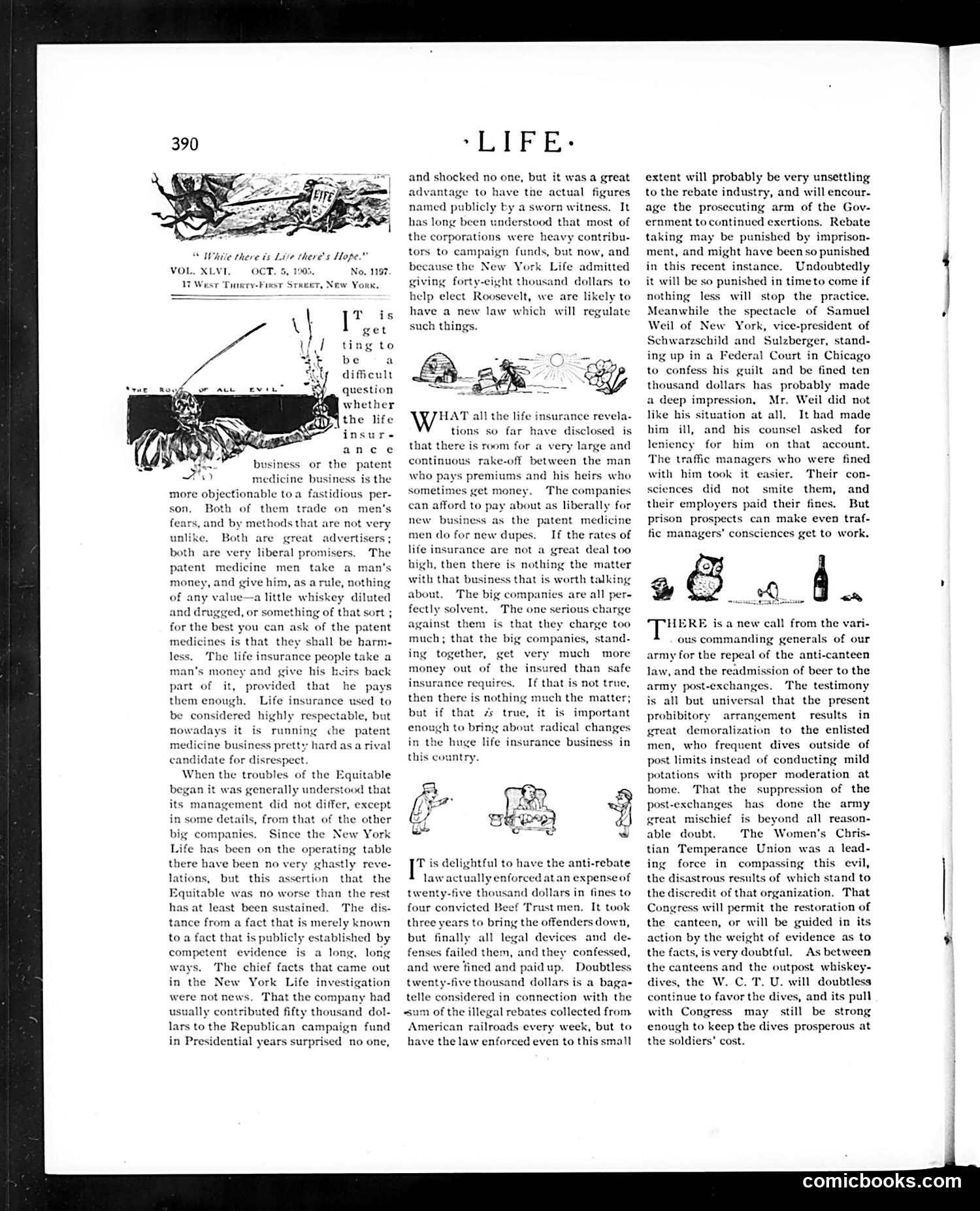
This page contains satirical commentary on life insurance and patent medicine industries rather than a political cartoon. The text criticizes life insurance companies for collecting premiums liberally while resisting payouts, and attacks patent medicine manufacturers for false advertising and selling ineffective products. The illustrated vignettes (small cartoon figures) appear to mock patent medicine practices—showing various dubious remedies and their typical consumers. The page also discusses enforcement of anti-rebate laws against insurance companies, mentioning a specific case involving "Schwarzschild and Sulzberger" who confessed to illegal practices. The overall satirical thrust targets corporate malfeasance in insurance and medicine—industries exploiting public trust through deception and financial manipulation. This reflects Progressive Era (early 1900s) concerns about corporate accountability and consumer protection.
📄 Transcribed text from this page (OCR, searchable)
Machine-transcribed from the original scan — historical spelling and the odd misread are preserved.
VOL. XLVI. OC 1905, 17 West Truery-Fiest Srxcet, New Yor. Uf] ting to be a f difficult question whether (the life insur ance business or the patent medicine business is the more objectionable toa fastidious per- son. Both of them de on men's fears, and by methods that are not ve unlike. Both are great advertisers both are very liberal promisers. The patent medicine men take a man’s money, and give him, as arule, nothing of any value—a little whiskey diluted and drugged, or something of that sort ; for the best you can ask of the patent medicines is that they shall be harm- less. The life insurance people take a man's money and give his heirs back part of provided that he pi them enough. Life insurance used to be considered highly respectable, but nowadays it is running che patent medicine business pretty hard as a ri candidate for disrespect. When the troubles of the Equitable began it was generally understood that its management did not differ, except in some details, from that of the other big companies. Since the New York Life has been on the operating table there have been no very ghastly reve- lations, but this assertion that the Equitable was no worse than the rest has at least been sustained. The dis- tance from a fact that is merely known to a fact that is publicly established by competent evidence is a long, long ways. The chief facts that came out in the New York Life investigation were not news. That the company had usually contributed fifty thousand dol- lars to the Republican campaign fund in Presidential years surprised _no one, *LIFE:- and shocked no one, but it was a great advantage to have the actual figures named publicly by a sworn witness. It has long been understood that most of the corporations were heavy contribu- tors to campaign funds, but now, and use the New York Life admitted giving forty-eight thousand dollars to help elect Roosevelt, we are likely to have a new law which will regulate such things. T all the life insurance revela- Ww" tions so far have disclosed is that there is room for a very large and continuous rake-off between the man who sometimes get money. The companies can afford to pay about as liberally for who pays premiums and his hei new business as the patent medicine men do for new dupes. If the rates of life insurance are not a great deal too high, then there is nothing the matter with that business that is worth talking about. The big companies are all per- fectly solvent. ‘The one serious charge against them is that they charge too much; that the big companies, stand- much more ed than safe ing together, get very money out of the insu insurance requires. If that is not true, then there is nothing much the matter; but if that ¢s true, it is important agh to bring about radical changes he huge life insurance business in this country. ena in 8 ¢ se T is delightful to have the anti-rebate law actually enforced atan expenseof twenty-five thousand dollars in fines to four convicted Beef Trust men. It took three years to bring the offenders down, but fi fenses failed them, and they confessed, and were fined and paid up. Doubtless twenty-five thousand dollars is a baga- telle considered in connection with the sum of the illegal rebates collected from American hay ly all legal devices and de- ilroads every week, but to the law enforced even to this small extent will probably be very unsettling to the rebate industry, and will encour. age the prosecuting arm of the Gov- ernment to continued exertions. Rebate taking may be punished by imprison- ment, and might have been so punished in this recent instance. Undoubtedly it will be so punished in timeto come if nothing less will stop the practice. Meanwhile the spectacle of Samuel Weil of New York, vice-president of Schwarzschild and Sulzberger, stand- ing up in a Federal Court in Chicago to confess his guilt and be fined ten thousand dollars has probably made a deep impression, Mr. Weil did not like his situation at all. It had made him ill, and his counsel asked for leniency for him on that account. The traffic managers who were fined with him took it sier. Their con- sciences did not smite them, and their employers paid their fines, But prison prospects can make even traf- fic managers’ consciences get to work. a@G oo fa HERE is a new call from the vari- ous commanding generals of our army for the repeal of the anti-canteen law, and the readmission of beer to the army post-exchanges. The testimony is all but universal that the present prohibitory arrangement results in great demoralization to the enlisted men, who frequent dives outside of post limits instead of conducting mild potations with proper moderation at home. That the suppression of the post-exchanges has done the army great mischief is beyond all reason- able doubt. The Women's Chris- tian Temperance Union was a lead- ing force in compassing this evil, the disastrous results of which stand to the discredit of that organization. That Congress will permit the restoration of the canteen, or will be guided in its action by the weight of evidence as to the facts, is very doubtful. As between the canteens and the outpost whiskey- dives, the W. C. T. U. will doubtless continue to favor the dives, and its pull with Congress may still be strong enough to keep the dives prosperous at the soldiers’ cost. . comicbooks.com