
A complete issue · 52 pages · 1905
Life — June 1, 1905
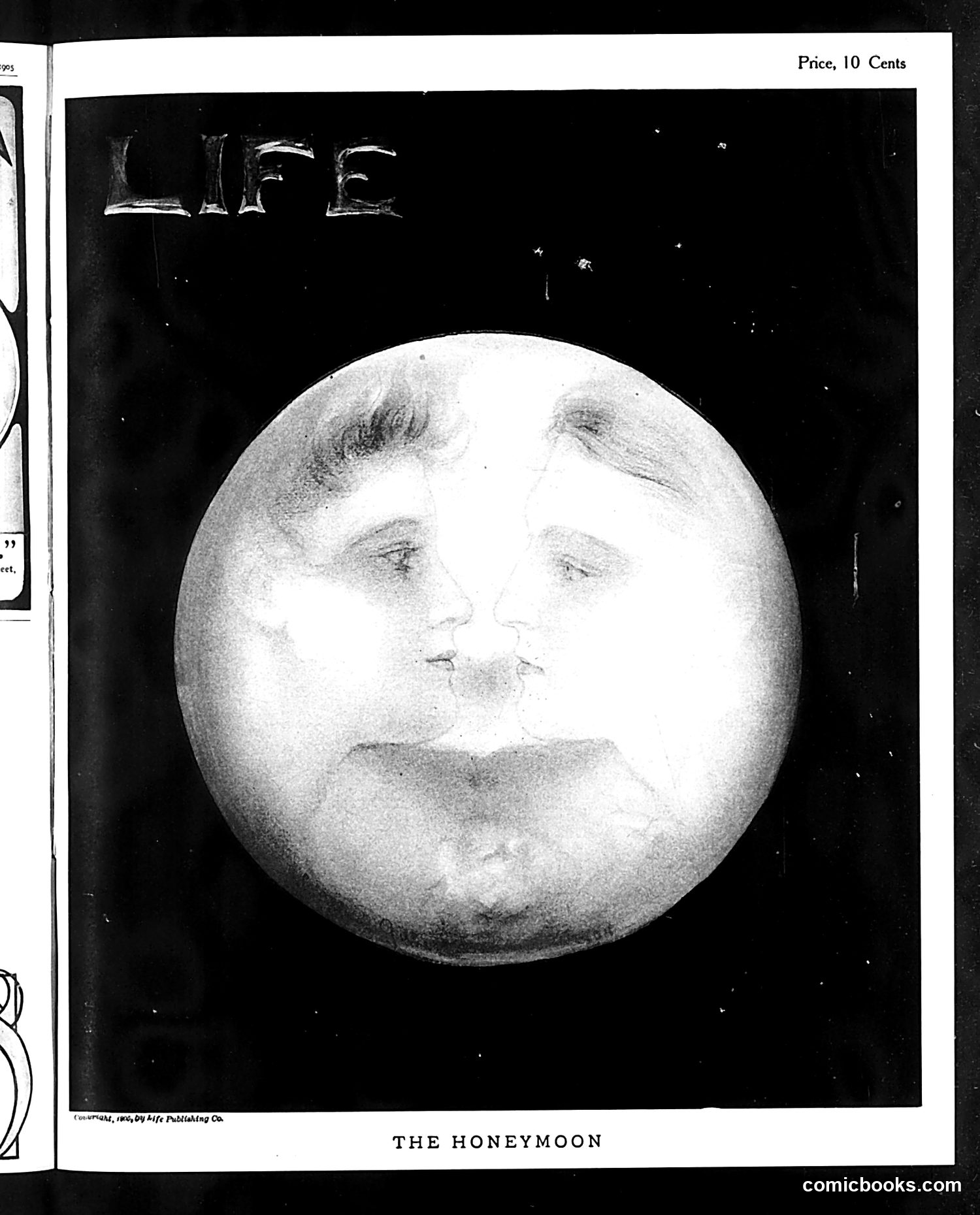
This page shows a surreal illustration titled "The Honeymoon" depicting a large moon-like sphere with two faces merged together in profile—appearing to represent a newly married couple. The imagery plays on the romantic notion of "honeymoon" literally by showing faces within/on the moon itself. The satire likely mocks newlyweds' idealized romantic notions or the clichéd sentimentality surrounding honeymoons. By merging two faces into one celestial body, the cartoon may suggest how couples lose individual identity in marriage, or it comments on the dreamy, unrealistic expectations people hold about married life. The price ("10 Cents") indicates this is an early 20th-century issue. Without additional context, the specific couple referenced remains unclear.
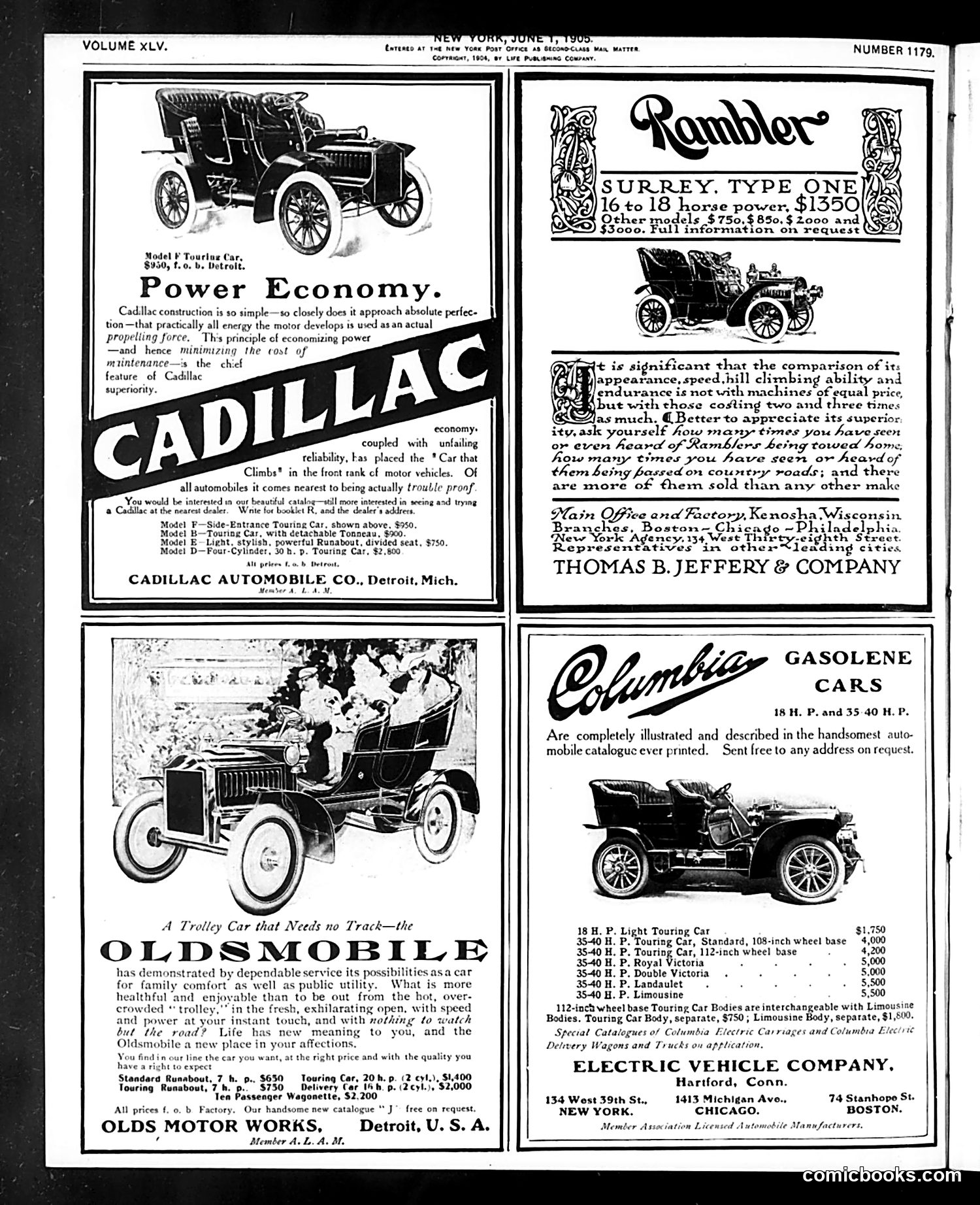
This page contains **automobile advertisements only**—no political cartoons or satirical content. Four early 1900s car manufacturers advertise their vehicles: Cadillac emphasizes "Power Economy" and reliability; Rumblers touts their Surrey Type with 16-18 horsepower; Oldsmobile markets a "Trolley Car that Needs no Track" for family comfort and public utility; and Columbia offers gasoline-powered cars in various models. The advertisements reflect the nascent automotive industry's competitive efforts to establish credibility and market dominance. Common sales pitches include power, economy, comfort, and dependability—concerns that remain relevant today. Prices range from $750 to $5,500, reflecting the vehicles' status as luxury items.
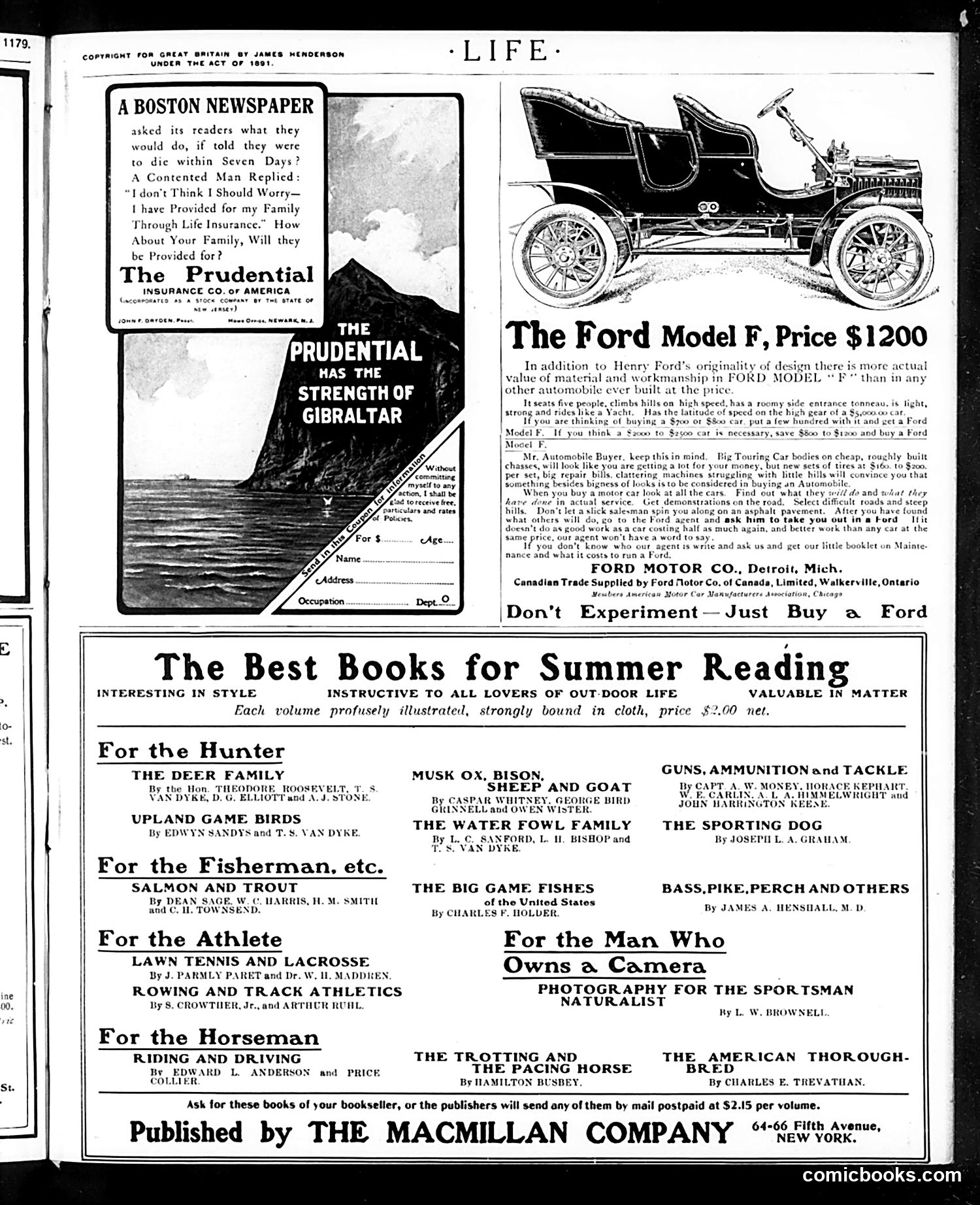
This page is primarily **advertising** rather than editorial content. The top features two ads: one for Metropolitan Life Insurance (responding to a Boston newspaper's question about providing for one's family), and one for the Ford Model F automobile priced at $1200. Below is a large advertisement section titled "The Best Books for Summer Reading" from Macmillan Company, organizing titles by interest (hunter, fisherman, athlete, horseman, etc.). **There is no political cartoon or satire on this page.** The only illustrative content consists of product advertisements—a life insurance appeal and an automobile advertisement with technical specifications. The page represents early 20th-century magazine advertising aimed at middle and upper-class readers interested in outdoor pursuits and financial security.
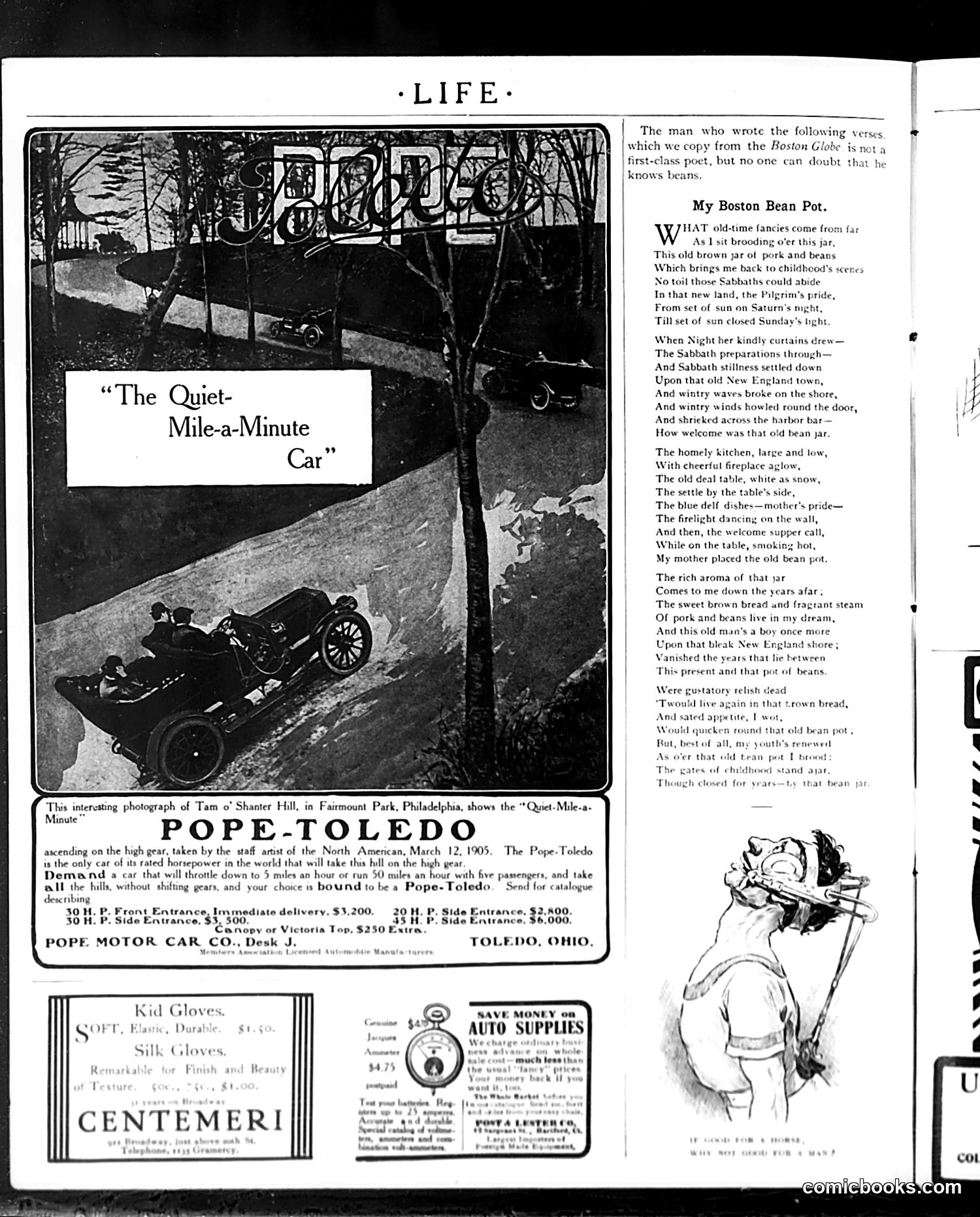
This page is primarily **advertising and nostalgic content**, not political satire. The main advertisement features the **Pope-Toledo automobile** (Pope Motor Car Co., Toledo, Ohio)—a real early 1900s car brand. The ad emphasizes the vehicle's power and speed, claiming it can throttle down to 5 miles per hour or exceed 50 mph with five passengers. The right side contains **"My Boston Bean Pot,"** a sentimental poem about a baked bean pot that evokes New England childhood memories and Puritan heritage. It's nostalgic Americana rather than satire. Lower advertisements include kid gloves and auto supplies. The **"Quiet-Mile-a-Minute Car"** headline appears to be advertising copy highlighting the Pope-Toledo's smooth, powerful performance—not political commentary.
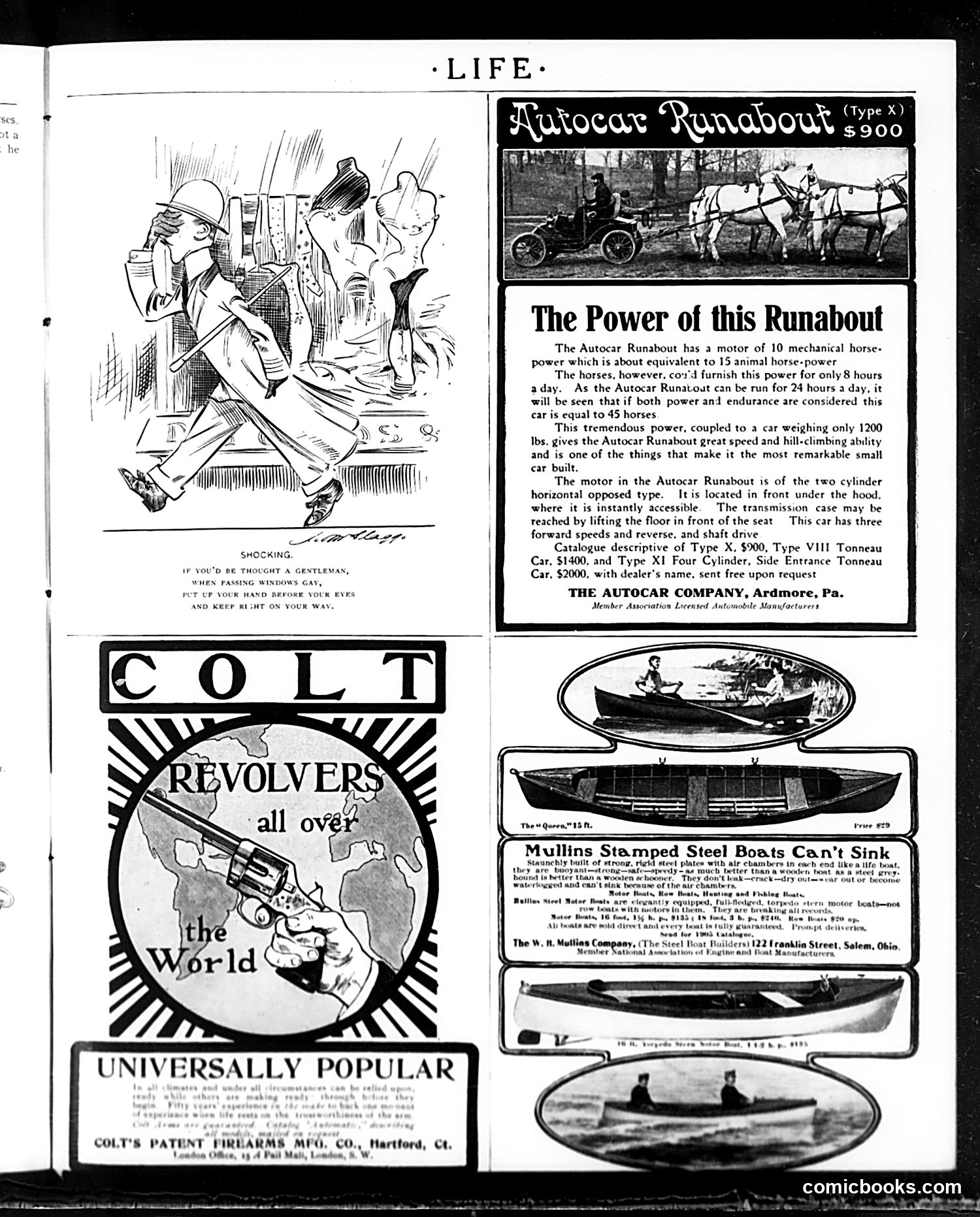
This page is **primarily advertising** for consumer products (Autocar Runabout automobiles, Colt Revolvers, and Mullins Stamped Steel Boats), with one cartoon. The cartoon at top-left shows a man in a hat being violently struck or knocked down, with the caption: "SHOCKING. / IF YOU'D BE THOUGHT A GENTLEMAN, / WHEN RIDING ON THE STREET, / PUT UP YOUR HAND BEFORE YOUR EYES / AND KEEP IT BIT ON THE WAY." The joke appears to satirize public comportment—specifically, that gentlemen should shield their eyes when encountering something shocking on city streets (possibly implied to be women in revealing dress or other unseemly sights). The ironic humor lies in the violent "shocking" action depicted contradicting the genteel advice given.
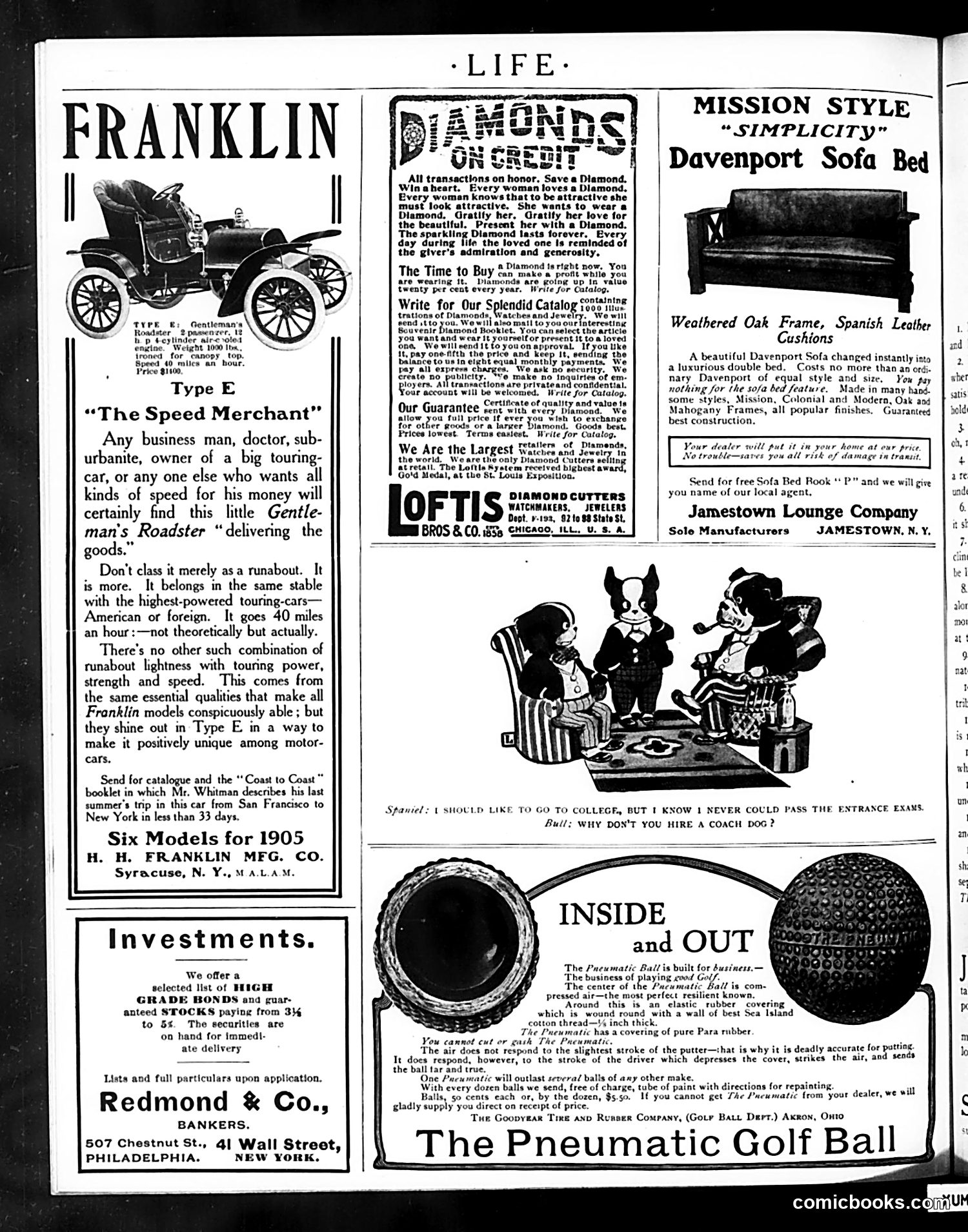
This page is primarily **advertising** with a small cartoon. The ads promote Franklin automobiles, diamond jewelry (Loftis Bros.), a sofa bed, and a golf ball. The cartoon shows **anthropomorphized animals** (appearing to be cats or dogs in clothing) at a table. One says: "Samuel, I should like to go to college, but I know I never could pass the entrance exam. But, why don't you hire a coach dog?" This is a **visual pun** playing on "coach dog" (a Dalmatian breed historically used with carriages) versus a human tutor/coach. The joke relies on wordplay rather than political satire—it's gentle humor about entrance exams and hiring tutors, typical of Life magazine's lighter comedic content from this era.
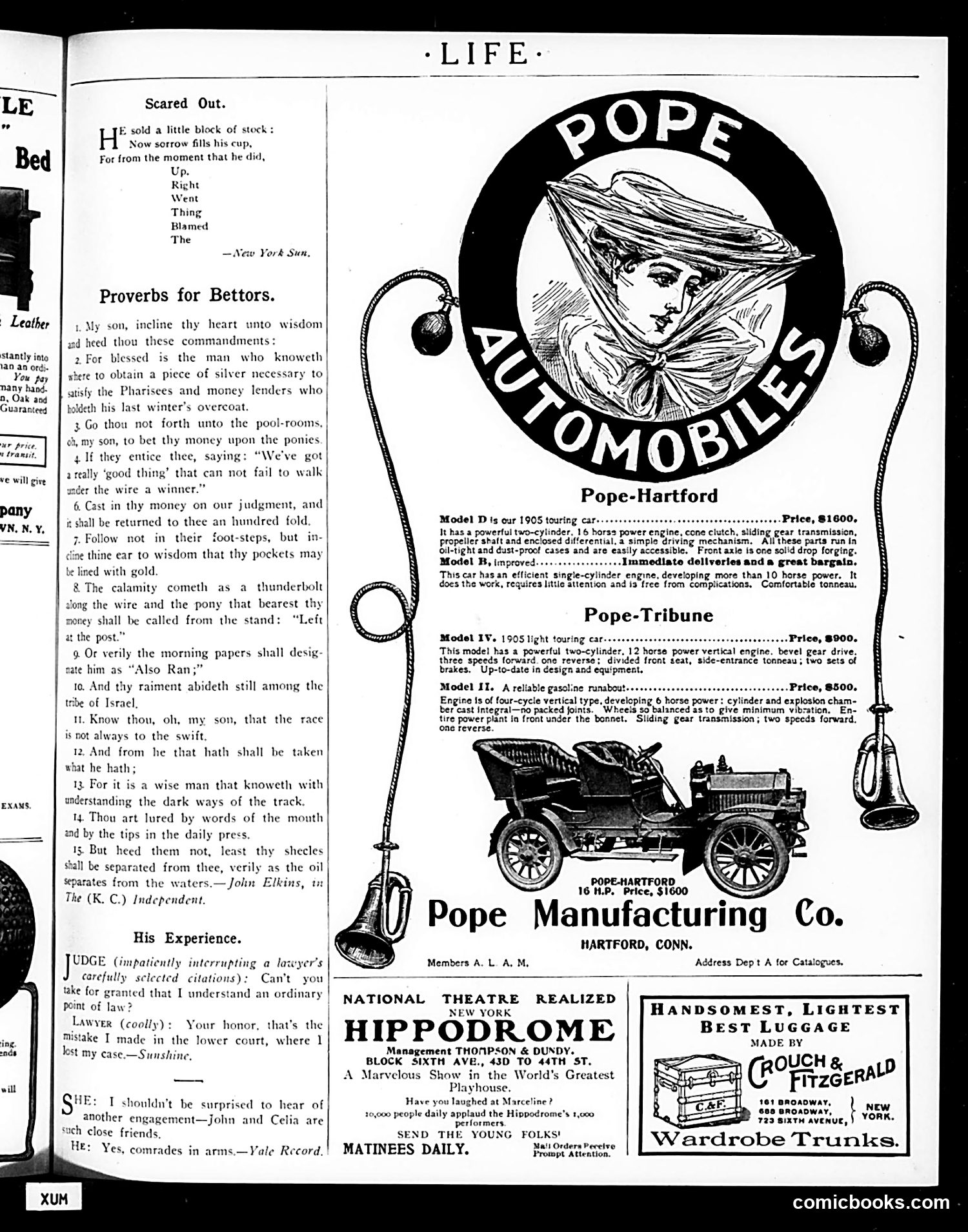
This page is primarily **advertising and humor content** rather than political satire. The dominant feature is a large **Pope-branded automobile advertisement** from Pope Manufacturing Co. in Hartford, Connecticut, showcasing three car models (Model D, Model IV, and Model II) with prices ranging from $800-$1,600. The page also contains: - A brief poem titled "Scared Out" about stock market anxiety - "Proverbs for Bettors"—satirical financial advice mocking gamblers and speculators - Advertisements for theatrical productions and luggage The overall theme appears to be **turn-of-the-century American consumer culture and finance**, with gentle satire directed at new wealth, speculation, and automotive luxury goods rather than political figures or events.
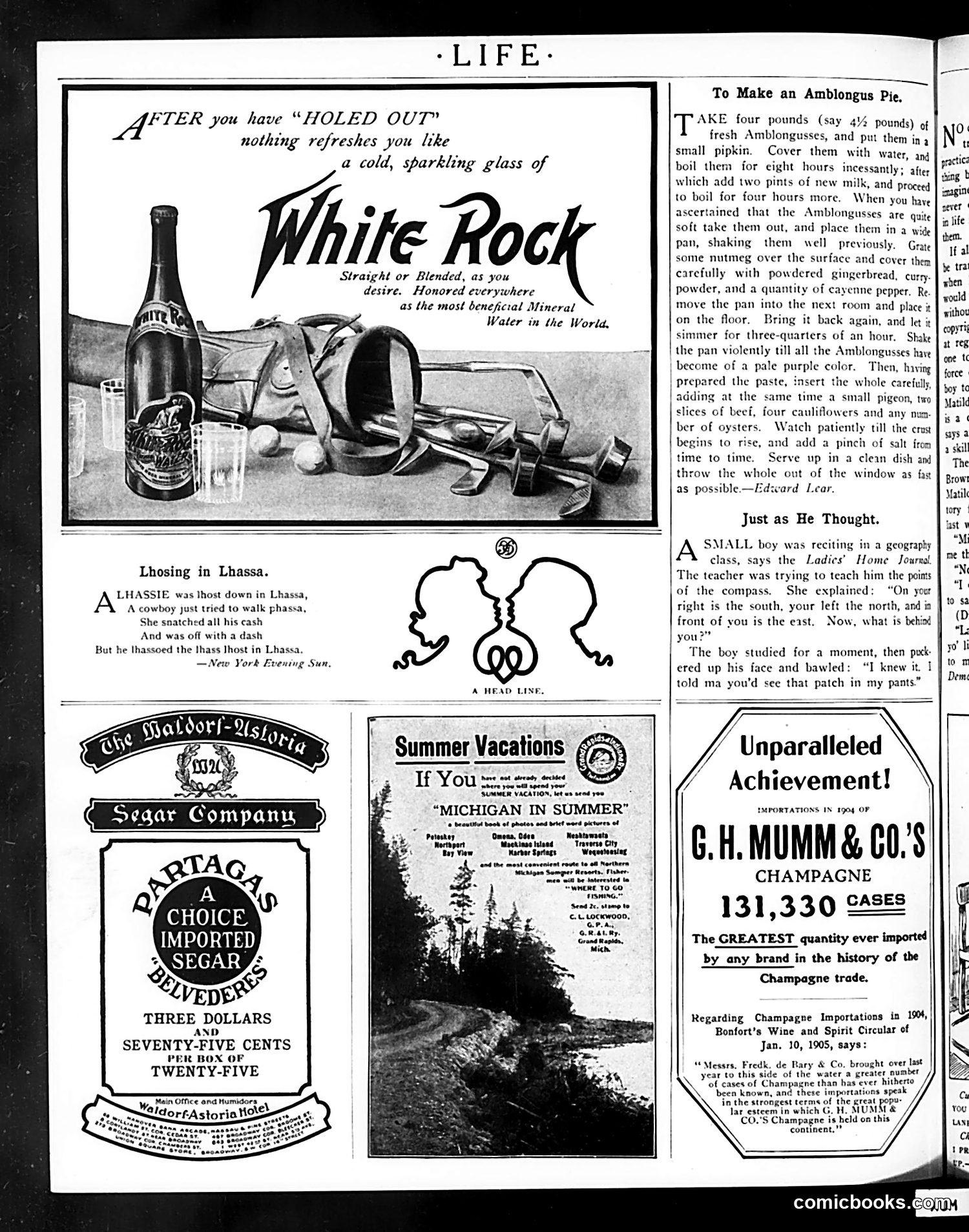
This page is primarily **advertising and light humor** rather than political satire. The main content includes: 1. **White Rock mineral water ad** — promotes the beverage as refreshing after exertion, claiming it's "the most beneficial Mineral Water in the World." 2. **"Losing in Lhassa" poem** — a brief humorous verse about a cowboy losing a poker game to a lhassa (likely a Lhassa Apso dog), with no clear satirical intent. 3. **"Just as He Thought"** — a mild joke about a schoolboy correctly identifying compass directions by pointing to a patch on his pants (likely an inside joke about navigation). 4. **Various advertisements** — including Partagas cigars, Michigan vacations, and G.H. Mumm champagne. The page reflects early 20th-century consumer culture rather than political commentary.
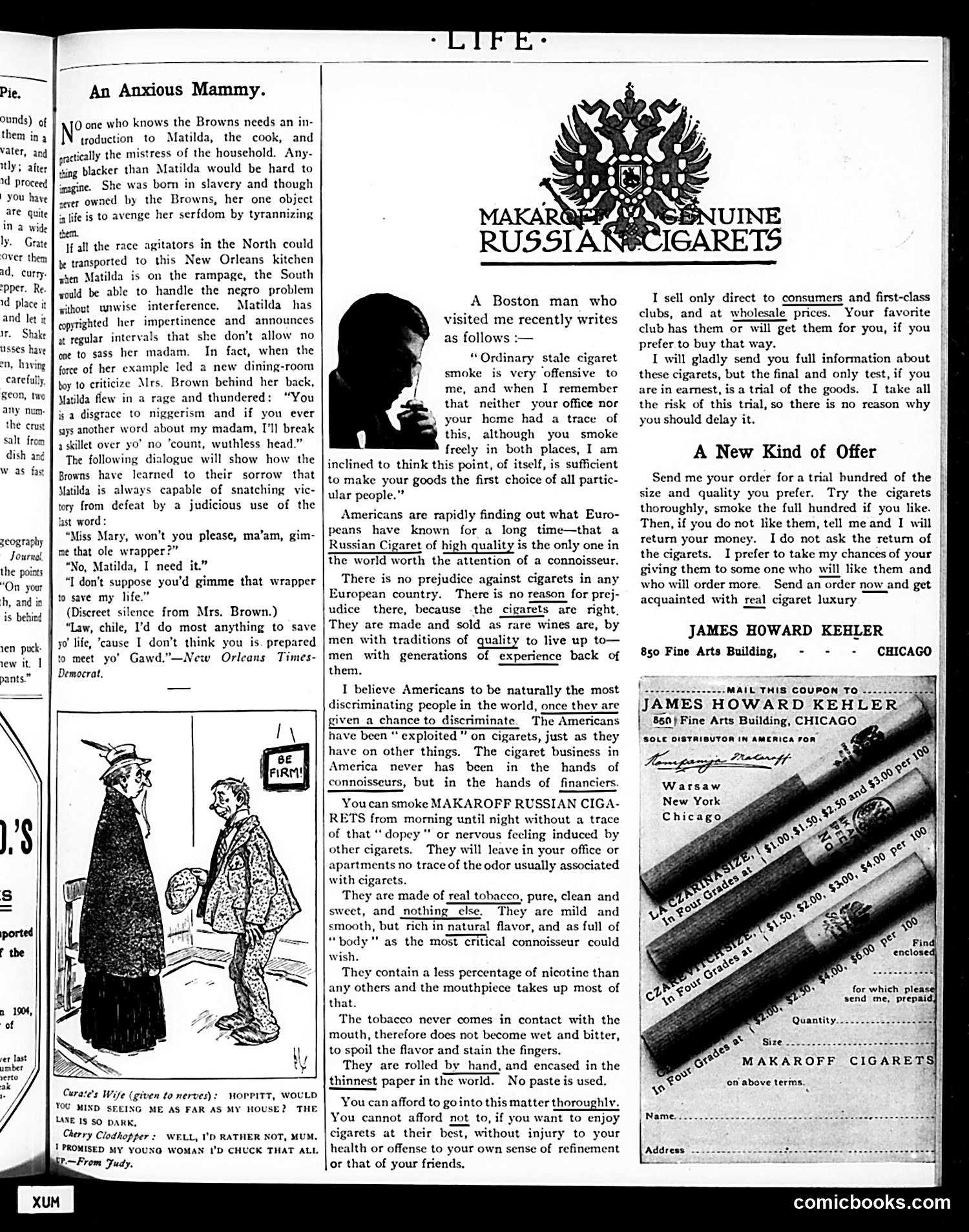
This Life magazine page contains two distinct elements: **Left side - "An Anxious Mammy":** A satirical story dialogue between Matilda (a Black cook) and Mrs. Brown about cigar smoking and racial tensions in the American South. The text uses outdated, offensive dialect and stereotypes common to early 20th-century publications. A cartoon illustration shows two figures in period dress having this conversation. **Right side - Makaroff Russian Cigarettes advertisement:** An extended advertisement with testimonial from "a Boston man," promoting Russian cigarettes as superior to American brands. It emphasizes their quality, lack of offensive odor, and purity. The page reflects the magazine's era: containing both racist content (the left story) and commercial promotion of luxury goods (cigarettes). The racial caricature and stereotypical "mammy" character were unfortunately standard satirical fare in early Life magazine.
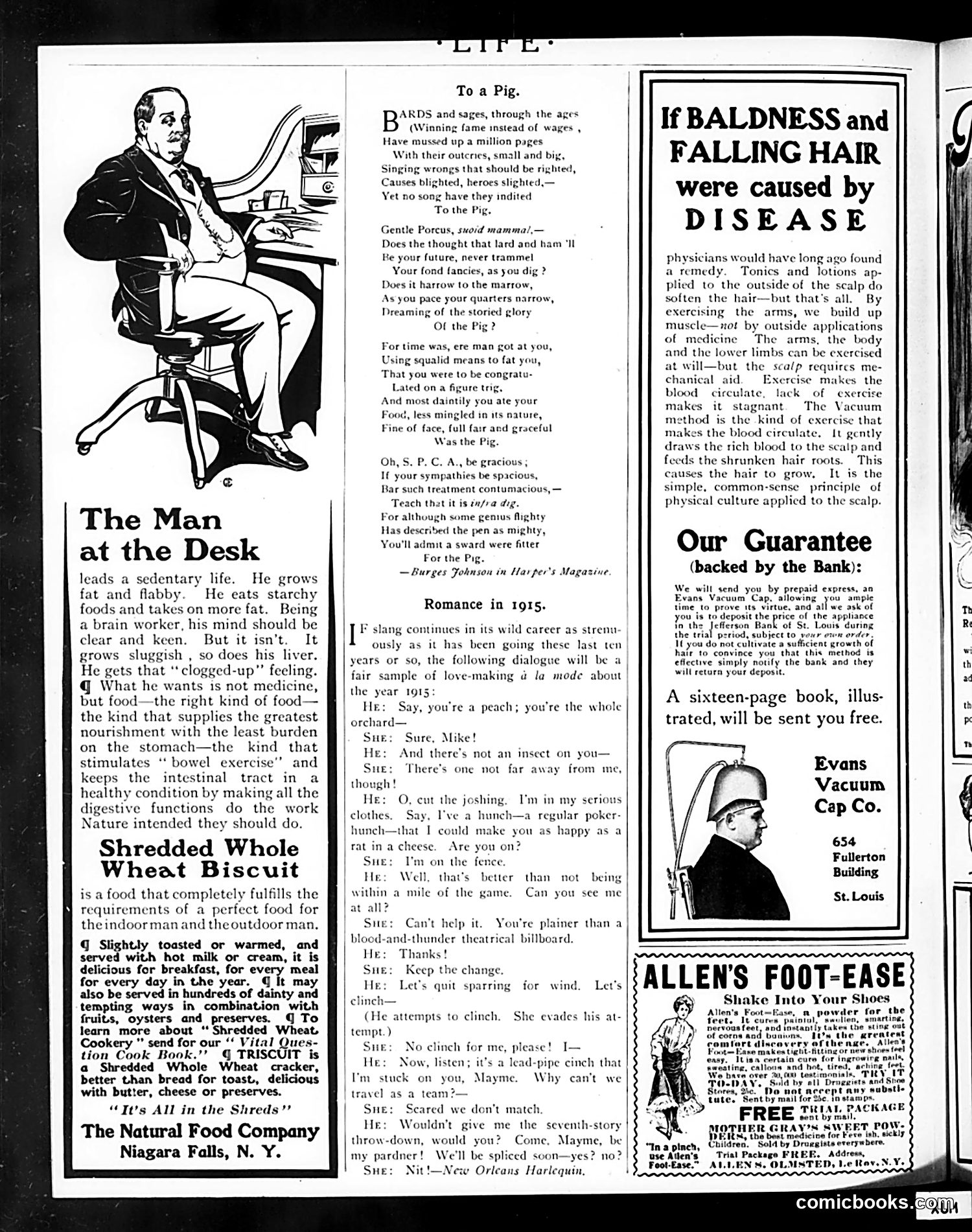
This is a satirical editorial cartoon criticizing sedentary office work. The illustration shows a portly, heavyset man slouched at a desk, and the accompanying text mocks his lifestyle: he "grows fat and flabby," eats starchy foods, and suffers digestive problems from lack of exercise. The satire targets the emerging desk-job culture of early 20th-century America. The piece argues that mental labor without physical activity creates health problems, though it ironically promotes "Shredded Whole Wheat Biscuit" as the solution—essentially claiming proper diet can compensate for sedentary work. This reflects Progressive Era concerns about modern industrial life's physical toll on white-collar workers.
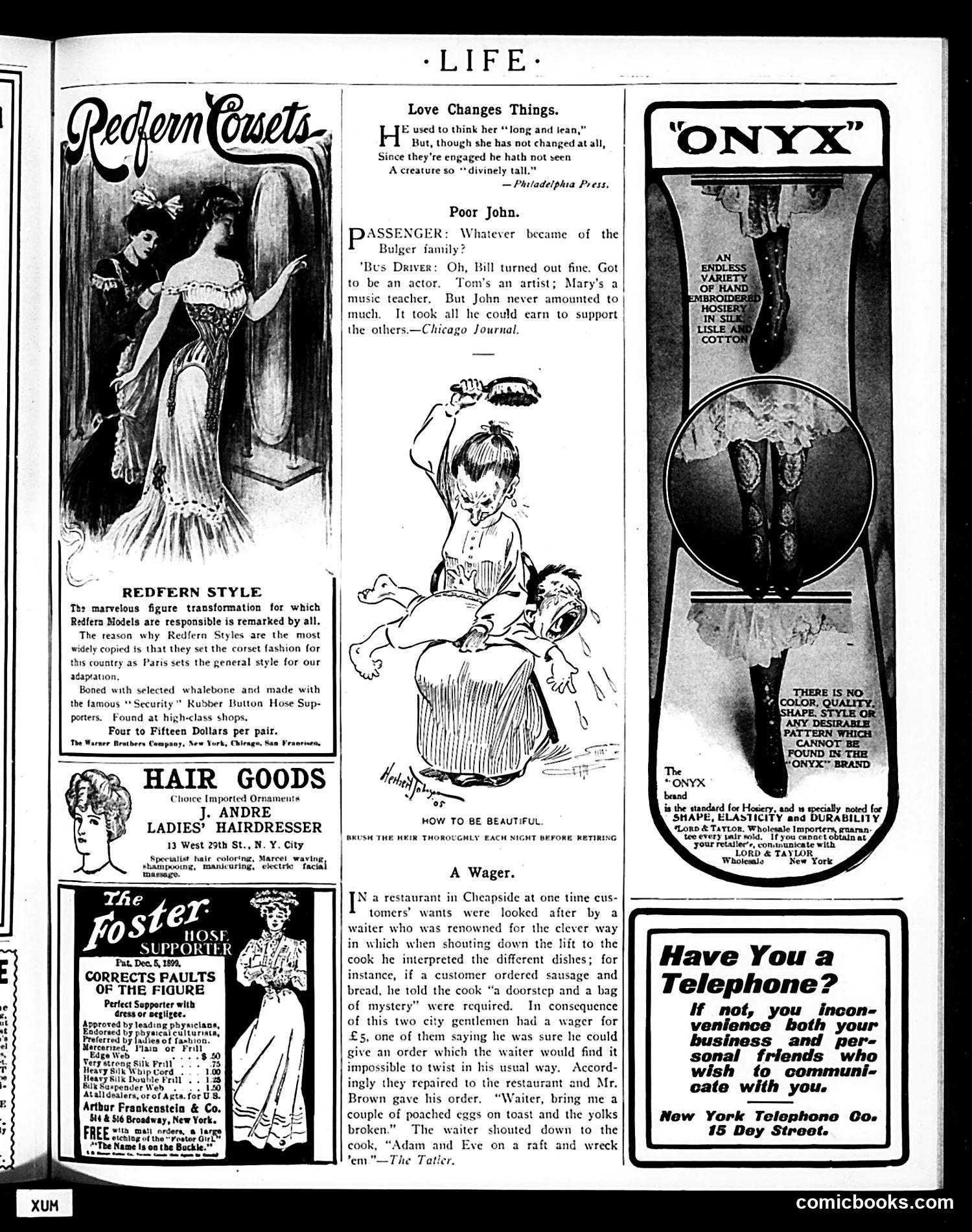
This page mixes advertisements with humor content typical of early 20th-century Life magazine. **Main Content:** The cartoons address domestic life and etiquette. "Love Changes Things" jokes about engagement expectations. "Poor John" presents a social commentary: while John's siblings (Bill the actor, Tom the artist, Mary the music teacher) pursued visible professions, John "never amounted to much" and had to support the family financially—satirizing how society undervalues unglamorous but necessary work. "How to Be Beautiful" offers ironic beauty advice, while "A Wager" depicts a restaurant scene where a waiter's literal interpretation of a customer's order creates comic chaos (requesting "Adam and Eve on a raft" produces absurd results). **Advertisements:** The page also carries period product ads (Redfern corsets, hair goods, hosiery) typical of Life's revenue model, targeting female readers with fashion and beauty products.
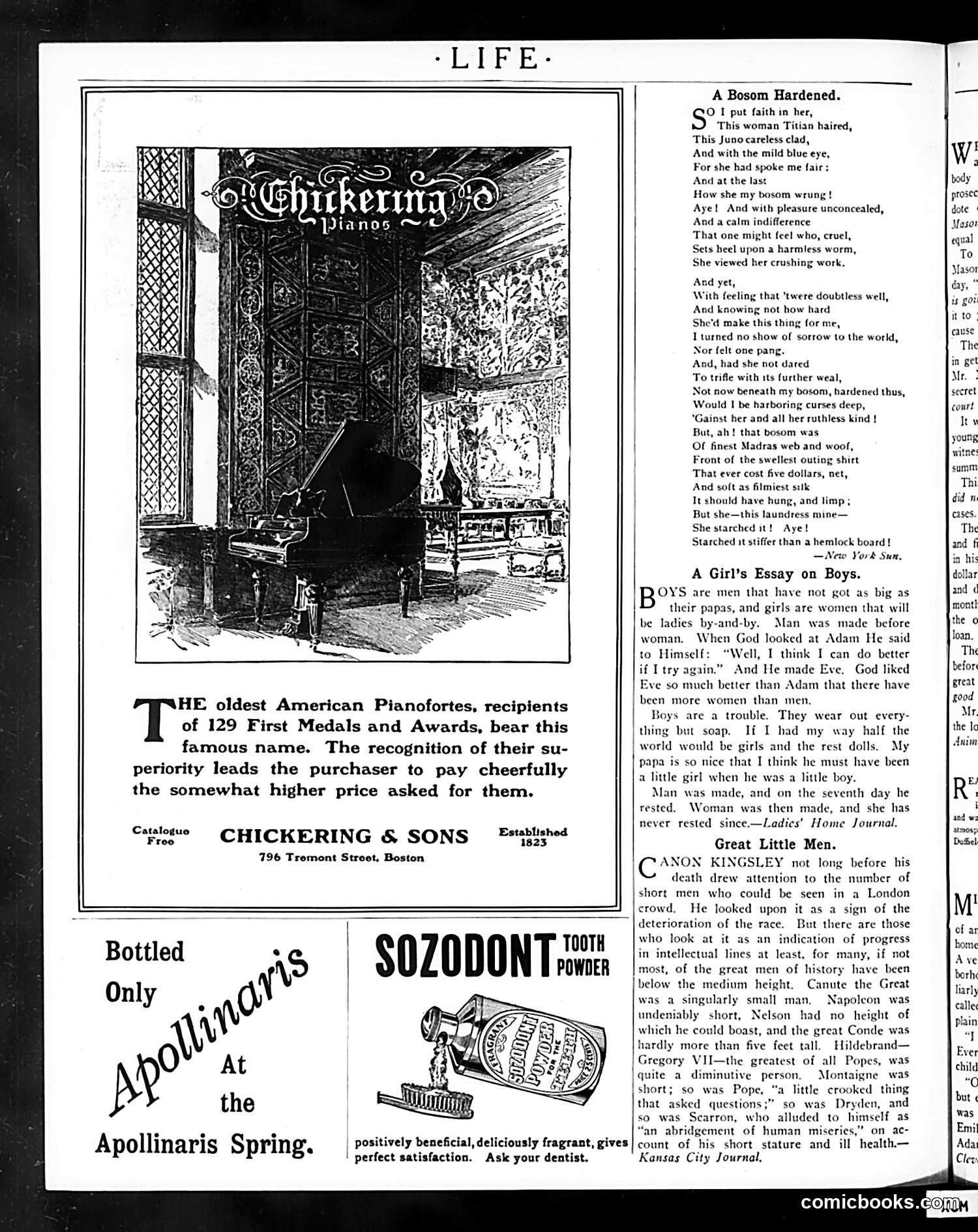
This page is primarily **advertising and literary content** rather than political satire. The main elements are: 1. **Chickering & Sons piano advertisement** (center-left): Emphasizes the company's prestige as "the oldest American Pianofortes, recipients of 129 First Medals and Awards," justifying their premium pricing. 2. **Sozodont Tooth Powder advertisement** (bottom): Claims the product is "positively beneficial, deliciously fragrant" and recommends consulting your dentist. 3. **Literary pieces** (right column): Include "A Bosom Hardened" (poetry about betrayal), "A Girl's Essay on Boys" (humorous commentary on gender differences), and "Great Little Men" (discussing historically short notable figures like Napoleon and Pope). The page reflects early 20th-century consumer culture and light satirical writing rather than political cartooning.
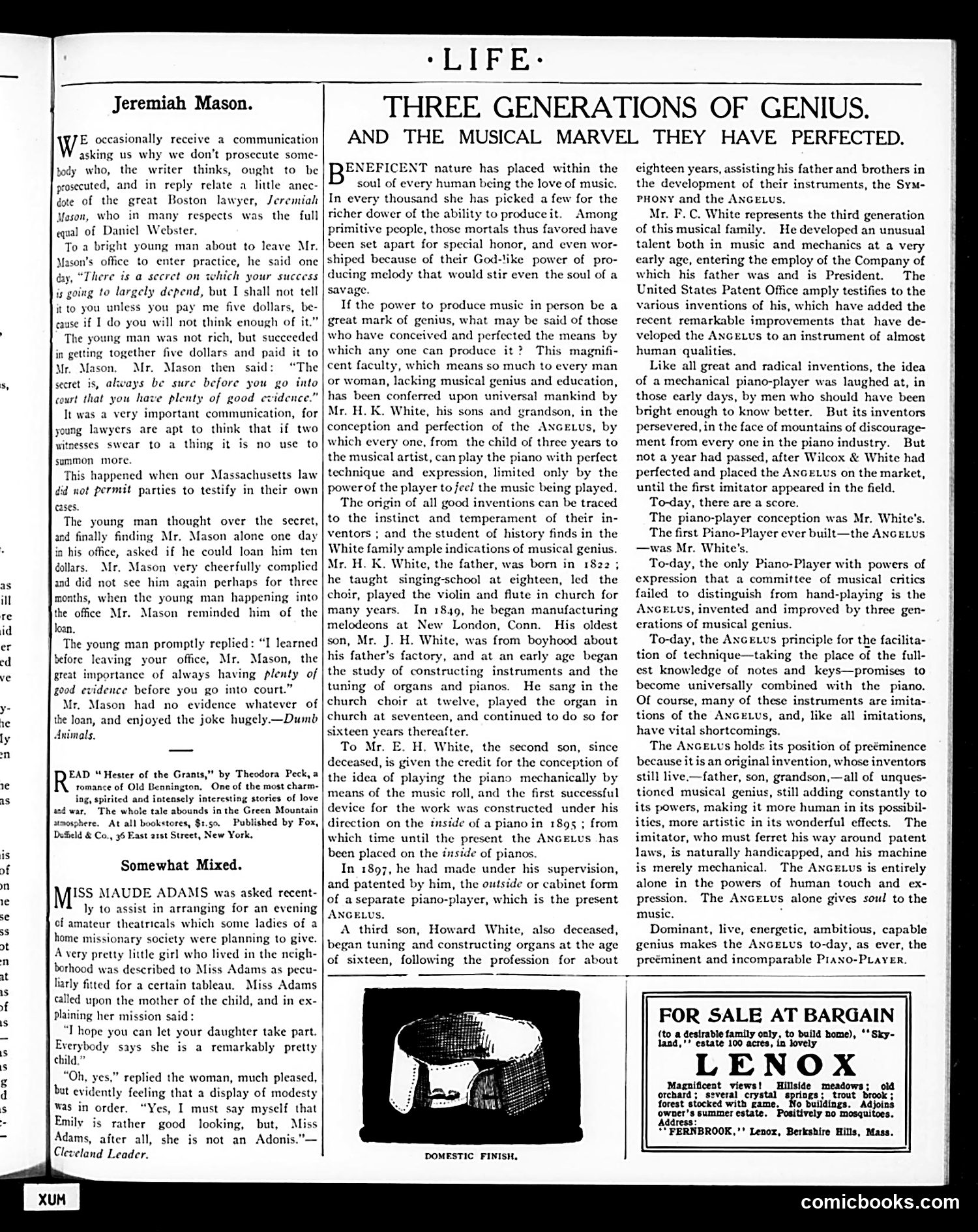
This page contains three distinct pieces: **Left column:** An anecdote about Boston lawyer Jeremiah Mason (1757-1848), illustrating a professional principle—gather sufficient evidence before proceeding. The story shows Mason teaching this lesson through a practical joke when a young lawyer, having learned the lesson, uses it to avoid documenting a loan. **Center column:** Promotional content about the White family's musical innovations. It celebrates three generations of the Whites who developed the "Angelus"—a piano-playing mechanism that allowed non-musicians to produce music. The text presents this as a democratic innovation, making musical performance accessible to ordinary people lacking training or natural genius. **Right column:** A small illustration labeled "Domestic Finish" (appears to show domestic items) and an advertisement for "Lenox" property in Massachusetts. The Angelus content reflects late-19th-century enthusiasm for mechanical innovations that democratized previously elite skills—similar to how player pianos fascinated the era. The Mason anecdote represents practical wisdom journalism common to *Life* magazine's editorial philosophy.
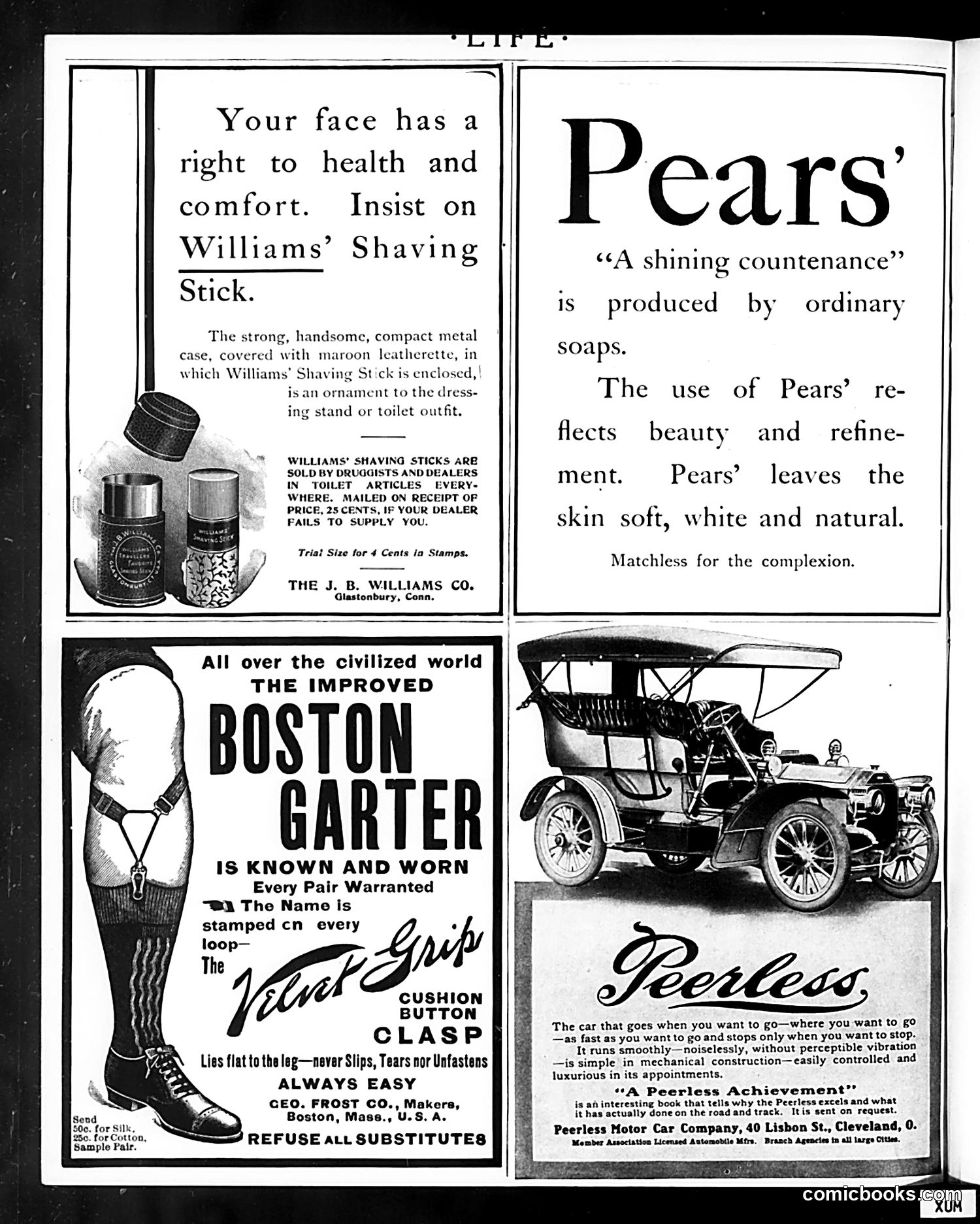
This is a **advertisements page**, not satire or editorial content. It features four unrelated product ads typical of early 1900s American magazines: 1. **Williams' Shaving Stick** — promotes a metal-cased shaving product emphasizing health and comfort for facial grooming 2. **Pears' Soap** — advertises complexion soap, claiming it produces a "shining countenance" and leaves skin "soft, white and natural" 3. **Boston Garter** — showcases men's leg garters with a cushioned button clasp, emphasizing they won't slip or tear 4. **Peerless Motor Car** — presents an automobile as a luxury item, emphasizing smooth operation, simple mechanics, and control The page reflects early-20th-century consumer culture, showcasing personal grooming products, clothing accessories, and emerging automobile technology. There is **no political satire or social commentary** visible—this is straightforward commercial advertising aimed at affluent readers.
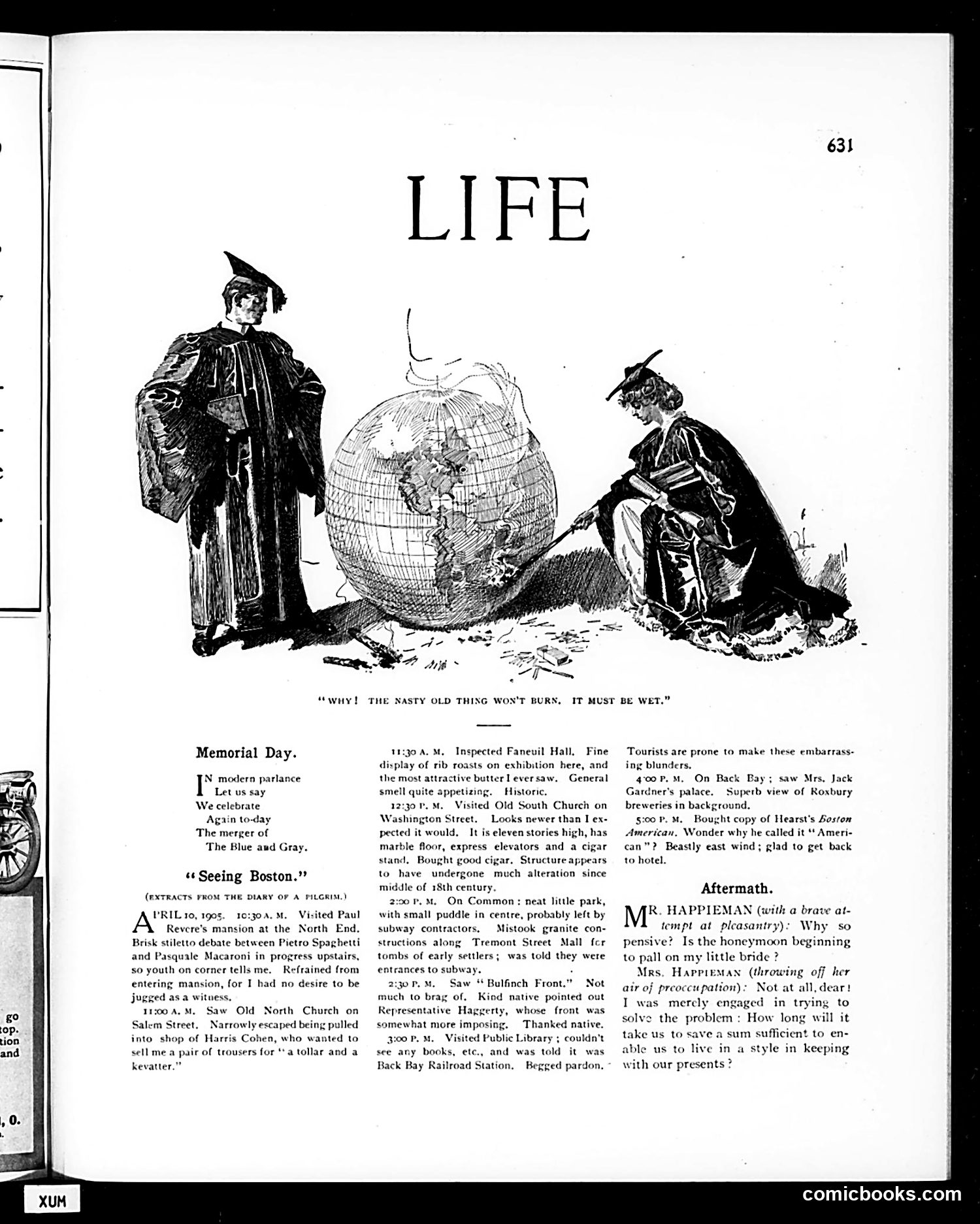
**Main Cartoon (top):** Shows two fashionably dressed figures struggling to burn a globe labeled "Earth." The caption reads "Why! The nasty old thing won't burn. It must be wet." This appears to be satirizing either environmental concerns or social/political resistance to change—the "old thing" that stubbornly refuses destruction despite efforts. **"Seeing Boston" (center):** A satirical diary mocking tourists visiting Boston's historical sites. The humor targets both tourists' ignorance and Boston's rapid modernization. The visitor confuses landmarks (thinks subway structures are settler tombs, mistakes a train station for the Public Library) and encounters ethnic stereotypes (Italian names at Paul Revere's house, a Jewish shopkeeper). The satire suggests Boston's historical identity is being erased by modern construction and immigration. **"Aftermath" (bottom):** A marital joke where the newlywed wife, despite appearing pensive, reveals she's actually worried about affording the lifestyle their wedding gifts suggest they should maintain—poking fun at middle-class financial anxieties and conspicuous consumption expectations.
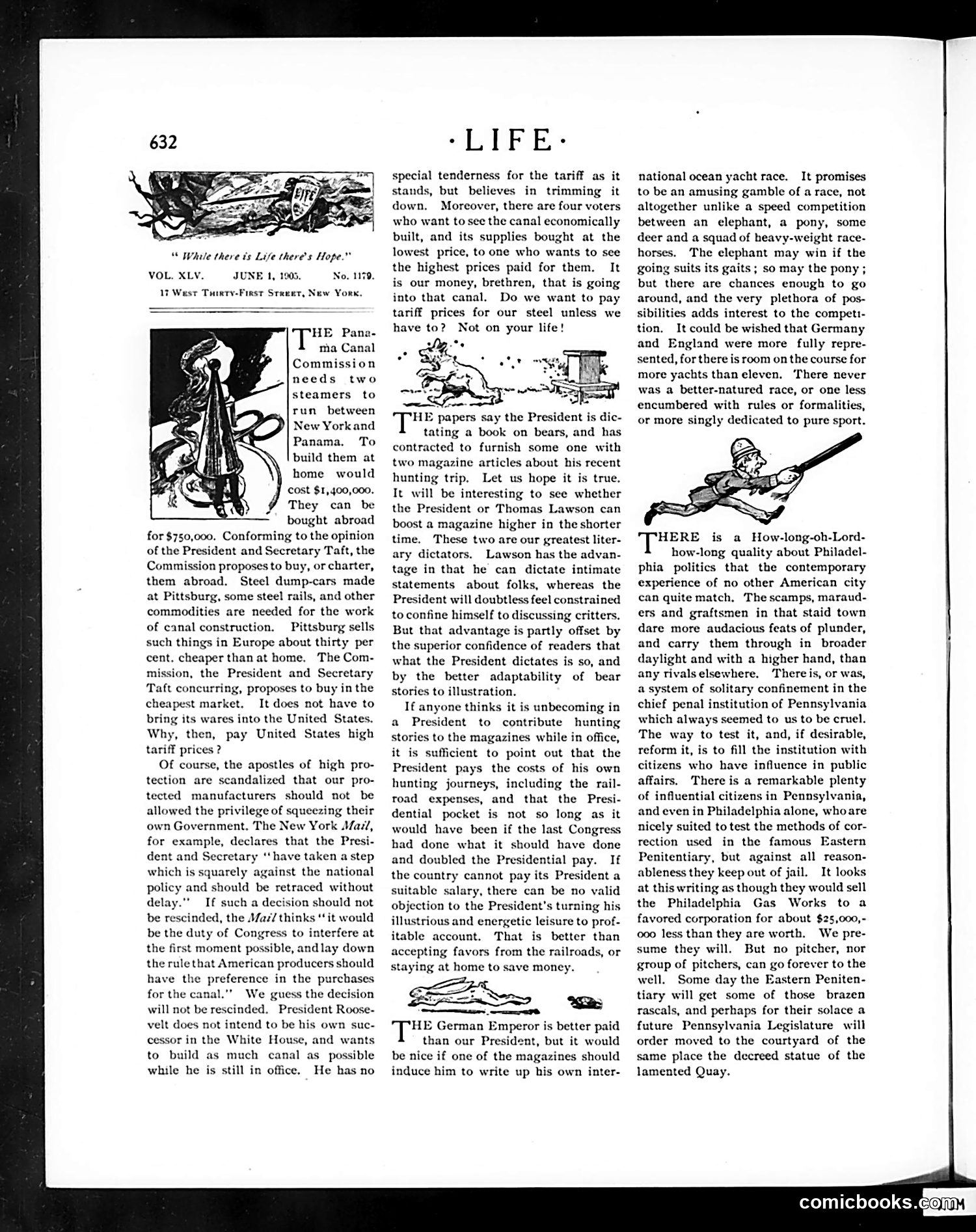
**The Tariff Debate (Main Article):** The piece satirizes American protectionist trade policy. The Panama Canal Commission wants to buy cheaper steamers and materials abroad rather than overpay domestic manufacturers. High-tariff advocates (specifically *The New York Mail*) oppose this, demanding government preference for American producers. Life ridicules this position: if buying foreign goods saves taxpayers money on a national project, why shouldn't the government do so? The satirist notes President Roosevelt pragmatically supports the cheaper option, unsentimentally favoring economic efficiency over protectionist ideology. **Secondary Item:** A brief piece jokes about Roosevelt supposedly writing articles about his hunting trips for magazines while president. The satire questions whether this is dignified—but then argues the President earns low salary and pays his own hunting expenses, so he deserves the income. This gently mocks both Roosevelt's prolific public output and the magazine industry's appetite for celebrity content. The cartoons (woodcuts) appear decorative rather than directly illustrating specific arguments.
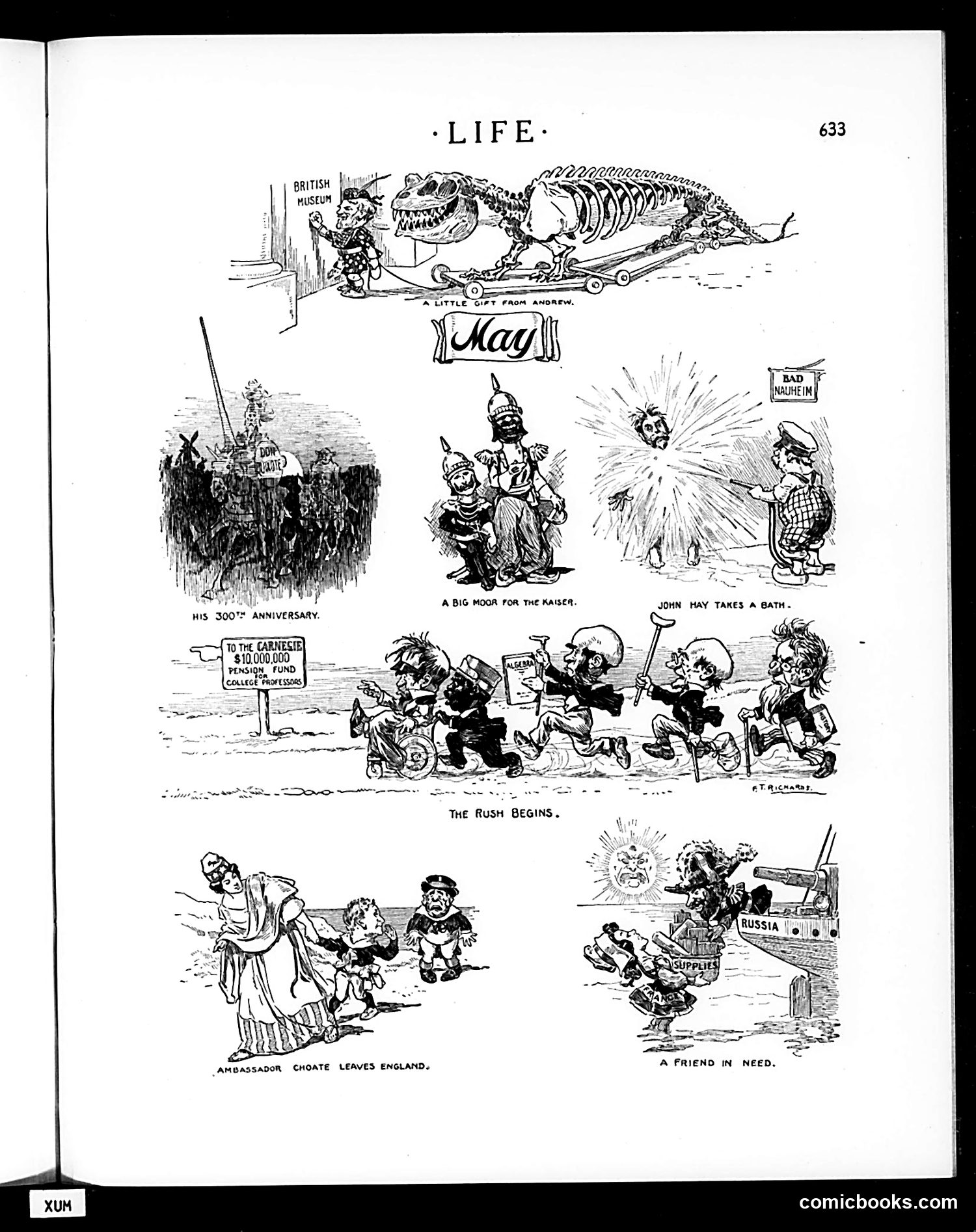
This page from *Life* magazine presents May-themed satirical cartoons. Key references include: **"His 300th Anniversary"**: Appears to mock a significant historical milestone, likely referencing German militarism or Kaiser Wilhelm II (the "300" may reference Prussian military tradition). **Carnegie Pension Fund reference**: Satirizes Andrew Carnegie's philanthropic initiatives, suggesting critique of how his $10 million college professor pension fund was implemented or publicized. **"Ambassador Choate Leaves England"**: Joseph H. Choate was U.S. Ambassador to Britain; the cartoon likely comments on diplomatic relations or his departure. **"A Friend in Need"**: References Russia receiving supplies, suggesting commentary on international relations or trade dynamics of the period. **"The Rush Begins"**: Bottom sequence depicts competitive activity, possibly relating to political appointments or international competition. The cartoons employ typical *Life* magazine style—satirizing American politics, wealthy industrialists, and international affairs through exaggeration and caricature.
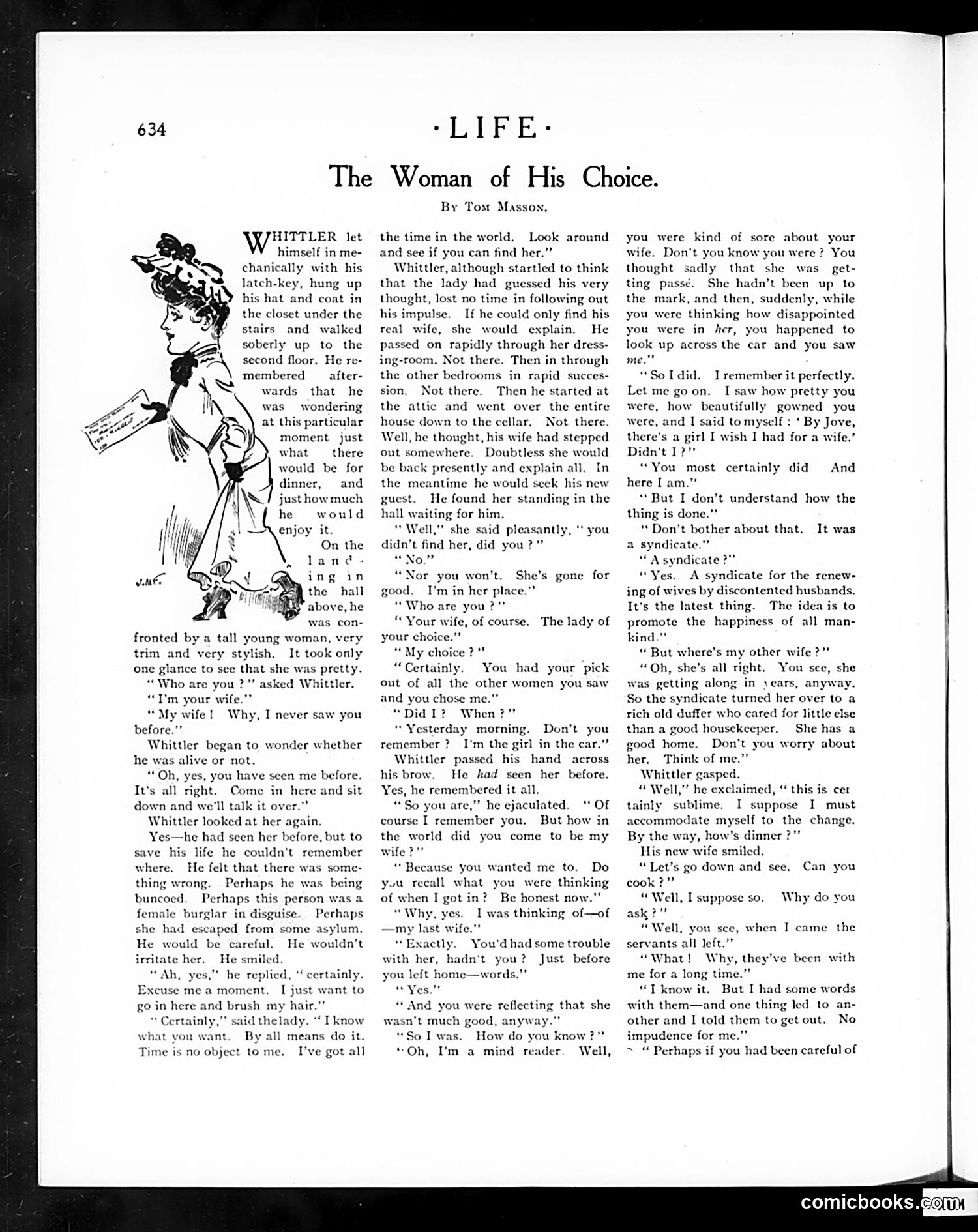
This is a satirical short story by Tom Masson (not a political cartoon) about a man named Whittler who comes home to find a mysterious stylish woman claiming to be his wife—replacing his actual wife entirely. The satire targets **marital dissatisfaction and male fantasy**. Whittler had mentally complained about his real wife during his commute, admiring an attractive woman in a car instead. The story plays with the absurd premise that a "syndicate" exists to replace wives for unhappy husbands, exploiting the fantasy of consequence-free infidelity or escape from marriage. The humor comes from the woman reading Whittler's mind and revealing his shallow, wandering desires—he chose based on appearance and a momentary attraction. The story satirizes both male fickleness and the commercialization of romance, treating marriage as a replaceable commodity. It's a critique of men who take their spouses for granted while fantasizing about younger, more stylish alternatives.
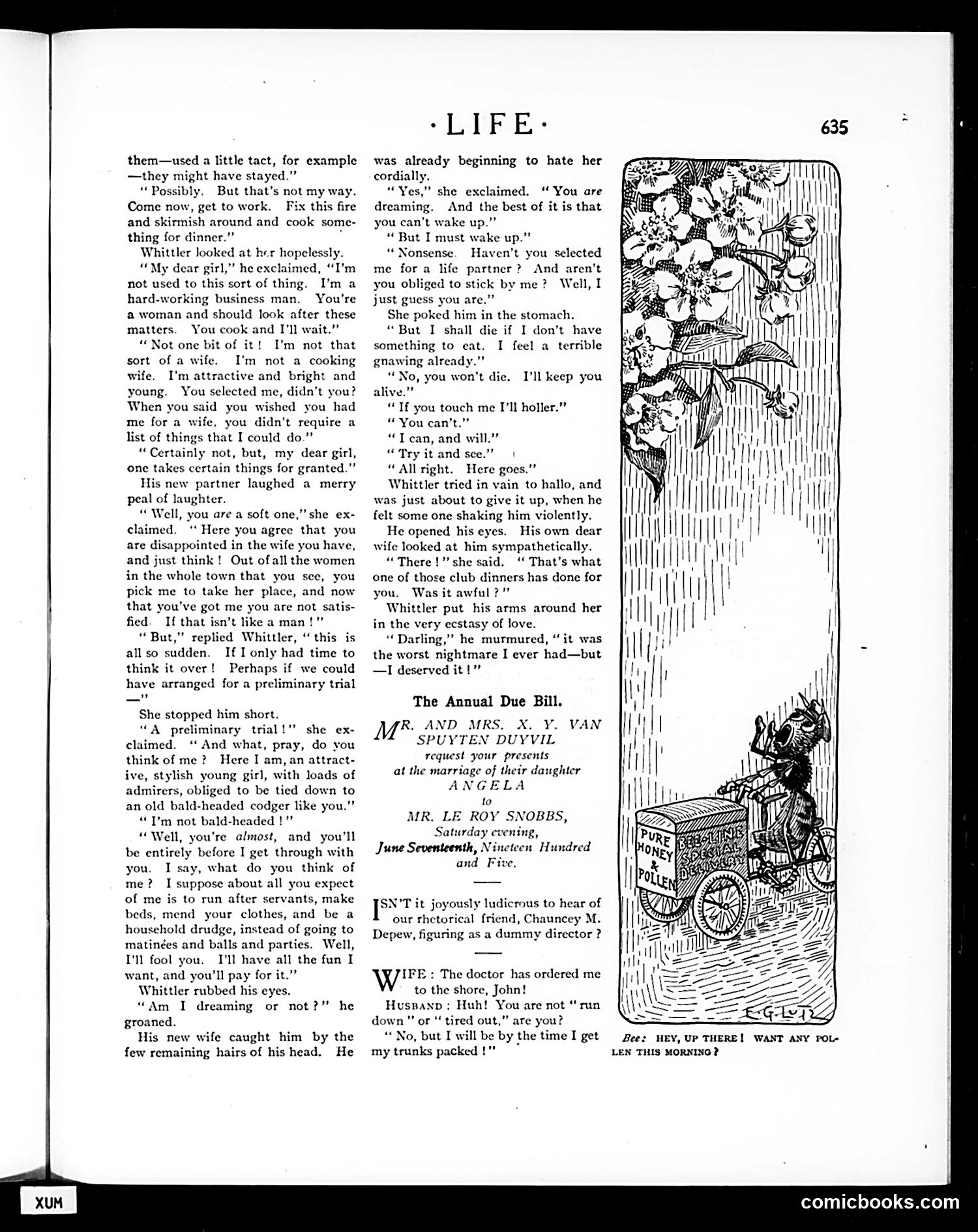
This page contains two distinct pieces of social satire: **"The Annual Due Bill"** (main story): A husband's nightmare where he marries a young, modern woman who refuses traditional domestic roles. She demands leisure, fun, and financial support while refusing to cook or clean—inverting Victorian gender expectations. The twist reveals it was a dream, and the relieved husband appreciates his real wife. The satire mocks both new feminist ideals and anxious husbands threatened by women's changing demands. **Lower cartoons**: Brief domestic humor pieces, including one about a wife's complaint regarding trunk-packing for a shore trip, and another appearing to reference Chauncey M. Depew (a real 19th-century politician/businessman) as a "dummy director"—likely satirizing his involvement in theater or business ventures. The magazine targets early 20th-century marriage anxieties and evolving gender roles, using exaggeration and nightmare scenarios for comedic effect.
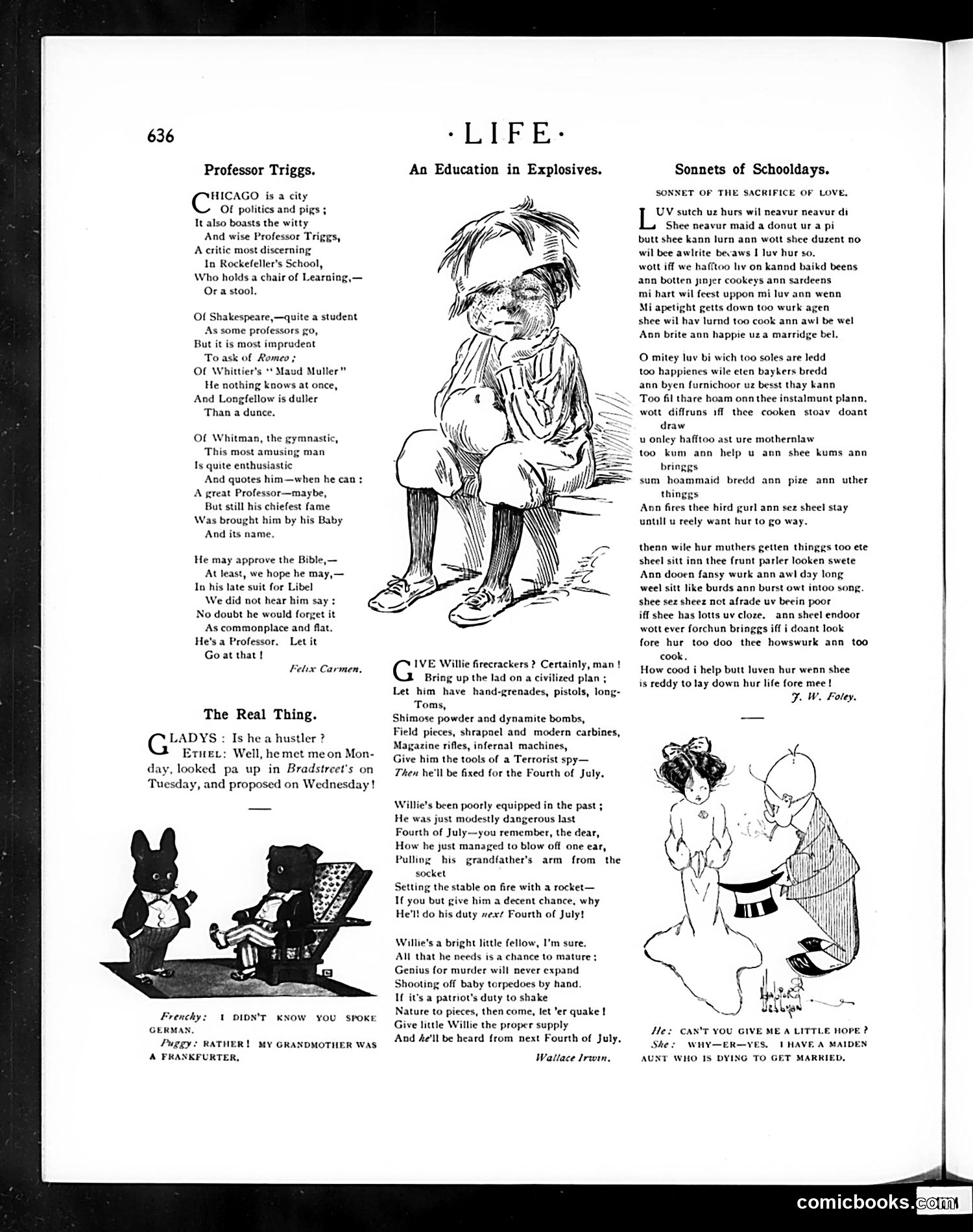
This page contains three satirical pieces typical of early 20th-century American humor: **"Professor Triggs"** mocks an academic at what appears to be a prestigious institution (possibly University of Chicago). The satire suggests he's an incompetent scholar—ignorant of major literary works despite his position—whose only claim to fame derives from his baby's name, implying his actual contributions to learning are negligible. **"An Education in Explosives"** by Wallace Irwin ironically advocates giving children dangerous weapons and explosives as Fourth of July toys. It's dark satire about America's casual acceptance of children's fireworks injuries (the poem references a child losing an ear), treating preventable tragedy as inevitable and patriotic. **"Sonnets of Schooldays"** parodies romantic poetry through deliberate misspelling and broken grammar, mocking sentimental love sonnets while depicting a young woman's resignation to domestic servitude and cooking. The page's illustrations—including silhouettes of animals and simple line drawings—complement these verbal jokes aimed at educated readers recognizing literary and social pretension.
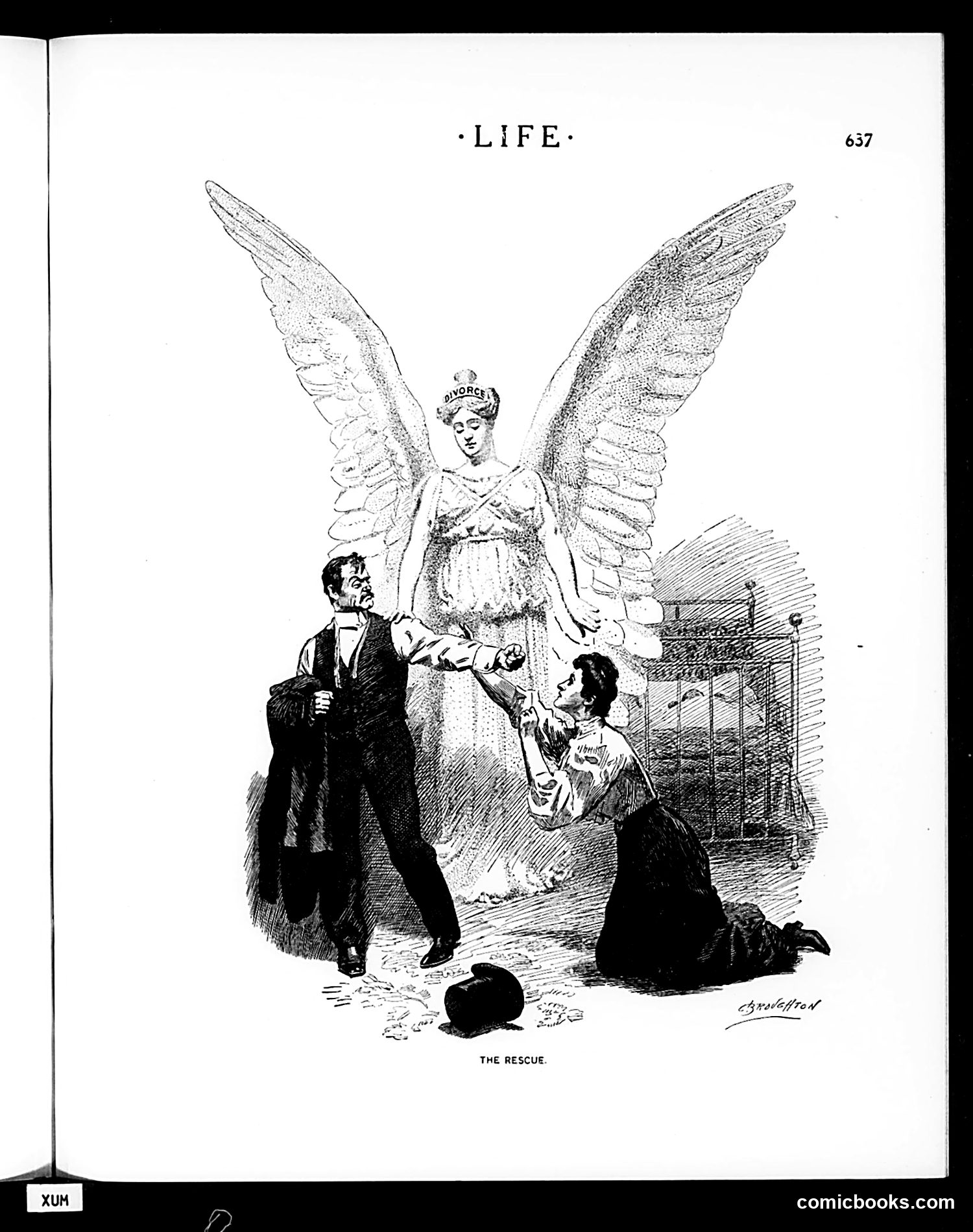
This allegorical cartoon depicts an angelic figure with large wings intervening in a scene below. Two men in formal Victorian-era dress appear to be in conflict or distress, while a woman kneels or sits on the ground. A cage is visible in the background. The title "The Rescue" suggests a moral or political intervention. The angel figure likely represents an idealized concept—possibly divine intervention, providence, or institutional authority. Without additional context about the magazine's date or surrounding articles, the specific figures and the particular crisis being satirized remain unclear. The formal dress and Victorian setting suggest this addresses 19th-century social or political circumstances, but the exact reference point cannot be determined from the image alone.
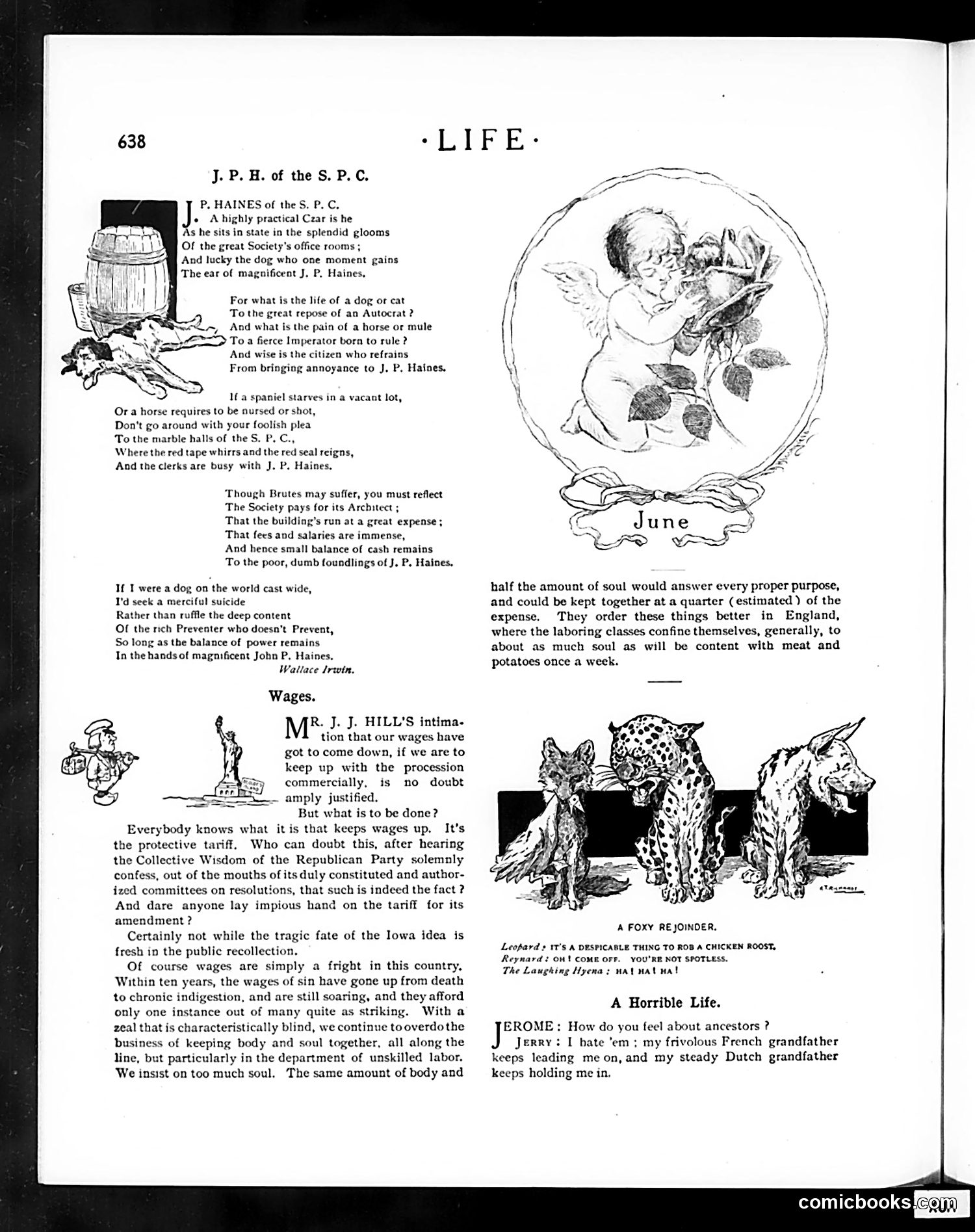
This page satirizes J.P. Haines, apparently an administrator of the Society for the Prevention of Cruelty to animals (S.P.C.), through a poem by Wallace Irwin. The satire attacks Haines as an autocrat who prioritizes bureaucratic expense and his own salary over actual animal welfare. The poet mocks that while animals suffer, the S.P.C. wastes resources on an expensive building, architect fees, and staff salaries—leaving little for actual animal care. Citizens seeking help are dismissed with red tape. The phrase "the rich Preventer who doesn't Prevent" captures the core critique: the organization exists in name only, serving administrative interests rather than animals. The page also includes commentary on wages and tariffs, and humorous dialogues about ancestry and animal behavior, typical of *Life* magazine's satirical format.
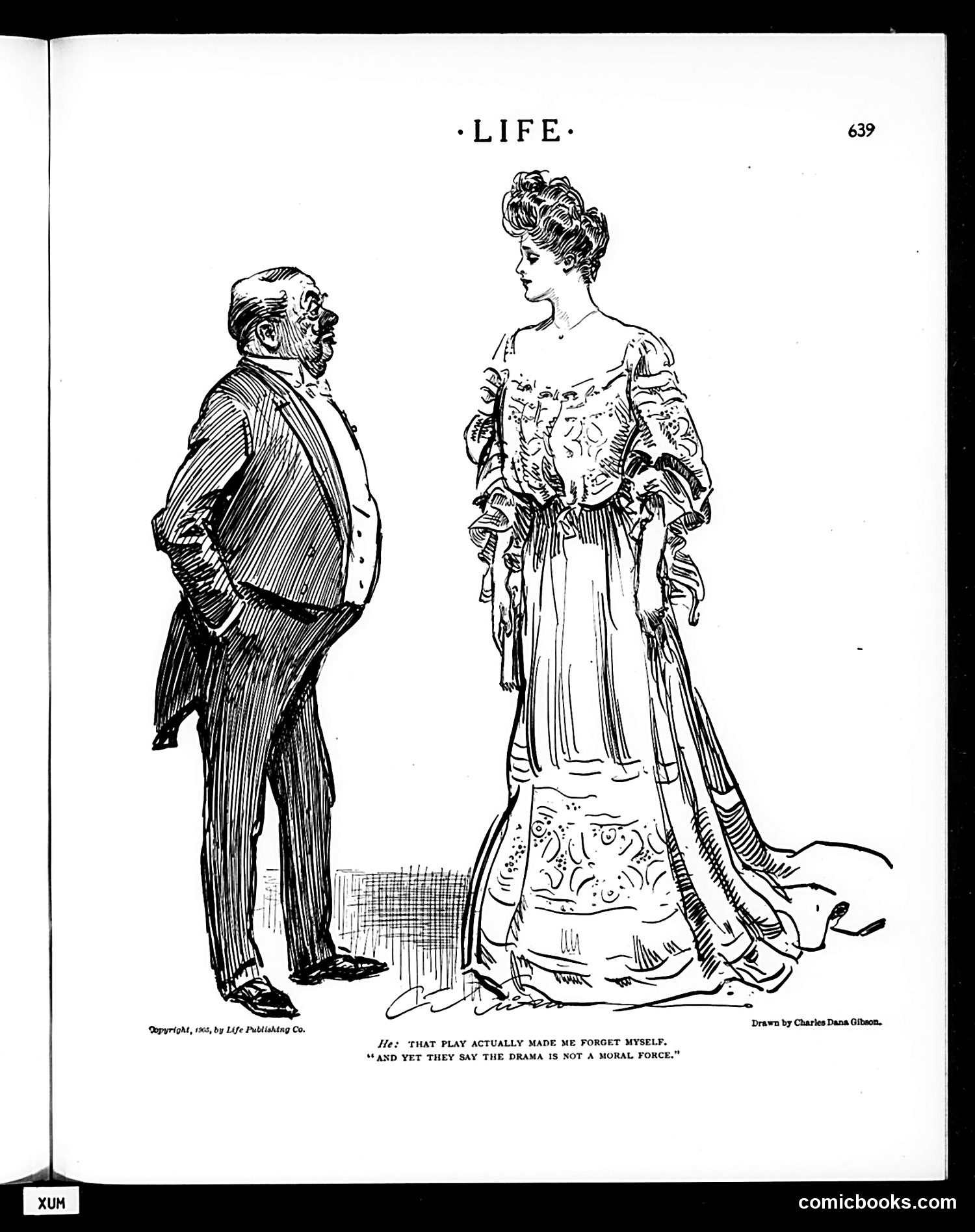
This is a satirical cartoon from *Life* magazine (copyright 1903) drawn by Charles Dana Gibson, likely depicting a social commentary on theatrical entertainment and morality. The image shows two figures in formal Edwardian dress: a portly gentleman in a suit and a elegantly dressed woman in an elaborate gown with a train. The caption reads: "HE: THAT PLAY ACTUALLY MADE ME FORGET MYSELF. 'AND YET THEY SAY THE DRAMA IS NOT A MORAL FORCE.'" The satire appears to mock the claim that theater has moral value. The gentleman's comment suggests the play was so absorbing it made him lose his composure or self-control—which the caption sarcastically presents as evidence of drama's "moral force." This critiques arguments that theater serves an uplifting purpose, suggesting instead it merely distracts or overwhelms audiences emotionally.
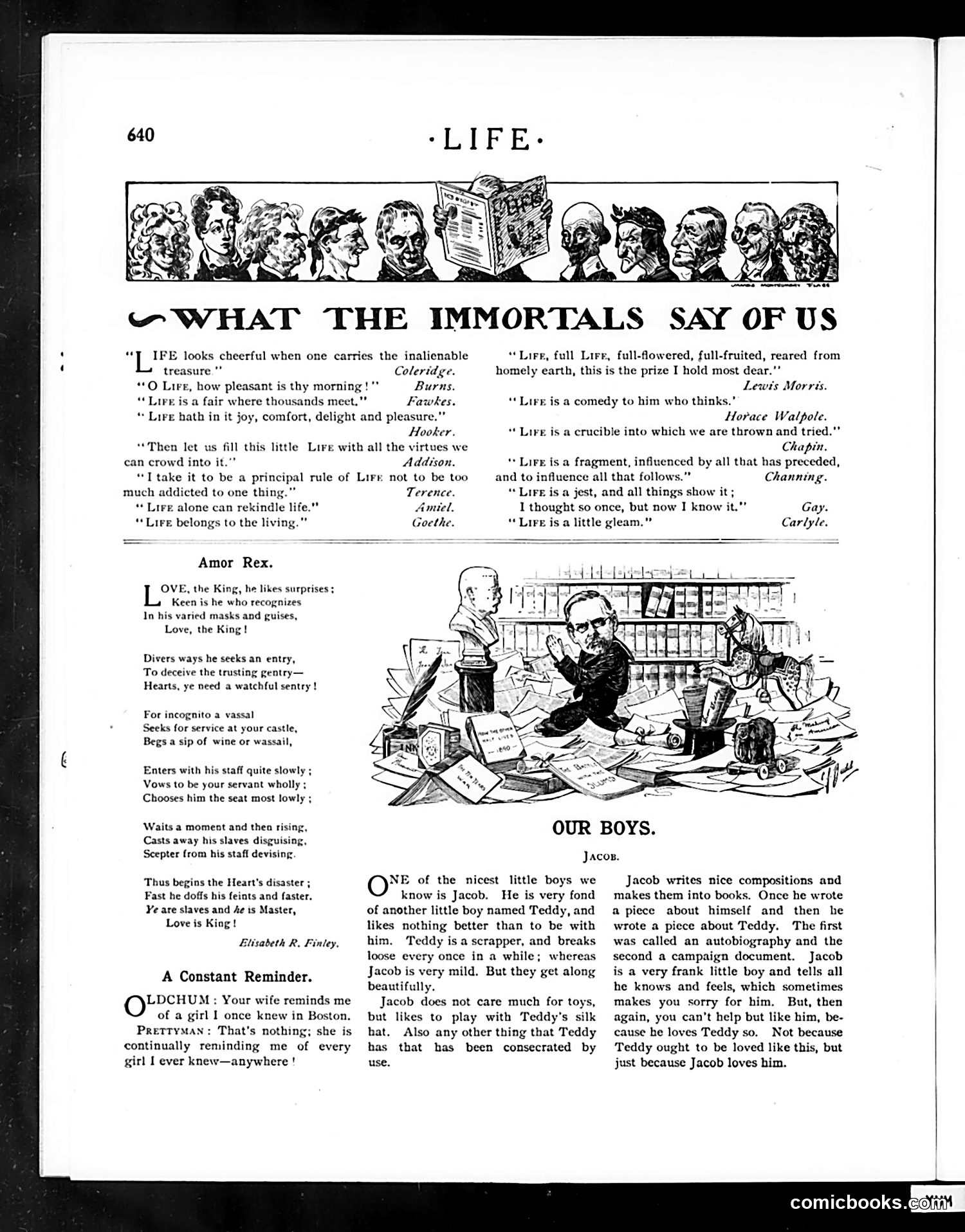
This page contains literary quotations and satirical humor typical of early 20th-century American magazines. **Top Section:** "What the Immortals Say of Us" compiles philosophical quotes about life from famous authors (Coleridge, Burns, Horace Walpole, Carlyle, etc.). The decorative header shows caricatured "immortals"—likely representing these classical and contemporary writers—offering their observations on human existence. **"Amor Rex" poem:** A playful allegory where "Love, the King" disguises himself as a humble servant to infiltrate hearts, ultimately revealing his true power. The satire mocks how love deceives people through disguise and false modesty before asserting dominance. **"Our Boys" illustration and text:** Depicts two boys—Jacob and Teddy—in a humorous character sketch. Jacob is presented as an earnest, mild-mannered boy who loves Teddy so much he even writes a "campaign document" about him (suggesting political ambition through flattery). The joke mocks sycophantic behavior and blind devotion. **"A Constant Reminder":** A brief joke about wives' supposedly endless capacity to remind husbands of past girlfriends.
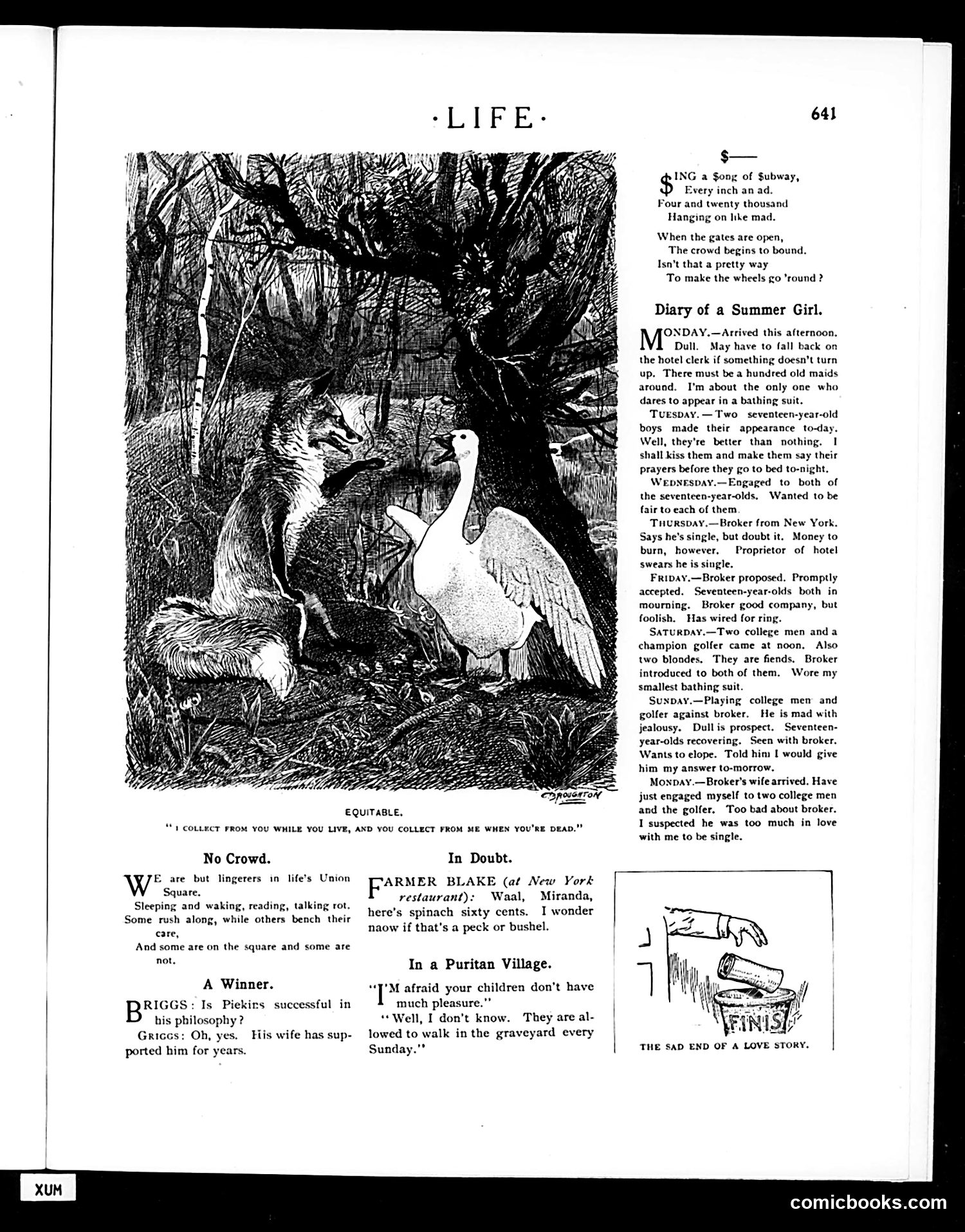
This page contains several brief satirical pieces mocking American society circa early 1900s: **"Equitable" Insurance Ad Parody**: A mock insurance company slogan satirizes transactional relationships—collecting premiums while living, then paying out after death. **"No Crowd"**: Cynical verse about Union Square idlers, distinguishing between those who actively participate in city life versus passive observers. **"A Winner"**: Brief joke about a successful philosopher whose success derives entirely from his wife's financial support—satire on male pretension. **"In Doubt"**: Rural farmer uncertainly pricing spinach at a New York restaurant, likely mocking urban-rural price disparities and farmer bewilderment at city commerce. **"In a Puritan Village"**: Dark humor about Puritan restrictions—children's only "pleasure" is walking in graveyards on Sundays. **"Diary of a Summer Girl"**: Humorous account of a young woman's resort romance, satirizing female fickleness, materialism, and moral flexibility regarding multiple engagements and suitors. The page reflects Life magazine's typical irreverent commentary on American manners, values, and hypocrisies.
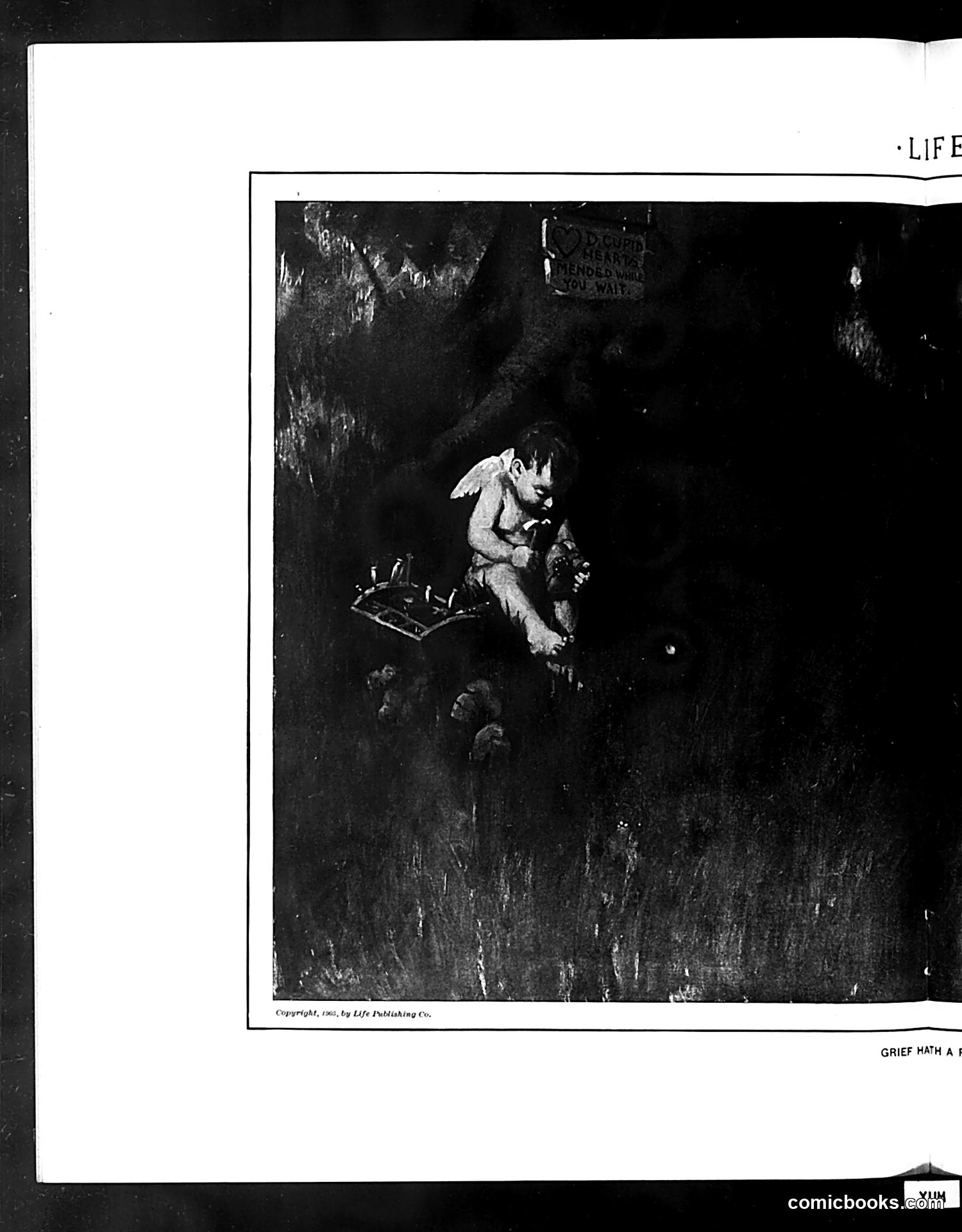
This appears to be a satirical cartoon from Life magazine (copyright 1903, per the visible credit line). The image shows a figure in what seems to be a dungeon or dark chamber, with a mousetrap visible and text referencing "SORROW" and something about waiting. The caption "GRIEF HATH A..." (incomplete on this page) suggests social or political commentary about suffering or hardship. The dungeon setting and mousetrap imagery likely carry symbolic weight—possibly commenting on entrapment, danger, or inescapable circumstances facing someone or some group. Without the complete caption and clearer identification of the figure depicted, the specific target of satire remains unclear. The melodramatic visual style typical of early 1900s Life magazine suggests it mocks either a public figure's predicament or a broader social condition of the era.
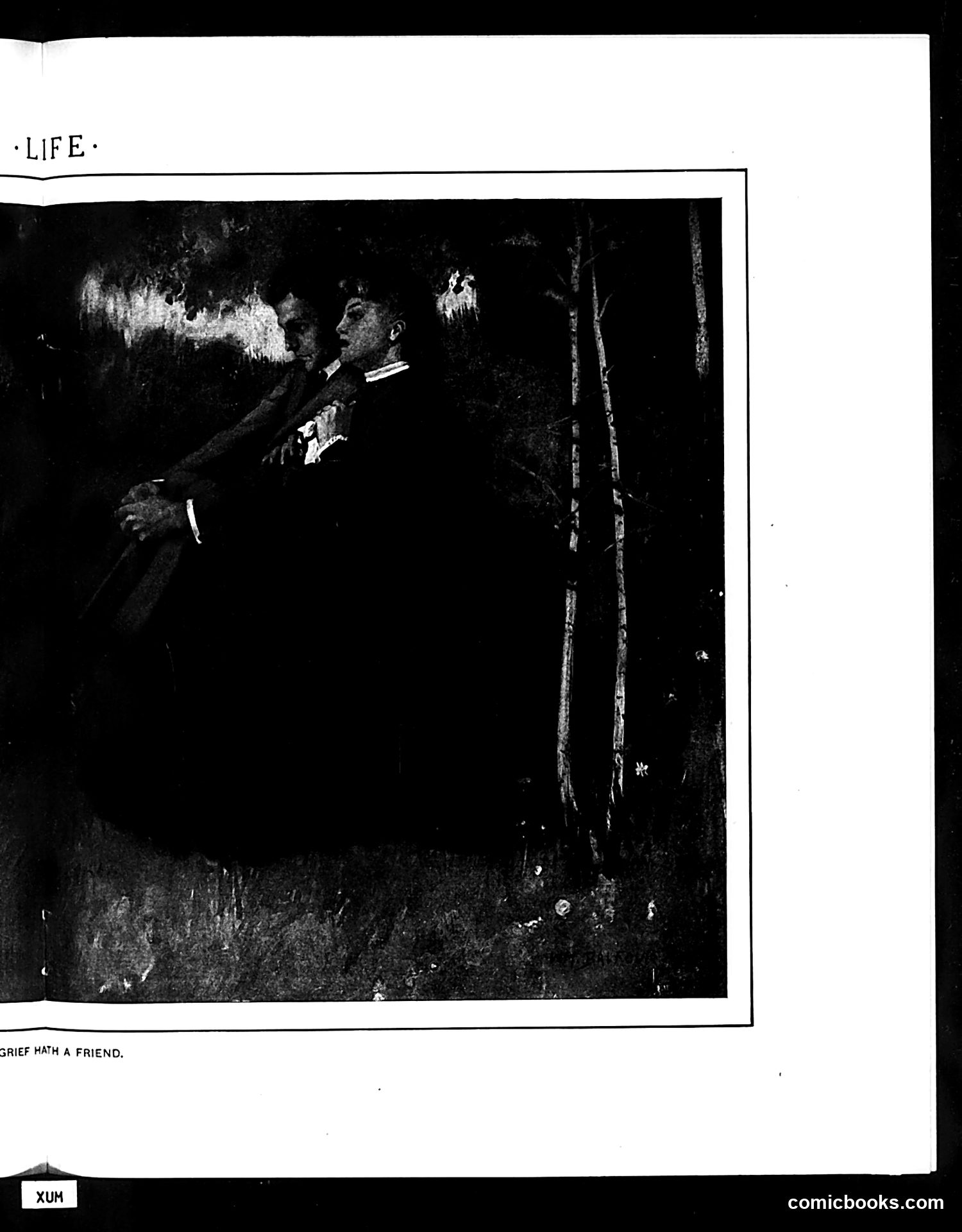
This page from *Life* magazine shows a military officer in dress uniform standing in a nighttime forest setting. The partial caption reads "GRIEF HATH A FRIEND," though the complete text is cut off. The image appears to be a political or satirical cartoon, likely from the early-to-mid 20th century based on the style and uniform. However, **without being able to identify the specific officer depicted or see the complete caption and surrounding text, I cannot reliably explain the satire's target or meaning**. The nighttime forest setting and the phrase "grief hath a friend" suggest commentary on war, loss, or military leadership, but the specific historical or political reference remains unclear from this partial page alone.
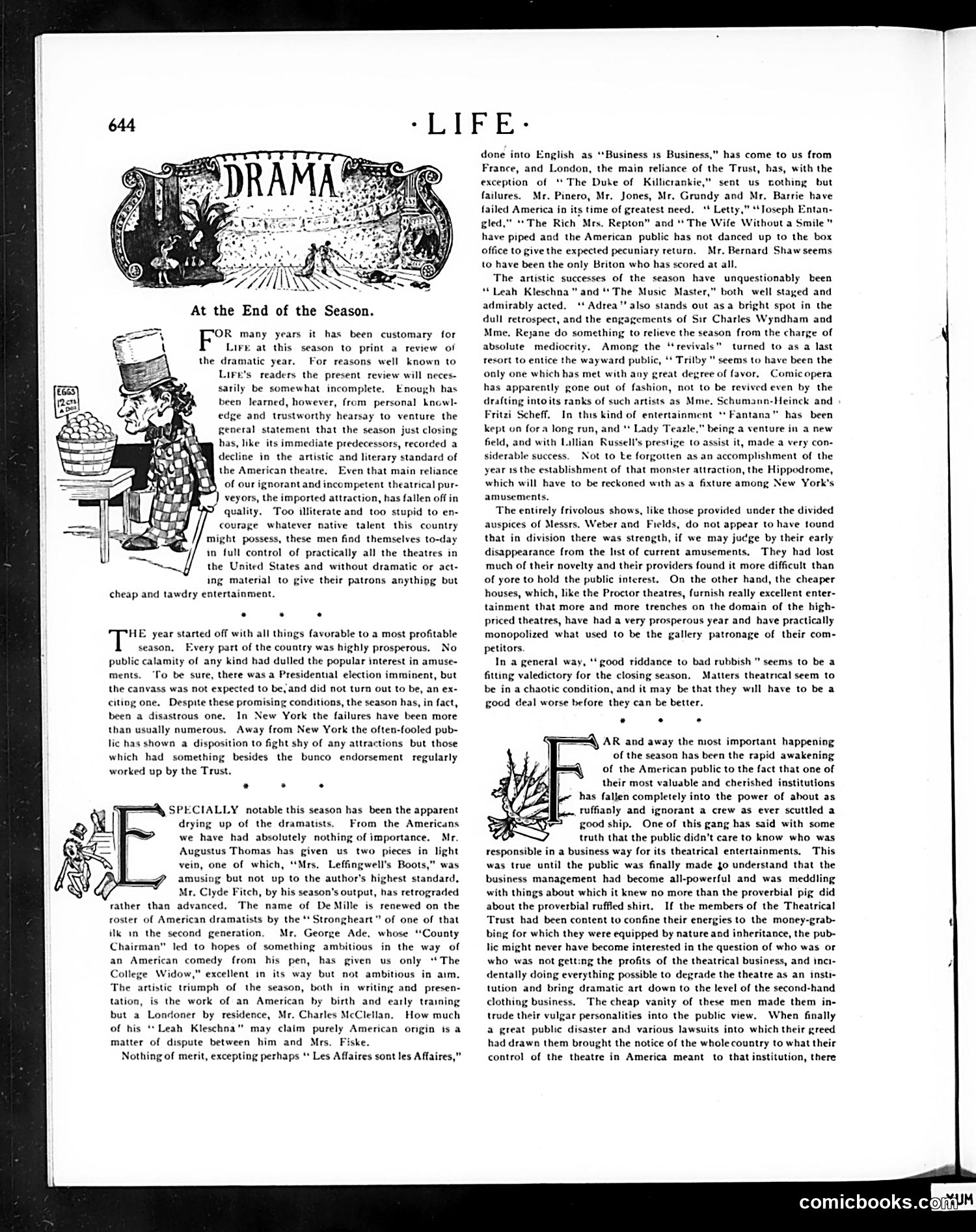
This is a theater season review from Life magazine (likely early 1900s, based on dramatists mentioned). The cartoon shows a character reading a stack of theatrical materials—representing the magazine's task of evaluating the year's plays. The article criticizes American theater's decline, blaming theatrical managers ("the Trust") who control most U.S. theaters and lack taste. It attacks them for importing cheap foreign attractions rather than developing native talent, calling them "illiterate and too stupid." The text reviews specific American playwrights (Augustus Thomas, Clyde Fitch, George Ade) as disappointing, praises Charles McClellan's "Leah Kleschna" as the season's artistic triumph, and notes that major British dramatists (Pinero, Jones, Barrie) failed to impress American audiences. Only George Bernard Shaw scored a success. The overall verdict: the theatrical season was disastrous despite national prosperity.
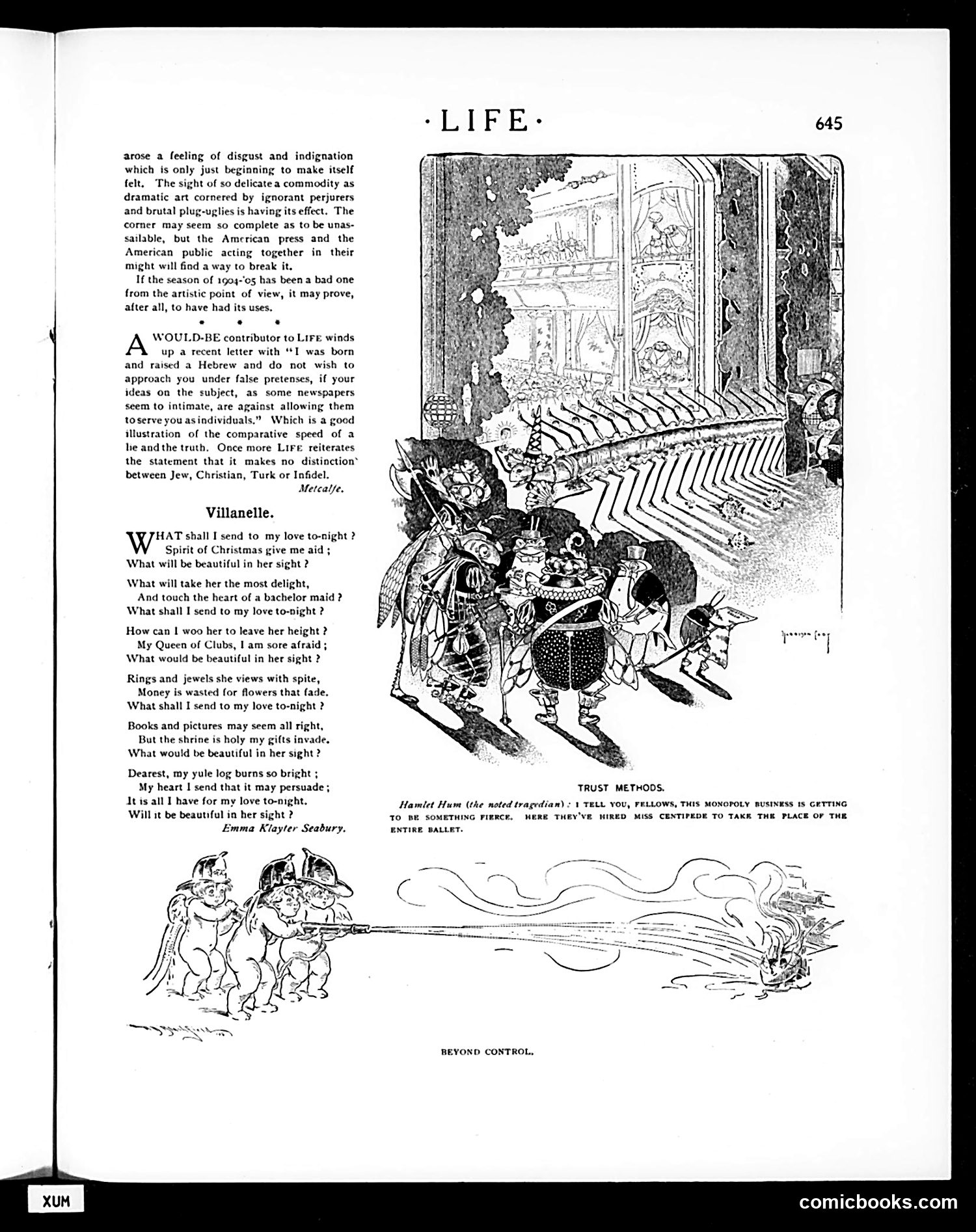
This page contains theatrical satire and poetry from an early 1900s issue. The main cartoon "Trust Methods" mocks theatrical monopolies—specifically, a producer has hired one performer (Miss Centipede) to replace an entire ballet corps, representing corporate consolidation in entertainment. The accompanying editorial text criticizes the "dramatic art corner" controlled by "ignorant perjurers and brutal plug-uglies" (theatrical thugs/corrupt operators), lamenting the 1904-05 season's artistic decline due to monopoly control. It expresses faith that American press and public will break this stranglehold. A secondary item defends Life's editorial stance, reiterating the magazine makes no religious distinctions—addressing accusations (from unnamed newspapers) that Life discriminates against Jewish contributors. The page also features "Villanelle," a romantic poem by Emma Klayter Seabury about Christmas gift-giving, and a lower cartoon ("Beyond Control") depicting cherubs losing control of a fire hose—unrelated to the theatrical critique above.
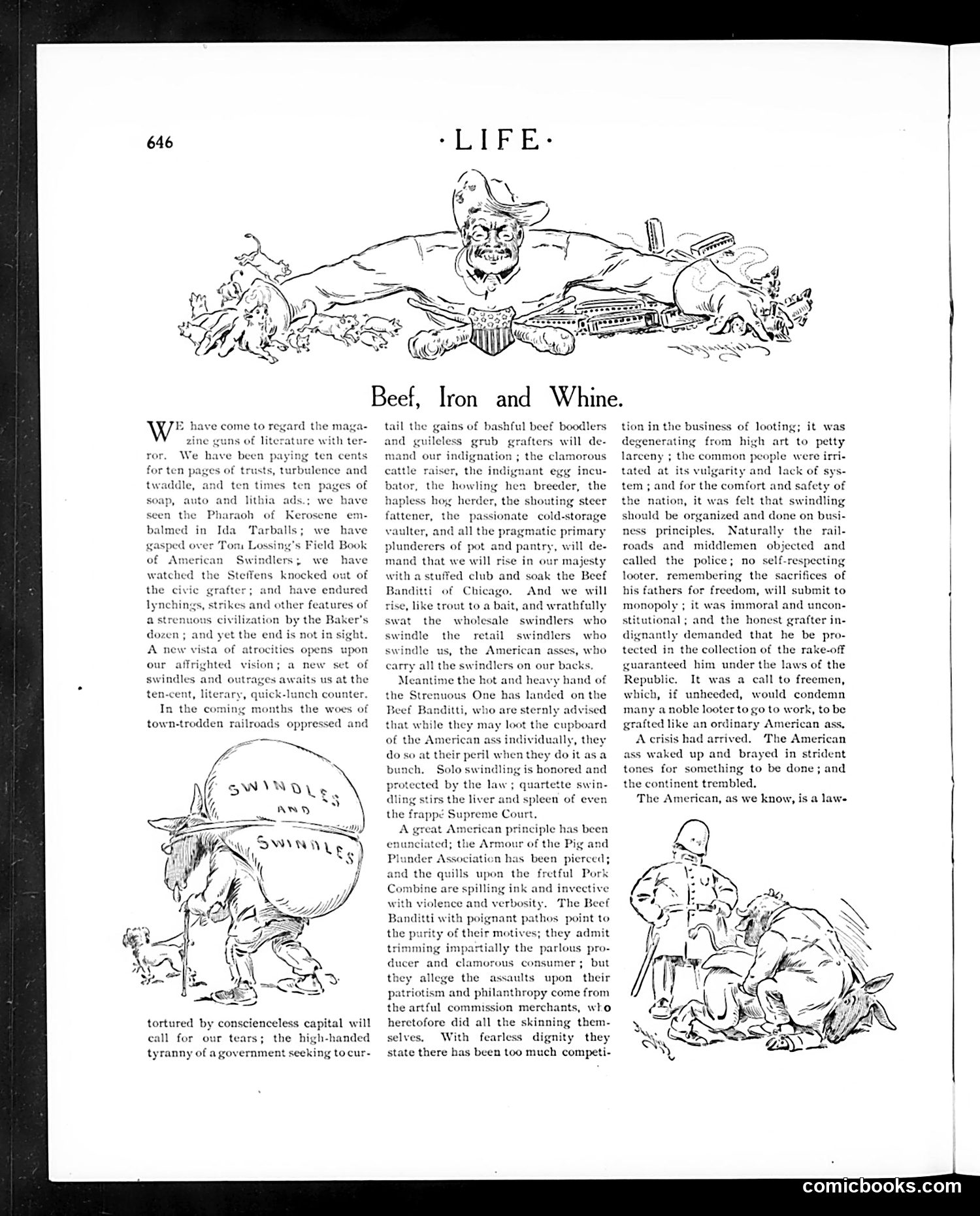
This 1906 Life magazine piece satirizes the American meat-packing industry's corruption and monopolistic practices. The title references both the industry's product (beef) and the constant complaints ("whine") of its operators. The text attacks "beef boodlers"—corrupt meat-packing magnates who manipulate prices and dodge regulations. It references the Armour company and "Beef Banditti" as organized criminal enterprises engaging in systematic looting under the guise of legitimate business. The cartoons depict these corrupt industrialists as literal swindlers and grafters, with caricatures showing them as duplicitous, bloated figures. The satire criticizes how these operators exploit both consumers and honest workers while using legal structures to protect their monopoly. The piece appears written around the time of Upton Sinclair's *The Jungle* (1906), which exposed meat-packing industry abuses. The "Strenuous One" likely references President Theodore Roosevelt, whose reform efforts the text suggests were insufficient against entrenched corporate corruption.
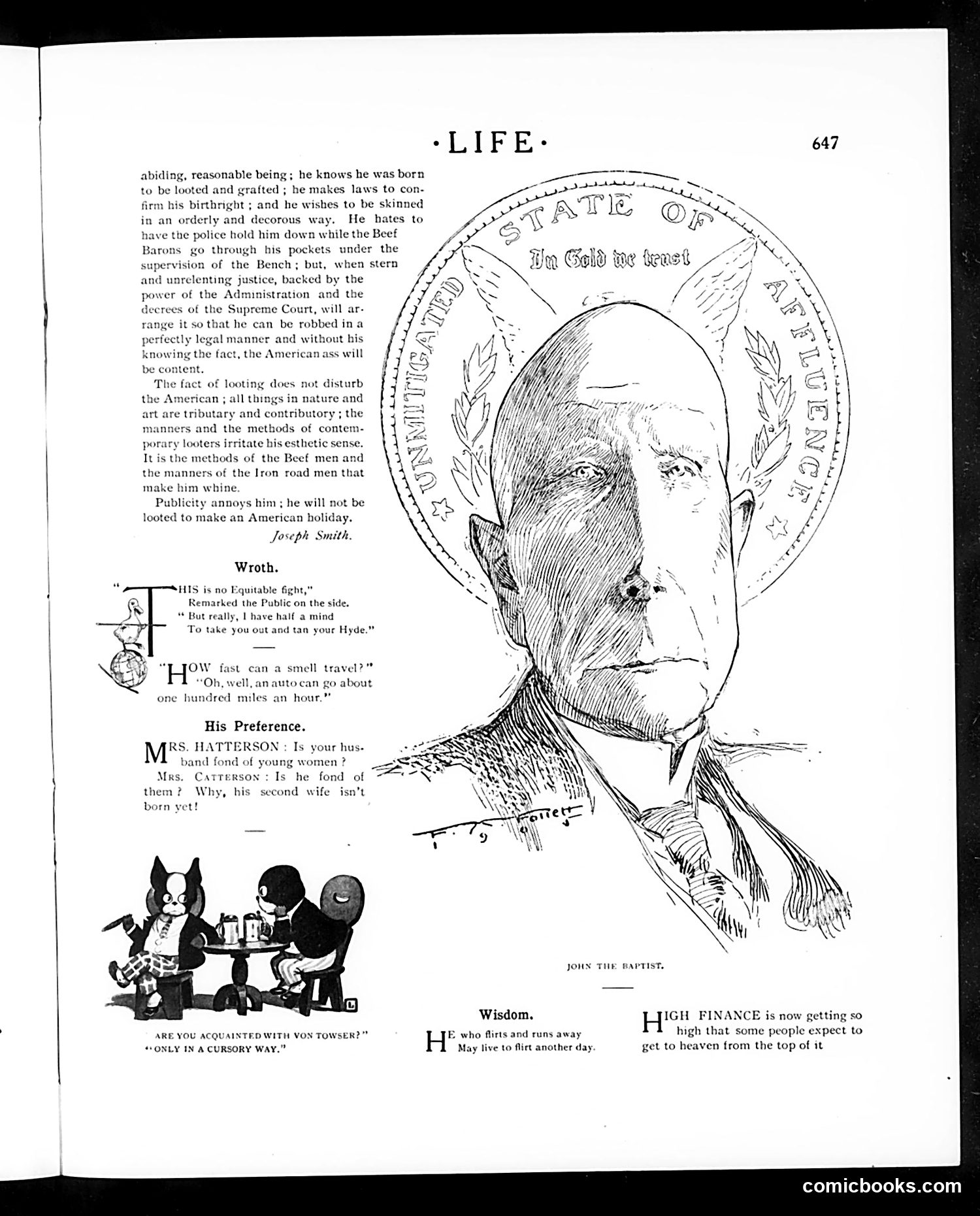
This page contains several unrelated satirical items typical of Life's format: **Main Image**: A large portrait labeled "John the Baptist" shows a bearded man's head on a U.S. coin or seal. The satire likely mocks a contemporary political or public figure by depicting them as a "saint," though the specific target is unclear without additional context. **"Wroth" section**: Depicts a dispute between "the Public" and an unnamed opponent (likely representing corporate or political interests—possibly referencing the "Beef Barons" and "Iron road men" mentioned in the text), satirizing unequal power dynamics in American society. **"His Preference"**: A crude joke about remarriage, playing on assumptions about men's preferences for young women. **"Wisdom"**: A quip about high finance becoming so elevated that people hope to reach heaven "from the top of it"—satirizing wealth inequality and financial excess. The overall page reflects Life's satirical commentary on American business corruption, class conflict, and social hypocrisy of the early 20th century.
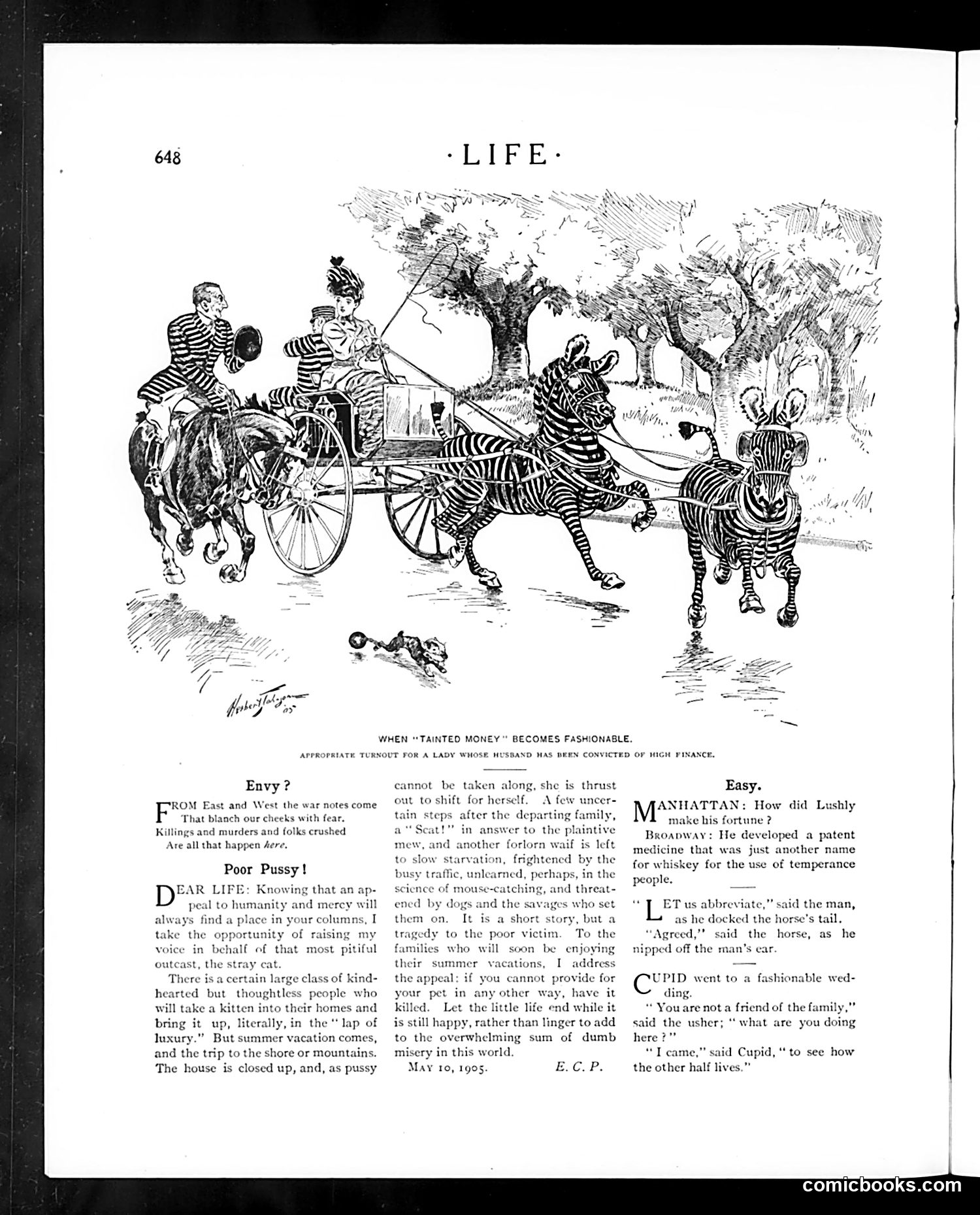
**The Main Cartoon:** The illustration shows a woman in an elaborate carriage drawn by zebras, attended by figures in striped clothing. The caption indicates this depicts "a lady whose husband has been convicted of high finance"—referring to a wealthy man convicted of financial crime (likely fraud or embezzlement). **The Satire:** The joke satirizes the hypocrisy of the wealthy: despite her husband's criminal conviction for financial misconduct, the woman continues to display ostentatious wealth and luxury. "Tainted money" (ill-gotten gains from crime) becomes socially acceptable among the fashionable set. This mocks how scandal doesn't truly diminish the social standing of the rich—they continue their extravagant lifestyles regardless of ethical violations. **The Articles Below:** The page includes unrelated pieces: "Poor Pussy" advocates humane treatment of abandoned house cats during summer vacations; the "Easy" dialogue makes a cynical joke about a man named Lushy who made his fortune selling patent medicine (whiskey disguised for temperance advocates).
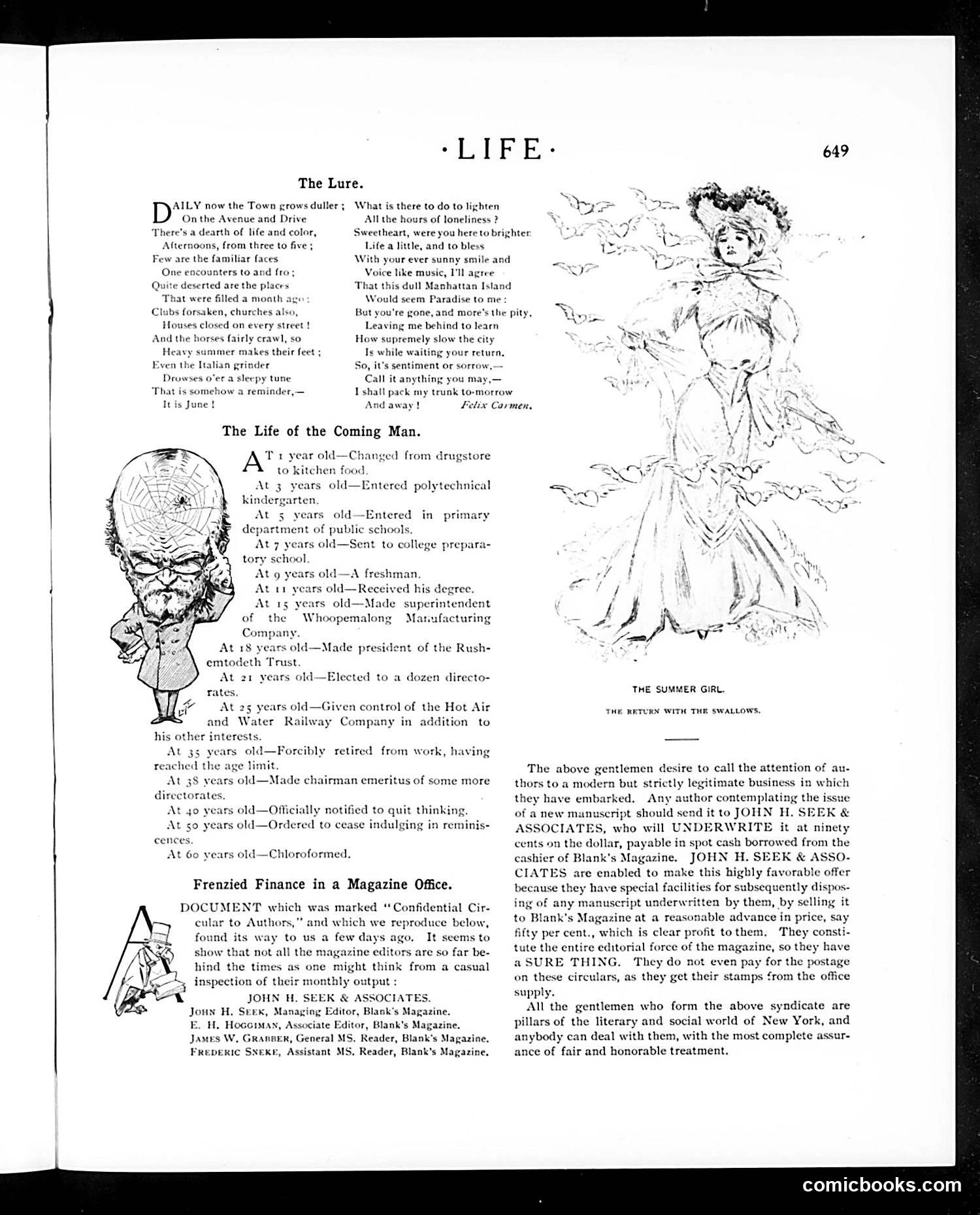
This page contains three satirical pieces: **"The Lure"** — A romantic poem about a lonely Manhattan summer, expressing sentimental longing for an absent sweetheart. The accompanying illustration shows a woman emerging from nature, suggesting pastoral escape from city tedium. **"The Life of the Coming Man"** — A career timeline satirizing American ambition and the corporate ladder, tracing a man from age 1 (drugstore to kitchen food) through increasingly impressive executive positions, culminating in forced retirement at 35 and "chloroforming" at 60. The joke targets the absurdity of obsessive careerism and planned obsolescence. **"Frenzied Finance in a Magazine Office"** — The centerpiece satire mocking unethical publishing practices. Life exposes a fraudulent scheme where magazine editors (Seek & Associates) solicit manuscripts, promising to "underwrite" them at 90 cents per dollar using borrowed money, then resell the same manuscripts to their own magazine at inflated prices, claiming profit. This exposes corrupt collusion between editors and publishers profiting from authors' work.
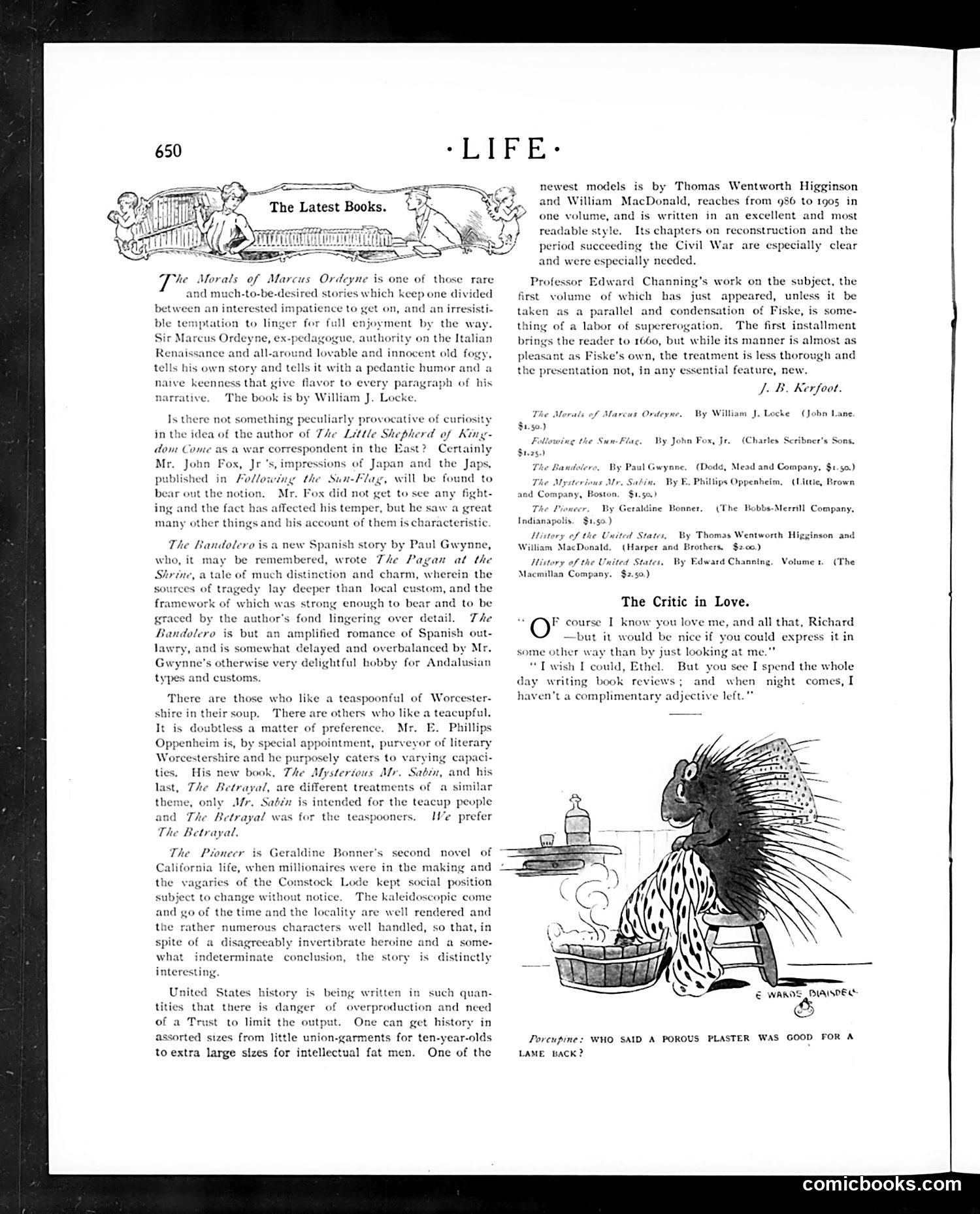
This page's main cartoon depicts a porcupine sitting at a desk with a typewriter and lamp, presumably a book critic. The creature appears irritable and defensive—its quills fully extended. The caption reads: "WHO SAID A POROUS PLASTER WAS GOOD FOR A LAME BACK?" **The satire:** The cartoon mocks literary critics as irritable, defensive figures. The "porous plaster" reference suggests that criticism is presented as a remedy or treatment—but the porcupine's aggressive posture implies critics are actually harmful or painful to authors. The joke plays on the critic's prickly nature: instead of soothing an author's "lame back" (wounded pride from bad reviews), the critic wounds them further with sharp barbs, much like a porcupine's quills. It's gentle satire on the combative relationship between critics and writers in the literary world.
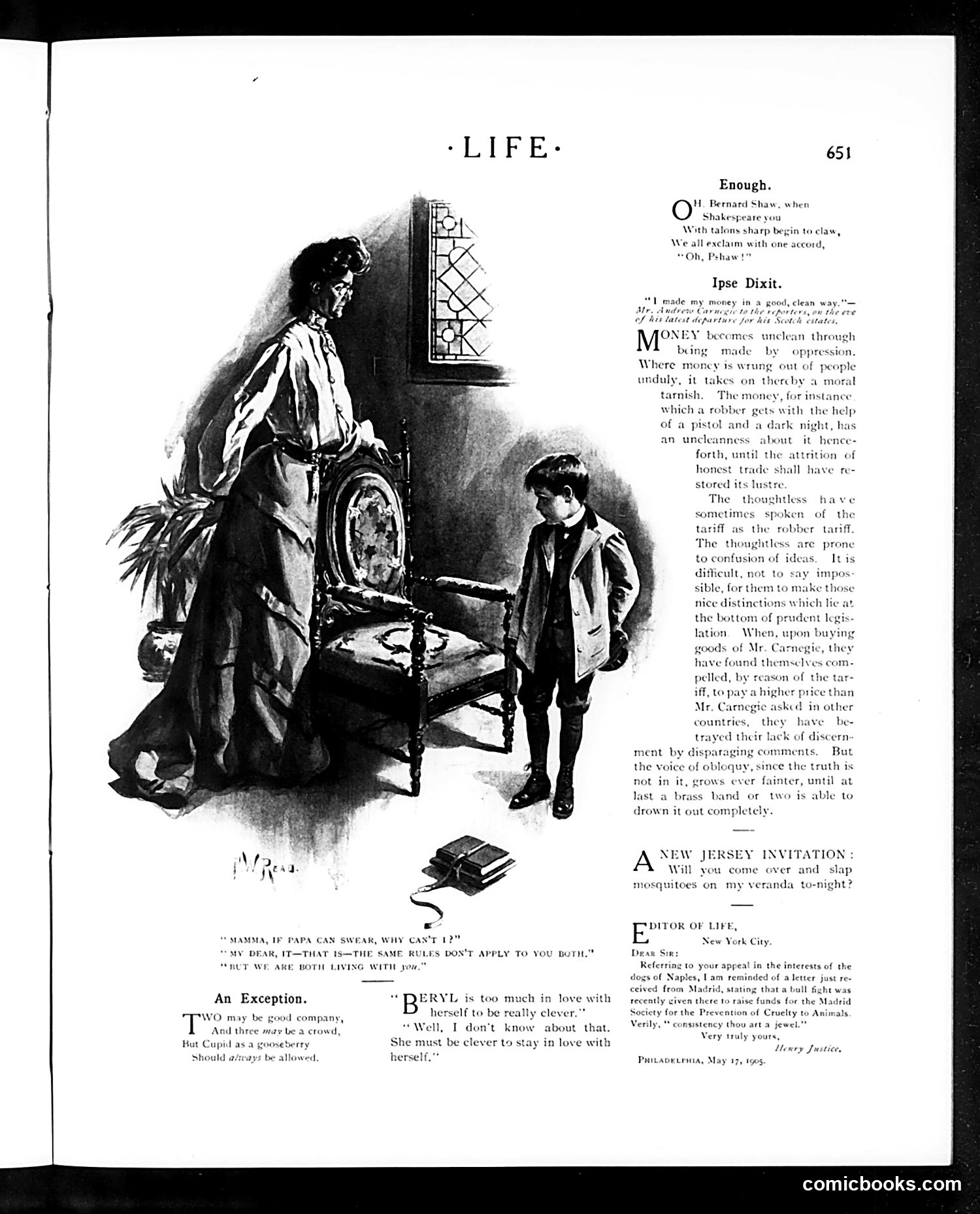
This page contains several satirical pieces typical of early 1900s Life magazine: **Main Cartoon (top):** Depicts an adult and child examining a chair, captioned about parents' swearing rules. The satire mocks parental hypocrisy—adults forbid children from swearing while doing so themselves. **"Ipse Dixit" section:** A lengthy essay critiquing the "tariff" (likely the protective tariff debate of the era) as morally tarnishing money obtained through unfair trade practices. It references "Mr. Carnegie," suggesting Andrew Carnegie's industrial practices. The piece argues tariffs artificially inflate prices and damage national commerce's moral standing. **"An Exception":** A brief joke about relationships—claiming that unlike bad company, a foolish lover "should always be allowed," suggesting romantic folly is somehow acceptable. **Bottom:** Contains reader correspondence, including one from Philadelphia (May 27, 1905) discussing animal cruelty prevention. The page reflects Progressive Era concerns: labor practices, industrial monopolies (Carnegie), tariff policy, and social reform movements—all packaged as light satirical commentary for educated magazine readers.
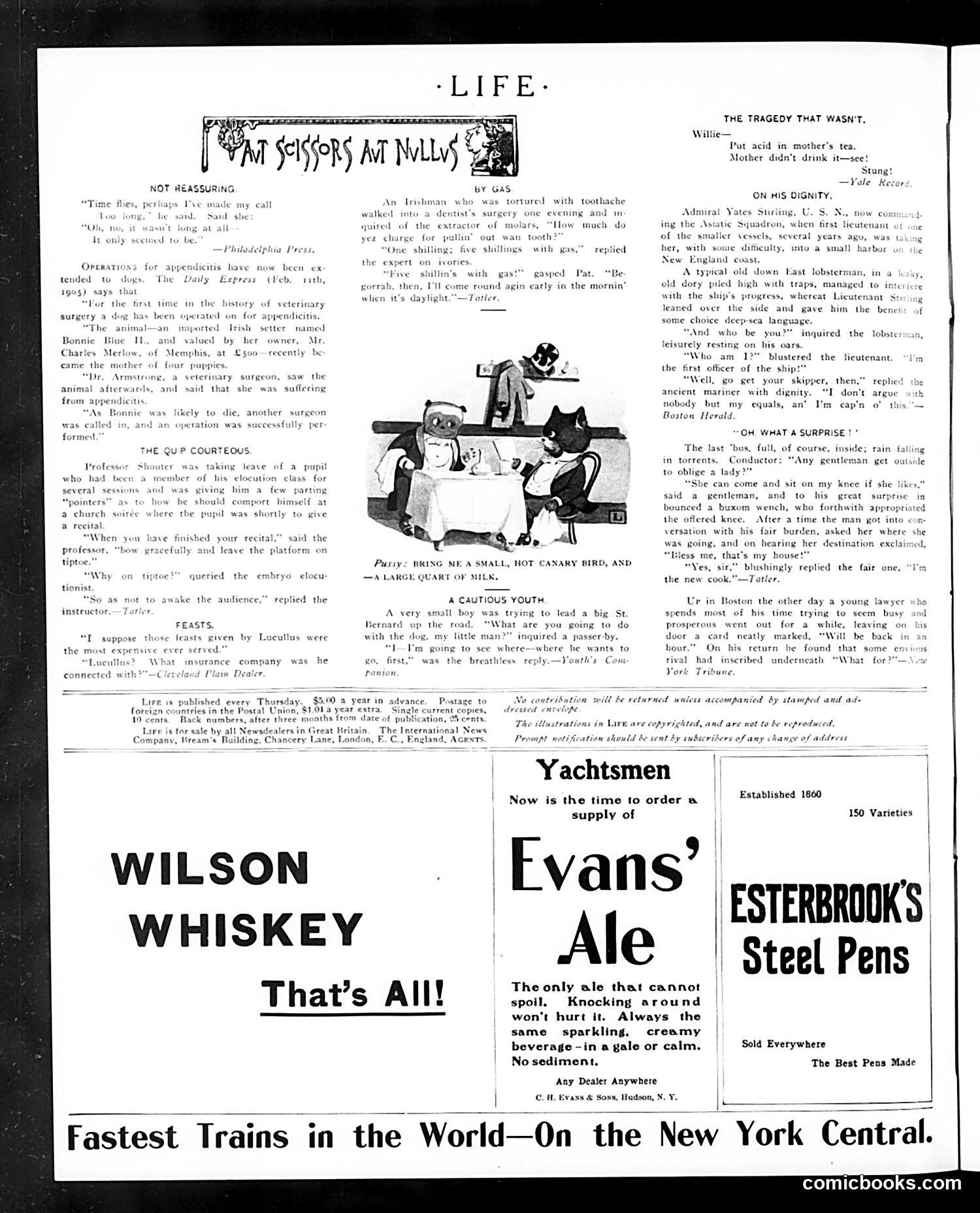
This page from *Life* magazine contains several humorous anecdotes typical of early 20th-century satirical humor: **"The Tragedy That Wasn't"** depicts an Irishman negotiating dental work with an extractor of molars—the joke hinging on Irish dialect humor and the man's hesitation about gas anesthesia costs. **"Operations"** jokes about a veterinary surgeon performing appendix surgery on a dog named Bonnie Blue. **"The Quid Courteous"** features a professor instructing a student on proper recital etiquette—the humor is the pupil's innocent misinterpretation about tiptoeing to avoid waking the audience. **"A Cautious Youth"** presents a young lawyer timidly asking a passerby for directions. The remaining anecdotes similarly rely on dialect humor, misunderstandings, and social awkwardness typical of the era's comedic conventions. The page is primarily **advertising-heavy**, featuring Wilson Whiskey, Evans' Ale, and Esterbrook's Steel Pens, with a tagline about New York Central trains at the bottom.
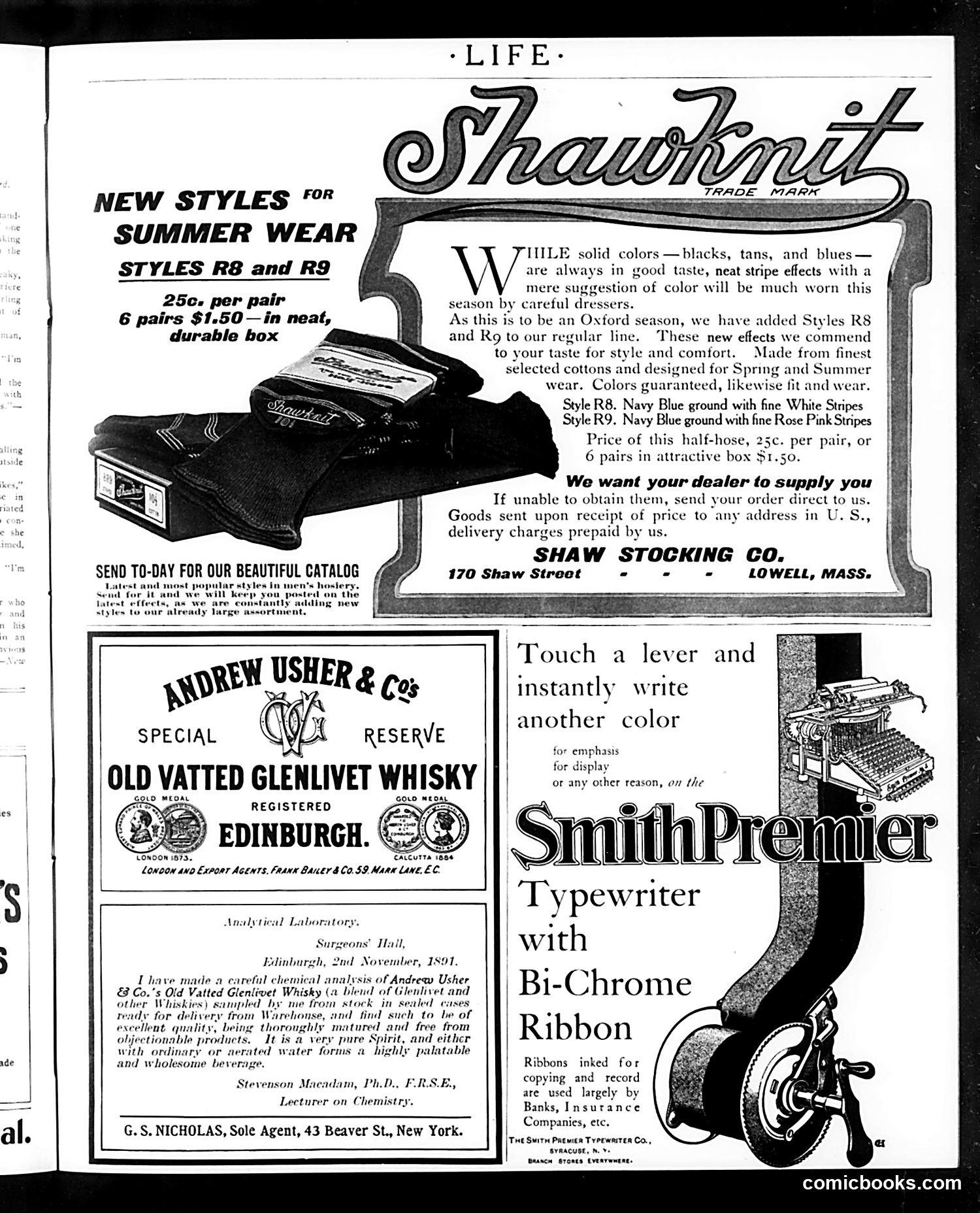
This is primarily an **advertising page** from Life magazine, not a satirical cartoon page. It contains four distinct advertisements: 1. **Shaw Stocking Co.** (top): Promotes new summer socks (Styles R8 and R9) in navy blue with white or pink stripes, priced at 25¢ per pair. 2. **Andrew Usher & Co.** (lower left): Advertises "Old Vatted Glenlivet Whisky" from Edinburgh, supported by a testimonial letter from a chemistry lecturer (dated 1891) certifying it as a "pure Spirit" and "wholesome beverage." 3. **Smith Premier Typewriter** (right): Features a typewriter with bi-chrome ribbon capability, allowing users to "touch a lever and instantly write another color," useful for emphasis and display. Notes the ribbon's use by banks and insurance companies. 4. **G.S. Nicholas** (bottom): Listed as the sole New York agent for the whisky. There is no political satire or social commentary visible on this page—it is straightforward commercial advertising typical of early 20th-century Life magazine content.
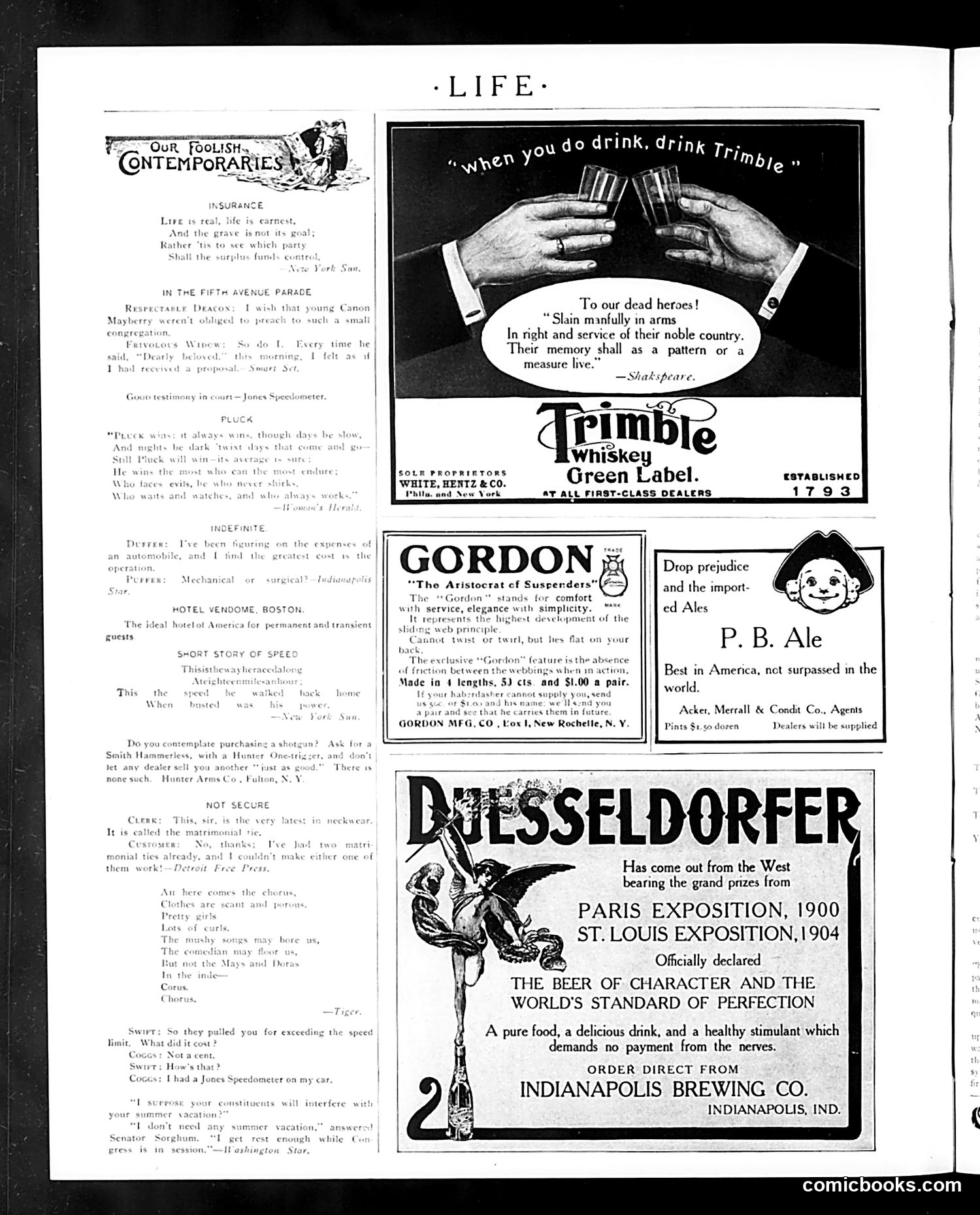
This page is primarily **advertising**, featuring liquor and beer promotions from the early 1900s. The notable content includes: **The Trimble Whiskey ad** (top right) uses a patriotic appeal, showing two men toasting "to our dead heroes" with a Shakespeare quote about soldiers fallen "in right and service of their noble country." This suggests the ads were published during or shortly after a war period—likely the Spanish-American War (1898) or its aftermath. **The other ads** (P.B. Ale, Düsseldorfer beer) make standard product claims about quality and superiority. **The left column** contains satirical pieces typical of Life magazine's "Our Foolish Contemporaries" section—mocking contemporary figures and social pretensions through brief anecdotes and dialogue. The **patriotic framing of alcohol sales** through war commemoration is notable: breweries and distilleries capitalized on national pride and military sacrifice to market their products—a practice that would face increasing criticism as attitudes toward both alcohol and war evolved.
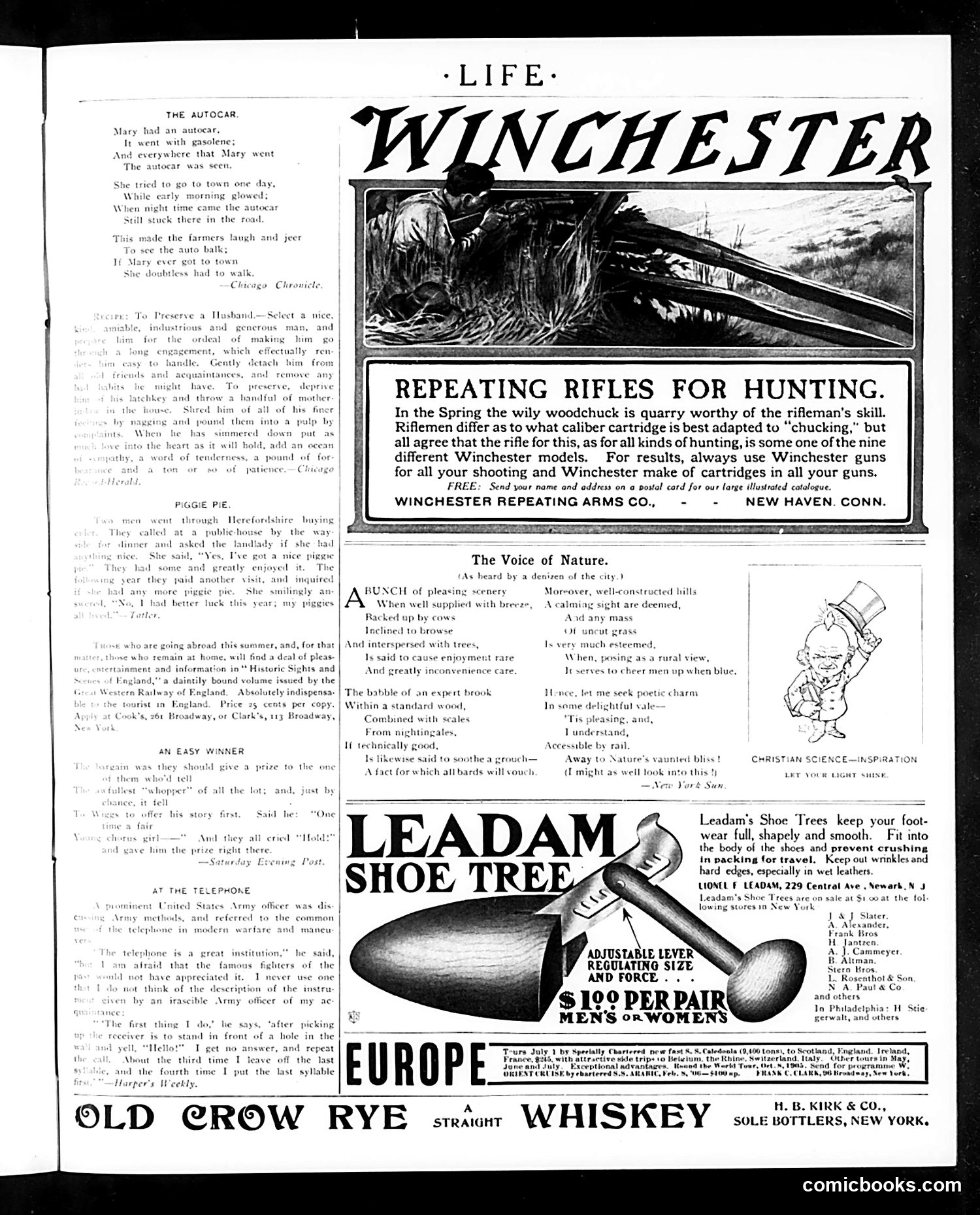
This page is primarily **advertising** interspersed with short humorous prose pieces and poetry—typical of Life magazine's format. The main satirical content includes: **"The Autocar"**: A poem mocking early automobiles, showing how Mary's newfangled car gets stuck in mud while farmers "laugh and jeer." The satire targets the unreliability and inconvenience of primitive automobiles versus traditional transportation. **"The Voice of Nature"**: A sentimental poem about pastoral scenery, likely satirizing the era's romanticization of nature—contrasting idealized rural beauty with the messy reality (cows, mud, inconvenience). **"Piggie Pie"** and other brief anecdotes appear to be gentle domestic humor about rural life and farming. The **advertisements** are period-typical: Winchester rifles (emphasizing hunting utility), Leadam Shoe Trees, Old Crow Rye whiskey, and a European travel ad. These reveal what products wealthy readers could afford circa 1900s-1910s. No specific political figures or sharp social commentary appear visible on this page—it's lighter entertainment and consumer goods marketing.
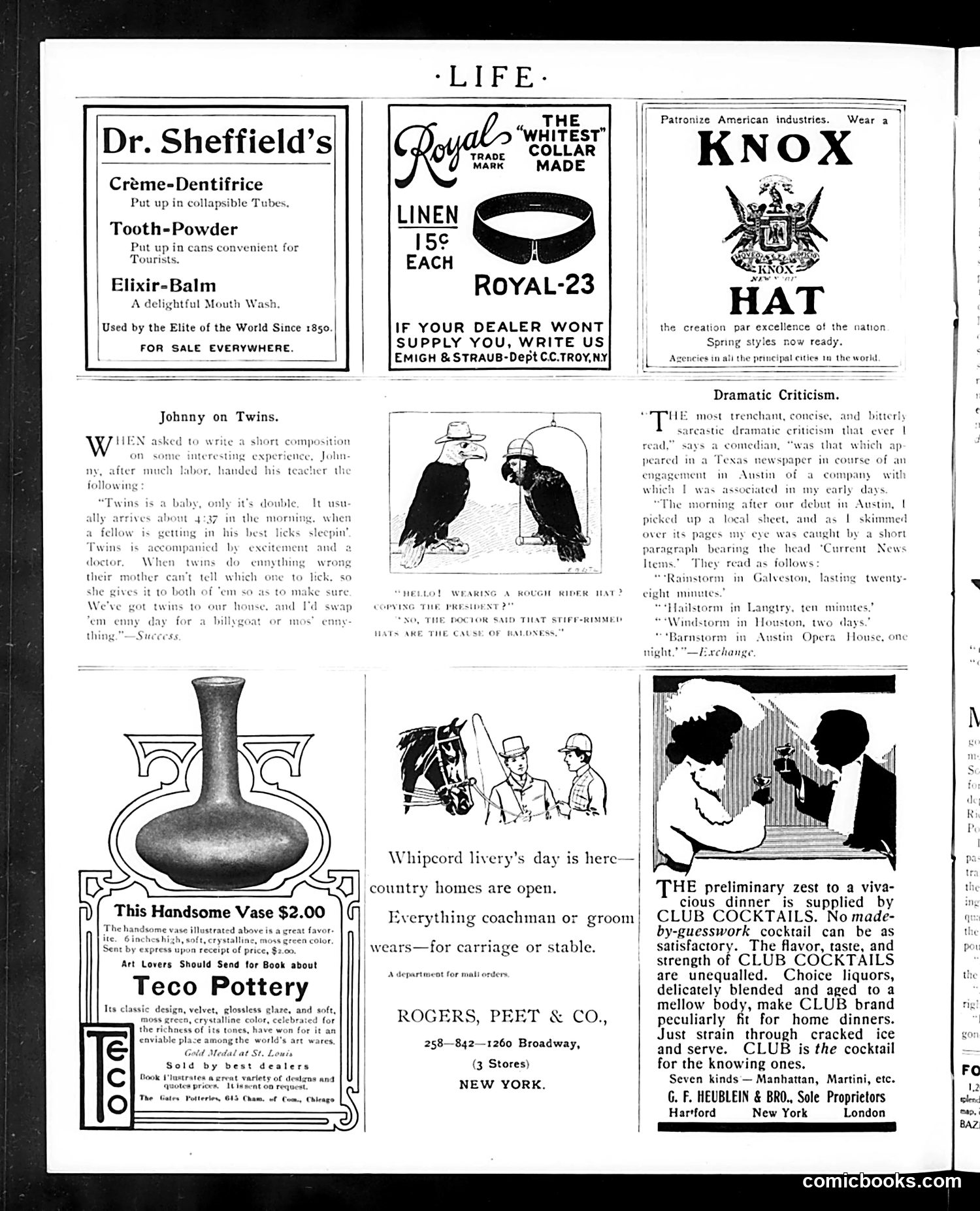
This page is primarily **advertisements and light humor** rather than political satire. The main content includes: **"Johnny on Twins"** is a humorous composition assignment where a student attempts to write about twins. The joke plays on innocent misunderstandings—twins arriving "about 4:37 in the morning" and the confusion about which twin is which. **The cartoon** shows two figures discussing a "Rough Rider hat," with a doctor claiming stiff-rimmed hats cause baldness—a topical reference to Theodore Roosevelt's iconic rough rider hat style, popular at this time. **"Dramatic Criticism"** is a joke about a Texas newspaper's absurdly brief reviews of theatrical productions ("Rainstorm in Galveston, lasting twenty-eight minutes"). The rest is standard product advertising (pottery, hats, clothing, dental products, cocktails) typical of Life magazine's revenue model in this era. There's no significant political commentary on this particular page.
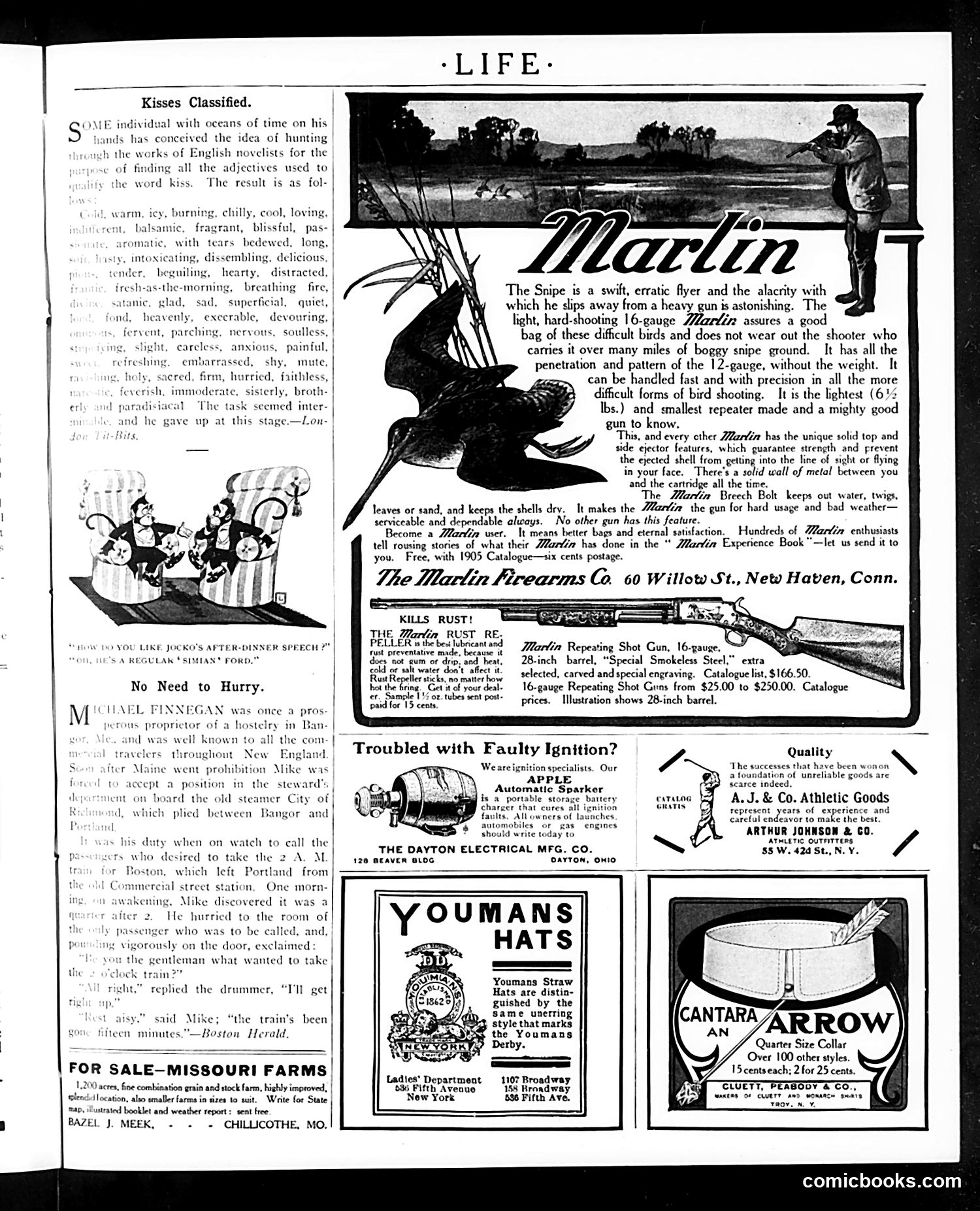
This page contains mostly **advertisements and filler content** rather than political satire. The top section, "Kisses Classified," is a humorous literary commentary: someone spent time cataloging all adjectives used to describe "kiss" in English novels, producing an absurdly long list (warm, icy, burning, etc.). The joke is on over-the-top romantic writing. Below that, "No Need to Hurry" is a brief anecdote about a ferry worker named Mike Finnegan who, when asked to wake a sleeping passenger for Boston, dismissively replies the train's been gone fifteen minutes—humor based on Irish working-class dialect and incompetence. The bulk of the page is **period advertising**: Marlin firearms for bird hunting, electrical ignition systems, Youmans hats, Arrow collars, and Missouri farmland for sale. These ads are typical of Life magazine's revenue model. The cartoons are minimal; the imagery supports product marketing rather than political commentary.
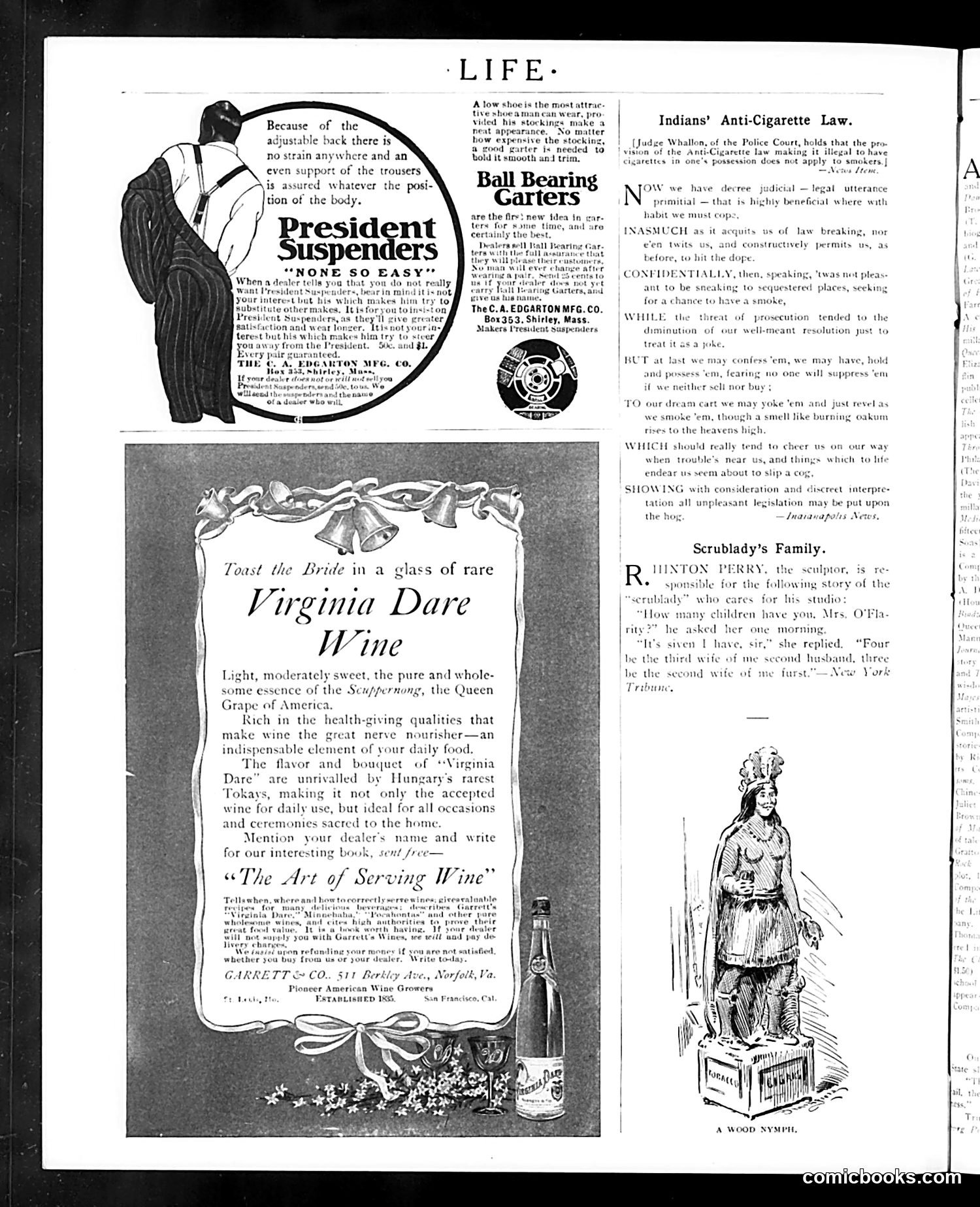
This page contains **advertisements and satirical commentary** rather than traditional political cartoons. The main items are: 1. **"President Suspenders"** ad (top left): A humorous pitch for adjustable suspenders, using "President" as a brand name to suggest authority and reliability. 2. **"Ball Bearing Garters"** ad: Another men's clothing advertisement emphasizing a new mechanical innovation (ball bearings) applied to sock garters. 3. **"Indians' Anti-Cigarette Law"** (right column): A satirical commentary on a Native American anti-cigarette ordinance, mocking how the law's wording creates loopholes—one can possess and smoke cigarettes, just not sell them. The piece jokes about finding ways around "unpleasant legislation." 4. **Virginia Dare Wine advertisement**: A full-page ad for American wine. 5. **"Scrublady's Family"** (bottom right): A humorous anecdote by sculptor Hinton Perry about a cleaning woman's marital history, playing on working-class stereotypes. The page reflects early 20th-century consumer culture and casual ethnic/class humor typical of *Life* magazine's satirical approach.
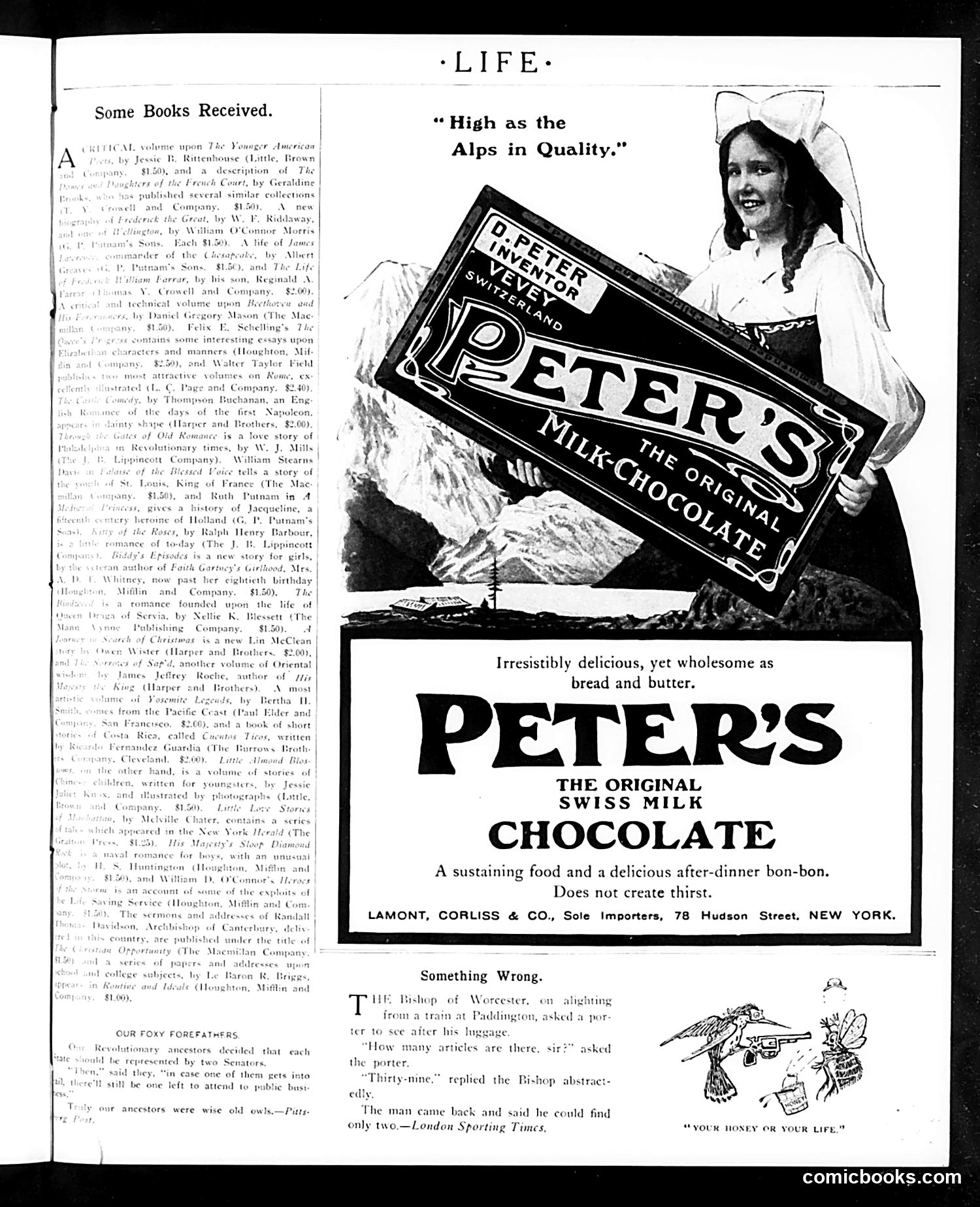
This page is primarily **advertising**, dominated by a Peter's Swiss Milk Chocolate advertisement featuring a woman in Alpine costume holding an oversized chocolate bar package, with marketing copy emphasizing quality and wholesomeness. The page includes two brief **humorous anecdotes** typical of Life's satirical content: 1. **"Something Wrong"**: A joke about the Bishop of Worcester, whose absent-mindedness (a common trope for absent-minded clergy) leads him to miscount his luggage articles—claiming thirty-nine when only two exist. The humor relies on the stereotype of distracted, impractical clerics. 2. **"Your Honey or Your Life"**: An illustration caption (partially visible) that appears to be another short joke, though the full text is unclear from the OCR. The page also contains a "Some Books Received" section listing recently published volumes with prices and publishers—standard editorial content for a literary magazine of this era (likely early 20th century).
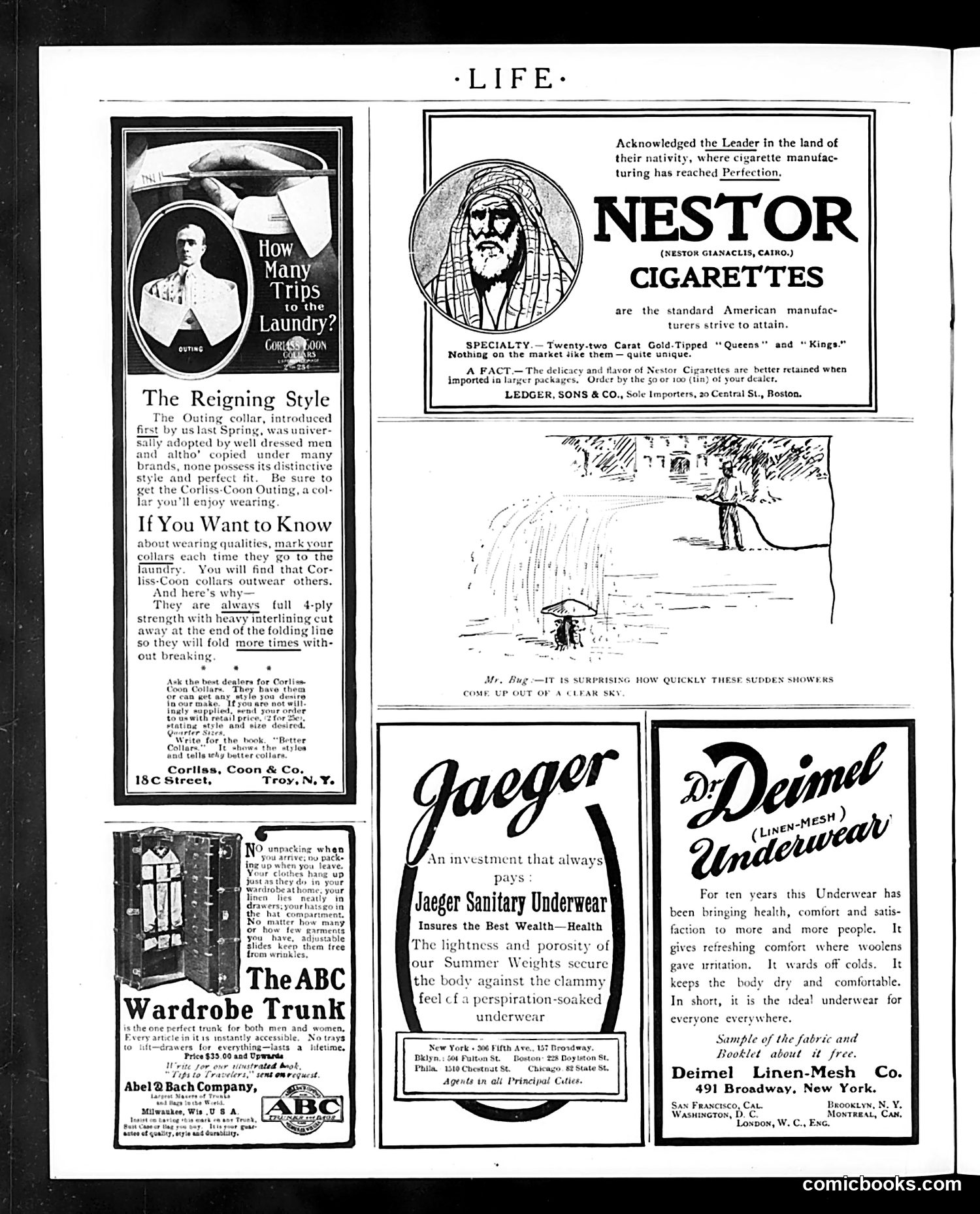
This page is primarily **advertising**, not editorial content or satire. It contains six commercial advertisements from the early 20th century: 1. **Corliss-Coon Collars** — promotes detachable shirt collars, emphasizing durability through repeated laundering 2. **Nestor Cigarettes** — Egyptian cigarettes imported to America, claiming manufacturing "perfection" 3. **ABC Wardrobe Trunk** — storage furniture for clothing 4. **Jaeger Sanitary Underwear** — health-focused undergarments 5. **Dr. Deimel Linen-Mesh Underwear** — competing undergarment brand emphasizing comfort over wool The cartoon labeled "Mr. Bug" shows a humorous weather observation about sudden rain showers—a light social observation unrelated to the ads. **For modern readers:** These ads reflect consumer culture priorities of the 1910s: durability, imported luxury goods, health consciousness, and proper storage/appearance standards. The emphasis on "sanitary" underwear reflects genuine health concerns of the era.
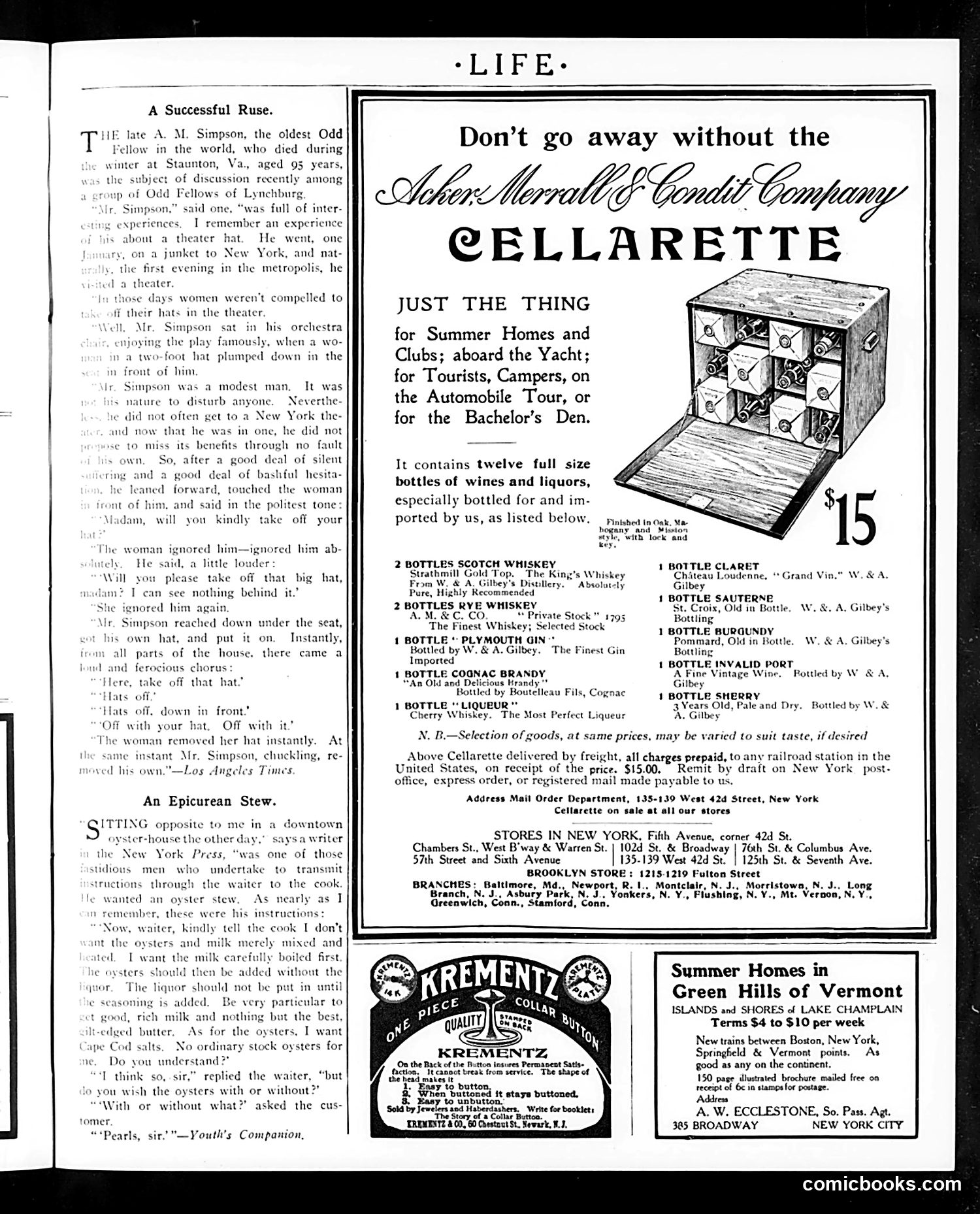
This page consists primarily of **advertisements and humorous anecdotes** rather than political satire. The two stories ("A Successful Ruse" and "An Epicurean Stew") are genteel comedy pieces common to Life magazine's humor section. The first describes an elderly Odd Fellow who silences a woman's large hat at a theater by suggesting it has "nothing behind it"—a mild insult that embarrasses her into removing it. The second recounts a fastidious diner's overly detailed oyster stew instructions, ending with the punchline that the waiter asks if he wants oysters "with or without pearls." The dominant content is **commercial advertising**: a Ahrn Morrall & Conduit Company "Cellarette" (a cabinet containing twelve bottles of liquor, priced $15), a Krementz button company ad, and vacation home promotions. These reflect early 20th-century consumer culture and leisure activities (yachting, automobile touring, summer homes). There is **no political satire** on this page—it represents Life's lighter, lifestyle-focused editorial and advertising content.
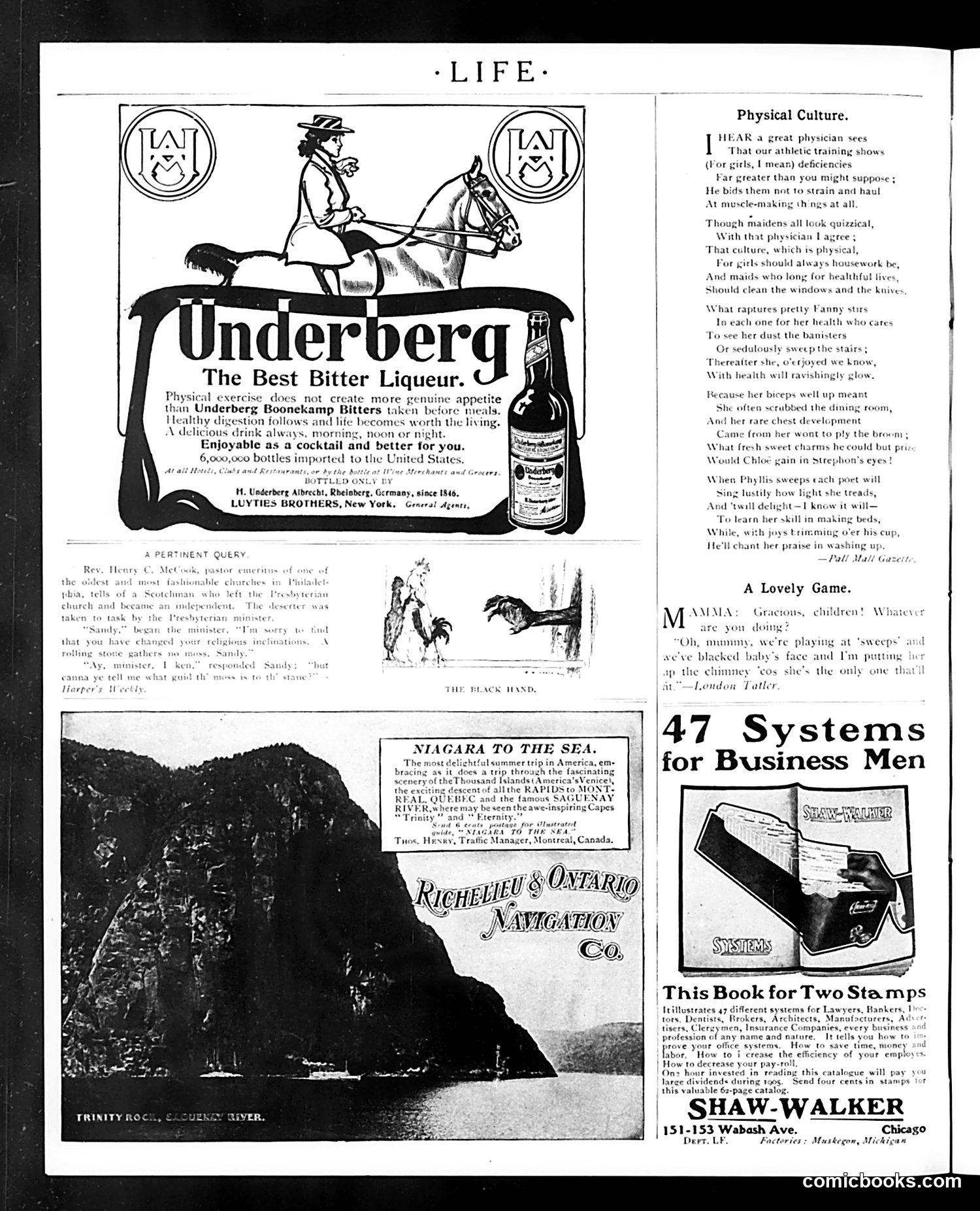
This page contains **advertising and light humor** rather than political satire. The main content includes: **"Physical Culture" poem**: A satirical piece mocking physicians who discourage girls from athletic training, suggesting instead that proper "physical culture" for women means housework—dusting, sweeping, cleaning windows and knives. The humor is in the contradiction: doctors claim strenuous exercise is bad for women, yet approve of physically demanding domestic labor. This reflects early 20th-century attitudes restricting women's athletics while expecting them to perform arduous household work. **Underberg advertisement**: Promotes a German bitter liqueur as an appetite stimulant, claiming 6 million bottles were imported to the U.S. **"A Lovely Game" anecdote**: Children playing at chimney sweeps by blackening a baby's face—a gentle joke about childhood mimicry. The remaining content comprises **travel and business advertisements** (Niagara tourism, Shaw-Walker office systems).
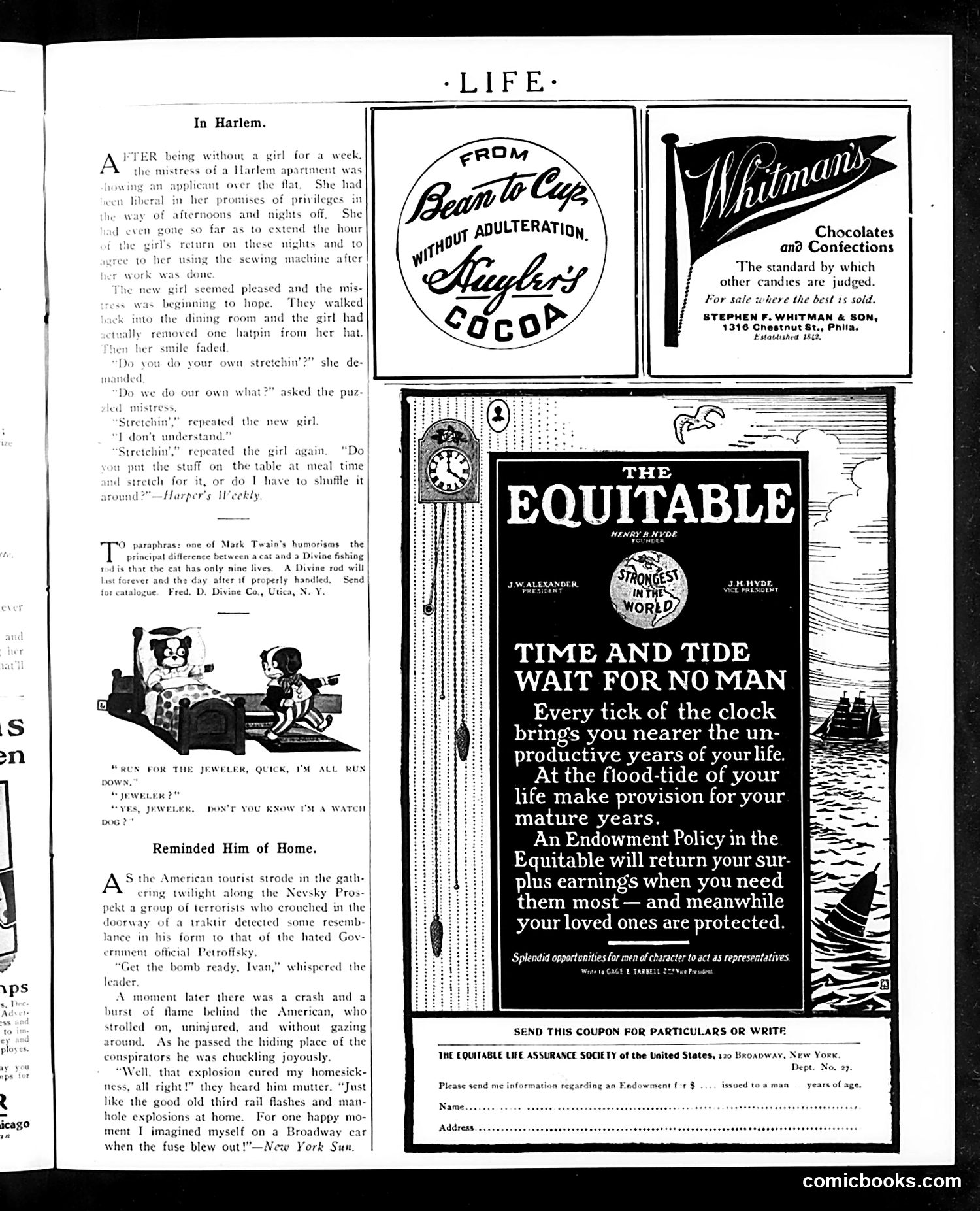
This page combines humor and advertising typical of early 20th-century Life magazine. **"In Harlem" story**: A satirical piece about a Harlem apartment-dweller's interaction with a new maid. The humor relies on misunderstanding the word "stretchin'" (likely referring to stretching laundry or fabric work), playing on dialect humor and class differences common to the era's comedic conventions. **"Reminded Him of Home"**: A joke about an American tourist in Russia (Nevsky Prospekt indicates St. Petersburg) who finds a bomb explosion amusing because it reminds him of New York subway accidents—satirizing American indifference to danger and comparing American industrial hazards to Russian political violence. **Advertisements**: Product ads (Shyler's Cocoa, Whitman's Chocolates) and an Equitable Life Assurance insurance pitch occupy the remainder, typical of the magazine's revenue model. The page reflects period attitudes toward race, ethnicity, and class through humor that modern readers would find offensive.
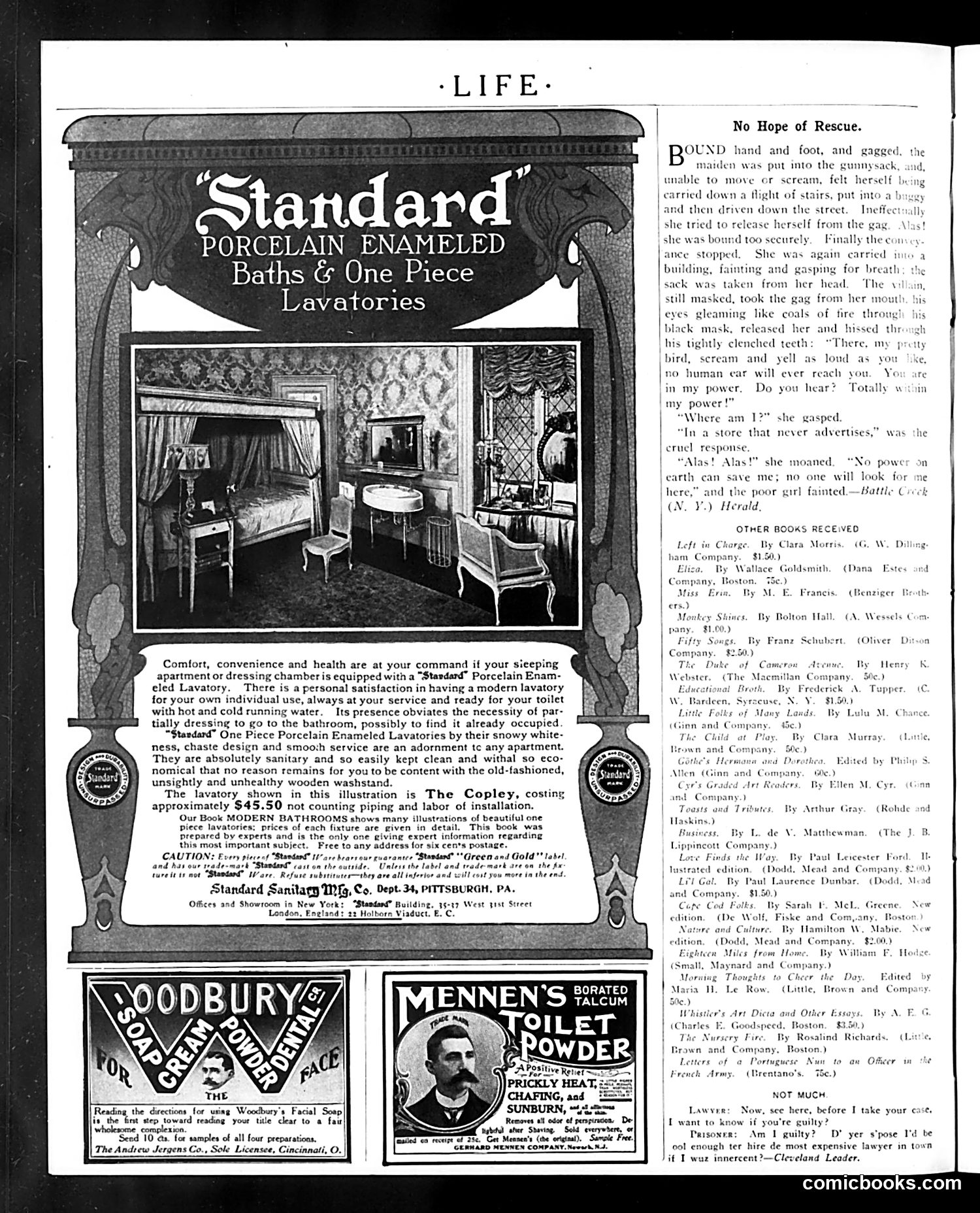
This page is primarily **advertising, not political satire**. The main content is a full-page advertisement for "Standard" brand porcelain enameled bathroom fixtures (lavatories/sinks). The large central image shows an elegant early-20th-century bedroom with modern plumbing fixtures. The satirical element is a small fictional narrative titled "No Hope of Rescue," which parodies melodramatic captive-girl stories. A woman kidnapped and locked in a dark room learns she's trapped in "a store that never advertises"—the joke being that without advertising, no one will ever find her. This clever setup mocks the importance of advertising while promoting the "Standard" brand itself. Below are advertisements for unrelated products: Woodbury's Facial Soap and Mennen's Borated Talcum Toilet Powder. The page includes a "Books Received" section listing recently published titles. This is fundamentally **commercial content masquerading as editorial**, typical of early Life magazine's fusion of advertising and satire.
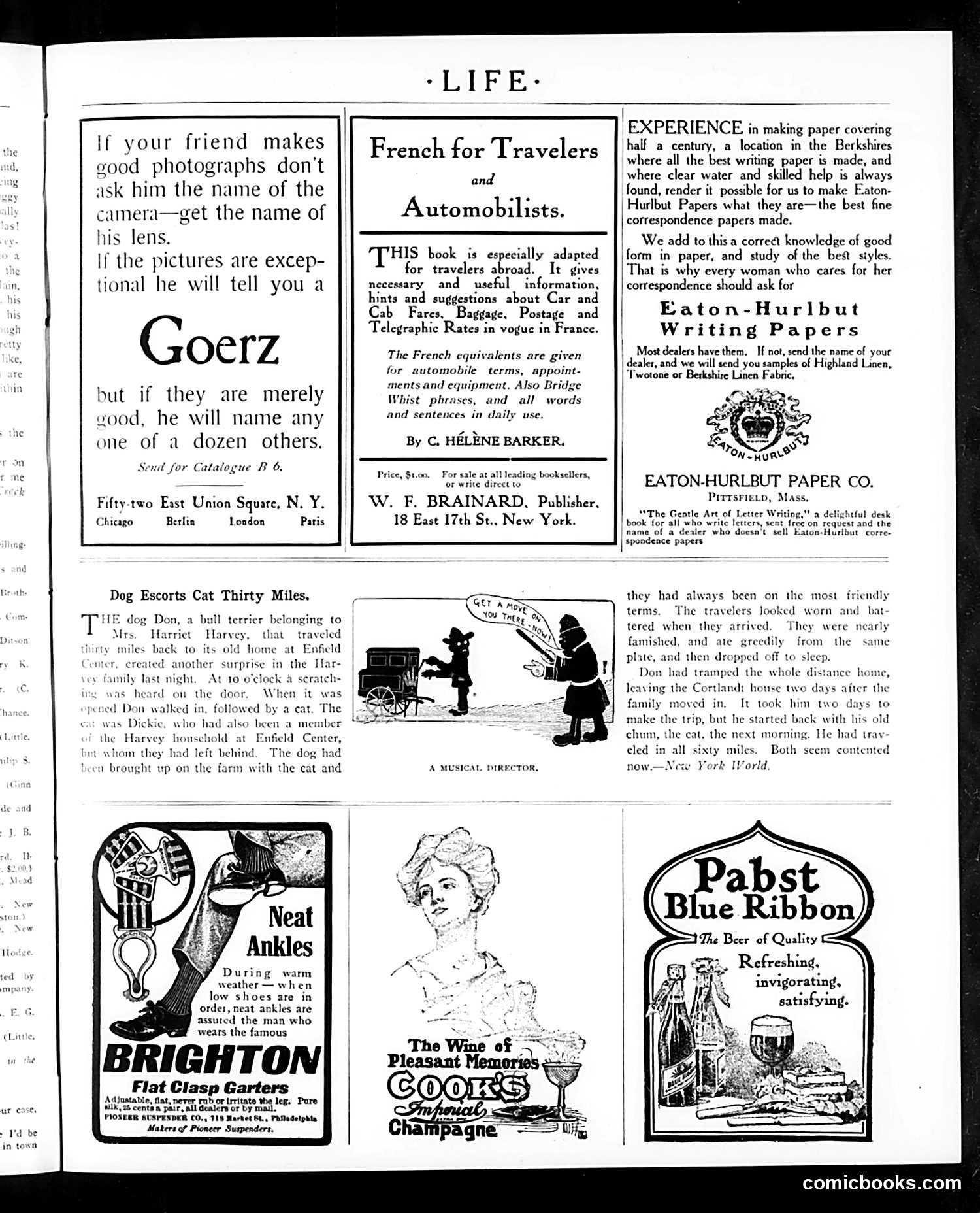
This page is primarily **advertisements and light humor pieces** rather than political satire. The main content includes: 1. **Goerz Camera Lens Ad** (top left): A joke about photographers being proud of quality lenses rather than camera brands—reflecting early 20th-century camera culture where lenses were prized components. 2. **"Dog Escorts Cat Thirty Miles"** (center): A heartwarming anecdote from the *New York World* about a bull terrier named Don who traveled 30 miles home alongside a cat when his family relocated, demonstrating animal loyalty. 3. **"A Musical Director"** (small cartoon): A sketch showing someone with a dog in a cart, with minimal satirical content—likely illustrating the dog story humorously. 4. **Product Advertisements**: Brighton garters, Cooks champagne, Eaton-Hurlbut writing paper, Pabst Blue Ribbon beer, and a French-language travel guide for automobilists. The page contains **no significant political commentary or social satire**—it's a typical Life magazine page blending consumer advertising with light human-interest stories.
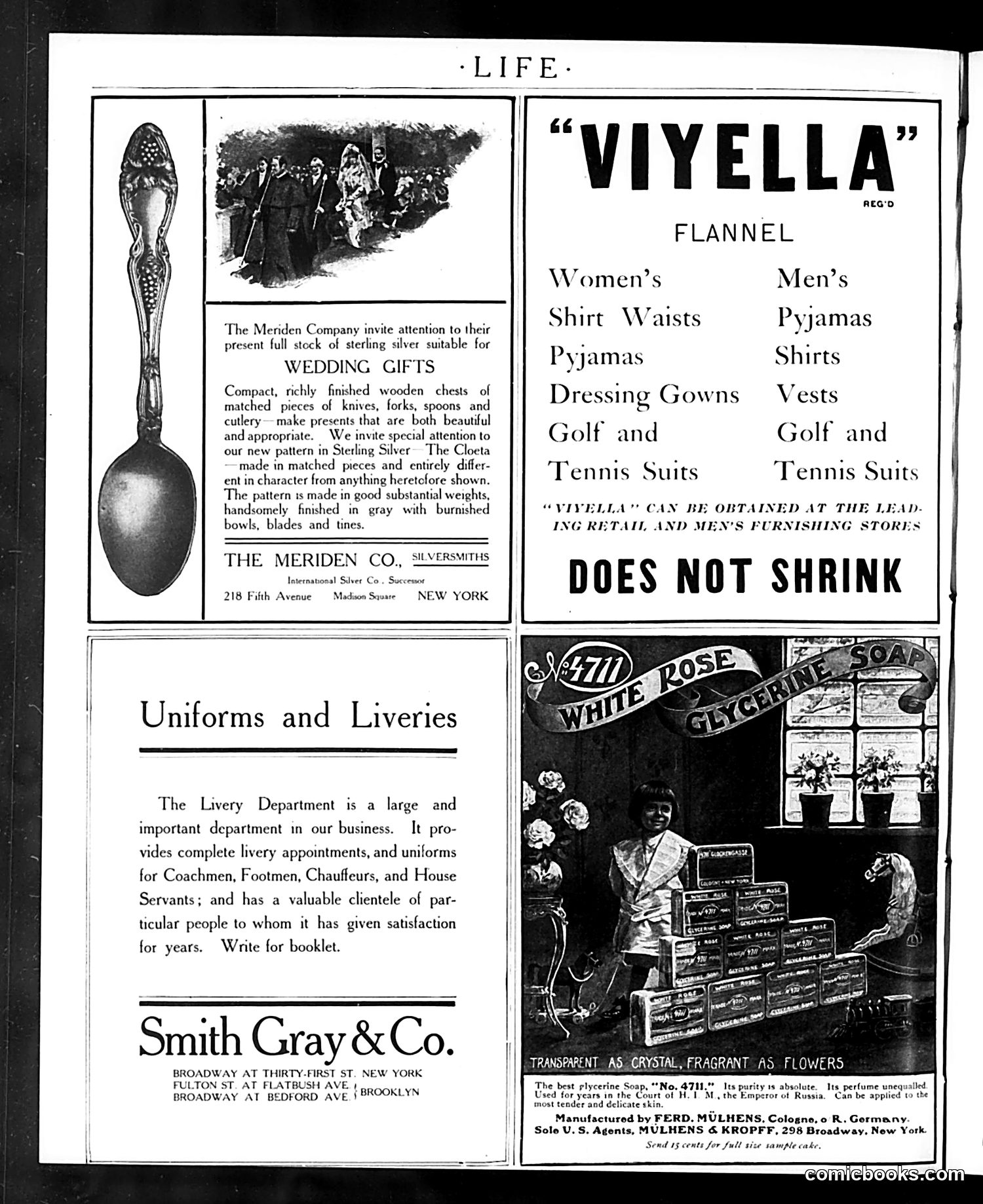
This page is **almost entirely advertising** with no political cartoon or satirical content. The ads showcase luxury goods for affluent early-20th-century consumers: - **Meriden Company** advertises sterling silver flatware sets for wedding gifts, emphasizing quality craftsmanship - **Smith Gray & Co.** promotes a "Livery Department" providing uniforms for servants (coachmen, footmen, chauffeurs, house servants)—reflecting the era's servant-keeping wealthy class - **Viyella** markets flannel clothing for both men and women - **No. 4711** glycerin soap claims imperial Russian court endorsement and ultra-purity The page reflects Edwardian-era consumer culture: formal servant hierarchies, elaborate entertaining with matched silverware, and luxury imported goods. There is no satire or political commentary visible—just straightforward product promotion targeting the wealthy.
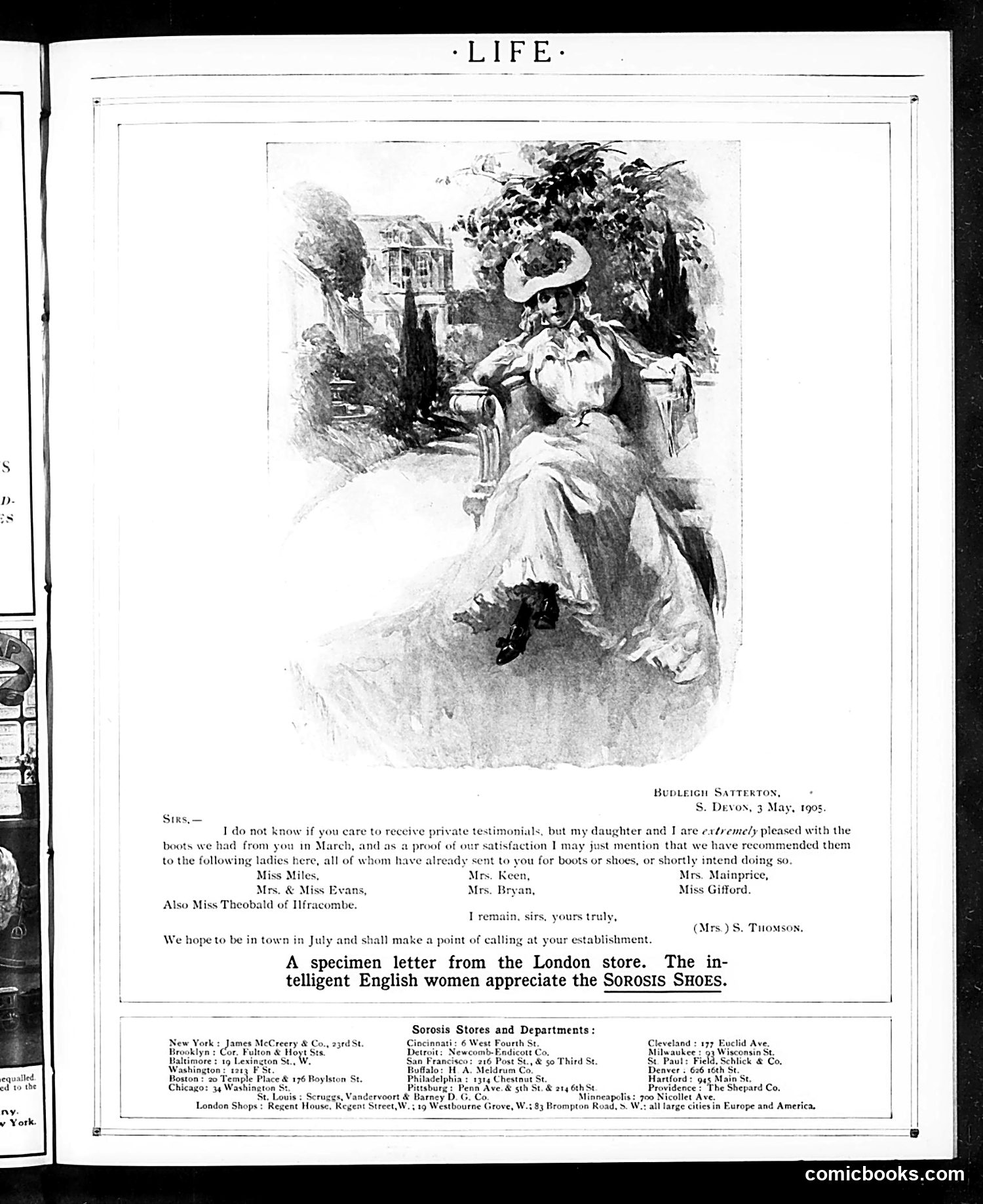
This page is primarily **advertising**, not political satire. It promotes Sorosis Shoes, a women's footwear brand. The illustration shows an elegantly dressed woman in early 1900s attire (wide-brimmed hat, flowing dress) seated in a garden setting, establishing a tone of refined femininity and leisure. The "specimen letter" below is a **testimonial advertisement**—a fake customer endorsement purporting to be from "Mrs. S. Thomson" of Budleigh Salterton, Devon, dated May 1905. She praises Sorosis boots to other women of apparent social standing (Miss Miles, Mrs. Bryan, etc.), claiming her friends have already ordered them. **The pitch to modern readers:** This exploits early-1900s consumer culture where wealthy women's word-of-mouth recommendations carried social weight. The ad targets "intelligent English women" by suggesting that respectable, affluent ladies endorse the product—a status-conscious marketing tactic. The page lists Sorosis store locations across America and Europe, emphasizing international availability to established clientele.
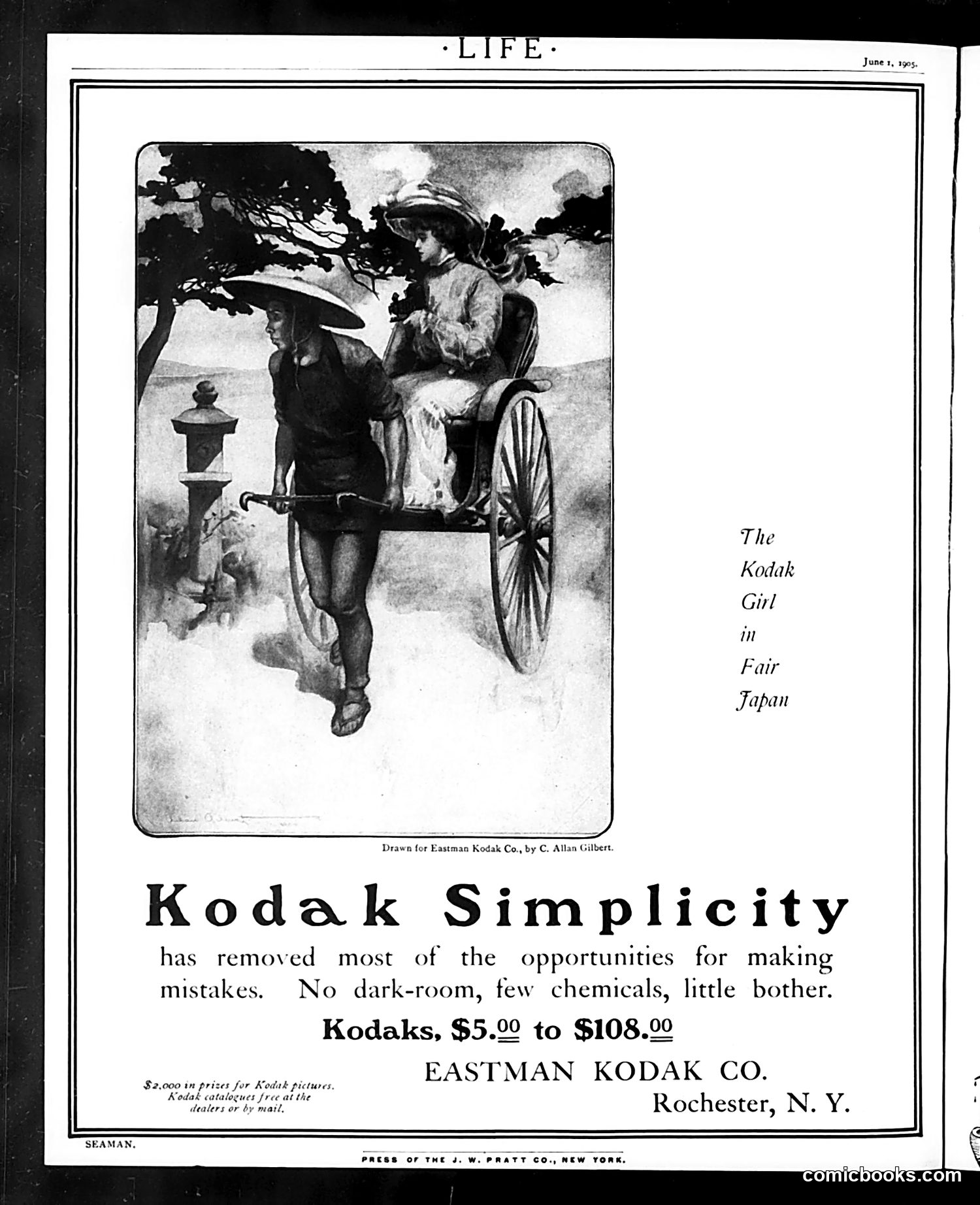
This is primarily a **Kodak camera advertisement** (not satire) from June 1, 1905, featuring an illustration titled "The Kodak Girl in Fair Japan." The drawing depicts a Western woman in a rickshaw being pulled by a Japanese man—a colonial-era image reflecting how the West then viewed Japan. The woman holds a camera, suggesting leisure tourism. The ad promotes **Kodak's "simplicity"** marketing strategy: cameras required "no dark-room, few chemicals, little bother," making photography accessible to casual users rather than technical specialists. This was genuinely revolutionary; earlier cameras were complex. The price range ($5.29–$108.22) indicates models for various budgets. The exotic "Fair Japan" setting appeals to aspirational customers imagining travel and documenting adventures. There's no political satire here—this is straightforward period advertising that reveals contemporary attitudes about Western women, empire, and consumer leisure.