
Life, 1905-06-01 · page 13 of 52
Life — June 1, 1905 — page 13: what you’re looking at
What you’re looking at
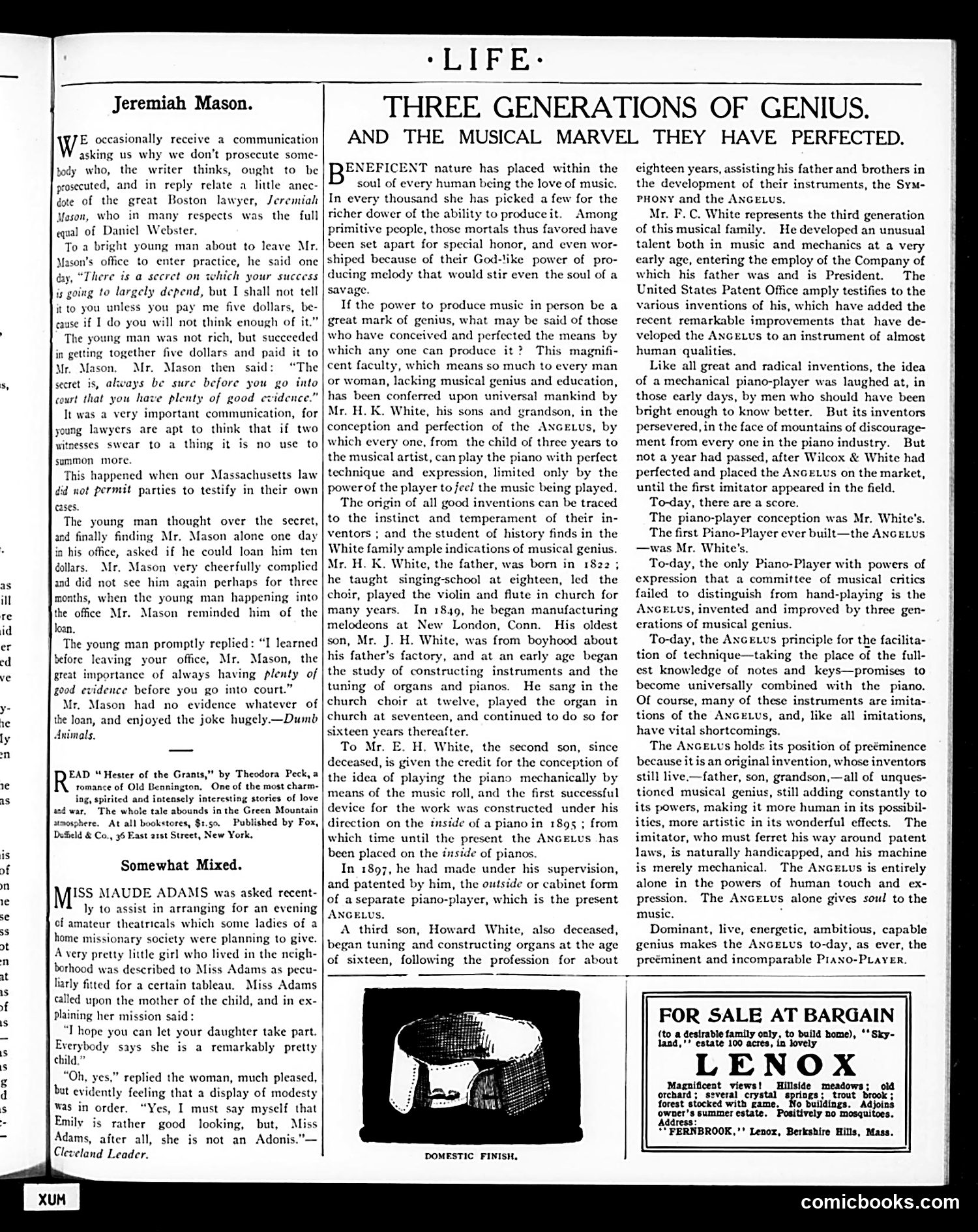
This page contains three distinct pieces: **Left column:** An anecdote about Boston lawyer Jeremiah Mason (1757-1848), illustrating a professional principle—gather sufficient evidence before proceeding. The story shows Mason teaching this lesson through a practical joke when a young lawyer, having learned the lesson, uses it to avoid documenting a loan. **Center column:** Promotional content about the White family's musical innovations. It celebrates three generations of the Whites who developed the "Angelus"—a piano-playing mechanism that allowed non-musicians to produce music. The text presents this as a democratic innovation, making musical performance accessible to ordinary people lacking training or natural genius. **Right column:** A small illustration labeled "Domestic Finish" (appears to show domestic items) and an advertisement for "Lenox" property in Massachusetts. The Angelus content reflects late-19th-century enthusiasm for mechanical innovations that democratized previously elite skills—similar to how player pianos fascinated the era. The Mason anecdote represents practical wisdom journalism common to *Life* magazine's editorial philosophy.
📄 Transcribed text from this page (OCR, searchable)
Machine-transcribed from the original scan — historical spelling and the odd misread are preserved.
ill ve ‘LIFE: Jeremiah Mason. E occasionally receive a communication asking us why we don’t prosecute some- body who, the writer thinks, ought to be prosecuted, and in reply relate a little anec- dote of the great Boston lawyer, Jeremiah Meson, who in many respects was the full equal of Daniel Webster. To a bright young man about to leave Mr. Mason’s office to enter practice, he said one day, “There is a secret on which your success is going to largely depend, but I shall not tell itto you unless you pay me five dollars, be- cause if I do you will not think enough of it. The young man was not rich, but succeeded in getting together five dollars and paid it to Mr. Mason, Mr. Mason then said: “The secret is, always be sure before you go into court that you have plenty of good evidence.” It was a very important communication, for young lawyers are apt to think that if two witnesses swear to a thing it is no use to summon more. This happened when our Massachusetts law did permit parties to testify in their own cases. The young man thought over the secret, and finally finding Mr. Mason alone one day in his office, asked if he could loan him ten dollars. Mr, Mason very cheerfully complied and did not see him again perhaps for three months, when the young man happening into the office Mr. Mason reminded him of the Joan, The young man promptly replied: “I learned before leaving your office, Mr. Mason, the great importance of always having plenty of good evidence before you go into court.” Mr. Mason had no evidence whatever of the loan, and enjoyed the joke hugely—Dumb Animals. EAD “Hester of the Grants," by Theodora Peck, a romance of Old Bennington. One of the most charm- ing, spirited and intensely interesting stories of love asd war, The whole tale abounds in the Green Mountain atnosphere. At all bookstores, $1.50. Published by Fox, Defbeld & Co., 36 East arst Street, New York, Somewhat Mixed. ISS MAUDE ADAMS was asked recent- ly to assist in arranging for an evening ef amateur theatricals which some ladies of a home missionary society were planning to give. A very pretty little girl who lived in the neigh- borhood was described to Miss Adams as pecu- harly fitted for a certain tableau. Miss Adams called upon the mother of the child, and in ex- plaining her mission said: “T hope you can let your daughter take part. Everybody says she is a remarkably pretty child.” “Oh, yes,” replied the woman, much pleased, bat evidently feeling that a display of modesty was in order. “Yes, I must say myself that Emily is rather good looking, but, Miss Adams, after all, she is not an Adonis. Cleveland Leader. THREE GENERATIONS OF GENIUS. AND THE MUSICAL MARVEL THEY HAVE PERFECTED. NEFICENT nature has placed within the soul of every human being the love of music. In every thousand she has picked a few for the richer dower of the ability to produce it. Among primitive people, those mortals thus favored have been set apart for special honor, and even wor- shiped because of their God-like power of pro- ducing melody that would stir even the soul of a savage. If the power to produce music in person be a | great mark of genius, what may be said of those | who have conceived and perfected the means by which any one can produce it? This magnifi- cent faculty, which means so much to every man or woman, lacking musical genius and education, has been conferred upon universal mankind by Mr. H. K. White, his sons and grandson, in the conception and perfection of the Anc which every one, from the child of three y the musical artist, can play the piano with perfect technique and expression, limited only by the powerof the player to jecl the music being played. The origin of all good inventions can be traced to the instinct and temperament of their in- ventors ; and the student of history finds in the White family ample indications of musical genius. Mr. H. K. White, the father, was born in 1822 ; he taught singing-school at eighteen, led the choir, played the violin and flute in church for many years. In 1849, he began manufacturing melodecons at New London, Conn. His oldest son, Mr. J. H. White, was from boyhood about his father's factory, and at an early age began the study of constructing instruments and the tuning of organs and pianos. He sang in the church choir at twelve, played the organ in church at seventeen, and continued to do so for sixteen years thereafter. To Mr. H. White, the second son, since deceased, is given the credit for the conception of the idea of playing the piano mechanically by means of the music roll, and the first successful device for the work was constructed under his direction on the tnside of a pianoin 1895 ; from which time until the present the ANGELUS has been placed on the inside of pianos. In 1897, he had made under his supervision, and patented by him, the outside or cabinet form of aseparate piano-player, which is the present ANGELUS. A third son, Howard White, also deceased, began tuning and constructing organs at the age of sixteen, following the profession for about eighteen years, assisting his father and brothers in the development of their instruments, the Sym- PHONY and the ANGELUs. Mr. F. C. White represents the third generation of this musical family. He developed an unusual talent both in music and mechanics at a very early age, entering the employ of the Company of which his father was and is President. The United States Patent Office amply testifies to the various inventions of his, which have added the recent remarkable improvements that have de- veloped the ANGELUs to an instrument of almost. human qualities. Like all great and radical inventions, the idea of a mechanical piano-player was laughed at, in those carly days, by men who should have been bright enough to know better. But its inventors persevered, in the face of mountains of discourage- ment from every one in the piano industry. But not a year had passed, after Wilcox & White had perfected and placed the ANGELUs on the market, until the first imitator appeared in the field. To-day, there are a score. The piano-player conception was Mr. White's. The first Piano-Player ever built—the ANGELUS —was Mr. White's. To-day, the only Piano-Player with powers of expression that a committee of musical critics failed to distinguish from hand-playing is the ANGELUS, invented and improved by three gen- erations of musical genius. To-day, the AnGEtvs principle for the facilita- tion of technique—taking the place of the full- est knowledge of notes and keys—promises to become universally combined with the piano. Of course, many of these instruments are imita- tions of the Ancetus, and, like all imitations, have vital shortcomings. The AnGEtUvs holds its position of preéminence because it is an original invention, whose inventors still live—father, son, grandson,—all of unques- tioned musical genius, still adding constantly to its powers, making it more human in its possibil- ities, more artistic in its wonderful effects. The imitator, who must ferret his way around patent is naturally handicapped, and his machine is merely mechanical. The ANGELUS is entirely alone in the powers of human touch and ex- pression. The ANGeLus alone gives soul to the music. . Dominant, live, energetic, ambitious, capable genius makes the ANGELUS to-day, as ever, the preéminent and incomparable P1ano-PLayvER. DOMESTIC FINISH, FOR SALE AT BARGAIN (to a Cee enty ty So vene anne) “*Sky- land,'? estate 100 acres, LENOX Magnificent views! orchard ; forest stocked with game. ‘rook s Adjoins ornetss ummer estate, Positively no mosquitoes. *SEERNBROOK,”* Lenox, Berkshire Hills, Mass. comicbooks.com