
Life, 1905-06-01 · page 28 of 52
Life — June 1, 1905 — page 28: what you’re looking at
What you’re looking at
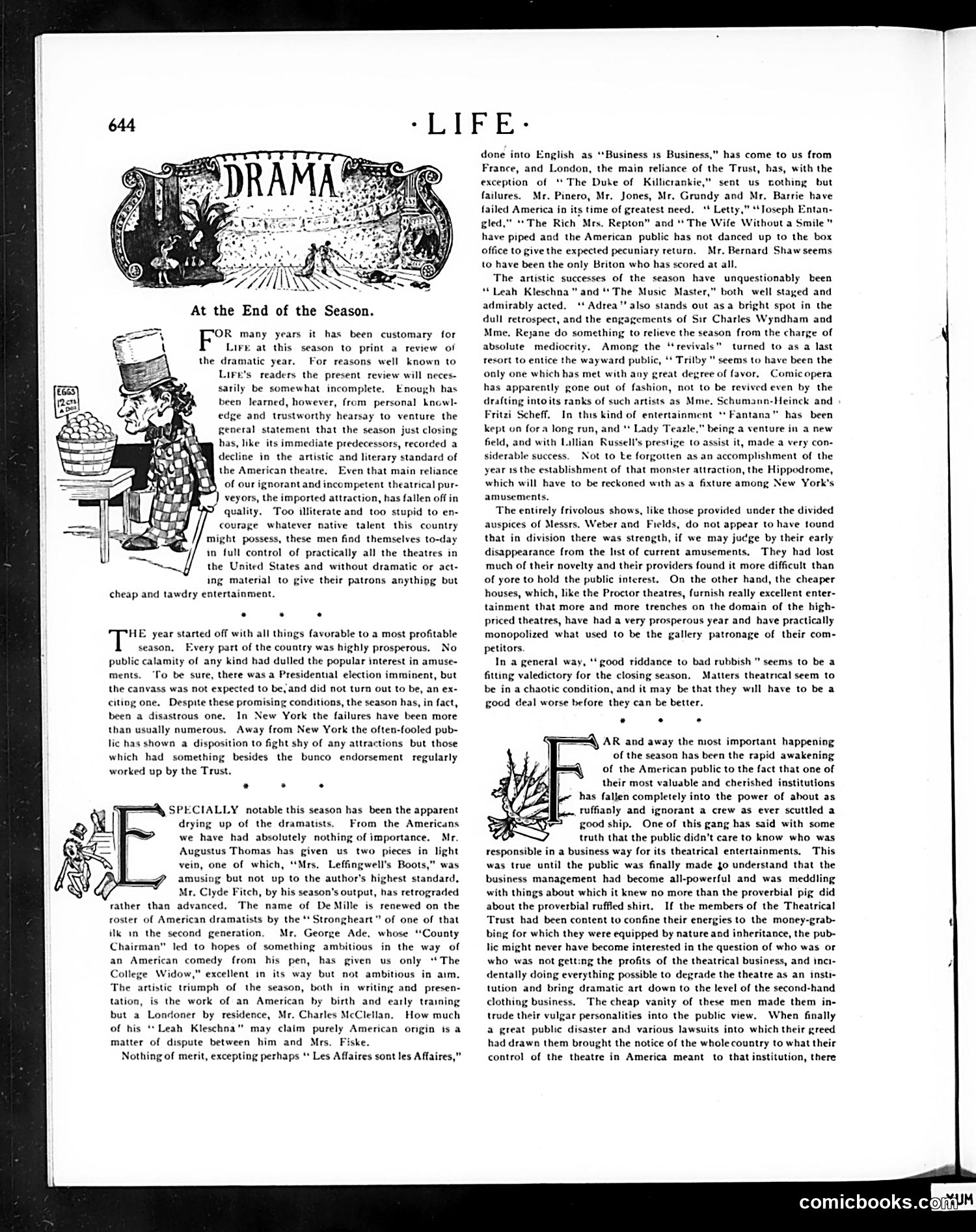
This is a theater season review from Life magazine (likely early 1900s, based on dramatists mentioned). The cartoon shows a character reading a stack of theatrical materials—representing the magazine's task of evaluating the year's plays. The article criticizes American theater's decline, blaming theatrical managers ("the Trust") who control most U.S. theaters and lack taste. It attacks them for importing cheap foreign attractions rather than developing native talent, calling them "illiterate and too stupid." The text reviews specific American playwrights (Augustus Thomas, Clyde Fitch, George Ade) as disappointing, praises Charles McClellan's "Leah Kleschna" as the season's artistic triumph, and notes that major British dramatists (Pinero, Jones, Barrie) failed to impress American audiences. Only George Bernard Shaw scored a success. The overall verdict: the theatrical season was disastrous despite national prosperity.
📄 Transcribed text from this page (OCR, searchable)
Machine-transcribed from the original scan — historical spelling and the odd misread are preserved.
“LIFE At the End of the Season. ‘OR many years it has been customary for Lire at this season to print a review of the dramatic year. For reasons well known to Lire's readers the present review will neces- sarily be somewhat incomplete, Enough has been learned, however, from personal knowl- edge and trustworthy hearsay to venture the general statement that the season just closing has, like its immediate predecessors, recorded a decline in the artistic and literary standard of the American theatre, Even that main reliance of our ignorant and incompetent theatrical pur- ) veyors, the imported attraction, has fallen off in quality. Too illiterate and too stupid to en- courage whatever native talent this country might possess, these men find themselves to-day tn full control of practically all the theatres in the United States and without dramatic or act- ing material to give their patrons anything but cheap and tawdry entertainment. HE. year started off with all things favorable to a most profitable season, Every part of the country was highly prosperous. No public calamity of any kind had dulled the popular interest in amuse- ments. ‘To be sure, there was a Presidential election imminent, but the canvass was not expected to be, and did not turn out to be, an ex- citing one. Despite these promising conditions, the season has, in fact, been a disastrous one. In New York the failures have been more than usually numerous. Away from New York the often-fooled pub- lic has shown a disposition to fight shy of any attractions but those which had something besides the bunco endorsement regularly worked up by the Trust. SPECIALLY notable this season has been the apparent drying up of the dramatists. From the Americans we have had absolutely nothing of importance. Mr. Augustus Thomas has given us two pieces in light vein, one of which, ‘Mrs, Leffingwell’s Boots,” was amusing but not up to the author's highest standard. Mr. Clyde Fitch, by his season's output, has retrograded rather than advanced, The name of De Mille is renewed on the roster of American dramatists by the“ Strongheart” of one of that ilk in the second generation. Mr, George Ade, whose “County Chairman" led to hopes of something ambitious in the way of an American comedy from his pen, has given us only “The College Widow,” excellent in its way but not ambitious in aim. ‘The artistic triumph of the season, both in writing and presen- tation, is the work of an American by birth and early training but a Londoner by residence, Mr. Charles McClellan. How much of his ‘Leah Kleschna” may claim purely American ongin is a matter of dispute between him and Mrs. Fiske. Nothing of merit, excepting perhaps * Les Affaires sont les Affaires,” done into English as “Business 1s Business,” has come to us from France, and London, the main reliance of the Trust, has, with the exception of ‘ The Duke of Killicrankie,” sent us nothing but failures. Mr. Pinero, Mr. Jones, Mr. Grundy and Mr. Barrie have failed America in its time of greatest need.‘ Letty,” “Toseph Entan- gled," The Rich Mrs. Repton” and “The Wife Without a Smile" have piped and the American public has not danced up to the box office to give the expected pecuniary return. Mr. Bernard Shaw seems to have been the only Briton who has scored at all. The artistic successes of the season have unquestionably been “Leah Kleschna "and “The Music Master,” both well staged and admirably acted, ‘* Adrea'’ also stands out asa bright spot in the dull retrospect, and the engagements of Sir Charles Wyndham and Mme, Rejane do something to relieve the season from the charge of absolute mediocrity. Among the “revivals” turned to as a last resort to entice the wayward public, ‘* Trilby " seems to have been the only one which has met with any great degree of favor, Comic opera has apparently gone out of fashion, not to be revived even by the drafting intoits ranks of such artists as Mme, Schumann-Heinck and Fritzi Scheff, In this kind of entertainment *Fantana” has been kept on fora long run, and Lady Teazle,” being a venture in a new field, and with Lillian Russell's prestige to assist it, made a very con- siderable success. Not to te forgotten as an accomplishment of the year 1s the establishment of that monster attraction, the Hippodrome, which will have to be reckoned with asa fixture among New York's amusements, The entirely frivolous shows, like those provided under the divided auspices of Messrs. Weber and Fields, do not appear to have tound that in division there was strength, if we may judge by their early disappearance from the list of current amusements, They had lost much of their novelty and their providers found it more difficult than of yore to hold the public interest. On the other hand, the cheaper houses, which, like the Proctor theatres, furnish really excellent enter- tainment that more and more trenches on the domain of the high- priced theatres, have had a very prosperous year and have practically monopolized what used to be the gallery patronage of their com- petitors. In a general way, *‘ good riddance to bad rubbish” seems to be a fitting valedictory for the closing season, Matters theatrical seem to be in a chaotic condition, and it may be that they will have to be a good deal worse before they can be better. . . . AR and away the most important happening of the season has been the rapid awakening of the American public to the fact that one of their most valuable and cherished institutions has fallen completely into the power of about as ruffianly and ignorant a crew as ever scuttled a good ship. One of this gang has said with some truth that the public didn’t care to know who was responsible in a business way for its theatrical entertainments. This was true until the public was finally made jo understand that the business management had become all-powerful and was meddling with things about which it knew no more than the proverbial pig did about the proverbial ruffied shirt. If the members of the Theatrical Trust bad been content to confine their energies to the money-grab- bing for which they were equipped by nature and inheritance, the pub- lic might never have become interested in the question of who was or who was not gett:ng the profits of the theatrical business, and inci- dentally doing everything possible to degrade the theatre as an insti- tution and bring dramatic art down to the level of the second-hand clothing business. The cheap vanity of these men made them in- trude their vulgar personalities into the public view. When finally a great public disaster and various lawsuits into which their greed had drawn them brought the notice of the whole country to what their control of the theatre in America meant to that institution, there comicbooks.comuda