
Life, 1905-06-01 · page 34 of 52
Life — June 1, 1905 — page 34: what you’re looking at
What you’re looking at
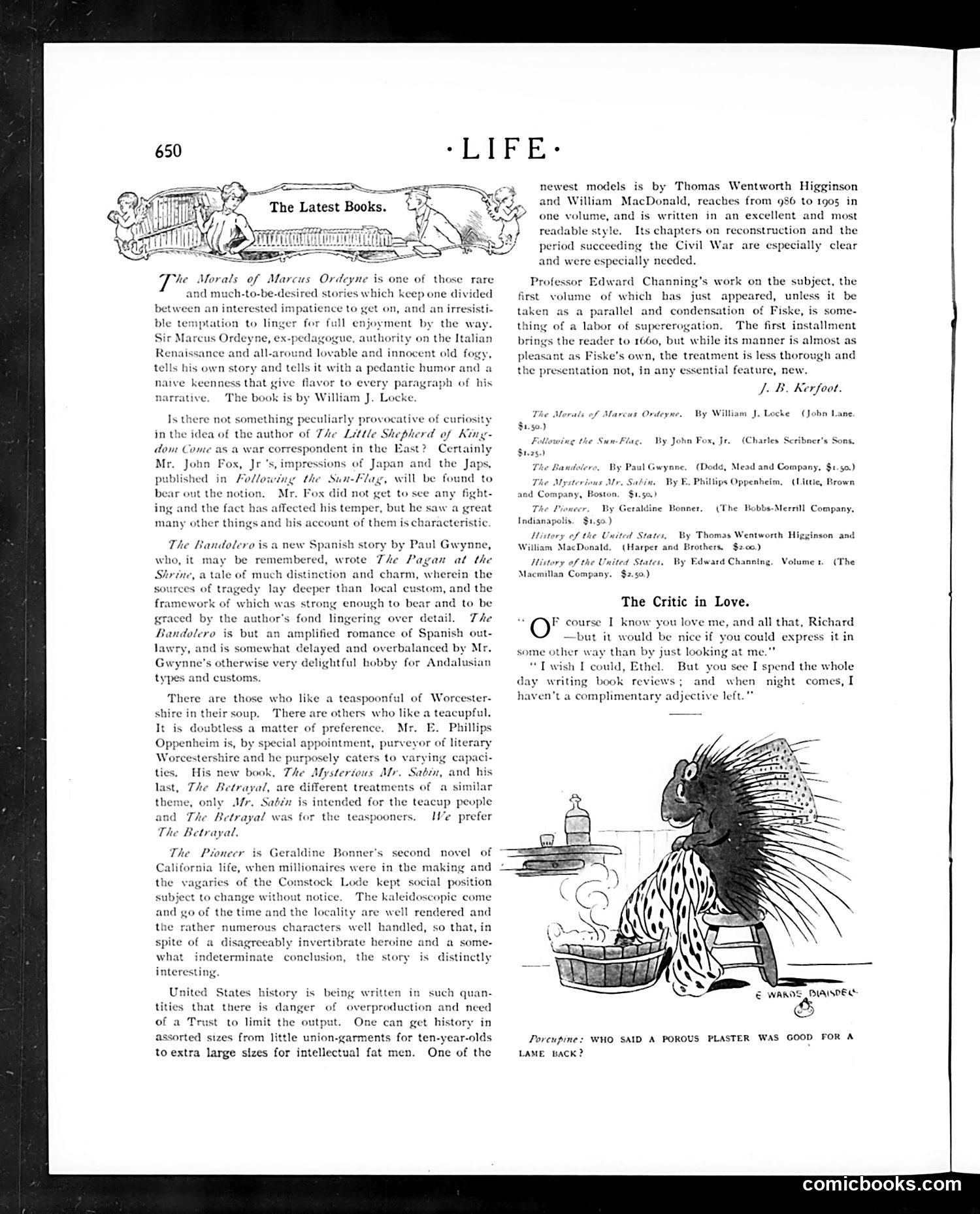
This page's main cartoon depicts a porcupine sitting at a desk with a typewriter and lamp, presumably a book critic. The creature appears irritable and defensive—its quills fully extended. The caption reads: "WHO SAID A POROUS PLASTER WAS GOOD FOR A LAME BACK?" **The satire:** The cartoon mocks literary critics as irritable, defensive figures. The "porous plaster" reference suggests that criticism is presented as a remedy or treatment—but the porcupine's aggressive posture implies critics are actually harmful or painful to authors. The joke plays on the critic's prickly nature: instead of soothing an author's "lame back" (wounded pride from bad reviews), the critic wounds them further with sharp barbs, much like a porcupine's quills. It's gentle satire on the combative relationship between critics and writers in the literary world.
📄 Transcribed text from this page (OCR, searchable)
Machine-transcribed from the original scan — historical spelling and the odd misread are preserved.
—— a The Latest Books. 1 much-to-be-desired sto: es which keep one divided an interested impatience to get on, and an irresisti Sir Marcus Ordeyne, ex-pedagogue, authority on the Italian Renais 1 all-around lovable and innocent old fogy, tells his own story and tells it with a pedantic humor and naive keenness that give flavor to every para The book is by William J. Locke. nee an oh of his narrative, Is there not something peculiarly provocative of curiosity in the idea of the author of The Little Shepherd of King- dom Come as a war correspondent in the East? Certainly Mr. Jobn Fox, Jr’s,impr Japan and the J published in Following the Sun-Flag, will be fe bear out the notion. Mr. Fox did not get to see any fight- ing and the fact has affected his temper, but he saw a great many other things ar ssions ¢ d to unt of them is charac ris a pristic. The Bandolero is a new Spanish story by Paul Gw ‘nne, who, it may be remembered, wrote The Pagan at the Shrine, atale of much distinction and charm, wherein the sources of tragedy lay deeper than local custom, and the framework of which was strong enough to bear and to be The amplified romance of Spanish out- graced by the author's fond lingering over detail. Bandolero is but lawry, Gwynne's otherwise very delightful hobby for Andalu: types and customs. nd is somewhat delayed and overbalanced by Mr. n 1 of Worcester- There are others who like a teacupful. matter of preference. M Phillips Oppenheim is, by special appointment, purveyor of literary Worcestershire and he purposely His new book, The Mysterious Mr. Sabin, and his last, The Betrayal, are different treatmer theme, only Mr, Saéén is intended for the teacup people and The Betrayal was for the teaspooners. MWe prefer The Betrayal. There are those who like a teaspoonf shire in their soup. It is doubtless « caters to varying capaci- ties, The Pioneer is Geraldine Bonner’s second novel of California life, when millionaires were in the making and the vagaries of the Comstock Lode kept social position subject to change without notice The kaleidoscopic come and go of the time d the locality are well rendered and the rather numerous cl rs well handled, so that, in spite of a disagreeably invertibrate heroine and a some- what indeterminate the story is distinctly interesting. conclu: United States history is being written in. such quan- tities that there is danger of overproduction and need of a Trust to limit the output. One can get history in assorted sizes from little union-garments for ten-year-olds to extra large sizes for intellectual fat men. One of the *“LIPE- newest models is by Thomas Wentworth Higginson and William MacDonald, reaches from 986 to 1905 in one volume, and is written in an excellent and most readable style. Its chapters on reconstruction and the period succeeding the Civil War are especially clear and were especially needed. Professor Edward Channing's work on the subject, the first. volume of which has just appeared, unless it be tak allel and condensation of Fiske, is some- thing of a labor of supererc ‘on. The first insta brings the reader to 1660, but while its manner is almost as pleasant as Fiske’s own, the treatment is less thorough and the presentation not, in any essential feature, new. /. B. Kerfoot. as a pa’ Iment / Marcus Ordeyne, By William J, Locke (obo Lane ¢ Sum Fl (Charles Scribner's Sons, The Baniolero, By Pa Company, Bost Indi History of the United States, By Thomas Wentworth Higy William MacDonald. (Harper and Brothers. $2.00.) Mi Macmillan Gwynne. (Dodé, Mead and Company, $1.50.) (Lite, Sahin, By E. Phillips Oppenheim, a. $4 Ry Geraldine Bonner. (The Bobbs-Merrill Company, polis. $1.50.) nson and, Inited States, Volume r. (T $2.50.) By Edward Channing The Critic in Love. O ? course I know you love me, and all that, Richard —but it would be nice if you could express it in some other way than by just looking at me." But you see I spend the whole nd when night comes, I “Twish I could, Ethel. day writing book reviews haven't a complimentary adjective left E WARDS, PIAINDEC Porcupine: WHO SAID A POROUS PLASTER WAS GOOD FOR A LAME BACK? comicbooks.com