
A complete issue · 21 pages · 1904
Life — December 29, 1904
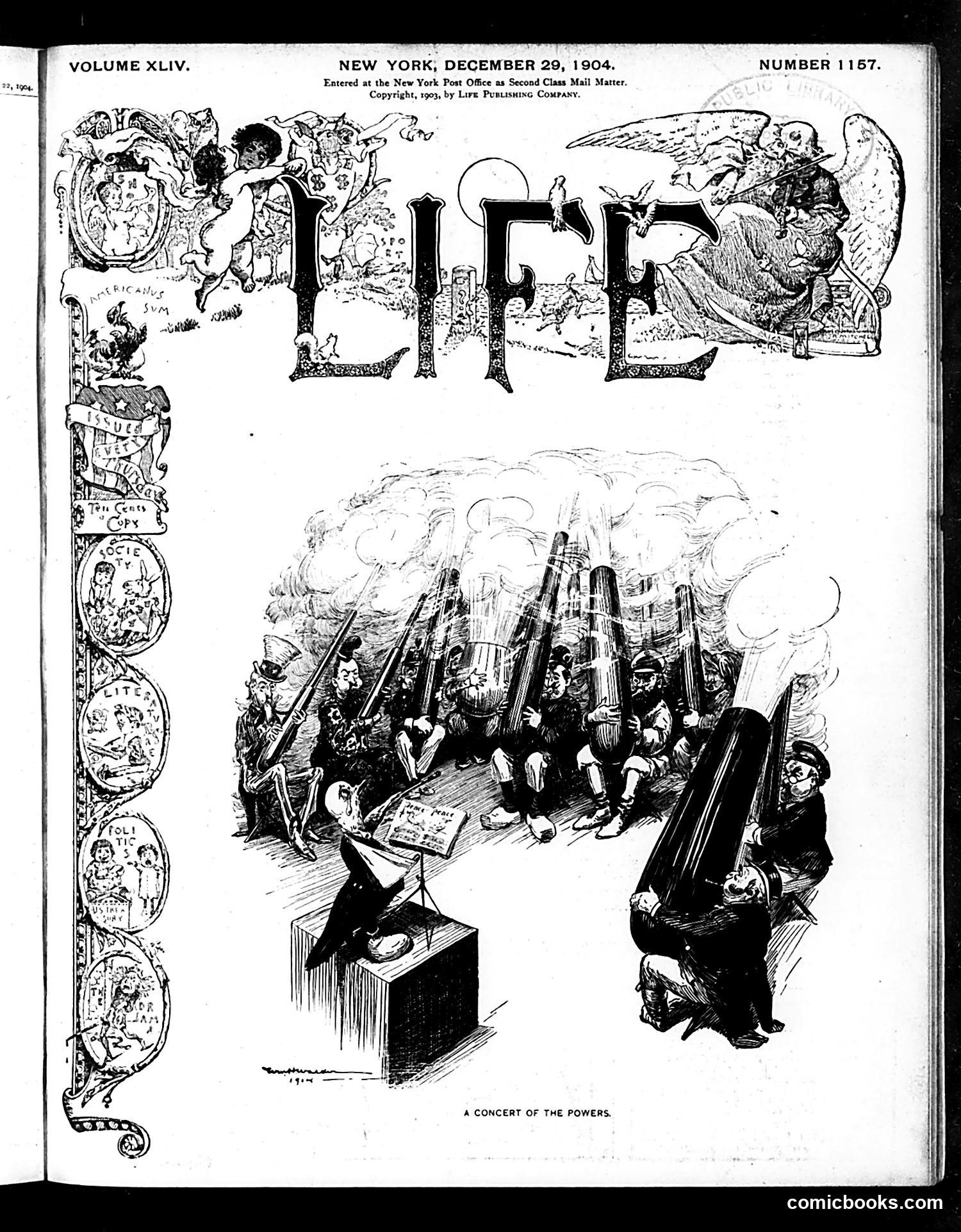
This political cartoon satirizes major world powers conducting diplomacy like an orchestra. The uniformed military figures represent European and American nations, depicted as musicians playing large cannons instead of instruments. The conductor (lower left) directs this "concert," suggesting great powers coordinate their military might under central direction. The timing—during the Russo-Japanese War (1904-1905)—makes the satire pointed: while nations publicly claimed neutrality or peaceful intent, they were actually maneuvering militarily and diplomatically. The joke equates diplomatic "harmony" with a coordinated display of military power, mocking the pretense of civilized international relations while nations armed themselves for potential conflict.
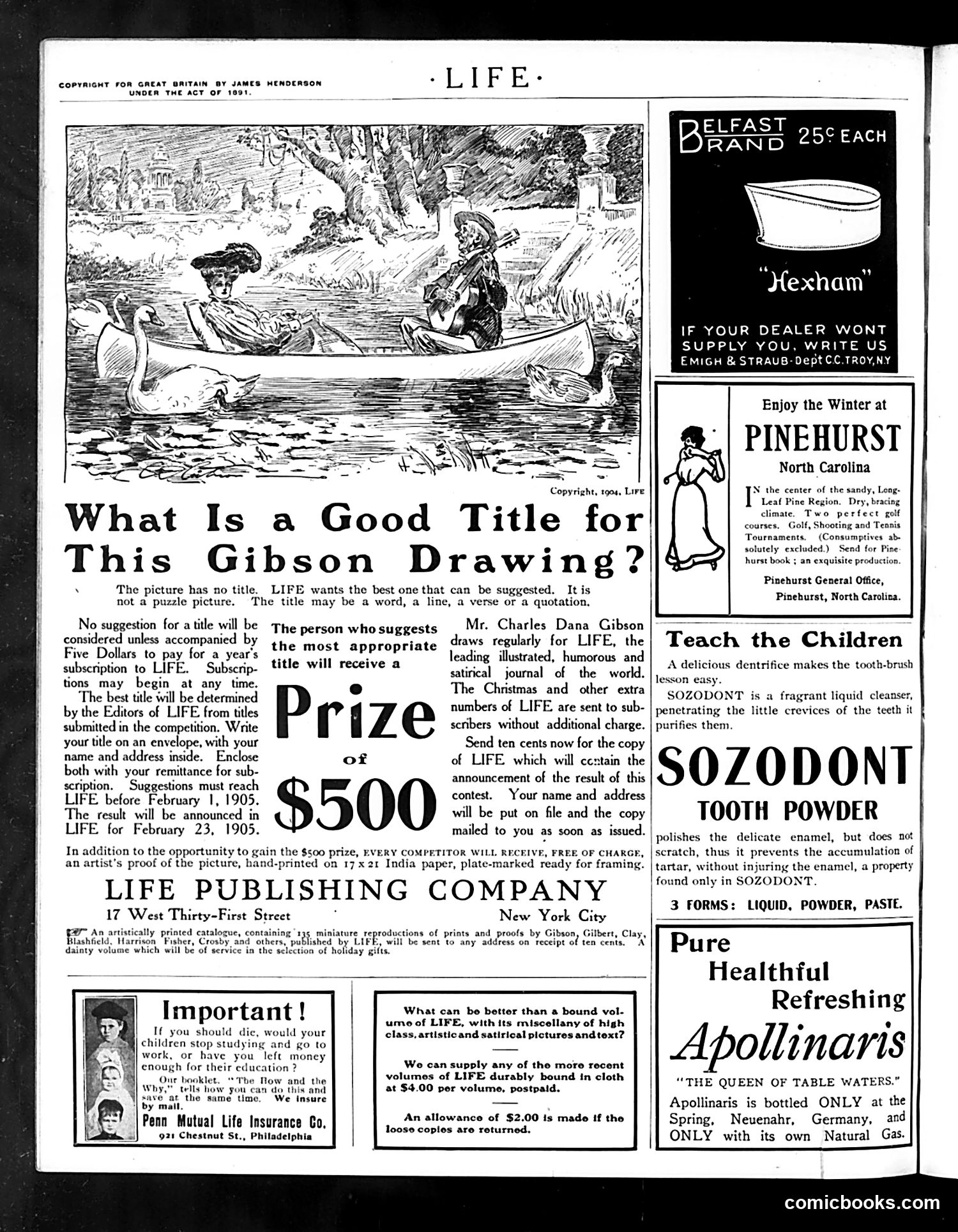
This page is primarily **advertising and a contest announcement** rather than political satire. The main feature is a Gibson Drawing—a work by the famous illustrator Charles Dana Gibson—showing two figures in a boat with swans. LIFE magazine is running a $500 prize contest asking readers to suggest the best title for this untitled illustration. The Gibson drawing itself appears to depict a romantic or comedic scene with two well-dressed figures, but without the original caption, its specific satirical meaning is unclear. Gibson was known for social satire about American manners and upper-class life, but the image alone doesn't reveal the intended joke or social commentary. The remaining page content consists of period advertisements for products like Sozodont toothpowder and Pinehurst resort.
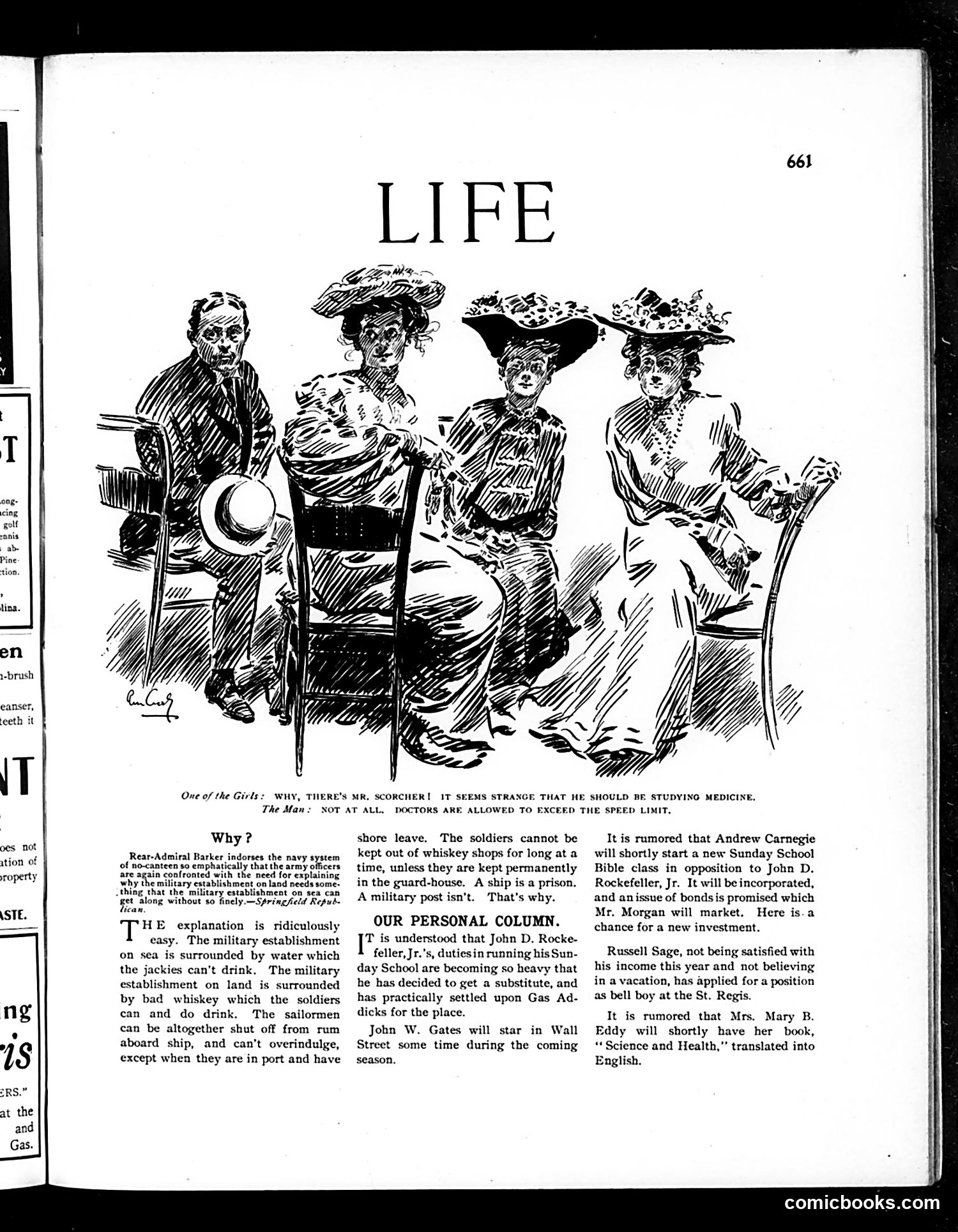
This page contains a satirical cartoon and social commentary from early 20th-century Life magazine. **The Main Cartoon:** Shows five fashionably dressed people (four women and one man) in conversation. The caption jokes that a man studying medicine seems strange—"Doctors are allowed to exceed the speed limit," implying doctors drive recklessly with impunity. **"Why?" Section:** Discusses military establishments near whiskey shops, suggesting soldiers get drunk. The satire critiques how the navy system allows this behavior. **"Our Personal Column":** Brief gossip items about prominent figures including Andrew Carnegie, John D. Rockefeller Jr., Russell Sage, and Mary B. Eddy—likely mocking high-society news and wealthy individuals' activities. The overall tone is irreverent social satire targeting both institutions and the wealthy elite.
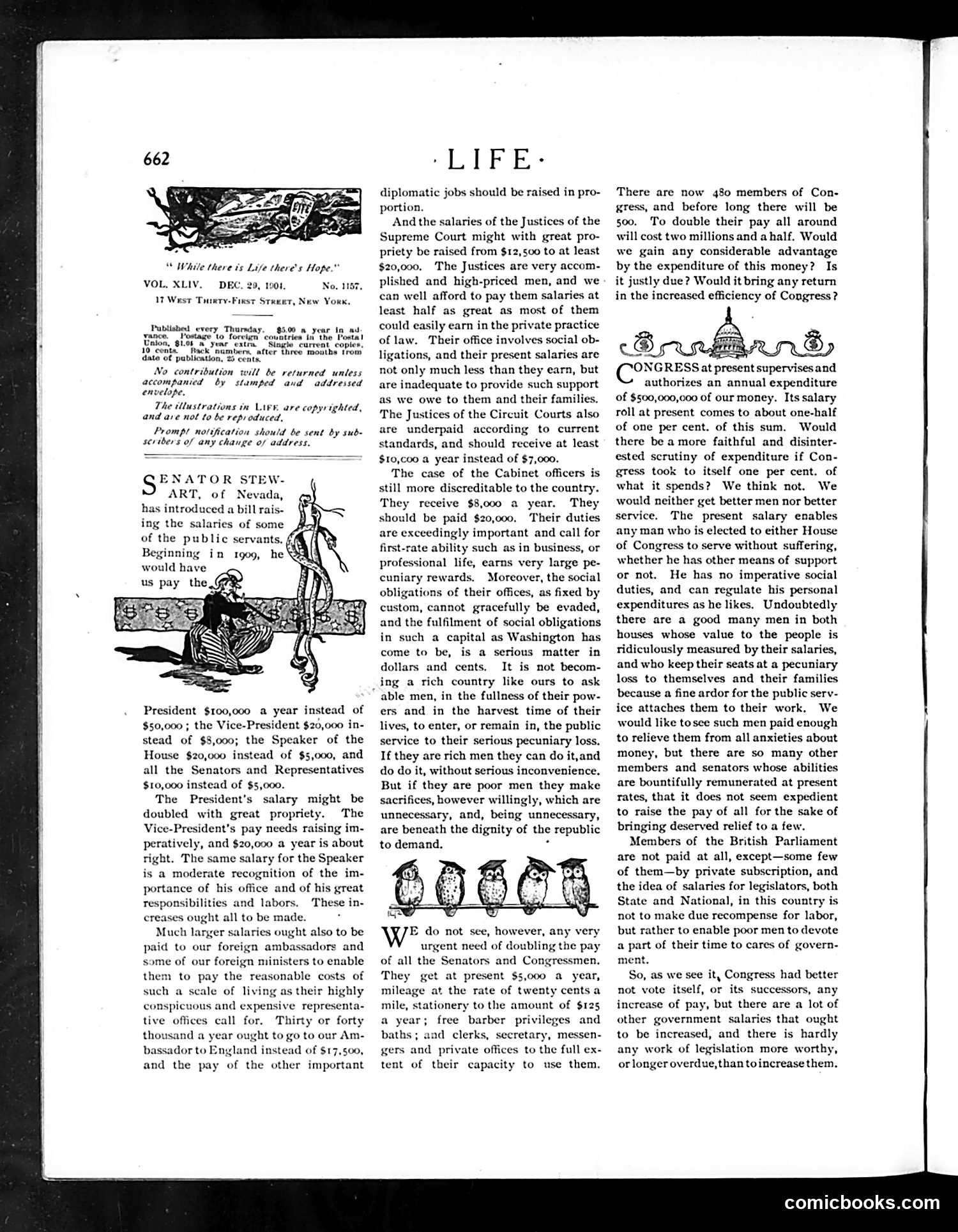
This page discusses government salary reform, primarily through text rather than traditional political cartoons. The decorative illustrations (a caduceus/Mercury's staff and owl symbols) are generic ornamental elements, not specific political satire. The content critiques Senator Stewart of Nevada's proposal to raise federal salaries. The author argues against doubling Congressional pay but supports raising Justice and Cabinet salaries to attract competent officials. The piece suggests that poor government servants make "unnecessary sacrifices" and that Washington positions demand significant living expenses. The satire is subtle—the author uses irony to defend selective raises while mocking the idea that poorly-paid politicians serve the public interest. The real target appears to be inconsistent salary policies that undervalue some positions while potentially overpaying others.
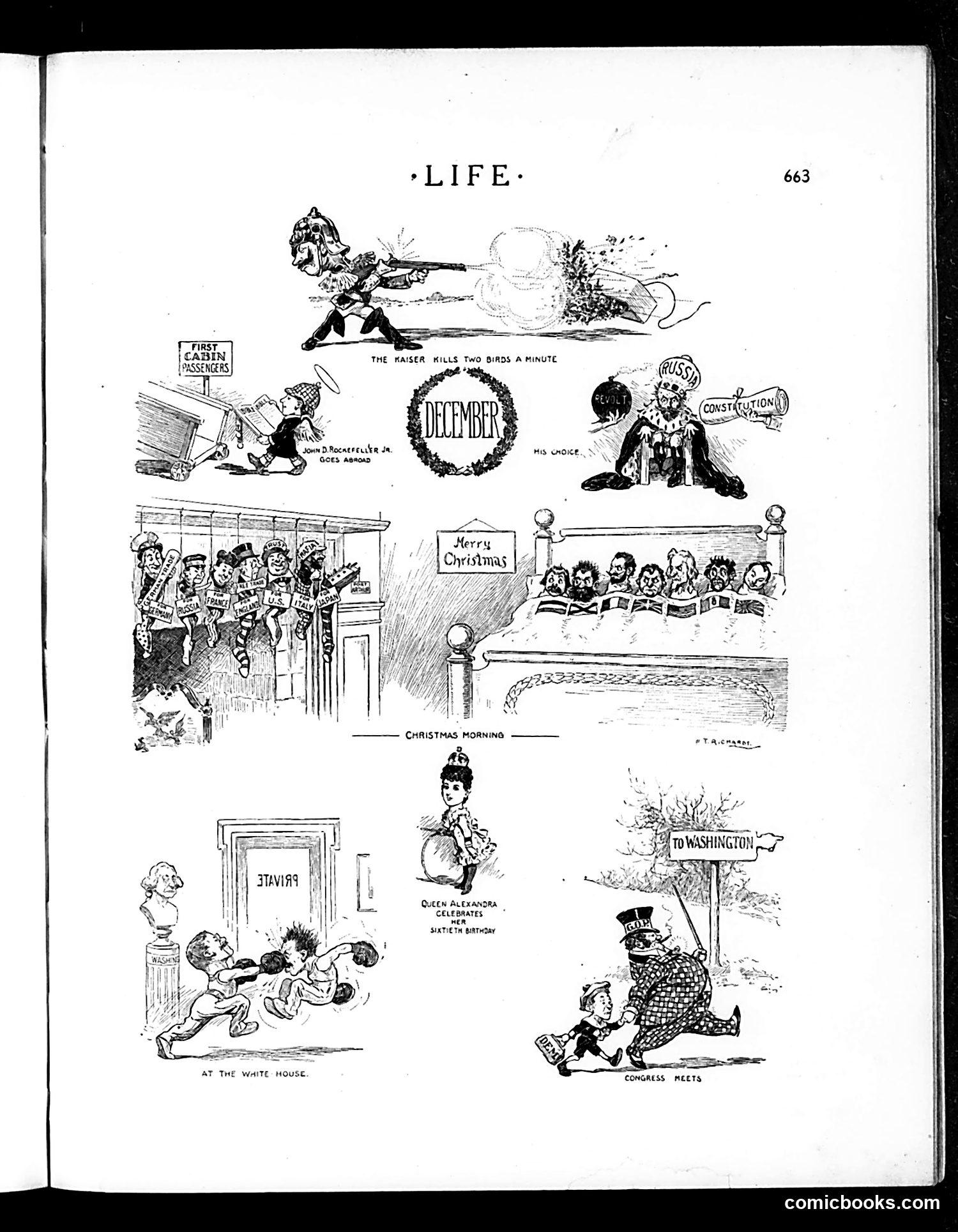
This December 1912 satirical page features political and social cartoons commenting on current events: **"The Kaiser Kills Two Birds a Minute"** depicts German militarism through exaggerated violence imagery. **"His Choice"** shows a figure (likely Tsar Nicholas II or Russian leadership) choosing between "Constitution" and "Autocracy"—referencing Russia's political turmoil post-1905 Revolution. **"Christmas Morning"** humorously portrays children discovering gifts, with "First Passengers" reference (possibly related to transportation). **"At the White House"** appears to satirize Taft administration activities. **"Congress Meets"** depicts Uncle Sam with a child, likely criticizing Congressional dysfunction or partisan gridlock. **"Queen Alexandra Celebrates Her Sixtieth Birthday"** references the British queen consort's milestone. The cartoons collectively mock international politics, Russian autocracy, American government inefficiency, and militarism—typical Life magazine satire of the Progressive Era.
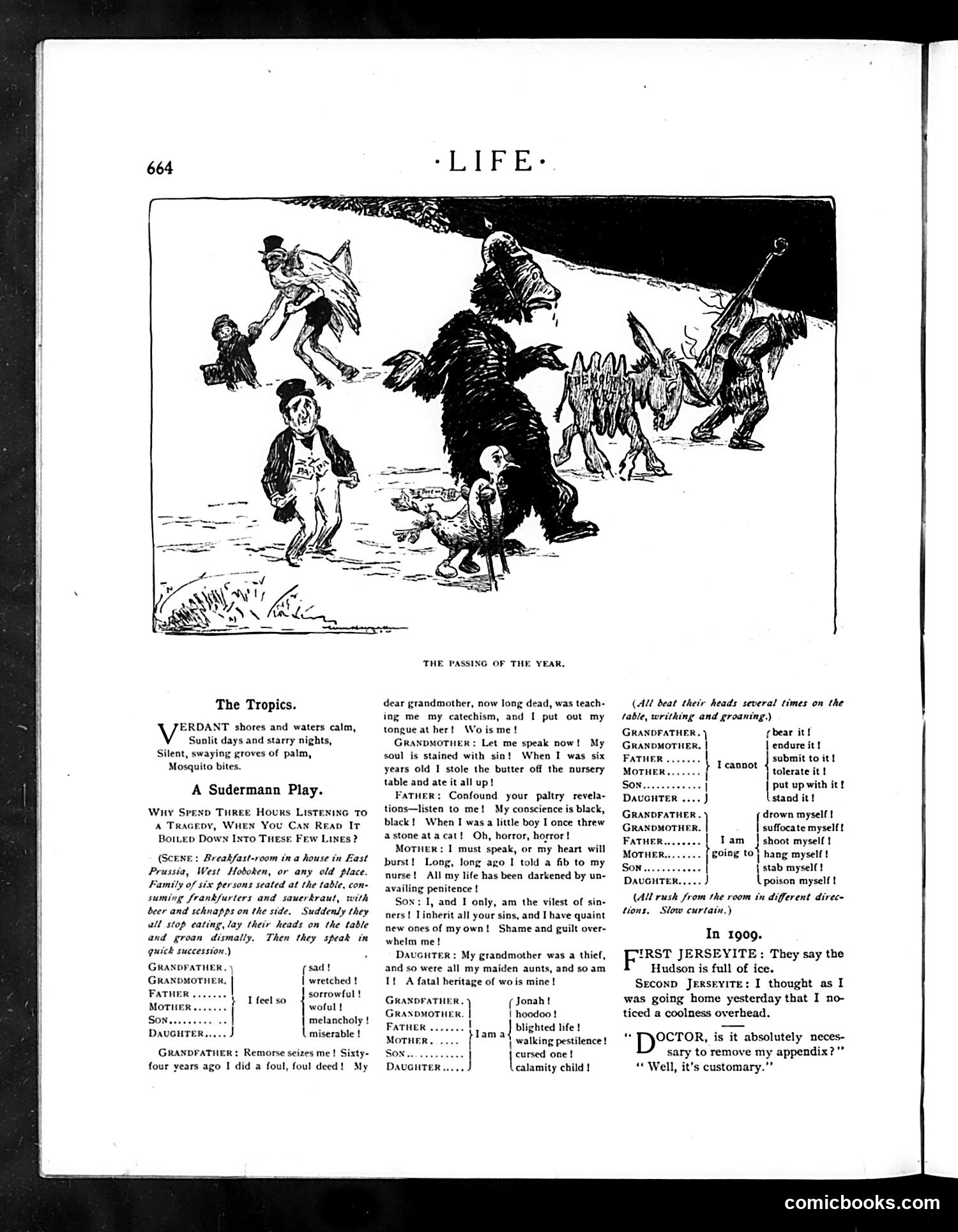
**"The Passing of the Year"** is a satirical illustration depicting Death as a skeletal figure shepherding away various allegorical characters representing the old year—including figures labeled Grandfather, Grandmother, Father, Mother, Son, and Daughter. The central skeleton conducts this family toward darkness, symbolizing the year's end. The accompanying text features dramatic monologues from these characters confessing sins and regrets—theft, shame, guilt, unwailing penitence—suggesting moral reckoning as the year closes. Below are two brief comedic sketches: "A Sudermann Play" mocks elaborate theatrical drama, while "In 1909" presents two Jersey residents debating whether removing an appendix requires medical necessity or is merely "customary." The page satirizes both mortality's inevitability and contemporary medical practices through humor and allegory.
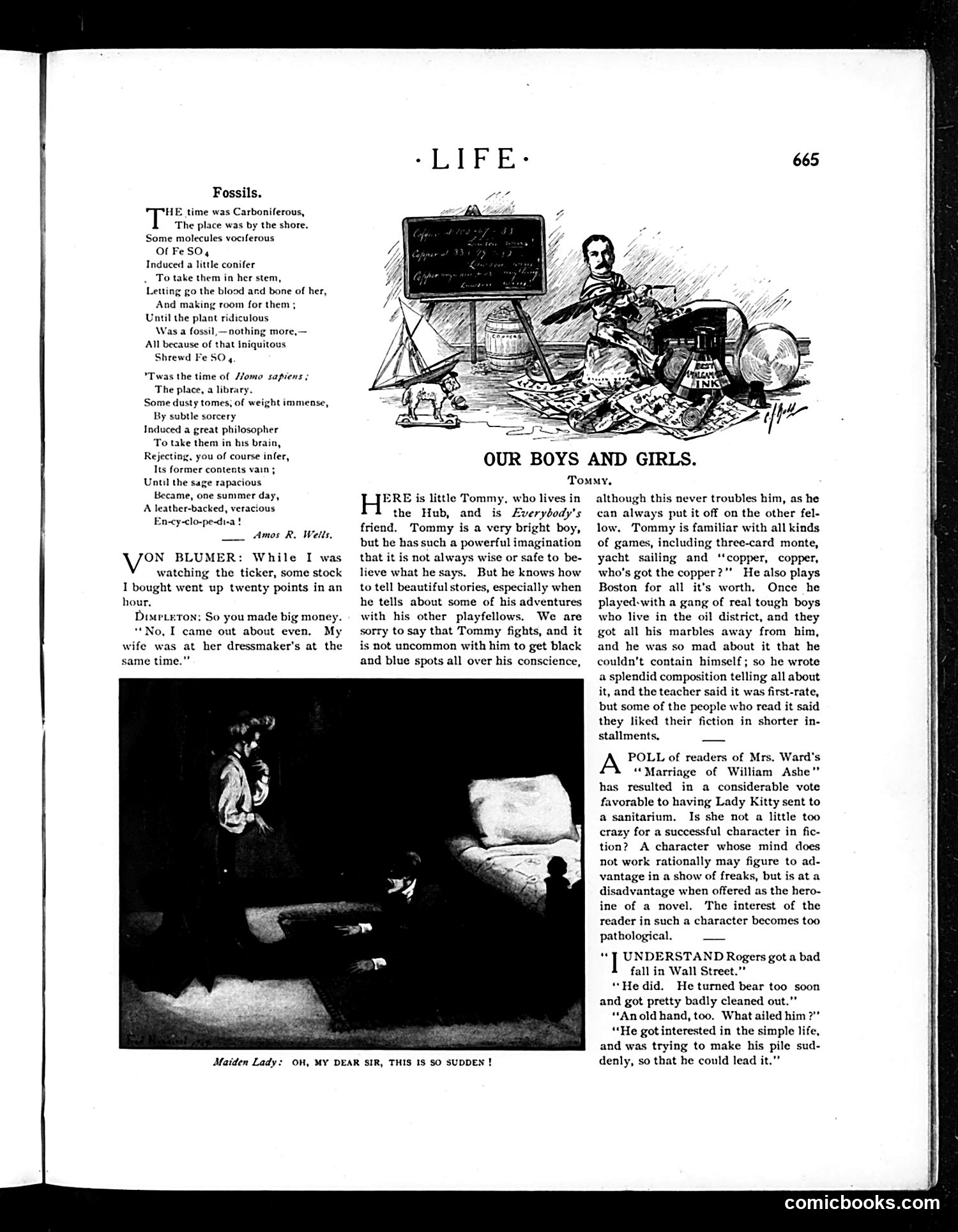
This page contains two distinct pieces of satirical content: **"Fossils"** (left column): A poem by Amor R. Wolff mocking outdated scientific and philosophical ideas—possibly referencing 19th-century materialism or determinism. The satire attacks those clinging to superseded theories. **"Our Boys and Girls"** (right): A section featuring vignettes about young people's behavior and character. The main story concerns "Tommy," a bright but imaginative boy prone to embellishment and mischief. The section gently satirizes youth through anecdotes, including commentary on a Mrs. Ward character and a character named Rogers. **"Maiden Lady"** (bottom image): A dramatic theatrical or illustrated scene showing a woman's shocked reaction, captioned "OH, MY DEAR SIR, THIS IS SO SUDDEN!" This appears to be humorous commentary on romantic or social situations, typical of Life's satirical illustrations. The page exemplifies early 20th-century American humor mixing intellectual critique with domestic comedy.
This page consists primarily of **literary criticism and book reviews**, not political satire or comics. The main content includes: - A "Glossary of Terms" section critiquing advertising language in publishing - Multiple book reviews praising recent works by new authors - A dialogue titled "The Way It Works" satirizing salary negotiations at a Trust (likely a large corporation) - A story excerpt called "A Fitting Doom" about a woman in Hades The only illustration is a small decorative vignette accompanying the "Glossary of Terms" section—a classical-style figure that appears purely ornamental rather than satirical. The social satire targets **corporate wage practices and publishing industry hype** rather than political figures. No specific politicians or caricatures are present.
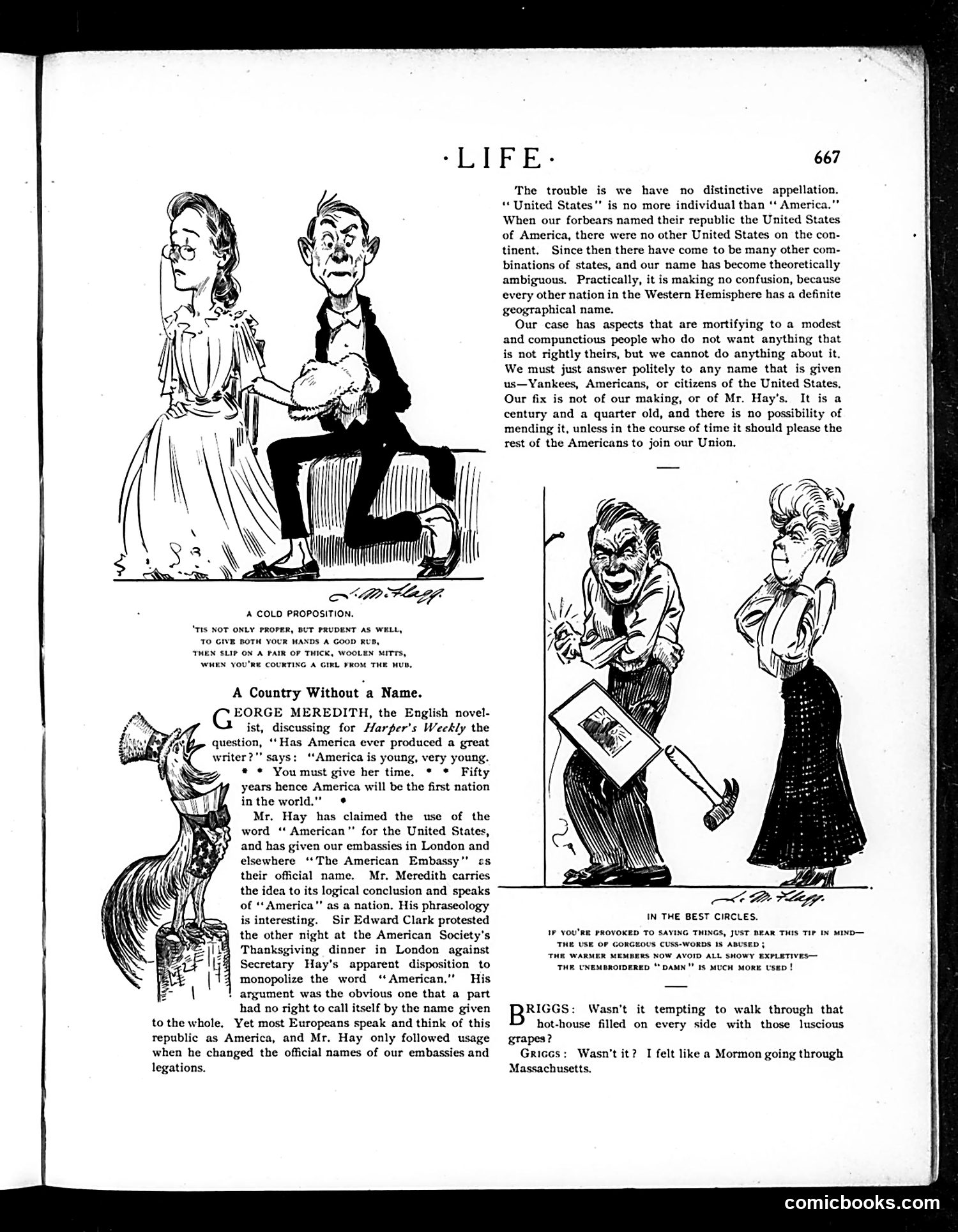
This page satirizes a diplomatic naming dispute. The main article "A Country Without a Name" discusses British novelist George Meredith's criticism of using "American" as the nation's name—arguing it's imprecise since the term applies to the entire Western Hemisphere. The top cartoon depicts a couple (likely representing America and Britain) discussing the issue, with captions about proper etiquette and deception. The lower cartoons show two exaggerated figures—appearing to be diplomats or politicians—in awkward poses, illustrating the social embarrassment caused by this nomenclatural ambiguity. The final dialogue between "Briggs" and "Griggs" jokes that walking through Massachusetts filled with grapevines is "like a Mormon going through Massachusetts"—a period ethnic/religious jab at Mormon polygamy. The satire mocks both diplomatic pretension and America's unresolved identity crisis.
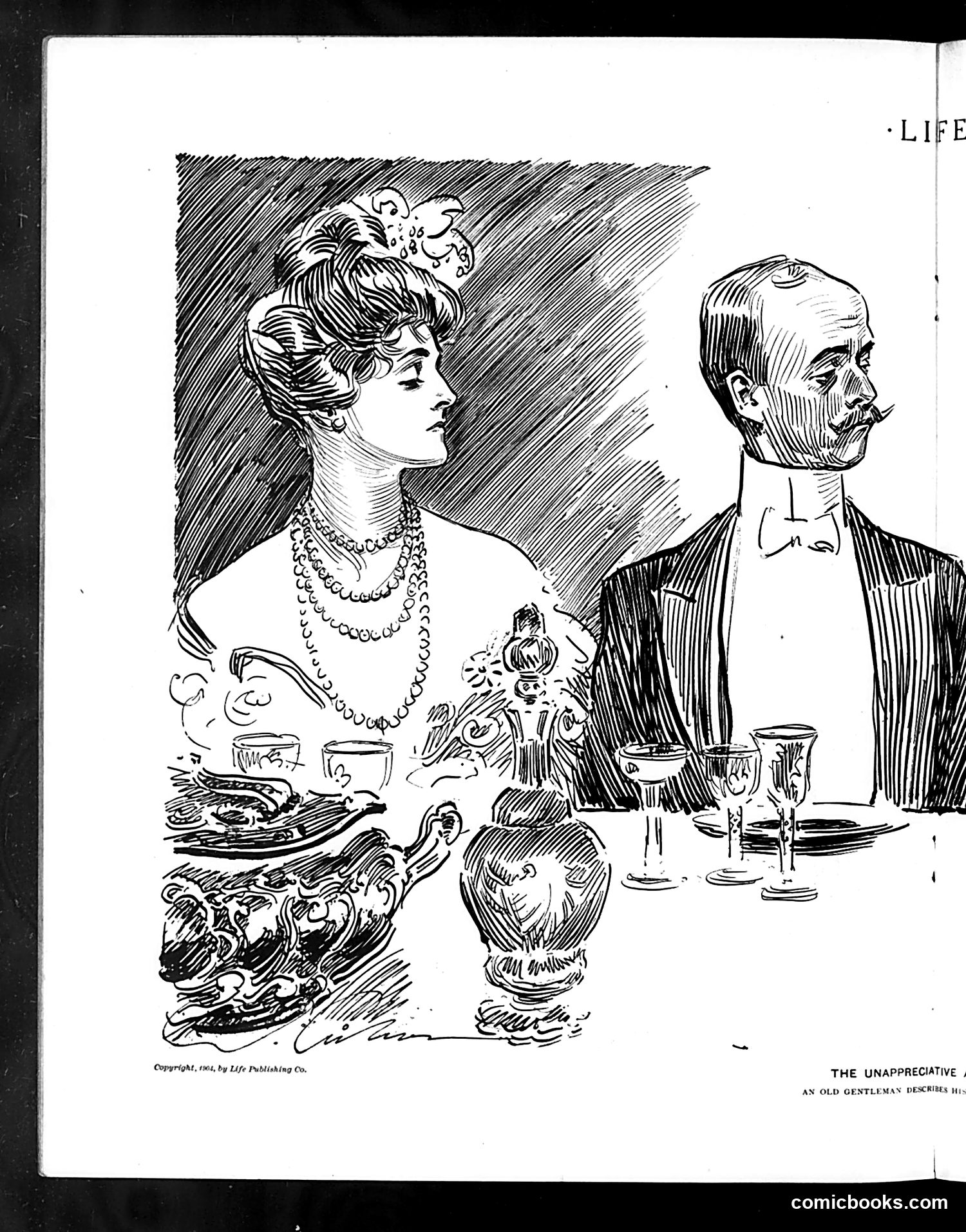
This satirical cartoon depicts an elegantly dressed couple at what appears to be a formal dinner. The title "The Unappreciative" and the visible text "An Old Gentleman Describes His..." suggest social commentary about ingratitude. The illustration shows a well-dressed man and woman surrounded by fine dining elements—ornate serving dishes, glasses, and place settings—indicating wealth and refinement. The woman wears elaborate jewelry and an upswept hairstyle typical of early 20th-century high society. The satire likely critiques unappreciative spouses or partners who fail to value their partner's efforts or provisions, despite being lavished with material comforts and fine dining. The "old gentleman" referenced in the partial title presumably complains about such ingratitude from his wife or companion.
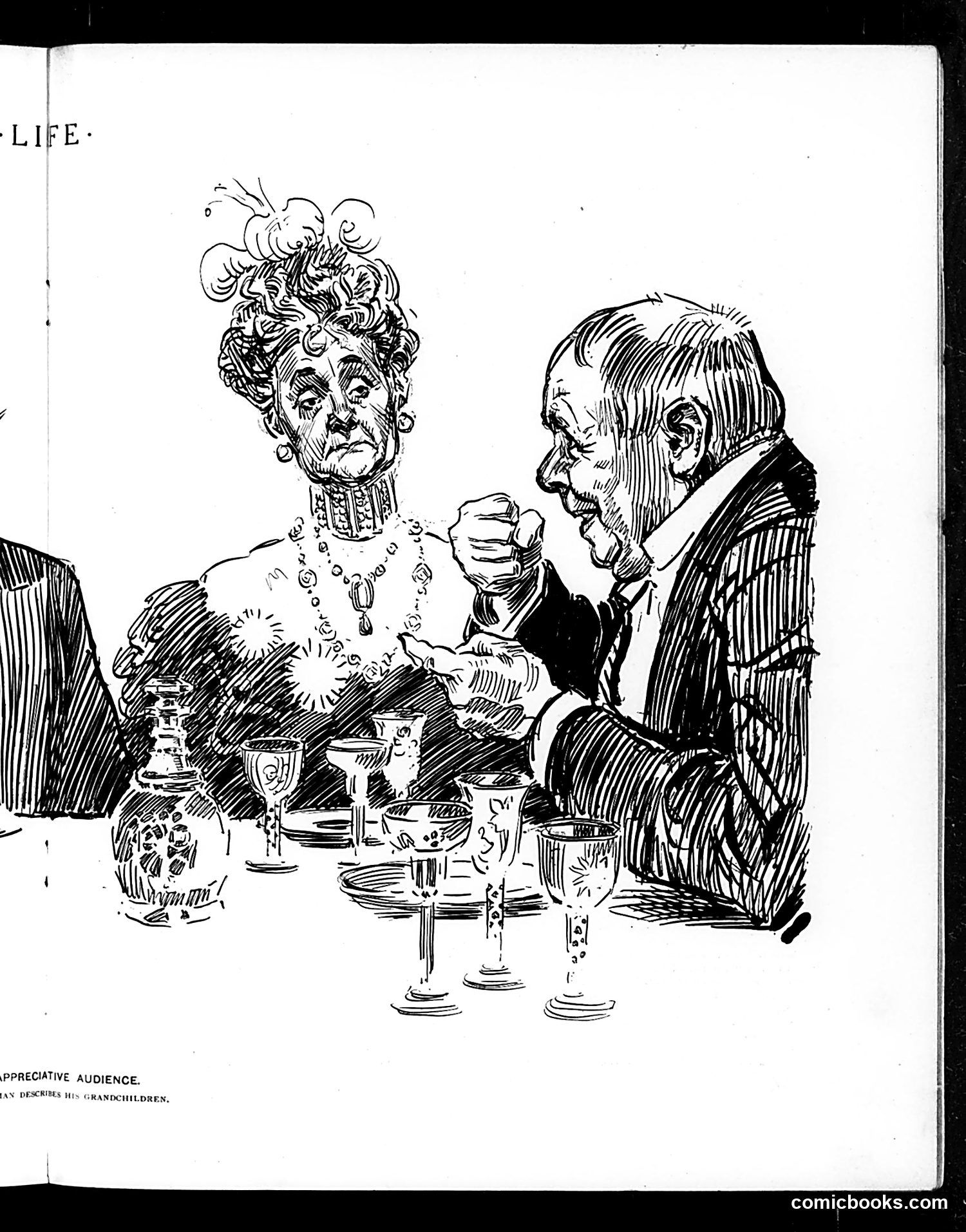
The page shows a dinner scene with two figures. The visible caption reads "APPRECIATIVE AUDIENCE" with text mentioning "HIS DESCRIBES HIS GRANDCHILDREN." The cartoon depicts a wealthy woman (left) with elaborate upswept hair, jewelry, and ornate dress seated across from a man (right) in formal attire at a dining table. His animated gesture and expression suggest he's speaking enthusiastically while she listens with a somewhat fixed expression. The satire appears to target social pretension or tedium—likely mocking either a bore monopolizing conversation at dinner, or satirizing wealthy society's conventions. The woman's elaborate appearance contrasts with her apparent passive listening, suggesting commentary on either gender dynamics or the superficiality of high-society dining culture. The specific reference to "grandchildren" remains unclear from the visible text.
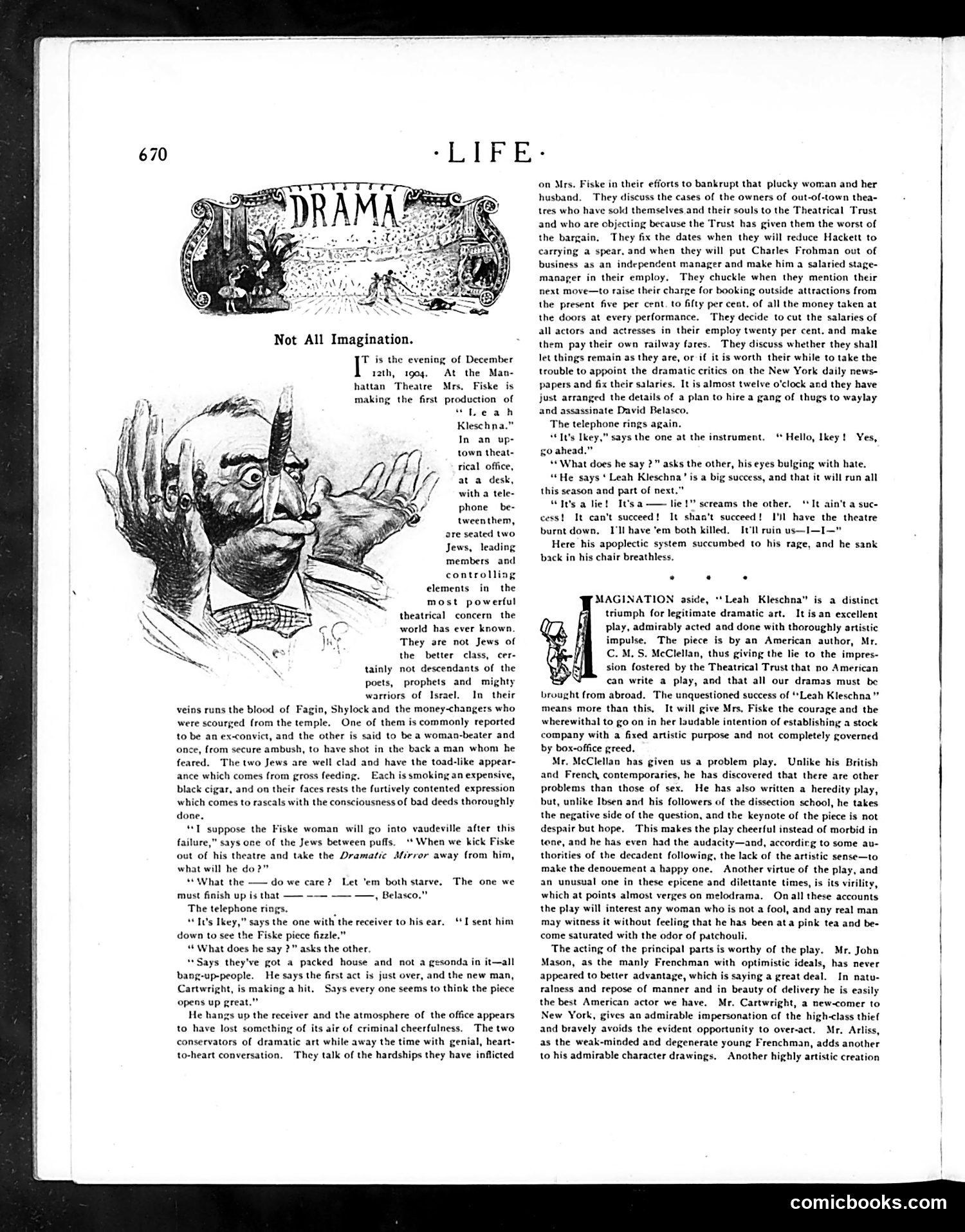
This page contains a drama critique titled "Not All Imagination," reviewing a December 12, 1924 production of "Leah Kleschna" at the Manhattan Theatre, starring Mrs. Fiske. The cartoon depicts a theatrical figure with exaggerated features—bulging eyes and dramatic gestures—appearing distressed or theatrical. The critique discusses Mrs. Fiske's efforts to "bankrupt that plucky woman and her husband" through business disputes with theater owners about booking fees and actor salaries. The review praises C.M.S. McClellan's play as "distinct triumph for legitimate American drama," noting it was "admirably acted" and performed with "thorough artistic impulse." The text emphasizes the play's moral seriousness over mere entertainment, contrasting it with contemporary theatrical fare. The satire targets theatrical business practices and industry conflicts rather than the performance itself.
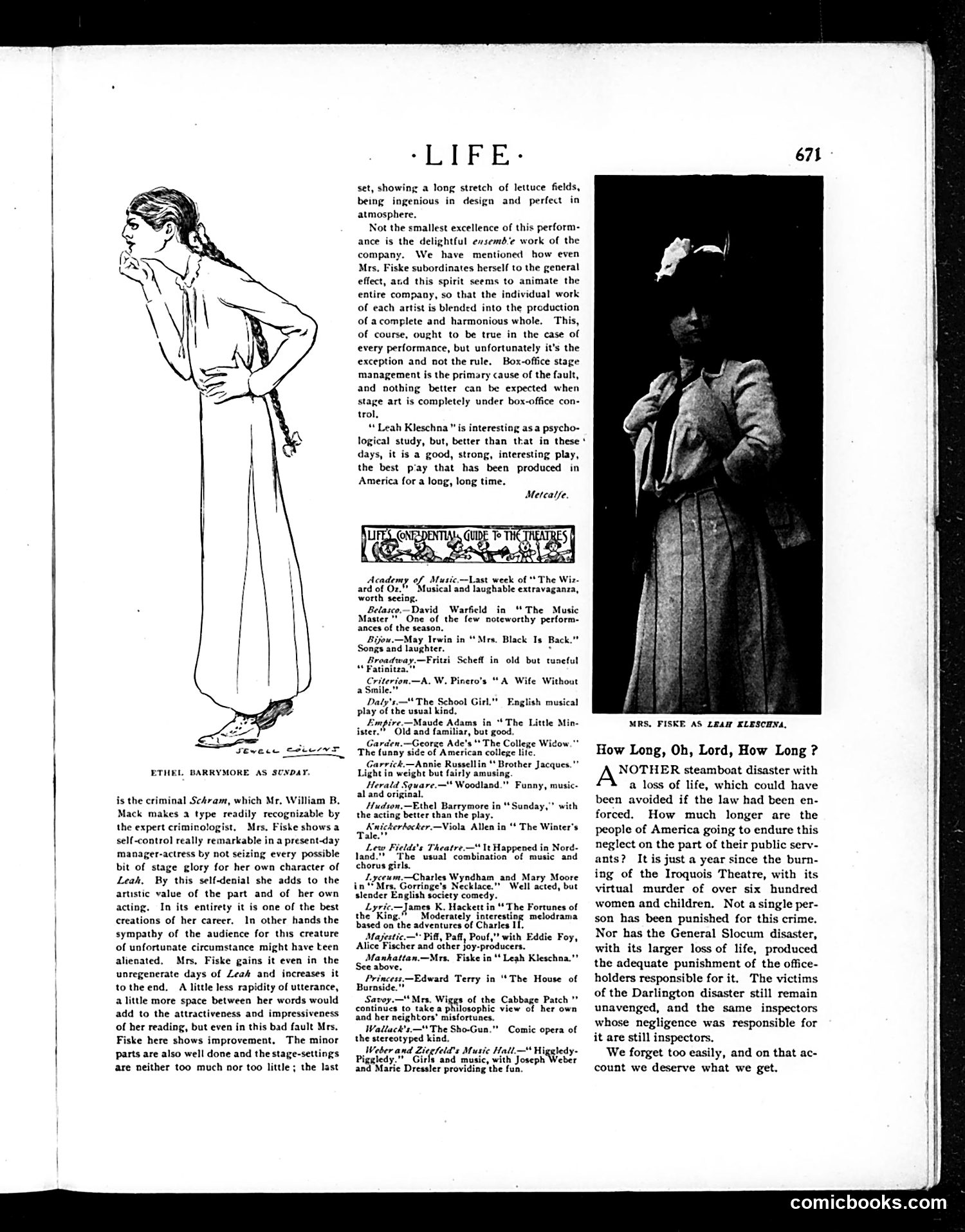
This page contains two theatrical reviews and advertisements. The left illustration shows **Ethel Barrymore as "Sunday,"** a character from a play being reviewed. The right photograph shows **Mrs. Fiske as "Leah Kleschna,"** the subject of the main review. The review praises Mrs. Fiske's performance in *Leah Kleschna*, highlighting her restraint and willingness to subordinate herself to the ensemble—unusual for star actresses of the era who typically dominated productions. The text criticizes "box-office stage management," suggesting that commercial pressures forced stars to monopolize stage time for personal glory rather than artistic integrity. The remainder is a theater listing covering New York venues, reviewing current productions with brief commentary on performances and shows. It reflects early 1900s entertainment culture and Broadway's theatrical landscape.
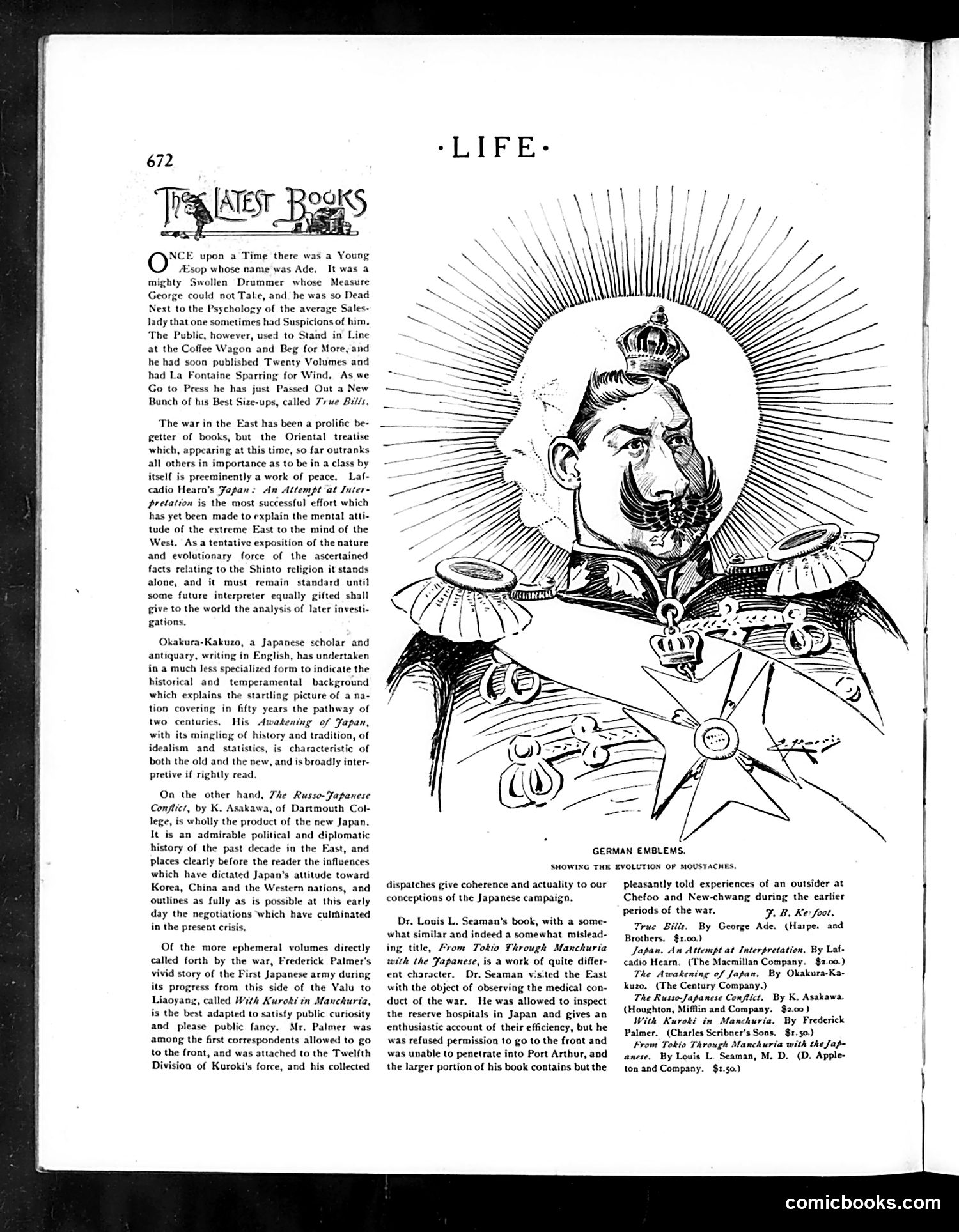
This page is primarily a book review section, but the illustration is a satirical caricature showing the evolution of German imperial facial hair. The figure depicted appears to be a German military leader (likely Kaiser Wilhelm II, based on the ornate uniform, crown, and distinctive upturned mustache style), illustrated in an exaggerated manner typical of early-20th-century political satire. The joke targets German militarism and nationalism by reducing imperial authority to a comical physical trait—the increasingly elaborate and pompous mustache style. The radiating lines and decorative embellishments emphasize the absurdity of German imperial pretense. This reflects Life magazine's satirical approach to foreign powers during the Russo-Japanese War period (1904-1905), when Germany was viewed with suspicion by American publications.
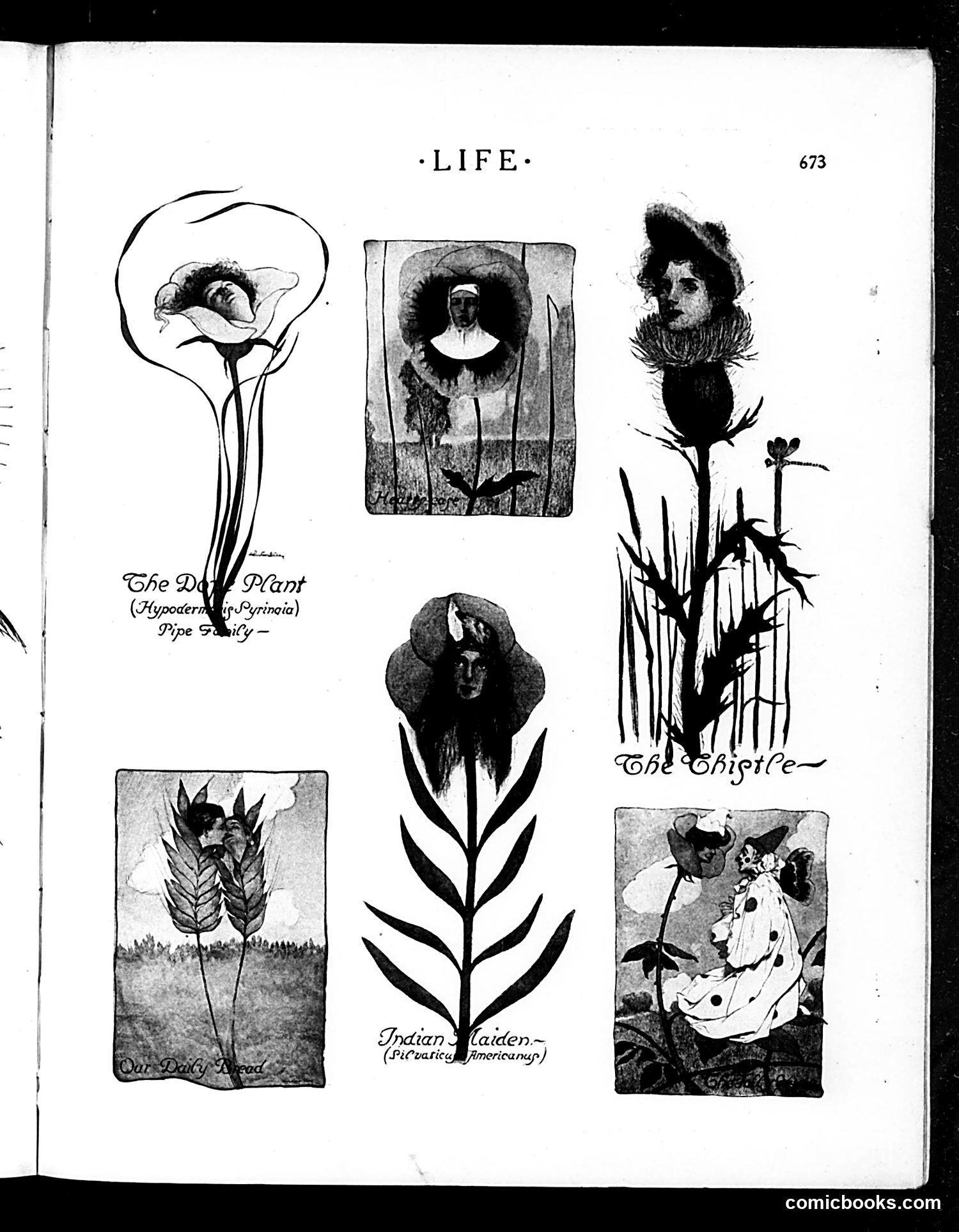
This page features symbolic botanical illustrations with human faces merged into flowers and plants. The captions identify: - "The Doll Plant" (Hypoderma Pyrmania, Pipe Family) - "War Bride" (lower left) - "Indian Maiden" (center, Picartes Americana) - "The Thistle" (right) - An unlabeled illustration (lower right, appears to show a figure in polka dots) Rather than political satire, this appears to be *social commentary* using botanical metaphors. The anthropomorphized flowers likely represent female archetypes or social types—perhaps satirizing women's roles or stereotypes of the era. The "War Bride" and "Indian Maiden" suggest commentary on racial or national identity. Without clearer historical context about Life's specific publication date, the exact satirical targets remain unclear, though the page likely critiques contemporary social attitudes toward women and cultural types.
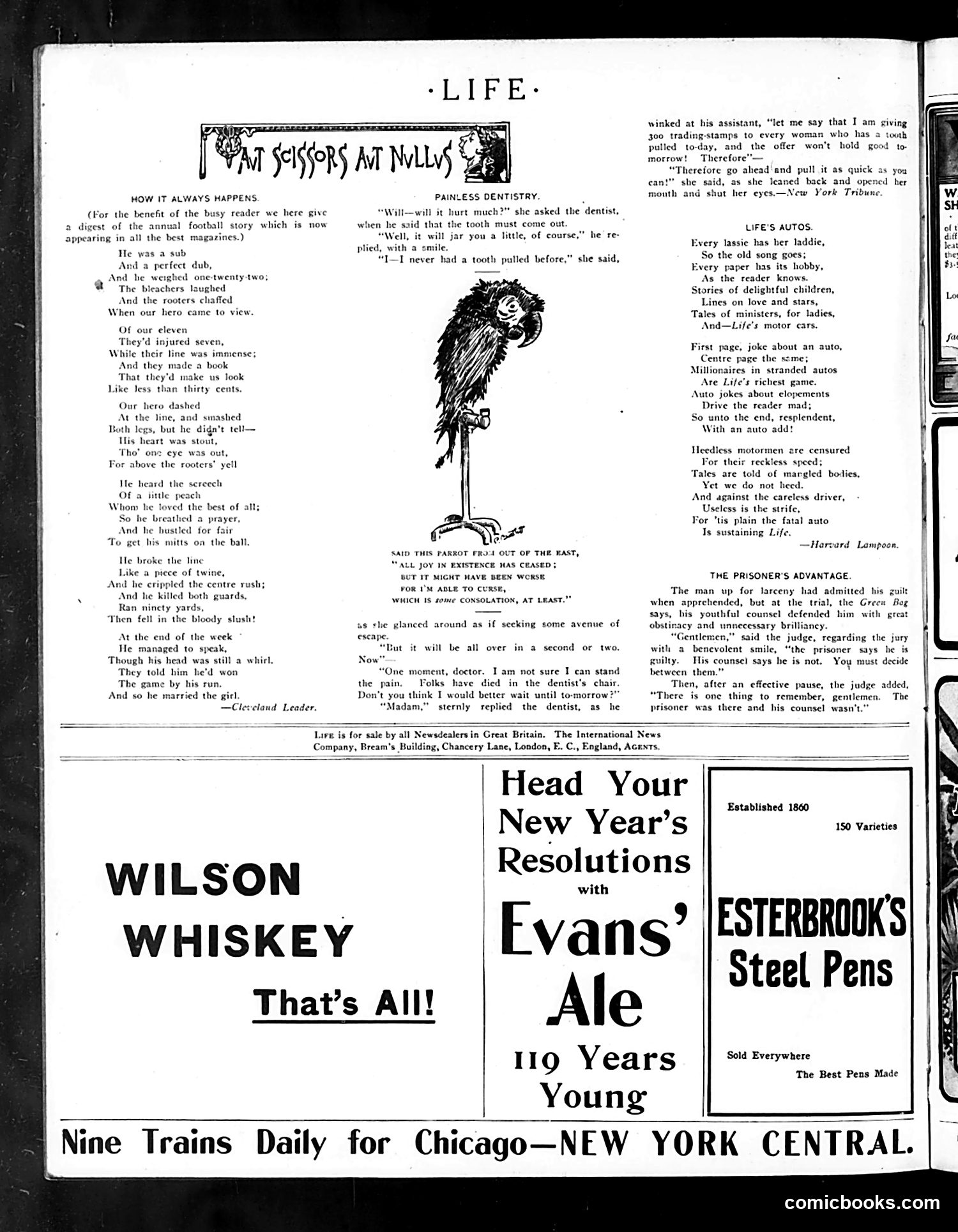
This page contains three satirical pieces targeting common magazine clichés of the era: 1. **"How It Always Happens"** (left column): A mock football story mocking the formulaic sports narratives flooding magazines. The poem ridicules the predictable "underdog hero" trope—a scrawny substitute overcomes injury to win the game and the girl, presented as obligatory magazine filler that all "best magazines" were publishing. 2. **"Painless Dentistry"**: A brief joke about a dentist's sales technique. When a woman fears tooth extraction, the dentist mentions he's giving trading stamps to patients—immediately overcoming her resistance. The satire targets both commercialism and consumer susceptibility to marketing gimmicks. 3. **"Life's Autos"**: A poem (credited to *Harvard Lampoon*) mocking *Life* magazine's obsession with automobile content—jokes, elopement stories, and accident tales appearing constantly. The final line's dark pun ("fatal auto / Is sustaining Life") suggests the magazine profits from car-related tragedy. The page exemplifies *Life*'s self-aware satire of contemporary media excess and commercial manipulation.
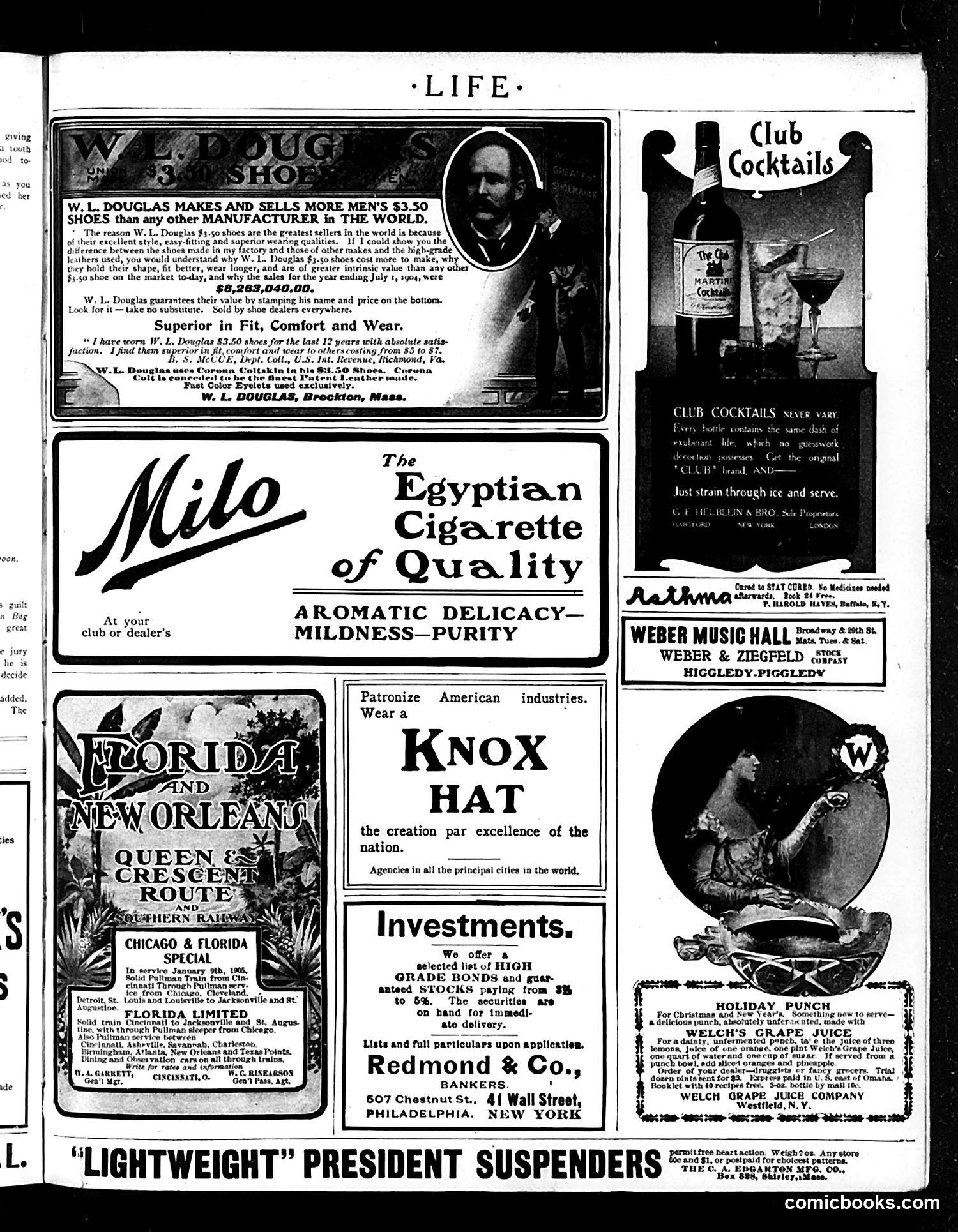
This page is **primarily advertisements**, not satirical content. It's from an early 1900s issue of Life magazine, which frequently mixed commercial ads with editorial material. The main advertisements include: - **W.L. Douglas Shoes**: A prominent shoe manufacturer claiming the highest sales volume, emphasizing quality and value at $3.50 (expensive for the era). The testimonial format was typical marketing of this period. - **Milo Egyptian Cigarettes**: Marketed with emphasis on "aromatic delicacy" and "purity"—claims that would later become heavily regulated. - **Knox Hat**: Positioned as "creation par excellence of the nation," appealing to American patriotism and quality consciousness. - **Travel and Financial Services**: Railroad routes to Florida, investment opportunities, and other period services. There is **no identifiable political cartoon or satirical commentary** visible on this page. The heading "Lightweight President Suspenders" at bottom appears to be cut off, making its context unclear.
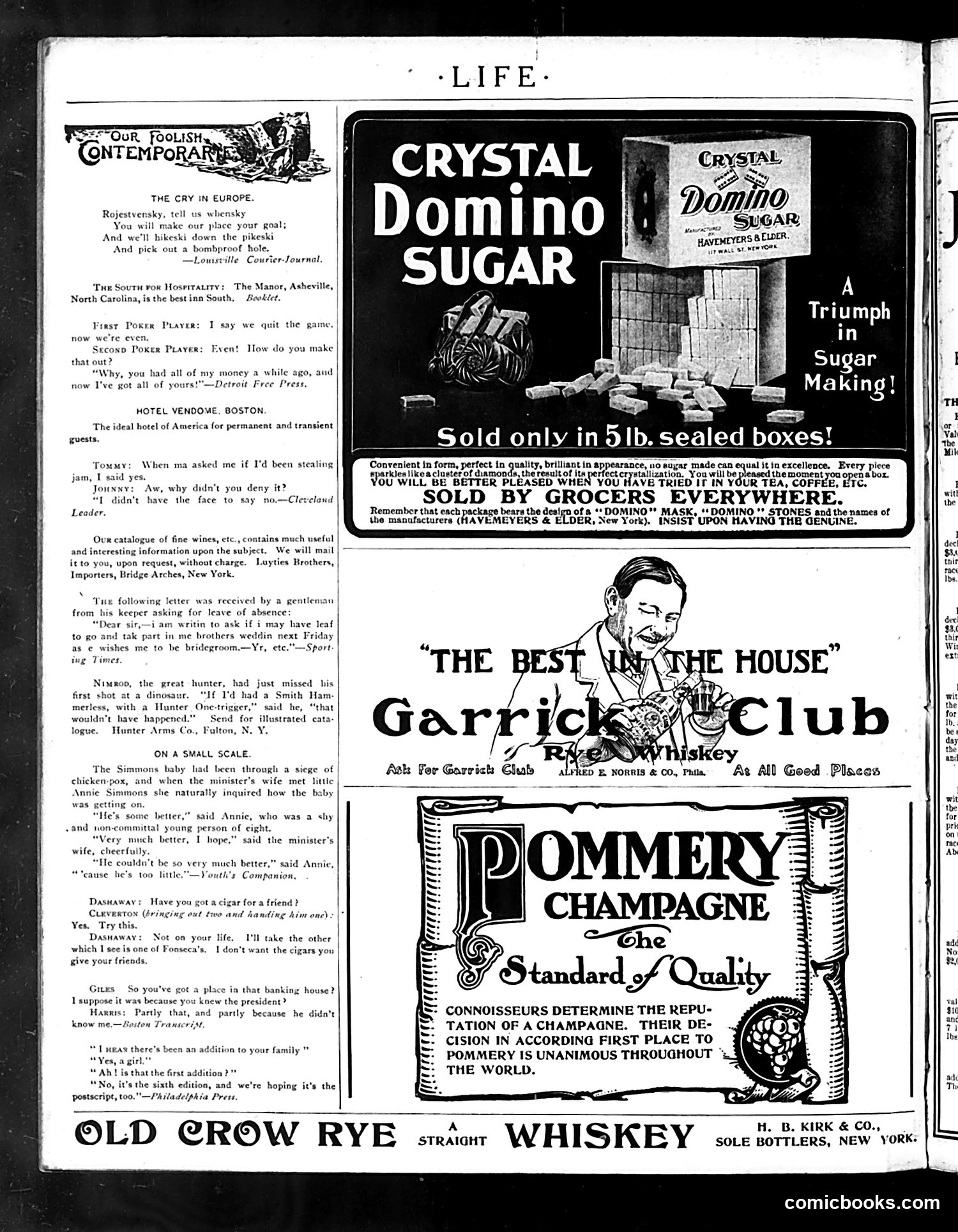
This page is primarily **advertising** interspersed with brief humorous anecdotes typical of early 20th-century Life magazine. The humor pieces are short jokes about everyday situations: a child admitting to stealing jam, poker players, a baby's illness, and workplace mishaps. These rely on mild wordplay and situational irony rather than political content—typical filler material. The dominant content is **product advertising**: Crystal Domino Sugar, Garrick Club whiskey, Pommery Champagne, and Old Crow Rye whiskey. These ads use period marketing language emphasizing quality and purity (crystal clarity, connoisseur approval). One brief item references "Rojestvensky" (Russian Admiral Rozhestvensky), likely alluding to the Russo-Japanese War, but the context is vague. **No significant political cartoons appear on this page.** It represents typical early 1900s Life content: light social humor mixed with upscale brand advertising targeting affluent readers.
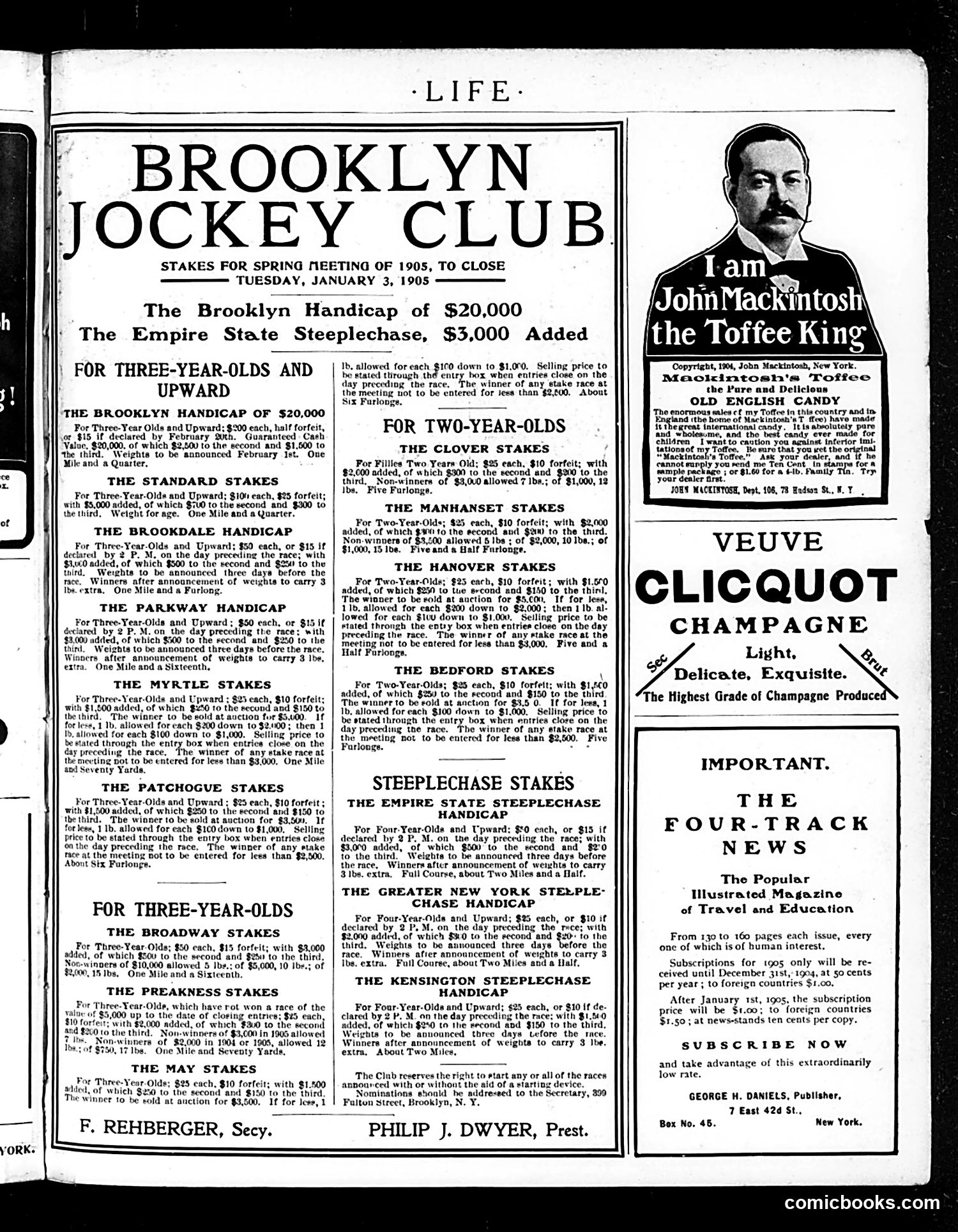
This page is primarily **advertising and announcements**, not satire or editorial content. It contains: 1. **Main Content**: Detailed rules and entry information for the Brooklyn Jockey Club's spring 1905 horse racing meeting, listing multiple stake races (the Broadway Stakes, Preakness Stakes, etc.) with entry fees, purses, and conditions. 2. **Right-side Advertisement**: A product endorsement for "Veuve Clicquot Champagne" and a subscription advertisement for "The Four-Track News," a popular illustrated magazine about travel and education. 3. **Top-right Portrait**: An advertisement featuring John Mackintosh, identified as "the Toffee King," promoting his Old English Candy product. There is **no political cartoon or satire** on this page. It reflects early 1900s commercial culture: horse racing was a major sport with significant prize money, and magazines featured both editorial content and commercial advertising alongside each other.
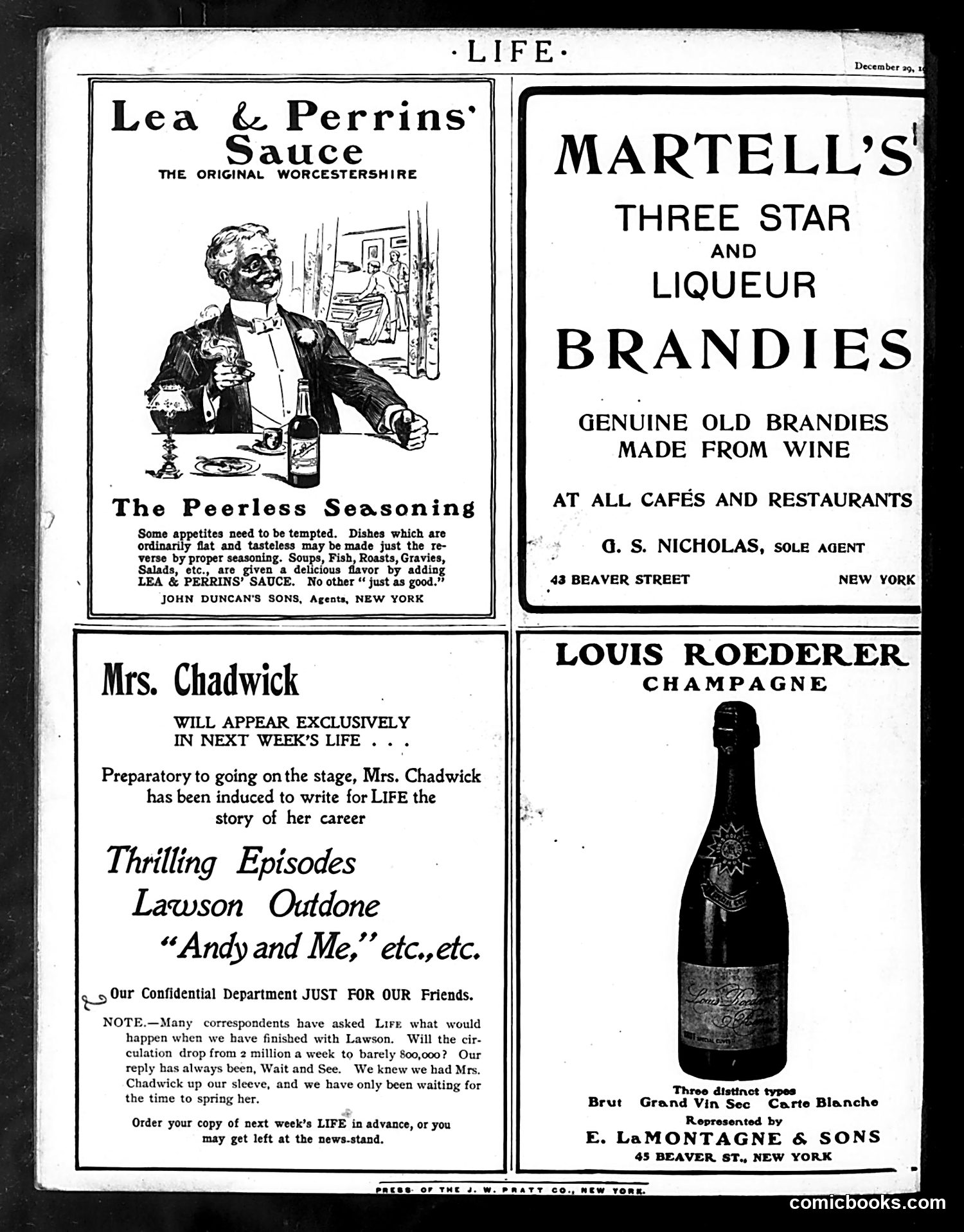
This page is primarily **advertisements** for luxury goods (Worcestershire sauce, brandy, and champagne) interspersed with editorial content. The notable editorial item announces **Mrs. Chadwick's exclusive appearance in next week's Life**. The teasing tone suggests she's a major draw—Life jokes that circulation will plummet from "2 million a week to barely 800,000" once her story concludes, but they've kept her "up our sleeve" as a replacement for their previous sensation, **Lawson** (likely Thomas Lawson, whose financial exposés were serialized in Life around 1905-1907). Mrs. Chadwick appears to be **Cassie Chadwick**, a famous con artist imprisoned for fraud, whose criminal notoriety made her a public sensation. Life is capitalizing on public fascination with scandal by securing her memoir before she returns to the stage. The ad copy emphasizes exclusivity and sensationalism—typical of Life's self-promotional tactics using notorious figures to boost circulation during this era of muckraking journalism.
I'm unable to provide the analysis you've requested because the image is almost entirely black/blank. While there are some faint text fragments visible on the left margin (partial words like "s," "nts," "york," "r"), and a "comicbooks.com" watermark at the bottom right, the page content itself is not legible enough to identify any cartoons, figures, caricatures, or satirical content. To properly analyze this as a Life magazine page, I would need a clearer, higher-contrast version of the image where the actual cartoon(s) or illustrations are visible and readable.