
Life, 1904-12-29 · page 14 of 21
Life — December 29, 1904 — page 14: what you’re looking at
What you’re looking at
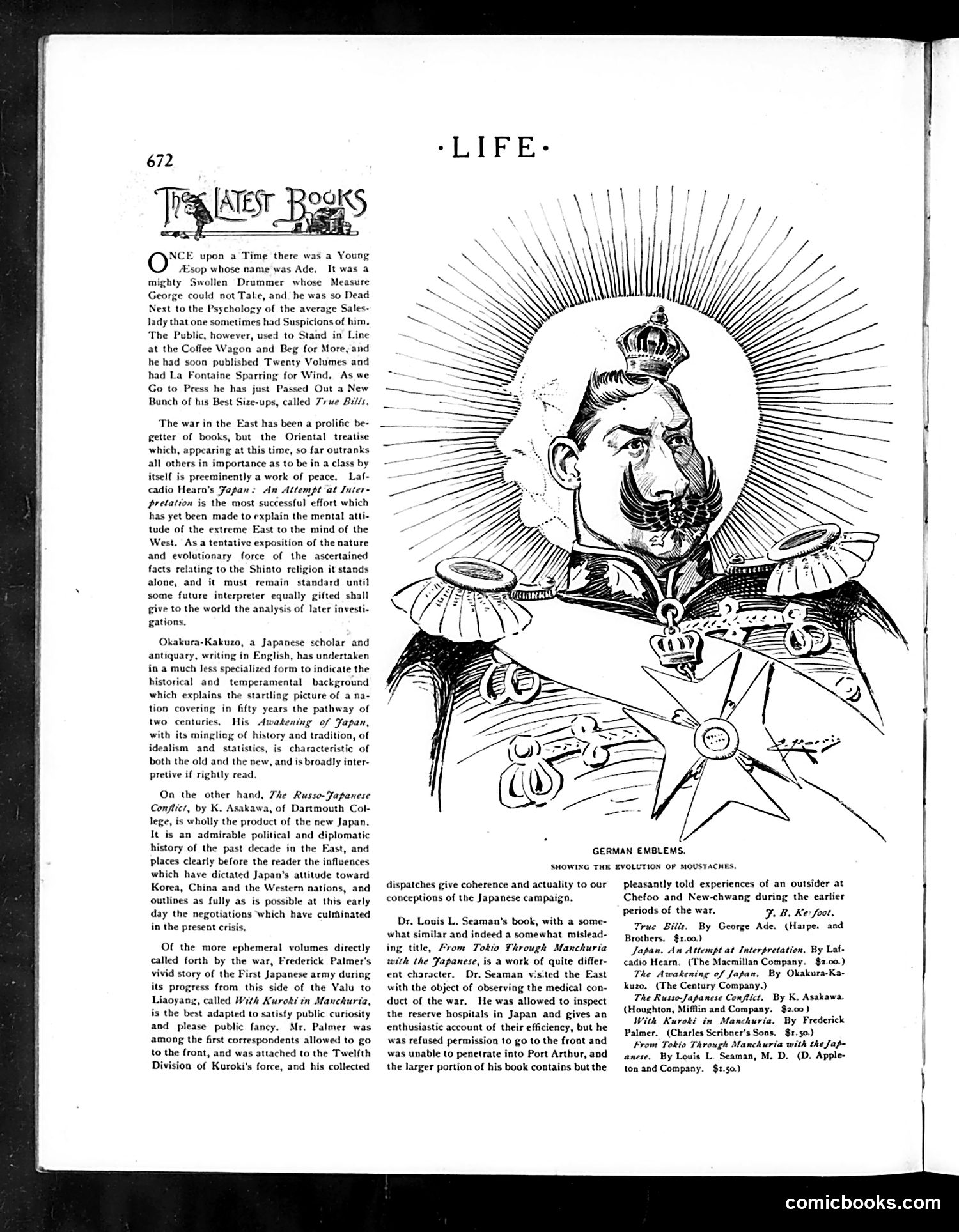
This page is primarily a book review section, but the illustration is a satirical caricature showing the evolution of German imperial facial hair. The figure depicted appears to be a German military leader (likely Kaiser Wilhelm II, based on the ornate uniform, crown, and distinctive upturned mustache style), illustrated in an exaggerated manner typical of early-20th-century political satire. The joke targets German militarism and nationalism by reducing imperial authority to a comical physical trait—the increasingly elaborate and pompous mustache style. The radiating lines and decorative embellishments emphasize the absurdity of German imperial pretense. This reflects Life magazine's satirical approach to foreign powers during the Russo-Japanese War period (1904-1905), when Germany was viewed with suspicion by American publications.
📄 Transcribed text from this page (OCR, searchable)
Machine-transcribed from the original scan — historical spelling and the odd misread are preserved.
NCE upon a Time there was a Young AEsop whose name was Ade, It was a mighty Swollen Drummer whose Measure George could not Take, and he was so Dead Next to the Psychology of the average Sales lady that one sometimes had Suspicions of him. ‘The Public, however, used to Stand in Line at the Coffee Wagon and Beg for More, and he had soon published Twenty Volumes and had La Fontaine Sparring for Wind. As we Go to Press he has just Passed Out a New Bunch of his Best Size-ups, called 7rue Bills, ‘The war in the East has been a prolific be- getter of books, but the Oriental treatise which, appearing at this time, so far outranks all others in importance as to be in a class by itself is preeminently a work of peace. Laf- cadio Hearn's Japan: An Attempt at Inter pretation is the most success(ul effort which has yet been made to explain the mental atti- tude of the extreme East to the mind of the West. Asa tentative exposition of the nature and evolutionary force of the ascertained facts relating to the Shinto religion it stands alone, and it must remain standard until some future interpreter equally gifted shall give to the world the analysis of later investi- gations. Okakura-Kakuzo, a Japanese scholar and antiquary, writing in English, has undertaken in a much less specialized form to indicate the historical and temperamental background which explains the startling picture of a na- tion covering in fifty years the pathway of two centuries, His Awakening of Japan, with its mingling of history and tradition, of idealism and statistics, is characteristic of both the old and the new, and isbroadly inter- pretive if rightly read. On the other hand, The Russo-Japanese Conflict, by K. Asakawa, of Dartmouth Col- lege, is wholly the product of the new Japan. It is an admirable political and diplomatic history of the past decade in the East, and places clearly before the reader the influences which have dictated Japan's attitude toward Korea, China and the Western nations, and outlines as fully as is possible at this early day the negotiations which have culshinated in the present crisis, Of the more ephemeral volumes directly called forth by the war, Frederick Palmer's vivid story of the First Japanese army during its progress from this side of the Yalu to Liaoyang, called With Kuroki in Manchuria, is the best adapted to satisfy public curiosity and please public fancy. Mr. Palmer was among the first correspondents allowed to go to the front, and was attached to the Twelfth ion of Kuroki’s force, and his collected GERMAN EMBLEMS. SHOWING THE EVOLUTION OF MOUSTACHES. dispatches give coherence and actuality to our conceptions of the Japanese campaign. Dr. Louis L. Seaman's book, with a some- what similar and indeed a somewhat mislead- ing title, From Tokio Through Manchuria with the Japanese, is a work of quite differ- ent character. Dr, Seaman visited the East with the object of observing the medical con- duct of the war, He was allowed to inspect the reserve hospitals in Japan and gives an enthusiastic account of their efficiency, but he was refused permission to go to the front and was unable to penetrate into Port Arthur, and the larger portion of his book contains but the pleasantly told experiences of an outsider at Chefoo and New-chwang during the earlier periods of the war, 7. B. Ke foot. True Bilis. By George Ade. (Harpe. and Brothers. $1.00.) Japan. An Attempt at Interpretation. By Lat cadio Hearn. (The Macmillan Company. $2.00.) The Awakening of Japan. By Okakura-Ka- kuzo, (The Century Company.) The Russo-Japanese Conflict, By K. Asakawa. (Houghton, Mifflin and Company. $2.00) With Kuroki in Manchuria, By Frederick Palmer. (Charles Scribner's Sons. $1.50.) From Tokio Through Manchuria with the Jap ancse. By Louis L. Seaman, M, D. (D. Apple ton and Company. $1.50.) comicbooks.com