
Life, 1904-12-29 · page 9 of 21
Life — December 29, 1904 — page 9: what you’re looking at
What you’re looking at
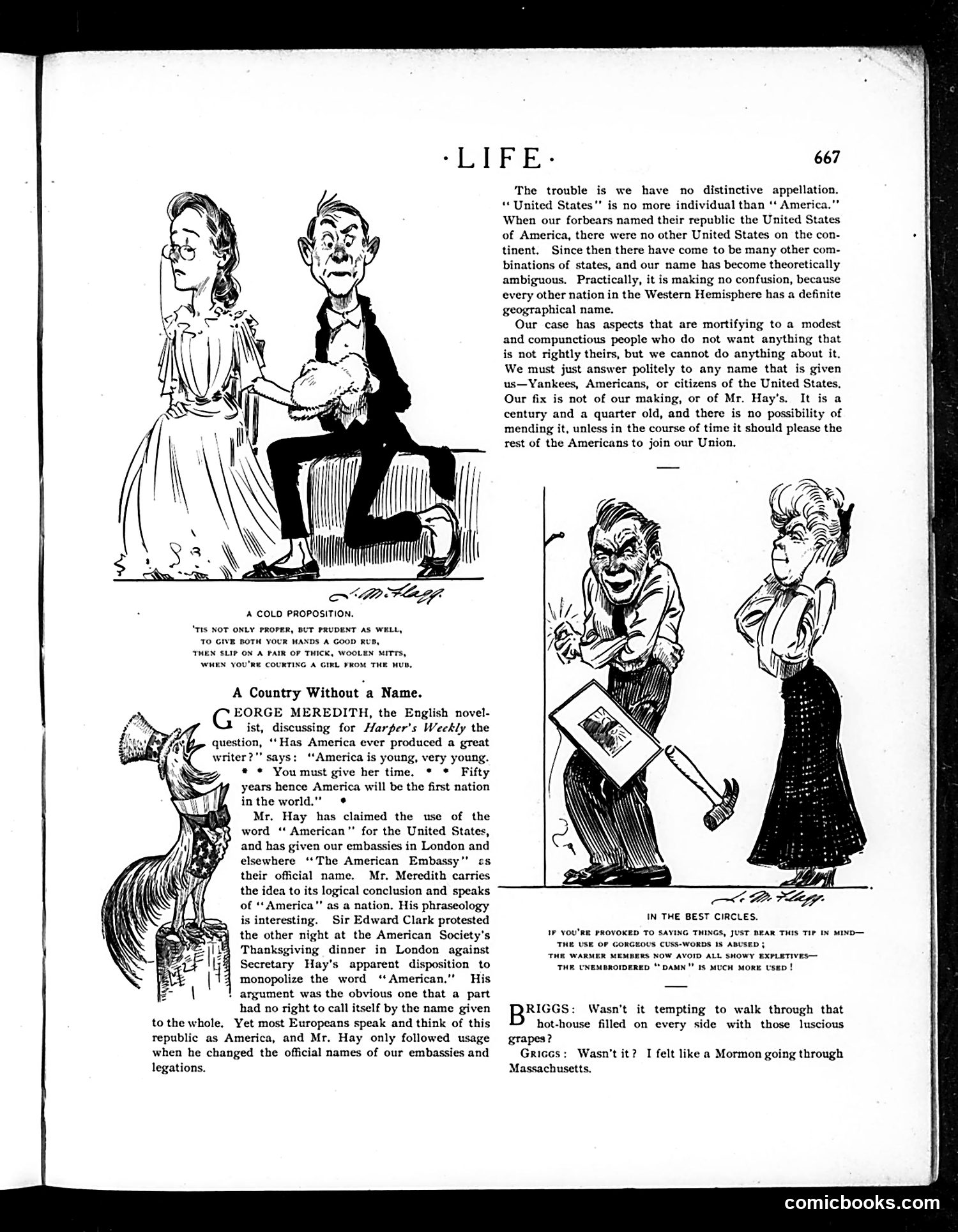
This page satirizes a diplomatic naming dispute. The main article "A Country Without a Name" discusses British novelist George Meredith's criticism of using "American" as the nation's name—arguing it's imprecise since the term applies to the entire Western Hemisphere. The top cartoon depicts a couple (likely representing America and Britain) discussing the issue, with captions about proper etiquette and deception. The lower cartoons show two exaggerated figures—appearing to be diplomats or politicians—in awkward poses, illustrating the social embarrassment caused by this nomenclatural ambiguity. The final dialogue between "Briggs" and "Griggs" jokes that walking through Massachusetts filled with grapevines is "like a Mormon going through Massachusetts"—a period ethnic/religious jab at Mormon polygamy. The satire mocks both diplomatic pretension and America's unresolved identity crisis.
📄 Transcribed text from this page (OCR, searchable)
Machine-transcribed from the original scan — historical spelling and the odd misread are preserved.
*LIF Es A COLD PROPOSITION. “TIS NOT ONLY PROPER, BUT PRUDENT AS WELL, TO GIVE BOTH YOUR MANDS A Goop RUB, THEN SLIP ON A PAIR OF THICK, WOOLEN MITTS, WHEN YOU'RE COUNTING A GIRL PROM THE HUB, A Country Without a Name. EORGE MEREDITH, the English novel- ist, discussing for Harper's Weekly the question, ‘‘Has America ever produced a great writer?" says: ‘America is young, very young. * * You must give her time. * * Fifty years hence America will be the first nation in the world.” Mr. Hay has claimed the use of the word ‘“ American" for the United States, and has given our embassies in London and elsewhere ‘*The American Embassy" cs their official name. Mr. Meredith carries the idea to its logical conclusion and speaks of “America” as a nation. His phraseology is interesting. Sir Edward Clark protested the other night at the American Society's Thanksgiving dinner in London against Secretary Hay's apparent disposition to monopolize the word ‘ American. His ! argument was the obvious one that a part had no right to call itself by the name given tothe whole, Yet most Europeans speak and think of this republic as America, and Mr. Hay only followed usage when he changed the official names of our embassies and legations. 667 The trouble is we have no distinctive appellation. ‘United States"’ is no more individual than ‘* America."” When our forbears named their republic the United States of America, there were no other United States on the con- tinent. Since then there have come to be many other com- binations of states, and our name has become theoretically ambiguous. Practically, it is making no confusion, because every other nation in the Western Hemisphere has a definite geographical name. Our case has aspects that are mortifying to a modest and compunctious people who do not want anything that is not rightly theirs, but we cannot do anything about it, We must just answer politely to any name that is given us—Yankees, Americans, or citizens of the United States, Our fix is not of our making, or of Mr. Hay's. It is a century and a quarter old, and there is no possibility of mending it, unless in the course of time it should please the rest of the Americans to join our Union. IN THE BEST CIRCLES. 1P YOU'RE PROVOKED TO SAYING THINGS, JUST REAR THIS TIP IN MIND— THE USE OF GORGEOUS CUSS-WORDS 18 ABUSED ; THE WARMER MEMBERS NOW AVOID ALL SNOWY EXPLETIVES— THR UNEMDROIDERED "DAMN"? IS MUCH MORE USED ! RIGGS: Wasn't it tempting to walk through that hot-house filled on every side with those luscious grapes? Griccs: Wasn't it? I felt like a Mormon going through Massachusetts. comicbooks.com