
Life, 1904-12-29 · page 4 of 21
Life — December 29, 1904 — page 4: what you’re looking at
What you’re looking at
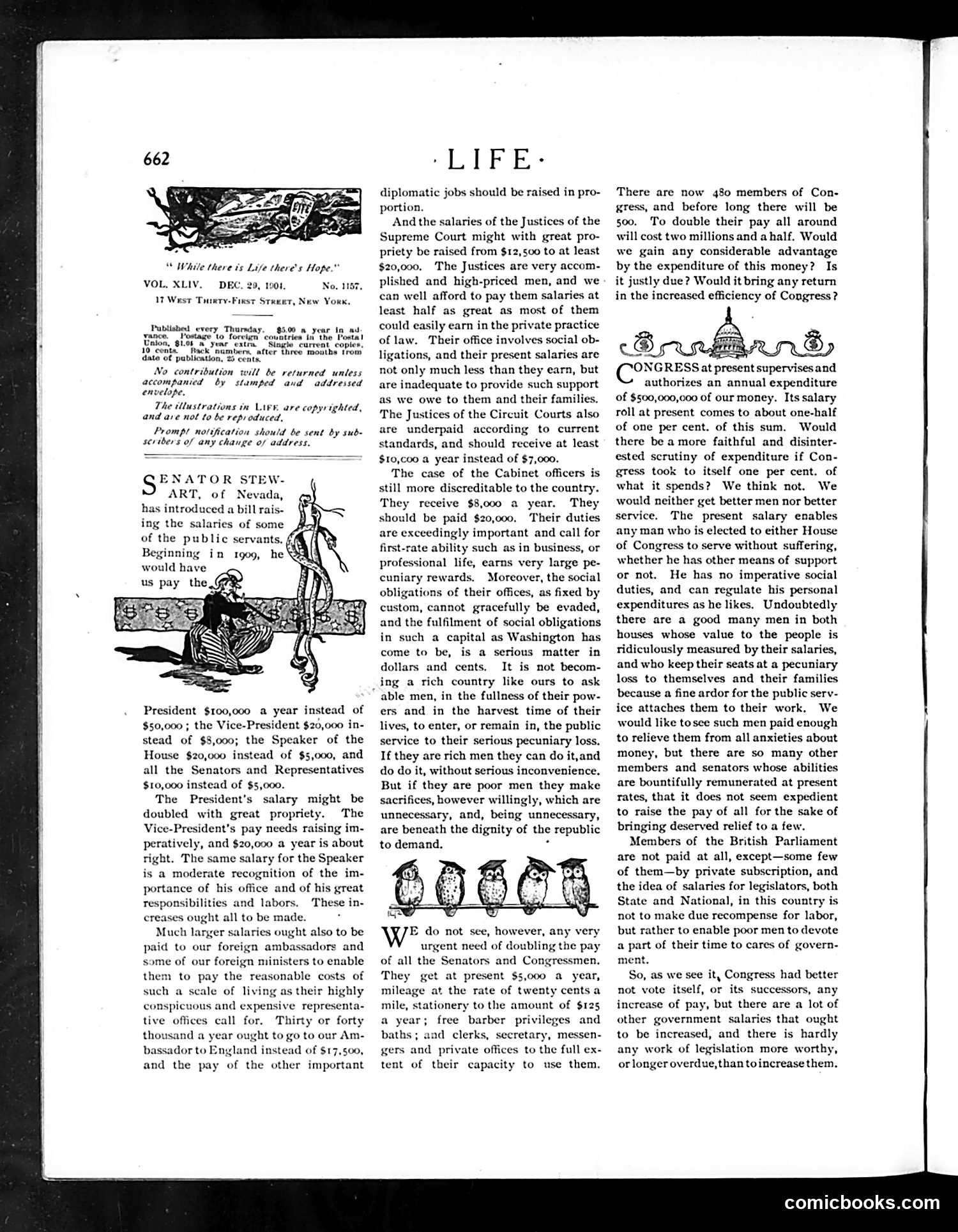
This page discusses government salary reform, primarily through text rather than traditional political cartoons. The decorative illustrations (a caduceus/Mercury's staff and owl symbols) are generic ornamental elements, not specific political satire. The content critiques Senator Stewart of Nevada's proposal to raise federal salaries. The author argues against doubling Congressional pay but supports raising Justice and Cabinet salaries to attract competent officials. The piece suggests that poor government servants make "unnecessary sacrifices" and that Washington positions demand significant living expenses. The satire is subtle—the author uses irony to defend selective raises while mocking the idea that poorly-paid politicians serve the public interest. The real target appears to be inconsistent salary policies that undervalue some positions while potentially overpaying others.
📄 Transcribed text from this page (OCR, searchable)
Machine-transcribed from the original scan — historical spelling and the odd misread are preserved.
“ While there i's Life there's Hope.” VOL. XLIV, DEC. 29, 1901. 17 West Tarery-First Street, New Yorn. No. 1157. Published every Thursday, $5.00 a year In ad yance. Postage to foreign countries In the Postal Union, $1.0 a year extra Single current copier, Rack’ humbera after three Touths {row dato of publication, 23 cents No contribution will be returned untess accompanied by stamped and addressed envelope. The illustrations in LAP¥. are copyrighted, and are not to be reproduced, Prompt notification should be sent by sub- seribers of any chauge of address. S VATOR ART, of Nevada, has introduced a bill rais- ing the salaries of some of the public servants, Beginning in 1909, he would have us pay the President $100,000 a year instead of $50,000 ; the Vice-President $20,000 in- stead of $8,000; the Speaker of the House $20,000 instead of $5,000, and all the Senators and Representatives $10,000 instead of $5,000. The President’s salary might be doubled with great propriety. The Vice-President’s pay needs raising im- peratively, and $20,000 a year is about right. The same salary for the Speaker is a moderate recognition of the im- portance of his office and of his great responsibilities and labors. These in- creases ought all to be made. Much larger salaries ought also to be paid to our foreign ambassadors and some of our foreign ministers to enable them to pay the reasonable costs of such a scale of living as their highly conspicuous and expensive representa- tive offic ll for, Thirty or forty year ought to go to our Am- assador to England instead of $17,500, and the pay of the other important -LIFE- diplomatic jobs should be raised in pro- portion. And the salaries of the Justices of the Supreme Court might with great pro- priety be raised from $12,500 to at least $20,000, The Justices are very accom- plished and high-priced men, and we can well afford to pay them salaries at least half as great as most of them could easily earn in the private practice of law. Their office involves social ob- ligations, and their present salaries are not only much less than they earn, but are inadequate to provide such support as we owe to them and their families. The Justices of the Circuit Courts also are underpaid according to current standards, and should receive at least $10,coo a year instead of $7,000. The case of the Cabinet officers is still more discreditable to the country. They receive $8,000 a year. They should be paid $20,000. Their duties are exceedingly important and call for first-rate ability such as in business, or professional life, earns very large pe- cuniary rewards. Moreover, the social obligations of their offices, as fixed by custom, cannot gracefully be evaded, and the fulfilment of social obligations in such a capital as Washington has come to be, is a serious matter in dollars and cents. It is not becom- _ing a rich country like ours to ask able men, in the fullness of their pow- ers and in the harvest time of their lives, to enter, or remain in, the public service to their serious pecuniary loss, If they are rich men they can do it,and do do it, without serious inconvenience. But if they are poor men they make sacrifices, however willingly, which are unnecessary, and, being unnecessary, are beneath the dignity of the republic to demand. . WE do not see, however, any very urgent need of doubling the pay of all the Senators and Congressmen. They get at present $5,000 a year, mileage at the rate of twenty cents a mile, stationery to the amount of $125 a year; free barber privileges and baths ; and clerks, secretary, messen- gers and private offices to the full ex- tent of their capacity to use them. There are now 480 members of Con- gress, and before long there will be 500. To double their pay all around will cost two millions and a half. Would we gain any considerable advantage by the expenditure of this money? Is it justly due? Would it bring any return in the increased efficiency of Congress? fer CONGRESS at present supervises and authorizes an annual expenditure of $500,000,000 of our money. Its salary roll at present comes to about one-half of one per cent. of this sum. Would there be a more faithful and disinter- ested scrutiny of expenditure if Con- gress took to itself one per cent. of what it spends? We think not. We would neither get better men nor better service. The present salary enables any man who is elected to either House of Congress to serve without suffering, whether he has other means of support or not. He has no imperative social duties, and can regulate his personal expenditures as he likes. Undoubtedly there are a good many men in both houses whose value to the people is ridiculously measured by their salaries, and who keep their seats at a pecuniary loss to themselves and their families because a fine ardor for the public serv- ice attaches them to their work, We would like tosee such men paid enough to relieve them from all anxieties about money, but there are so many other members and senators whose abilities are bountifully remunerated at present rates, that it does not seem expedient to raise the pay of all for the sake of bringing deserved relief to a few. Members of the British Parliament are not paid at all, except—some few of them—by private subscription, and the idea of salaries for legislators, both State and National, in this country is not to make due recompense for labor, but rather to enable poor men to devote a part of their time to cares of govern- ment. So, as we see it, Congress had better not vote itself, or its successors, any increase of but there are a lot of other government salaries that ought to be increased, and there is hardly any work of legislation more worthy, or longer overdue, than toincrease them. comicbooks.com