
Life, 1904-12-29 · page 12 of 21
Life — December 29, 1904 — page 12: what you’re looking at
What you’re looking at
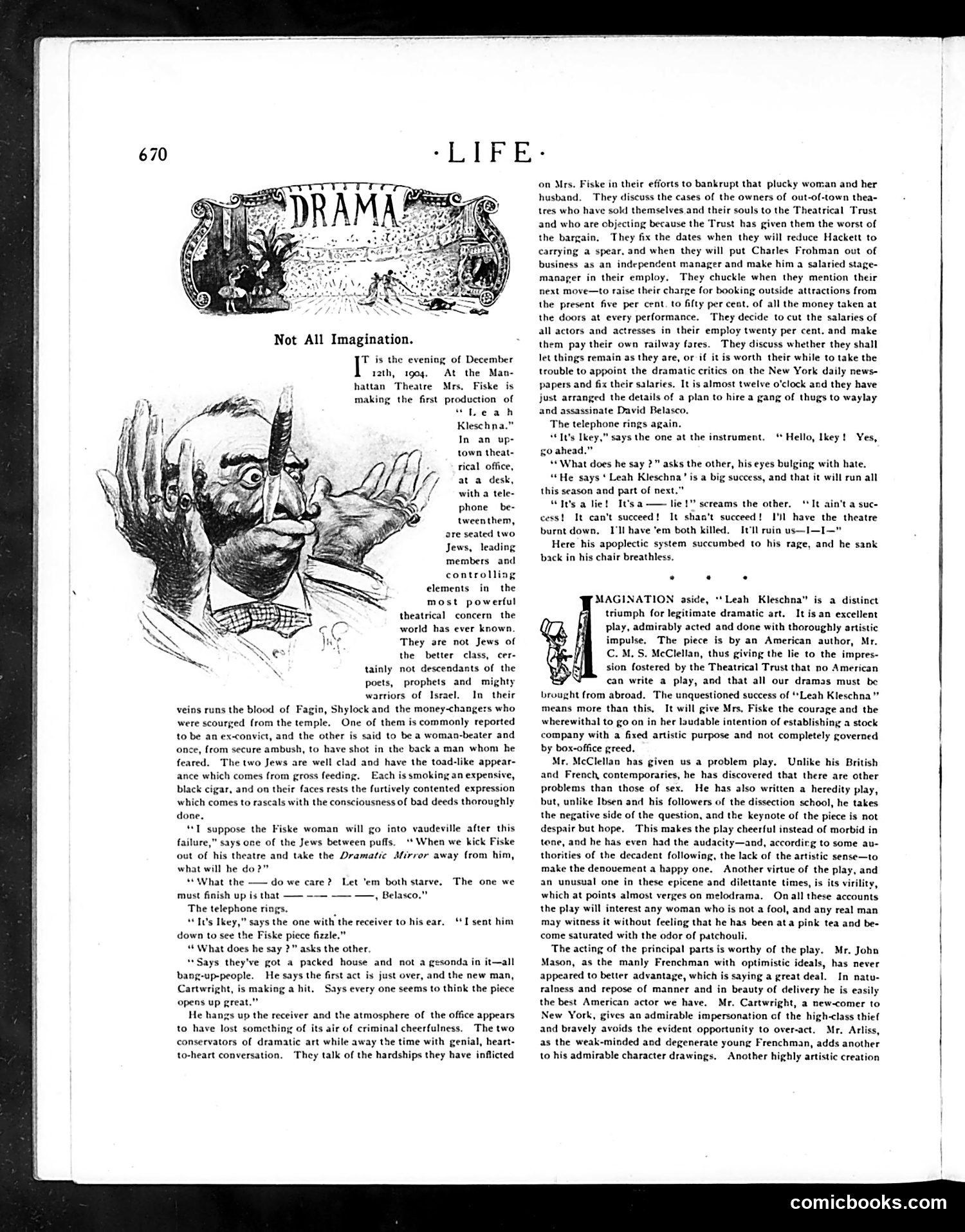
This page contains a drama critique titled "Not All Imagination," reviewing a December 12, 1924 production of "Leah Kleschna" at the Manhattan Theatre, starring Mrs. Fiske. The cartoon depicts a theatrical figure with exaggerated features—bulging eyes and dramatic gestures—appearing distressed or theatrical. The critique discusses Mrs. Fiske's efforts to "bankrupt that plucky woman and her husband" through business disputes with theater owners about booking fees and actor salaries. The review praises C.M.S. McClellan's play as "distinct triumph for legitimate American drama," noting it was "admirably acted" and performed with "thorough artistic impulse." The text emphasizes the play's moral seriousness over mere entertainment, contrasting it with contemporary theatrical fare. The satire targets theatrical business practices and industry conflicts rather than the performance itself.
📄 Transcribed text from this page (OCR, searchable)
Machine-transcribed from the original scan — historical spelling and the odd misread are preserved.
Not All Imagination. T is the evening of December rath, 1904, At the Man- hattan Theatre Mrs, Fiske is making the first production of “Leah town theat- rical office, Lf wa desk, JY (witha tele- phone be- tweenthem, are seated two Jews, leading members and controlling elements in the most powerful theatrical concern the world has ever known. They are not Jews of the better class, cer- tainly not descendants of the poets, prophets and mighty warriors of Israel, In their veins runs the blood of Fagin, Shylock and the money-changezs who were scourged {rom the temple. One of them is commonly reported to be an ex-convict, and the other is said to be a woman-beater and once, from secure ambush, to have shot in the back a man whom he feared. The two Jews are well clad and have the toad-like appear- ance which comes from gross feeding, Each is smoking an expensive, black cigar, and on their faces rests the furtively contented expression which comes to rascals with the consciousness of bad deeds thoroughly done, “TL suppose the Fiske woman will go into vaudeville after this failure,” says one of the Jews between puffs. “* When we kick Fiske out of his theatre and take the Dramatic Mirror away {rom him, what will he do?” ** What the —— do we care? Let ‘em both starve, The one we must finish up is that — -—— — —, , Belasco.” The telephone rings. “I's Ikey,” says the one with the receiver to his ear. I sent him down to see the Fiske piece fizzle,” “ What does he say ?” asks the other. ‘Says they've got a packed house and not a gesonda in it—all bang-up-people. He says the first act is just over, and the new man, Cartwright, is making a hit. Says every one seems to think the piece ‘opens up great.” He hangs up the receiver and the atmosphere of the office appears to have lost something of its air of criminal cheerfulness. The two conservators of dramatic art while away the time with genial, heart- to-heart conversation. They talk of the hardships they have inflicted on Mrs. Fiske in their efforts to bankrupt that plucky woman and her husband. They discuss the cases of the owners of out-of-town thea- tres who have sold themselves and their souls to the Theatrical Trust and who are objecting because the Trust has given them the worst of the bargain, They fix the dates when they will reduce Hackett to carrying a spear, and when they will put Charles Frohman out of business as an independent manager and make him a salaried stage- manager in their employ. They chuckle when they mention their next move—to raise their charge for booking outside attractions from the present five per cent. to fifty per cent, of all the money taken at the doors at every performance. They decide to cut the salaries of all actors and actresses in their employ twenty per cent. and make them pay their own railway fares. They discuss whether they shall let things remain as they are, or if it is worth their while to take the trouble to appoint the dramatic critics on the New York daily news- papers and fix their salaries, It is almost twelve o'clock and they have just arranged the details of a plan to hire a gang of thugs to waylay and assassinate David Belasco. The telephone rings again. “It's Ikey,” says the one at the instrument. go ahead. “+ What does he say ?” asks the other, his eyes bulging with hate, “He says ‘ Leah Kleschna’ is a big success, and that it will run all this season and part of next.” “It's a lie! It's a — lie!” screams the other. cess! It can't succeed! It shan't succeed! I'll have the theatre burnt down, I'll have ‘em both killed. It'll ruin us—I—1—" Here his apoplectic system succumbed to his rage, and he sank back in his chair breathless, “Hello, Ikey ! Yes, “Tt ain't a suc- MAGINATION aside, “Leah Kleschna” is a distinct triumph for legitimate dramatic art. It is an excellent play, admirably acted and done with thoroughly artistic impulse, The piece is by an American author, Mr. C. M.S. McClellan, thus giving the lie to the impres- sion fostered by the Theatrical Trust that no American can write a play, and that all our dramas must be brought from abroad. The unquestioned success of ‘Leah Kleschna” means more than this, It will give Mrs, Fiske the courage and the wherewithal to go on in her laudable intention of establishing a stock company with a fixed artistic purpose and not completely governed by box-office greed. Mr. McClellan has given us a problem play. Unlike his British and French, contemporaries, he has discovered that there are other problems than those of sex. He has also written a heredity play, but, unlike Ibsen and his followers of the dissection school, he takes the negative side of the question, and the keynote of the piece is not despair but hope, This makes the play cheerful instead of morbid in tone, and he has even had the audacity—and, accordirg to some au- thorities of the decadent following, the lack of the artistic sense—to make the denouement a happy one. Another virtue of the play, and an unusual one in these epicene and dilettante times, is its virility, which at points almost verges on melodrama. On all these accounts the play will interest any woman who is not a fool, and any real man may witness it without feeling that he has been ata pink tea and be- come saturated with the odor of patchouli. The acting of the principal parts is worthy of the play. Mr. John Mason, as the manly Frenchman with optimistic ideals, has never appeared to better advantage, which is saying a great deal. In natu- ralness and repose of manner and in beauty of delivery he is easily the best American actor we have. Mr. Cartwright, a new-comer to New York, gives an admirable impersonation of the high-class thief and bravely avoids the evident opportunity to over-act. Mr. Arliss, as the weak-minded and degenerate young Frenchman, adds another to his admirable character drawings. Another highly artistic creation comicbooks.com