
Life, 1904-12-29 · page 7 of 21
Life — December 29, 1904 — page 7: what you’re looking at
What you’re looking at
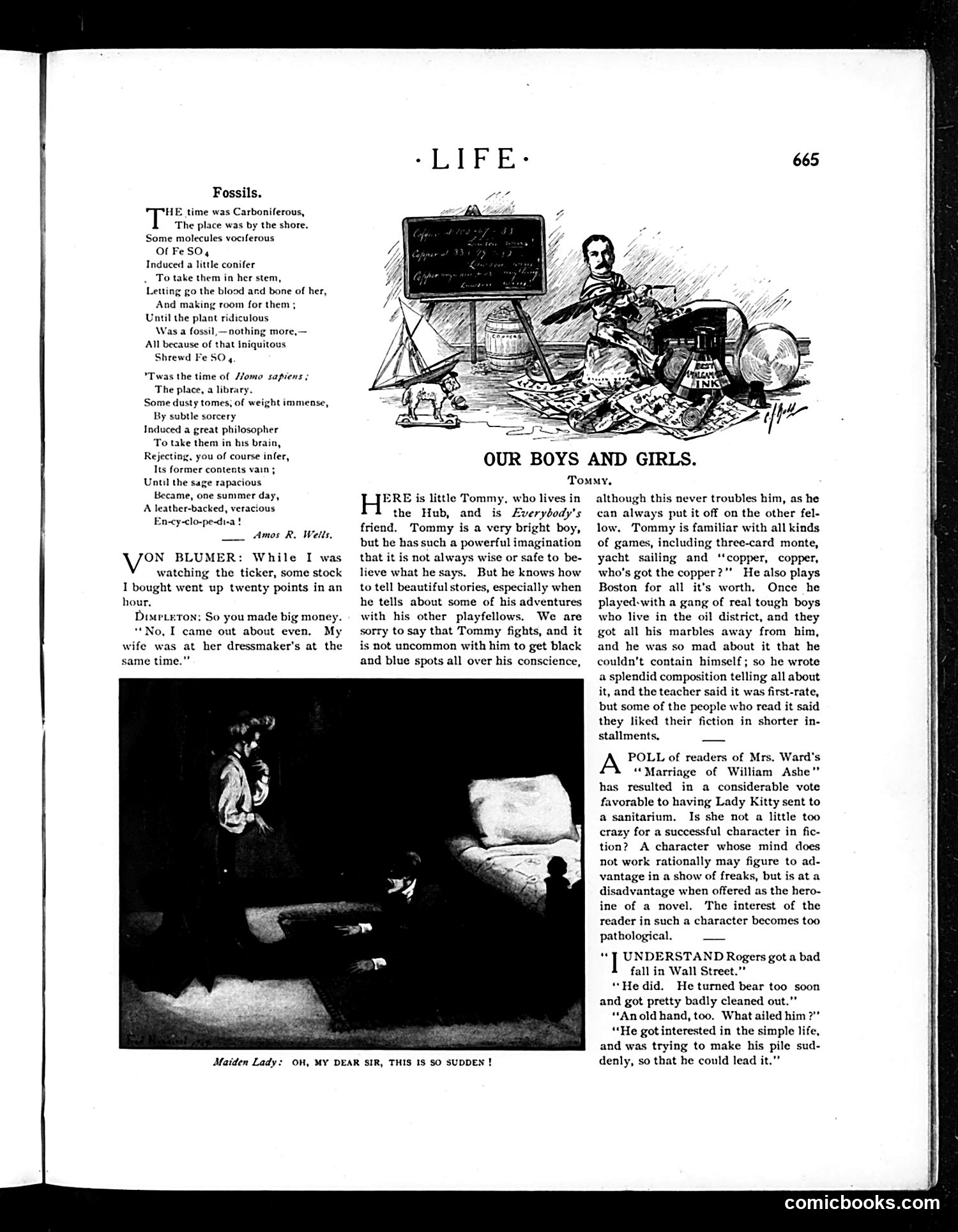
This page contains two distinct pieces of satirical content: **"Fossils"** (left column): A poem by Amor R. Wolff mocking outdated scientific and philosophical ideas—possibly referencing 19th-century materialism or determinism. The satire attacks those clinging to superseded theories. **"Our Boys and Girls"** (right): A section featuring vignettes about young people's behavior and character. The main story concerns "Tommy," a bright but imaginative boy prone to embellishment and mischief. The section gently satirizes youth through anecdotes, including commentary on a Mrs. Ward character and a character named Rogers. **"Maiden Lady"** (bottom image): A dramatic theatrical or illustrated scene showing a woman's shocked reaction, captioned "OH, MY DEAR SIR, THIS IS SO SUDDEN!" This appears to be humorous commentary on romantic or social situations, typical of Life's satirical illustrations. The page exemplifies early 20th-century American humor mixing intellectual critique with domestic comedy.
📄 Transcribed text from this page (OCR, searchable)
Machine-transcribed from the original scan — historical spelling and the odd misread are preserved.
Fossils. HE. time was Carboniferous, ‘The place was by the shore. Some molecules vociferous Of Fe SO, Induced a little conifer . To take them in her stem, Letting go the blood and bone of her, And making room for them ; Until the plant ridiculous Was a fossil, nothing more,— All because of that iniquitous Shrewd Fe SO 4 "Twas the time of Homo sapiens ; The place, a library. Some dusty tomes; of weight immense, By subtle sorcery Induced a great philosopher To take them in bis brain, Rejecting, you of course infer, Its former contents vain ; Until the sage rapacious Became, one summer day, A leather-backed, veracious En-cy-clo-pe-di-a! ___ Amos R. Wells, ‘ON BLUMER: While I was watching the ticker, some stock I bought went up twenty points in an hour. Duwrieton: So you made big money. ‘*No, I came out about even. My wife was at her dressmaker’s at the same time.” Tommy, ERE is little Tommy, who lives in the Hub, and is Everybody's friend. Tommy is a very bright boy, but he has such a powerful imagination that it is not always wise or safe to be- lieve what he says. But he knows how to tell beautiful stories, especially when he tells about some of his adventures with his other playfellows. We are sorry to say that Tommy fights, and it is not uncommon with him to get black and blue spots all over his conscience, Maiden Lady: OW, MY DEAR SIR, THIS IS SO SUDDEN ! although this never troubles him, as he can always put it off on the other fel- low. Tommy is familiar with all kinds of games, including three-card monte, yacht sailing and ‘‘copper, copper, who's got the copper?” He also plays Boston for all it’s worth, Once he played-with a gang of real tough boys who live in the oil district, and they got all his marbles away from him, and he was so mad about it that he couldn't contain himself; so he wrote a splendid composition telling all about it, and the teacher said it was first-rate, but some of the people who read it said they liked their fiction in shorter in- stallments, POLL of readers of Mrs. Ward's “Marriage of William Ashe” has resulted in a considerable vote favorable to having Lady Kitty sent to a sanitarium, Is she not a little too crazy for a successful character in fic- tion? A character whose mind does not work rationally may figure to ad- vantage in a show of freaks, but is ata disadvantage when offered as the hero- ine of a novel. The interest of the reader in such a character becomes too pathological. “TT UNDERSTAND Rogers got a bad fall in Wall Street.”” ‘He did. He turned bear too soon and got pretty badly cleaned out.”” “‘Anold hand, too. What ailed him?” “He gotinterested in the simple life, and was trying to make his pile sud- denly, so that he could lead it.”” comicbooks.com