
Life, 1904-12-29 · page 13 of 21
Life — December 29, 1904 — page 13: what you’re looking at
What you’re looking at
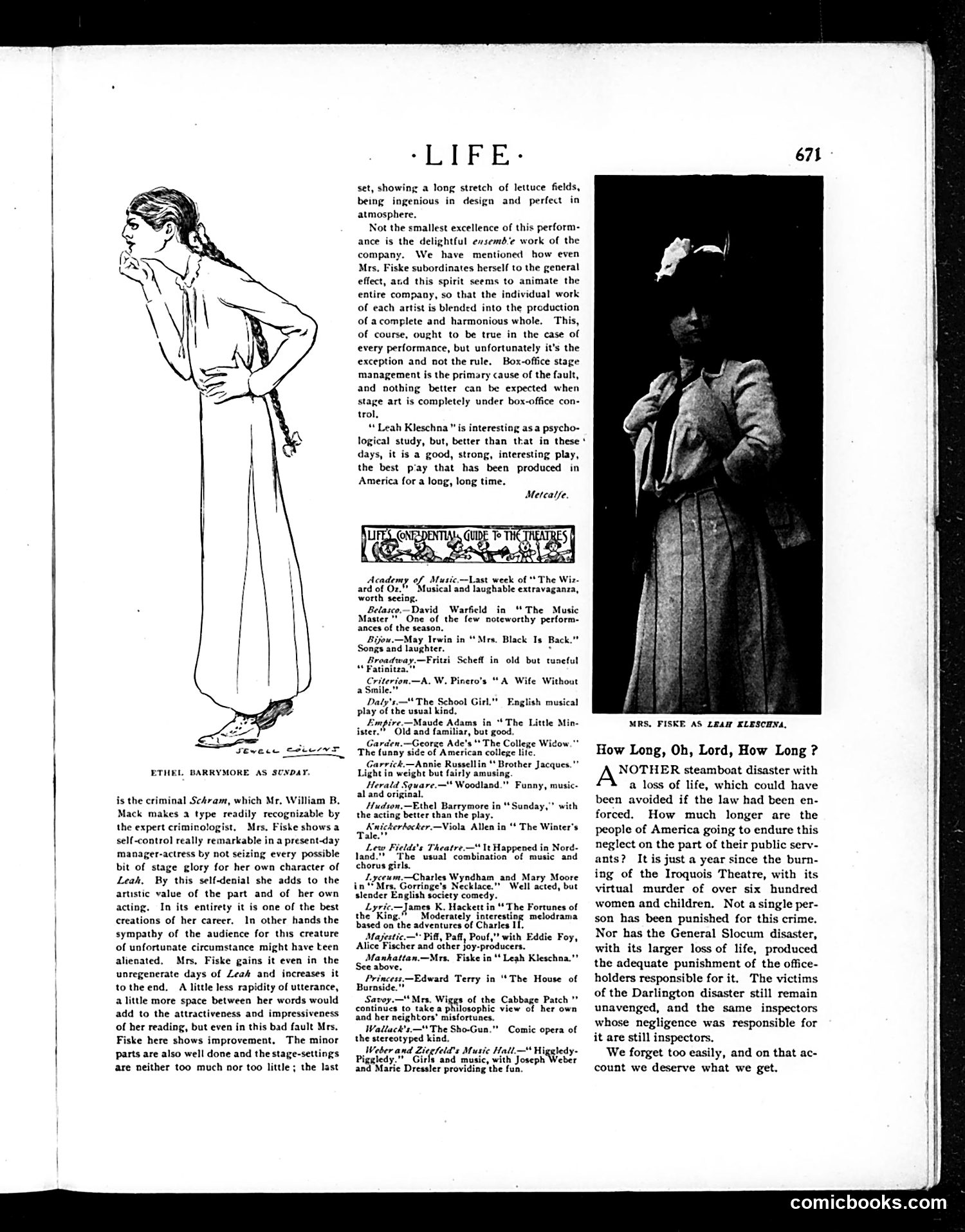
This page contains two theatrical reviews and advertisements. The left illustration shows **Ethel Barrymore as "Sunday,"** a character from a play being reviewed. The right photograph shows **Mrs. Fiske as "Leah Kleschna,"** the subject of the main review. The review praises Mrs. Fiske's performance in *Leah Kleschna*, highlighting her restraint and willingness to subordinate herself to the ensemble—unusual for star actresses of the era who typically dominated productions. The text criticizes "box-office stage management," suggesting that commercial pressures forced stars to monopolize stage time for personal glory rather than artistic integrity. The remainder is a theater listing covering New York venues, reviewing current productions with brief commentary on performances and shows. It reflects early 1900s entertainment culture and Broadway's theatrical landscape.
📄 Transcribed text from this page (OCR, searchable)
Machine-transcribed from the original scan — historical spelling and the odd misread are preserved.
Sbwece Seles sees ETHEL BARRYMORE AS scypar. is the criminal Schram, which Mr, William B. Mack makes a type readily recognizable by the expert criminologist, Mrs, Fiske shows a self-control really remarkable in a present-day manager-actress by not seizing every possible bit of stage glory for her own character of Leah, By this self-denial she adds to the artistic value of the part and of her own acting. In its entirety it is one of the best creations of her career, In other hands the sympathy of the audience for this creature of unfortunate circumstance might have teen alienated. Mrs, Fiske gains it even in the unregenerate days of Leah and increases it tothe end. A little less rapidity of utterance, a little more space between her words would add to the attractiveness and impressiveness of her reading, but even in this bad fault Mrs, Fiske here shows improvement, The minor parts are also well done and the stage-settings are neither too much nor too little; the last ‘LUPE set, showing a long stretch of lettuce fields, being ingenious in design and perfect in atmosphere. Not the smallest excellence of this perform- ance is the delightful exsemd‘e work of the company. We have mentioned how even Mrs, Fiske subordinates herself to the general effect, and this spirit seems to animate the entire company, so that the individual work of each artist is blended into the production of acomplete and harmonious whole. This, of course, ought to be true in the case of every performance, but unfortunately it's the exception and not the rule. Box-office stage management is the primary cause of the fault, and nothing better can be expected when stage art is completely under box-office con- trol, “ Leah Kleschna "is interesting asa psycho- logical study, but, better than that in these days, it is a good, strong, interesting play, the best p'ay that has been produced in America for a long, long time. Metcalfe, Academy of Music —Last week of * The Wiz- ard of Oz." Musical and laughable extravaganza, worth seeing. Belasce.—David Warficld in “The Music Master" One of the few noteworthy perform- ances of the season. Bijou.—May Irwin in “* Mrs. Black Is Back.” ‘Songs and laughter. : Broadway.—Fritzi Schefl in old but tuneful “ Fatinitza Criterion.—A. W. Pinero’s “A Wife Without a Smile.” Daly's —"" The School Girl.” English musical play of the usual kind, Empire.—Maude Adams in “The Little Min- ister.” Old and familiar, but good. Garden.—George Ade's * The College Widow.”* The funny side of American college lie. Garrick.—Annie Russellin ** Brother Jacques."” Light in weight but fairly amusing. Herald Square.—* Woodland.” Funny, music- al and original. Hudson.—Ethel Barrymore in “Sunday,” with the acting better than the play. Knickerkocker.—Viola Allen in“ The Winter's Tale."* Lew Fields's Theatre — It Happened in Nord- land.” ‘The usual combination of music and chorus girls. Lyceum.—Charles Wyndham and Mary Moore in Mrs. Gorringe’s Necklace." Well acted, but slender English society comedy. Lyric—James K. Hackett in “The Fortunes of the King.” Moderately interesting melodrama based on the adventures of Charles If. Majestic.—"" Piff, Pafl, Pouf,”” with Eddie Foy, Alice Fischer and other Joy-producers. Manhattan.—Mrs, Fiske in Leah Kleschna."* See above, Princess—Edward Terry in “The House of Burnside. Savoy. —" Mrs. Wiggs of the Cabbage Patch "” continues to take a philosophic view of her own and her neightors’ misfortunes. Waltack's.—" The Sho-Gun." Comic opera of the stereotyped kind, Weber and Ziegfeld's Music Hall — Higgledy- Piggledy.”” Girls and music, with Joseph Weber and Marie Dressler providing the fun, 671 MRS, FISKE AS L4H KLESCHNA, How Long, Oh, Lord, How Long ? NOTHER steamboat disaster with a loss of life, which could have been avoided if the law had been en- forced. How much longer are the people of America going to endure this neglect on the part of their public serv- ants? It is just a year since the burn- ing of the Iroquois Theatre, with its virtual murder of over six hundred women and children, Not a single per- son has been punished for this crime. Nor has the General Slocum disaster, with its larger loss of life, produced the adequate punishment of the office- holders responsible for it. The victims of the Darlington disaster still remain unavenged, and the same inspectors whose negligence was responsible for it are still inspectors. We forget too easily, and on that ac- count we deserve what we get. comicbooks.com