
A complete issue · 24 pages · 1904
Life — November 17, 1904
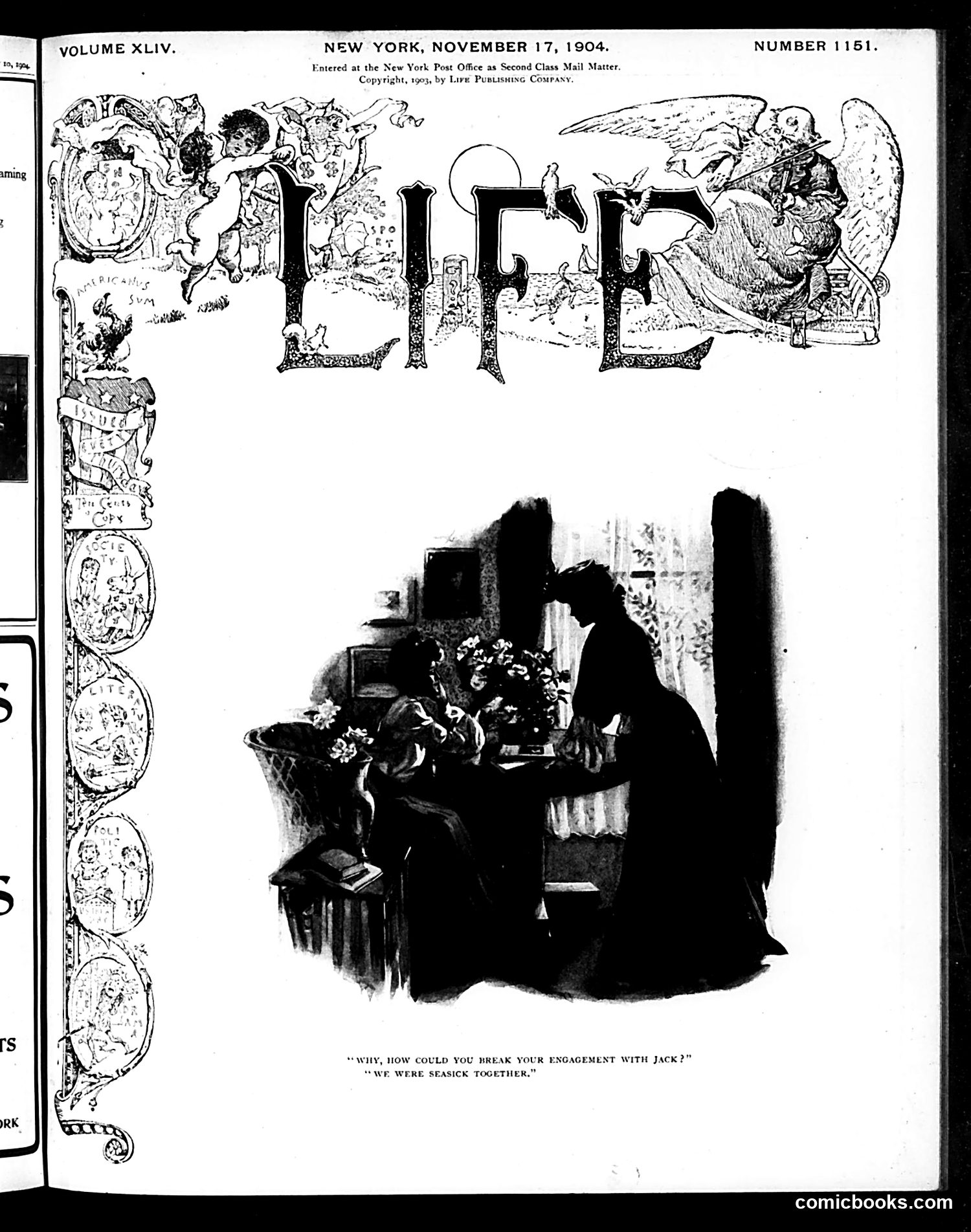
This page features a social cartoon with the caption: "Why, how could you break your engagement with Jack?" / "We were seasick together." The illustration depicts two women in what appears to be a ship's cabin or similar enclosed space, with one woman confronting another about breaking an engagement. The joke relies on early 1900s courtship customs: seasickness was considered deeply embarrassing and unflattering, particularly for women. Sharing such an intimate, unglamorous experience—being visibly ill together—apparently violated the romantic ideal necessary for marriage. The satire mocks how fragile Victorian engagement promises were, suggesting that witnessing someone's physical vulnerability could destroy romantic interest, even when that vulnerability resulted from circumstance rather than character.
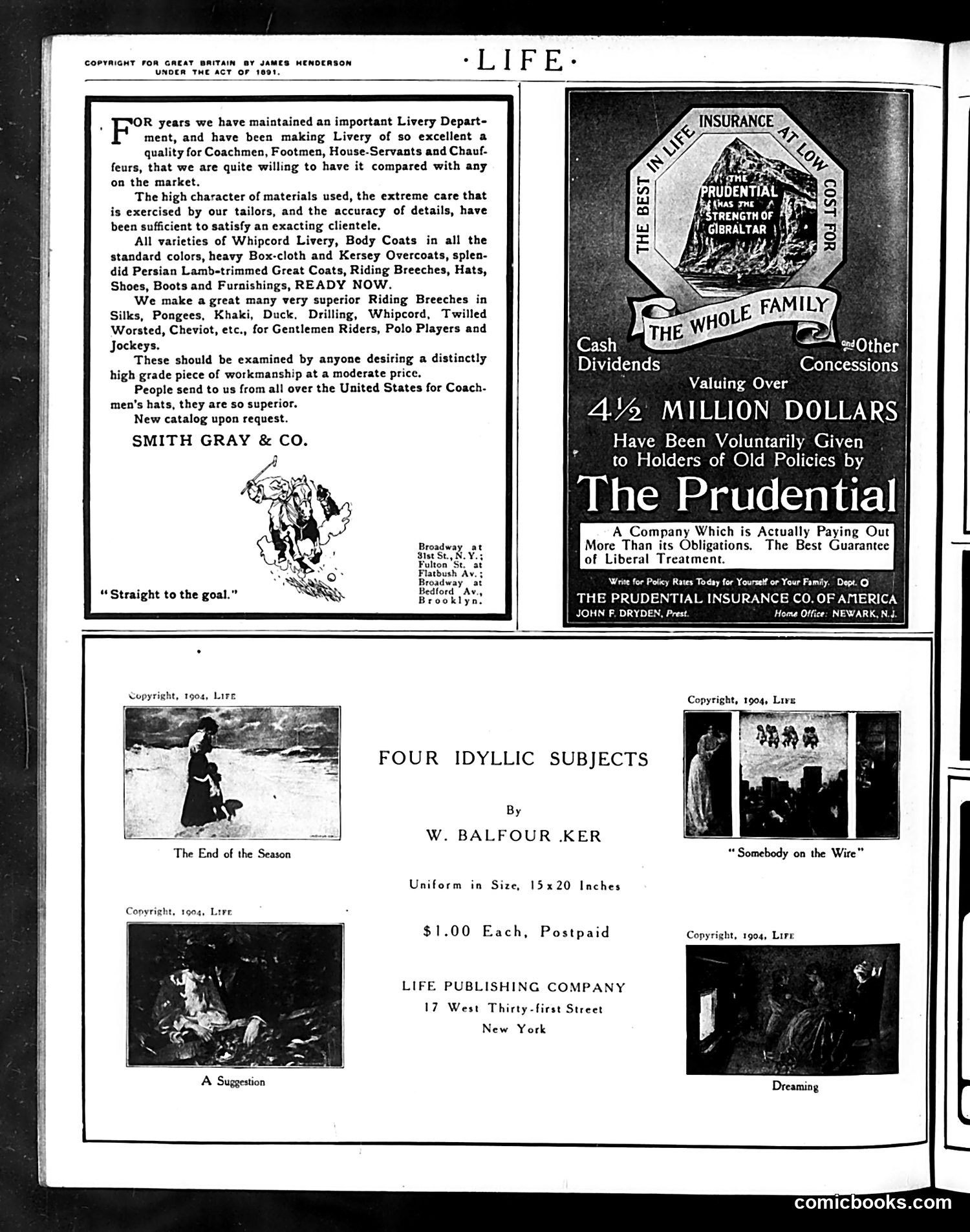
This page is primarily **advertising and artwork**, not satire or political cartoon. The top half contains two ads: Smith Gray & Co. (a livery/clothing company) and The Prudential Insurance Company promoting life insurance benefits. The bottom half advertises "Four Idyllic Subjects" — photographic art prints by W. Balfour Ker, offered by Life Publishing Company for $1.00 each. The four images are titled: "The End of the Season," "Somebody on the Wire," "A Suggestion," and "Dreaming." These appear to be sentimental or domestic scenes typical of early 1900s art photography. There is no political satire or caricature present. This is a commercial page mixing business advertisements with art sales.
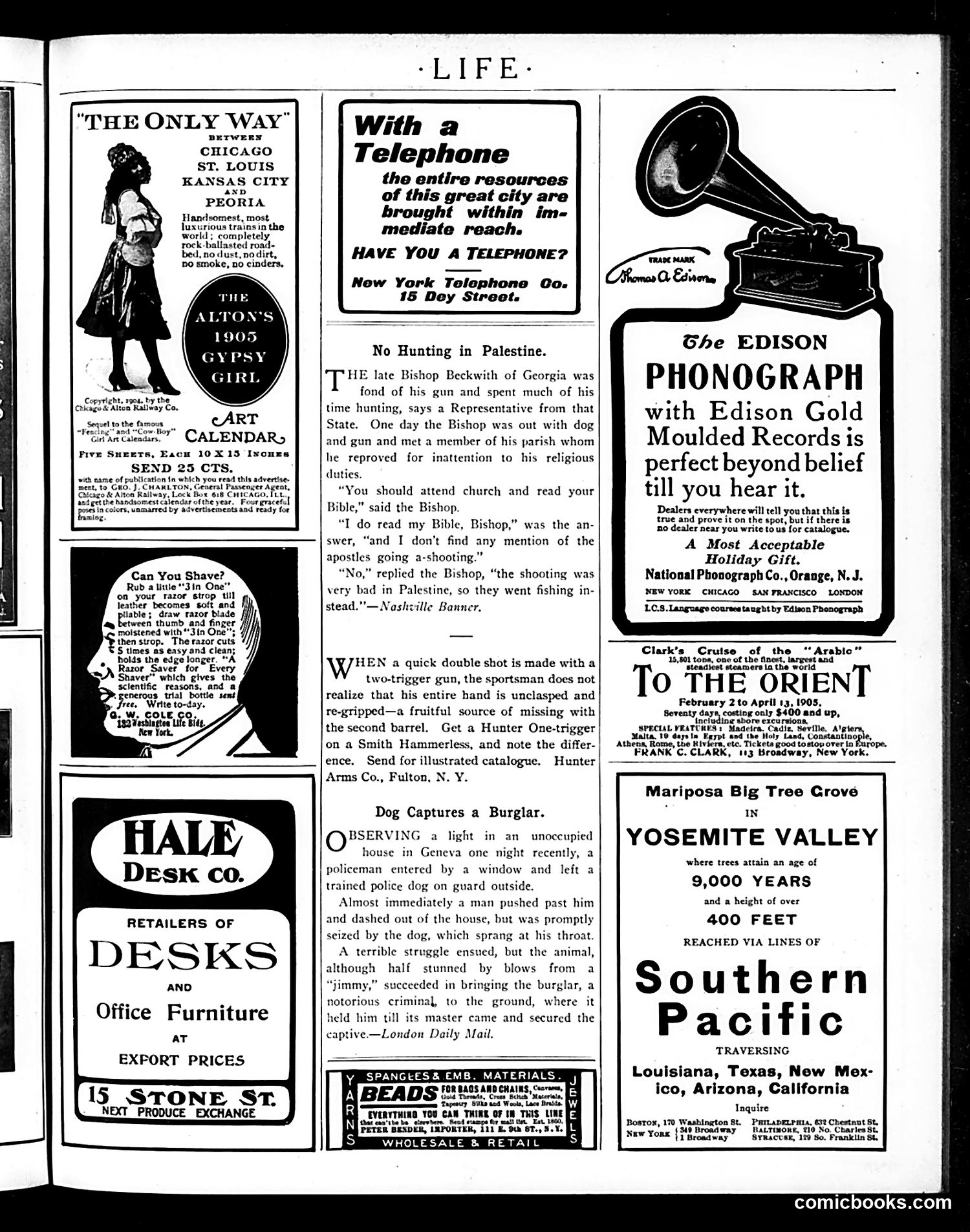
This page is primarily **advertising**, not political satire. The ads promote consumer products and services circa 1905: - **Alton's 1905 Gypsy Girl Calendar** - a promotional calendar - **Telephone service** - promoting New York Telephone Company - **Edison Phonograph** - with gold-moulded records, marketed as a holiday gift - **Hunter Arms** - sporting rifle advertisement - **Hale Desk Co.** - office furniture retailer - **Orient cruise** - travel advertisement for the Southern Pacific railway The page includes one brief **humorous anecdote** about a bishop who confused Biblical hunting with actual hunting in Palestine—a light joke with no political content. The advertisements reflect early 20th-century consumer goods and services targeting middle-class readers. There is no discernible political cartoon or social satire on this page.
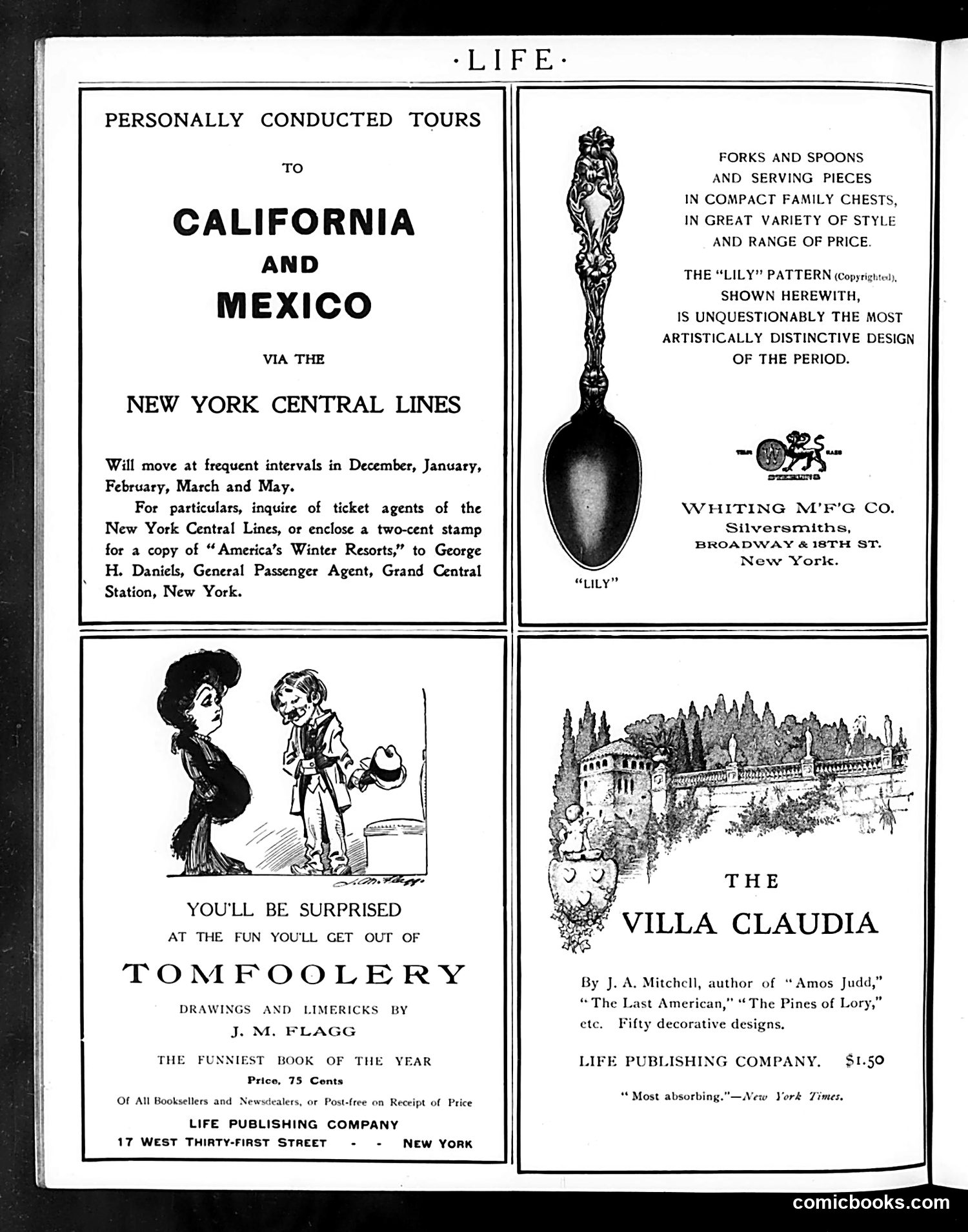
This page is primarily **advertising content**, not editorial cartoons or political satire. It contains four advertisements: 1. **Top left**: Travel tours to California and Mexico via New York Central Lines 2. **Top right**: Whiting Manufacturing Company's "Lily" pattern silverware 3. **Bottom left**: "Tomfoolery," a humor book with drawings and limericks by J.M. Flagg. The cartoon shows a woman and child in a domestic scene; the joke appears to relate to humorous domestic situations. 4. **Bottom right**: "The Villa Claudia," a novel by J.A. Mitchell The Tomfoolery advertisement is the only element with cartoon imagery, but it's promotional rather than political commentary. This appears to be a typical early 20th-century magazine page mixing travel promotions, household goods, and entertainment products.
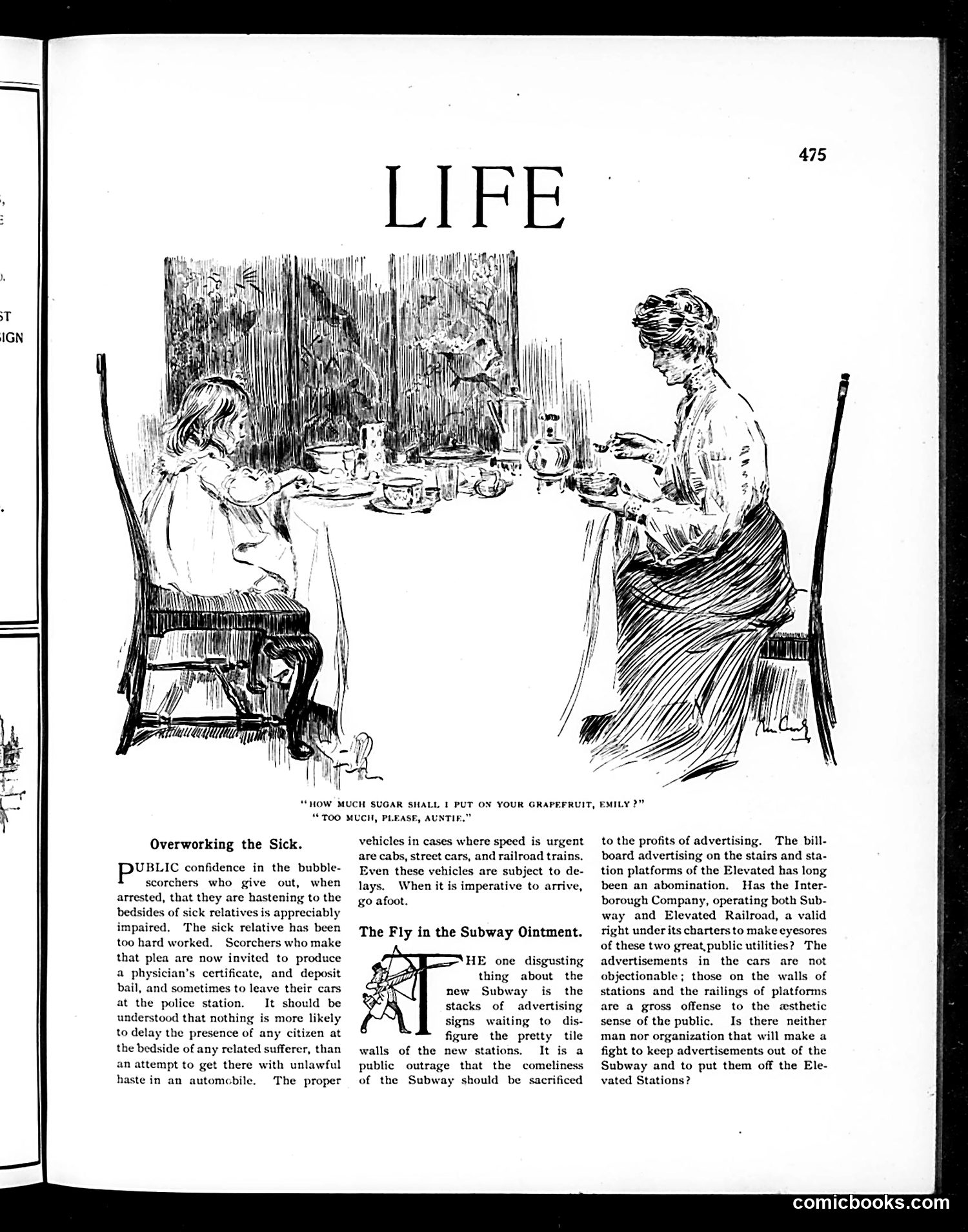
The main cartoon depicts two women at breakfast. The caption reads: "How much sugar shall I put on your grapefruit, Emily?" / "Too much, please, auntie." This is a gentle domestic humor piece about excessive sugar consumption—likely satirizing either early 20th-century dietary habits or advertising claims about sugar's benefits. The articles below address public infrastructure complaints: "Overworking the Sick" criticizes ambulance drivers rushing patients unsafely, and "The Fly in the Subway Ointment" protests excessive advertising signage in new subway stations, arguing advertisements disfigure public spaces. These pieces reflect Progressive Era concerns about public health, safety, and aesthetic preservation against commercial interests.
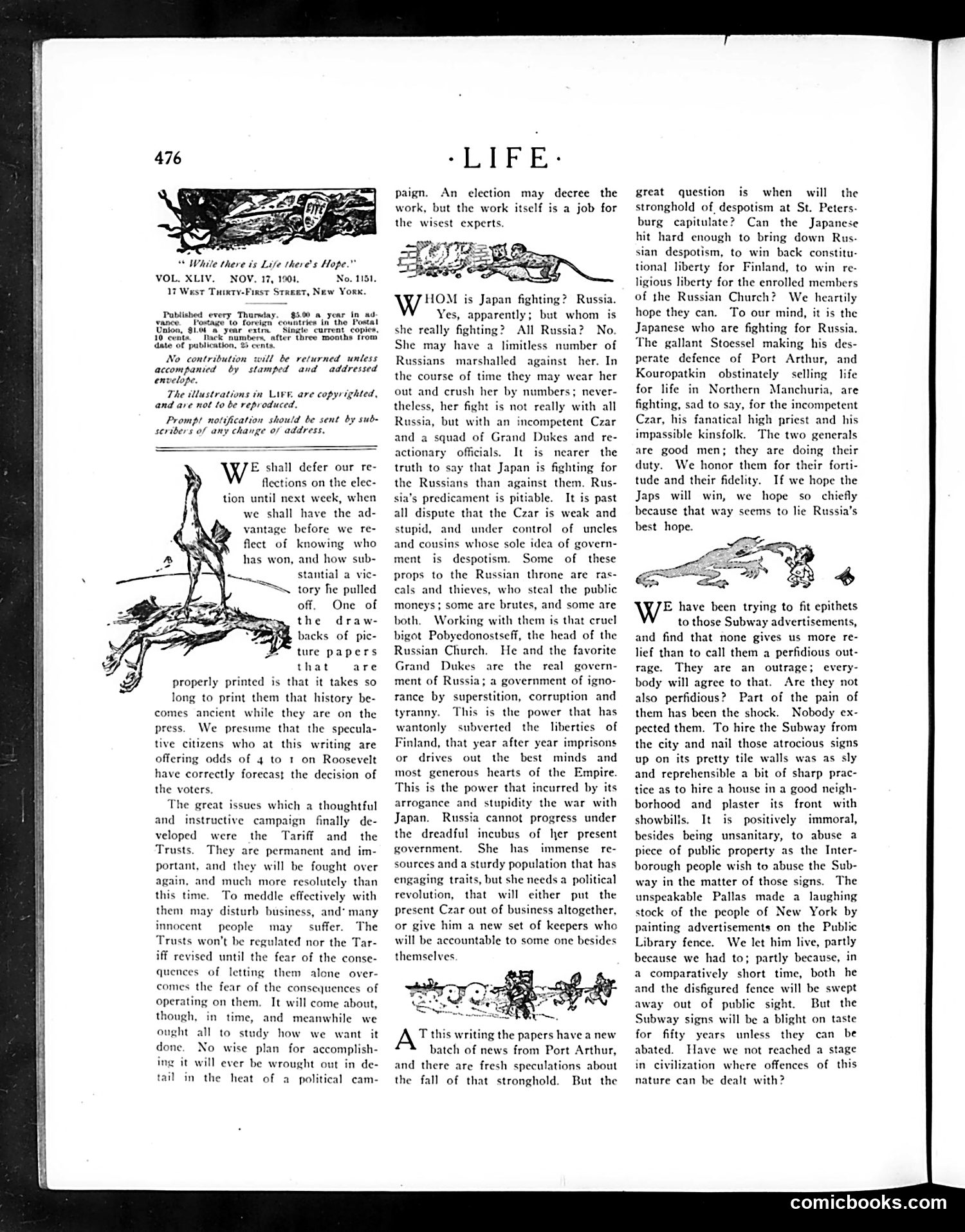
This editorial page discusses the Russo-Japanese War (1904-1905). The text argues that Japan isn't really fighting "all Russia" but rather an incompetent Tsar and corrupt officials—the "real" Russia, it claims, is politically enslaved. The accompanying illustrations appear to depict allegorical figures, likely representing abstract concepts of power, tyranny, or struggle, though specific identities are unclear from the image alone. The page also critiques Subway advertisements in New York City as eyesores and "pernicious outrages," arguing they deface public property. The author advocates for stricter regulation of such commercial signage. The overall message reflects progressive-era skepticism toward both Russian autocracy and unchecked American commercial interests.
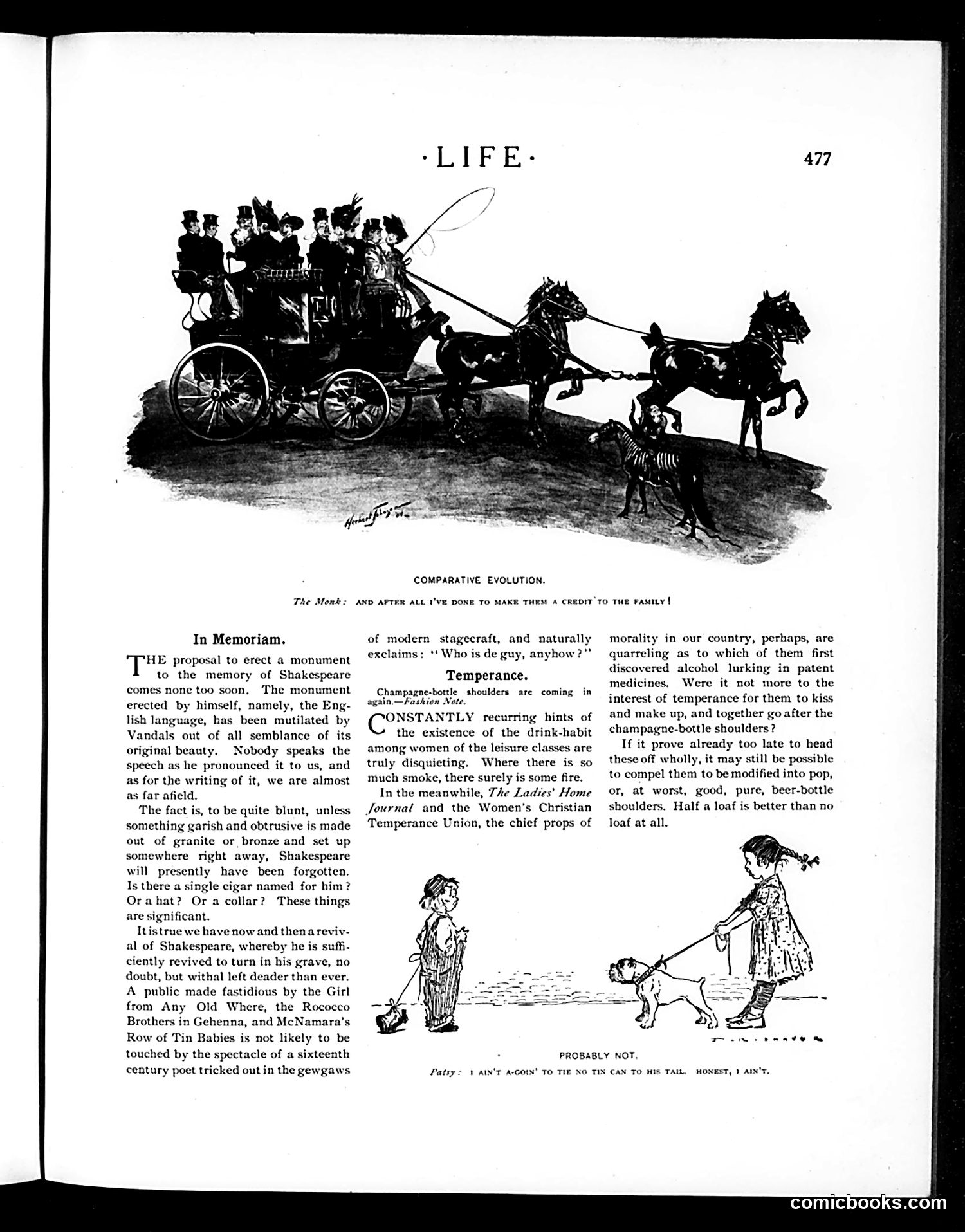
This page contains two distinct satirical pieces from *Life* magazine: **Top cartoon ("Comparative Evolution"):** A visual pun showing a stagecoach full of well-dressed passengers pulled by horses, with the caption "The Monk: and after all I've done to make them a credit to the family!" The joke plays on Darwin's theory of evolution, sarcastically suggesting humans have "evolved" from monkeys—but modern society remains chaotic and undignified. **Bottom section ("Temperance"):** Satirizes the Women's Christian Temperance Union's crusade against alcohol. The text mocks wealthy women's hypocrisy regarding champagne while advocating temperance. The accompanying sketch shows a child with a dog, captioned "Probably Not"—a young girl unable to coax obedience from her pet, suggesting women reformers are similarly ineffective at controlling social behavior. Both pieces critique contemporary moral reform movements through humor and irony.
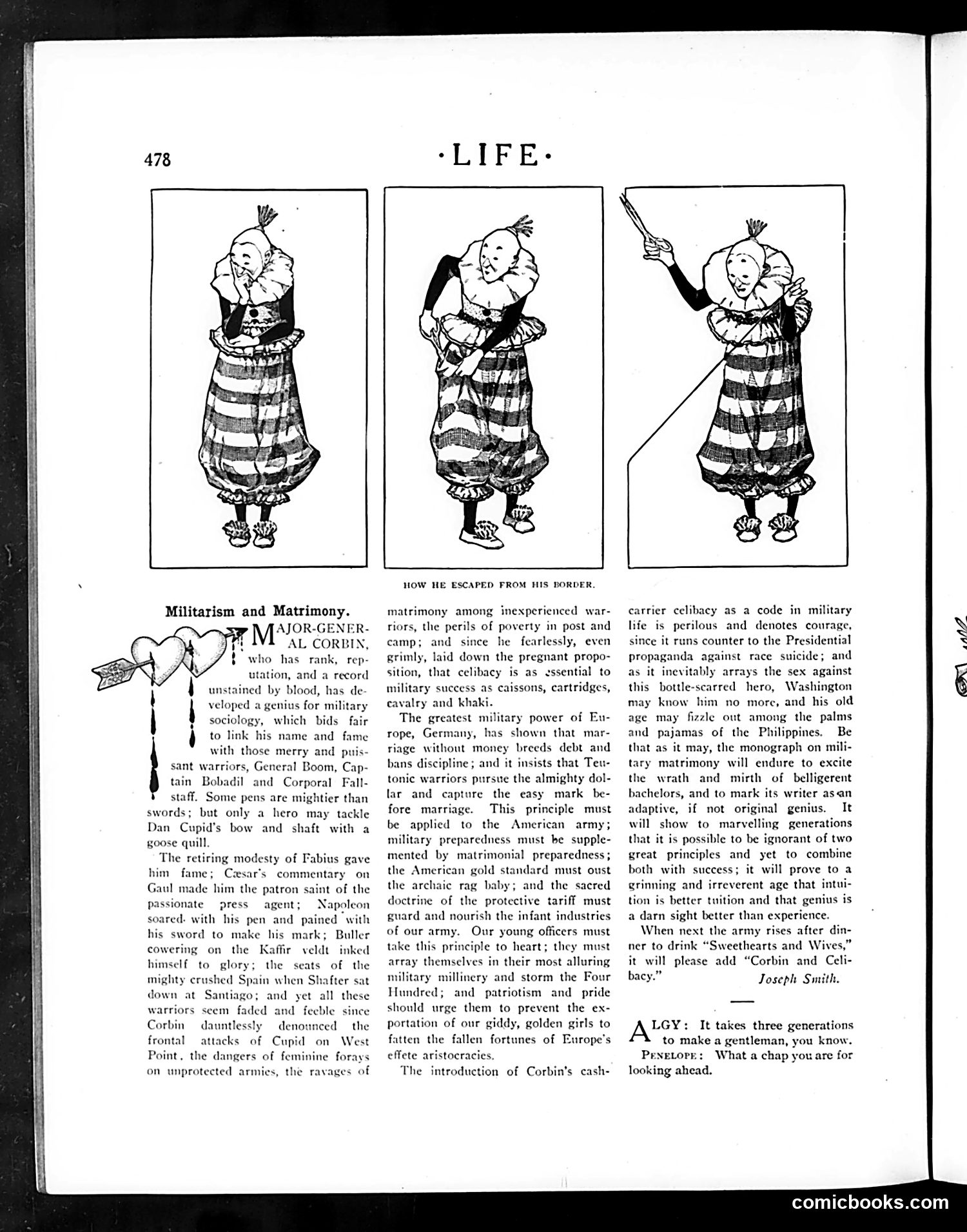
The three-panel cartoon shows a clown-like figure in a striped costume progressing through three poses. The caption "HOW HE ESCAPED FROM HIS BORDER" suggests military escape or desertion. The accompanying essay argues that military readiness requires officers to marry young—that matrimony is "essential to military success" alongside "cartridges, cavalry and khaki." The text references Major-General Corbin and invokes historical figures (Napoleon, Caesar, Butler) to support mandatory military marriage. The satire targets American military doctrine by proposing an absurd solution—forced matrimony—to strengthen the army. The cartoon's exaggerated clown figure ridicules this notion. The piece appears to critique both military overreach and the instrumental use of women's roles in justifying military policy.
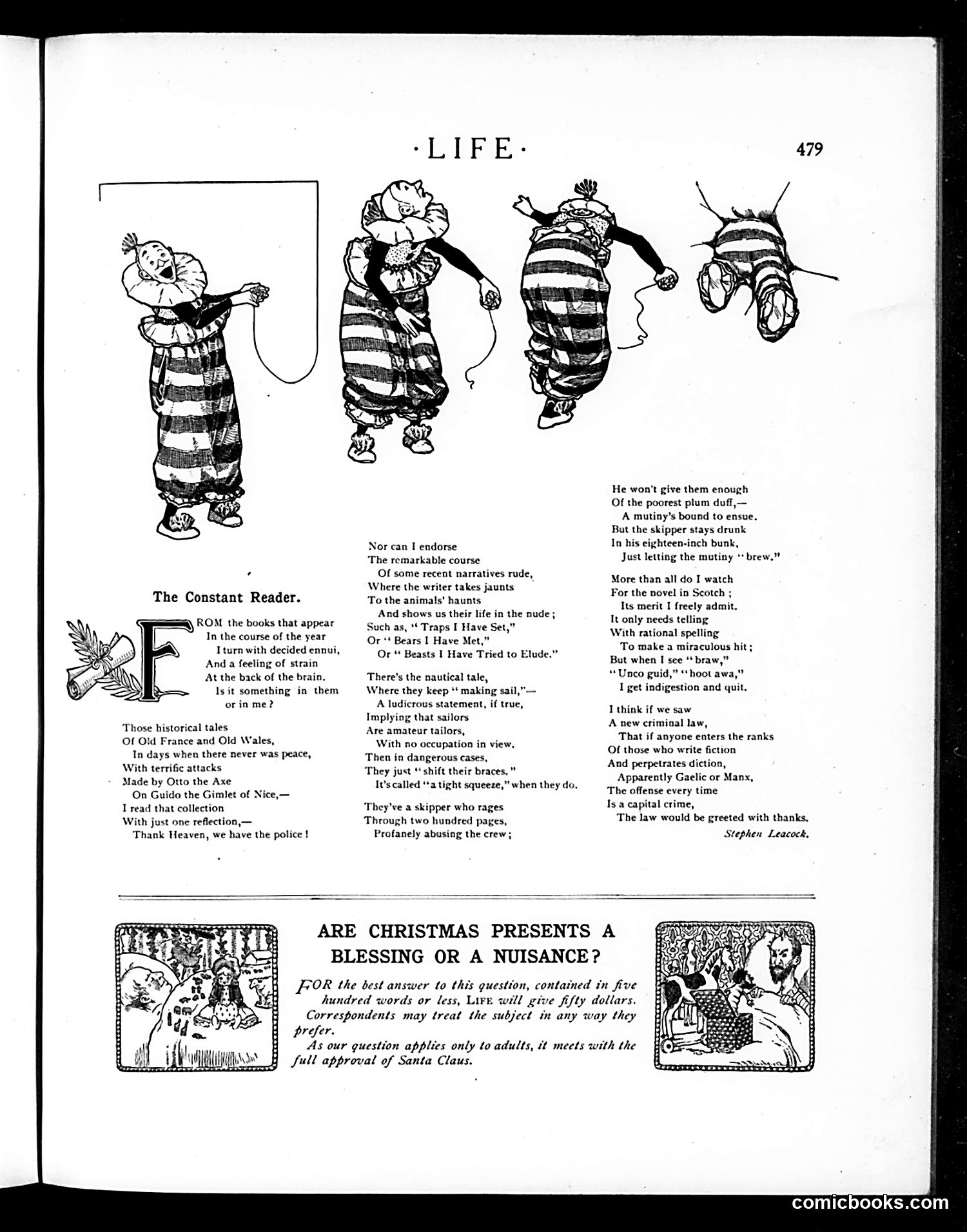
**Main Content: "The Constant Reader"** This is a satirical poem by Stephen Leacock critiquing poorly-written adventure novels popular in the early 20th century. The cartoon illustrations show a character (likely representing the exhausted reader) in striped pajamas, progressively more disheveled as he consumes these books. Leacock mocks narratives with absurd titles like "Traps I Have Set" and "Beasts I Have Tried to Elude," and complains about Scottish novels filled with dialect and unconvincing sailor stories. The satire targets low-quality pulp fiction's prevalence and readers' tolerance for it. **Bottom Section:** A contest announcement asking readers whether Christmas presents are "a blessing or a nuisance," offering fifty dollars for the best 500-word answer. It's positioned as addressing adults only, with Santa's approval—a humorous editorial feature typical of Life magazine's interactive content.
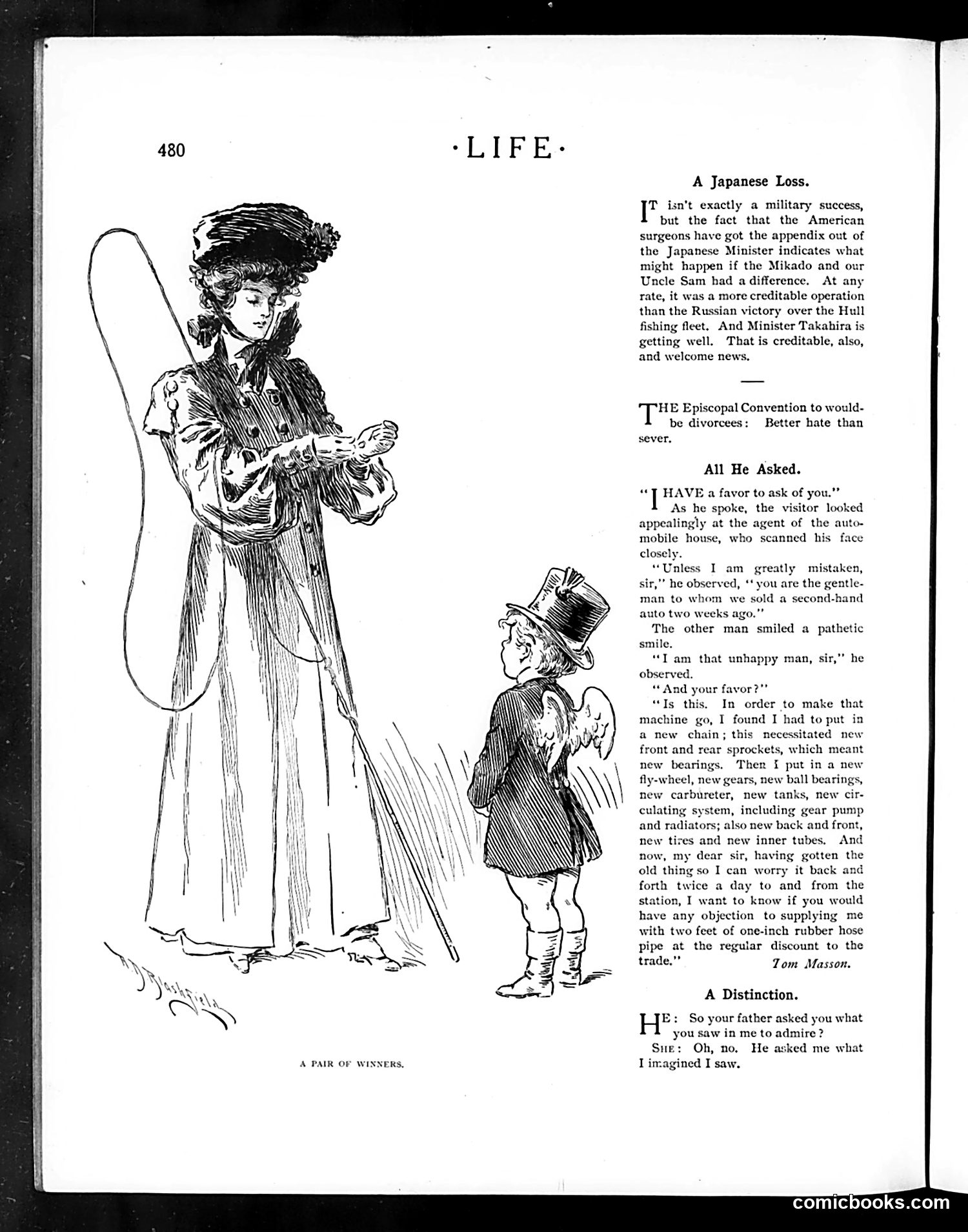
**The Main Cartoon ("A Pair of Winners"):** Shows a fashionably dressed woman fishing and a small man in a top hat below her. The title suggests both are "winners"—likely depicting a successful courtship or social conquest. The woman appears to be "fishing" (metaphorically) for a husband, having caught this gentleman. **The Accompanying Pieces:** Brief humorous items reference contemporary topics: a Japanese military loss (likely from the Russo-Japanese War era), Episcopal divorce debates, and an auto-repair anecdote about a used-car buyer facing mounting repair costs. **Overall Context:** This appears to be a typical Life magazine page mixing satirical commentary on current events with genteel humor about courtship and consumer problems—entertainment for early 20th-century American readers.
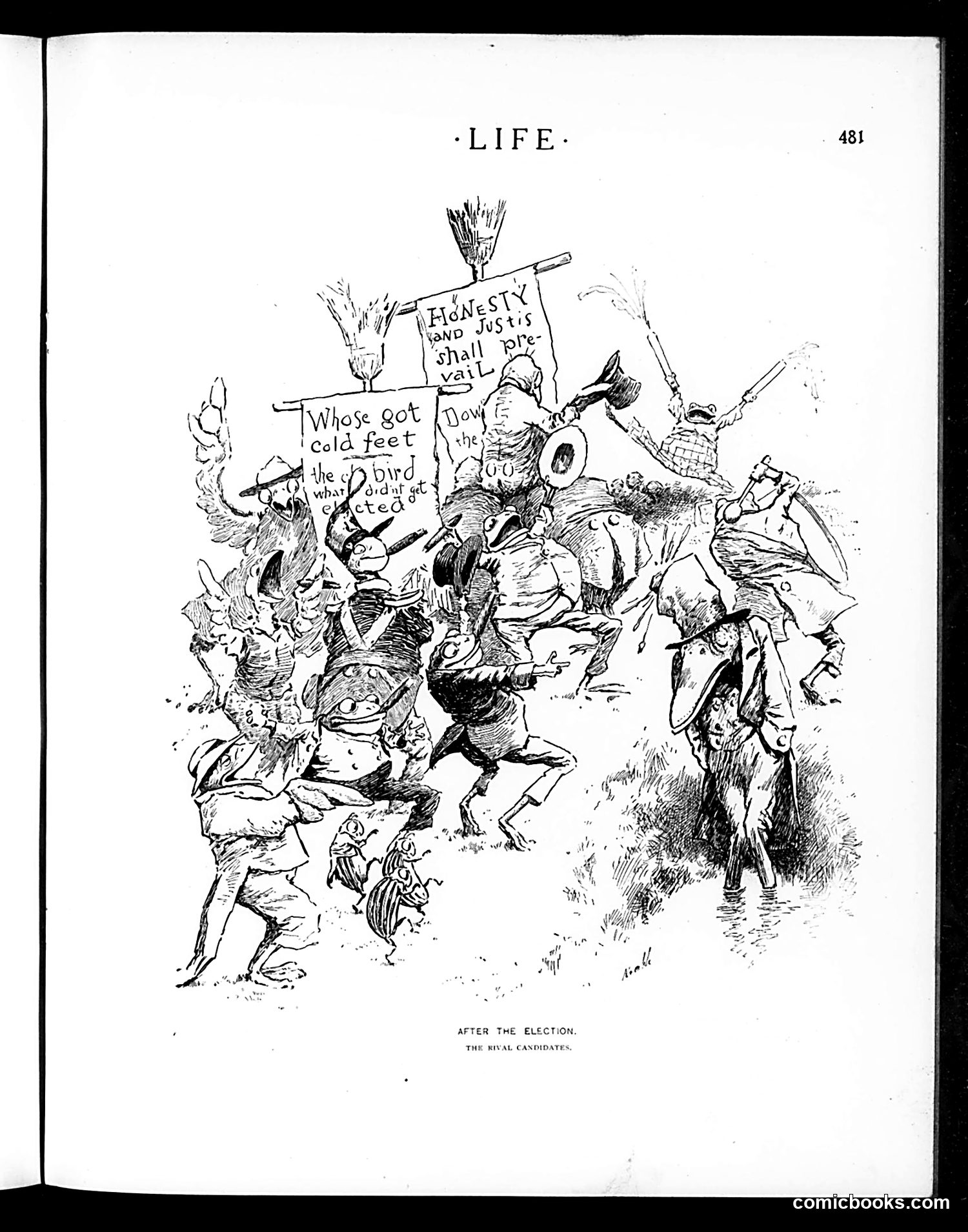
This satirical cartoon depicts the chaotic aftermath of an election. Multiple figures—representing rival political candidates—dance and cavort wildly around a central pole bearing signs proclaiming "Honesty and Justice shall prevail." One banner references "Whose got cold feet / the bird / acted" while another shows candidates in undignified, animalistic poses. The scene suggests that once the election concludes, political rivals abandon their noble campaign promises and revert to self-serving behavior and bitter rivalry. The "honesty and justice" banner appears ironic—a hollow pledge rendered meaningless by the candidates' actual conduct. The cartoon satirizes the hypocrisy of politicians who campaign on virtue but behave corruptly once elected or defeated.
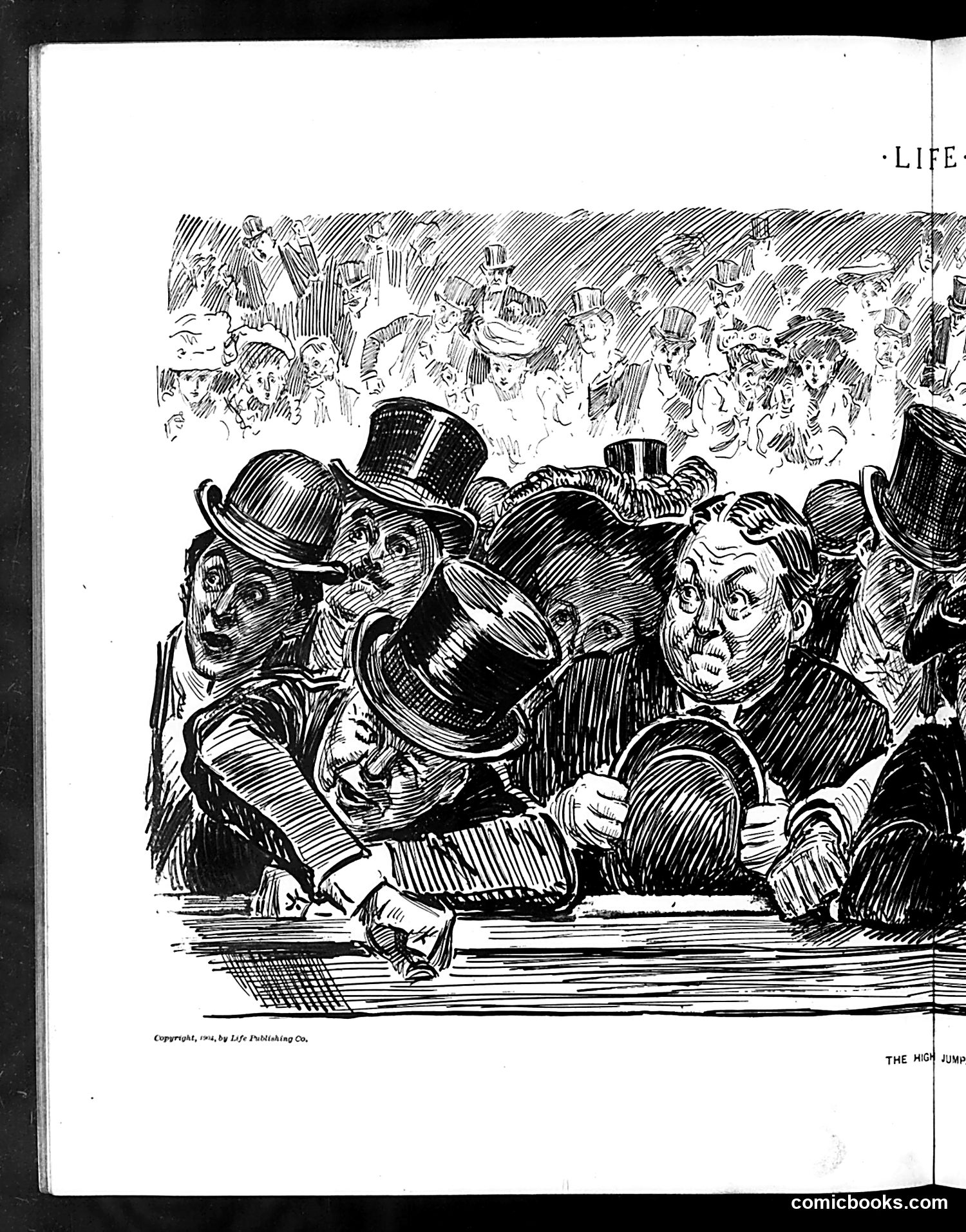
This satirical cartoon depicts several well-dressed gentlemen in top hats attempting or preparing for a high jump competition. The figures are exaggerated caricatures with distinctive facial features typical of early 20th-century political cartooning. The "high jump" appears to be a metaphor for social or economic advancement. The foreground shows three prominent figures straining or struggling with the effort, while a crowd watches in the background. The satirical point likely critiques the difficulty or artificiality of social mobility—the notion that achieving success requires enormous effort and may be rigged against certain groups. Without additional context or visible text identifying specific individuals, the exact political figures or social commentary remains unclear, though the theme of class struggle or meritocracy appears central.
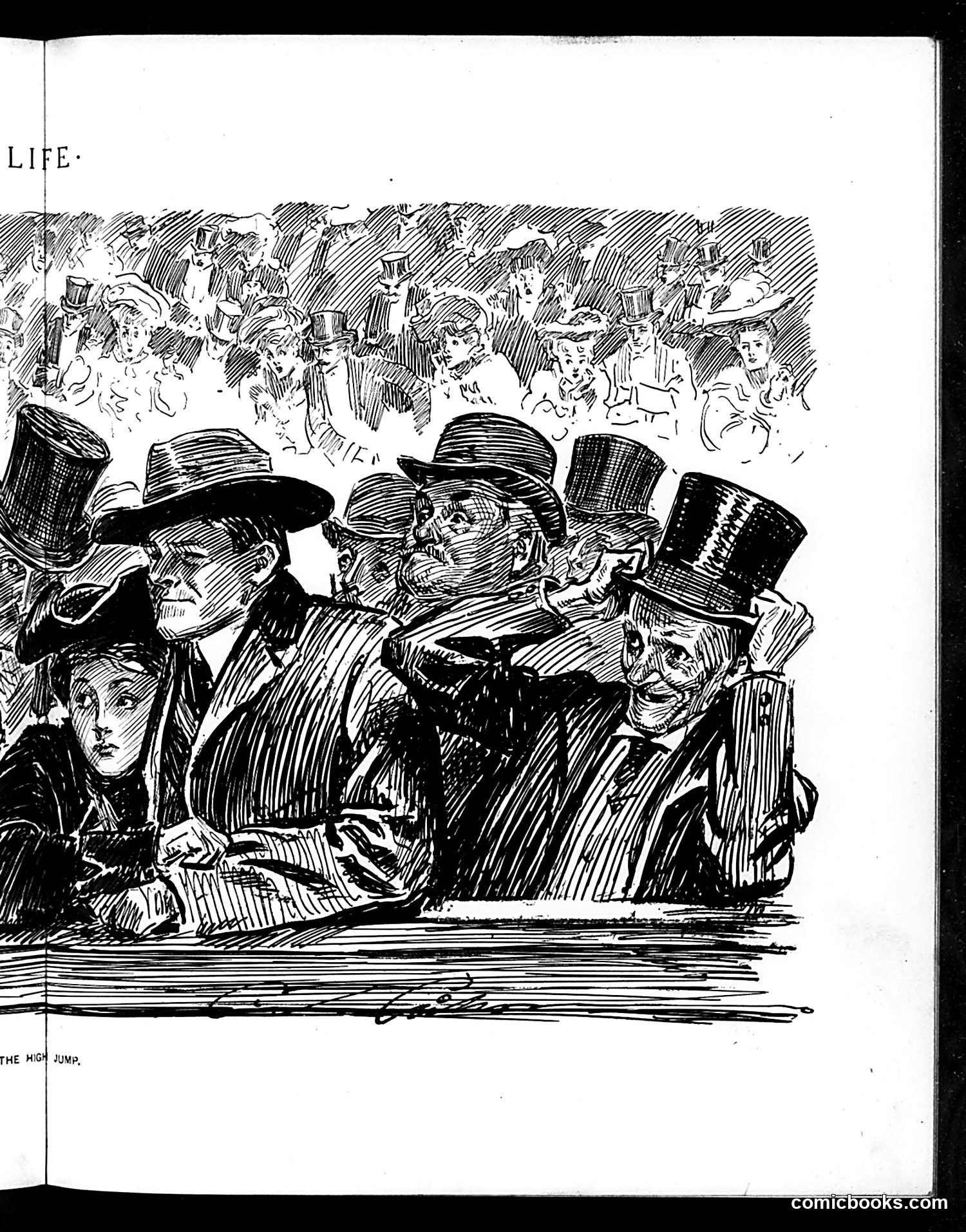
This satirical cartoon depicts wealthy, well-dressed men in top hats attempting to leap over a barrier—literally "the high jump." The figures in the foreground are heavily shaded and darkly rendered, suggesting they represent elite or privileged classes. The lighter, more lightly-sketched crowd in the background appears to represent common people. The satire likely critiques either: - Economic inequality and the difficulty the wealthy face maintaining their status - Social mobility barriers (the "jump" being an obstacle to advancement) - Class competition or struggle during a period of social tension The exaggerated caricatures and formal dress emphasize mockery of upper-class pretension. Without additional context or visible dates, the specific historical moment remains unclear, though the style suggests early-to-mid 20th century publication.
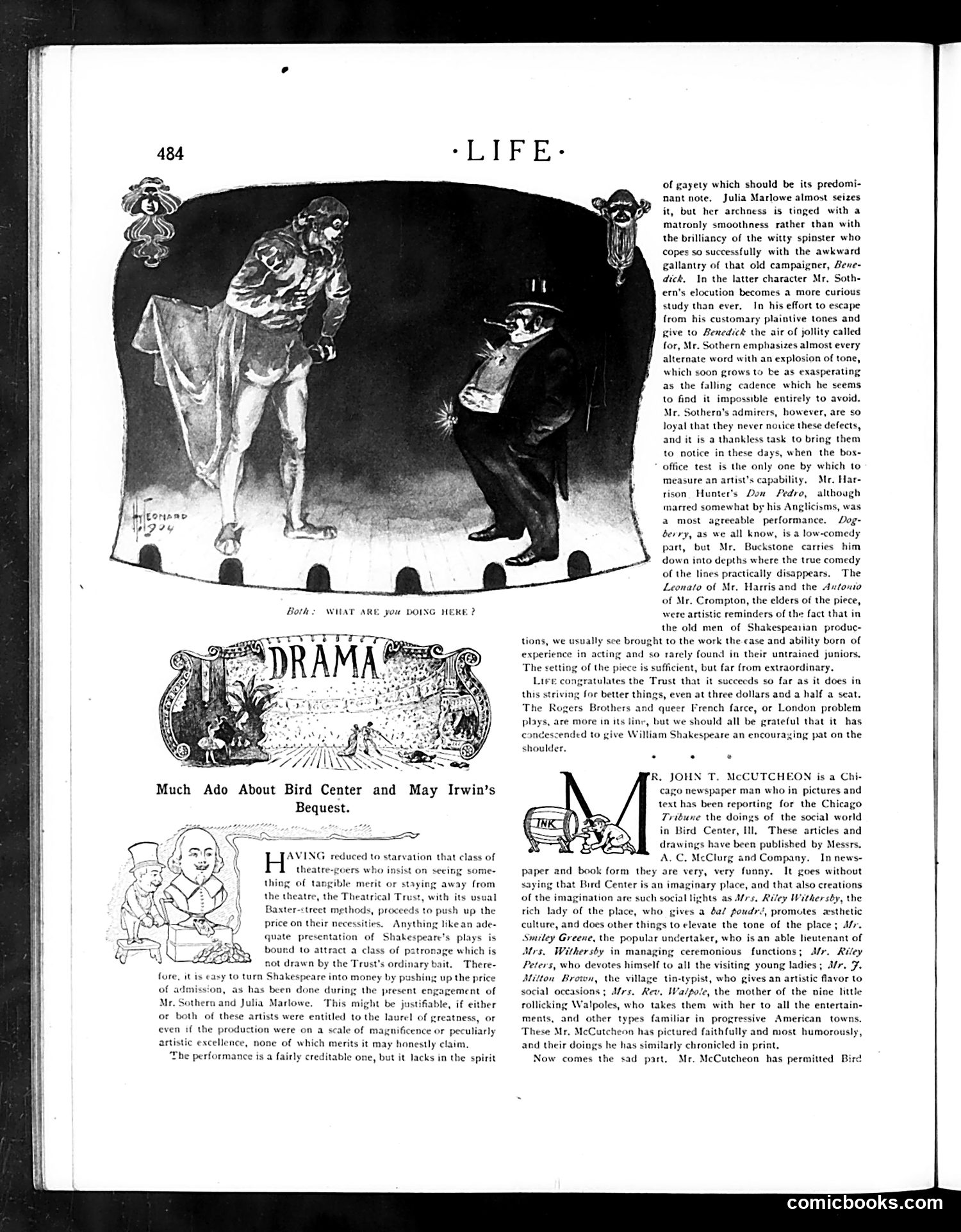
This page contains a theatrical review and arts content, not primarily political satire. **The Main Cartoon:** Shows a well-dressed man (appearing to be a theater manager or impresario) confronting what looks like actors or performers on stage, with the caption "WHAT ARE YOU DOING HERE?" The illustration critiques a Shakespeare production. **The Theater Review:** Discusses a production of *Much Ado About Nothing* starring Mr. Sothern and Julia Marlowe. The critic argues the actors lack brilliance despite charging high prices (three dollars and a half per seat). Julia Marlowe's performance feels matronly rather than witty; Sothern's delivery is criticized for exaggerated, explosively-emphasized words that become tiresome. The review suggests audiences only measure success by box-office returns rather than artistic merit. **Secondary Content:** Introduces John T. McCutcheon's humorous illustrations and articles about fictional "Bird Center, Illinois" published by A.C. McClurg and Company—satirizing small-town American social pretensions through characters like "Mrs. Riley Withersby." The page reflects early 1900s concerns about commercialism overshadowing theatrical artistry.
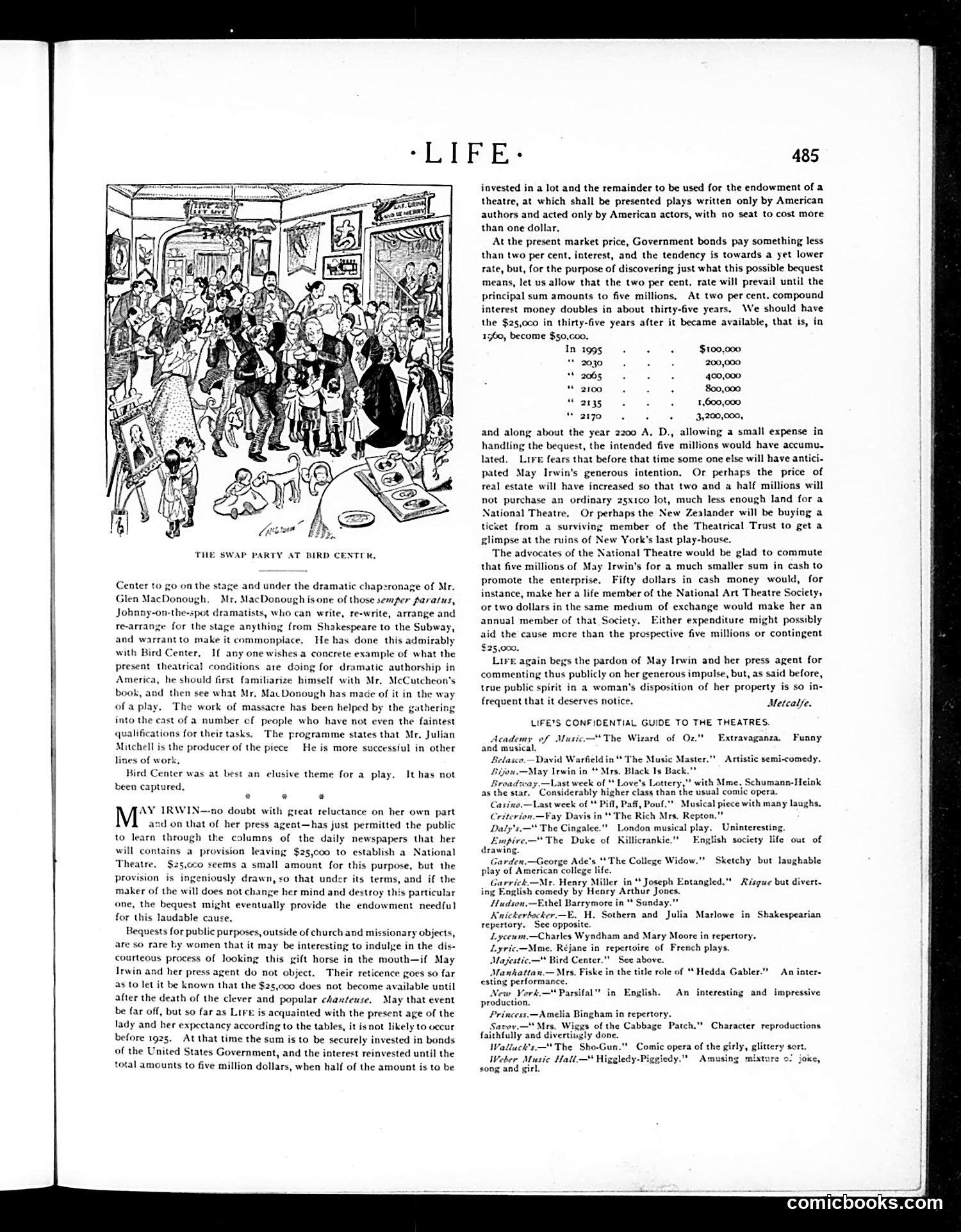
The cartoon illustrates a crowded theatrical scene labeled "The Swap Party at Bird Center," satirizing the chaos of contemporary theatrical production. The illustration depicts numerous people in what appears to be backstage confusion—reflecting the text's critique of how theatrical authorship functions in America. The accompanying article mocks the adaptation of a play by criticizing the involvement of unqualified cast members and producers. It sarcastically suggests that if someone wants to understand how theatrical conditions damage dramatic authorship, they should examine this particular production, where even the producer Julian Mitchell appears miscast despite success elsewhere. The broader satire targets how American theater prioritizes spectacle and commercial casting over artistic merit.
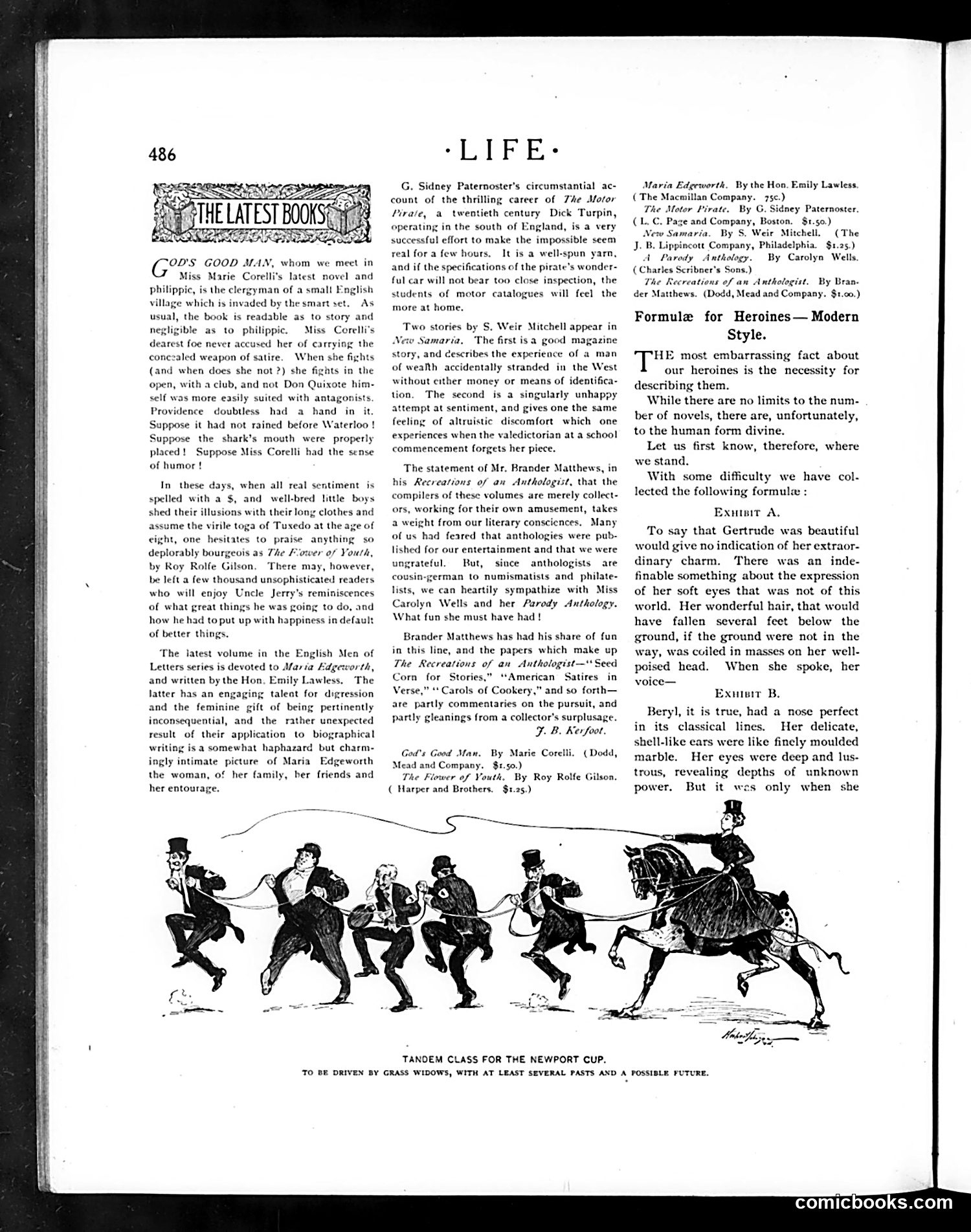
This page contains book reviews and literary commentary rather than political cartoons. The single illustration at the bottom is a humorous sporting cartoon captioned "Tandem Class for the Newport Cup," depicting five men in formal dress being pulled along by a woman on horseback—a joke about wealthy socialites at Newport, Rhode Island competing in fashionable events. The text reviews several books, notably criticizing Marie Corelli's *God's Good Man* as lacking genuine satirical bite despite its social commentary, and praising Roy Rolfe Gilson's *The Flower of Youth* for appealing to sentimental readers. References to "smart set" invasions and themes of "bourgeois" sentiment suggest the era's preoccupation with class distinctions between refined society and ordinary people. The page reflects turn-of-century concerns about commercialization ("all real sentiment is spelled with a $") and changing social values.
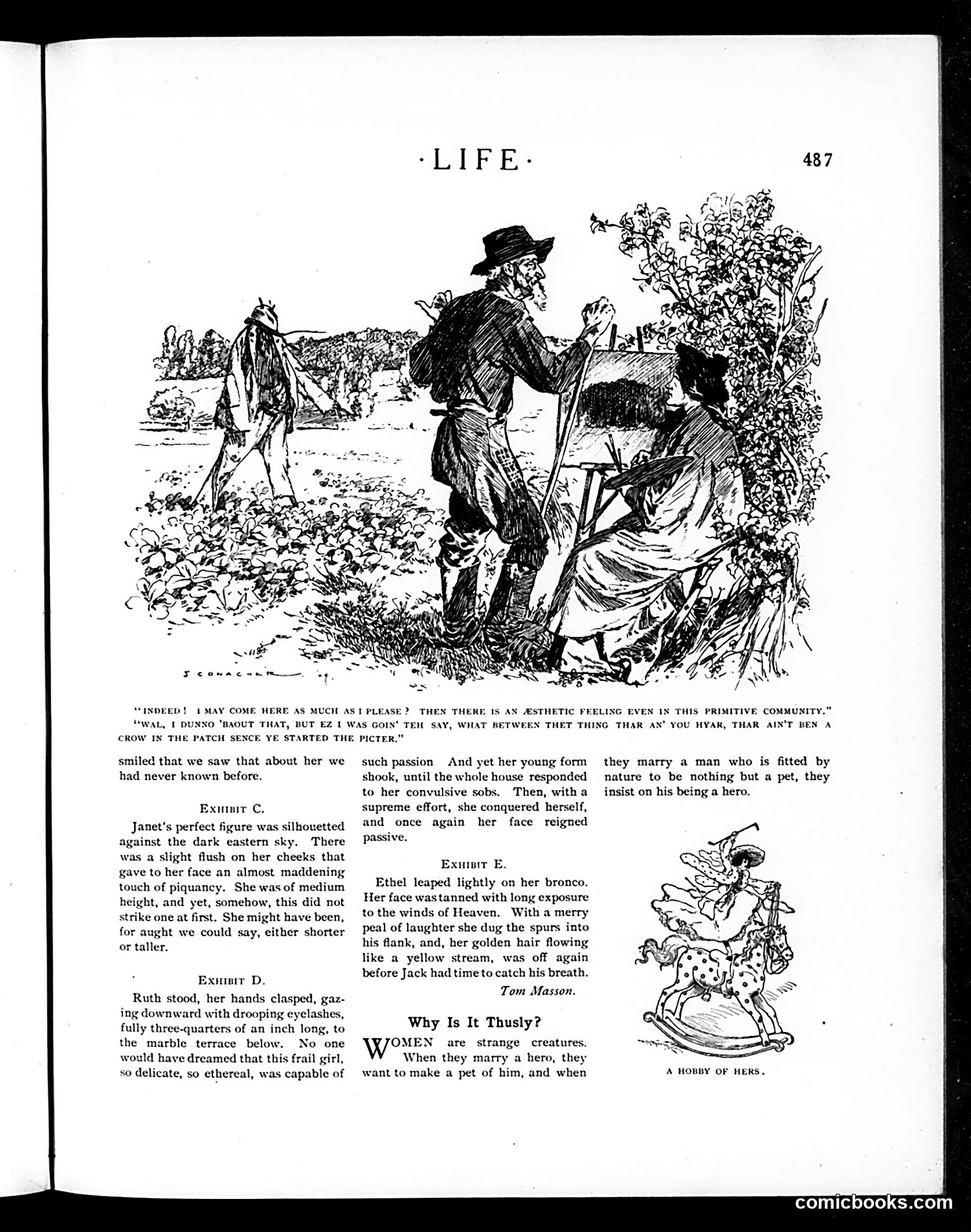
This page from *Life* magazine contains two distinct satirical pieces: **Top Cartoon:** A rural farmer complains to an aesthete visitor about a scarecrow. The joke mocks pretentious urban intellectuals who romanticize primitive rural life. The farmer speaks in dialect ("WAL, I DUNNO"), while the visitor uses affected language about "aesthetic feeling." The punchline: the scarecrow (presumably placed by the aesthetic visitor) is so lifelike that it's actually *stopped* scaring crows—inverting the farmer's practical concerns against the visitor's artistic pretensions. **Literary Parody ("Why Is It Thusly?"):** This satirizes overwrought romantic fiction common in the era. The excerpts mock purple prose describing heroines with exaggerated physical details ("drooping eyelashes, fully three-quarters of an inch long"). The accompanying essay's final paragraph critiques women's contradictory expectations of husbands—wanting heroes to be pets, or pets to be heroes—a commentary on gender role confusion in contemporary marriage.
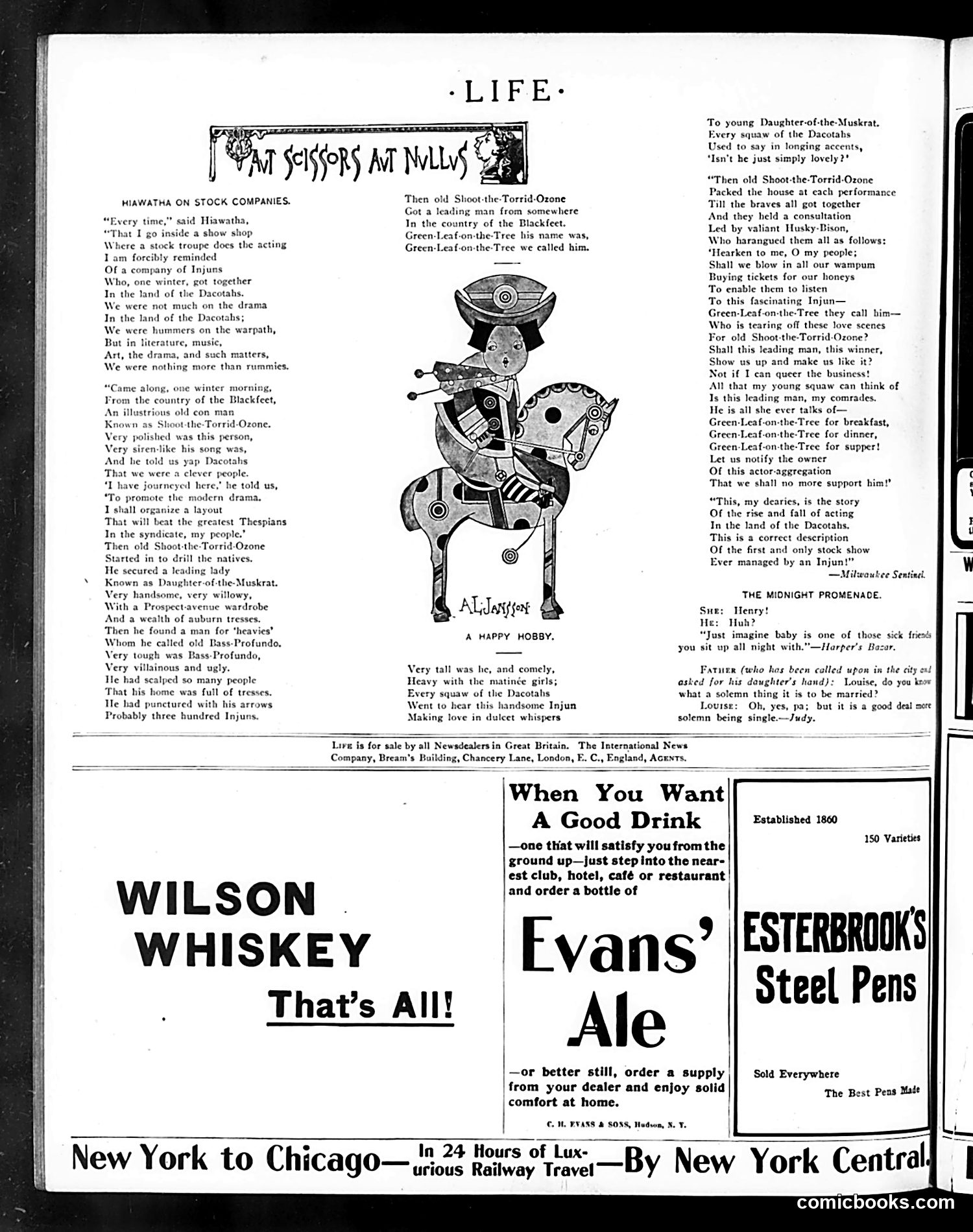
This humorous poem satirizes traveling theatrical stock companies—professional troupes that toured America performing standardized productions. The joke uses Native American characters (a framing device that wouldn't work today) to mock the formula: a smooth con-man impresario recruits attractive leads, packages entertainment, and exploits audiences' infatuation with leading actors. The satire's target: stock company managers who cynically manipulate audiences' emotions for profit. The wives' obsession with "Green-Leaf-on-the-Tree" (the handsome lead) causes husbands to withdraw financial support—the company collapses when audiences realize they're being exploited. The underlying critique: theatrical stock companies were seen as artistically shallow, profit-driven operations that relied on star power rather than genuine dramatic merit. The poem suggests audiences were foolish to bankrupt themselves for romantic fantasies.
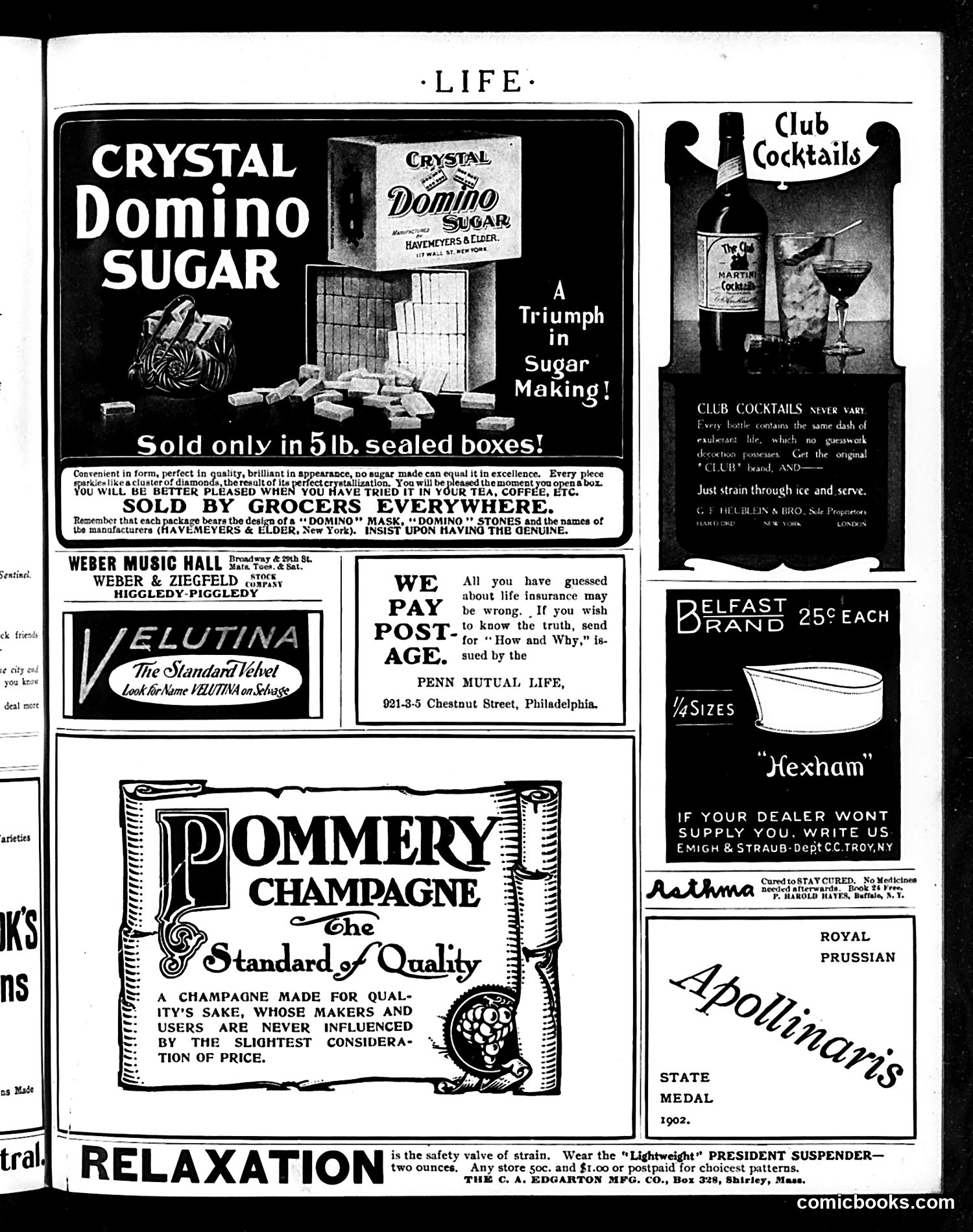
This page is primarily **advertising**, not satire or political commentary. It contains multiple product advertisements from the early 1900s: **Crystal Domino Sugar** (top left) promotes refined sugar cubes, emphasizing their purity and crystalline appearance. **Club Cocktails** (top right) advertises a bottled cocktail mixer, suggesting convenience for home drink-making. Other ads include **Pommery Champagne** (emphasizing quality over price), **Belfast Brand Hexham** bowls, **Velutina** fabric, **Apollinaris** mineral water, **Penn Mutual Life Insurance**, and **President Suspenders**. The page also lists entertainment at **Weber Music Hall** with Weber & Ziegfeld's "Higgledy-Piggledy" production. There is **no identifiable political cartoon or satire** on this page—it is a straightforward collection of period advertisements and entertainment notices typical of *Life* magazine's commercial content.
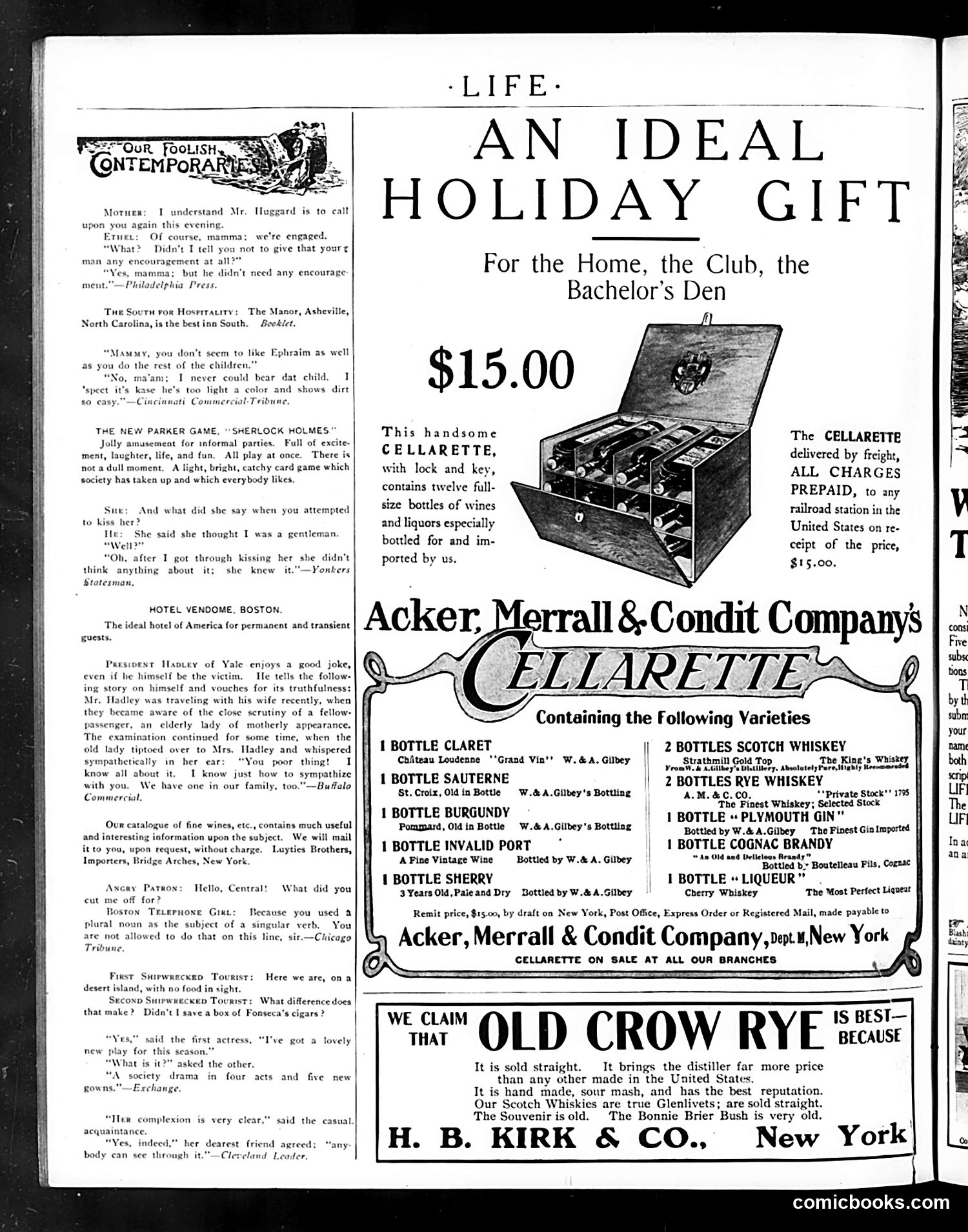
This page is primarily **advertising and humor**, not political satire. The main content consists of: **"Our Foolish Contemporaries"** - A humor column featuring brief anecdotes mocking everyday social situations: a young woman lying to her mother about a suitor's encouragement; casual racism in a comment about a child's skin color; a woman unimpressed by a man's kiss; and linguistic pedantry from a telephone operator. **The Cellarette Advertisement** - The dominant feature is a $15 mail-order wine/liquor cabinet from Acker, Merrall & Condit Company, containing twelve bottles of imported spirits. This was marketed as an upscale holiday gift for homes, clubs, and bachelor apartments—clearly targeting affluent readers during Prohibition's approach (this appears pre-1920). **Secondary advertisements** include Old Crow Rye whiskey and various hotel/game promotions. The page reflects early 20th-century middle/upper-class American life, with casual period prejudices and the normalized consumption of alcohol before Prohibition's implementation.
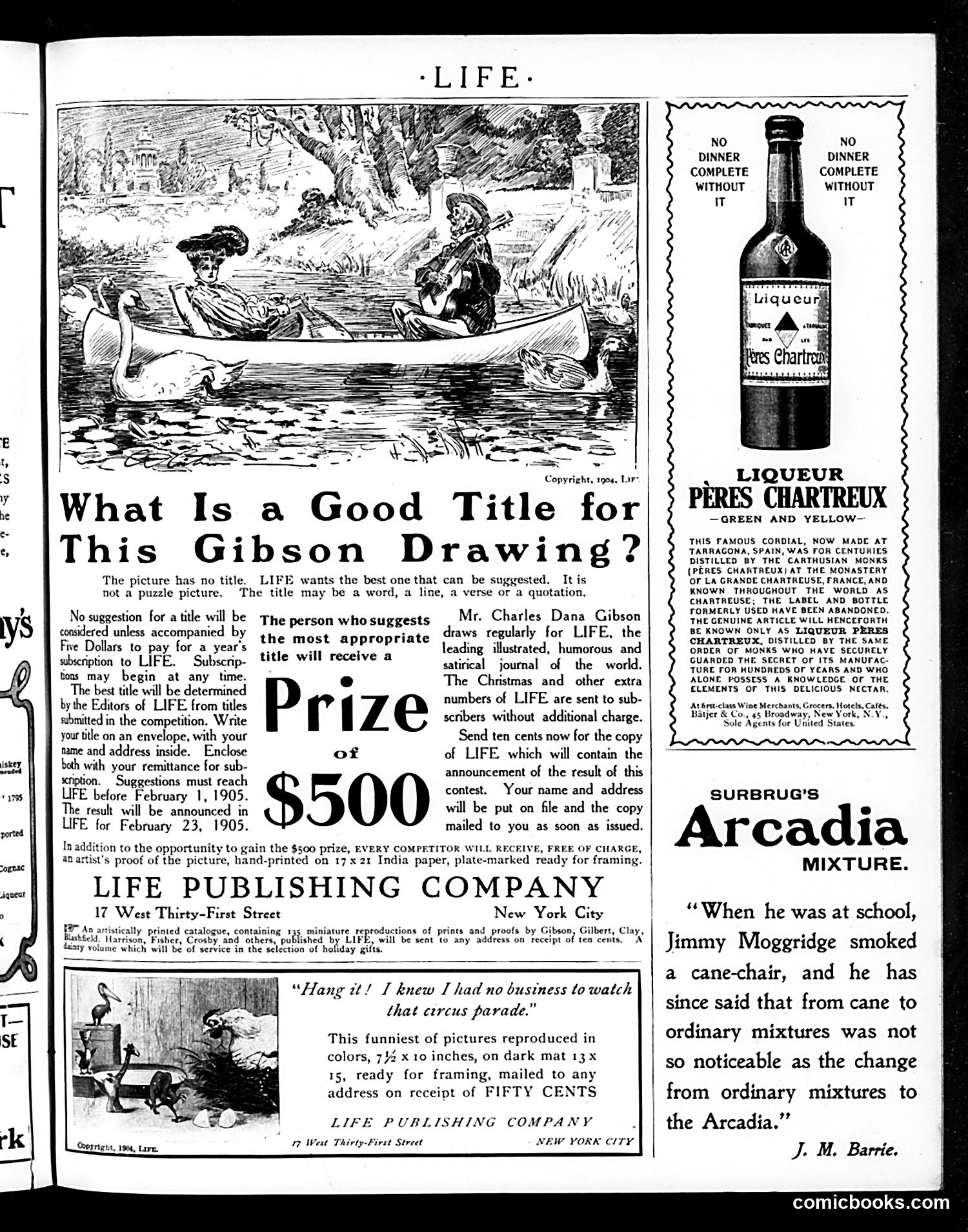
This page primarily consists of **advertising and a contest announcement** rather than political satire. The main feature is a **Gibson Drawing contest**: Life publishes an untitled illustration by Charles Dana Gibson (the famous "Gibson Girl" artist) showing elegantly dressed figures in a boat, and invites readers to suggest titles for a $500 prize. Competitors receive a free artist's proof regardless. The advertisements are typical early-1900s luxury goods: - **Liqueur Pères Chartreux**: A cordial formerly made by Carthusian monks, emphasizing its centuries-old monastic origins and "secret formula"—a common marketing tactic exploiting the exotic appeal of European religious tradition. - **Surbrug's Arcadia Mixture**: A tobacco product endorsed with a testimonial from J.M. Barrie (the Peter Pan author), claiming superior quality to ordinary mixtures. There is minimal political or social satire here—this is primarily a commercial publication page designed to entertain readers while promoting upscale consumer goods.
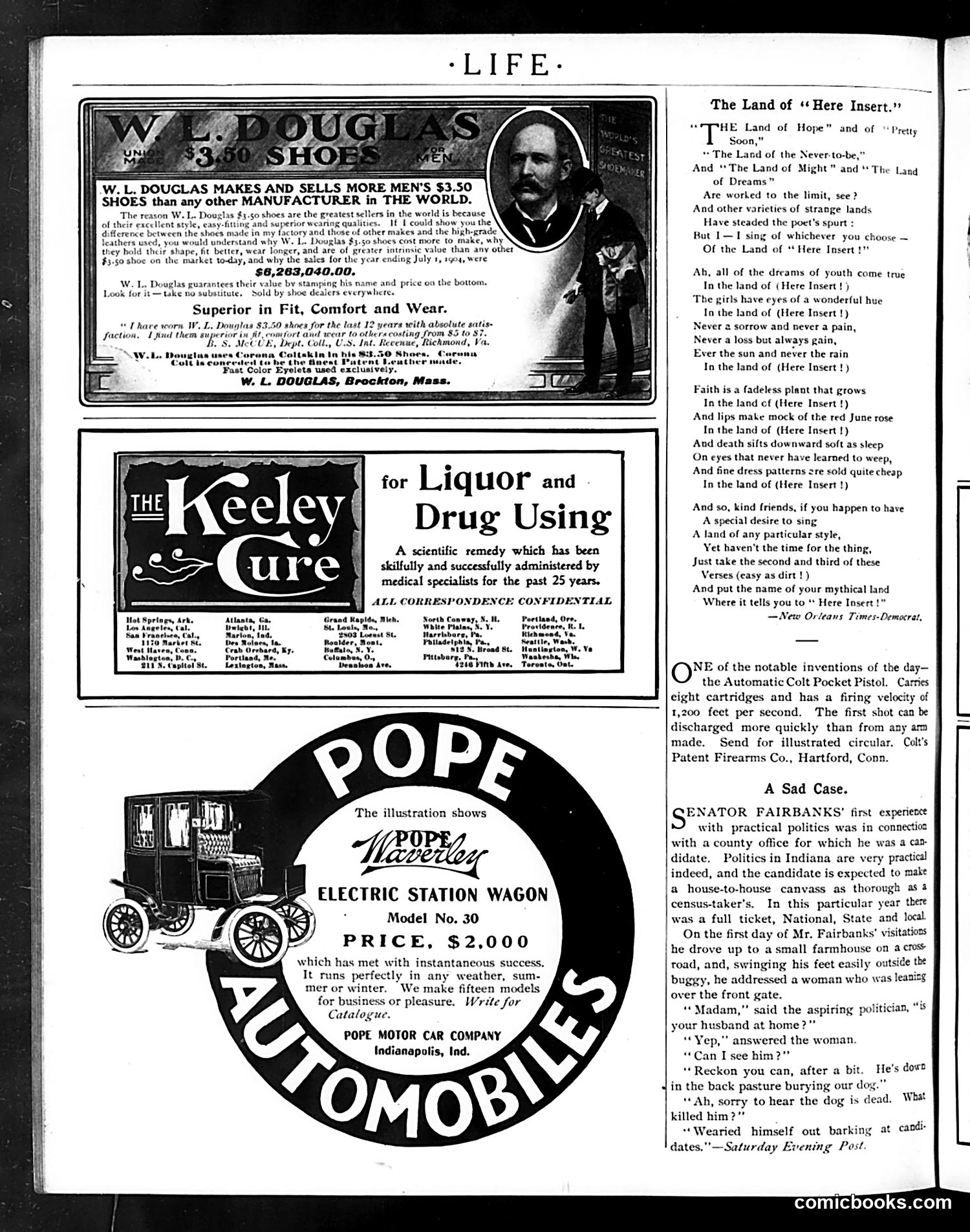
This page is primarily **advertising** with some poetry and a brief anecdote. The main content includes: **Advertisements:** - W.L. Douglas $3.50 shoes (emphasizing value and durability) - "Keeley Cure" for liquor and drug addiction (claiming 25 years of medical success) - Pope Motor Car Company's electric station wagon ($2,000) - Colt automatic pocket pistol **Editorial Content:** - A humorous poem titled "The Land of 'Here Insert'"—satirizing flowery, formulaic poetry by offering a template readers can fill in with their own mythical land names - "A Sad Case"—the beginning of an anecdote about Senator Fairbanks' political campaigning in Indiana, suggesting practical politics required door-to-door canvassing **Context for modern readers:** This reflects early 1900s consumer culture, including the era's patent medicines (the Keeley Cure was a real addiction treatment), emerging automobile industry, and political campaign methods. The poetry parody gently mocks sentimental Victorian verse conventions.
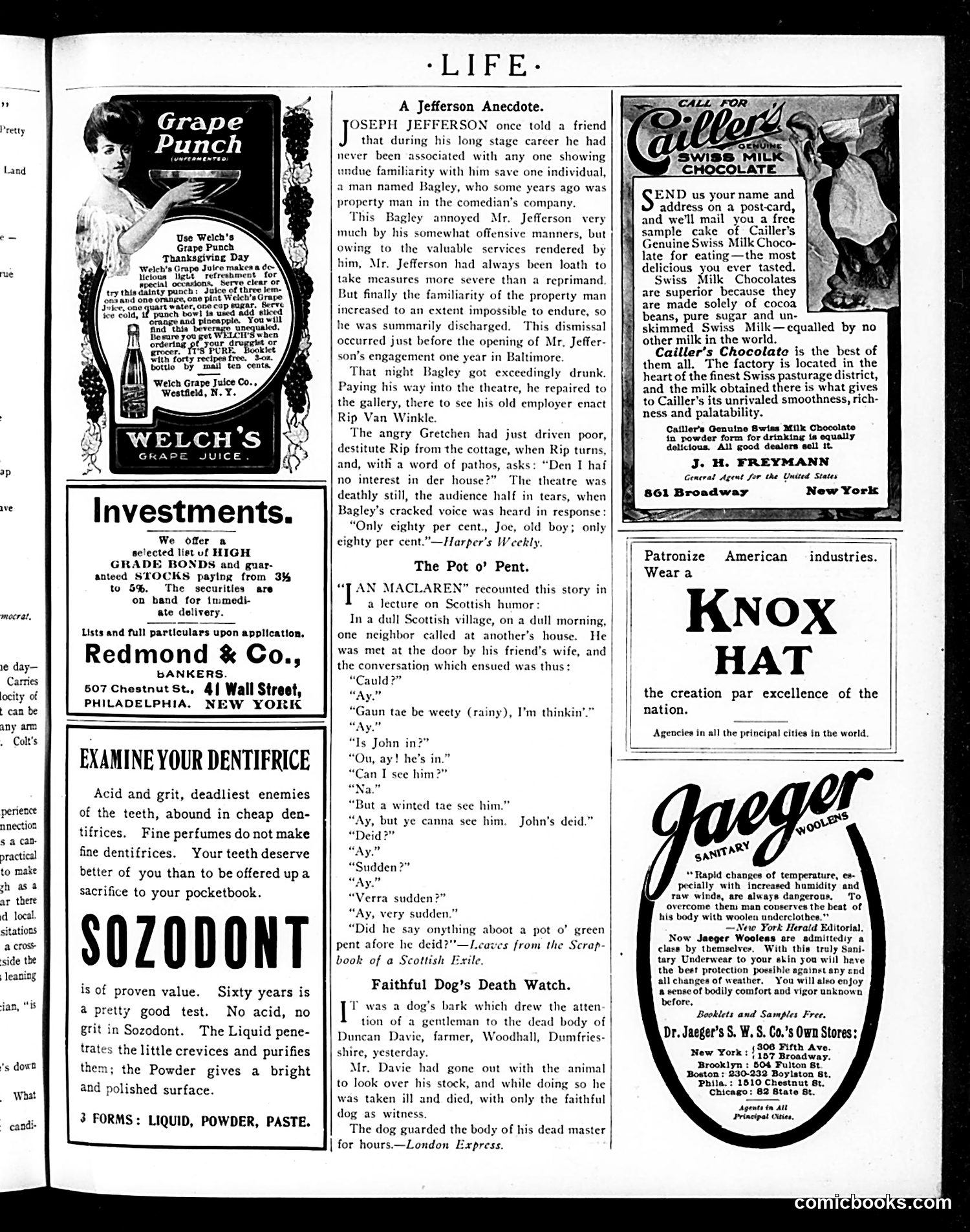
This page is primarily **advertising and humor anecdotes** rather than political cartooning. The main content includes three brief humorous stories: a Jefferson anecdote about actor Joseph Jefferson and a drunk property man named Bagley who heckles him during a performance of *Rip Van Winkle*; "The Pot o' Pent," a Scottish dialect joke about a neighbor's death delivered with comedic miscommunication; and "Faithful Dog's Death Watch," about a dog guarding its master's corpse. The surrounding advertisements promote products typical of the era: Welch's Grape Juice, Cailler's Swiss Milk Chocolate, Sozodont toothpaste, Knox Hats, and Jaeger Sanitary Underwear. There is **no political satire** on this page. Instead, it reflects early 20th-century Life magazine's format: genteel humor for middle-class readers interspersed with consumer product ads. The anecdotes emphasize propriety, class distinctions, and sentimental domesticity—values the magazine's audience would recognize.
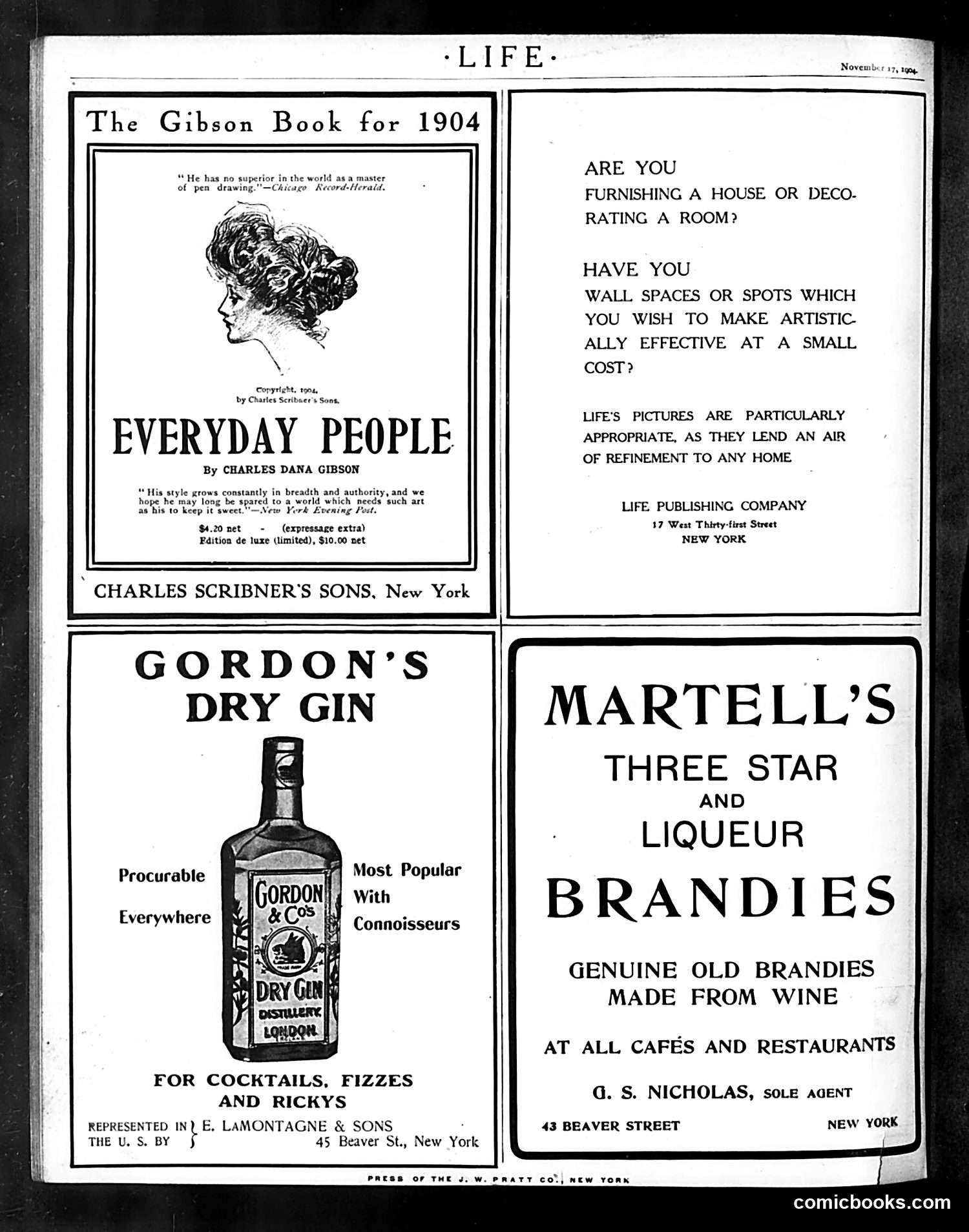
This is primarily an **advertising page** rather than satirical content. The dominant feature is a book advertisement for Charles Dana Gibson's *Everyday People*, showcasing his famous pen-drawn illustrations of elegant women and society figures. Gibson was America's premier illustrator of the era, celebrated for capturing refined urban life. The page also contains three liquor advertisements (Gordon's Dry Gin, Martell's Brandy) and a pitch from Life Publishing Company itself, offering pictures for home decoration "at a small cost"—positioning Life magazine illustrations as affordable art for middle-class homes. The Gibson book advertisement emphasizes his artistic authority and the cultural value of his work, quoting praise from major newspapers. This reflects early 20th-century America's appetite for illustrated magazines and Gibson's celebrity status as a visual chronicler of contemporary high society and manners.