
Life, 1904-11-17 · page 6 of 24
Life — November 17, 1904 — page 6: what you’re looking at
What you’re looking at
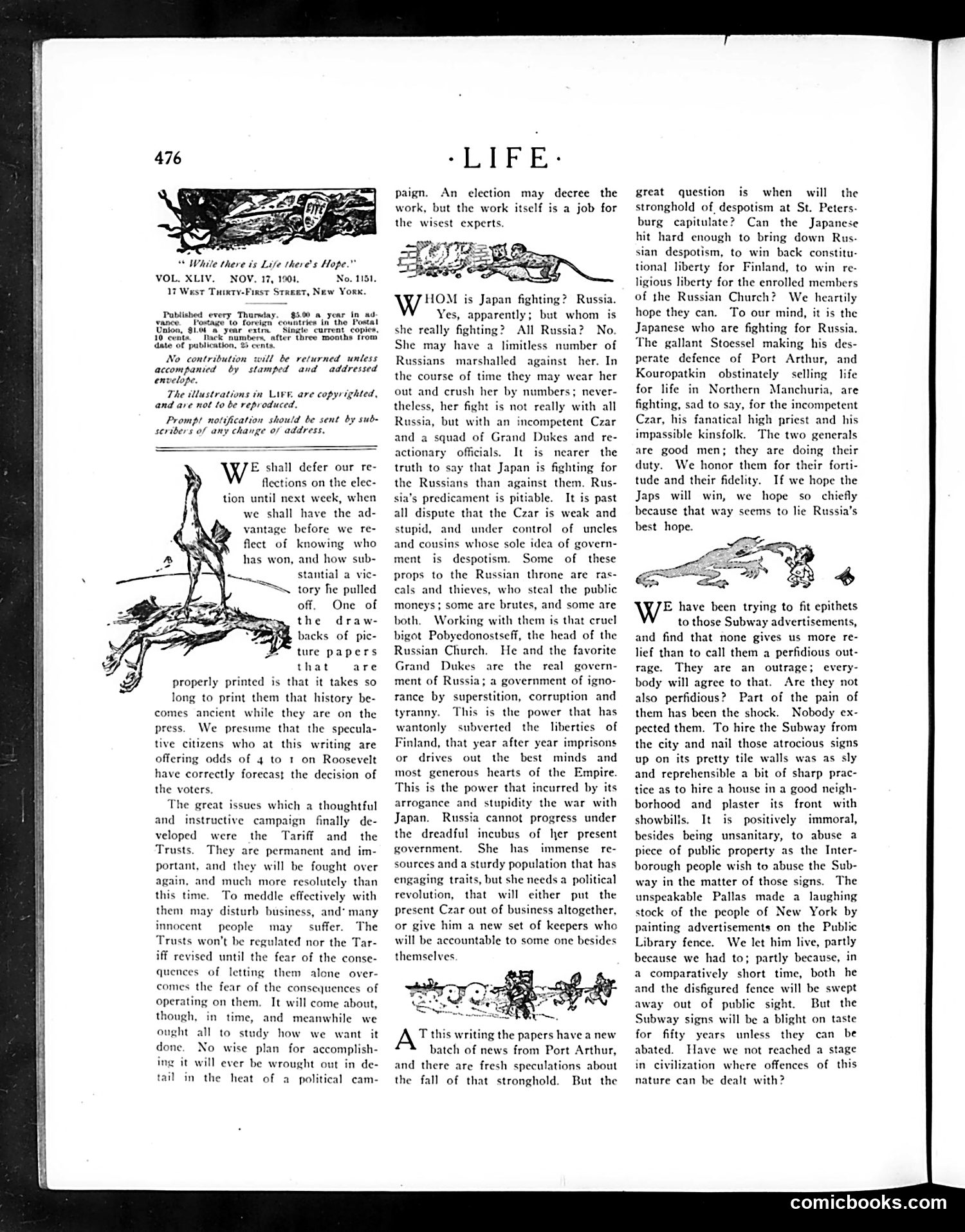
This editorial page discusses the Russo-Japanese War (1904-1905). The text argues that Japan isn't really fighting "all Russia" but rather an incompetent Tsar and corrupt officials—the "real" Russia, it claims, is politically enslaved. The accompanying illustrations appear to depict allegorical figures, likely representing abstract concepts of power, tyranny, or struggle, though specific identities are unclear from the image alone. The page also critiques Subway advertisements in New York City as eyesores and "pernicious outrages," arguing they deface public property. The author advocates for stricter regulation of such commercial signage. The overall message reflects progressive-era skepticism toward both Russian autocracy and unchecked American commercial interests.
📄 Transcribed text from this page (OCR, searchable)
Machine-transcribed from the original scan — historical spelling and the odd misread are preserved.
“* While there is Life there's Hope.” VOL. XLIV. NOV. 17, 1901, No. 1151, Published every Thurnay. Postage to foreign cor ‘the Fostai SL a year extra Si copies. Tack numbers after three moaths trom date of publication, 2 cents No contribution will be returned untess accompanied by stamped and addressed envelope. The illustrations in Live, are copyrighted, and ave not to be reproduced. Prompt notification should be sent by sub- seribers of any change 0/ address, WE shall defer our re- flections on the elec- tion until next week, when we shall have the ad- vantage before we re- flect of knowing who has won, and how sub- stantial a vic- tory he pulled off. One of the draw- backs of pic- ture papers that are properly printed is that it takes so long to print them that history be- comes ancient while they are on the press. We presume that the specula- tive citizens who at this writing are offering odds of 4 to 1 on Roosevelt have correctly forecast the decision of the voters, The great issues which a thoughtful and instructive campaign finally de- veloped were the Tariff and the Trusts. They are permanent and im- portant, and they will be fought over again, and much more resolutely than this time. To meddle effectively with them may disturb business, and’ many innocent people may suffer. The Trusts won't be regulated nor the Tar- iff revised until the fear of the conse- quences of letting them alone over- comes the fear of the consequences of operating on them. It will come about, though, in time, and meanwhile we ought all to study how we want it No wise plan for accomplish- ing it will ever be wrought out in de- tail in the heat of a political cam- done. LIFE paign. An election may decree the work, but the work itself is a job for the wisest experts. HOM is Japan fighting? Russia. apparently; but whom is she really fighting? All Russia? No. She may have a limitless number of Russians marshalled against her. In the course of time they may wear her out and crush her by numbers; never- theless, her fight is not really with all Russia, but with an incompetent Czar and a squad of Grand Dukes and re- actionary officials. It is nearer the truth to say that Japan is fighting for the Russians than against them. Rus- predicament is pitiable. It is past all dispute that the Czar is weak and stupid, and under control of uncles and cousins whose sole idea of govern- ment is despotism. Some of these props to the Russian throne are ras- cals and thieves, who steal the public moneys; some are brutes, and some are both. Working with them is that cruel bigot Pobyedonostseff, the head of the Russian Church. He and the favorite Grand Dukes are the real govern- ment of Russia; a government of igno- rance by superstition, corruption and tyranny. This is the power that has wantonly subverted the liberties of Finland, that year after year imprisons or drives out the best minds and most generous hearts of the Empire. This is the power that incurred by its arrogance and stupidity the war with Japan. Russia cannot progress under the dreadful incubus of her present government. She has immense re- sources and a sturdy population that has engaging traits, but she needs a political revolution, that will either put the present Czar out of business altogether, or give him a new set of keepers who will be accountable to some one besides themselves. — At this writing the papers have a new batch of news from Port Arthur, and there are fresh speculations about the fall of that stronghold. But the great question is when will the stronghold of, despotism at St. Peters- burg capitulate? Can the Japanese hit hard enough to bring down Rus- sian despotism, to win back constitu- tional liberty for Finland, to win re- ligious liberty for the enrolled members of the Russian Church tily hope they can. To our mind, it is the Japanese who are fighting for Russ The gallant Stoessel making his de: perate defence of Port Arthur, and Kouropatkin obstinately _ selling for life in Northern Manchuria, are fighting, sad to say, for the incompetent Czar, his fanatical high priest and his impassible kinsfolk. The two generals are good men; they are doing their duty. We honor them for their forti- tude and their fidelity. If we hope the Japs will win, we hope so chiefly because that way seems to lie Russia’s best hope. life E have been trying to fit epithets to those Subway advertisements, and find that none gives us more re- lief than to call them a perfidious out- rage. They are an outrage; every- body will agree to that. Are they not also perfidious? Part of the pain of them has been the shock. Nobody ex- pected them. To hire the Subway from the city and nail those atrocious signs up on its pretty tile walls was as sly and reprehensible a bit of sharp prac- tice as to hire a house in a good neigh- borhood and plaster its front with showbills. It is positively immoral, besides being unsanitary, to abuse a piece of public property as the Inter- borough people wish to abuse the Sub- way in the matter of those signs. The unspeakable Pallas made a laughing stock of the people of New York by painting advertisements on the Public Library fence. We let him live, partly because we had to; partly because, in a comparatively short time, both he and the disfigured fence will be swept away out of public sight. But the Subway signs will be a blight on taste for fifty years unless they can be abated. Have we not reached a stage in civilization where offences of this nature can be dealt with? comicbooks.com