
Life, 1904-11-17 · page 15 of 24
Life — November 17, 1904 — page 15: what you’re looking at
What you’re looking at
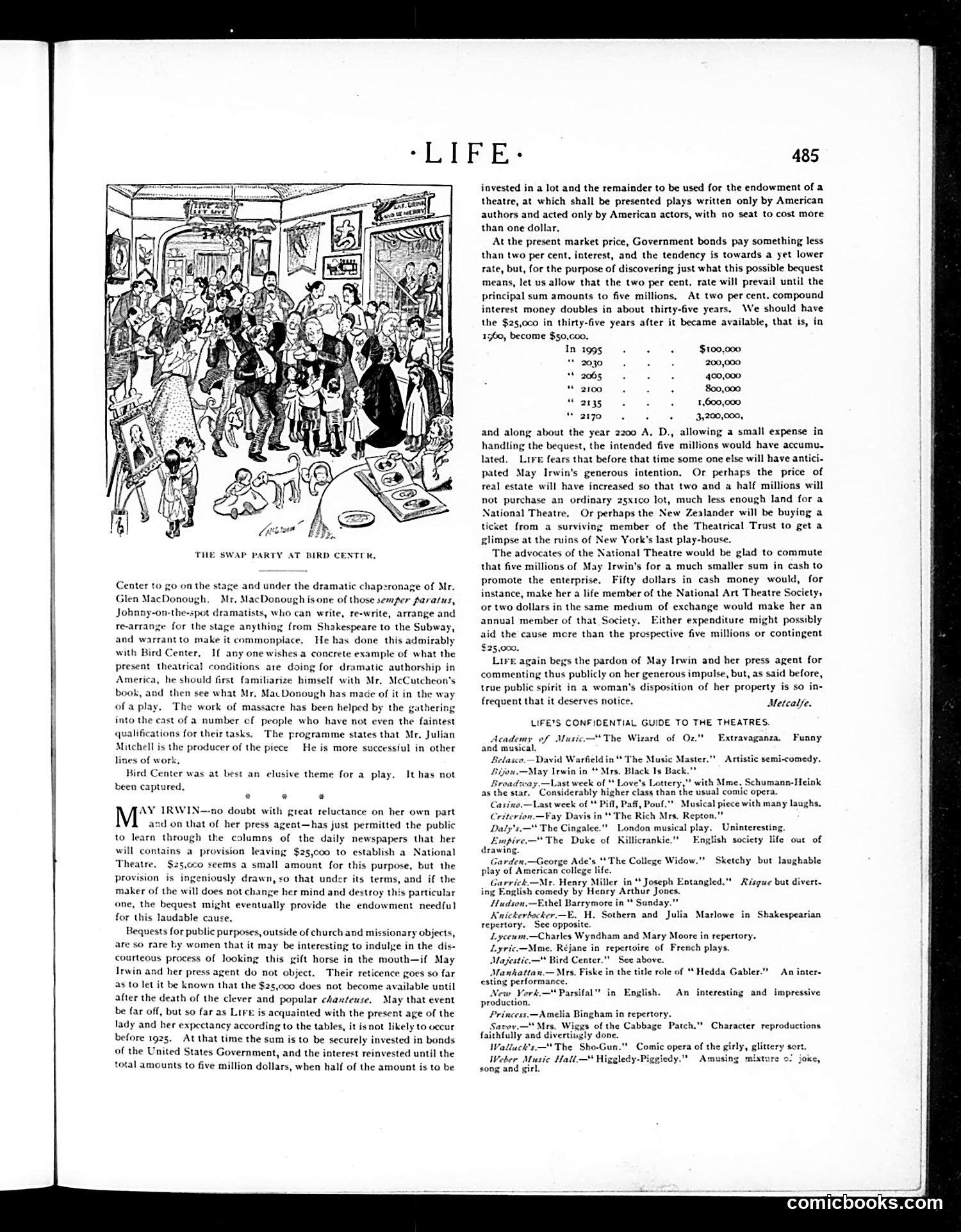
The cartoon illustrates a crowded theatrical scene labeled "The Swap Party at Bird Center," satirizing the chaos of contemporary theatrical production. The illustration depicts numerous people in what appears to be backstage confusion—reflecting the text's critique of how theatrical authorship functions in America. The accompanying article mocks the adaptation of a play by criticizing the involvement of unqualified cast members and producers. It sarcastically suggests that if someone wants to understand how theatrical conditions damage dramatic authorship, they should examine this particular production, where even the producer Julian Mitchell appears miscast despite success elsewhere. The broader satire targets how American theater prioritizes spectacle and commercial casting over artistic merit.
📄 Transcribed text from this page (OCR, searchable)
Machine-transcribed from the original scan — historical spelling and the odd misread are preserved.
“LIF E= THE SWAP PARTY AT BIRD CENTER. Center to go on the stage and under the dramatic chapsronage of Mr. Glen MacDonough. Mr, MacDonough isone of those semper paratus, Jobnny-on-the-spot dramatists, who can write, re-write, arrange and rearrange for the stage anything from Shakespeare to the Subway, He has done this admirably If any one wishes a concre: and warrant to make it commonplace, with Bird Center, ample of what the present theatrical conditions are doing for dramatic authorship in America, he should first familiarize himself with Mr. McCutcheon's book, and then see what Mr. MacDonough has mace of it in the way ofa play, The work of massacte has been helped by the g: into the cast of a number cf people who have not even the faintest qualifications for their tasks. The programme states that Mr. Julian Mitchell is the producer of the piece He is more successful in other lines of work. Bird Center was at best an been captured. sive theme for a play, Ithas not ® « * AY IRWIN—no doubt with great reluctance on her own part nd on that of her press agent—has just permitted the public to learn through the columns of the daily newspapers that her will contains a provision leaving $25,coo to establish a National Theatre. $25,0co seems a small amount for this purpose, but the provision is ingeniously drawn, so that under its terms, and if the maker of the will does not change her mind and destroy this particular one, the bequest might eventually provide the endowment needful for this laudable cause, Bequests for public purposes, outside of church and missionary objects, are so rare by women that it may be interesting to indulge in the dis- courteous process of looking this gift horse in the mouth—if May Irwin and her press agent do not object, Their reticence goes so far as to let it be known that the $25,000 does not become available until after the death of the clever and popular chanteuse. May that event be far off, but so far as Lire is acquainted with the present age of the lady and her expectancy according to the tables, it is not likely to occur before 1925. At that time the sum is to be securely invested in bonds of the United States Government, and the interest reinvested until the total amounts to five million dollars, when half of the amount is to be 485 invested in a lot and the remainder to be used for the endowment of a theatre, at which shall be presented plays written only by American authors and acted only by American actors, with no seat to cost more than one dollar, At the present market price, Government bonds pay something less than two per cent, interest, and the tendency is towards a yet lower rate, but, for the purpose of discovering just what this possible bequest means, let us allow that the two per cent, rate will prevail until the principal sum amounts to five millions, At two per cent. compound interest money doubles in about thirty-five years. We should have the $25,0co in thirty-five years after it became available, that is, in 1560, become $50,c00, In 1995 : “2030. ; “2100. : “ang fs Mam 6 bw and along about the year 2200 A. D., allowing a small expense in handling the bequest, the intended five millions would have accumu. lated. LiFe fears that before that time some one else will have antici- pated May Irwin's generous intention, Or perhaps the price of real estate will have increased so that two and a half millions will not purchase an ordinary 25xtco lot, much less enough land for a National Theatre, Or perhaps the New Zealander will be buying a ticket from a surviving member of the Theatrical Trust to get a glimpse at the ruins of New York's last play-house, ‘The advocates of the National Theatre would be glad to commute that five millions of May Irwin's for a much smaller sum in cash to promote the enterprise. Fifty dollars in cash money would, for instance, make her a life member of the National Art Theatre Societys or two dollars in the same medium of exchange would make her an annual member of that Society. Either expenditure might possibly d the cause more than the prospective five millions or contingent $25,000, Lire again begs the pardon of May Irwin and her press agent for commenting thus publicly on her generous impulse, but, as said before, true public spirit in a woman's disposition of her property is so in- frequent that it deserves notice. Metcalfe. $100,000 200,000 400,000 800,000 1,600,000 3,200,000, LIFE’S CONFIDENTIAL GUIDE TO THE THEATRES. Academy of Music.—*The Wizard of Oz." and musical. Belasco.—David Warfield in * The Music Master."" Artistic semi-comedy. Bijou,—May Irwin in “* Mrs, Black Is Back.” Broadway.—Last week of * Love's Lottery," with Mme, Schumann-Heink as the star, Considerably higher class than the usual comic opera. Casino.—Last week of * Piff, Paff, Pouf."” Musical piece with many laughs, Criterion. —Fay Davis in * The Rich Mrs, Repton. he Cingalee.” London musical play, Uninteresting. Duke of Killicrankie."” English society life out of Extravaganza, Funny Garden.—George Ade's “The College Widow.” Sketchy but laughable play of American college life. Garrick —Mr. Henry Miller in“ Joseph Entangled." Risgue but ing English comedy by Henry Arthur Jones. Hudson.—Ethel Barrymore in “ Sunday." Knickerbocker.—E. H. Sothern and Julia Marlowe in Shakespearian repertory. See opposite. Lyceum.—Charles Wyndham and Mary Moore in repertory. Lyric.—Mme. Réjane in repertoire of French plays. Majestic.—* Bird Center.” See above. Manhattan.— Mrs. Fiske in the title role of “Hedda Gabler.” esting performance. New York.—" Parsifal” in English. production. Princess.—Amelia Bingham in repertory. Sarov.—* Mes. Wiggs of the Cabbage Patch," Character reproductions faithfully and divertingly done. Huck's.—"The Sho-Gun." Comic opera of the girly, glittery sort. Weber Music Hall — Higgledy-Pigg! Amusing mixture o! song and girl. An inter- An interesting and impressive