
Life, 1904-11-17 · page 16 of 24
Life — November 17, 1904 — page 16: what you’re looking at
What you’re looking at
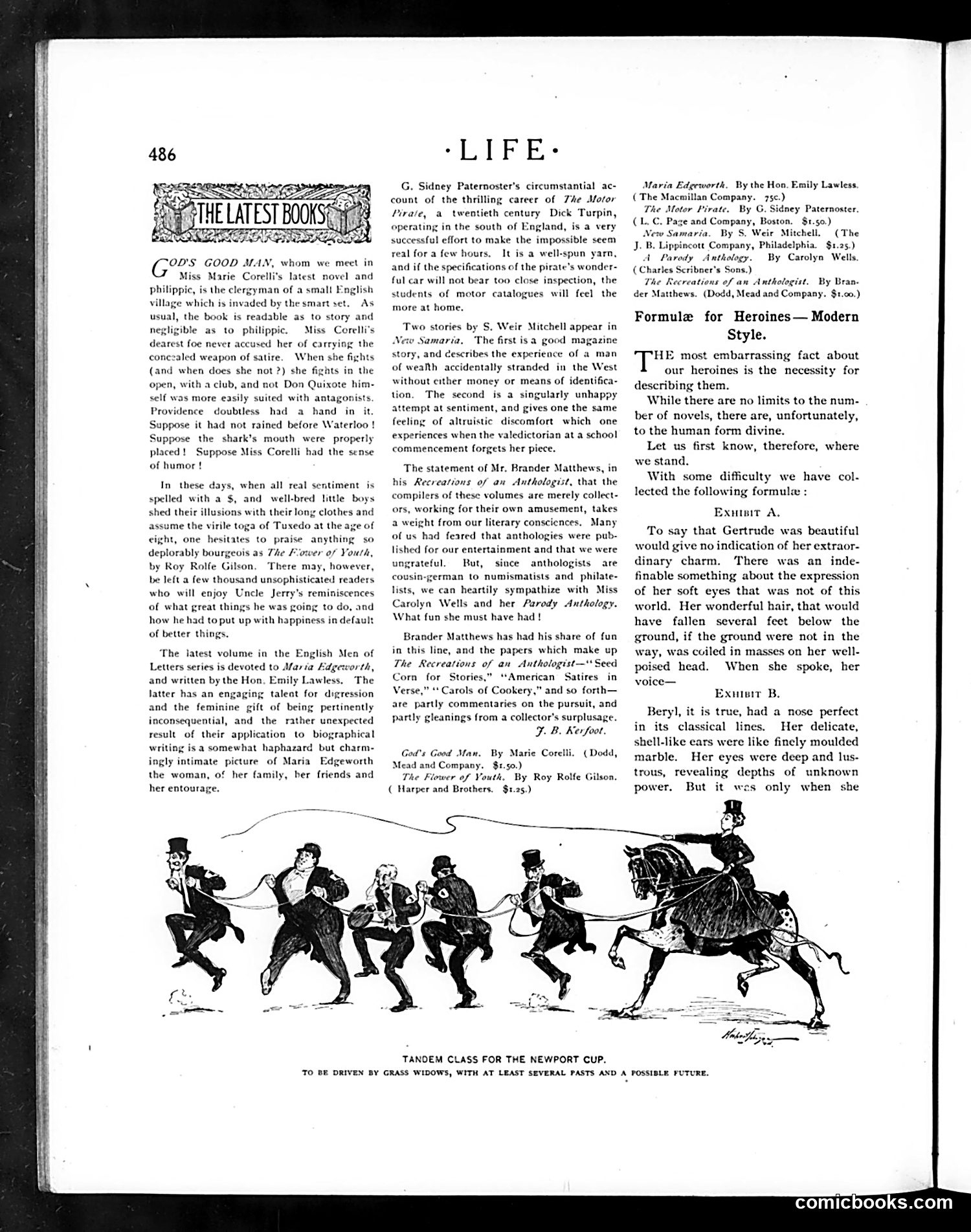
This page contains book reviews and literary commentary rather than political cartoons. The single illustration at the bottom is a humorous sporting cartoon captioned "Tandem Class for the Newport Cup," depicting five men in formal dress being pulled along by a woman on horseback—a joke about wealthy socialites at Newport, Rhode Island competing in fashionable events. The text reviews several books, notably criticizing Marie Corelli's *God's Good Man* as lacking genuine satirical bite despite its social commentary, and praising Roy Rolfe Gilson's *The Flower of Youth* for appealing to sentimental readers. References to "smart set" invasions and themes of "bourgeois" sentiment suggest the era's preoccupation with class distinctions between refined society and ordinary people. The page reflects turn-of-century concerns about commercialization ("all real sentiment is spelled with a $") and changing social values.
📄 Transcribed text from this page (OCR, searchable)
Machine-transcribed from the original scan — historical spelling and the odd misread are preserved.
philippic, is the clergyman of a smal! English village which is invaded by the smart set. As usual, the book is readable as to story and negligible as to philippic. Miss Corelli's dearest foe never accused her of carrying t conezaled weapon of satire. When she fights (and when does she not ?) she fights in the open, with a club, and not Don Quixote him- self was more easily suited with antagonists doubtless had a hand in it Suppose it had not rained before Waterloo ! Suppose the shark's mouth were properly placed! Suppose Miss Corelli had the sense of humor t Providence In these days, when all real sentiment is spelled with a $, and well-bred little boys shed their illusions with their long clothes and assume the virile toga of Tuxedo at the age of cight, one hesitates to praise anything so deplorably bourgeois as The Flower of Youth, by Roy Rolfe Gilson, be left a few thousand unsophisticated readers who will enjoy Uncle Jerry’s reminiscences of what great things he was going to do, and how he had to put up with happiness in default of better things, There may, however, ‘The jatest volume in the English Men of Letters series is devoted to Maria Edgeworth, and written by the Hon. Emily Lawless. The latter has an engaging talent for digression and the feminine gift of being pertinently inconsequential, and the rather unexpected result of their application to. biographical writing is a somewhat haphazard but charm- intimate picture of Maria Edgeworth the woman, of her family, ber friends and her entourage. ‘LIF Be G, Sidney Paternoster’s circumstantial ac- count of the thrilling career of The Motor Pirale, a twentieth century Dick Turpin, operating in the south of England, is a very successful effort to make the impossible seem real for a few hours, It is a well-spun yarn, and if the specifications of the pirate’s wonder- ful car will not bear too close inspection, the students of motor catalogues will feel the more at home. Two stories by S, Weir Mitchell appear in The first isa good magazine story, and describes the experience of a man of wealth accidentally stranded in the West without either money or means of identifica- tion. The second is a singularly unhappy attempt at sentiment, and gives one the same feeling of altruistic discomfort which one experiences when the valedictorian at a school commencement forgets her piece. Samaria. The statement of Mr. Brander Matthews, in his Recreations of an Anthologist, that the compilers of these volumes are merely collect- ors, working for their own amusement, takes a weight from our literary consciences, Many of us had feared that anthologies were pub- lished for our entertainment and that we were ungrateful. But, since anthologists are cousin-german to numismatists and_philate- lists, we can heartily sympathize with Miss Carolyn Wells and her Parody Anthology. What fun she must have had ! Brander Matthews has had his share of fun in this line, and the papers which make up The Recreations of an Anthologist—" Seed Corn for Stories,” ‘American Satires in Verse,” Carols of Cookery,” and so forth— are partly commentaries on the pursuit, and partly gleanings from a collector's surplusage. J. B. Kerfoot. God's Good Man, By Marie Corelli. Mead and Company. $1.50.) The Flower of Youth. By Roy Rolfe Gilson. ( Harper and Brothers. $1.25.) (Doda, TANOEM CLASS FOR THE NEWPORT CUP. Maria Edgeworth. By the Hon. Emily Lawless. (The Macmillan Company. 75¢.) The Motor Pirate. By G. Sidney Paternoster. (L. C. Page and Company, Boston. $1.50.) wv Samaria. By S, Weir Mitchell. (‘The J. B. Lippincott Company, Philadelphia. $1.25.) A Parody Anthology. By Carolyn Wells. (Charles Scribner's Sons.) The Recreations of an Anthologist. By Bran- der Matthews. (Dodd, Mead and Company. $1.00.) Formule for Heroines— Modern Style. HE most embarrassing fact about our heroines is the necessity for describing them. While there are no limits to the num- ber of novels, there are, unfortunately, to the human form divine. Let us first know, therefore, where we stand. With some difficulty we have col- lected the following formula : Exuimit A, To say that Gertrude was beautiful would give no indication of her extraor- dinary charm. There was an inde- finable something about the expression of her soft eyes that was not of this world. Her wonderful hair, that would have fallen several feet below the ground, if the ground were not in the way, was coiled in masses on her well- poised head. When she spoke, her voice— Exum B. Beryl, it is true, had a nose perfect in it: ssical lines. Her delicate, shell-like cars were like finely moulded marble. Her eyes were deep and lus- trous, revealing depths of unknown power. But it wes only when she TO BE DRIVEN BY GRASS WIDOWS, WITH AT LEAST SEVERAL PASTS AND A POSSIBLE FUTURE. comicbooks.com