
Life, 1904-11-17 · page 14 of 24
Life — November 17, 1904 — page 14: what you’re looking at
What you’re looking at
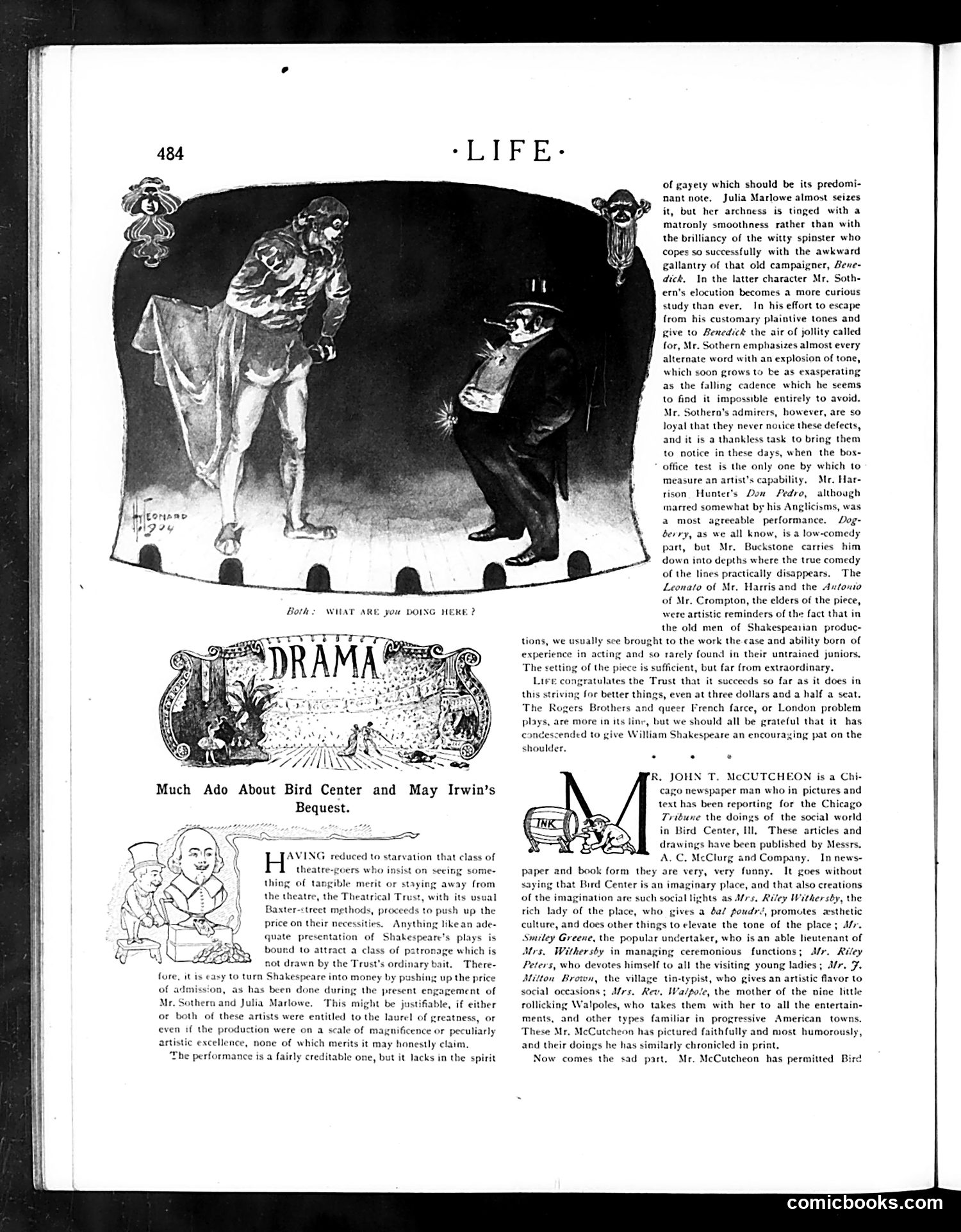
This page contains a theatrical review and arts content, not primarily political satire. **The Main Cartoon:** Shows a well-dressed man (appearing to be a theater manager or impresario) confronting what looks like actors or performers on stage, with the caption "WHAT ARE YOU DOING HERE?" The illustration critiques a Shakespeare production. **The Theater Review:** Discusses a production of *Much Ado About Nothing* starring Mr. Sothern and Julia Marlowe. The critic argues the actors lack brilliance despite charging high prices (three dollars and a half per seat). Julia Marlowe's performance feels matronly rather than witty; Sothern's delivery is criticized for exaggerated, explosively-emphasized words that become tiresome. The review suggests audiences only measure success by box-office returns rather than artistic merit. **Secondary Content:** Introduces John T. McCutcheon's humorous illustrations and articles about fictional "Bird Center, Illinois" published by A.C. McClurg and Company—satirizing small-town American social pretensions through characters like "Mrs. Riley Withersby." The page reflects early 1900s concerns about commercialism overshadowing theatrical artistry.
📄 Transcribed text from this page (OCR, searchable)
Machine-transcribed from the original scan — historical spelling and the odd misread are preserved.
Both: WANT ARE you DOING HERE? = P/N SS Much Ado About Bird Center and May Irwin’s Bequest. a AVING reduced to starvation that class of theatr thing of tangible merit or staying away from the theatre, the Theatrical Tru Banter-ctreet price on their neces: ‘cers who insist on seeing some- , with its usval proceeds to push up the s. Anything likean ade- quate presentation of Shakespeare's plays is bound to attract a class of patronage which is not drawn by the Trust's ordinary bait. There- fore, it is easy to turn Shakespeare into money by pushing up the price of admission, as has been done during the present engagement of Mr. Sothern and Julia Marlowe. This might be justifiable, if either or both of these artists were entitled to the laurel of greatness, or even if the production were on a scale of magnificence or peculiarly artistic excellence, none of which merits it may honestly claim. he performance is a fairly creditable one, but it lacks in the spirit of gayety which should be its predomi- nant note, Julia Marlowe almost seizes it, but her archness is tinged with a matronly smoothness rather than with the brilliancy of the witty spinster who copes so successfully with the awkward gallantry of that old campaigner, Bene- dick, In the latter character Mr. Soth- ern's elocution becomes a more curious study than ever, In his effort to escape from his customary plaintive tones and give to Benedich the air of jollity called for, Mr. Sothern emphasizes almost every alternate word with an explosion of tone, which soon grows to be as exasperating as the falling cadence which he seems to find it impossible entirely to avoid. Mr. Sothern's admirers, however, are so loyal that they never notice these defects, and it is a thankless task to bring them to notice in these days, when the box- office test is the only one by which to measure an artist's capability, Mr. Har- rison Hunter's Don Pedro, although marred somewhat by his Anglicisms, was a most agreeable performance. Dog- berry, as we all know, is a low-comedy part, but Mr. Buckstone carries him down into depths where the true comedy of the lines practically disappears. The Leonato of Mr. Harris and the Axtonto of Mr. Crompton, the elders of the piece, were artistic reminders of the fact that in the old men of Shakespeatian produc- tions, we usually see brought to the work the case and ability born of experience in acting and so rarely found in their untrained juniors, The setting of the piece is sufficient, but far from extraordinary, Lire congratulates the Trust that it succeeds so far as it does in this striving for better things, even at three dollars and a half a seat. The Rogers Brothers and queer French farce, or London problem , but we should all be grateful that it has aded to give William Shakespeare an encouraging pat on the shoulder. plays, are more in its conde R. JOHN T. MCCUTCHEON is a Chi- cago newspaper man who in pictures and text has been reporting for the Chicago Tribune the doings of the social world in Bird Center, Ill, These articles and drawings have been published by Messr A.C, McClurg and Company, In news- paper and book form they are very, very funny. saying that Bird Center is an imaginary place, and that also creations of the imagination are such social lights as Mrs. Riley Withersby rich lady of the place, who gives a dal poudré, culture, and does other things to elevate the tone of the place; fr. Smiley Greene, the popular undertaker, who isan able lieutenant of Mrs, Withersby in managing ceremonious functions; Mr. Riley s himself to all the visiting young ladies; Mr. 7. Atilton Brown, the village tin-typist, who gives an artistic flavor to social occasions ; Mrs. Rev. the mother of the nine litt! rollicking Walpole: her to all the entertain- ments, and other types familiar in progressive American towns. These Mr. McCutcheon has pictured faithfully and most humorously, and their doings he has similarly chronicled in print, Now comes the sad part, Mr, McCutcheon has permitted Bird It goes without Peters, who devi comicbooks.com