
A complete issue · 38 pages · 1904
Life — October 6, 1904
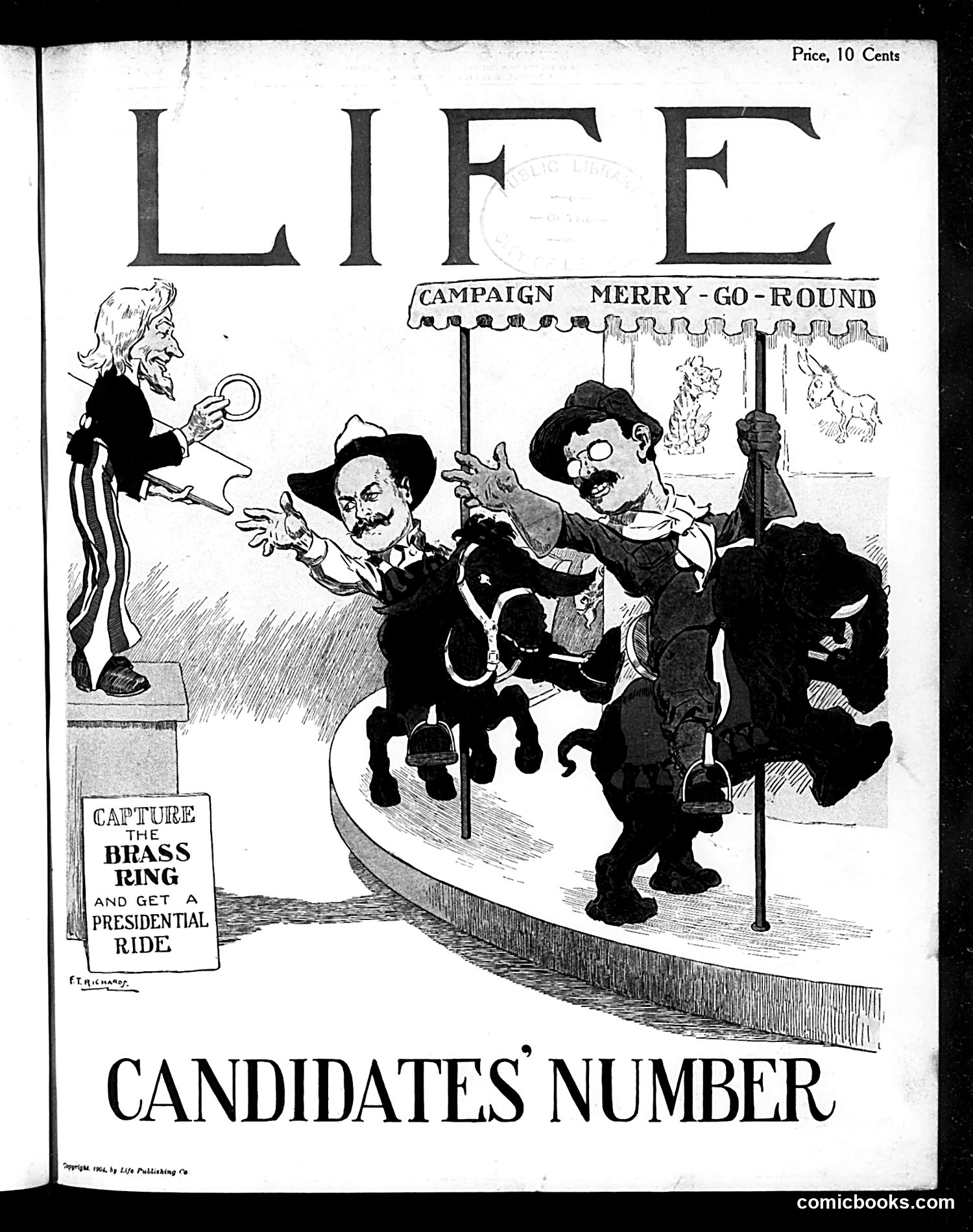
This is a "Candidates' Number" cover for *Life* magazine, satirizing a presidential election campaign. The central cartoon shows three caricatured political figures riding a "Campaign Merry-Go-Round," suggesting candidates are going in circles without substantive progress. On the left, Uncle Sam holds a ring labeled "Capture the Brass Ring and Get a Presidential Ride," referencing the carnival game—implying the presidency is merely a prize to be chased rather than a serious office. The three candidates appear to be exaggerated caricatures typical of early 20th-century political satire, though their specific identities cannot be definitively determined from the image alone. The "merry-go-round" metaphor critiques campaign cycles as repetitive entertainment rather than meaningful political discourse.
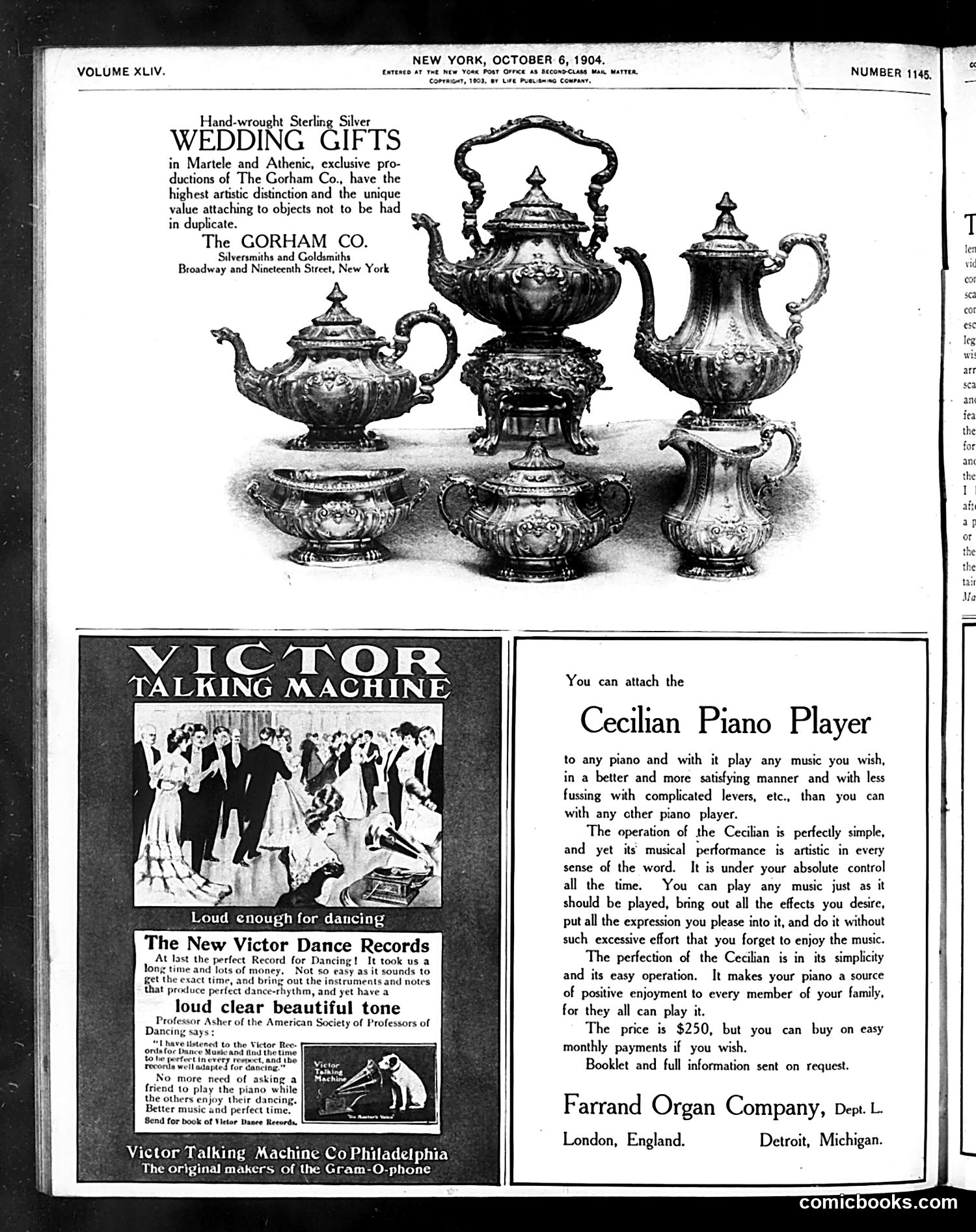
This page is **primarily advertising**, not satire or political commentary. The top half features an advertisement for The Gorham Company, presenting hand-wrought sterling silver wedding gifts—a tea service set with teapots, pitchers, and serving vessels typical of wealthy Edwardian households. Below are two separate product advertisements: 1. **Victor Talking Machine** promotes their new dance records, emphasizing clear tone and perfect timing for dancing. 2. **Cecilian Piano Player** advertises an automatic piano attachment costing $250 (or available on monthly payments), marketed as simple to operate yet musically sophisticated. All three advertisements target affluent consumers seeking luxury goods for entertainment and home use. There is no discernible political cartoon or satirical content on this page—it represents standard commercial advertising from *Life* magazine's October 6, 1904 issue.
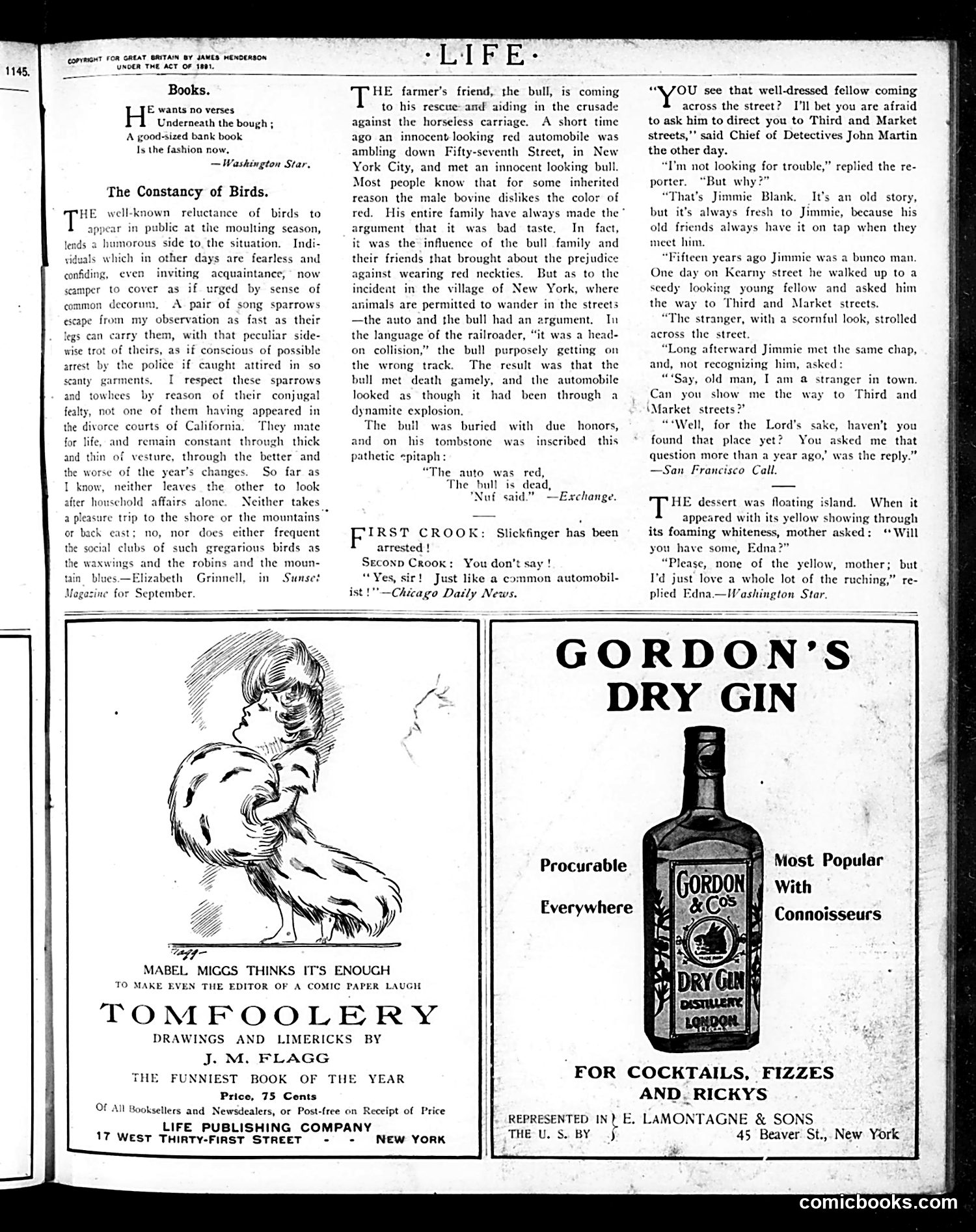
This page is primarily **advertising and humorous short fiction** rather than political commentary. The main content includes: 1. **"Books" section**: Book reviews of "The Constancy of Birds" and other titles, with literary commentary. 2. **Short humorous anecdotes**: Stories about a bull causing trouble in New York City and desert mirages, designed as light entertainment. 3. **"Tomfoolery" cartoon advertisement** (left): Features a drawing by J.M. Flagg advertising a humor book. The caption suggests it's funny enough to amuse even serious editors. 4. **Gordon's Dry Gin advertisement** (right): A standard product advertisement highlighting the gin's popularity. The page contains no identifiable political satire or caricature of specific figures. It's a typical Life magazine entertainment/advertisement page from the early 20th century.
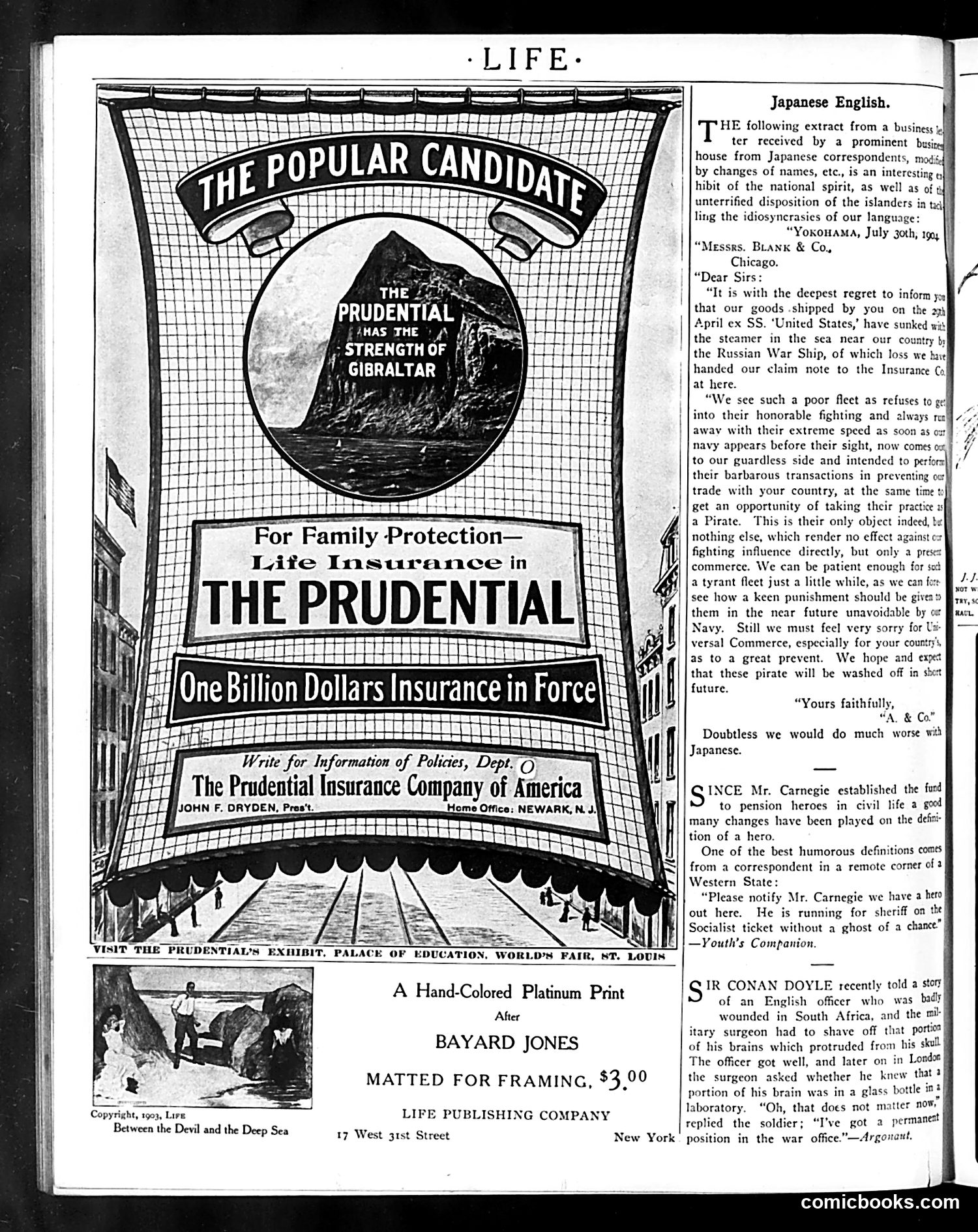
This is primarily a **Life magazine advertisement** for The Prudential Insurance Company (circa 1904, based on the World's Fair reference). The cartoon uses patriotic imagery—specifically Gibraltar as a symbol of strength and stability—to market life insurance as "family protection." The ad's title, "The Popular Candidate," appears ironic or tongue-in-cheek, suggesting insurance itself is the "popular candidate" voters should choose. The Gibraltar imagery invokes security and permanence, positioning the Prudential as an unshakeable financial fortress. The accompanying text about Japanese business correspondence and piracy references contemporary geopolitical tensions, though these seem tangential to the main insurance pitch. The page mixes advertising with magazine content addressing international commerce concerns of the era.
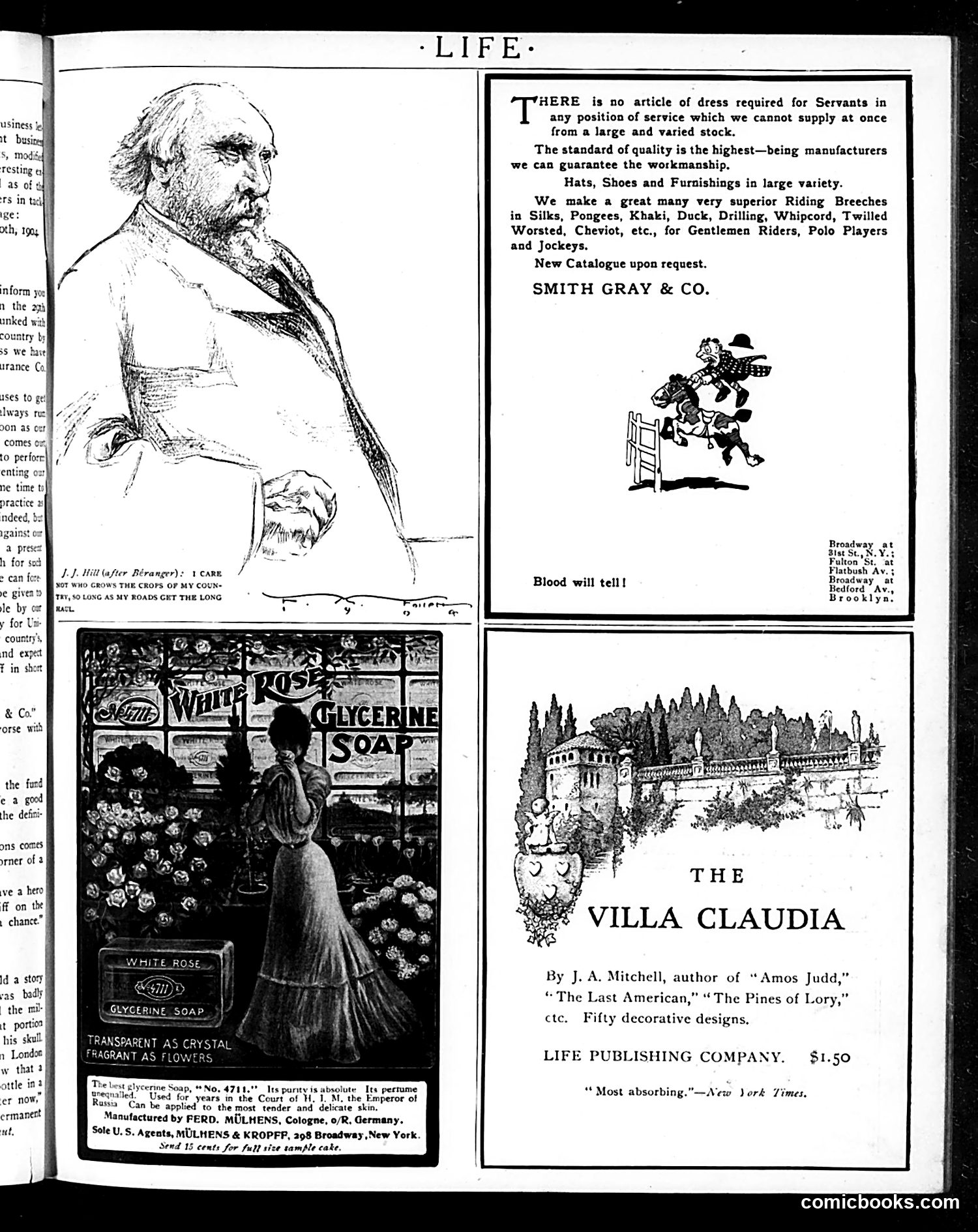
This page from *Life* magazine contains primarily **advertisements and book promotions** rather than political satire. The main content includes: 1. **Portrait sketch** (upper left): A bearded gentleman identified as "J.J. Hill (After Bierstadt)" with a quote about his railroad business—appears to be a prominent businessman of the era. 2. **Smith Gray & Co. advertisement**: Promotes riding breeches and furnishings for gentlemen riders and polo players, targeting the wealthy leisure class. 3. **Glycerine Soap advertisement**: Features a woman at a shop display, marketing transparent soap as luxurious and suitable for delicate skin. 4. **Book promotion**: *The Villa Claudia* by J.A. Mitchell, published by Life Publishing Company ($1.50). The page reflects early 20th-century commercial culture targeting affluent readers rather than delivering satirical commentary.
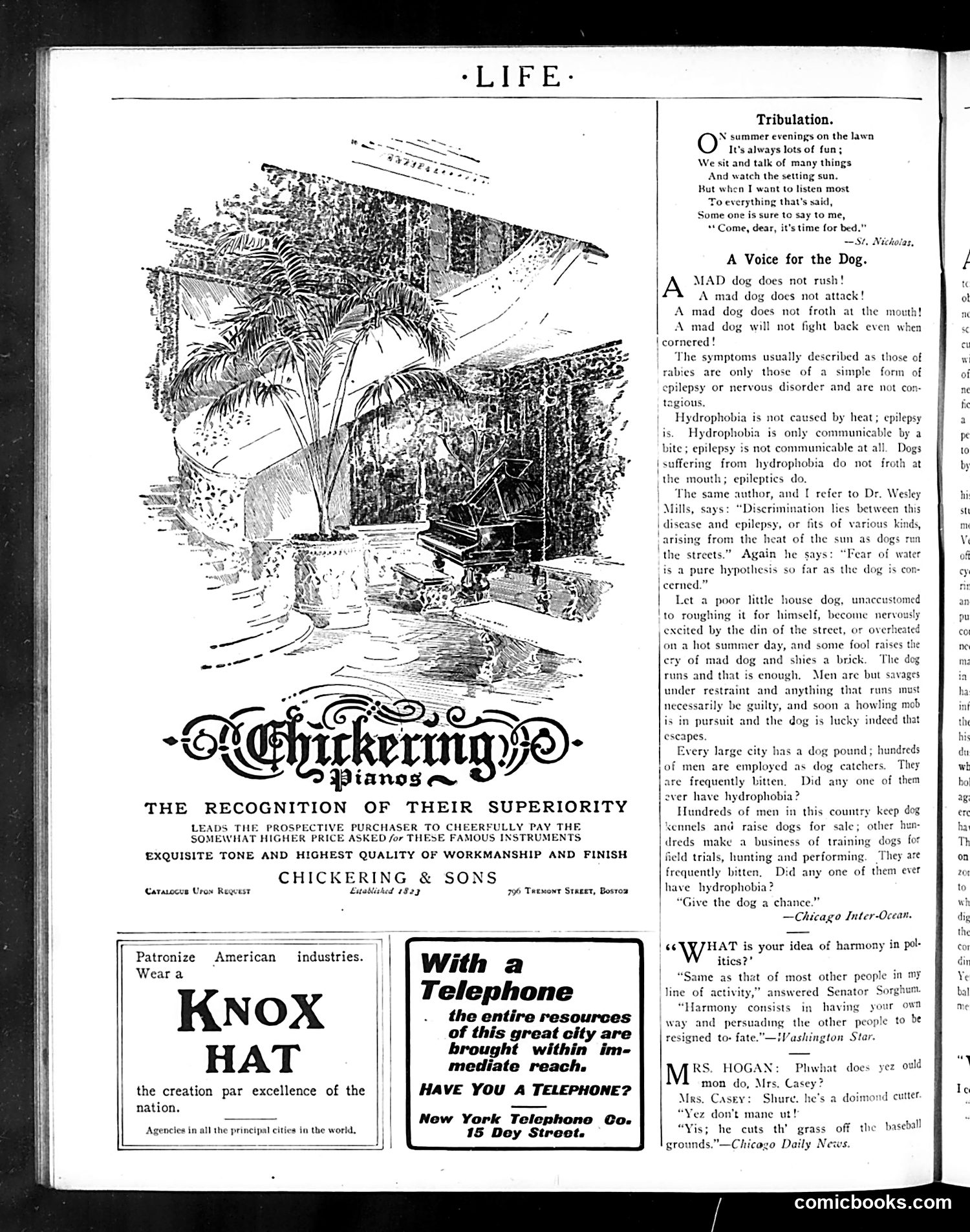
This page is primarily **advertising and humor content** rather than political satire. The main illustration depicts a domestic scene—a woman in a parlor with houseplants and furnishings, accompanying a Chickering & Sons piano advertisement emphasizing their instruments' quality and craftsmanship. Below are three advertisements: Knox Hat (promoting American industry), New York Telephone Company (emphasizing connectivity), and others. The text pieces are light social humor: "Tribulation" (verse about summer evenings), "A Voice for the Dog" (defending dogs against hydrophobia accusations), and brief comedic exchanges between characters about harmony in politics and a woman's diamond cutlet. The overall page reflects early 20th-century consumer culture and genteel domestic humor rather than pointed political commentary.
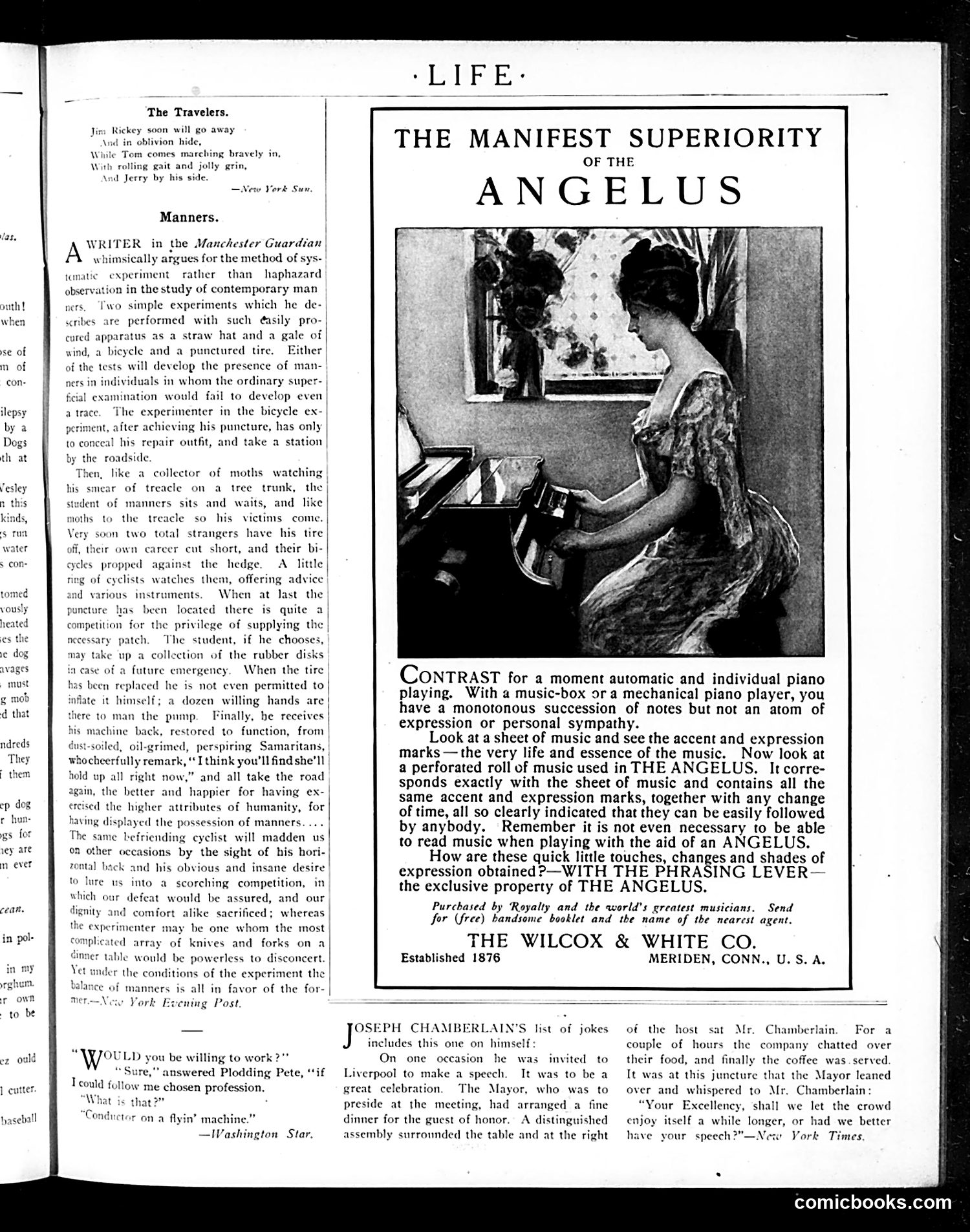
This is a **product advertisement** for the Angelus player piano, disguised as editorial content. The ad compares automatic piano playing to human performance, arguing that the Angelus piano roll reproduces music with perfect expression and nuance—matching the sheet music's markings exactly. The visual shows someone operating the mechanical device. The implied satire targets the era's anxiety about **mechanization replacing human skill**. The ad ironically claims the machine *surpasses* individual musicianship by eliminating human inconsistency, an absurd sales pitch that actually highlights what listeners would lose: genuine artistic interpretation and emotional variation. This reflects early 1900s concerns about industrialization's cultural impact, packaged as humorous advertising in a satirical magazine.
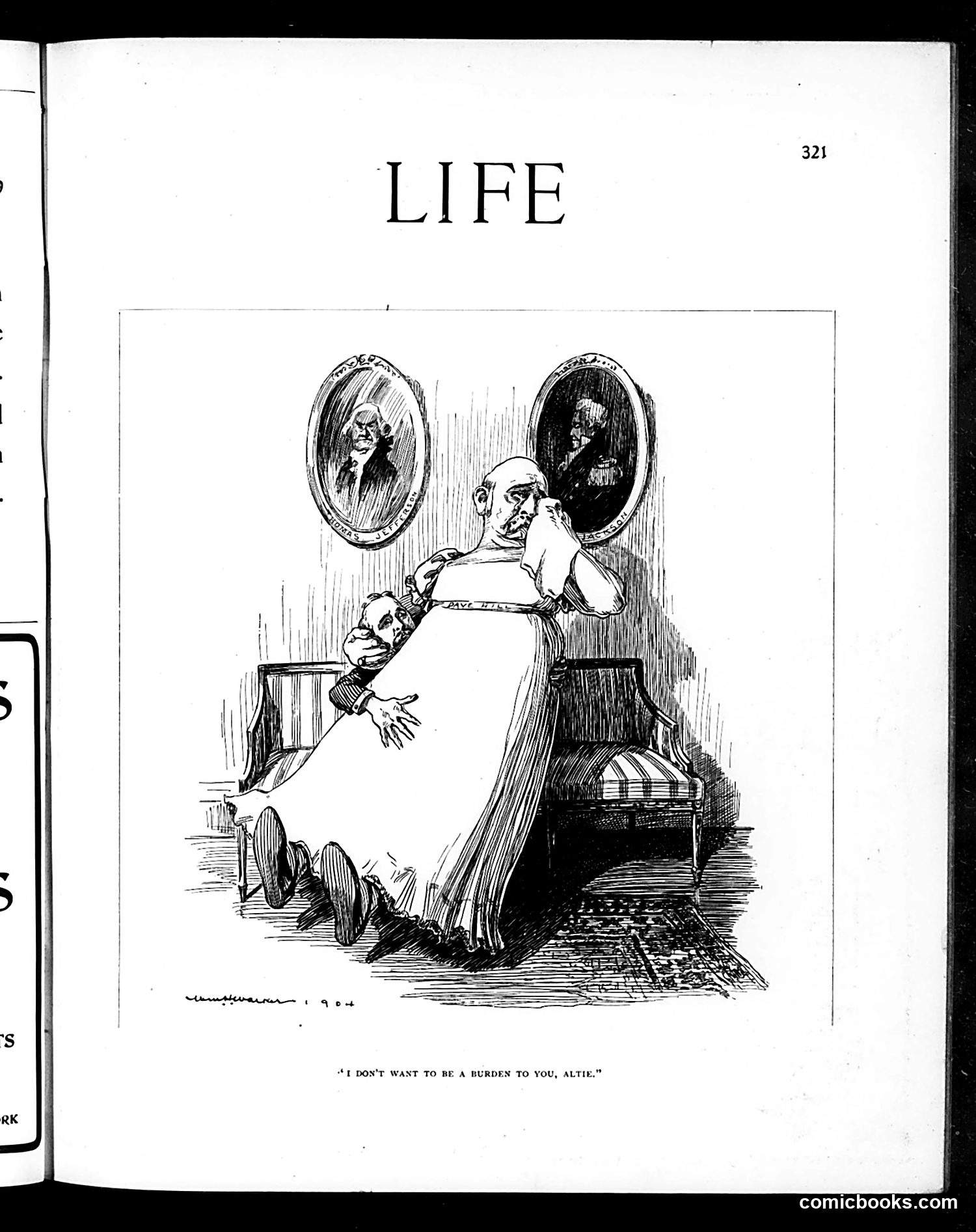
This is a satirical cartoon from *Life* magazine showing a domestic scene with a somewhat exasperated woman holding a small child. Two portraits hang on the wall behind her. The caption reads: "I DON'T WANT TO BE A BURDEN TO YOU, ALTIE." The cartoon appears to satirize marital dynamics and gender roles, likely from the early-to-mid 20th century. The woman's statement—claiming she doesn't want to be a burden while clearly expressing frustration—employs ironic understatement, a common satirical technique. The reference to "Altie" (presumably a nickname for her husband) and her exasperated posture suggest tension between spouses about domestic responsibilities, particularly childcare. The portraits likely represent family ancestors or idealized figures, contrasting with the messy reality depicted below. The satire targets either male indifference to domestic duties or women's resigned acceptance of unequal household labor.
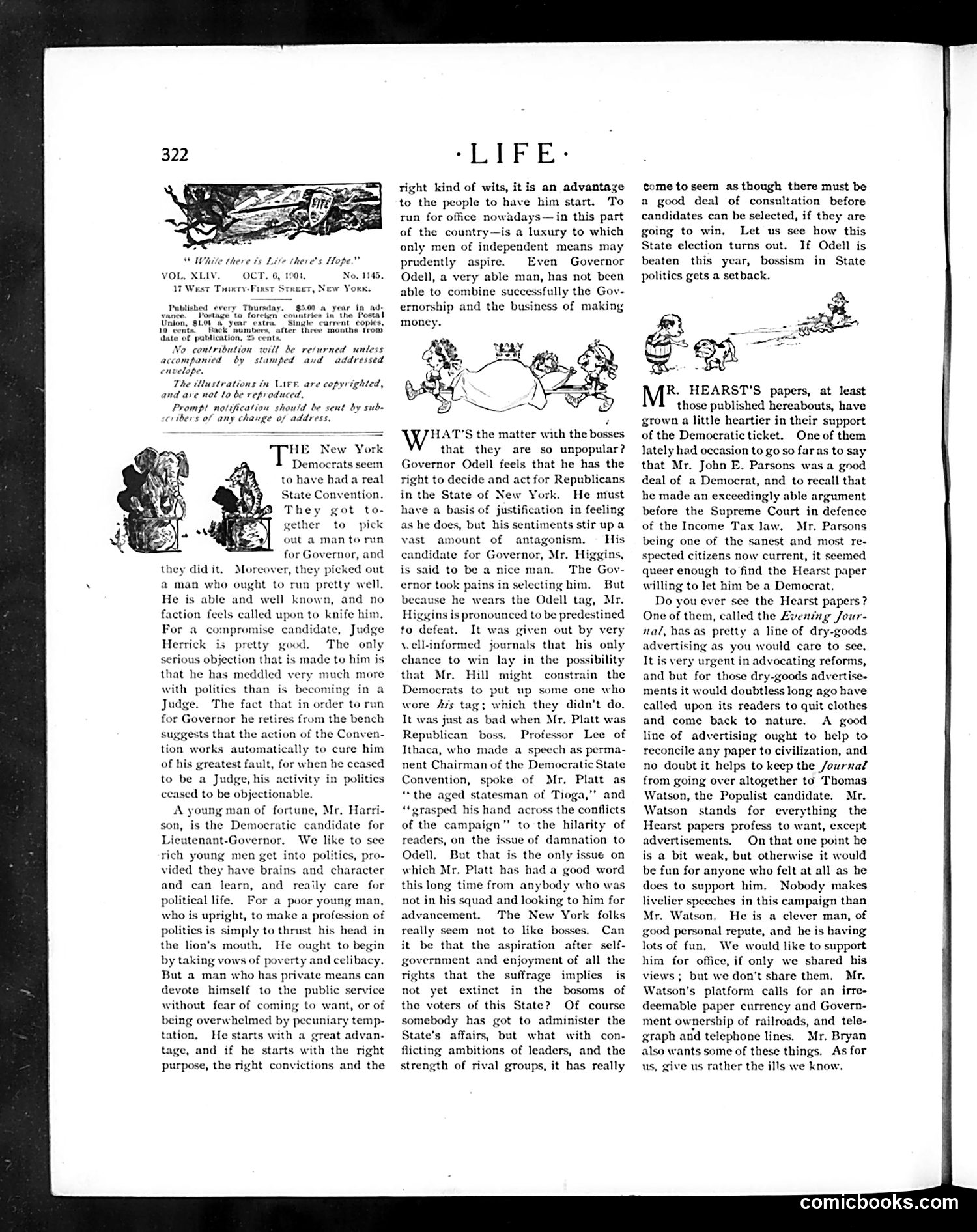
This page from *Life* magazine discusses New York Democratic State Convention politics. The article criticizes Governor Odell for concentrating political power and preventing independent candidates from running for office—described as "a luxury to which only men of independent means may prudently aspire." The text also mocks Democratic boss antagonism toward their own candidates, specifically attacking a selection process for gubernatorial candidates. It mentions Mr. Higgins as a "nice man" whose candidacy stirred opposition, and critiques how newspaper coverage (specifically the *Evening Journal*) promoted Democratic advertisements while the *Journal* itself supported the Populist candidate Thomas Watson. The illustrations show caricatured figures in what appears to be political confrontation or debate, though specific identities are unclear from the image alone.
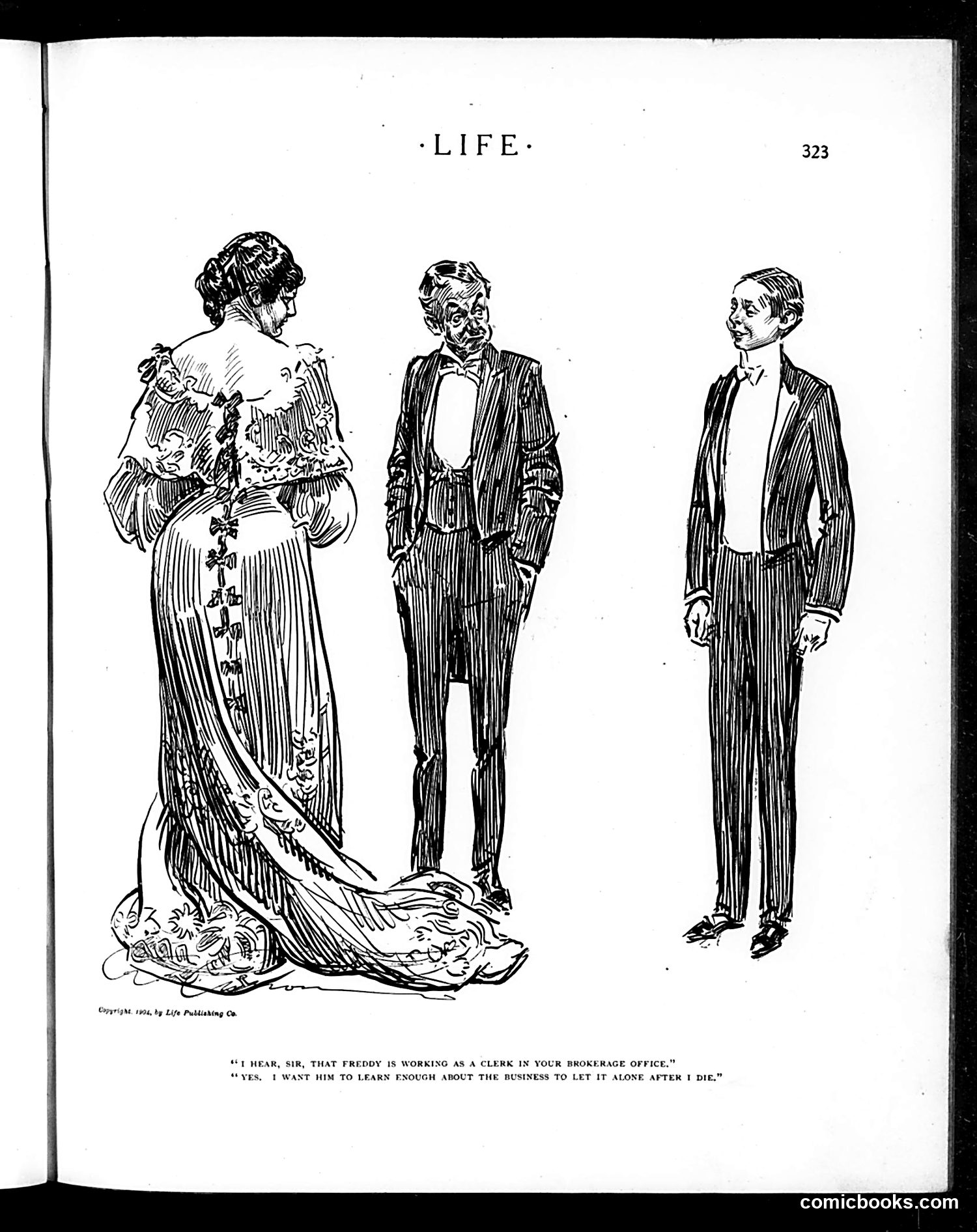
This is a single-panel cartoon from *Life* magazine showing three figures in formal attire: a woman in an elaborate gown (shown from behind), and two men in business suits. The caption reads: "I hear, sir, that Freddy is working as a clerk in your brokerage office." "Yes. I want him to learn enough about the business to let it alone after I die." **The satire:** This is social commentary on wealthy inheritance and business incompetence. The joke suggests that the speaker wants his son Freddy to learn *just enough* about the family brokerage business to understand why he shouldn't run it himself—implying the son lacks capability. It satirizes upper-class attitudes toward business education and the assumption that family members will inherit commercial enterprises regardless of aptitude. The elaborate dress of the woman emphasizes the wealth of these characters, making the critique of idle privilege sharper.
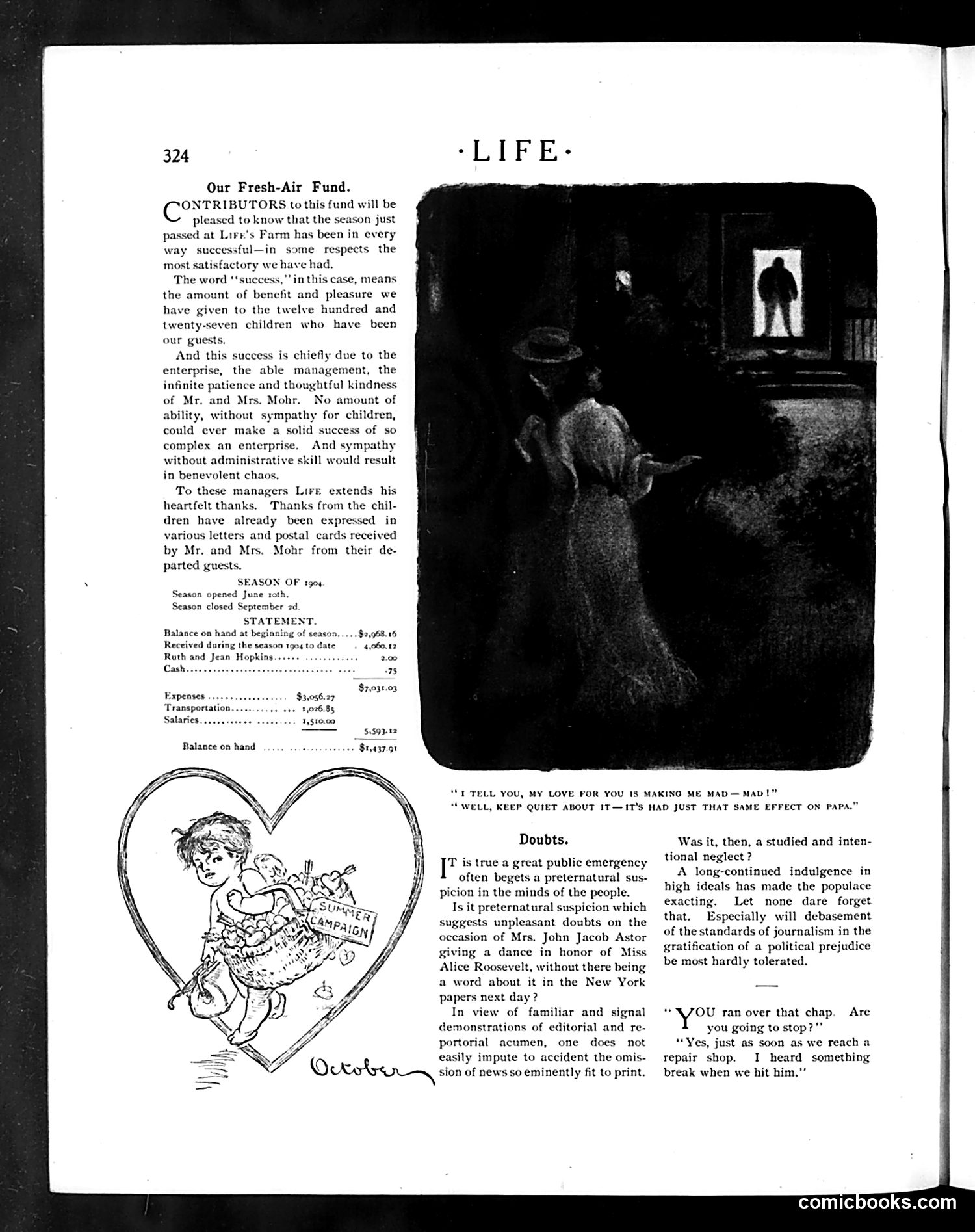
This page contains a management testimonial for "Liff's Farm," a children's guest facility that operated from June to September 1924. The text praises managers Mr. and Mrs. Mohr for successfully hosting 1,227 children. The decorative heart illustration (signed "Octobor") shows a cherub promoting a "Summer Campaign," likely advertising the farm's services. The "Doubts" section appears to be satirical commentary on journalistic standards, criticizing newspapers for failing to report on Mrs. John Jacob Astor's dance for Alice Roosevelt without editorial skepticism. The dialogue snippet about stopping at a repair shop suggests humorous everyday observations rather than political satire. The page primarily functions as institutional promotion combined with light social humor typical of Life magazine's satirical approach.
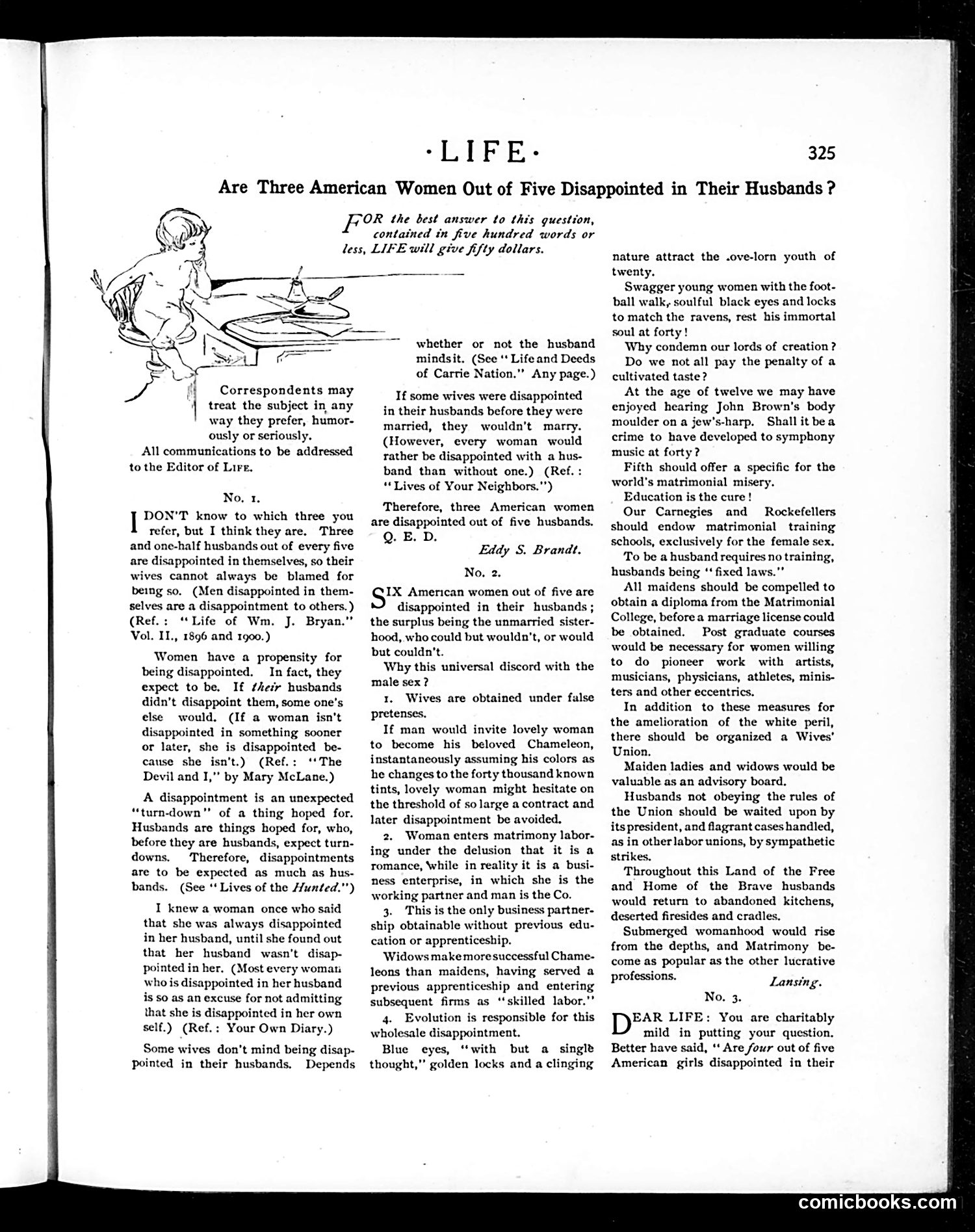
This page presents a **humorous advice column contest** rather than a political cartoon. *Life* magazine solicited reader responses to a provocative question about marital satisfaction, offering fifty dollars for the best answer. The illustration shows a woman at a desk—likely representing the editor or a correspondent—introducing the contest. The responses shown employ satirical logic and self-aware humor typical of early 20th-century American wit. Writers reference contemporary figures (William Jennings Bryan, Carrie Nation) and popular literature to argue whether wives' disappointment stems from husbands' failures or women's unrealistic expectations. The satire targets **gender roles and courtship illusions**: men attract wives through false pretenses; women mistake marriage for romance rather than a business partnership; evolution explains why youthful charm fades. One response suggests widows make better wives because they've apprenticed in "marriage labor." The tone is lighthearted social commentary on matrimonial mismatch—mocking both sexes' expectations.
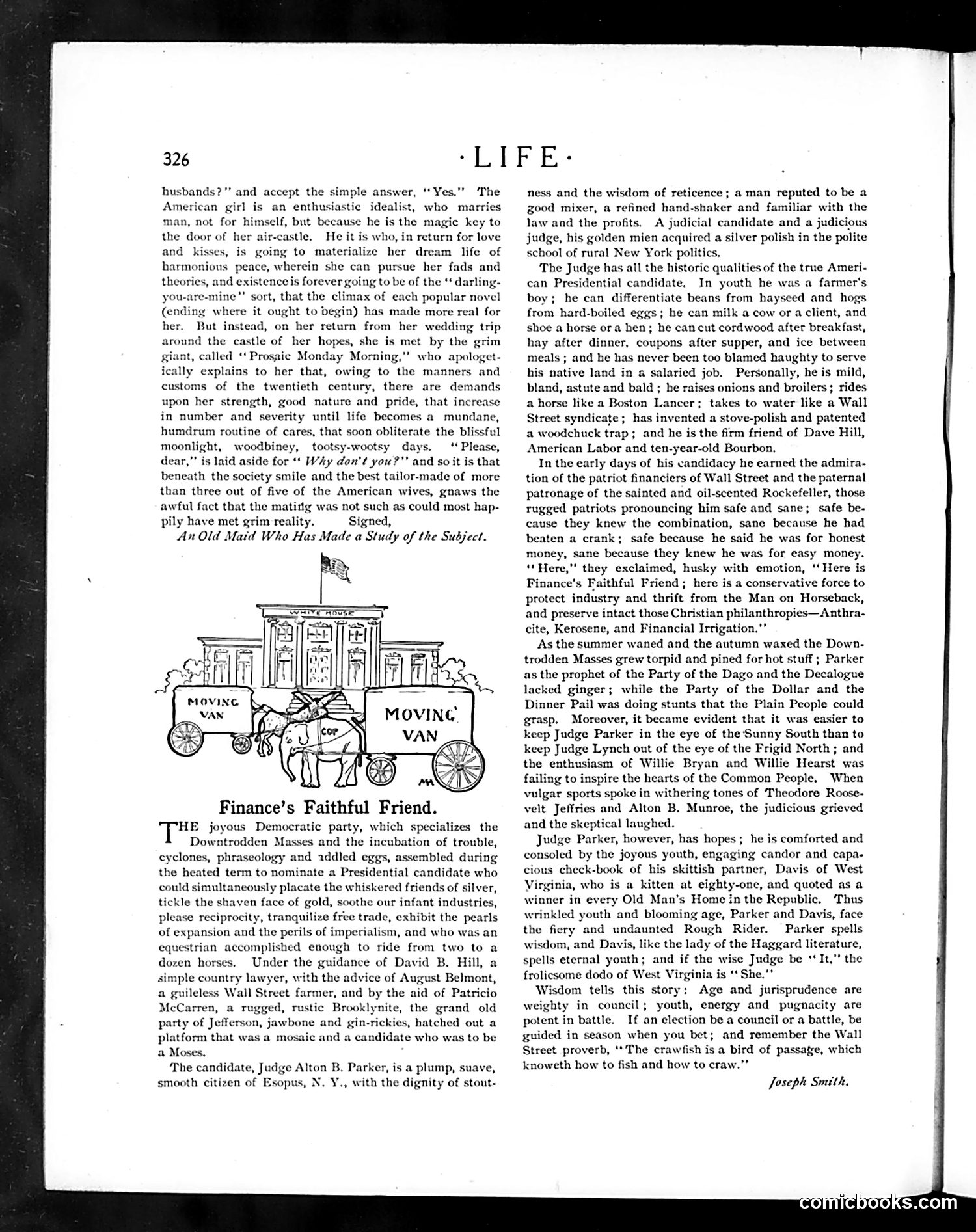
This page satirizes the 1904 Democratic National Convention and its presidential nominee, Judge Alton B. Parker. The cartoon depicts a "Moving Van" — representing the Democratic Party's attempt to transport a viable candidate — symbolizing how the party leadership (David B. Hill, August Belmont, and Patricio McCarren) assembled Parker as their standardized, compromise candidate. The satire mocks Parker as an artificially constructed "Moses" — a man with contrived everyman credentials (farmer's boy background, milking cows and clients alike). Life ridicules how he simultaneously tried to placate incompatible Democratic factions: silver advocates, gold interests, labor, industry, and various ideological positions. The opening section by "An Old Maid" provides ironic contrast, lamenting how marriage's romantic ideals collide with mundane reality — paralleling how the Party's manufactured candidate represents compromise over genuine vision.
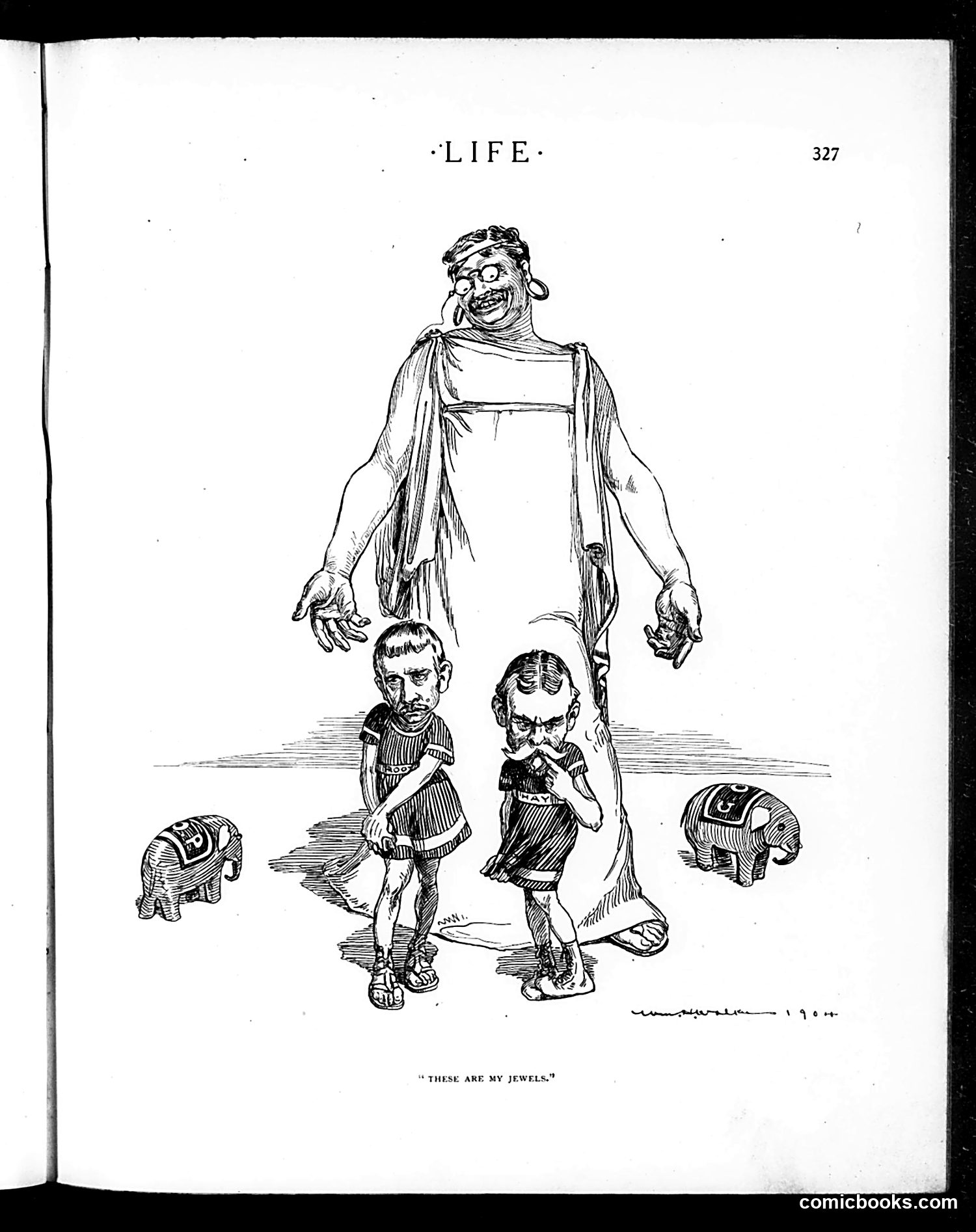
This 1914 satirical cartoon depicts a large adult figure surrounded by two small children and what appear to be elephants wearing decorative coverings. The caption reads "These Are My Jewels." The cartoon appears to use the classical Roman reference—Cornelia's famous statement about her children being her greatest treasures—ironically. The adult figure likely represents a political leader or public figure, while the children and elephants suggest dependents or subjects under their control. The presence of the elephants (associated with the Republican Party) alongside children suggests commentary on how a political leader treats or exploits their followers—comparing them to possessions rather than valuing them genuinely. The satire critiques treating people instrumentally rather than with authentic care, despite rhetoric claiming to cherish them. The exact historical context and specific figures remain unclear without additional publication date confirmation or caption details.
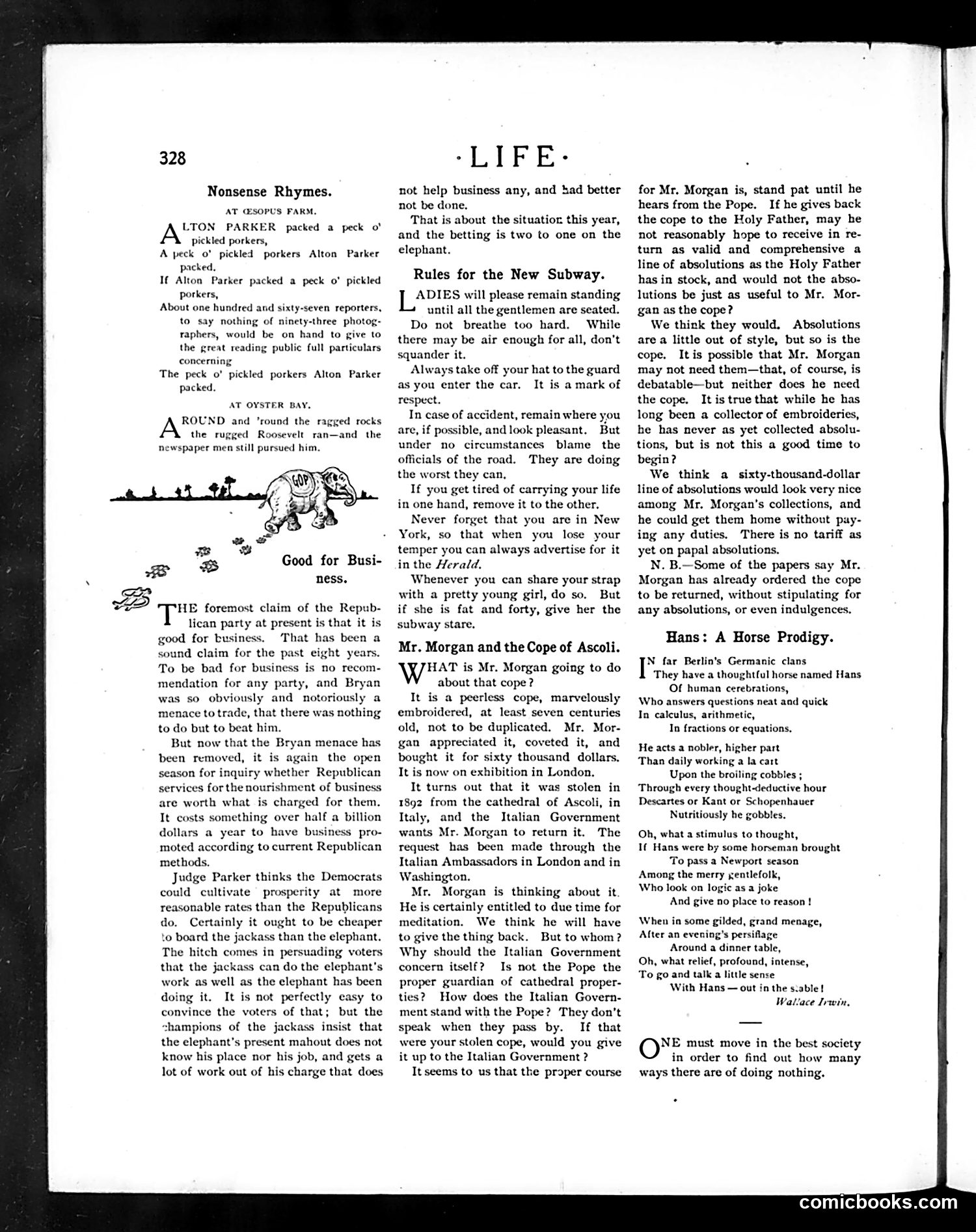
This page from *Life* magazine contains satirical commentary on American politics circa 1904, using absurdist humor to critique public figures and current events. **The Nonsense Rhymes** mock presidential candidates Alton Parker (Democratic) and Theodore Roosevelt (Republican). The Parker verse ridicules how the press obsessively follows political figures; the Roosevelt verse ("Round and 'round the ragged rocks the rugged Roosevelt ran") similarly jokes about his constant media attention—both suggesting politicians are pursued relentlessly by reporters. **"Good for Business"** sarcastically argues that Republicans claim credit for prosperity while Democrats (represented as a "jackass") might manage it more cheaply. Judge Parker (the Democratic candidate) is subtly referenced as offering an alternative. **The Mr. Morgan/Cope of Ascoli section** discusses J.P. Morgan, the wealthy industrialist and art collector, who purchased a stolen religious garment (a cope) from Italy's cathedral. The satire questions whether Morgan—or the Italian Government, or the Pope—should return it, mocking the murky ethics of wealthy collectors acquiring questionable artifacts. The "Rules for the New Subway" is general humor about crowded New York transit conditions.
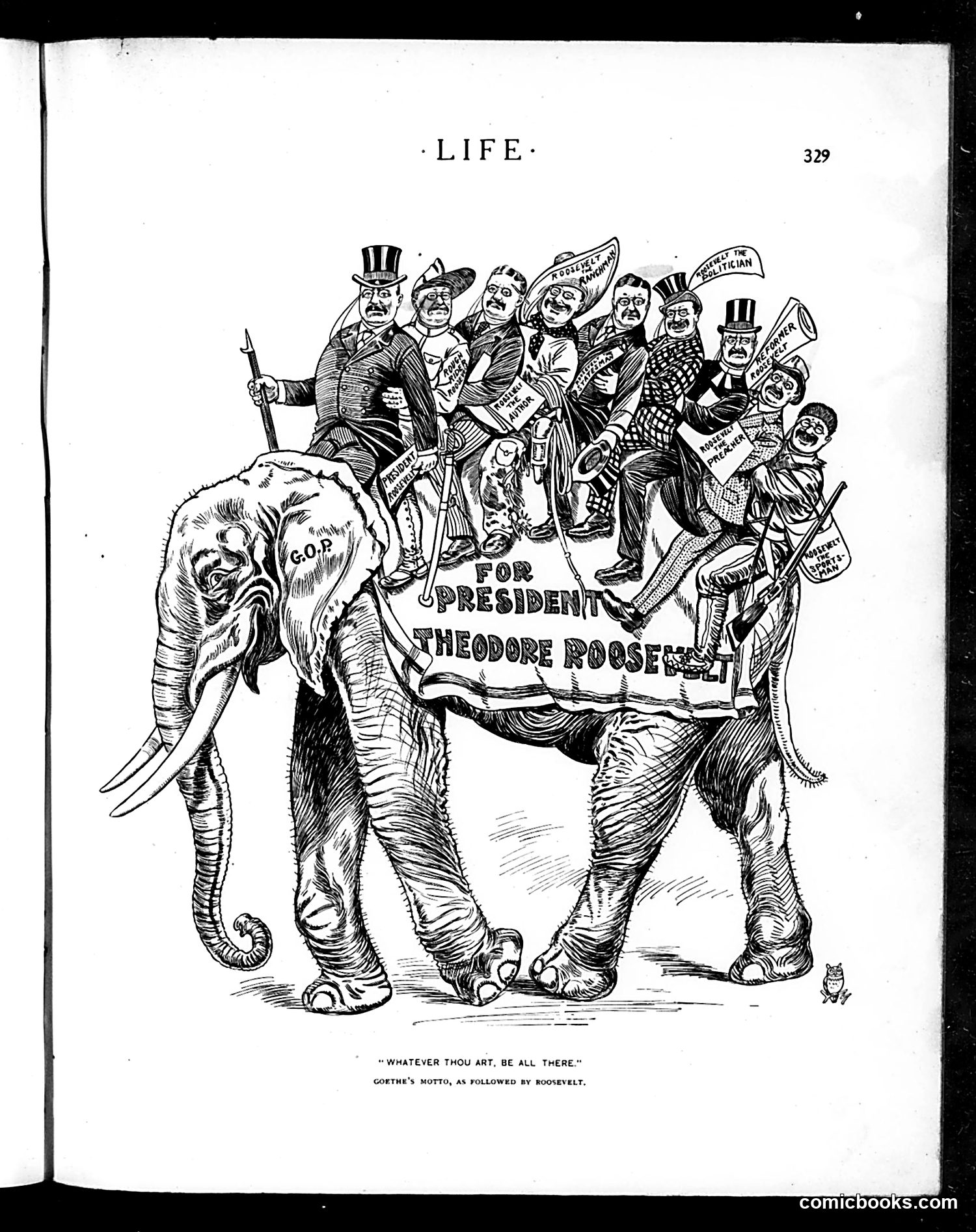
This satirical cartoon from *Life* magazine depicts an elephant (the Republican Party symbol, marked "G.O.P.") carrying a crowd of various political figures and supporters on its back, labeled "For President Theodore Roosevelt." The elephant strains under the weight of this diverse group of men wearing top hats and holding banners representing different political factions and interests. The satire suggests that Roosevelt's presidential campaign attracted a chaotic coalition of competing interests and hangers-on, all riding on the Republican Party's back. The caption attributes the phrase "Whatever thou art, be all there" (Goethe's motto) to Roosevelt, sarcastically implying he embraced all these conflicting groups simultaneously—a critique of his political expansiveness or the unwieldy nature of his political support.
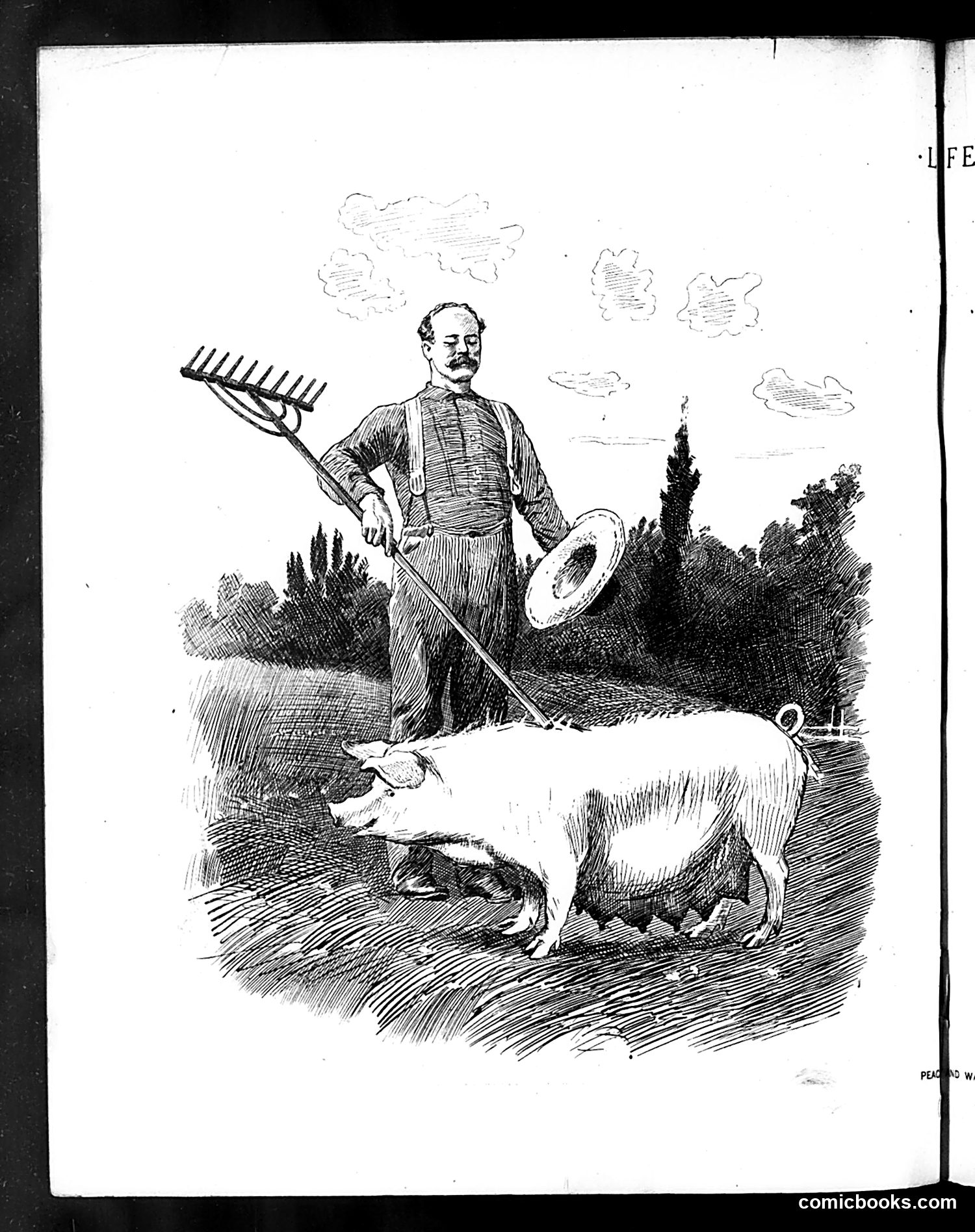
This engraving depicts a man in late 19th-century work clothes holding a rake and a plate, standing over a pig. The cartoon appears to satirize agricultural labor or farming practices of the era. The man's confident posture and the tools he displays suggest commentary on a farmer or agricultural worker, though the specific political figure or policy being lampooned is unclear from the image alone. The presence of the pig—a common symbol in political cartoons for greed, filth, or indulgence—combined with the farming implements suggests social critique regarding agricultural wealth, labor conditions, or possibly corrupt agricultural practices. Without additional textual context or publication date information visible on this page, the precise satirical target remains uncertain.
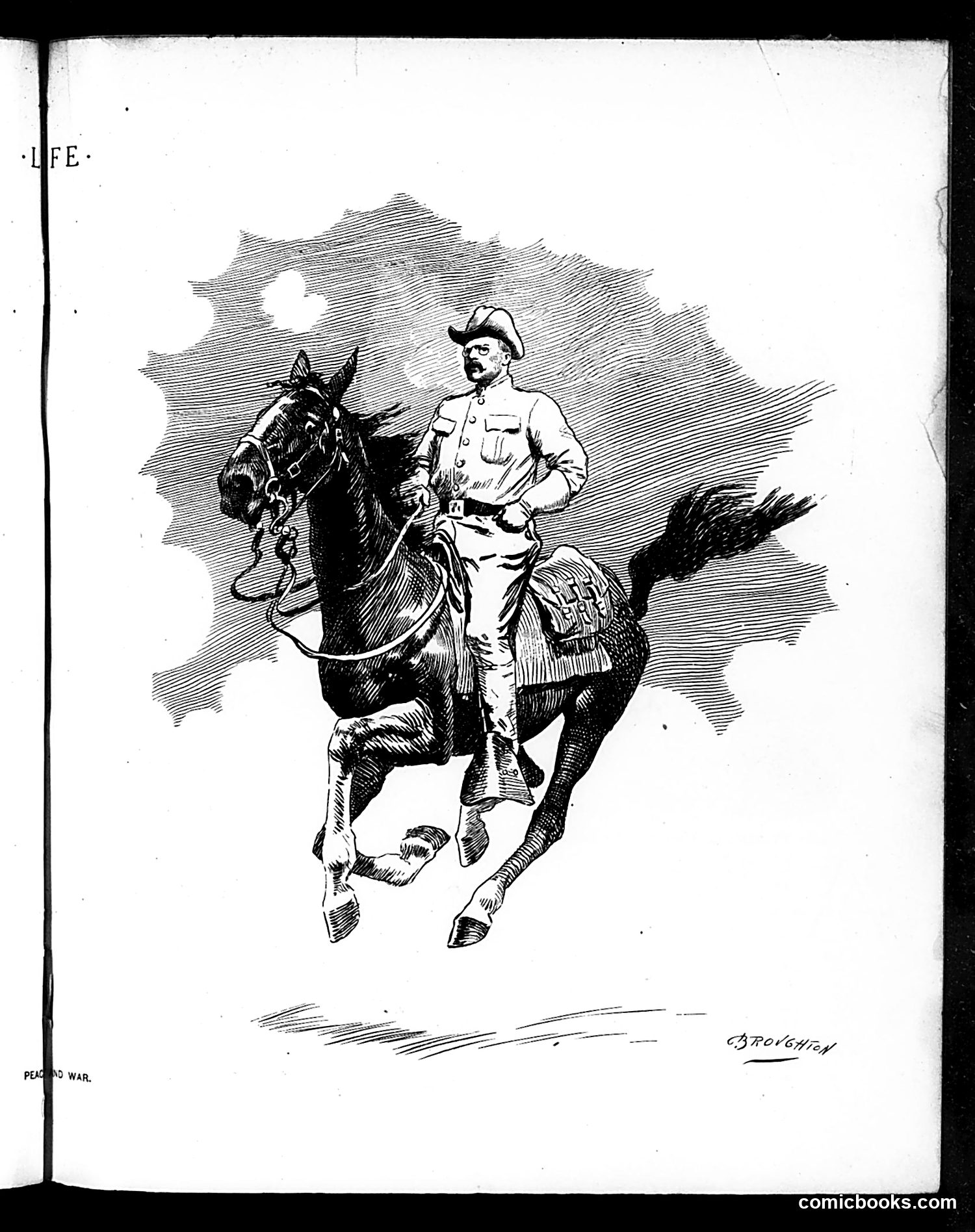
This is a military illustration signed by C. Broughton showing a mounted cavalry officer in uniform on a galloping horse. The figure wears what appears to be early 20th-century military dress with a peaked cap and decorative shoulder insignia (epaulettes), suggesting officer rank. The page header reads "LIFE" and a notation indicates "PUCK'S WAR," suggesting this relates to wartime satire or commentary. However, without clearer OCR text or additional context clues visible in the image itself, I cannot definitively identify which specific officer or military figure is caricatured, nor can I determine the precise satirical point being made. The dynamic pose emphasizes military action or movement, but the exact political or social commentary remains unclear from the image alone.
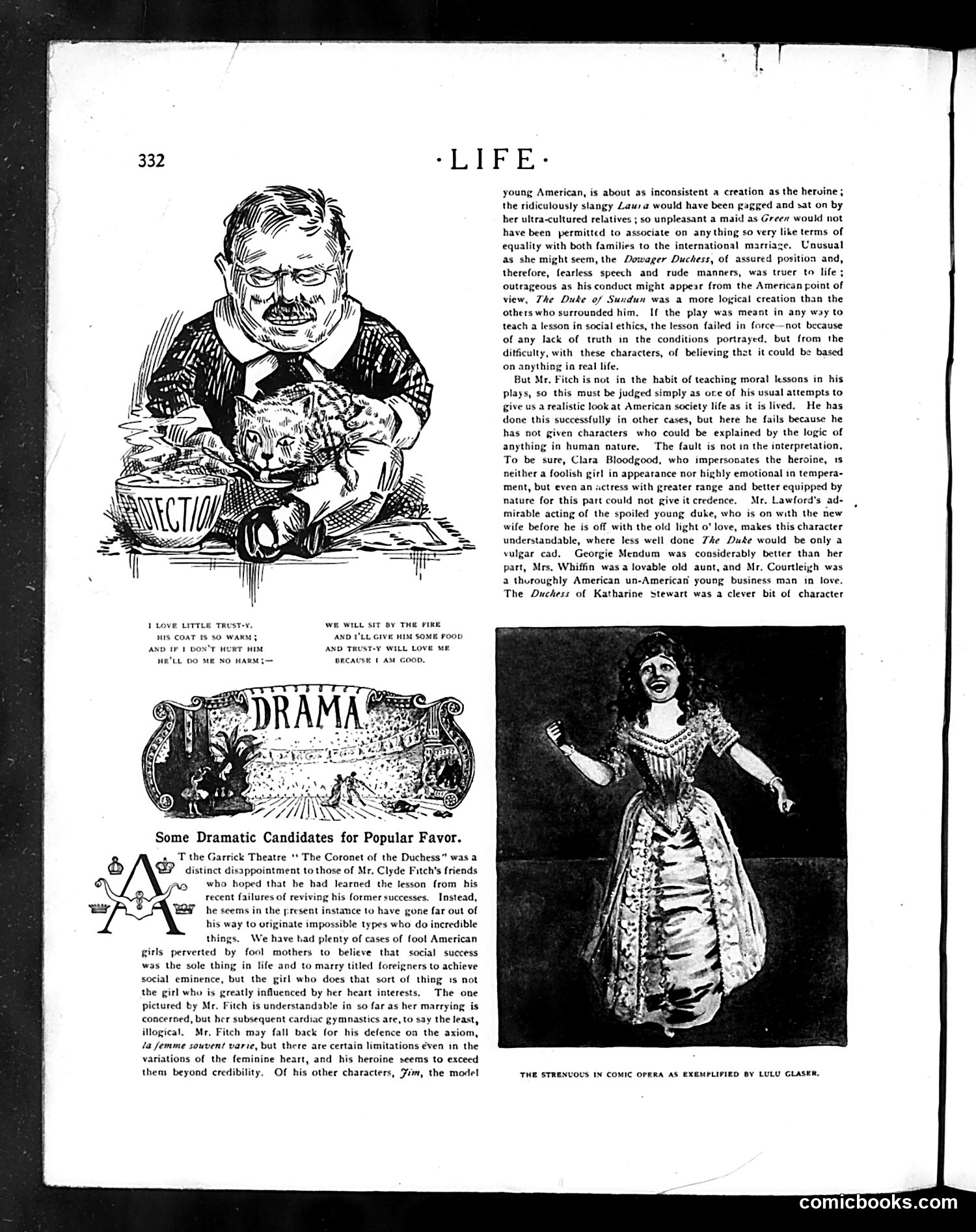
This page reviews playwright Clyde Fitch's play "The Coronet of the Duchess," performing at the Garrick Theatre. The cartoon (top left) appears to be unrelated theatrical humor. The review critiques Fitch's characters as implausible. The heroine—a foolish American girl who marries a foreign duke—behaves illogically, especially in her romantic entanglements. While such marriages to titled foreigners were real phenomena among wealthy American families of the era, the reviewer argues this specific character strains credibility beyond the "limitations of the feminine heart." However, the reviewer praises other cast members, particularly actor Lawford's portrayal of the "spoiled young duke" and actress Clara Bloodgood's performance, despite weak characterization. The bottom image shows Lulu Glaser in comic opera, illustrating another theatrical offering. The review exemplifies how Life magazine critiqued contemporary theater for both artistic merit and social realism.
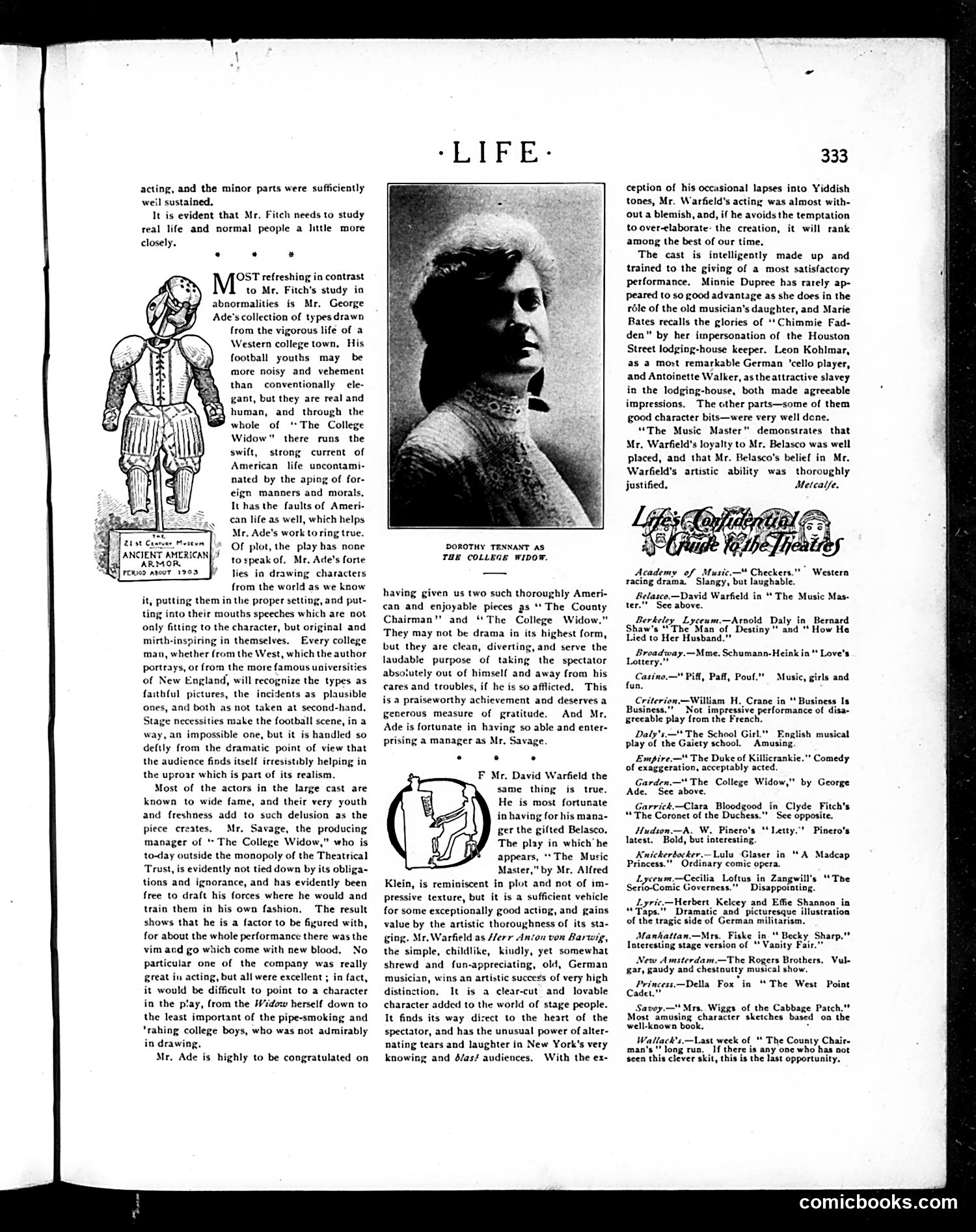
This page reviews three theatrical productions from the early 1900s. The main cartoon depicts **Dorothy Tennant as "The College Widow,"** the title character of George Ade's play—a work praised here for its authentic portrayal of American college life over European artificiality. The critic contrasts Ade's realistic depiction of Western college characters with another playwright's (Mr. Fitch's) focus on "abnormalities." Ade's strength lies in drawing recognizable types—football players, college boys—rendered with genuine American vigor rather than imitated "foreign manners and morals." The review also praises producer Mr. Savage's independence from the "Theatrical Trust" monopoly, and David Warfield's performance in "The Music Master," celebrating his portrayal of a kindly German musician. The satire targets theatrical pretension: Ade succeeds by capturing real American life authentically, while gaining artistic credibility without resorting to melodrama or foreign affectation.
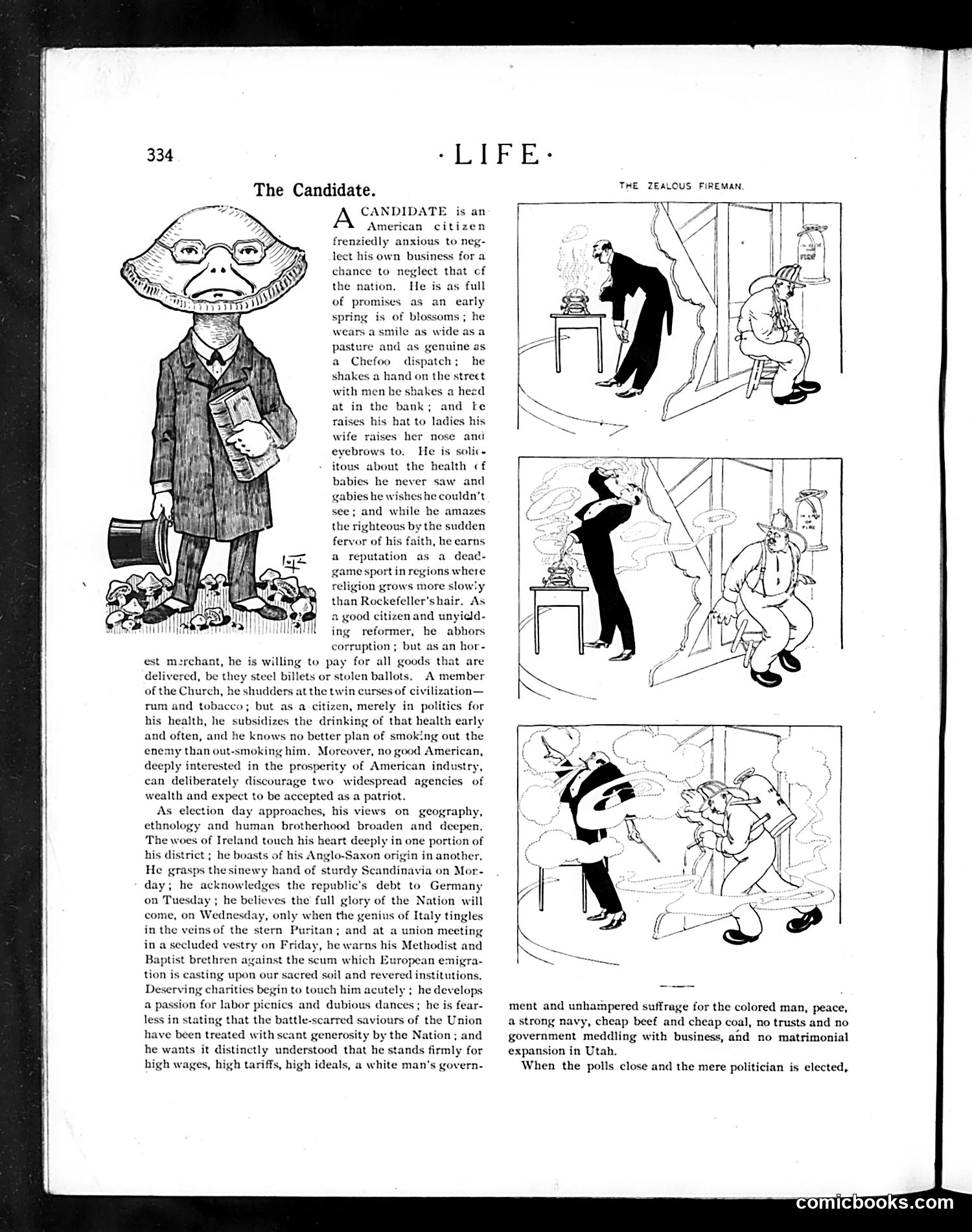
This is a satirical definition of the typical American political candidate, illustrated with a caricatured figure carrying a newspaper and standing amid discarded items (suggesting corruption or waste). **The satire targets:** - **Hypocrisy**: The candidate claims reform while accepting "stolen ballots"; opposes rum and tobacco publicly while subsidizing drinking for political gain - **Pandering**: His views on ethnicity and geography conveniently shift by day—praising Scandinavian, German, Italian, and Puritan heritage as needed to win votes - **Inconsistency**: He's solicitous about babies he's never met, generous about stolen goods if it wins elections, and patriotic about protecting industries while opposing trusts - **Empty promises**: Full of "genuine as a Chefoo dispatch" (a known source of unreliable news) The accompanying comic strip titled "The Zealous Fireman" (right panel) appears to show someone creating chaos while claiming to help—likely reinforcing the theme of self-serving incompetence masquerading as public service. This reflects turn-of-the-century American distrust of machine politics and candidate opportunism.
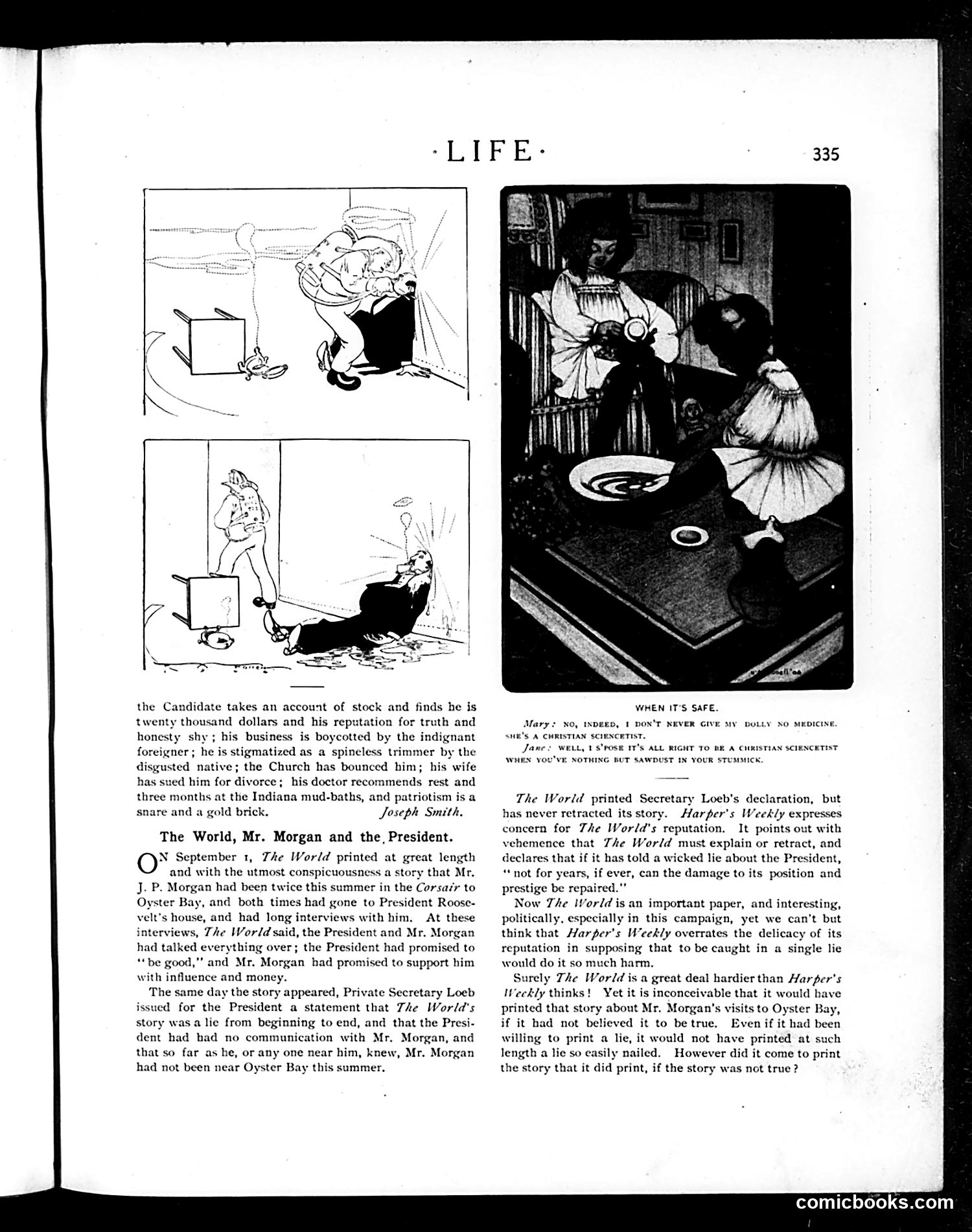
This page contains two distinct items: **Top cartoons** (by Joseph Smith): Satirize a hapless candidate whose business fails, gets boycotted, faces divorce, and is mocked—the implication being that patriotic service ruins one's life. **Main article**: Addresses a controversy between *The World* newspaper and President Theodore Roosevelt. *The World* reported that J.P. Morgan (the powerful financier) visited Roosevelt twice at Oyster Bay for secret negotiations where Roosevelt promised to "be good" and Morgan promised financial support. Roosevelt's secretary Loeb denied this entirely. *Life's* sister publication *Harper's Weekly* demanded *The World* retract the story or face permanent reputational damage. *Life* sarcastically questions *Harper's Weekly's* concern, arguing that major newspapers survive false stories regularly. The implicit point: corporate influence on politics was real enough that such a story seemed plausible, and press accountability for falsehoods was weak. **Bottom cartoon**: Mocks Christian Science by having a child with sawdust-filled stomach reject medicine—dark satire on the sect's rejection of medical treatment.
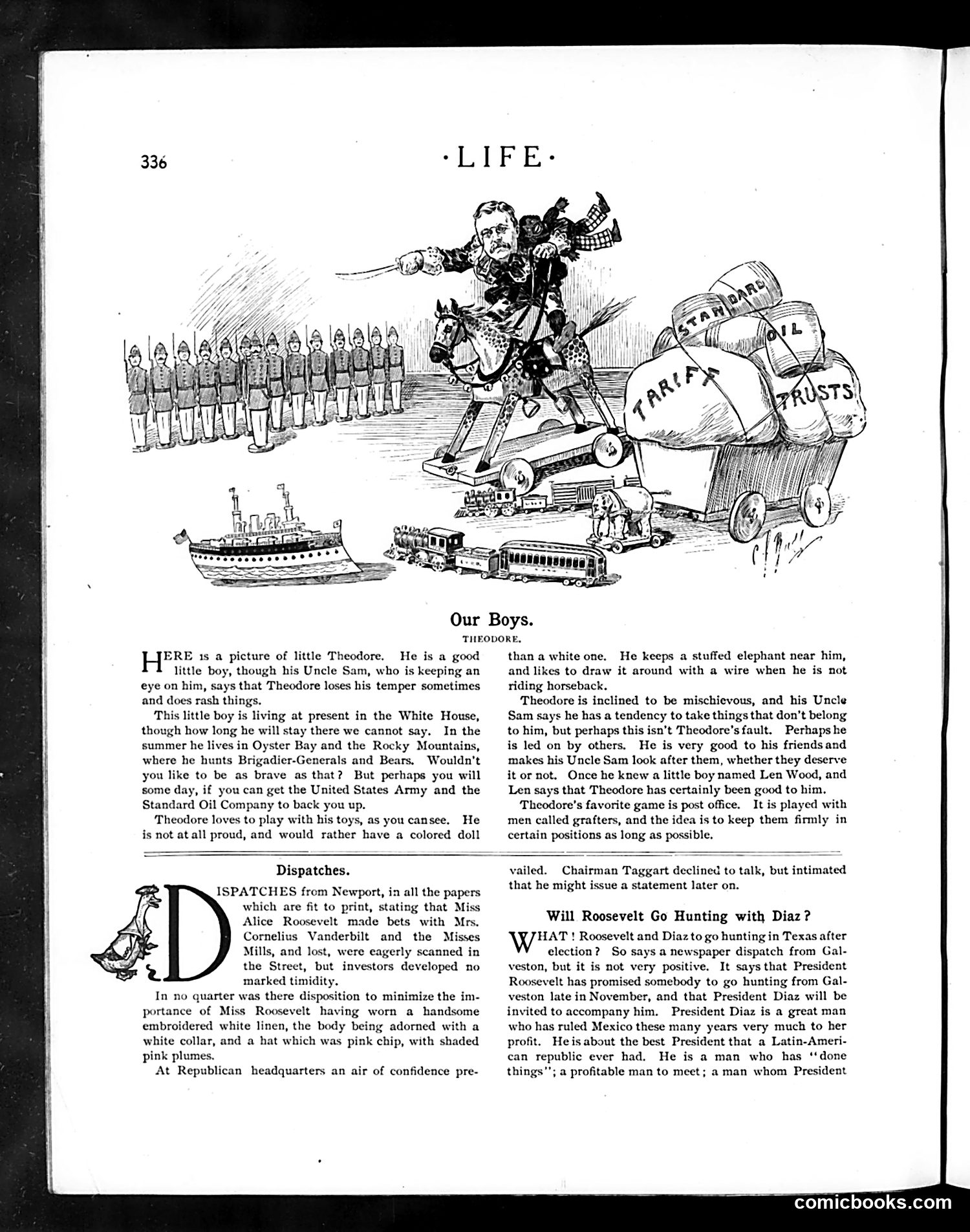
This 1904 Life magazine page satirizes President Theodore Roosevelt through a children's story format. "Little Theodore" is Roosevelt himself, depicted as impulsive and reckless—"Uncle Sam" (the U.S. government) watches him nervously. The cartoon criticizes Roosevelt's aggressive policies: his military interventions ("hunts Brigadier-Generals"), corporate trust-busting ("post office" game with "grafters"), and imperialist tendencies. The accompanying train laden with "Tariff," "Standard Oil," and "Trusts" represents the political machinery backing him. The "Dispatches" section mocks Alice Roosevelt (his daughter) for betting on horse races and fashion choices, suggesting the scandal was overblown by society pages while stock markets remained unmoved. The final item sarcastically praises Mexican President Porfirio Díaz as "the best President" while hinting Roosevelt's proposed hunting trip is actually political posturing—celebrating a foreign leader's autocratic "accomplishments" while cynically noting his profitability to American interests. The overall tone: Roosevelt is impulsive, corrupt-adjacent, and theatrically imperial.
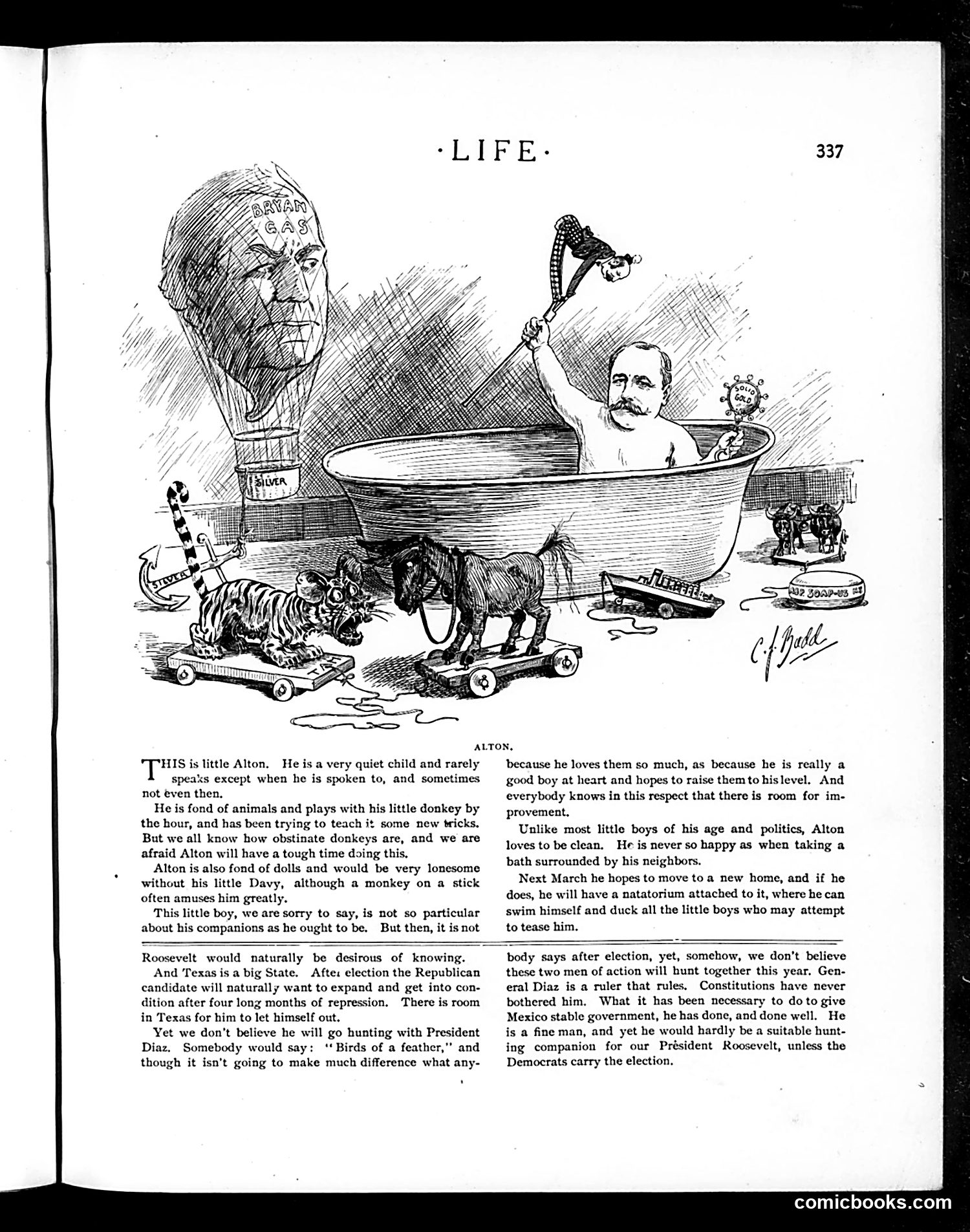
This 1908 Life magazine cartoon satirizes Theodore Roosevelt through an extended metaphor about a boy named "Alton" and his animal companions. The large head with "Bryan 1908" written on it represents William Jennings Bryan, the Democratic presidential candidate. The text employs thinly-veiled allegory: "Alton" represents Roosevelt; his stubborn donkey symbolizes the Republican Party; his "little Davy" (monkey) references the Democratic opposition. The commentary mocks Roosevelt's political nature—his desire to "expand" after the election and his unlikely hunting partnership with Mexican President Porfirio Díaz. The satire suggests Roosevelt will remain politically active and unpredictable post-presidency, while ridiculing his potential alliance with the autocratic Díaz. The cartoon criticizes Roosevelt's expansionist tendencies and questions whether he should partner with a foreign authoritarian ruler, using the innocent language of children's activities to deliver pointed political criticism.
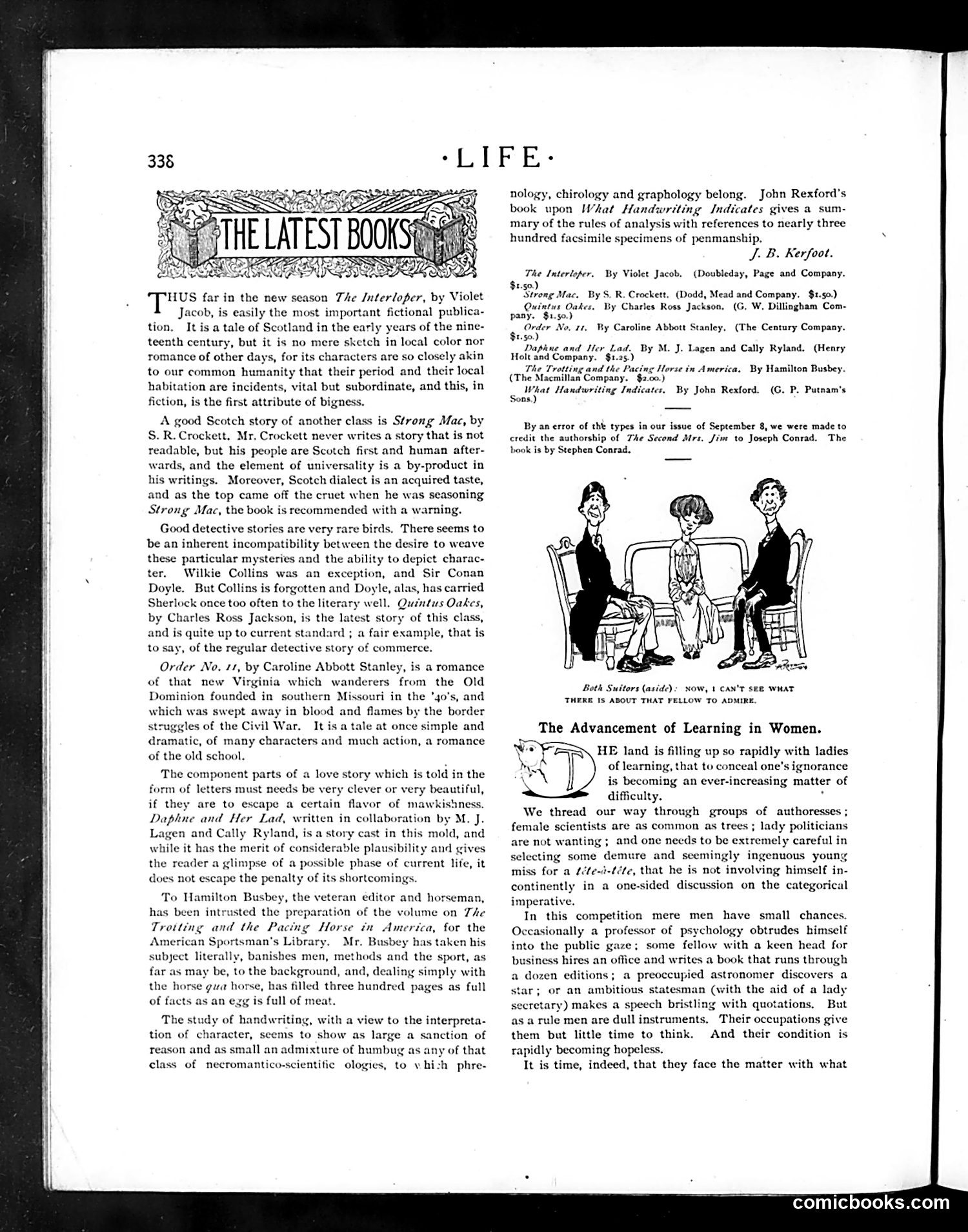
This page is primarily a **book review section** titled "The Latest Books," not primarily satirical content. The main text reviews recent novels and non-fiction works, including Scottish fiction (*The Interloper*, *Strong Mac*), detective stories, and a Civil War romance. The **single cartoon** depicts three well-dressed figures in conversation, with the caption: "Bob Sniters (aside): 'Now, I can't see what there is about that fellow to admire.'" The joke appears to be social satire about pretension and conformity—one character publicly pretends to admire someone while privately expressing disdain. It's a commentary on artificial social behavior and the gap between public affection and private opinion among the upper classes. The second article, "The Advancement of Learning in Women," discusses women's limited opportunities in academic and professional fields, describing their situation as "hopeless"—reflecting early 20th-century gender barriers.
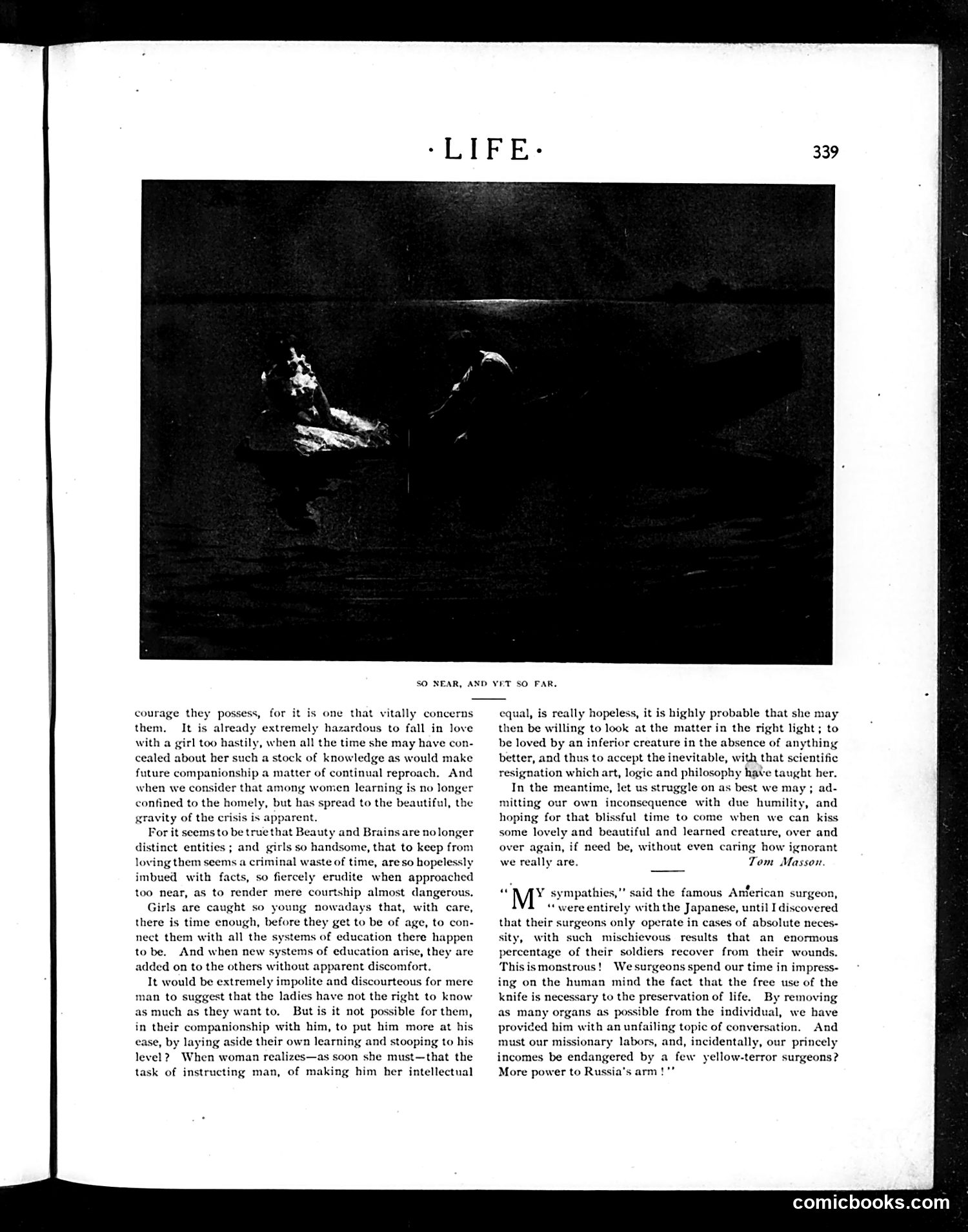
This page contains two separate satirical pieces from *Life* magazine (a 19th-century humor publication, not the photo magazine). **Main Article:** A tongue-in-cheek complaint about educated women. The author laments that modern women now possess both beauty *and* intelligence—making courtship dangerously intimidating. He mockingly suggests women should graciously "dumb themselves down" for men's comfort, since educating men to their level is "hopeless." The satire mocks male insecurity about female education and learning. **Lower Section:** A darkly comic monologue from an unnamed American surgeon praising Russian (not Japanese—the text appears garbled) military surgeons for *not* operating unnecessarily on wounded soldiers. The surgeon ironically complains that high soldier survival rates threaten surgeons' profitable practices and prestige. This satirizes surgical greed and the financial incentive to over-operate. Both pieces use exaggeration and ironic voice to critique social attitudes—male anxiety about educated women, and medical profession self-interest over patient welfare.
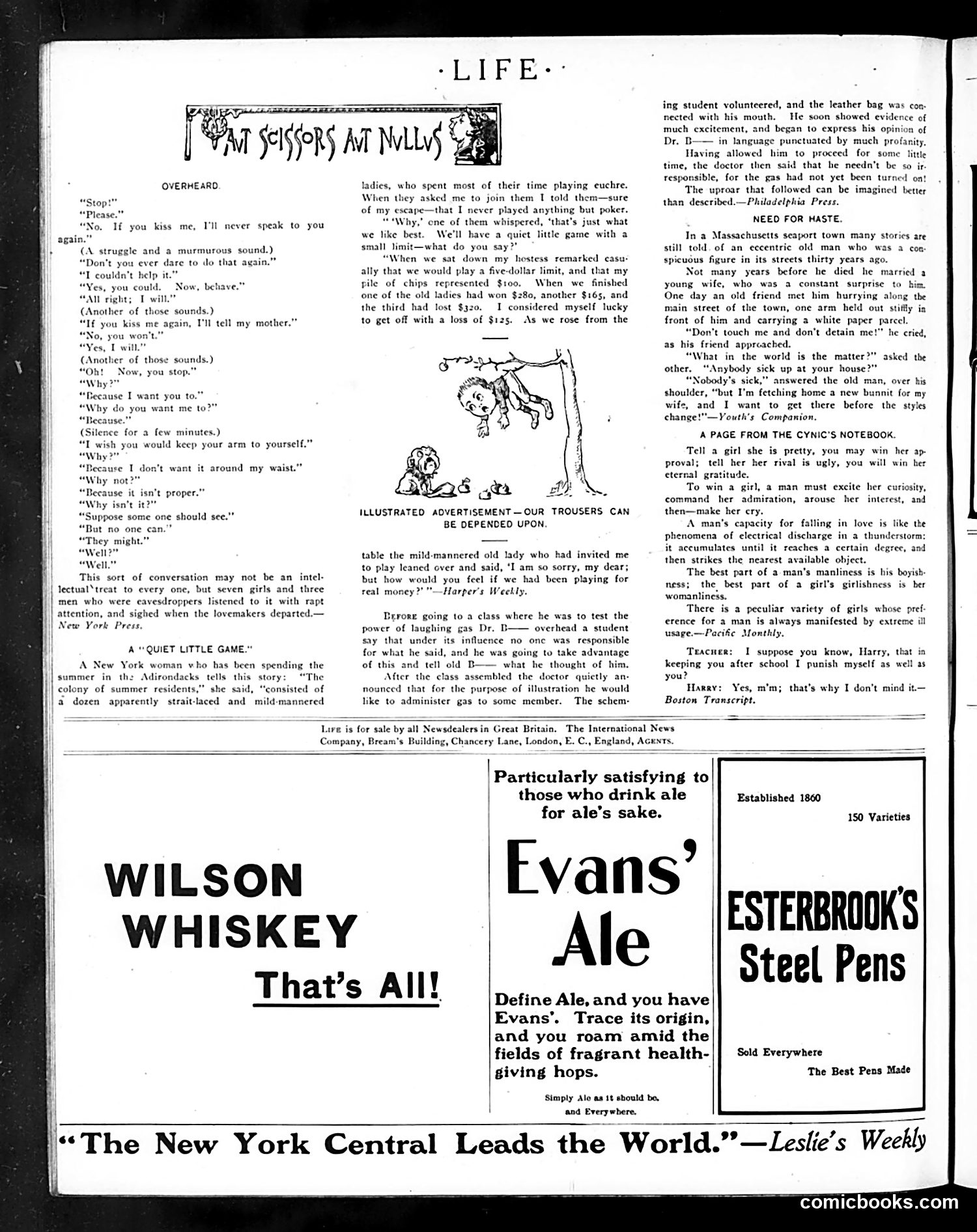
This page contains three humorous anecdotes satirizing social hypocrisy and human nature, typical of *Life's* early 20th-century satirical style. **"Scissors at Nullus"** mocks romantic courtship conventions through overheard dialogue where a young couple engage in flirtatious banter—the woman protests impropriety while accepting the man's advances, then eavesdroppers sigh sentimentally at this performance of propriety. **"A Quiet Little Game"** exposes the duplicity of respectable society ladies. They claim to play only innocent card games (euchre), then reveal they're serious high-stakes poker players. The joke's punchline—the hostess's mock sympathy about "real money"—highlights their calculated deception. **The Laughing Gas anecdote** shows a student's comeuppance: planning to insult his professor under the influence of laughing gas (claiming irresponsibility), he's humiliated when the doctor reveals the gas was never actually turned on—his behavior was entirely voluntary. Together, these pieces mock pretense, hidden vice beneath respectability, and people's self-serving rationalizations—central to *Life's* satirical mission in exposing American social hypocrisy.
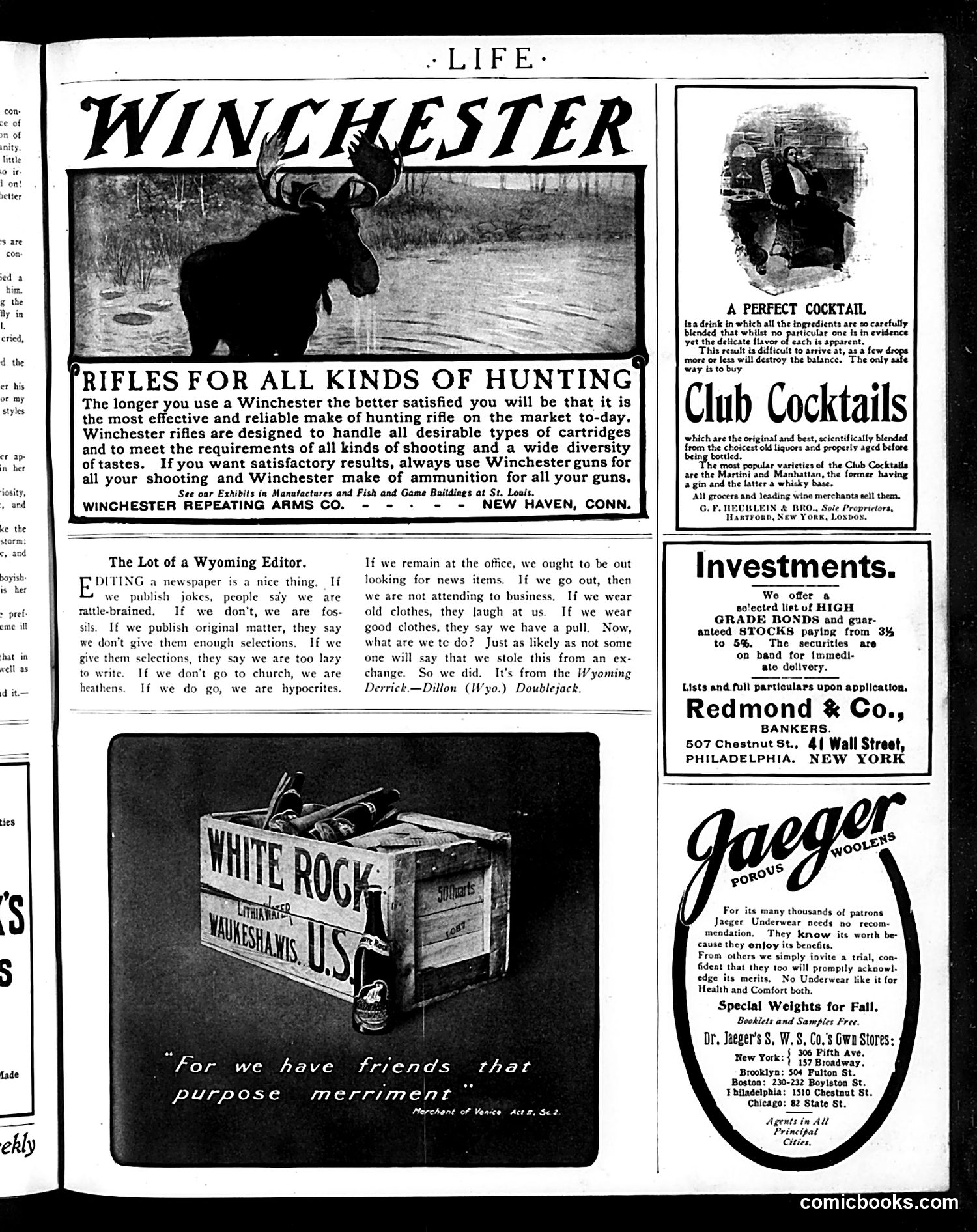
This page is primarily **advertising**, not satirical content. However, it contains one brief editorial joke: **"The Lot of a Wyoming Editor"** is a humorous complaint about the impossible position of newspaper editors. The editor lists contradictions: if they publish jokes, readers call them scatterbrained; if they don't, they're fossils. If they attend church, they're hypocrites; if they don't, they're heathens. If they stay in the office, they should be seeking news; if they leave, they're not working. The joke satirizes the **no-win situation of pleasing the public**—whatever choice an editor makes invites criticism. The attribution to the *Wyoming Derrick* suggests this was a common complaint among frontier newspaper editors of the era. The remainder of the page consists of period advertisements for Winchester rifles, Club Cocktails, investment bonds, and Jaeger underwear—typical of early 20th-century Life magazine's revenue model.
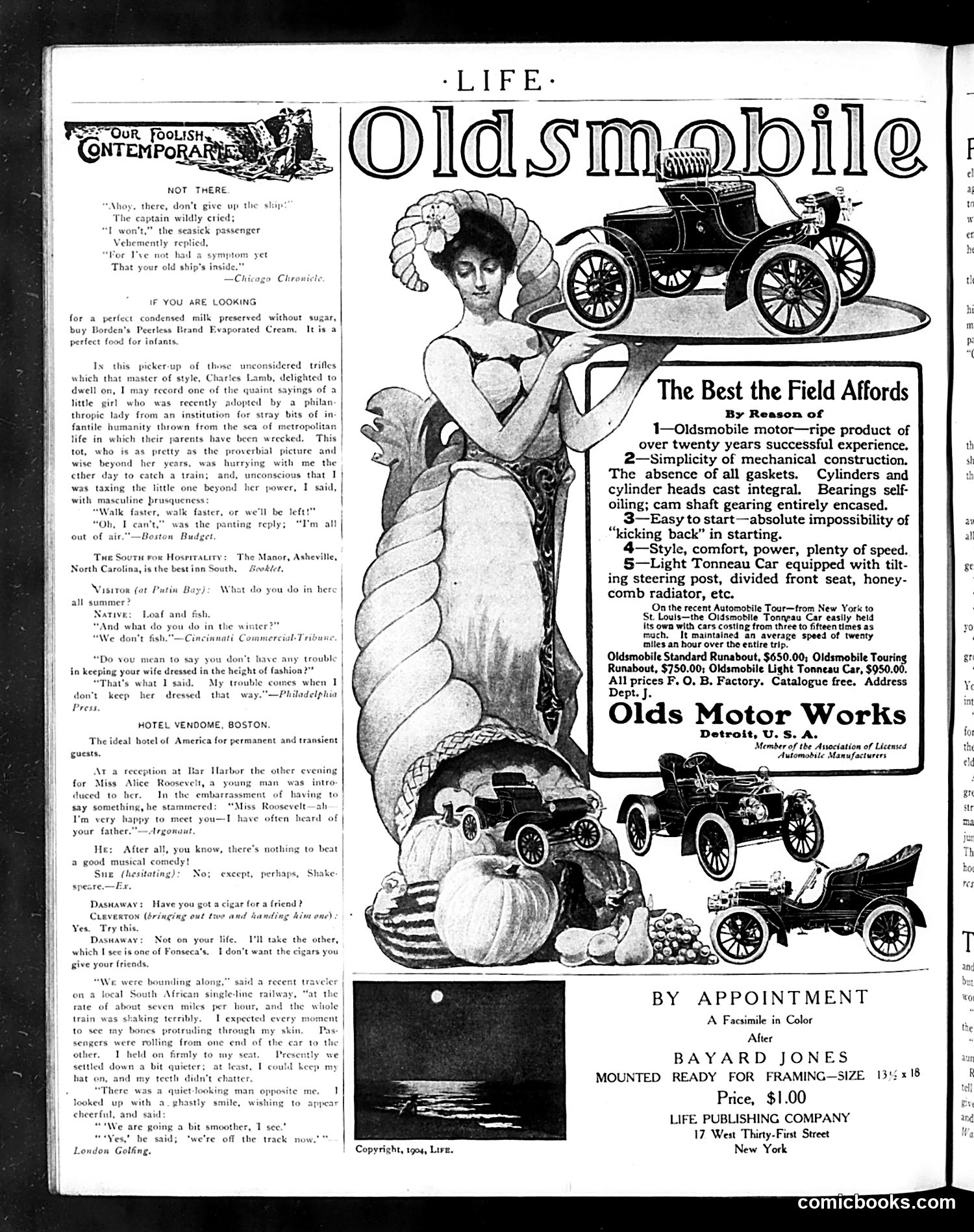
This page combines satirical humor and advertising, typical of Life's format. The left side features "Our Foolish Contemporaries," a recurring section of short anecdotes mocking human behavior. The jokes target social pretension—a guest arriving without luggage, a fashion-obsessed wife, friends being served inferior cigars—capturing middle-class anxieties of the early 1900s. The dominant image is a fetishized illustration of a woman in classical dress reclining beside an early automobile, advertising Oldsmobile motor cars. The juxtaposition is deliberate: automobiles were new luxury items, and the image connects mechanical progress with feminine allure to market to wealthy male readers. The bottom anecdote about a derailing train mocking passengers' fear adds dark comedy typical of the era. Overall, the page reflects early-20th-century consumer culture and gender attitudes while satirizing contemporary social foibles.
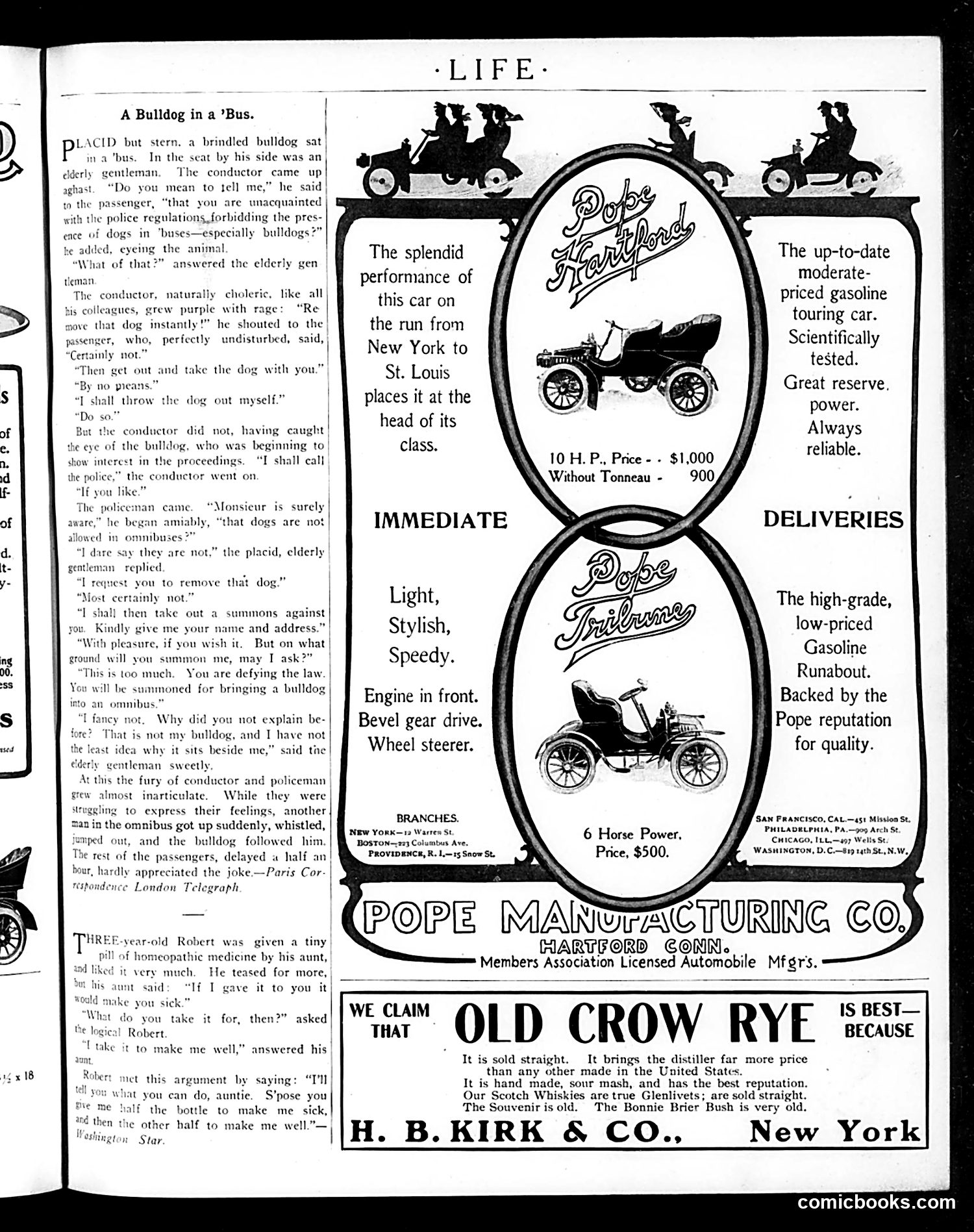
This humorous story satirizes British bus regulations and social rigidity. A gentleman travels with a bulldog despite conductor rules prohibiting dogs—especially bulldogs—from buses. When the conductor demands removal, the gentleman calmly refuses each escalating threat (ejection, police, summons) with polite deflection, ultimately claiming it's not even his dog and he doesn't know why it sits beside him. The joke targets petty bureaucratic authority figures (the conductor grows "purple with rage") who are powerless against gentlemanly composure and logical absurdity. The unnamed gentleman's unflappable politeness and willingness to call bluffs undermines the conductor's authority. When a third passenger simply whistles and the dog follows him out, the entire conflict dissolves—revealing the conductor's threats were hollow all along. The satire mocks rigid rule-enforcement and class pretension.
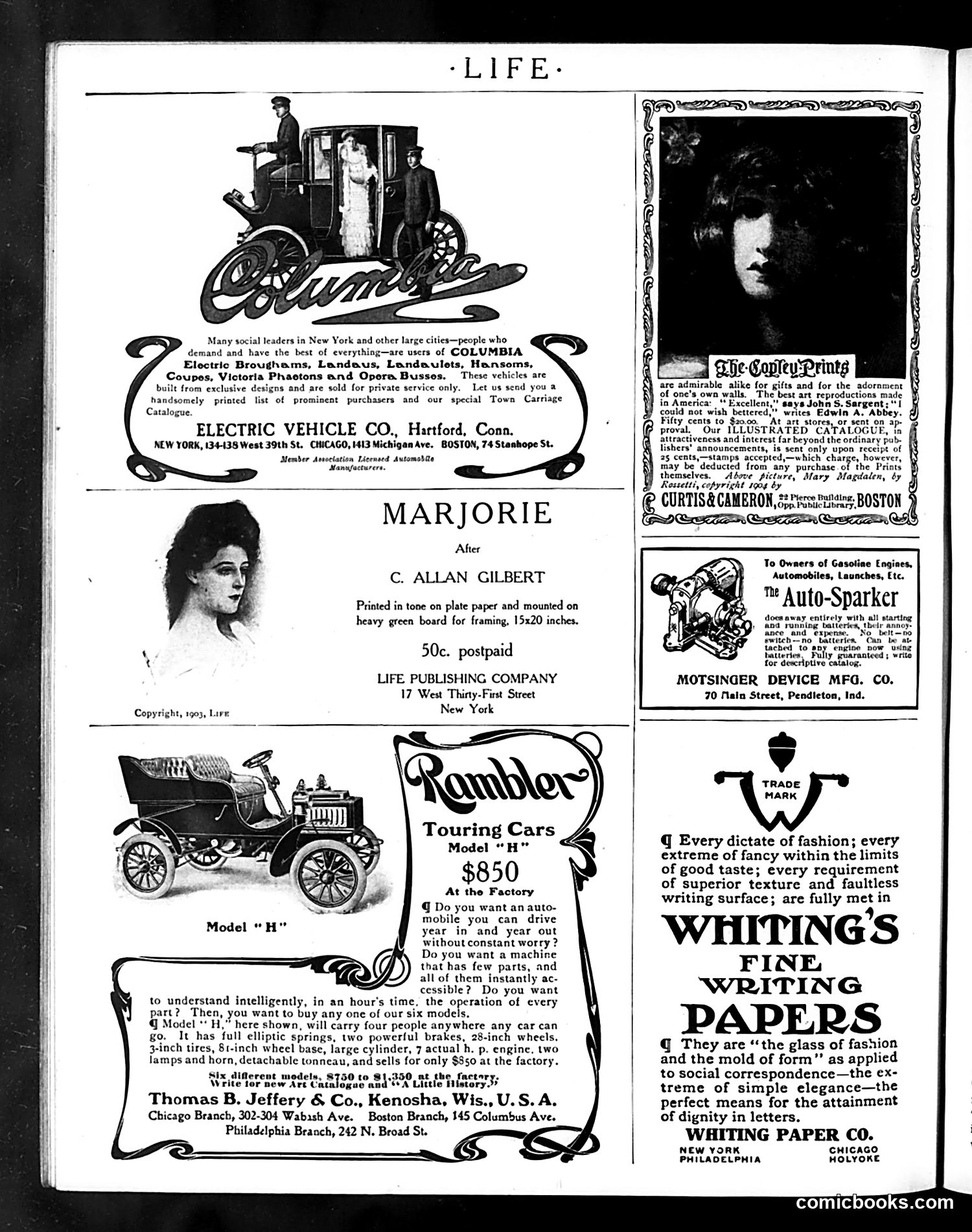
This page is **primarily advertising**, not satirical content. It showcases early 1900s luxury goods and automobiles targeting wealthy consumers. The main elements are: **Automobiles**: Multiple ads for electric and gasoline-powered vehicles—Columbia Electric broughams (for "social leaders"), Rambler touring cars ($850), and the Model "H" automobile. These represent the cutting-edge technology of the era, marketed as reliable alternatives to horse-drawn carriages. **Art reproduction**: A portrait titled "Marjorie" after C. Allan Gilbert, sold as framed prints (50 cents to $20), positioned as affordable art for home decoration. **Premium goods**: Auto-Sparker device, Whiting's Fine Writing Papers—luxury items emphasizing quality and status. The implicit message: these products signal wealth, sophistication, and modernity. The tone is aspirational rather than satirical, appealing to early 20th-century affluent readers who could afford automobiles and fine stationery as status symbols.
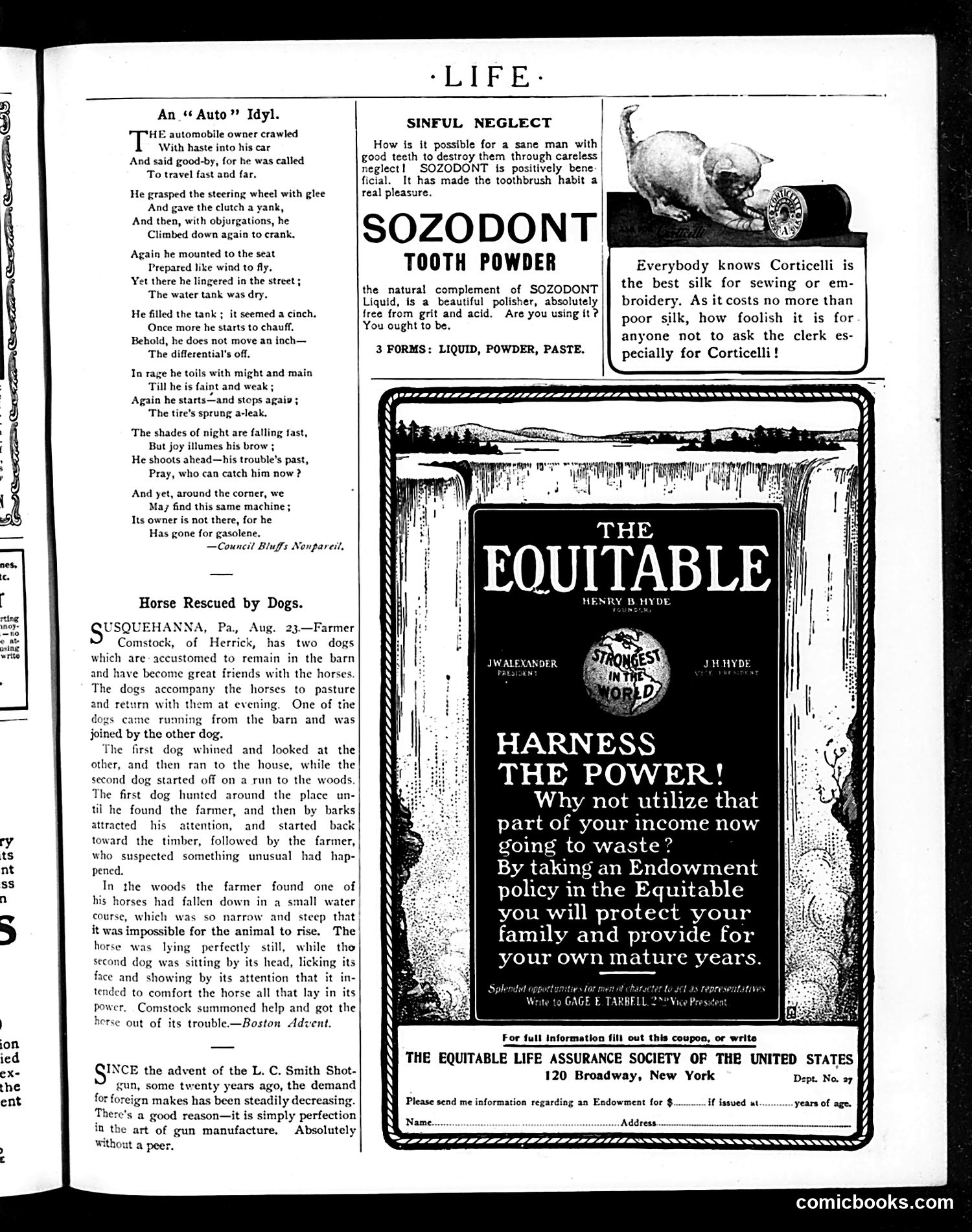
This page combines satirical poetry with period advertisements, typical of early 1900s Life magazine. **The "Auto" Idyl** is a humorous poem mocking the newfangled automobile. It ridicules the vehicle's unreliability through a comedic narrative: an owner enthusiastically departs, then faces endless mechanical failures—dry water tank, disengaged differential, tire leak—before finally getting moving, only to discover he's out of gasoline. The joke satirizes the automobile's reputation as temperamental and impractical compared to horses, capturing early-20th-century skepticism about automotive technology. **"Horse Rescued by Dogs"** is a sentimental anecdote from Susquehanna, Pennsylvania, describing how two farm dogs rescue a trapped horse from a ravine—highlighting animals' intelligence and loyalty. The advertisements (Sozodont tooth powder, Corticelli silk, Equitable Life insurance, L.C. Smith shotguns) are typical period marketing, using various persuasive appeals.
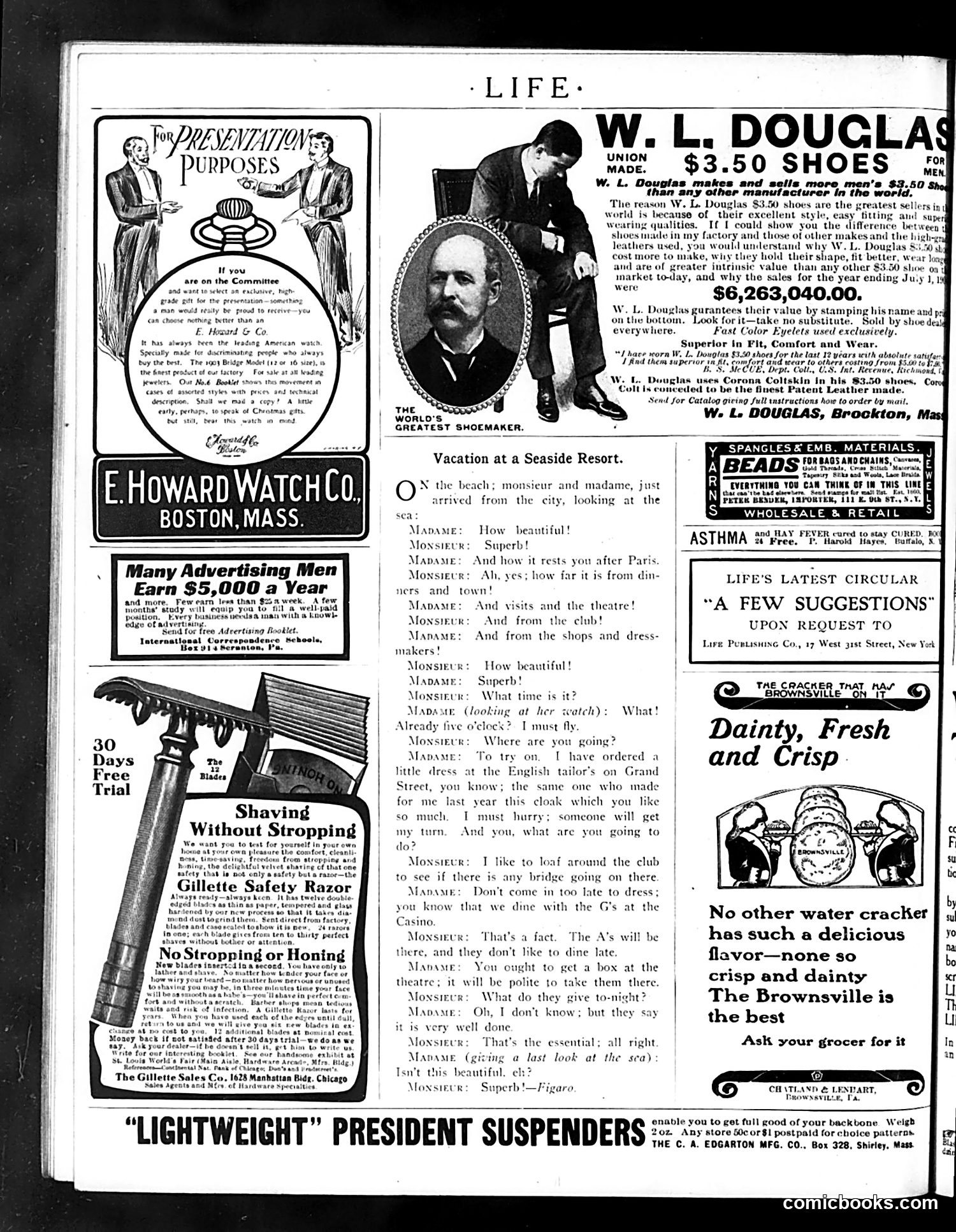
This page is primarily **advertisements** interspersed with a light satirical dialogue. **Main Content:** The central "cartoon" is a humorous dialogue titled "Vacation at a Seaside Resort" featuring a wealthy French couple (Monsieur and Madame). The satire mocks upper-class leisure priorities: Madame abandons her seaside vacation—supposedly restful after Paris—to shop for dresses, while Monsieur prioritizes his gentlemen's club and card games. The joke targets how the affluent cannot truly escape their urban routines and spending habits even on holiday. **Supporting Context:** The surrounding advertisements (W.L. Douglas shoes, Gillette razors, watches) represent typical early-20th-century magazine revenue. No specific political figures are caricatured here. The satire is gentle social commentary on wealthy conventions rather than sharp political critique. The dialogue's French names and references signal that such European affectations and leisurely lifestyles were recognizable—and mockable—to Life's American middle-class readership.
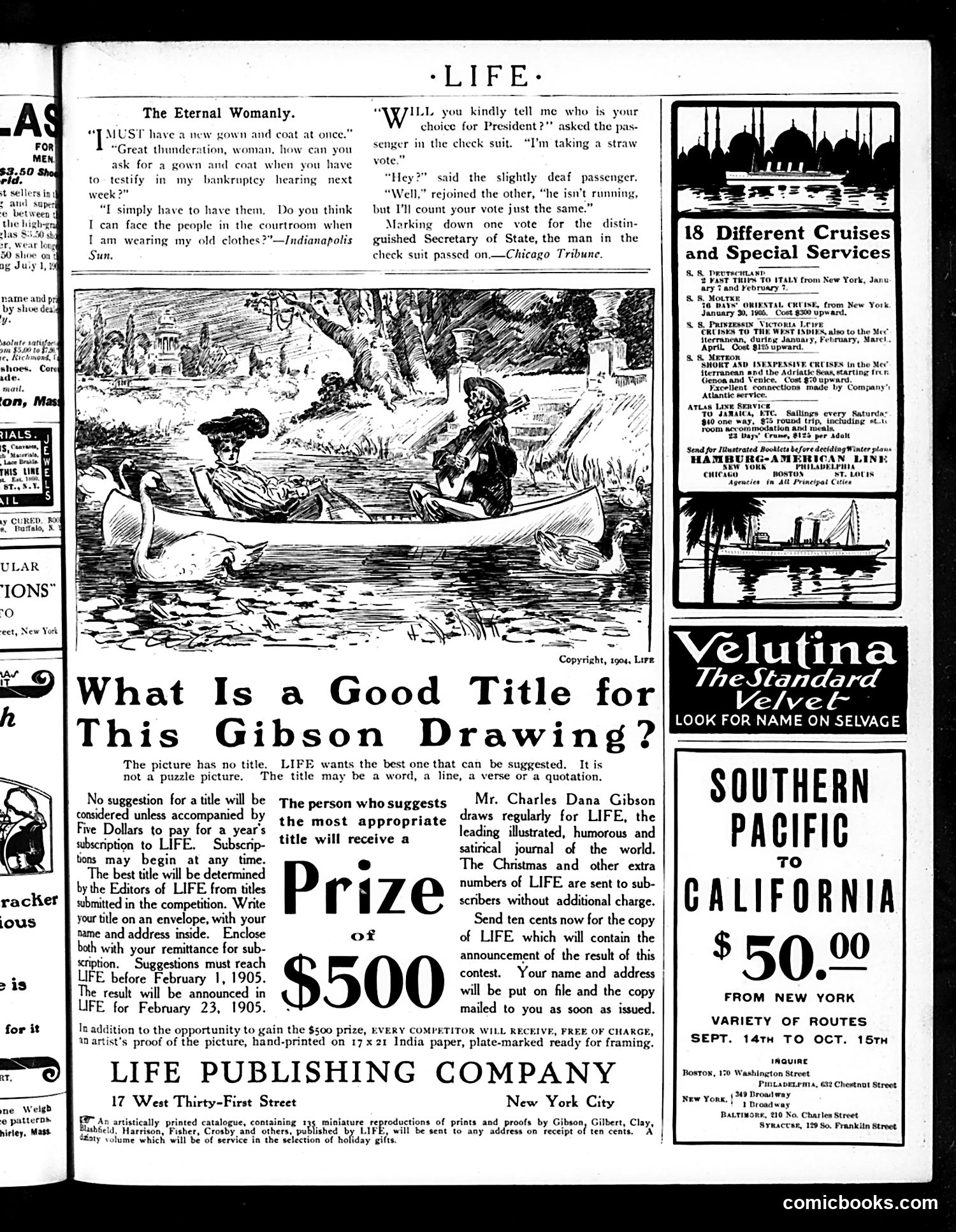
This page contains three separate humorous pieces satirizing American social behavior: 1. **"The Eternal Womanly"**: A married woman demands new clothes for a bankruptcy hearing despite financial crisis. The satire targets women's vanity and prioritization of appearance over fiscal responsibility—a common theme in early 20th-century humor about gender. 2. **The Political Joke**: A passenger takes a "straw vote" for president; when asked, someone votes for the Secretary of State "who isn't running." The humor mocks both casual political engagement and the absurdity of voting for non-candidates—suggesting voter apathy or ignorance. 3. **Gibson Drawing Contest**: The page features a Charles Dana Gibson illustration (a famous society cartoonist) with a title-naming contest offering $500—substantial money then. The drawing depicts figures in a rowboat, likely containing social commentary typical of Gibson's satirical work. The advertisements promote luxury cruises and Southern Pacific rail travel, reflecting the affluent readership Life cultivated.
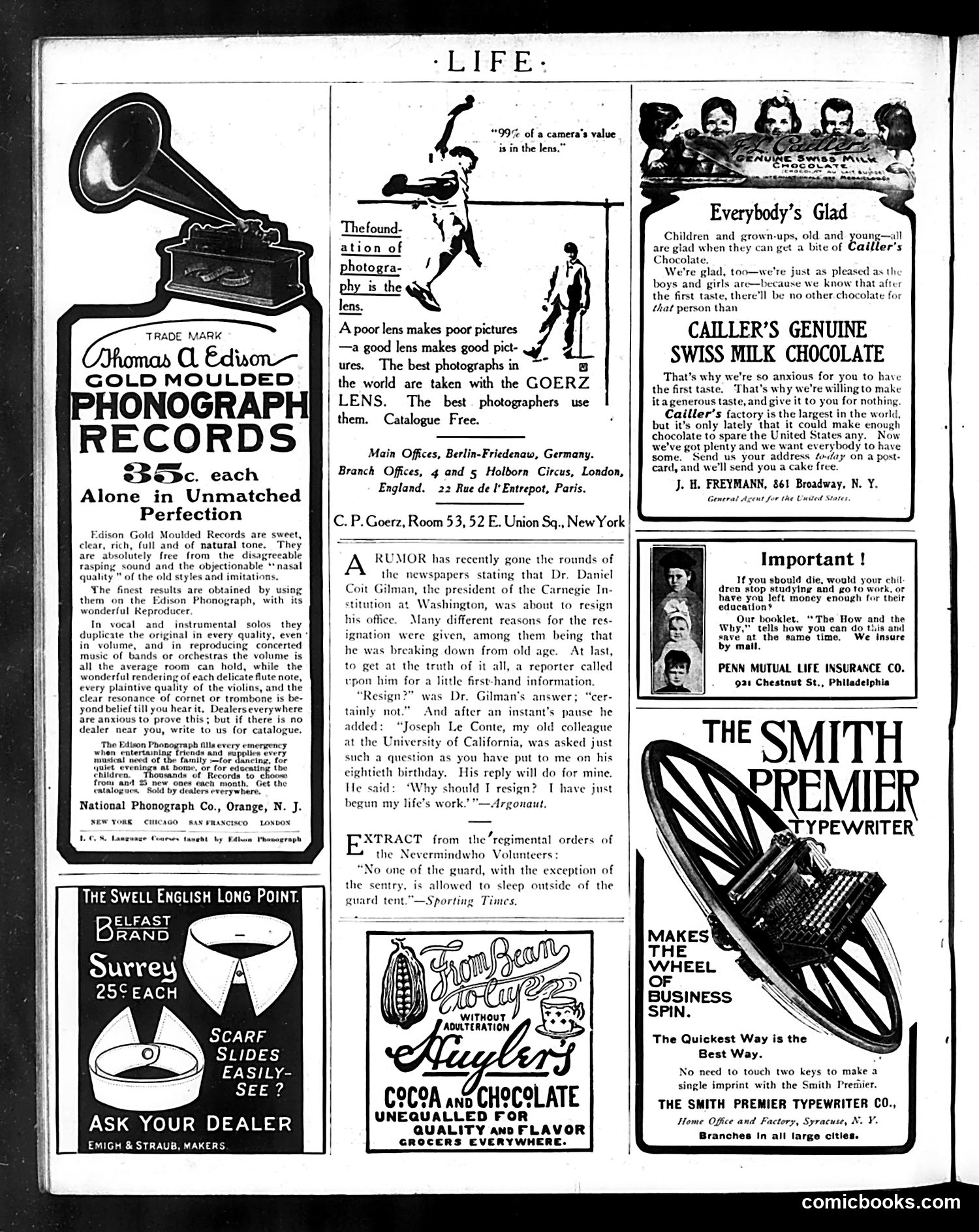
This is primarily an **advertising page** from Life magazine, not a satirical cartoon page. The page contains multiple product advertisements interspersed with brief editorial content. The notable editorial item is a humorous anecdote about **Dr. Daniel Coit Gilman**, president of the Carnegie Institution, addressing rumors he would resign due to old age. When asked why he wouldn't resign, Gilman quotes his elderly colleague Joseph Le Conte: "Why should I resign? I have just begun my life's work." The joke celebrates intellectual vigor in old age—a mild satire on ageist assumptions. The advertisements promote Edison phonographs, photographic lenses (Goerz brand), Swiss chocolate (Cailler's), typewriters (Smith Premier), and other consumer goods typical of the era. The page reflects early 20th-century consumer culture and contemporary attitudes toward aging professionals.
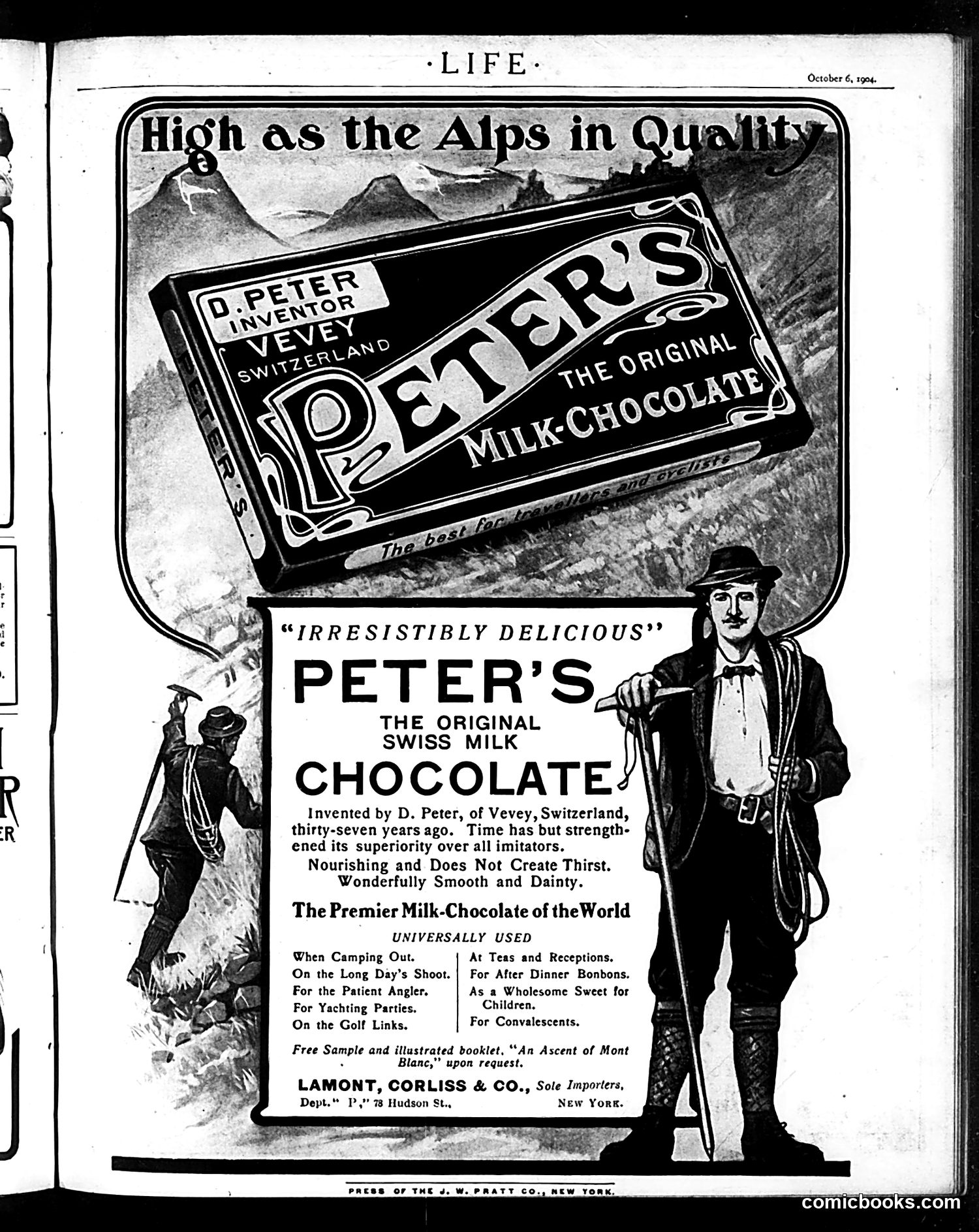
This is a **full-page advertisement**, not satire or political commentary. It promotes Peter's chocolate, a Swiss brand invented 37 years prior (circa 1867). The imagery depicts an Alpine mountaineer ascending a snowy peak, reinforcing the product's Swiss origin and premium positioning. The headline "High as the Alps in Quality" uses geographic prestige to suggest excellence. The ad emphasizes the chocolate's versatility across upper-class leisure activities: camping, shooting, yachting, golf, afternoon teas, and as a children's treat. Claims about being "nourishing" and not creating thirst suggest practical benefits for outdoor pursuits. The distributor, Lamont, Corliss & Co. in New York, offers a free booklet about Mont Blanc climbing, using mountaineering romance to market the product. This reflects early 1900s advertising conventions: associating imported goods with European sophistication and targeting affluent consumers with leisure activities.
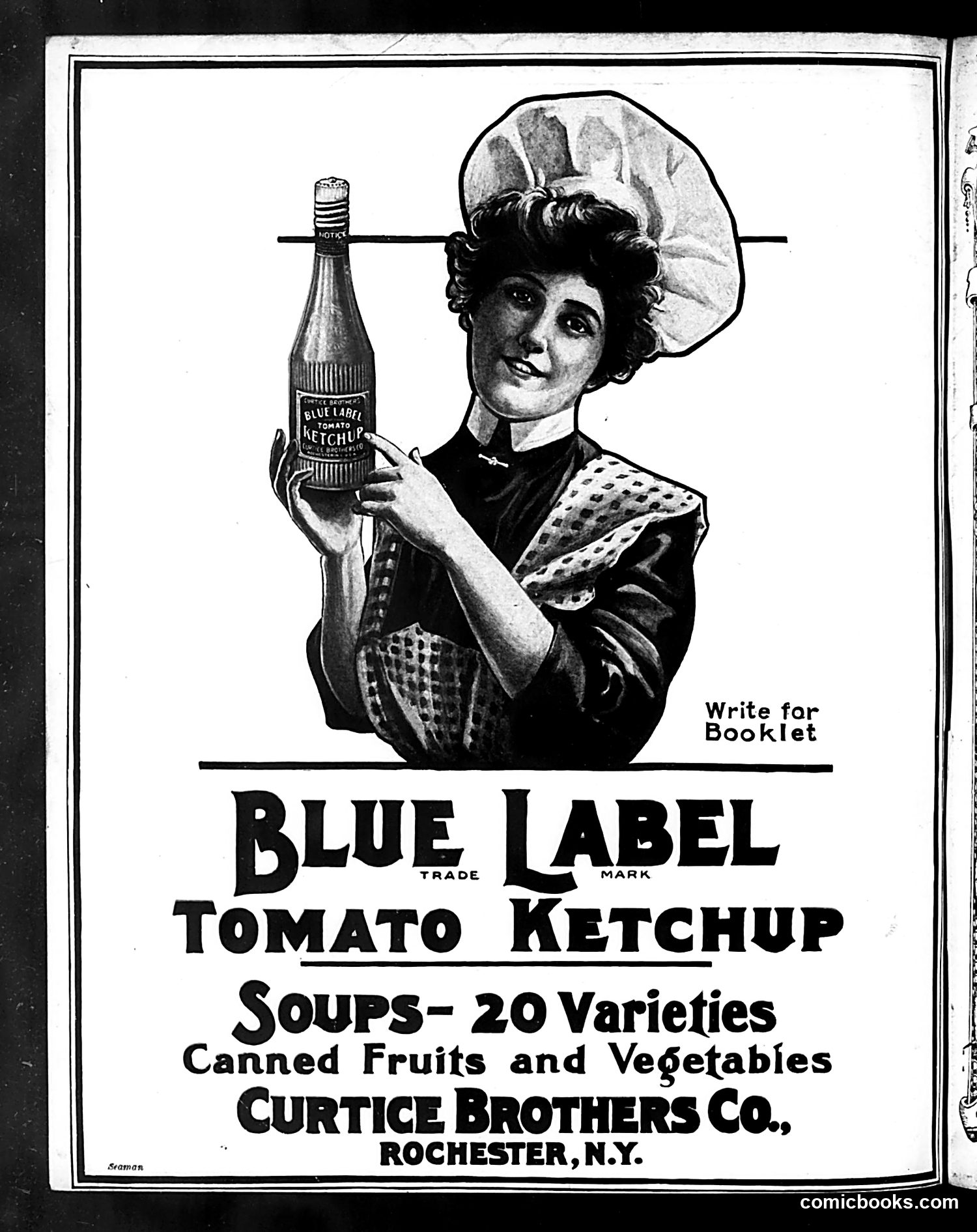
This is a straightforward product advertisement, not political satire. It promotes Blue Label Tomato Ketchup and other canned goods by Curtice Brothers Co. of Rochester, New York. The image features an illustrated woman in early 1900s dress—wearing a large decorative hat and holding a ketchup bottle—presented as an endorsement figure. The styling suggests this appeals to housewives and home cooks, the primary consumers of canned goods in that era. The advertisement offers a free booklet about their products, including 20 soup varieties and canned fruits and vegetables. This reflects common early advertising strategies: using attractive illustrated figures and offering informational materials to build brand awareness and consumer trust in packaged foods.