
Life, 1904-10-06 · page 26 of 38
Life — October 6, 1904 — page 26: what you’re looking at
What you’re looking at
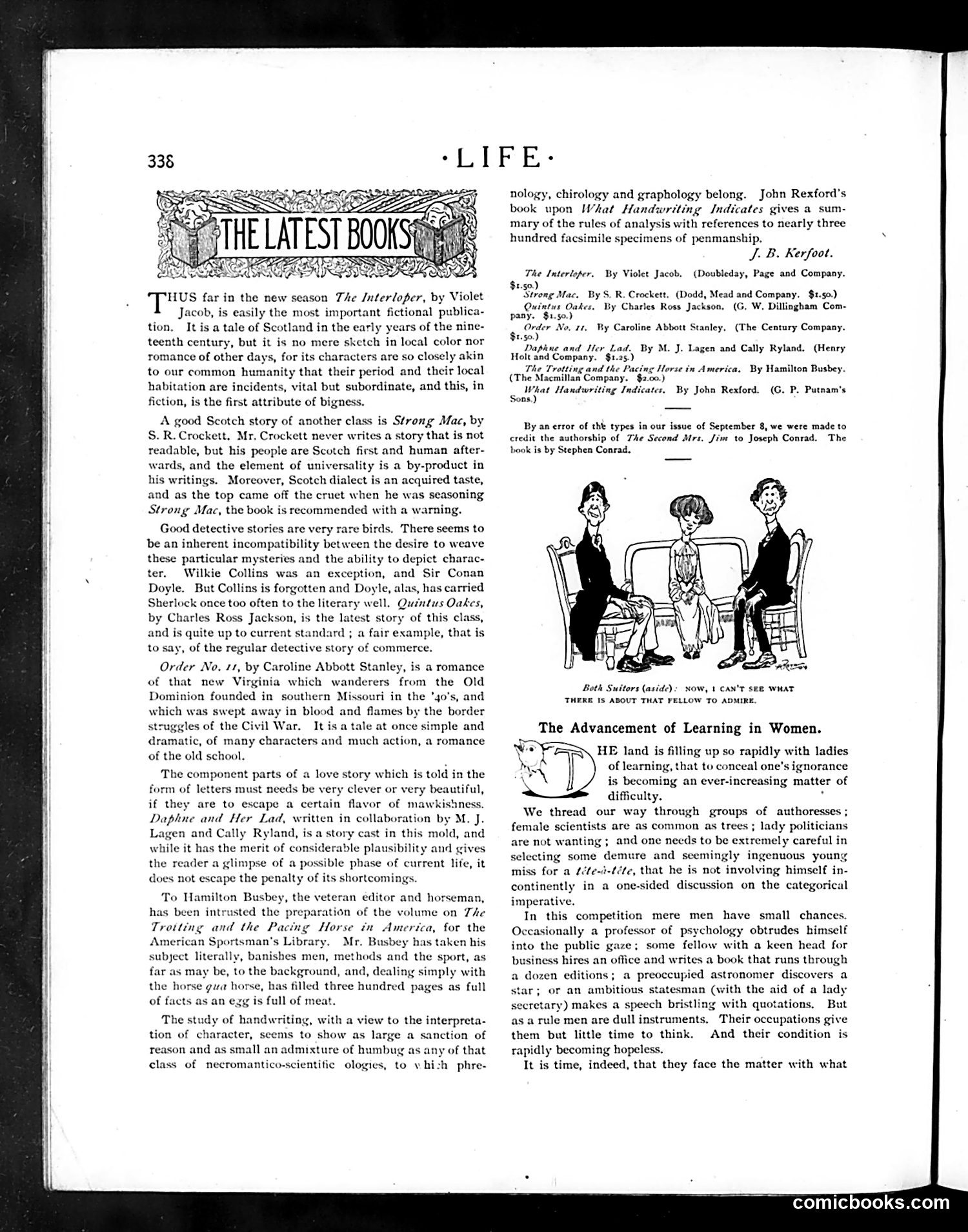
This page is primarily a **book review section** titled "The Latest Books," not primarily satirical content. The main text reviews recent novels and non-fiction works, including Scottish fiction (*The Interloper*, *Strong Mac*), detective stories, and a Civil War romance. The **single cartoon** depicts three well-dressed figures in conversation, with the caption: "Bob Sniters (aside): 'Now, I can't see what there is about that fellow to admire.'" The joke appears to be social satire about pretension and conformity—one character publicly pretends to admire someone while privately expressing disdain. It's a commentary on artificial social behavior and the gap between public affection and private opinion among the upper classes. The second article, "The Advancement of Learning in Women," discusses women's limited opportunities in academic and professional fields, describing their situation as "hopeless"—reflecting early 20th-century gender barriers.
📄 Transcribed text from this page (OCR, searchable)
Machine-transcribed from the original scan — historical spelling and the odd misread are preserved.
-LIFE- i far in the new season The /nterloper, by s easily the most important fictional publica- tion, It is a tale of Scotland in the early years of the nine- teenth century, but it is no mere sketch in local color nor romance of other days, for its characters are so closely akin to our common humanity that their period and their local habitation are incidents, vital but subordinate, and this, in fiction, is the first attribute of bigness. A good Scotch story of another class is Strong Mac, by S.R. Crockett. Mr. Crockett never writes a story that is not readable, but his people are Scotch first and human after- wards, and the element of universality is a by-product in his writings. Moreover, Scotch dialect is an acquired taste, and as the top came off the cruet when he was seasoning Strong Mac, the book is recommended with a warning. Good detective stories are very rare birds. There seems to be an inherent incompatibility between the desire to weave these particular mysteries and the ability to depict charac- ter. Wilkie Collins was an exception, and Sir Conan Doyle. But Collins is forgotten and Doyle, alas, has carried Sherlock once too often to the literary well. Quintus Oakes, by Charles Ross Jackson, is the latest story of this class, and is quite up to current standard ; a fair example, that is to say, of the regular detective story of commerce. Order No. 11, by Caroline Abbott Stanley, is a romance of that new Virginia which wanderers ‘from the Old Dominion founded in southern Missouri in the "4 and which was swept away in blood and flames by the border struggles of the Civil War. It is a tale at once simple and dramatic, of many characters and much action, a romance of the old school. The component parts of a love story which is told in the form of letters must needs be very clever or very beautiful, if they are to escape a certain flavor of mawkishness. Daphne and Her Lad, written in collaboration by M. J. Lagen and Cally Ryland, is a story cast in this mold, and while it has the merit of considerable plausibility and gives the reader a glimpse of a possible phase of current life, it does not escape the penalty of its shortcomings. To Hamilton Busbey, the veteran editor and horseman, has been intrusted the preparation of the volume on The Trotting and the Pacing Horse in America, for the American Sportsman's Library. Mr. Busbey has taken his subject literally, banishes men, methods and the sport, as far as may be, to the background, and, dealing simply with , has filled three hundred pages as full full of mea the horse gua hors of facts as an e. The study of handwriting, with a view to the interpreta- tion of character, scems to show as large a sanction of reason and as small an admixture of humbug as any of that class of necromantico-scientific ologies, nology, chirology and graphology belong. John Rexford’s book upon What Handwriting Indicates gives a sum- mary of the rules of analysis with references to nearly three hundred facsimile specimens of penmanship. J. B. Kerfoot. The Interloper. By (Doubleday, Page and Company. $1.50.) ‘Strong Mac. By S. R. Crockett. (Dodd, Mead and Company. $1.0.) Onintus Oakes, By Charles Ross Jackson. (G. W. Dillingham Com- pany. $1.50.) Order No. 11, $1.50.) Daphne and Her Holt and Company. $1 The Trotting and the Pacing Horse in America. (The Macmillan Company. $2.00.) What Handwriting Indicates, Sons.) iolet Jacob. Ry Caroline Abbott Stanley, (The Century Company. Pal By M. J. Lagen and Cally Ryland. (Henry By Hamilton Busbey. By John Rexford. (G. P. Putnam's By an error of tht types in our issue of September 8, we were made to credit the authorship of The Second Mrs. Jim to Joseph Conrad. The book is by Stephen Conrad, Both Suitors (aside): NOW, CAN'T SEE WHAT. THERE 18 ABOUT THAT FELLOW TO ADAURE. The Advancement of Learning in Women. of learning, that to conceal on is becoming an ever-increasing matter of difficulty. We thread our way through groups of authoresses ; female scientists are as common as trees ; lady politicians are not wanting ; and one necds to be extremely careful in selecting some demure and seemingly ingenuous young miss for a féfe-d-¢éfe, that he is not involving himself in- continently in a one-sided discussion on the categorical imperative. In this competition mere men have small chances. Occasionally a professor of psychology obtrudes himself into the public gaze; some fellow with a keen head for business hires an office and writes a book that runs through i a preoccupied astronomer discovers a or an ambitious statesman (with the aid of a lady secretary) makes a speech bristling with quotations, But as a rule men are dull instruments. Their occupations gi them but little time to think. And their condition is rapidly becoming hopeless. It is time, indeed, that they face the matter with what comicbooks.com