
Life, 1904-10-06 · page 10 of 38
Life — October 6, 1904 — page 10: what you’re looking at
What you’re looking at
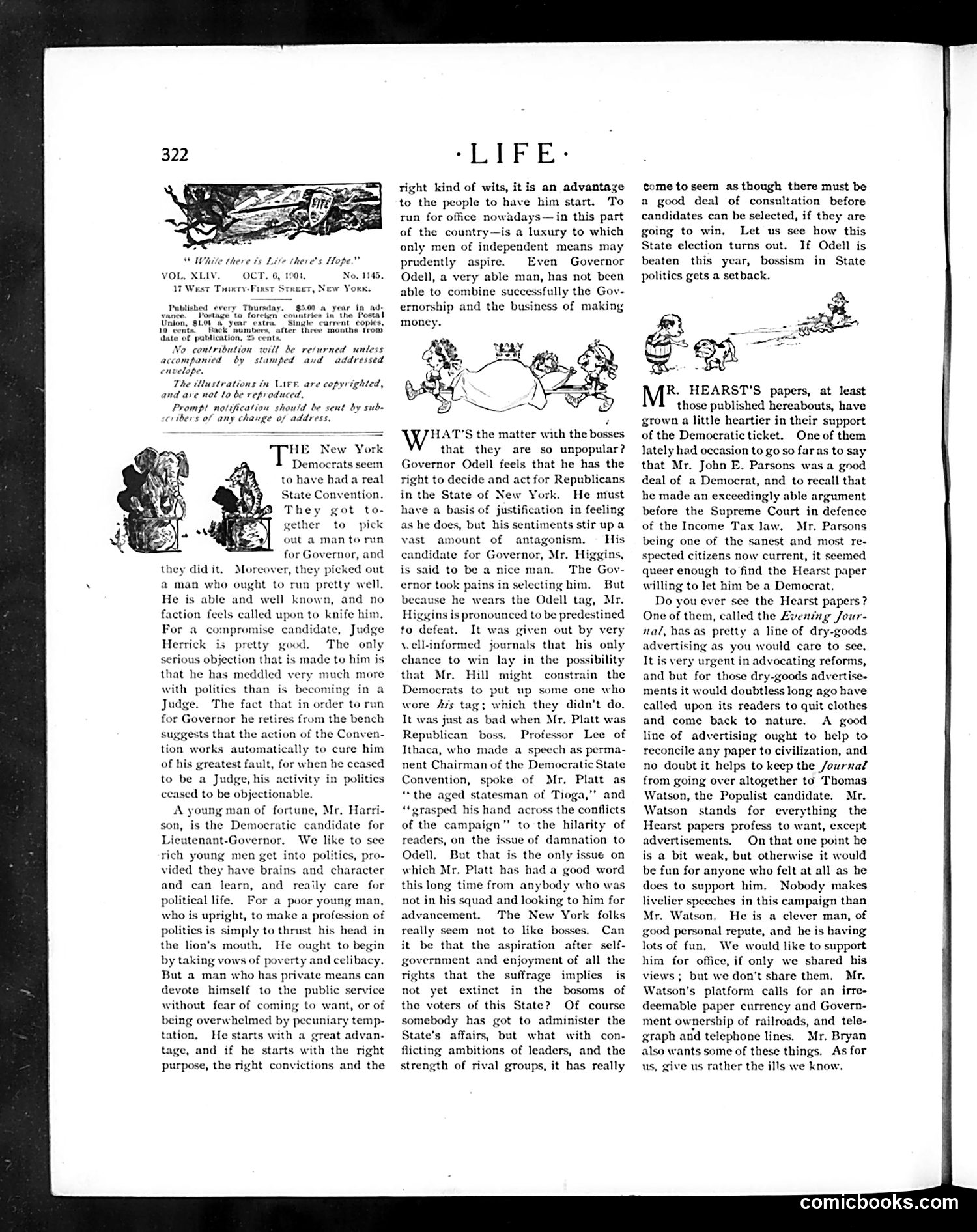
This page from *Life* magazine discusses New York Democratic State Convention politics. The article criticizes Governor Odell for concentrating political power and preventing independent candidates from running for office—described as "a luxury to which only men of independent means may prudently aspire." The text also mocks Democratic boss antagonism toward their own candidates, specifically attacking a selection process for gubernatorial candidates. It mentions Mr. Higgins as a "nice man" whose candidacy stirred opposition, and critiques how newspaper coverage (specifically the *Evening Journal*) promoted Democratic advertisements while the *Journal* itself supported the Populist candidate Thomas Watson. The illustrations show caricatured figures in what appears to be political confrontation or debate, though specific identities are unclear from the image alone.
📄 Transcribed text from this page (OCR, searchable)
Machine-transcribed from the original scan — historical spelling and the odd misread are preserved.
“ White there t's Lite there's Hope.” VOL, XLIV. OCT. 6, 1901, No. 1145, 17 West Triery-Frest S: Thuratay. $509 a year in ad: tea In the Postal Rack” nui ee months from of pablication, No contribution will be re‘urned unless accompanied by stamped and addressed envelope. The illustrations in LAtR. are copyrighted, and ave not to be reproduced, Prompt notification should be sent by sub= cribers of any change of address. HE New York Democrats seem to have had a real State Convention. They got to- gether to pick out a man to run for Governor, and did it. Moreover, they picked out n who ought to run pretty well. He is able and well known, and no faction feels called upon to knife him. For a compromise candidate, Judge Herrick is pretty good. The only serious objection that is made to him is that he has meddled very much more with politics than is becoming in a Judge. The fact that in order to run for Governor he retires from the bench suggests that the action of the Conven- tion works automatically to cure him of his greatest fault, for when he ceased to be a Judge, his activity in politics ceased to be objectionable. A young man of fortune, Mr. Harri- son, is the Democratic candidate for Lieutenant-Governor, We like to sce rich young men get into politics, pro- vided they have brains and character and can learn, and reaily care for political life. For a poor young man, who is upright, to make a profession of politics is simply to thrust his head in the lion’s mouth, He ought to begin by taking vows of poverty and celibacy, But a man who has private means can devote himself to the public service without fear of coming to want, or of being overwhelmed by pecuniary temp- tation, He starts with a great advan- tage, and if he rts with the right purpose, the right convictions and the ‘LIFE: right kind of wits, itis an advantage to the people to have him start. To run for office nowadays—in this part of the country—is a luxury to which only men of independent means may prudently aspire. Even Governor Odell, a very able man, has not been able to combine successfully the Gov- ernorship and the business of making money. HAT'S the matter with the bosses that they are so unpopular? Governor Odell feels that he has the right to decide and act for Republicans in the State of New York, He must have a basis of justification in feeling s he does, but his sentiments stir up a t amount of antagonism. His undidate for Governor, Mr. Higgins, is said to be a nice man. The Gov- ernor took pains in selecting him, But because he w the Odell tag, Mr. Higgins is pronounced to be predestined to defeat. It given out by very \.ell-informed journals that his only chance to win lay in the possibility that Mr. Hill might constrain the Democrats to put up some one who wore Ais tag: which they didn't do. It was just as bad when Mr. Platt was Republican boss. Professor Lee of Ithaca, who made a specch as perma- nent Chairman of the Democratic State Convention, spoke of Mr. Platt as “the aged statesman of Tioga, “grasped his hand across the conflicts of the campaign” to the hilarity of readers, on the issue of damnation to Odell. But that is the only issue on which Mr. Platt has had a good word this long time from anybody who was not in his squad and looking to him for advancement. The New York folks really seem not to like bosses. Can it be that the aspiration after self- government and enjoyment of all the rights that the suffrage implies is not yet extinct in the bosoms of the voters of this State? Of course somebody has got to administer the State’s affairs, but what with con- flicting ambitions of leaders, and the strength of rival groups, it has really come to seem as though there must be a good deal of consultation before candidates can be selected, if they are going to win, Let us sce how this State election turns out. If Odell is beaten this year, bossism in State politics gets a setback. Bn & R. HEARST’S papers, at least those published hereabouts, have grown a little heartier in their support of the Democratic ticket. One of them lately had occasion to go so faras to say that Mr, John E. Parsons was a good deal of a Democrat, and to recall that he made an exceedingly able argument before the Supreme Court in defence of the Income Tax law. Mr. Parsons being one of the sanest and most re- spected citizens now current, it seemed queer enough to find the Hearst paper willing to let him be a Democrat. Do you ever see the Hearst papers? One of them, called the Evening Jour- nal, has as pretty a line of dry-goods advertising as you would care to see. It is very urgent in advocating reforms, and but for those dry-goods advertise- ments it would doubtless long ago have called upon its readers to quit clothes and come back to nature. A good line of advertising ought to help to reconcile any paper to civilization, and no doubt it helps to keep the Journal from going over altogether to Thomas. Watson, the Populist candidate. Mr. Watson stands for everything the Hearst papers profess to want, except advertisements. On that one point he is a bit weak, but otherwise it would be fun for anyone who felt at all as he does to support him. Nobody makes livelier speeches in this campaign than Mr. Watson. He is a clever man, of good personal repute, and he is having lots of fun, We would like to support him for office, if only we shared his views ; but we don't share them. Mr. Watson’s platform calls for an irre- deemable paper currency and Govern- ment ownership of railroads, and tele- graph and telephone lines. Mr. Bryan also wants some of these things. As for us, give us rather the ills we know, comicbooks.com