
Life, 1904-10-06 · page 21 of 38
Life — October 6, 1904 — page 21: what you’re looking at
What you’re looking at
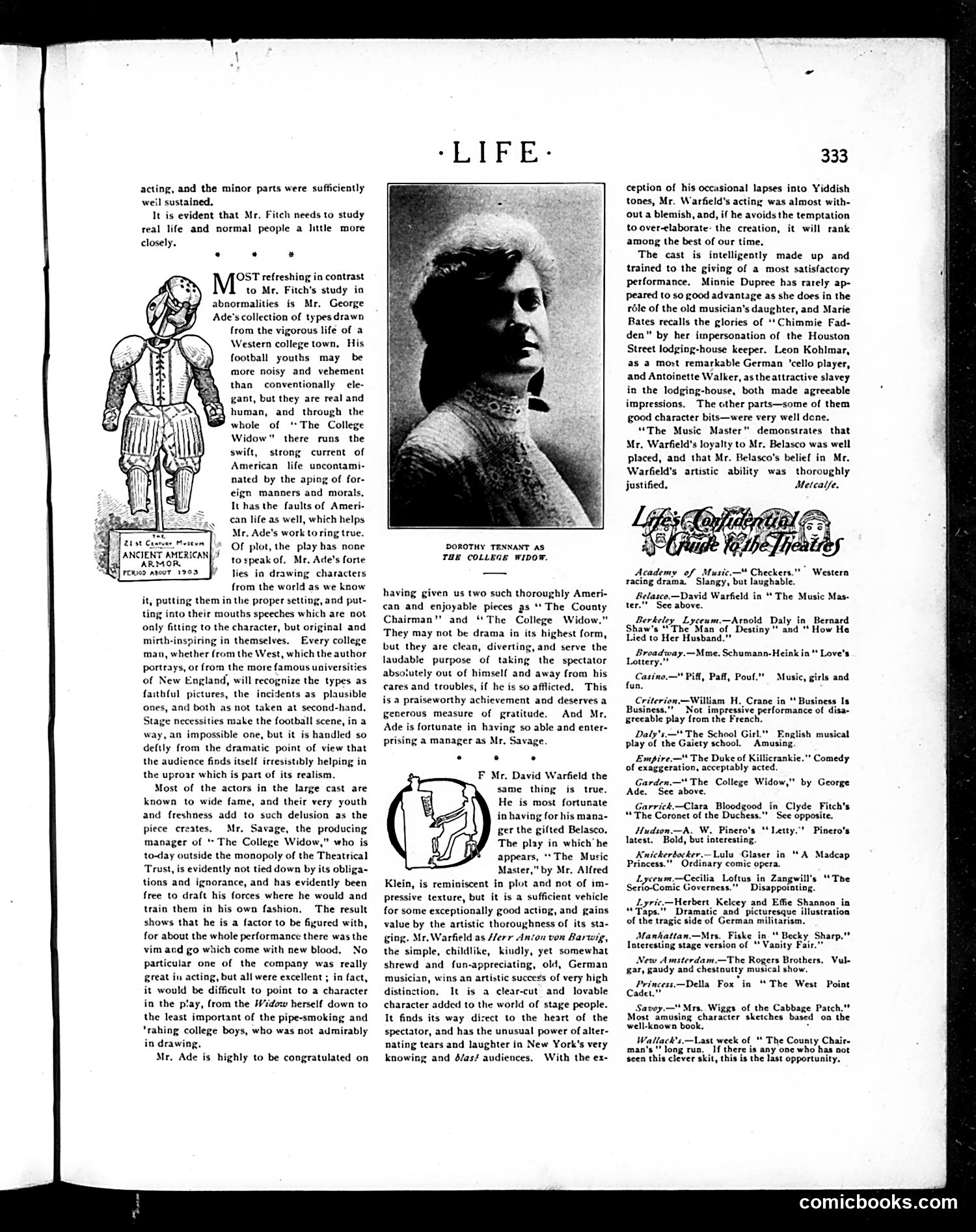
This page reviews three theatrical productions from the early 1900s. The main cartoon depicts **Dorothy Tennant as "The College Widow,"** the title character of George Ade's play—a work praised here for its authentic portrayal of American college life over European artificiality. The critic contrasts Ade's realistic depiction of Western college characters with another playwright's (Mr. Fitch's) focus on "abnormalities." Ade's strength lies in drawing recognizable types—football players, college boys—rendered with genuine American vigor rather than imitated "foreign manners and morals." The review also praises producer Mr. Savage's independence from the "Theatrical Trust" monopoly, and David Warfield's performance in "The Music Master," celebrating his portrayal of a kindly German musician. The satire targets theatrical pretension: Ade succeeds by capturing real American life authentically, while gaining artistic credibility without resorting to melodrama or foreign affectation.
📄 Transcribed text from this page (OCR, searchable)
Machine-transcribed from the original scan — historical spelling and the odd misread are preserved.
acting, and the minor parts were sufficiently weil sustained, It is evident that Mr. Fitch needs to study real life and normal people a Inttle more . . * OST refreshing in contrast to Mr, Fitch’s study in abnormalities is Mr. George y) Ade’s collection of typesdrawn from the vigorous life of a Western college town, His football youths may be more noisy and vehement than conventionally ele- gant, but they are real and human, and through the whole of ‘The College Widow” there runs the swift, strong current of American life uncontami- nated by the aping of for- cign manners and morals, It has the faults of Ameri- can life as well, which helps Mr. Ade’s work toring true. Of plot, the play has none tospeak of. Mr. Ade’s forte lies in drawing characters from the world as we know it, putting them in the proper setting, and put- ting into their mouths speeches which are not only fitting to the character, but original and mirth-inspiring in themselves, Every college man, whether (rom the West, which the author portrays, or from the more famous universities of New England, will recognize the types as faithful pictures, the incidents as plausible ones, and both as not taken at second-hand, Stage necessities make the football scene, in a way, an impossible one, but it is handled so deftly from the dramatic point of view that the audience finds itself irresistibly helping in the uproar which is part of its realism. Most of the actors in the large cast are known to wide fame, and their very youth and freshness add to such delusion as the piece creates. Mr. Savage, the producing manager of * The College Widow to-day outside the monopoly of the Theatrical Trust, is evidently not tied down by its obliga- tions and ignorance, and has evidently been free to draft his forces where he would and train them in his own fashion. The result shows that he is a factor to be figured with, for about the whole performance there was the vim acd go which come with new blood. No particular one of the company was really great in acting, but all were excellent ; in fact, it would be difficult to point to a character in the play, from the Widow herself down to the least important of the pipe-smoking and ‘rahing college boys, who was not admirably in drawing. Mr, Ade is highly to be congratulated on ARMOR FERED AGT 1903 DOROTHY TRNNANT AS THE COLLEGE WIDOW. having given us two such thoroughly Ameri- can and enjoyable pieces as ** The County Chairman” and ‘The College Widow.” They may not be drama in its highest form, but they are clean, diverting, and serve the laudable purpose of taking the spectator absolutely out of himself and away from his cares and troubles, if he is so afflicted, This is a praiseworthy achievement and deserves a generous measure of gratitude. And Mr. Ade is fortunate in having so able and enter- prising a manager as Mr, Savag. F Mr. David Warfield the same thing is true. He is most fortunate in having for his mana- ger the gifted Belasco, The play in which’ he appears, “The Music Master," by Mr. Alfred Klein, is reminiscent in plot and not of im- pressive texture, but it is a sufficient vehicle for some exceptionally good acting, and gains value by the artistic thoroughness of its sta- ging. Mr. Warfield as Herr Anion von Barwig, the simple, childlike, kiudly, yet somewhat shrewd and fun-appreciating, old, German musician, wins an artistic succe#s of very high distinction, It is a clear-cut and lovable character added to the world of stage people. It finds its way dizect to the heart of the spectator, and has the unusual power of alter- nating tears and laughter in New York's very knowing and é/as/ audiences. With the ex- 333 ception of his occasional lapses into Yiddish tones, Mr. Warfield's acting was almost with- out a blemish, and, if he avoids the temptation toover-elaborate: the creation, it will rank among the best of our time, The cast is intelligently made up and trained to the giving of a most satisfactory performance. Minnie Dupree has rarely ap- peared to so good advantage as she does in the rile of the old musician's daughter, and Marie Bates recalls the glories of *Chimmie Fad- den” by her impersonation of the Houston Street lodging-house keeper. Leon Kohlmar, as a most remarkable German ‘cello player, and Antoinette Walker, as the attractive slavey in the lodging-house, both made agreeable impressions. The other parts—some of them good character bits—were very well dene. “The Music Master" demonstrates that Mr. Warfield’s loyalty to Mr. Belasco was well placed, and that Mr. Belasco's belief in Mr. Warfield’s artistic ability was thoroughly justified, Metcalfe. Academy of Music.— Checkers. racing drama. Slangy, but laughable. Selasco.—David Warfield in “ The Music Mas- See above. Berkeley Lyceum.—Arnold Daly in, Bernard Shaw's The Man of Destiny” and ‘How He Lied to Her Husband,” Breadway.—Mme. Schumann-Heink in“ Love's Lottery.”” Casino.—* Piff, Paff, Pout.” Music, girls and fun. Criterion.—William H. Crane in “Business Is Business. ‘ot impressive performance of dis greeable play from the French. Daly's, he School Girl."* English musical play of the Gaiety school. Amusing Empire.—* The Duke of Killicrankie."" Comedy of exaggeration, acceptably acted. Garden.—"' The College Widow," by George Ade, See above. Garrick.—Clara_ Bloodgood in Clyde Fitch's ‘he Coronet of the Duchess.” See opposite. Hudson—&. W, Pinero’s ** Letty." latest. Bold, but interesting. Knickerbocker. Lulu Glaser in A Madcap Princess.” Ordinary comic opera. Pinero’s Lyceum.—Cecilia Loftus in Zangwill’s “The Serfo-Comic Governe: Disappointing. Lyric.—Herbert. Kelcey and Effie Shannon in “Taps.” Dramatic _and_ picturesque illustr: of the tragic side of German militarism. Mankattan—Mrs. Fiske in,“ Becky Sharp.” Interesting stage version of “Vanity Fair.” New Amsterdam.—The Rogers Brothers. Vul- gar, gaudy and chestnutty musical show. Princess.—Della Fox in “ The West Point Cadet.” Savoy. Mrs. Wiggs of the Cabbage Patch."* Most amusing character sketches based on the well-known book. = Wallack's.—Last week of “ The County Chair- man's" long rua. If there is any one who has not seen this clever skit, this is the last opportunity, comicbooks.com