
Life, 1904-10-06 · page 20 of 38
Life — October 6, 1904 — page 20: what you’re looking at
What you’re looking at
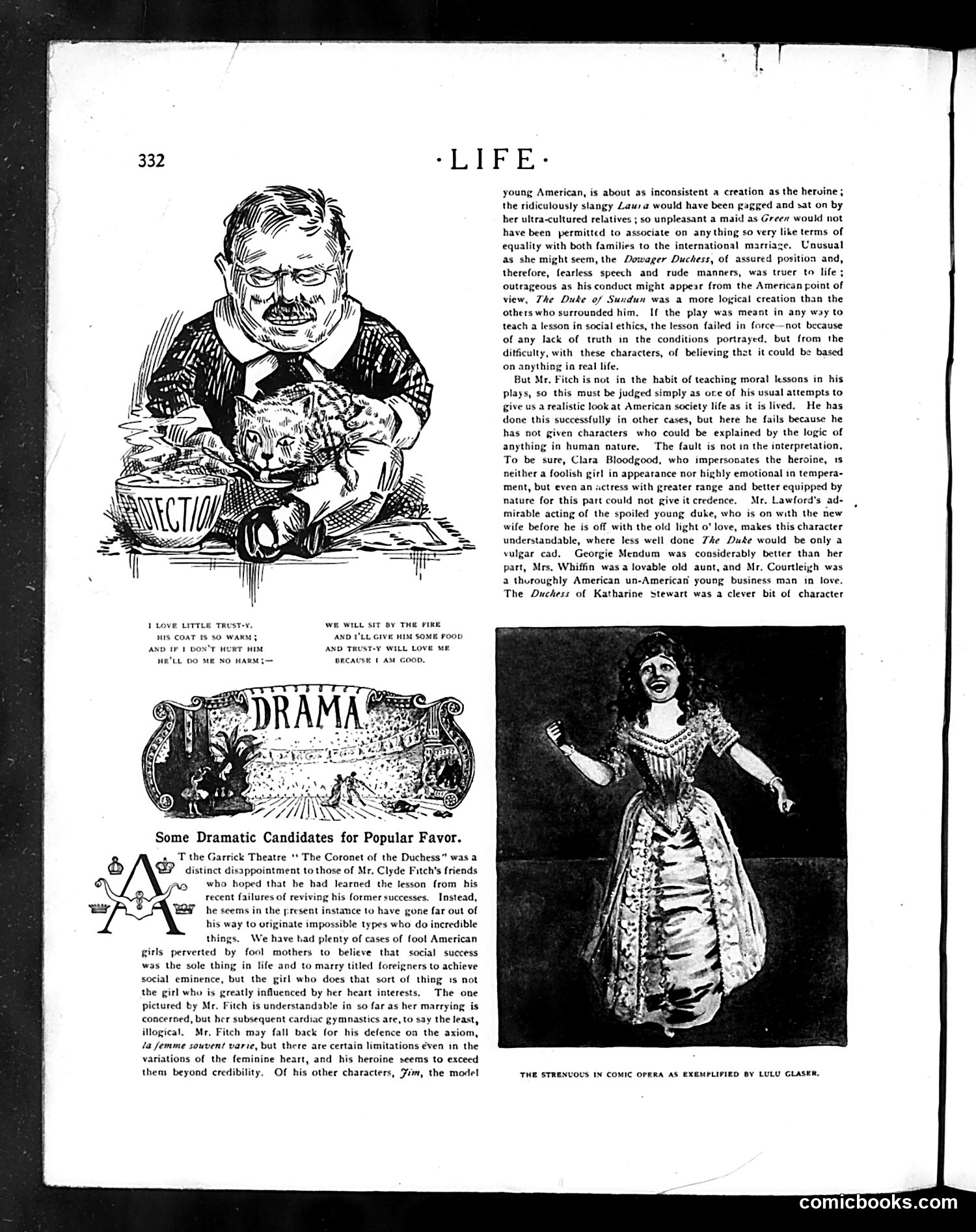
This page reviews playwright Clyde Fitch's play "The Coronet of the Duchess," performing at the Garrick Theatre. The cartoon (top left) appears to be unrelated theatrical humor. The review critiques Fitch's characters as implausible. The heroine—a foolish American girl who marries a foreign duke—behaves illogically, especially in her romantic entanglements. While such marriages to titled foreigners were real phenomena among wealthy American families of the era, the reviewer argues this specific character strains credibility beyond the "limitations of the feminine heart." However, the reviewer praises other cast members, particularly actor Lawford's portrayal of the "spoiled young duke" and actress Clara Bloodgood's performance, despite weak characterization. The bottom image shows Lulu Glaser in comic opera, illustrating another theatrical offering. The review exemplifies how Life magazine critiqued contemporary theater for both artistic merit and social realism.
📄 Transcribed text from this page (OCR, searchable)
Machine-transcribed from the original scan — historical spelling and the odd misread are preserved.
-LIFE- young American, is about as inconsistent a creation as the heruine ; the ridiculously slangy Lausa would have been gagged and sat on by her ultra-cultured relatives ; so unpleasant a maid as Green would not have been permitted to associate on any thing so very like terms of equality with both families to the international marriage. Unusual as she might seem, the Dowager Duchess, of assured position and, therefore, fearless speech and rude manners, was truer to life; outrageous as his conduct might appear from the American point of view, The Duke of Sundun was a more logical creation than the others who surrounded him. If the play was meant in any way to teach a lesson in social ethics, the lesson failed in force—not because of any lack of truth in the conditions portrayed, but from the ditficulty, with these characters, of believing thet it could be based on anything in real life. But Mr, Fitch is not in the habit of teaching moral lessons in his plays, so this must be judged simply as ore of his usual attempts to give us a realistic look at American society life as it is lived. He has done this successfully in other cases, but here he fails because he has not given characters who could be explained by the logic of anything in human nature, The fault is not in the interpretation, To be sure, Clara Bloodgood, who impersonates the heroine, 1s neither a foolish girl in appearance nor highly emotional in tempera- ment, but even an actress with greater range and better equipped by nature for this part could not give it credence. Mr. Lawford’s ad- mirable acting of the spoiled young duke, who is on with the new wife before he is off with the old light o' love, makes this character understandable, where less well done Zhe Duke would be only a vulgar cad. Georgie Mendum was considerably better than her part, Mrs, Whiffin was a lovable old aunt, and Mr. Courtleigh was a thoroughly American un-American young business man in love. The Duchess of Katharine Stewart was a clever bit of character 1 Love LITTLE TRUST-Y, We WILL SIT BY THE FIRE MIS COAT IS SO WAK: AND I'LL GIVE MIM SOME FOOD AND IF 1 DON'T HURT HIME AND TRUST-Y WILL LOVE ME MRTLL DO ME NO MARS BECAUSE | AM GOOD. Some Dramatic Candidates for Popular Favor. ‘T the Garrick Theatre ** The Coronet of the Duchess” was a BP distinct disappointment to those of Mr, Clyde Fitch's friends Ao who hoped that he had learned the lesson from his recent failures of reviving his former successes. Instead, VY he seems in the present instance to have gone far out of his way to originate impossible types who do incredible things. We have bad plenty of cases of fool American girls perverted by fool mothers to believe that social success was the sole thing in life and to marry titled foreigners to achieve social eminence, but the girl who does that sort of thing ts not the girl who is greatly influenced by her heart interests, The one pictured by Mr. Fitch is understandable in so faras her marrying is concerned, but her subsequent cardiac gymnastics are, to say the least, illogical, Mr, Fitch may fall back for his defence on the axiom, 4a femme souvent varie, but there are certain limitations éven in the variations of the feminine heart, and his heroine seems to exceed them beyond credibility. Of his other characters, Fim, the model ‘THE STRENUOUS IN COMIC OPERA AS EXEMPLIFIED BY LULU GLASER, comicbooks.com