
Life, 1904-10-06 · page 23 of 38
Life — October 6, 1904 — page 23: what you’re looking at
What you’re looking at
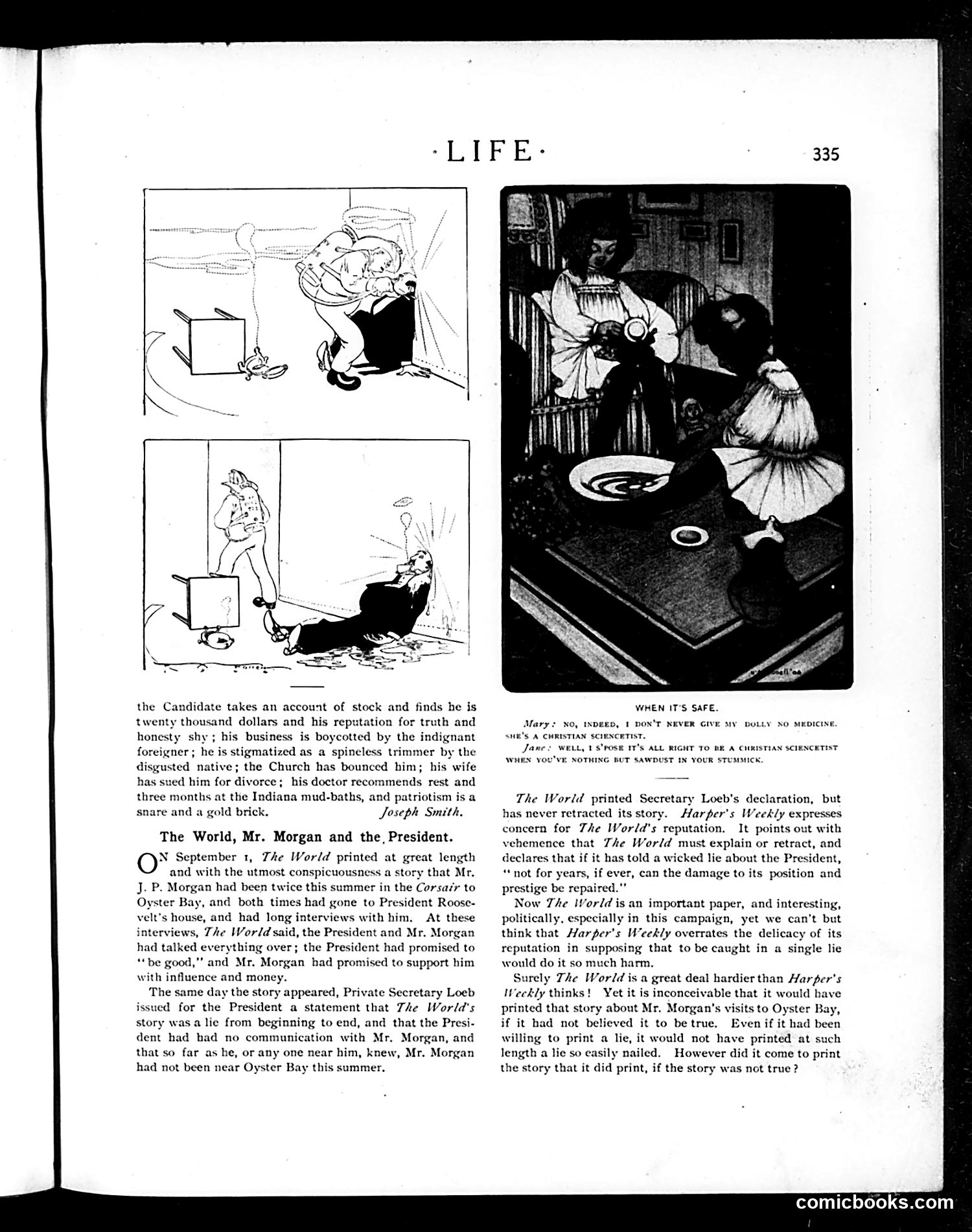
This page contains two distinct items: **Top cartoons** (by Joseph Smith): Satirize a hapless candidate whose business fails, gets boycotted, faces divorce, and is mocked—the implication being that patriotic service ruins one's life. **Main article**: Addresses a controversy between *The World* newspaper and President Theodore Roosevelt. *The World* reported that J.P. Morgan (the powerful financier) visited Roosevelt twice at Oyster Bay for secret negotiations where Roosevelt promised to "be good" and Morgan promised financial support. Roosevelt's secretary Loeb denied this entirely. *Life's* sister publication *Harper's Weekly* demanded *The World* retract the story or face permanent reputational damage. *Life* sarcastically questions *Harper's Weekly's* concern, arguing that major newspapers survive false stories regularly. The implicit point: corporate influence on politics was real enough that such a story seemed plausible, and press accountability for falsehoods was weak. **Bottom cartoon**: Mocks Christian Science by having a child with sawdust-filled stomach reject medicine—dark satire on the sect's rejection of medical treatment.
📄 Transcribed text from this page (OCR, searchable)
Machine-transcribed from the original scan — historical spelling and the odd misread are preserved.
disgusted native; the Church has bounced him; his wife has sued him for divorce; his doctor recommends rest and three months at the Indiana mud-baths, and patriotism is a snare and a gold brick. Joseph Smith. The World, Mr. Morgan and the, President. N September 1, The World printed at great length and with the utmost conspicuousness a story that Mr, J. P. Morgan had been twice this summer in the Corsa/r to Oyster Bay, and both times had gone to President Roose- velt’s house, and had long interviews with him, At these interviews, The World said, the President and Mr. Morgan had talked everything over; the President had promised to “be good,” and Mr. Morgan had promised to support him with influence and money. The same day the story appeared, Private Secretary Loeb issued for the President a statement that The World's story was a lie from beginning to end, and that the Presi- dent had bad no communication with Mr. Morgan, and that so far as he, or any one near him, knew, Mr. Morgan had not been near Oyster Bay th WHEN IT'S SAFE. Mary: XO, INDEED, 1 DON'T NEVER GIVE MY DOLLY NO MEDICINE. SHE'S A CHRISTIAN SCIENCETIST. Jane: WELL, 1 S'POSE IT'S ALL RIGHT TO BE A CHRISTIAN SCIENCETIST WHEN YOU'VE NOTHING BUT SAWDUST IN YOUR STUMNICK. The World printed Secretary Loeb’s declaration, but has never retracted its story. Harper's Weekly expresses concern for The World's reputation. It points out with vehemence that The World must explain or retract, and declares that if it has told a wicked lie about the President, “not for years, if ever, can the damage to its position and prestige be repaired.”” Now The |Vor/d is an important paper, and interesting, politically, especially in this campaign, yet we can’t but think that Harper's Weekly overrates the delicacy of its reputation in supposing that to be caught in a single lie would do it so much harm, Surely The World is a great deal hardier than Harper's Weekly thinks! Yet it is inconceivable that it would have printed that story about Mr. Morgan’s if it had not believed it to be true. nif it had been willing to print a lie, it would not have printed at such length a lic so easily nailed. However did it come to print the story that it did print, if the story was not true? comicbooks.com