
A complete issue · 20 pages · 1904
Life — March 10, 1904
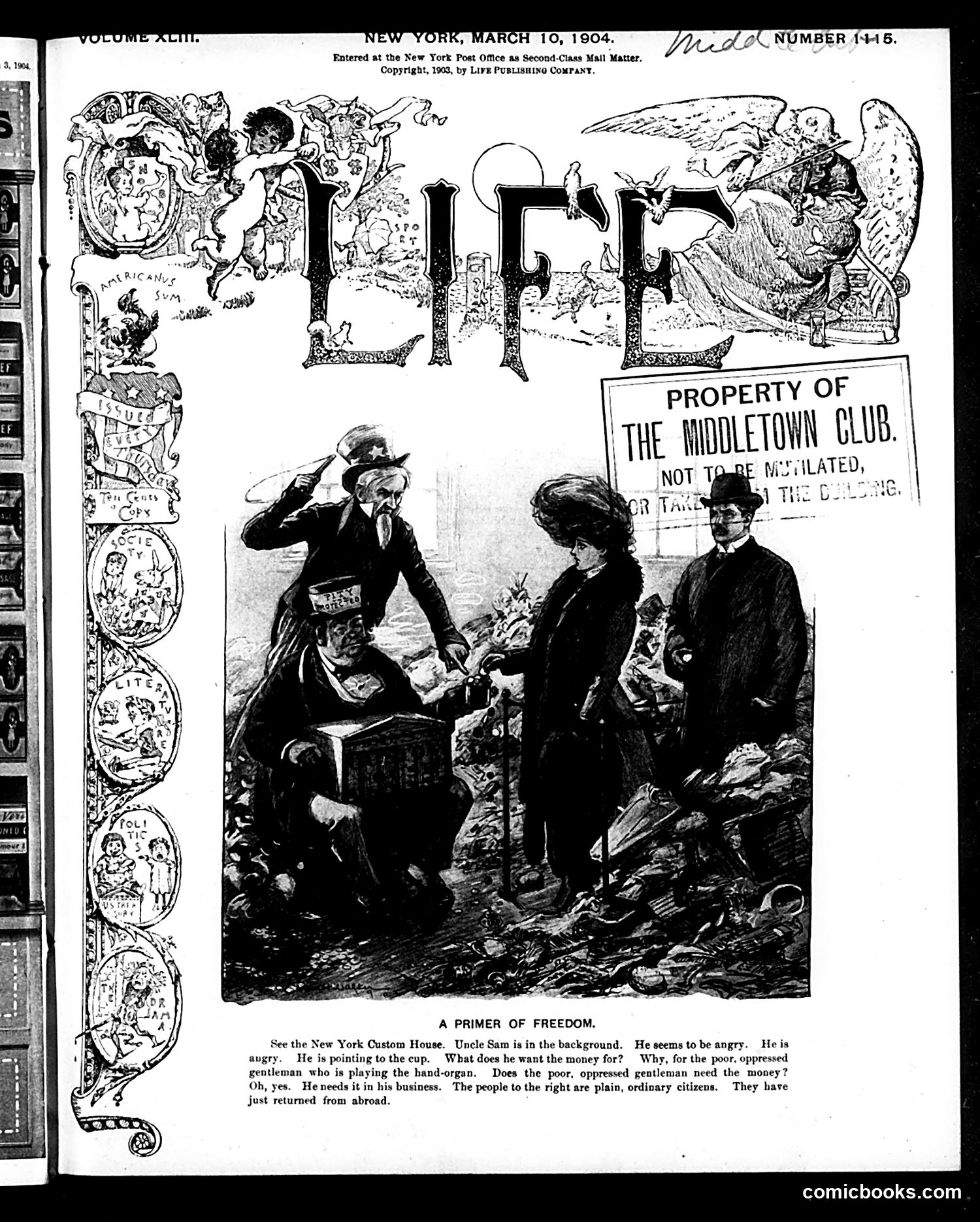
This satirical cartoon critiques U.S. tariff and immigration policy. Uncle Sam (identifiable by his top hat and characteristic appearance) angrily points at a cup, demanding money from poor immigrants at the Custom House. The caption's rhetorical questions mock the contradiction: America claims to offer freedom to "oppressed gentlemen" and "poor, ordinary citizens," yet immediately extracts fees from returning immigrants and the economically vulnerable. The satire targets the hypocrisy of American immigration rhetoric—the nation markets itself as a refuge for the poor and downtrodden ("primer of freedom"), but the government's first action is extracting customs duties and fees from those same people upon arrival. The scene exposes the gap between American ideals of liberty and economic reality.
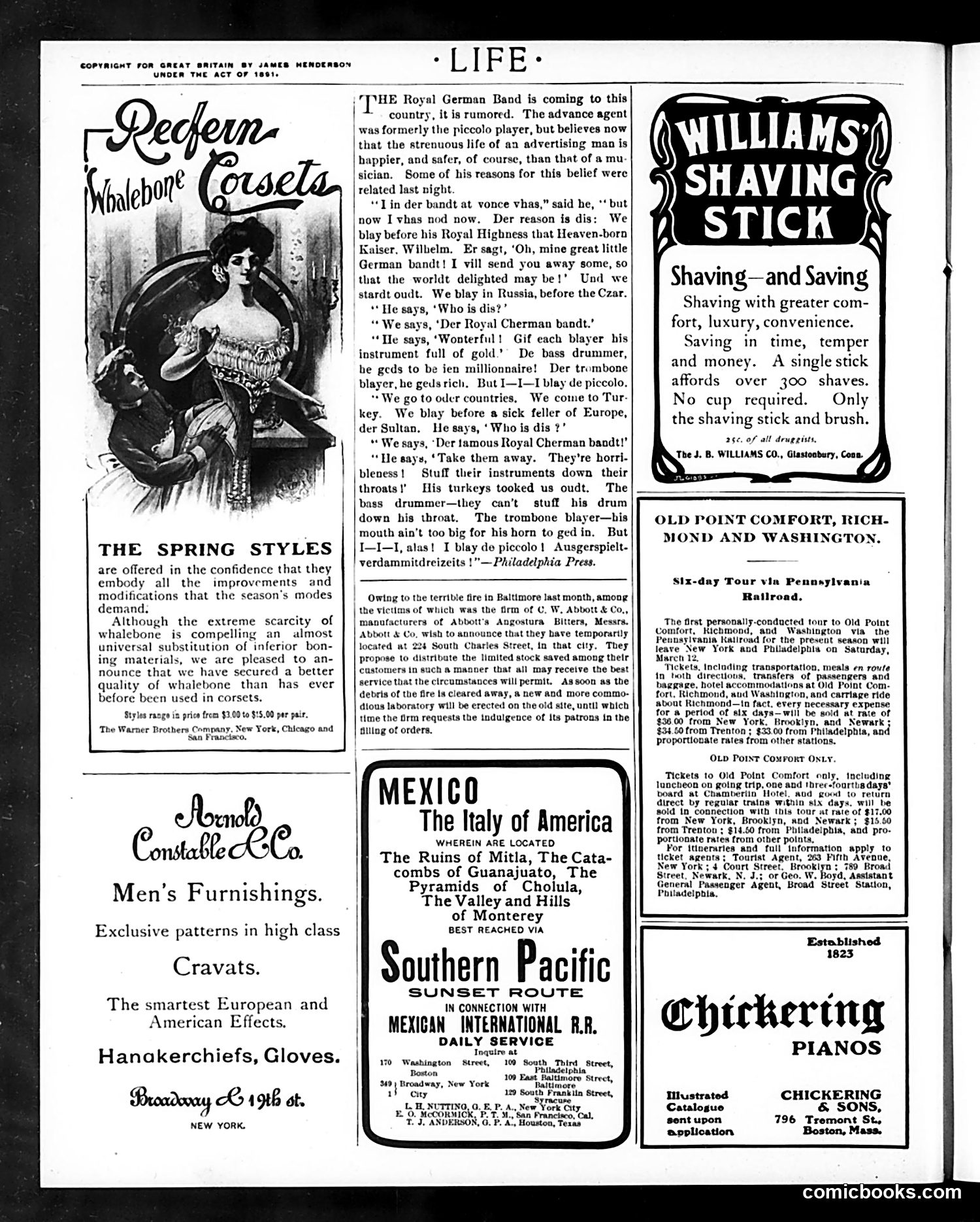
This page is primarily **advertisements** with one satirical article. The main content is a humorous piece about the "Royal German Band" visiting the country. The satire mocks German cultural pretensions by having the advance agent claim the band's music is superior to a musician's life, then describes absurd scenarios where the band performs before various European royalty and dignitaries—the Sultan, the Czar, and others—with increasingly ridiculous consequences (turkeys stuffing instruments, drummers unable to play). The joke targets both German cultural superiority and European monarchy's perceived absurdity. The piece appears designed to entertain American readers by satirizing German nationalism and royal European customs. The remaining content consists of period advertisements for corsets, cravats, pianos, and travel services—typical of *Life* magazine's commercial pages.
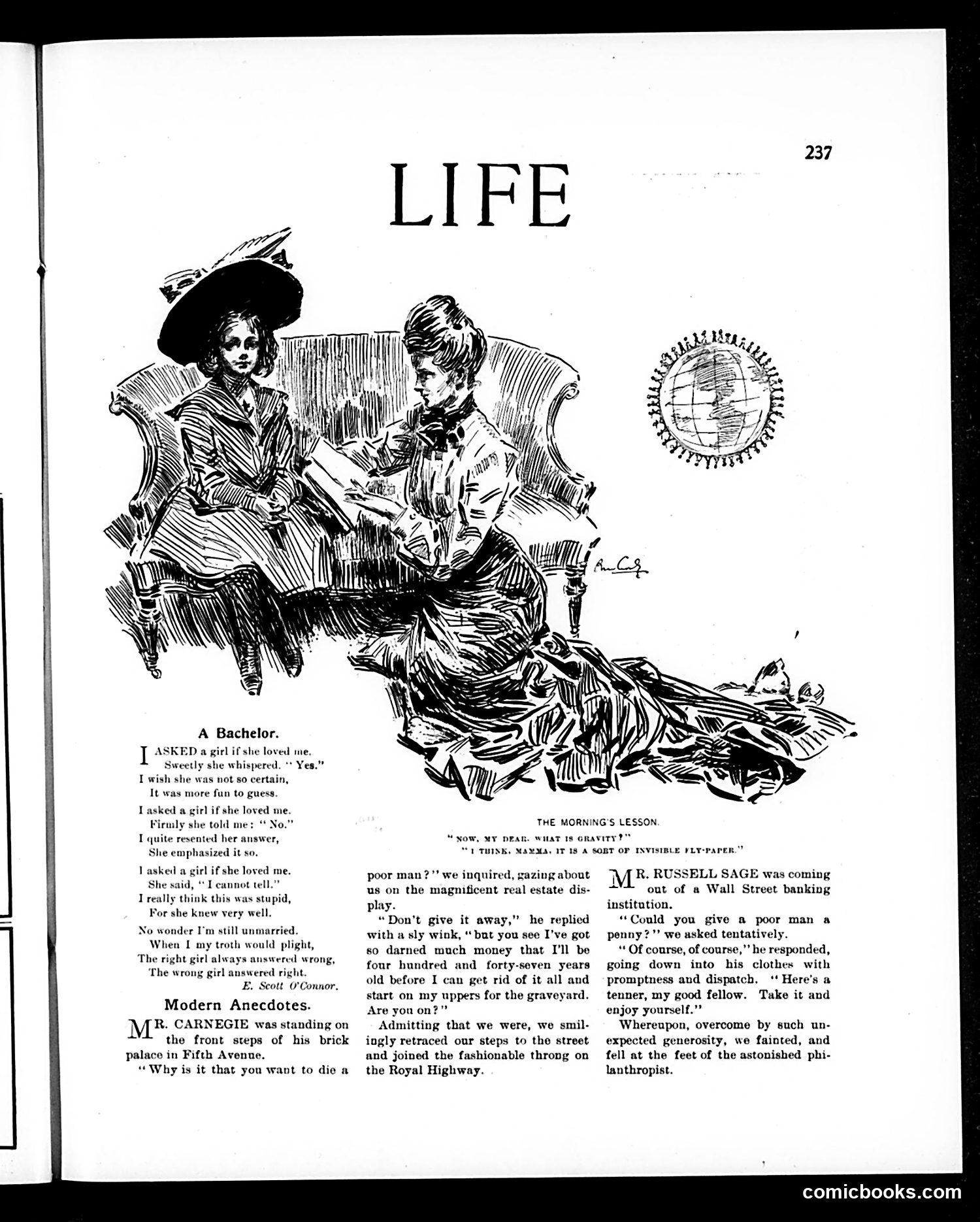
This page contains three distinct pieces of early 20th-century humor: **"A Bachelor"** is a poem about romantic rejection—a man asks three different girls if they love him, receiving inconsistent answers, leading him to conclude bachelorhood is preferable. **"Modern Anecdotes"** features a brief anecdote about Mr. Carnegie (likely Andrew Carnegie, the wealthy industrialist) standing at his brick palace on Fifth Avenue. Someone asks why he wants to build there—the joke's punchline is cut off but implies commentary on Carnegie's wealth and ostentatious real estate. **"The Morning's Lesson"** satirizes wealth disparity: wealthy people question whether they should give money to a poor man, ultimately deciding against it with various justifications. The illustration shows fashionably dressed women discussing the matter. The overall theme critiques both romantic uncertainty and economic inequality.
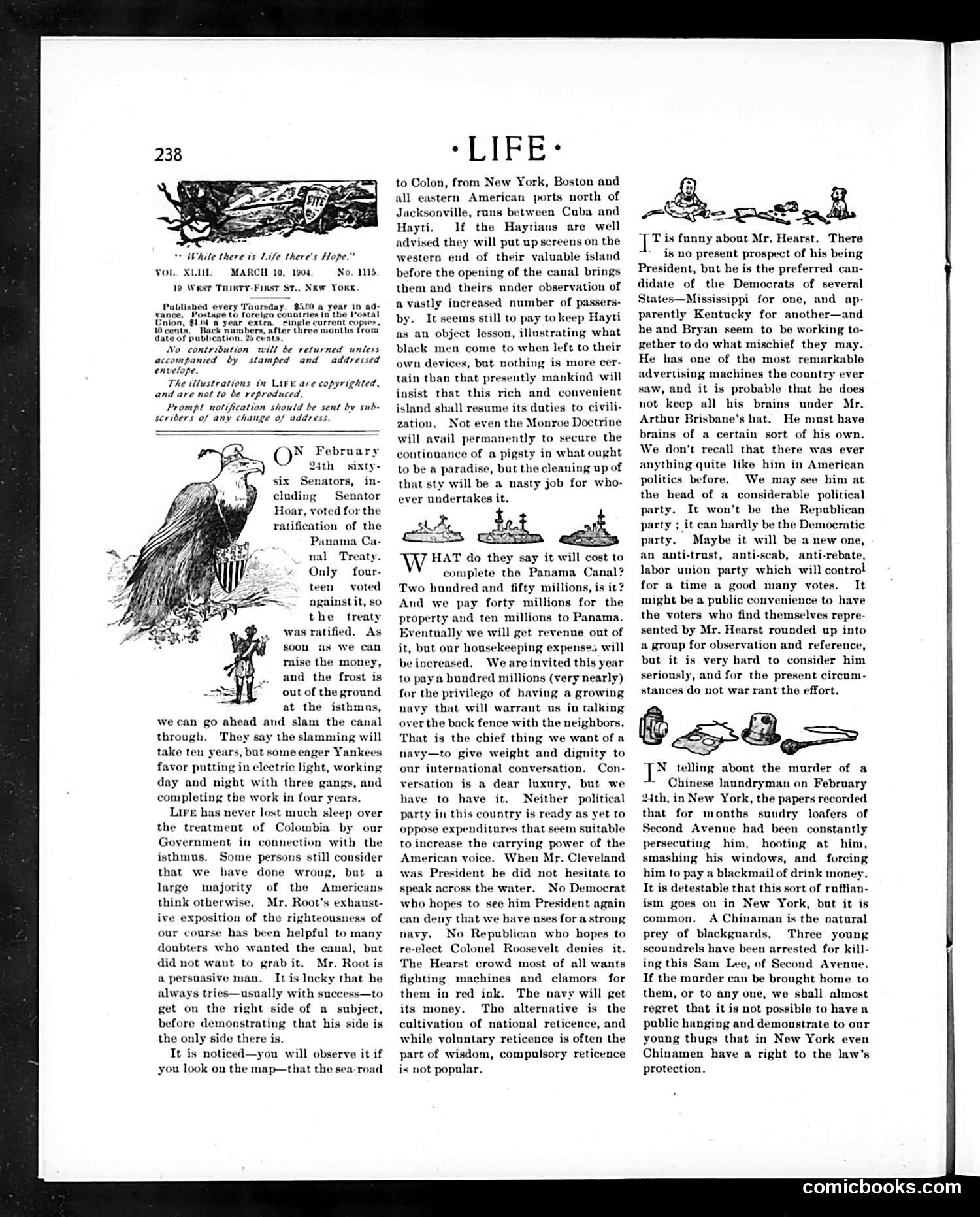
This page from Life magazine (dated March 19, 1903) contains political commentary rather than a traditional cartoon. The text discusses Mr. Hearst, the newspaper publisher, as a potential Democratic presidential candidate. The satirical point: Life mocks the idea that Hearst—despite his wealth and media influence—could unite the fractious Democratic Party or command respect as a serious presidential contender. The eagle illustration is decorative rather than satirical. The right column discusses a Chinese laundry murder in New York, reflecting period concerns about Chinese immigrant communities and urban crime. The Panama Canal discussion occupies much space, advocating for naval expansion as justification for the project's costs. The satire here targets Democratic opposition to such military spending.
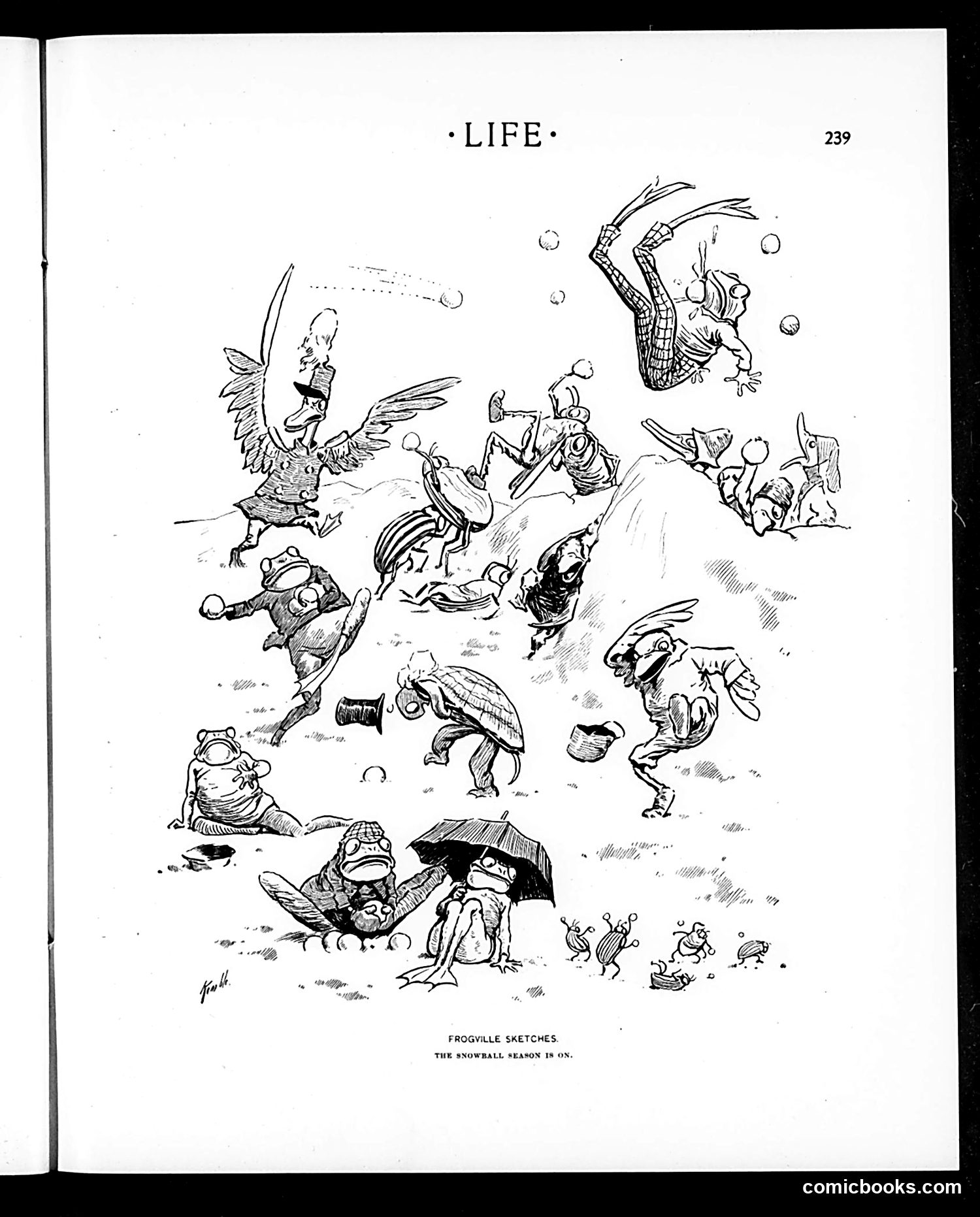
This is a whimsical cartoon featuring anthropomorphic frogs engaged in winter snowball combat. The caption indicates it's part of a "Frogville Sketches" series, depicting frogs as stand-ins for human society during snowy weather. The humor derives from treating frog characters with human-like qualities—they throw snowballs, use umbrellas for protection, and display physical comedy typical of slapstick entertainment. Some figures appear upside-down or airborne from impact, emphasizing the chaotic fun of snowball fights. Rather than political satire, this represents lighthearted seasonal humor common to Life magazine's entertainment content. The detailed pen work and numerous small figures create a busy, comedic scene celebrating winter recreation through animal anthropomorphism—accessible humor requiring no contemporary political knowledge.
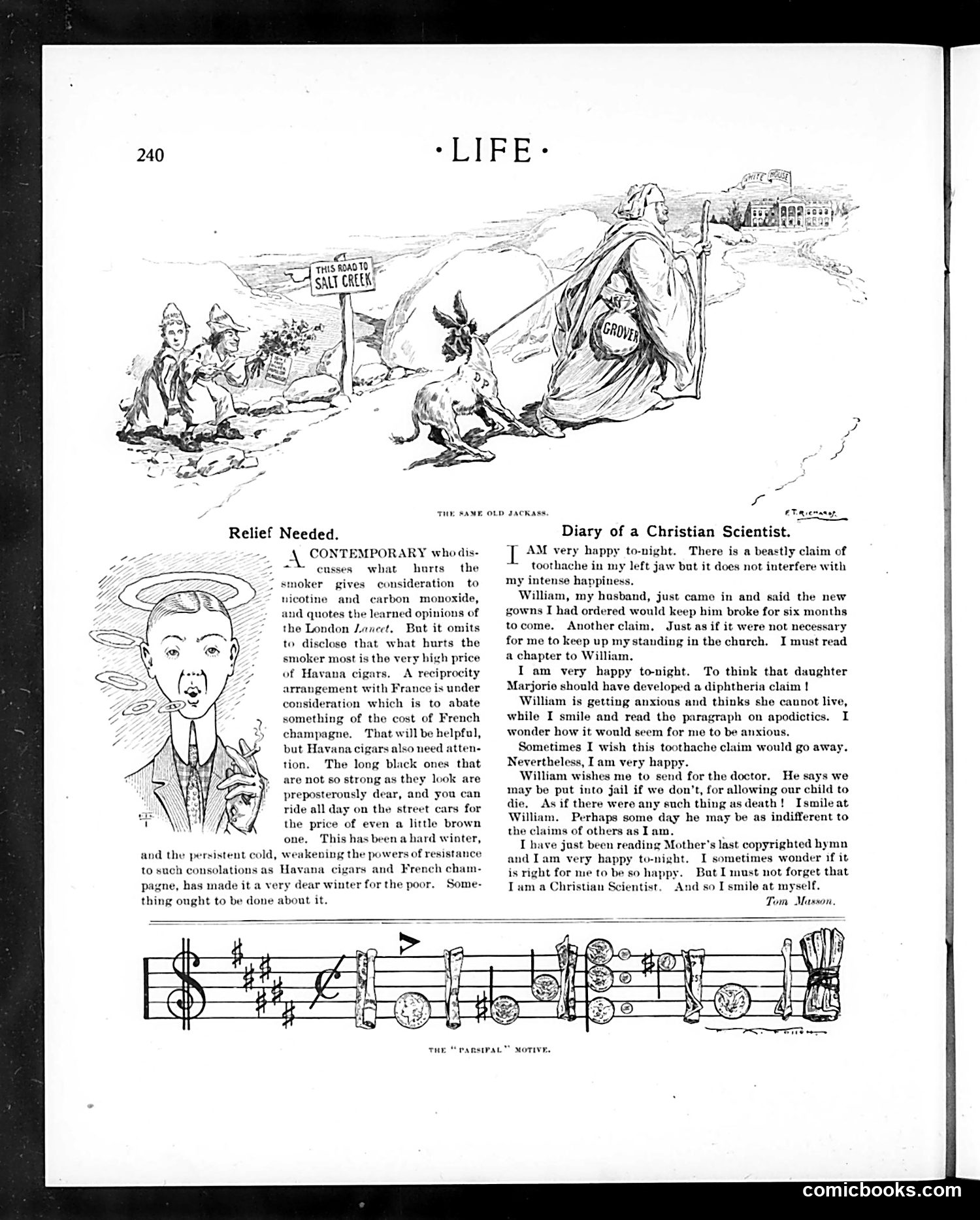
**Top Cartoon - "The Same Old Jackass":** This satirical illustration depicts a figure labeled "Greed" as a robed, skeletal character controlling or dominating common people (shown as smaller figures). A sign reading "THIS ROAD TO SALT CREEK" suggests a journey toward ruin or failure. The "same old jackass" title implies this represents a recurring, unchanging problem in society—greed's persistent destructive influence on ordinary citizens. **"Relief Needed":** A satirical piece mocking smokers' self-deception. It criticizes smokers who excuse tobacco's harmful effects (nicotine, carbon monoxide) while claiming Havana cigars and French champagne provide adequate compensation. The caricatured face shows exaggerated distress, ridiculing the rationalization that luxury goods justify health damage. **"Diary of a Christian Scientist":** This satirizes Christian Science beliefs, particularly about denying illness. The narrator celebrates ignoring her daughter's toothache and maintains happiness despite real suffering, embodying the magazine's critique of the faith's approach to medical treatment.
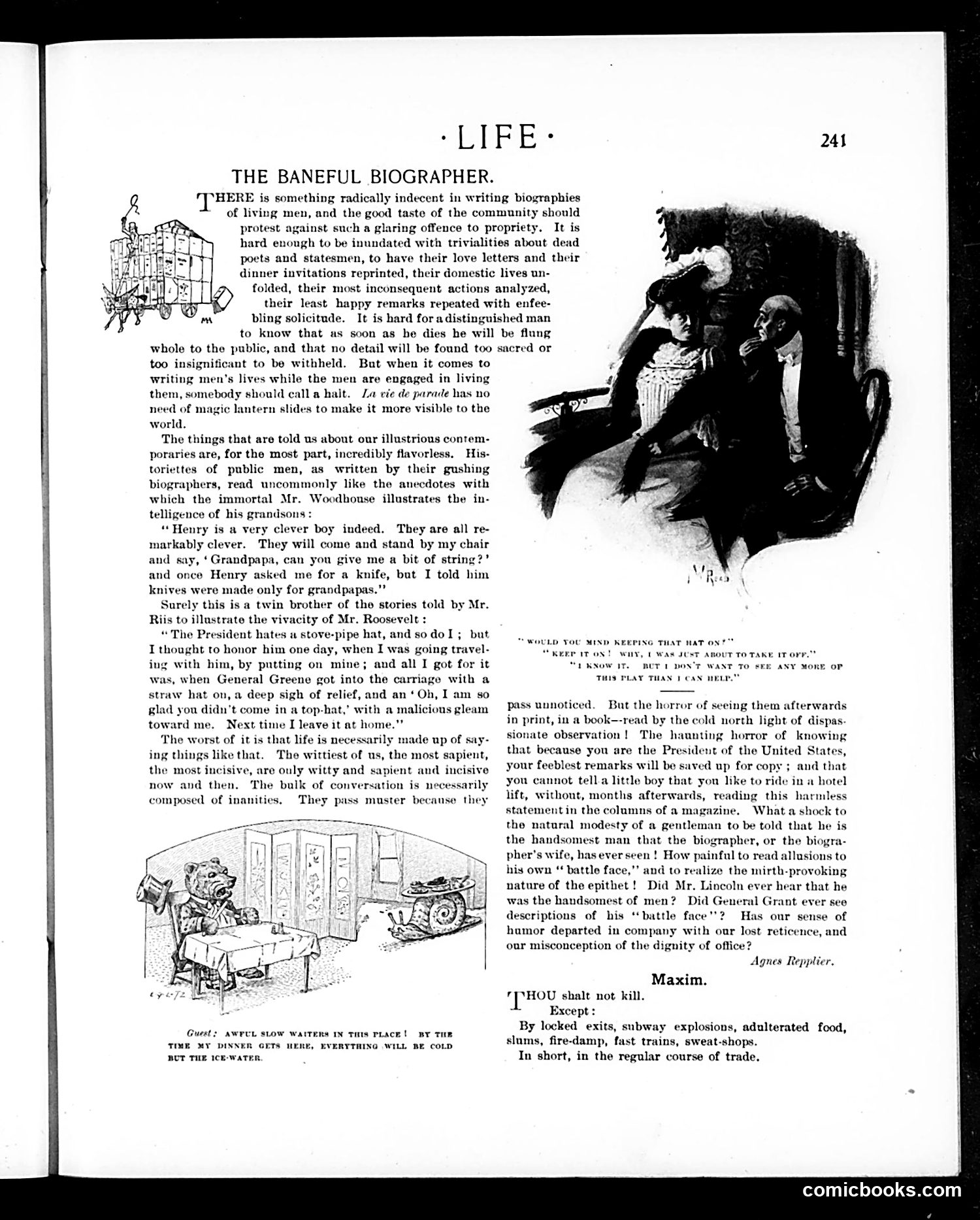
This satirical essay attacks biographers who write embarrassing details about living public figures. The author protests against publishing "love letters," "domestic lives unfolded," and "most inconsequent actions" of prominent men—violating their privacy in the name of biography. The accompanying cartoon illustrates the problem: a biographer appears to be extracting intimate or unflattering information from a reluctant subject. The text includes anecdotes mocking this practice, such as a story about President Theodore Roosevelt allegedly being asked by his grandson for string or a knife "because knives were made only for grandpapas"—the kind of trivial, undignified domestic detail that biographers supposedly published. The piece satirizes how such biographical intrusions destroy public figures' dignity and privacy.
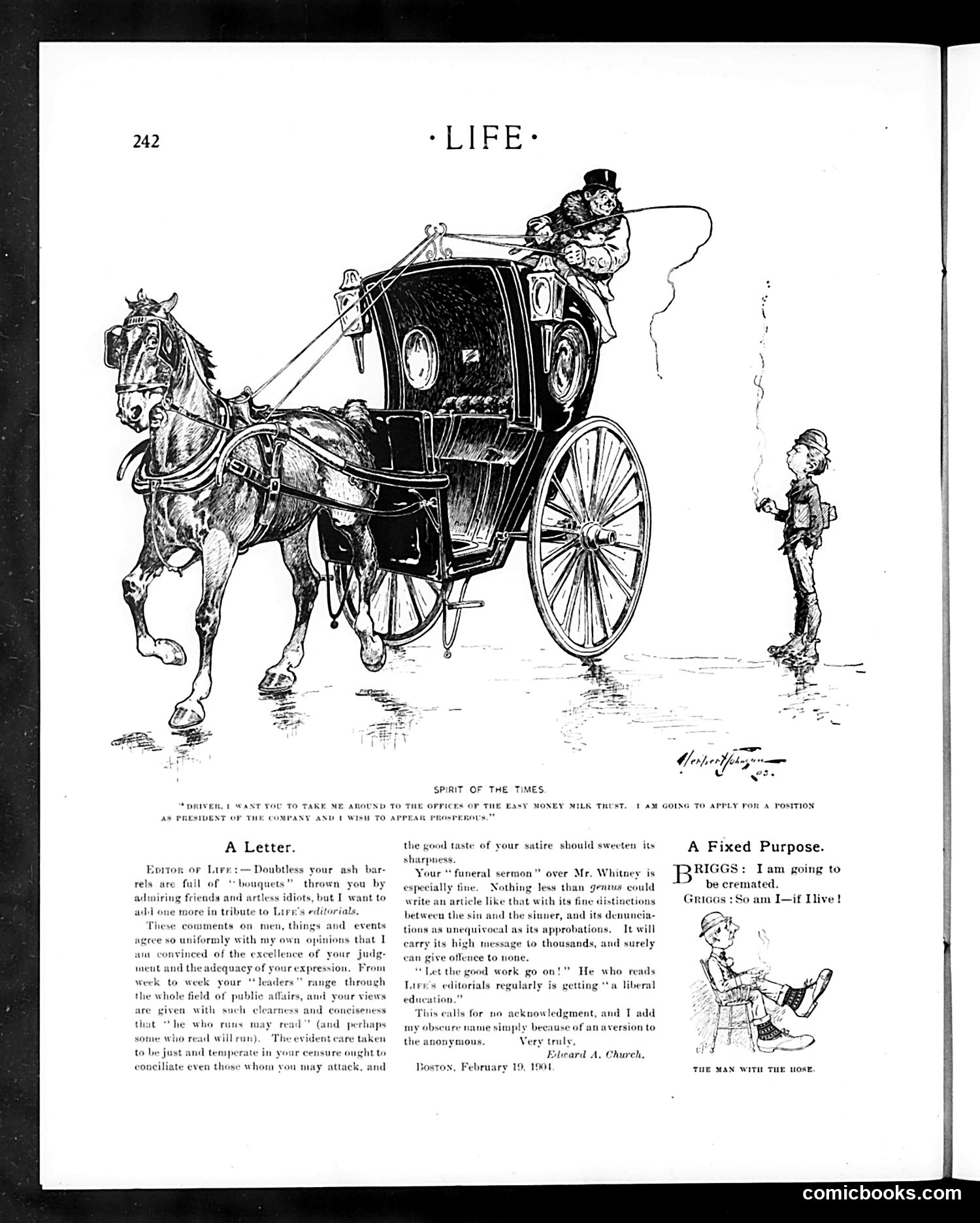
The main cartoon, titled "Spirit of the Times," depicts a wealthy man in a carriage pulled by an ornate horse, commanding a street urchin to take him to "the offices of the Easy Money Silk Trust." He promises the boy a job as company president if he complies—obvious satire of the era's corrupt corporate practices and nepotism. Below, "A Letter" contains editorial correspondence praising Life's satirical "leaders" for their clarity and fairness in addressing public issues. The writer notes Life's editorials provide "liberal education" to readers. On the right, "A Fixed Purpose" shows a boy declaring he'll become a hobo "if I live!"—likely satirizing how some viewed the vagrant lifestyle as preferable to arduous work. The page satirizes Gilded Age wealth inequality, corporate corruption, and social mobility struggles.
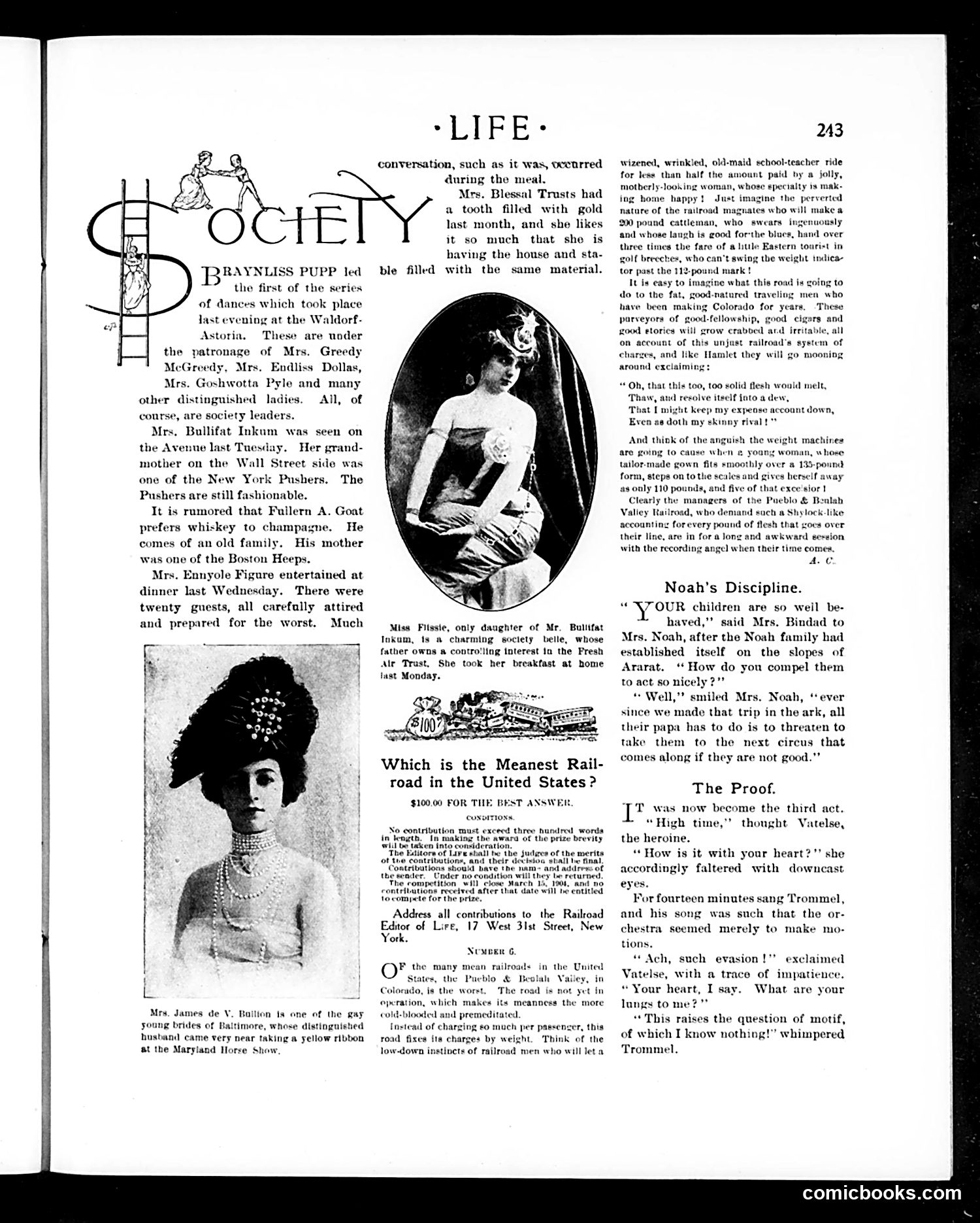
This page contains **society gossip and satirical short fiction** rather than political cartoons. The "Society" section reports on wealthy New York socialites and their activities—dinners, club visits, and family connections among the established elite (the McCreedy, Inckum, and Pushier families). The embedded fiction piece "Noah's Discipline" and "The Proof" appear to be satirical stories mocking Victorian-era theatrical melodrama and overwrought emotional dialogue ("How is it with your heart?"). A contest asks readers to identify "the meanest railroad in the United States," suggesting contemporary frustration with railroad monopolies and their treatment of passengers—a common Progressive-era complaint about corporate practices charging excessive fares.
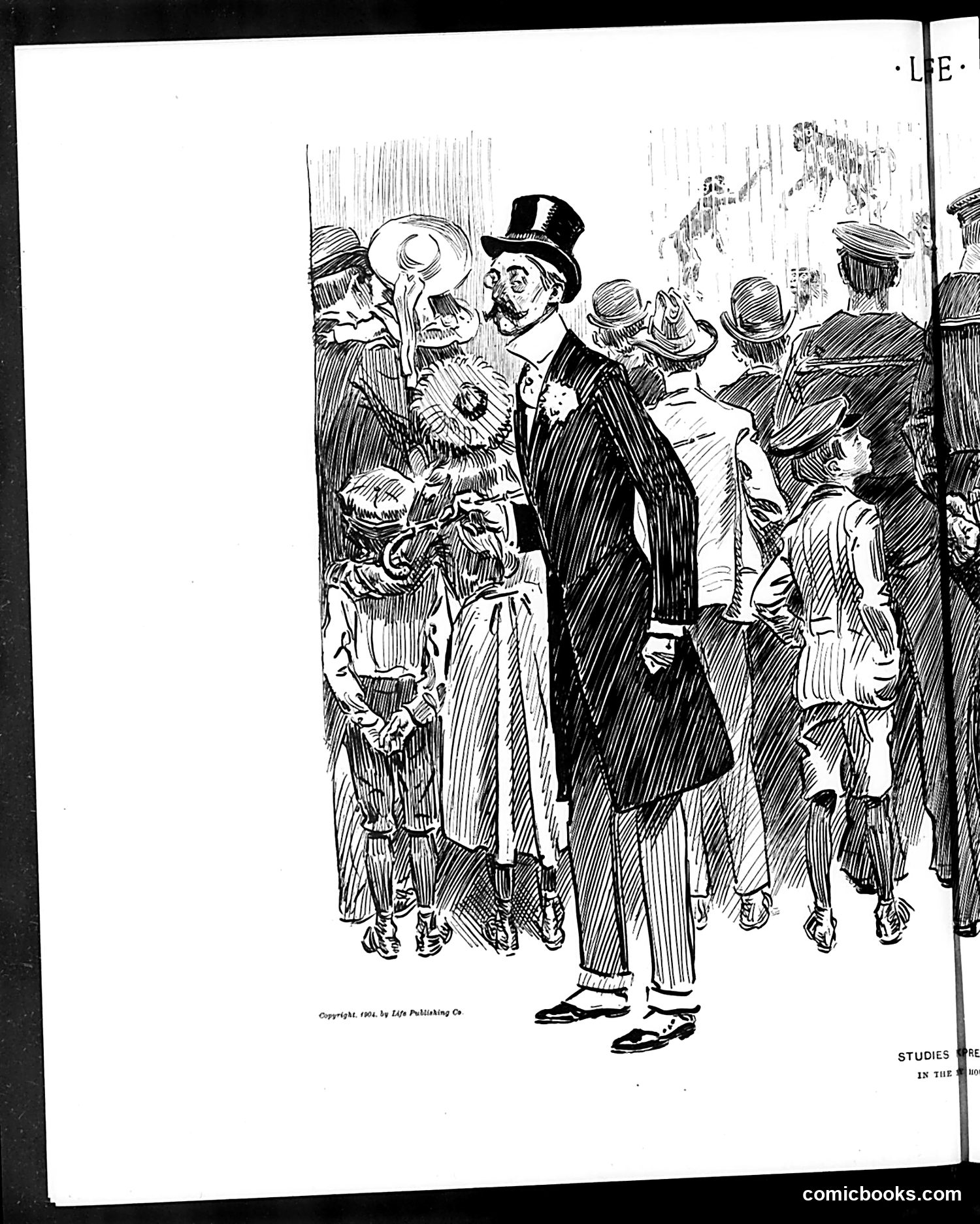
This is a satirical illustration from Life magazine (copyright 1904). The drawing depicts a well-dressed gentleman in a top hat and pinstriped suit surrounded by a crowd of working-class men in caps and casual dress. The central figure appears to be a wealthy or prominent person of some status, based on his formal attire contrasting sharply with those around him. The satire likely critiques class divisions or social inequality—the stark visual difference between the formally dressed central figure and the surrounding working men emphasizes disparity. Without additional context visible on this page, the specific political or social event being referenced remains unclear, though the composition suggests commentary on wealth, privilege, or class consciousness during the early 1900s Progressive Era.
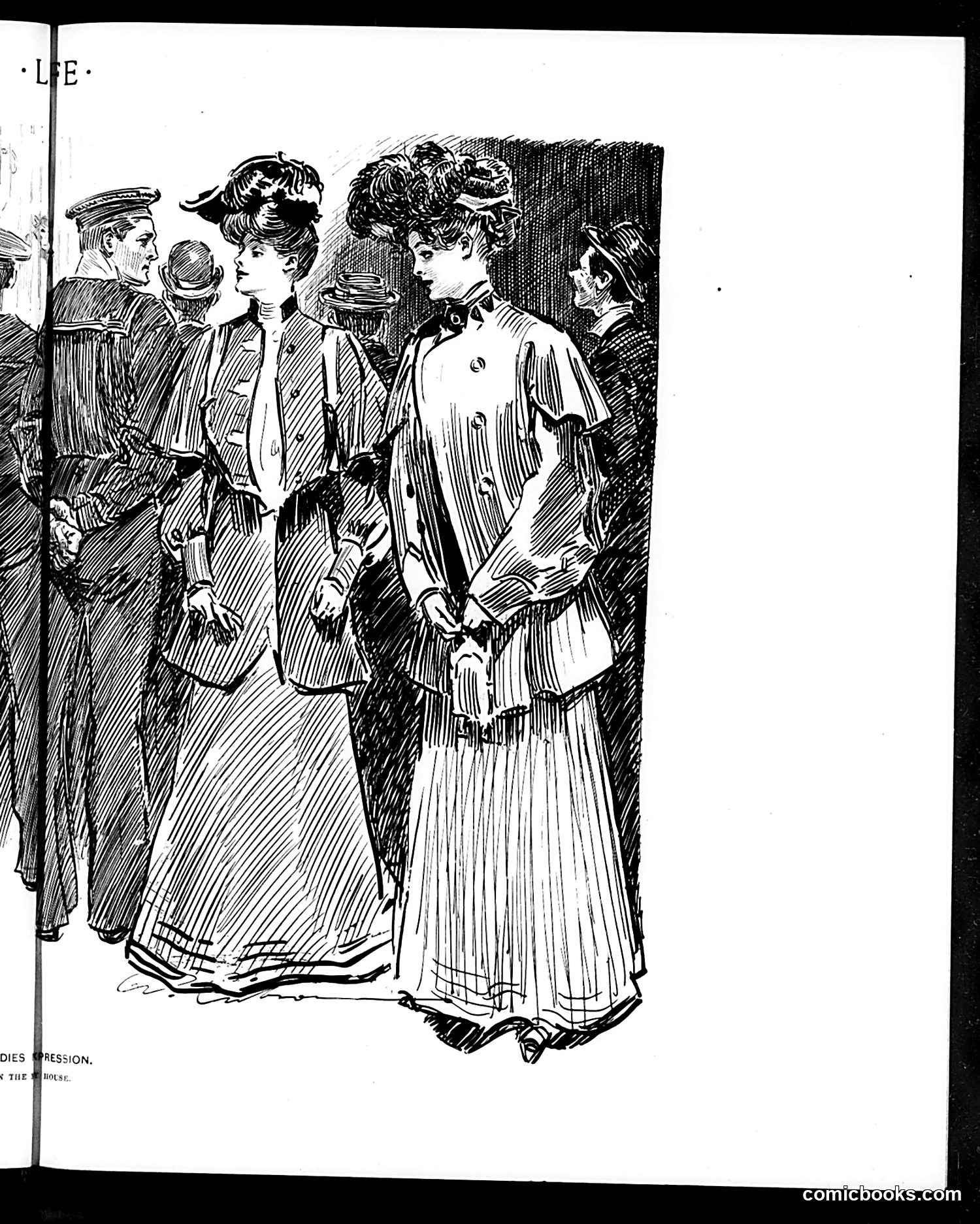
This appears to be a social satire from Life magazine's early period, depicting what looks like a formal social gathering or reception. The illustration shows well-dressed figures in early 1900s attire—men in suits and women in elaborate Gibson Girl-style gowns with high pompadour hairstyles. Without clearer text identifying specific individuals or a visible caption, the exact satirical target remains unclear. However, the composition suggests commentary on either high society pretension, fashionable excess, or possibly gender dynamics of the era. The formal positioning and detailed rendering of elaborate clothing might satirize the artificiality or superficiality of upper-class social conventions. The partial OCR text at bottom is illegible, preventing confirmation of the intended joke or reference.
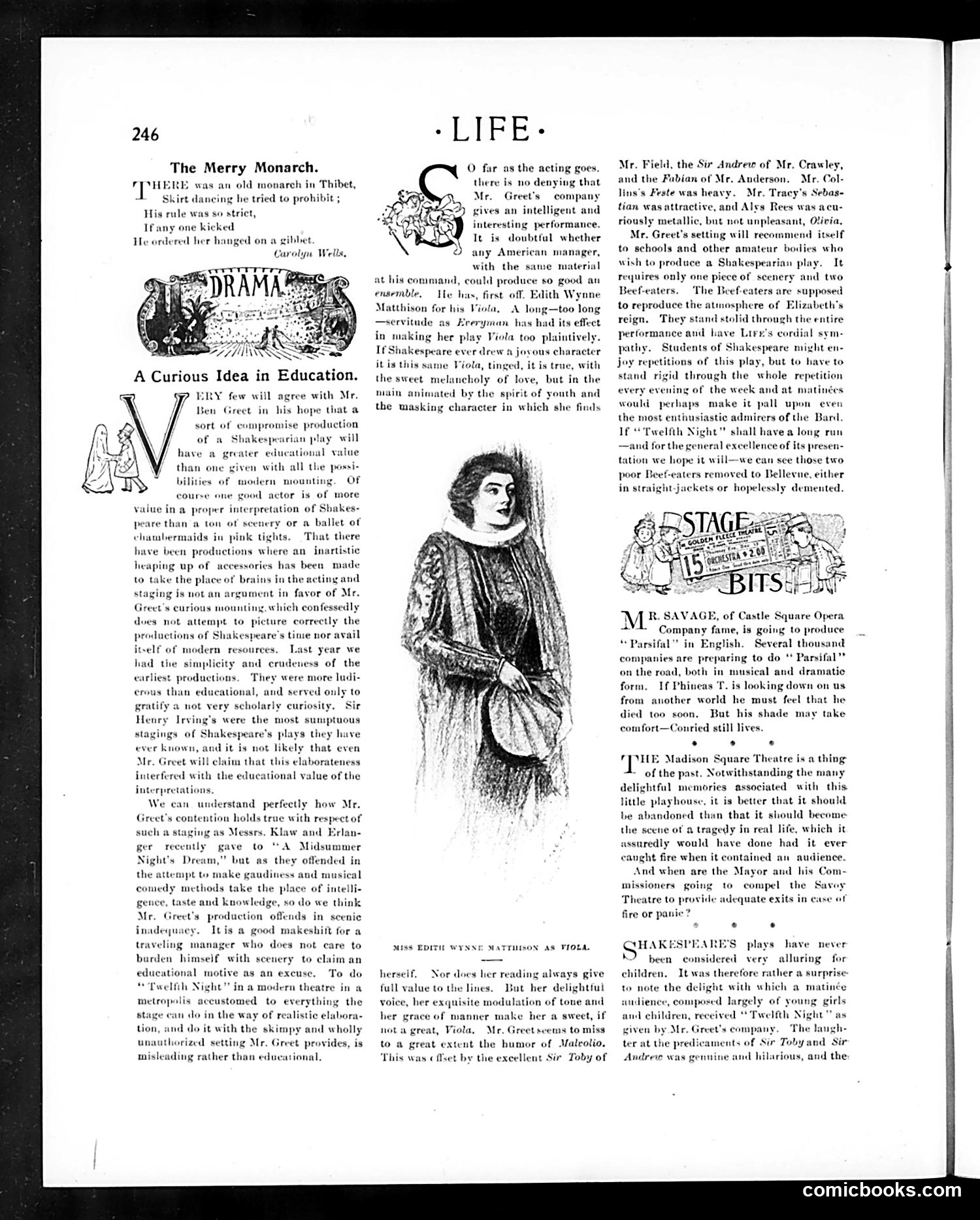
This page discusses theater criticism rather than political satire. The main content critiques Mr. Greet's Shakespeare productions, particularly his staging choices for "Twelfth Night." The central illustration shows **Miss Edith Wynne Matthison as Viola**, the female lead character who disguises herself as a man in the play. The article's satire targets Greet's educational approach to Shakespeare—specifically his use of elaborate staging and scenery that the critic argues distracts from the text itself. The writer sarcastically suggests that Shakespeare productions shouldn't require modern theatrical resources, implying Greet's approach is pretentious and unnecessary. The "Stage Bits" section briefly mentions an upcoming "Parsifal" opera production. This is primarily **theater criticism and commentary**, not political satire.
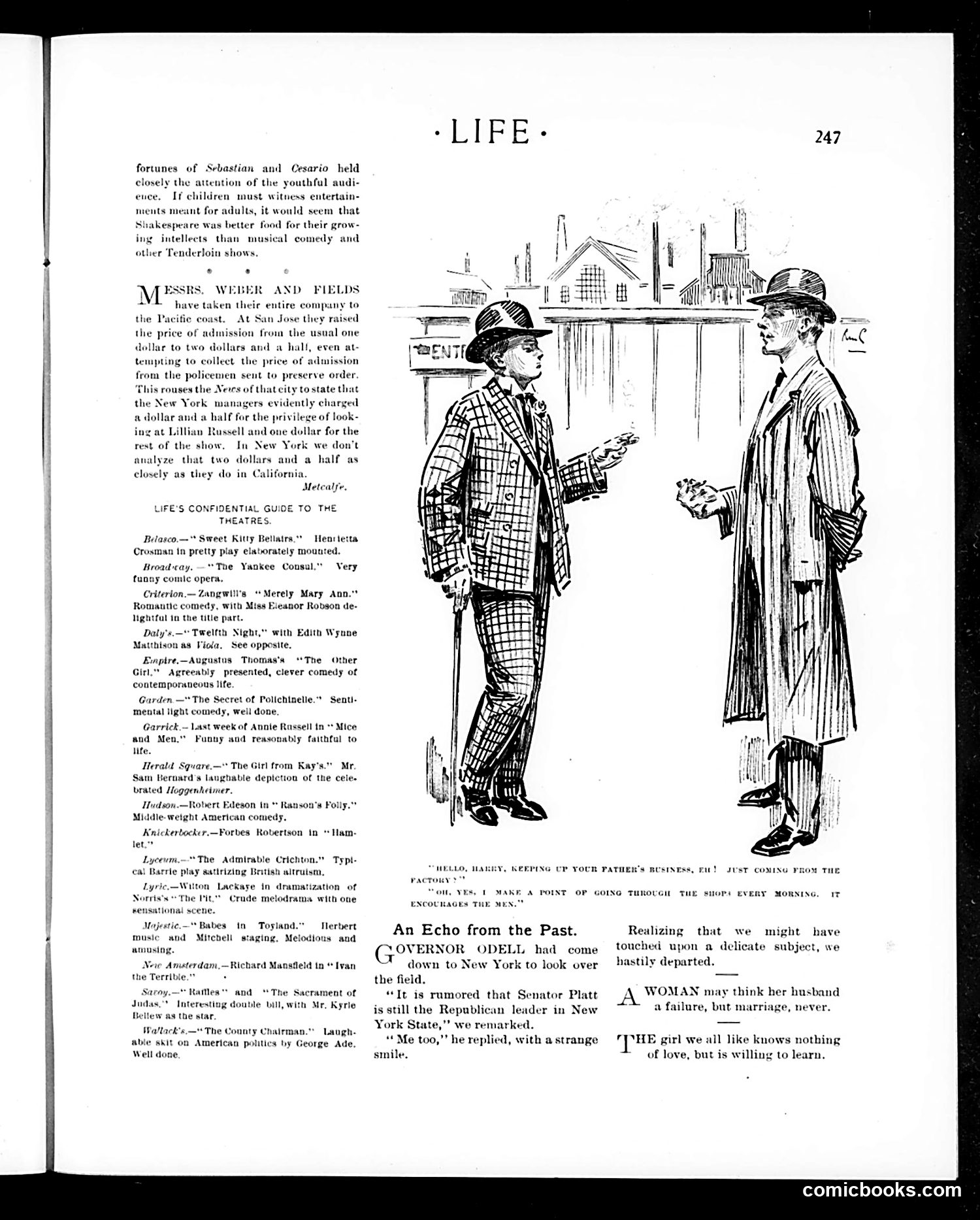
This page from *Life* magazine contains theatrical reviews and satirical commentary on early 1900s New York theater and politics. **The Main Cartoon** depicts two men in conversation—one in a checkered suit (identified by caption as "Harry") and another in a coat. The caption references Harry "keeping up" his father's factory business and mentions the father "encourages the men," suggesting workplace dynamics or labor relations humor. **The Political Reference** appears in "An Echo from the Past," discussing Governor Odell meeting with Senator Platt about Republican leadership in New York State. The cryptic exchange—when asked if Platt leads Republicans, Odell replies "Me too"—suggests backstage political maneuvering or power struggles within the Republican Party that readers would have recognized from contemporary politics. **Theater Reviews** at page bottom list contemporary Broadway productions, indicating *Life*'s cultural coverage alongside satire. The page satirizes both theatrical pretension and political ambition typical of Gilded Age New York society.
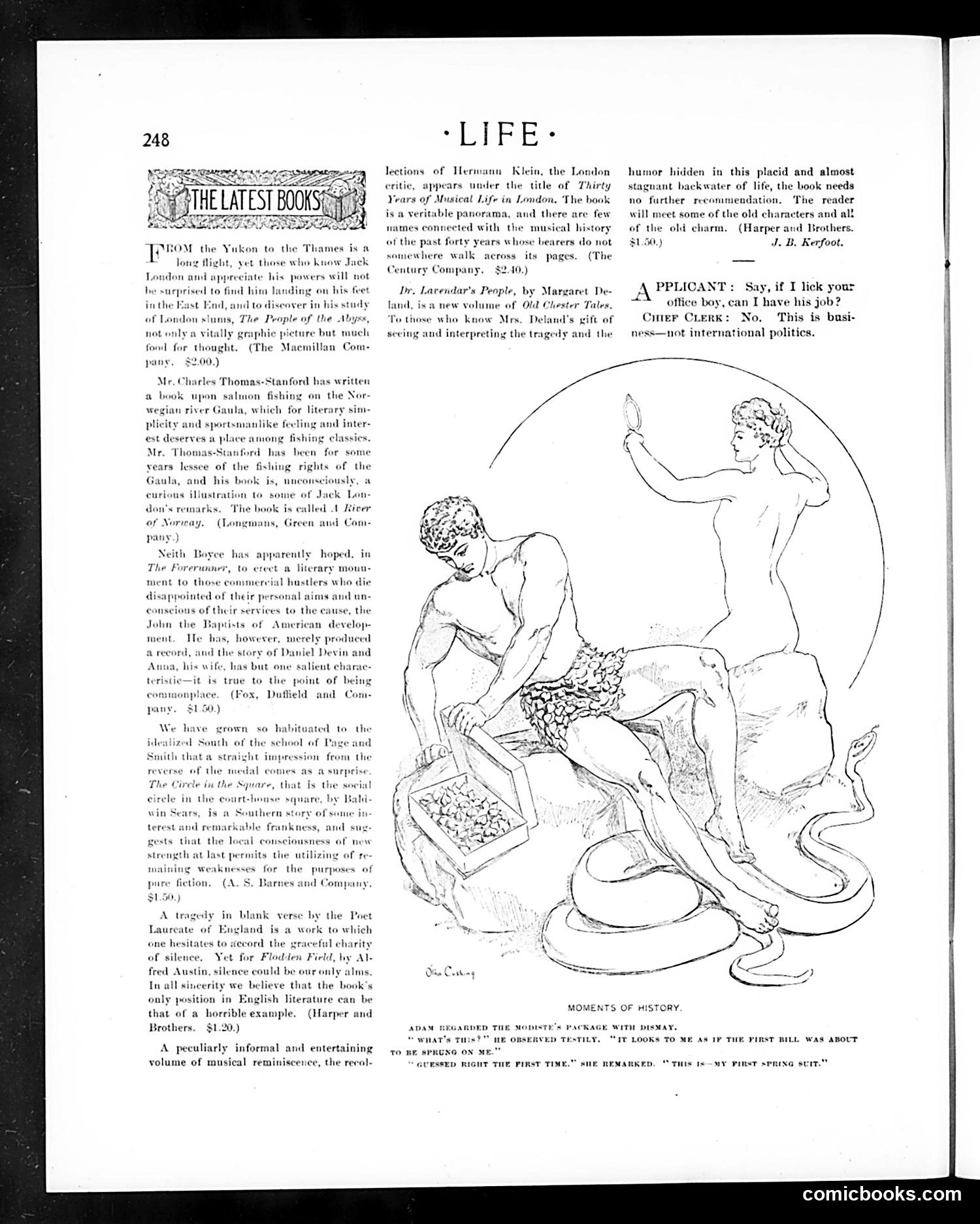
This single-panel cartoon depicts a domestic scene with two figures examining what appears to be Adam's first package or bill. The woman observes testily that "it looks to me as if the first bill was about to be sprung on me," while the man responds about his first spring suit. The satire plays on **the eternal complaint of wives about husbands' spending and bills**—a domestic comedy staple. By framing it as "Adam" (the biblical first man) receiving his first bill or package, the joke suggests that this marital dynamic—women worrying about household expenses and men's purchases—is as old as human history itself. It's gentle social satire about gender roles and consumer spending habits, treating a timeless domestic argument as a "moment of history."
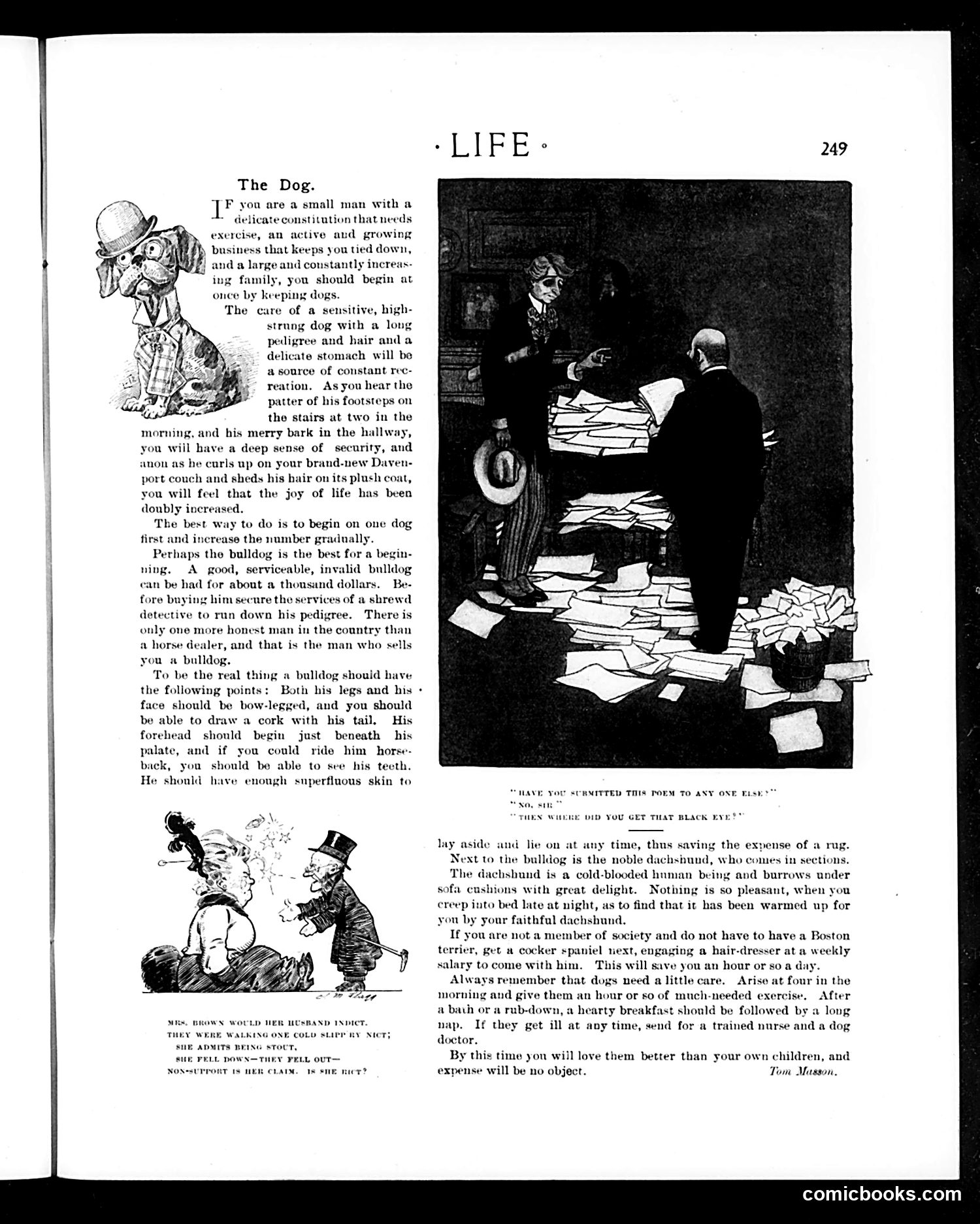
This is a humorous article satirizing wealthy Americans' obsession with expensive pedigree dogs. The text mocks the impracticality of dog ownership for delicate men—describing how a high-strung dog will disrupt sleep, shed on furniture, and require constant, expensive care (trained nurses, dog doctors, weekly hair-dressers). The jokes target class pretension: bulldogs cost "a thousand dollars" and require hiring detectives to verify pedigree. The author sardonically notes that only "one more honest man in the country than a horse dealer" sells bulldogs—suggesting widespread fraud. The accompanying cartoons illustrate the absurdity: one shows a small man overwhelmed by a dog, another depicts office chaos (likely from the poem-submission joke about getting a black eye). The satire's point: spending lavishly on dogs as status symbols is ridiculous, yet wealthy people will happily spend far more on dogs than their own children. The tone is gently mocking of upper-class excess.
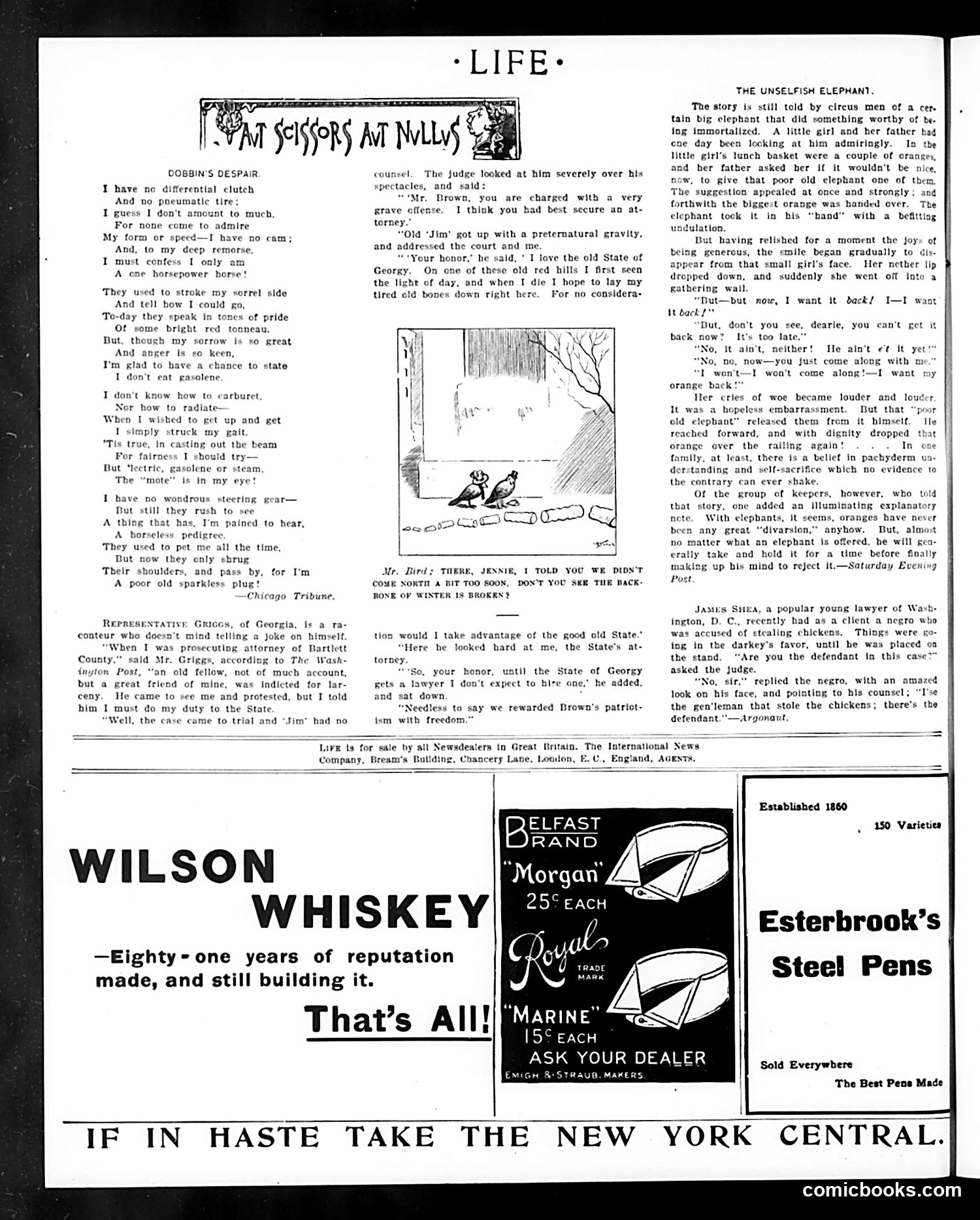
This page contains three distinct pieces of satirical humor: 1. **"Cobbin's Despair"** (poem): A horse laments obsolescence as automobiles replace him. The "sparkless plug" reference suggests the horse is outdated technology, echoing anxieties about automobiles displacing traditional transportation. This satirizes the rapid industrial changes of the early 1900s. 2. **Representative Griggs anecdote**: A Georgia politician tells a story about prosecuting an old friend for larceny. The defendant, "Jim," patriotically refuses to hire a lawyer because he won't exploit Georgia (the "old State") for personal advantage. The humor lies in this backwards logic—his patriotism prevents him from defending himself legally, making the prosecutor's job awkward. 3. **"The Unselfish Elephant"**: A sentimental story about a girl who gives an elephant an orange, then wants it back before he eats it. The elephant resolves the embarrassment by spitting it out. The advertisements (Wilson Whiskey, Belfast Brand pens, Esterbrook's Steel Pens) occupy the lower portion. This appears to be a typical early-20th-century humor and advertising magazine layout.
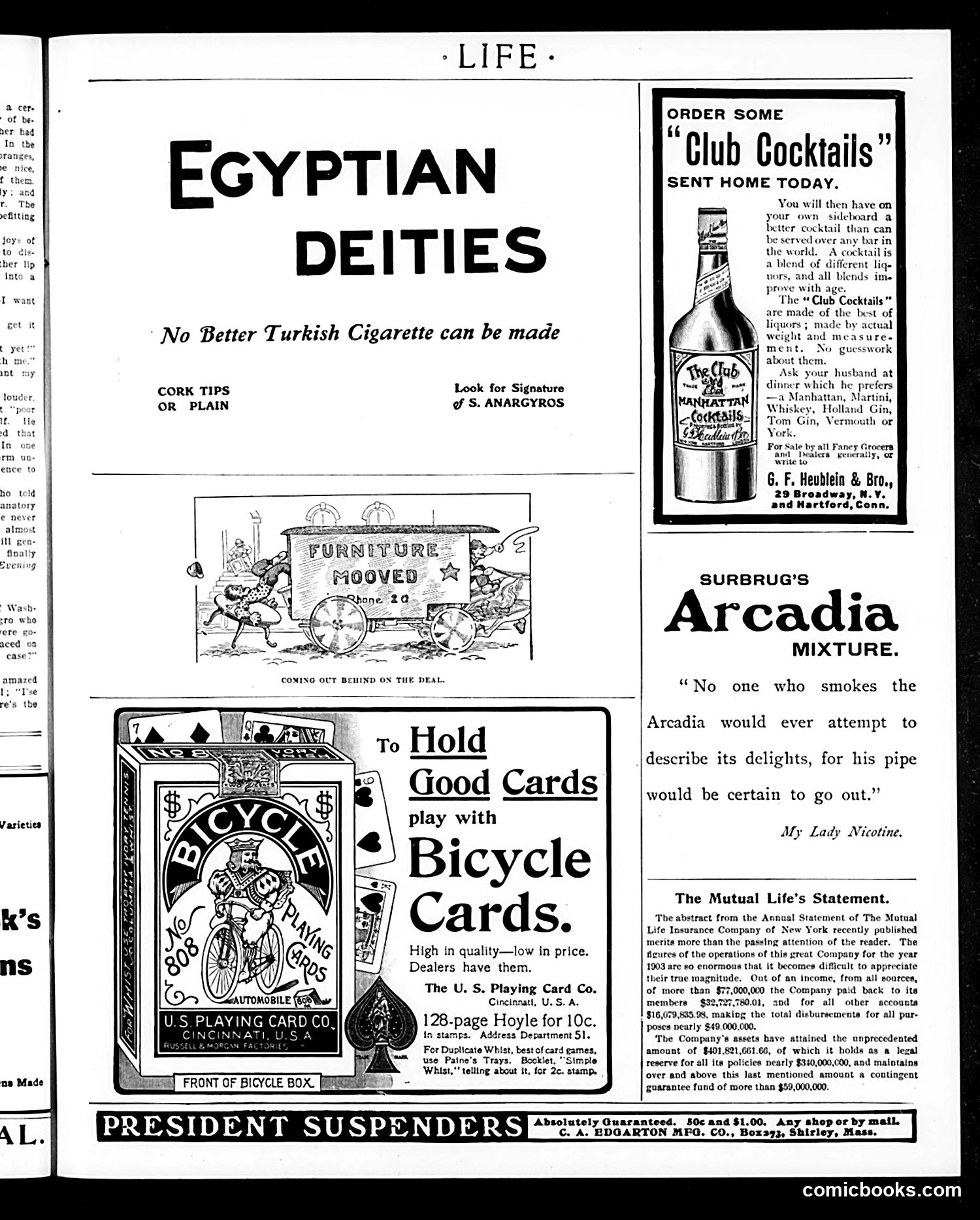
This page is primarily **advertising**, not editorial content or political satire. The main items are: **Egyptian Deities cigarettes** — a Turkish cigarette brand advertisement emphasizing quality ("No Better Turkish Cigarette can be made"), with a signature mark for authenticity. **Bicycle Playing Cards** — promoting card quality and a free Hoyle guide for card games like Whist. **Club Cocktails** — pre-made cocktail mixtures for home use, listing varieties (Manhattan, Martini, etc.), targeting affluent households. **Arcadia Mixture** — pipe tobacco, using a humorous quote suggesting the product is so delightful one forgets to smoke it. **Surbrug's insurance and financial notices** — including The Mutual Life Insurance Company's annual report highlighting substantial assets and disbursements. The page reflects early 1900s consumer culture: luxury goods (cigarettes, spirits, cards) marketed to middle-to-upper-class readers, plus financial institutions advertising their stability. No political satire is evident—this is straightforward period advertising.
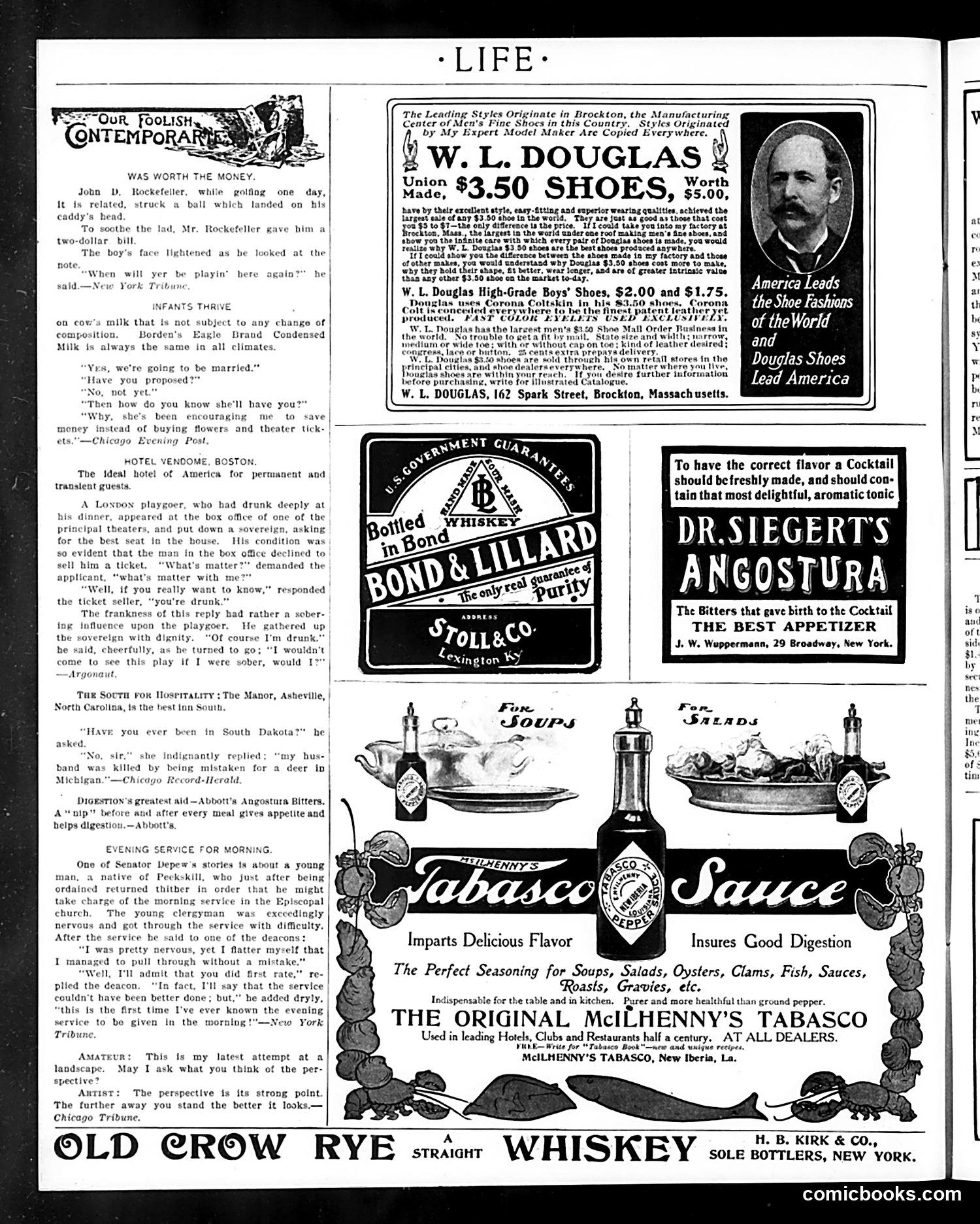
This page is primarily **advertising**, not political satire. The dominant content includes ads for W.L. Douglas shoes ($3.50), Bond & Lillard whiskey, Dr. Siegert's Angostura bitters, and Tabasco sauce. The editorial cartoons are brief humorous anecdotes: 1. **"Our Foolish Contemporary"** mocks a rival publication for praising Rockefeller's generosity when he gave a boy two dollars after hitting him with a golf ball—satire of hypocritical wealth worship. 2. **Brief jokes** include a drunk playgoer's honesty about his condition, and wordplay about a woman preferring engagement money to flowers. These are genteel, light humor typical of *Life* magazine's satirical tradition. The page reflects early 20th-century advertising conventions mixing editorial content with product endorsements, including alcohol and medicinal tonics now recognized as questionable.
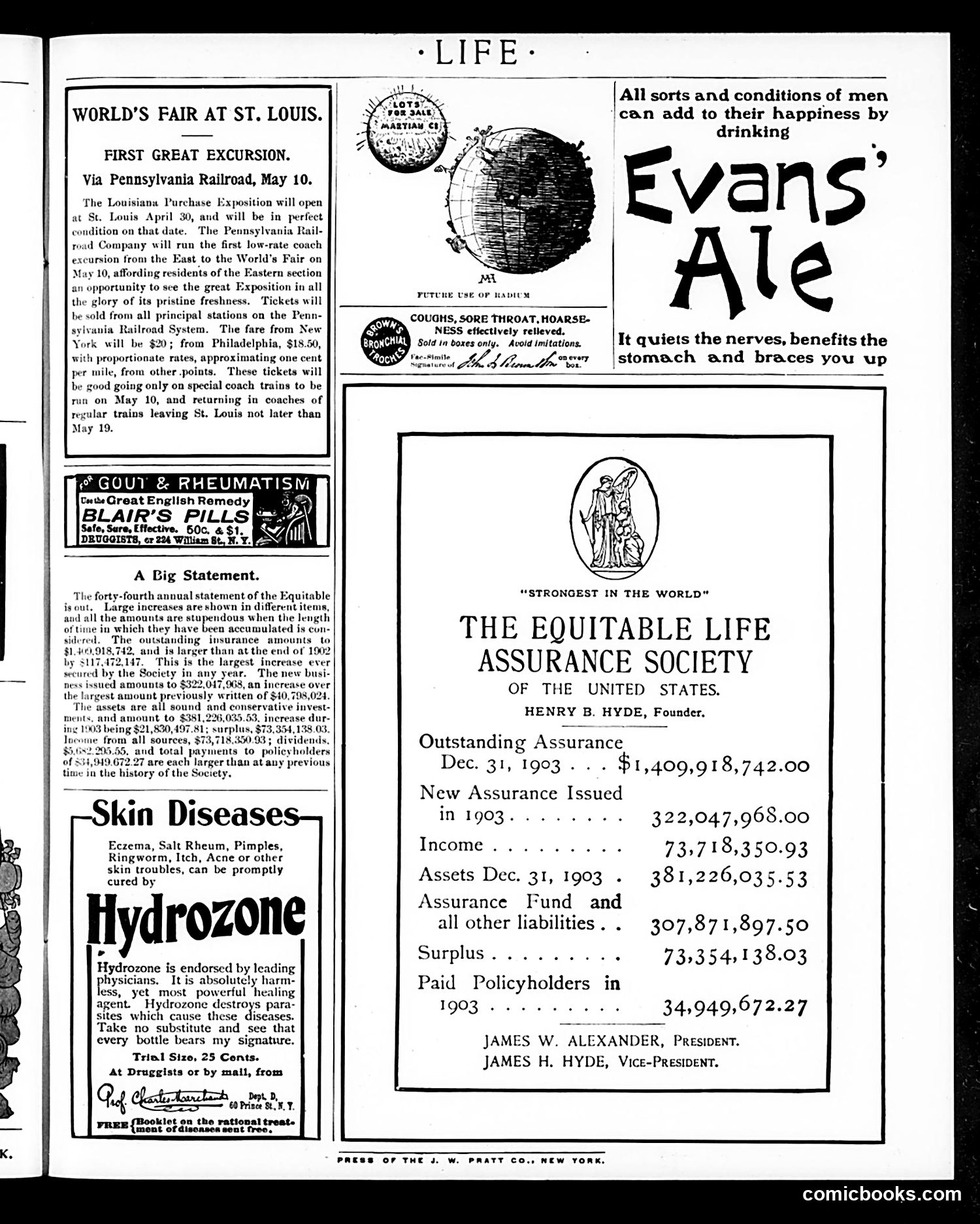
This is primarily an **advertising page** with minimal editorial content. The layout features early 1900s patent medicine and commercial advertisements: **Key Content:** - **World's Fair excursion**: Pennsylvania Railroad promoting low-cost coach trips to the 1904 St. Louis World's Fair (Louisiana Purchase Exposition) - **Evans' Ale**: Claims to "quiet nerves" and benefit digestion—typical of era's dubious health claims - **Proprietary medicines**: Advertisements for Blair's Pills (gout/rheumatism), Hydrozone (skin diseases), and Bronchitis remedy—all presented with medical endorsements that would be illegal today - **Equitable Life Assurance Society**: Financial statement displaying company assets and growth **Historical Context for Modern Readers:** This reflects the early 1900s before FDA regulation (1906). Patent medicines routinely made unsubstantiated health claims. The ads use "scientific" language and doctor endorsements to build credibility. The fair promotion and insurance statistics suggest economic optimism of the era. **No political cartoon or satire is present**—this is straightforward advertising content.
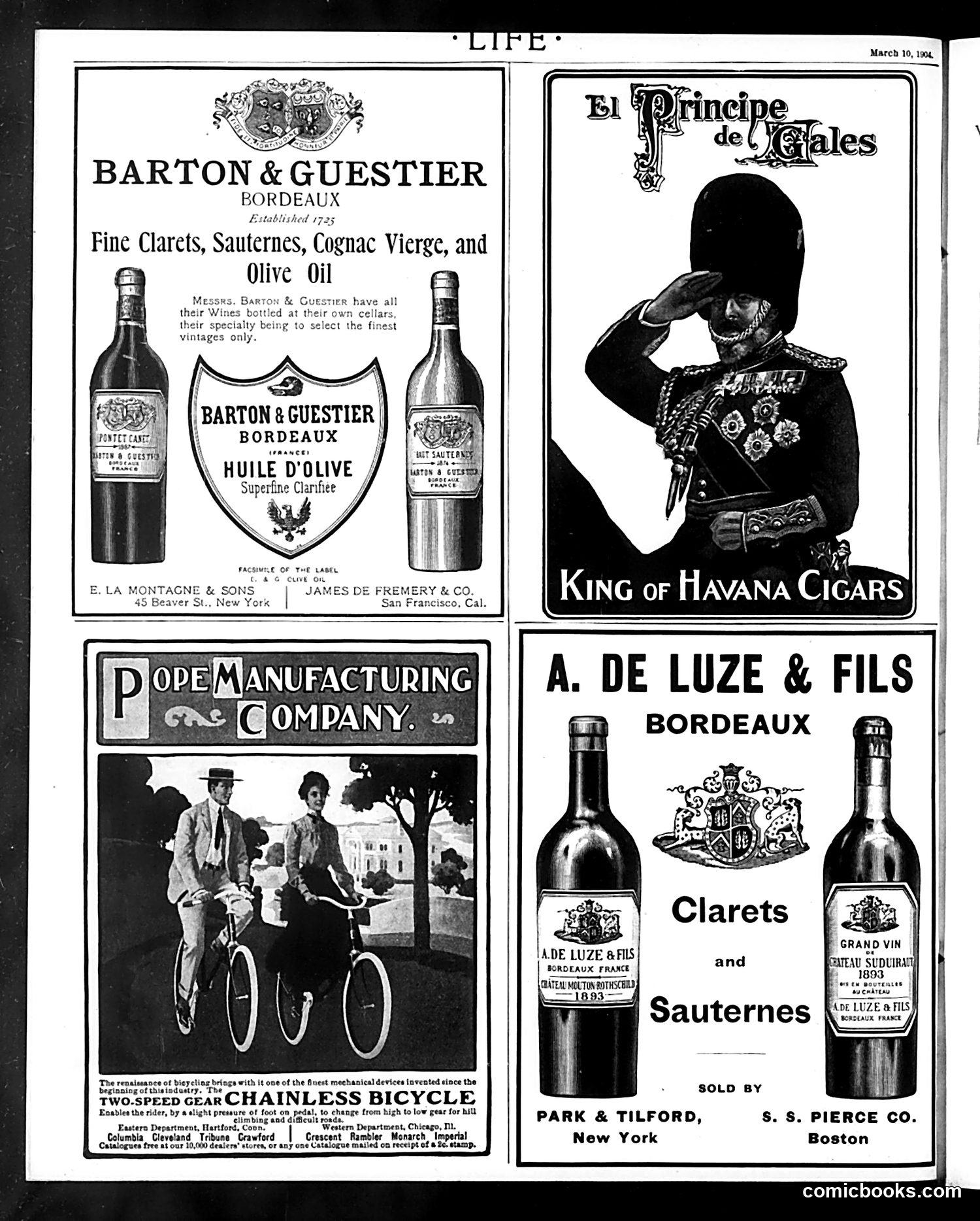
This is primarily an **advertising page**, not political satire. It contains four commercial advertisements: 1. **Barton & Guestier** (Bordeaux wines and olive oil) 2. **El Príncipe de Gales** (King of Havana Cigars) — featuring a military figure in formal dress, likely referencing the Prince of Wales 3. **Pope Manufacturing Company** — advertising their two-speed chainless bicycle, showing two cyclists; the text emphasizes this as a mechanical innovation 4. **A. de Luze & Fils** (Bordeaux wines) — sold through New York and Boston distributors The only potentially satirical element is the cigar advertisement's use of royal imagery to market a luxury product. Otherwise, this reflects early 1900s consumer advertising targeting wealthy Americans interested in imported European goods and new mechanical technologies.