
Life, 1904-03-10 · page 12 of 20
Life — March 10, 1904 — page 12: what you’re looking at
What you’re looking at
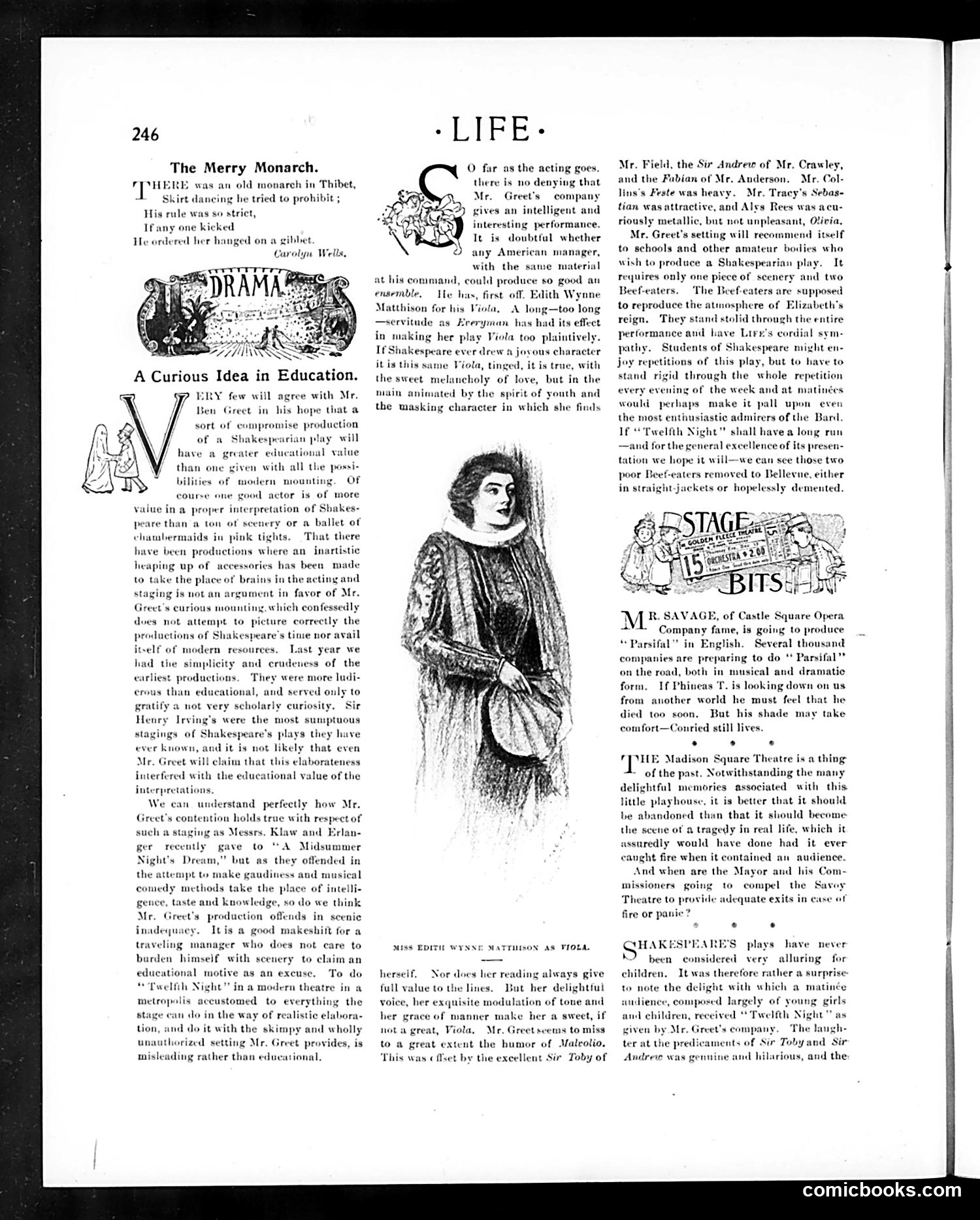
This page discusses theater criticism rather than political satire. The main content critiques Mr. Greet's Shakespeare productions, particularly his staging choices for "Twelfth Night." The central illustration shows **Miss Edith Wynne Matthison as Viola**, the female lead character who disguises herself as a man in the play. The article's satire targets Greet's educational approach to Shakespeare—specifically his use of elaborate staging and scenery that the critic argues distracts from the text itself. The writer sarcastically suggests that Shakespeare productions shouldn't require modern theatrical resources, implying Greet's approach is pretentious and unnecessary. The "Stage Bits" section briefly mentions an upcoming "Parsifal" opera production. This is primarily **theater criticism and commentary**, not political satire.
📄 Transcribed text from this page (OCR, searchable)
Machine-transcribed from the original scan — historical spelling and the odd misread are preserved.
246 The Merry Monarch. d monarch in Thibet, ¢ tried to prohibit ; 5 was an irt dancing His rule was so strict, y one kicked al her hanged on a vhet arolyn Wells. A Curious Idea in Education. ERY few will agree with Mr. Ben Greet in his hope that a sort of compromise production of a Shakespearian play will yal value ti er edu have a gi than one ven with all the possi- f modern mounting. Of «actor is of more value in a proper interpretation of Shakes- peare than a ton of scenery or a ballet of ids in pink tights, That there ductions where an inartistic chambe: have been pr heap up of accessories has been made ins in the acting and it in favor of Me. to take the place of b staging is not an ar mounting. which eonfessedly not attempt to picture correctly the luctions of Shakespeare's tine nor avail elf of modern re: had the simplicit duc crous than educatior ot very s ary Irving's were the most sumptuous gs of Shakespeare's plays they have ever known, and it is not li y that even Mr. ¢ this elaborateness interfered with the educational value of the interpretations. We can understand perfectly how Mr. Greet’s contention holds true with respect of s Messrs. Klaw and an- gee recently gave to “A Midsummer Night's Dream,” but as they offended in the attempt to make gaudi 1 comedy methods take the place of intel aste and knowledge, so do we think reet's production offends in scenic Itis a good n shift for a traveling manager who does not care to eet’s cur rees. Last year we and crudeness of the ions. They were more ludi- , and served only to cholarly curiosity. Sir i claim th: such ss and musi burden himself with scen toe y man educational motive as an excuse. To do “Twelfth Night” in a modern theatre in is accustomed to everything the in do in the way of realistic elal do it with the skimpy and wholly unauthorized setting Mr. Greet provides, is misleading rather than edu a ional, “LITRE + O far as the acting goes. there is no denying that Mr. Greet’s company 3 gives an intelligent and +3 interesting performance. as 1 s RY Ni It is doubtful whether > any American manager, with the samwe m: at his command, could produce so good an ensemble, Ile has, first off. Edith Wynne Matthison for his Viola, A long—too long servitude as yman has had its effect in making her play Viola too plaintively. If Shakespeare ever drew a jovous character it is this same Viola, tinged, it is true, with the sweet melancholy of love, but in the main animated by the spirit of youth and the wasking character in which she finds MISS EDIT WYNNE MATTUISON AS FIOLA. herself. Nor docs her reading always give full value to the lines. But hee delightful voice, her exqitisite modulation of tone and her g ke her a sweet, if nota great, Viola, Mr. Greet seems to miss to a great extent the humor of Mateolio. This was « flset by the excellent Sir Toby of of manner m Mr. Field, the Sir Andrew of Mr. Crawle and the Fabian of Me. Anderson. Mr. Col- Mr. Tracy's Sebas- tian was attractive, and Alys Rees was acu- riously metallic, but not unpleass Mr. Greet’s setting will recomme to schools and other amateur bo wish to produce a Shakespearian pl requires only one piece of scenery and two Beef-eaters. ‘The Beef-eaters are supposed lins’s Feste was heavy. roduce the atmosphere of cth's They stand stolid th entire performance and have Lire’s cordial sym- pathy. Students of speare might en- y repetitions of this play, but to to 1 through the whole repetiti would perhaps make it pall upon ev the most enthusiastic admirers of the Bard. If “Twelfth Night” shall have a long run nd for the general excellence of its presen- tation we hope it will—we ean see those two poor Beef-eaters removed to Bellevue, either in straight-jackets or hopelessly demented. N R. SAVAGE, of Castle Square Opera - Company fame, is going to produce “Parsifal” in English. Several thousand companies are preparing to do “ Parsifal” oth in musical and dramatic ‘on the read, form. If Phineas T. is looking down on us. from another world he must feel that he died too soon, But his shade may take comfort—Conried still live . ° . [LE Madison Square Theatee isa thing of the past. Notwithstanding the many delightful memories associated with this little playhouse, it is better that it should be abandoned than that it should become the scene of a tragedy in real life, which it assuredly would have done had it ever caught fire when it contained an audience. And when are the Mayor aud his Com- oners going to compel the Theatre to fire or pani rovide adequate exits in ease ° . have never alluring for her a surprise GHAKESPEARE been considered children, It was therefore ra to note the delight with wh tdienc aul children, receiv by Mr. Greet’s company nents of Sir Toby nd hilarious, and the composed 1 giv ter at the pred Andrew wa genninn | ] { comicbooks.com