
Life, 1904-03-10 · page 4 of 20
Life — March 10, 1904 — page 4: what you’re looking at
What you’re looking at
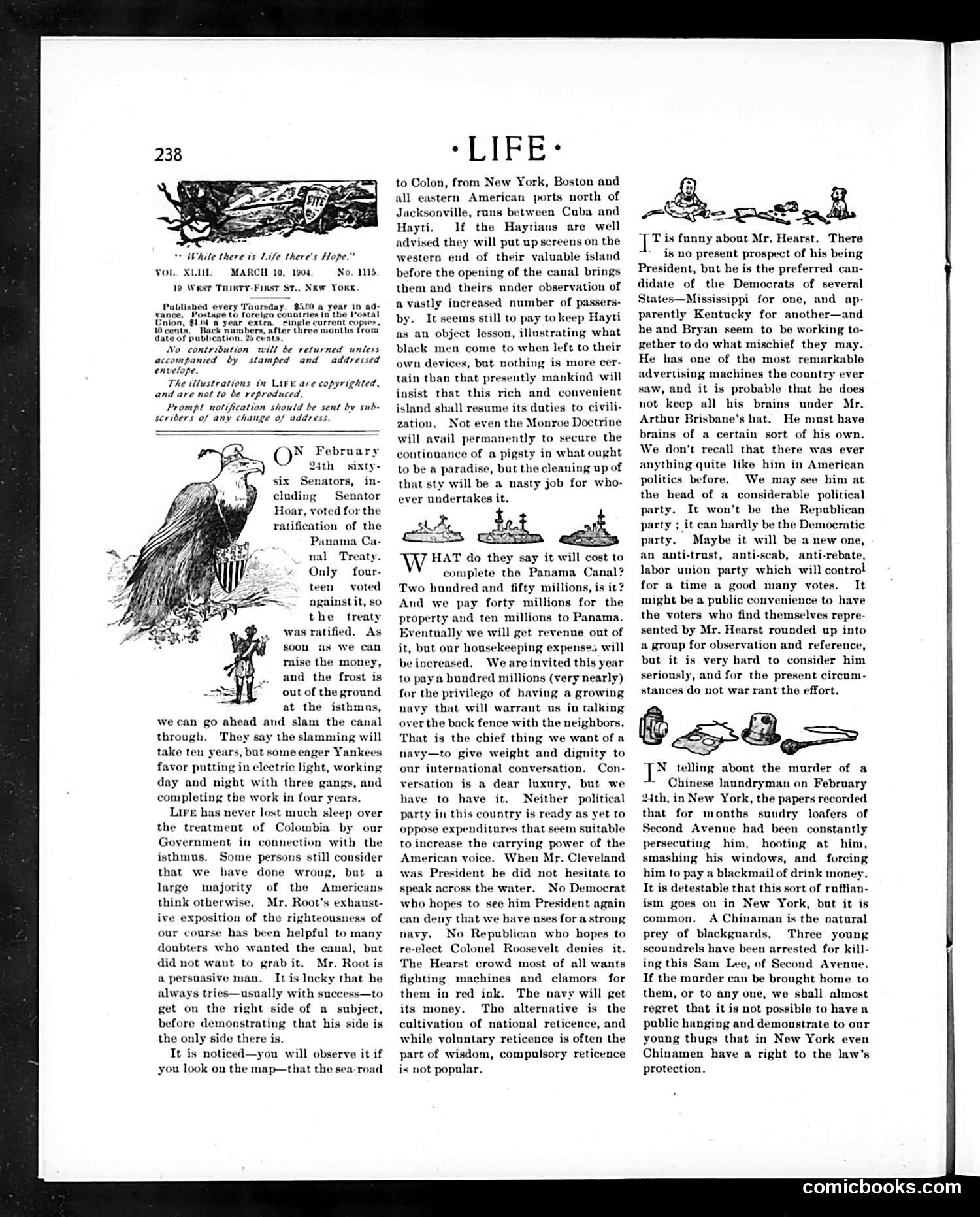
This page from Life magazine (dated March 19, 1903) contains political commentary rather than a traditional cartoon. The text discusses Mr. Hearst, the newspaper publisher, as a potential Democratic presidential candidate. The satirical point: Life mocks the idea that Hearst—despite his wealth and media influence—could unite the fractious Democratic Party or command respect as a serious presidential contender. The eagle illustration is decorative rather than satirical. The right column discusses a Chinese laundry murder in New York, reflecting period concerns about Chinese immigrant communities and urban crime. The Panama Canal discussion occupies much space, advocating for naval expansion as justification for the project's costs. The satire here targets Democratic opposition to such military spending.
📄 Transcribed text from this page (OCR, searchable)
Machine-transcribed from the original scan — historical spelling and the odd misread are preserved.
‘+ While there is Life there's Hope.” VoL. XLUL MARCH 10, 1908 19 Wrst Tainty-Finst St. Puoblisbed every Toursday $00 a year tn ad- vance, Postage to foreizo countries In the Postal Union, §1m a year extra, sing! es Rack harobers, after three months date of publication. 25 cats. No contribution will be returned untess accompanied by stamped and addressed envelope. The illustrations in Lie. ave copyrighted, and are not to be reproduced. Prompt notification should be sent by sub- scribers of any change of address. Toro C NN February 2th sixty- six Senators, in- cluding Senator Hoar, voted for the ratification of the Panama Ca- nal Treaty. Only four- teen voted against it, so the treaty was ratified. As soon as we can raise the money, and the frost is out of the ground at the isthmus, we can go ahead and slam the canal through. They say the slamming will take ten years, but some eager Yankees favor putting in electric light, working day and night with three gangs, and completing the work in four years. Lire has never lost much sleep over the treatment of Colombia by our Government in connection with the isthmus, Some persons still consider that we have done wrong, but a large majority of the Americans think otherwise. Mr. Root’s exhaust- ive exposition of the righteousness of our course has been helpfal to many doubters who wanted the canal, but did not want to grab it. Mr. Root is a persuasive man. It is lucky that he always tries—usually with success—to get on the right side of a subject, before demonstrating that his side is the only side there is. It is noticed—you will observe it if you look on the map—that the sea-road “EIFE* to Colon, from New York, Boston and all eastern American ports north of Jacksonville, rans between Cuba and Hayti. If the Haytiaus are well advised they will put up screens on the western end of their valuable island before the opening of the canal brings them and theirs under observation of a vastly increased number of passers- by. It seems still to pay tokeep Hayti as an object lesson, illustrating what black men come to when left to their own devices, but nothing is more cer- tain than that presently mankind will insist that this rich and convenient island shall resume its duties to civili- zation. Not even the Monroe Doctrine will avail permanently to secure the continuance of a pigsty in what ought to be a paradise, but the cleaning up of that sty will be a nasty job for who- ever undertakes it. W HAT do they say it will cost to complete the Panama Canal? Two hundred and fifty millions, is it? And we pay forty millions for the property and ten millions to Panama. Eventually we will get revenue out of it, but our housekeeping expenses will beincreased. We are invited this year to pay a hundred millions (very nearly) for the privilego of having a growing navy that will warrant us in talking over the back fence with the neighbors. That is the chief thing we want of a navy—to give weight and dignity to our international conversation. Con- versation is a dear luxury, but we have to have it. Neither political party in this country is ready as yet to oppose expenditures that seem suitable to increase the carrying power of the American voice. When Mr. Cleveland was President he did not hesitate to speak across the water. No Democrat who hopes to see him President again can deny that we have uses for a strong navy. No Republican who hopes to re-elect Colonel Roosevelt denies it. The Hearst crowd most of all wants fighting machines and clamors for them in red ink. The navy will get its money. The alternative is the cultivation of national reticence, and while voluntary reticence is often the part of wisdom, compulsory reticence is not popular. 8 Ed, “See ec wee ] T is fanny about Mr. Hearst. There is no present prospect of his being President, but he is the preferred can- didate of the Democrats of several States—Mississippi for one, and ap- parently Kentucky for another—and he and Bryan seem to be working to- gether to do what mischief they may. He has one of the most remarkable advertising machines the country ever saw, and it is probable that he does not keep all his brains under Mr. Arthur Brisbane’s hat. He must have brains of a certain sort of his own. We don't recall that there was ever anything quite like him in American politics before. We may see him at the head of a considerable political party. It won't be the Republican party ; it can hardly be the Democratic party. Maybe it will be a new one, an anti-trust, anti-scab, anti-rebate, labor union party which will control for a time a good many votes. It might be a public convenience to have the voters who find themselves repre- sented by Mr. Hearst rounded up into a group for observation and reference, bat it is very hard to consider him seriously, and for the present circam- stances do not war rant the effort. 68 = laundrymau on February 24th, in New York, the papers recorded that for months sundry loafers of Second Avenue had been constantly persecuting him, hooting at him, smashing his windows, and forcing him to pay a blackmail of drink money. It is detestable that this sort of ruffian- ism goes on in New York, but it is common. A Chinaman is the nataral prey of blackguards. Three young scoundrels have been arrested for kill- ing this Sam Lee, of Second Avenue. If the murder can be brought home to them, or to any one, we shall almost regret that it is not possible to havea public hanging and demonstrate to our young thugs that in New York even Chinamen have a right to the law’s protection. comicbooks.com