
Life, 1904-03-10 · page 3 of 20
Life — March 10, 1904 — page 3: what you’re looking at
What you’re looking at
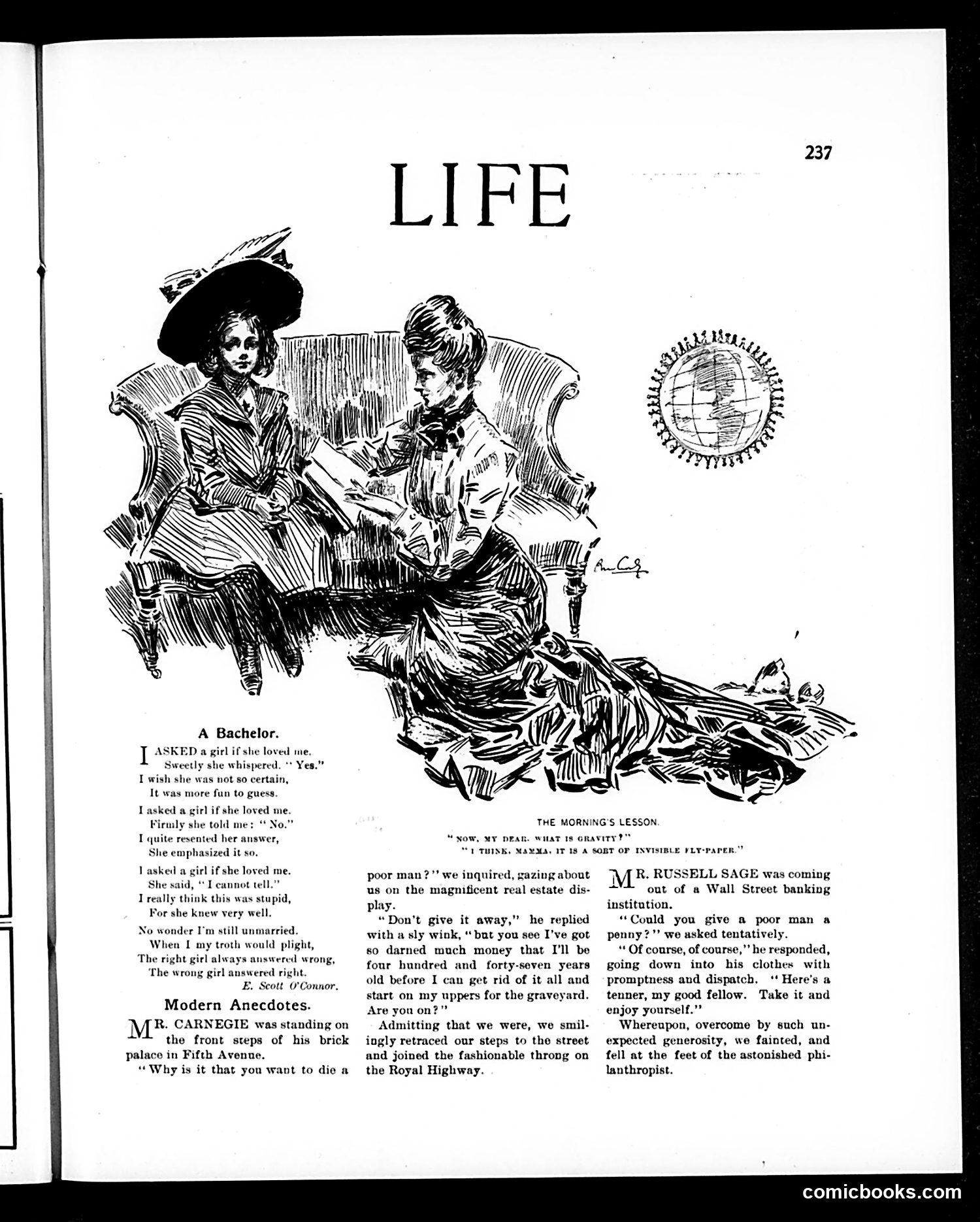
This page contains three distinct pieces of early 20th-century humor: **"A Bachelor"** is a poem about romantic rejection—a man asks three different girls if they love him, receiving inconsistent answers, leading him to conclude bachelorhood is preferable. **"Modern Anecdotes"** features a brief anecdote about Mr. Carnegie (likely Andrew Carnegie, the wealthy industrialist) standing at his brick palace on Fifth Avenue. Someone asks why he wants to build there—the joke's punchline is cut off but implies commentary on Carnegie's wealth and ostentatious real estate. **"The Morning's Lesson"** satirizes wealth disparity: wealthy people question whether they should give money to a poor man, ultimately deciding against it with various justifications. The illustration shows fashionably dressed women discussing the matter. The overall theme critiques both romantic uncertainty and economic inequality.
📄 Transcribed text from this page (OCR, searchable)
Machine-transcribed from the original scan — historical spelling and the odd misread are preserved.
A Bachelor. ASKED a girl if she lov he whispered, ** Y I wish she was not so certain, It was more fun to guess. Sweet: Tasked a girl if she loved me. Firuily she told me: “ No.” I quite resented her answer, She emphasized it so. irl if she loved me. For she knew very well. No wonder I'm still unmarried. When I my troth would plight, The right girl always answered wrong, ‘The wrong girl answered right. E. Scott O'Connor, Modern Anecdotes. M®. CARNEGIE was standing on the front steps of his brick palace in Fifth Avenue. “Why is it that you want to die a THE MORNING'S LESSON. “Now, MY DEAR. WHAT Is ORAVITY?™ “THINK, MAYMA, IT 18 A SOBT OP INVISIBLE PLY-PArER.”” poor man?’ we inquired, gazing about us on the magnificent real estate dis- play. “Don't give it away,” he replied with a sly wink, “ but you see I've got so darned much money that I'll be four hundred and forty-seven years old before I can get rid of it all and start on my uppers for the graveyard. Are you on?” Admitting that we were, we smil- ingly retraced our steps to the street and joined the fashionable throng on the Royal Highway. M® RUSSELL SAGE was coming * out of a Wall Street banking institution. “Could you give a poor man a penny ?’’ we asked tentatively. “ Of course, of course,” he responded, going down into his clothes with promptness and dispatch. ‘' Here's a tenner, my good fellow. Take it and enjoy yourself.”” Whereupon, overcome by such un- expected generosity, we fainted, and fell at the feet of the astonished phi- lanthropist. comicbooks.com