
Life, 1904-03-10 · page 7 of 20
Life — March 10, 1904 — page 7: what you’re looking at
What you’re looking at
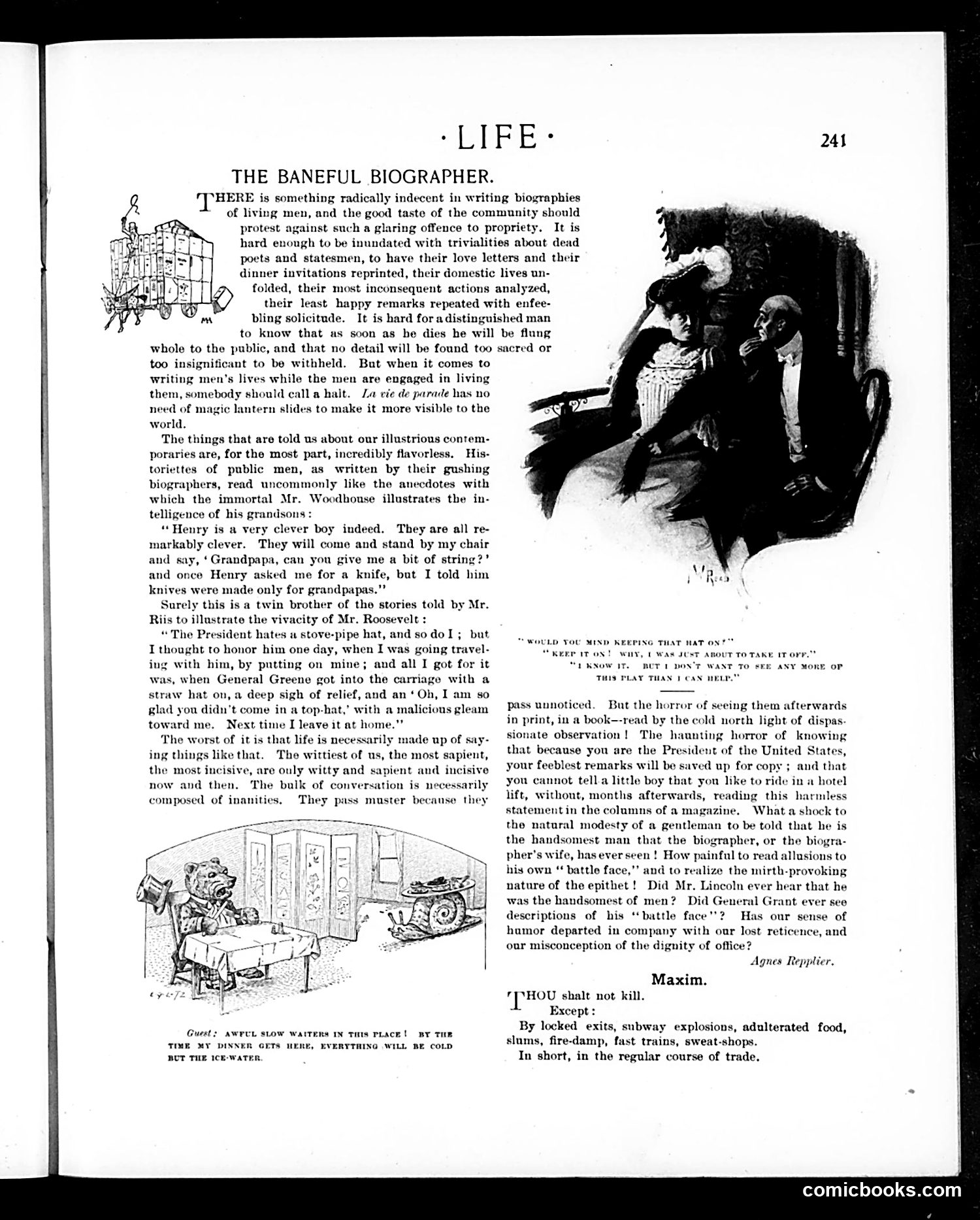
This satirical essay attacks biographers who write embarrassing details about living public figures. The author protests against publishing "love letters," "domestic lives unfolded," and "most inconsequent actions" of prominent men—violating their privacy in the name of biography. The accompanying cartoon illustrates the problem: a biographer appears to be extracting intimate or unflattering information from a reluctant subject. The text includes anecdotes mocking this practice, such as a story about President Theodore Roosevelt allegedly being asked by his grandson for string or a knife "because knives were made only for grandpapas"—the kind of trivial, undignified domestic detail that biographers supposedly published. The piece satirizes how such biographical intrusions destroy public figures' dignity and privacy.
📄 Transcribed text from this page (OCR, searchable)
Machine-transcribed from the original scan — historical spelling and the odd misread are preserved.
“HIRE THE BANEFUL BIOGRAPHER. (IT BERE is something radically indecent in writing biographies of living men, and the good taste of the community should protest against such a glaring offence to propriety. It is hard enough to be inundated with trivialities about dead poets and statesmen, to have their love letters and their dinner invitations reprinted, their domestic lives un- folded, their most inconsequent actions analyzed, their least happy remarks repeated with enfee- bling solicitude. It is hard for adistinguished man to know that as soon as he dies he will be flung whole to the public, and that no detail will be found too sacred or too insignificant to be withheld. But when it comes to writing men’s lives while the men are engaged in living them, somebody should call a halt. La vie de parade has no need of magic lantern slides to make it more visible to the world. The things that are told us about our illustrious contem- poraries are, for the most part, incredibly flavorless, His- toriettes of public men, as written by their gushing biographers, read uncommonly like the anecdotes with which the immortal Mr. Woodhouse illustrates the in- telligence of his grandsons: “Henry is a very clever boy indeed. They are all re- markably clever. They will come and stand by my chair and say, ‘Grandpapa, can you give me a bit of string?’ ked me for a knife, but I told him knives were made only for grandpapas.”” Surely this is a twin brother of the stories told by Mr. Riis to illustrate the vivacity of Mr. Roosevelt : “The President hates a stove-pipe hat, and so doI; but . t d LD YOU MIND KEEPING THAT HAT ON? I thought to honor him one day, when I was going travel- REEP it ON! Way, tas ster Amour To take irc iug with him, by putting on mine; and all I got for it “2 KNOW IT. RUT 1 DON'T WANT TO EE ANY MOI was, when General Greene got into the carriage with a THI9 PLAY THAN 1 CAN HELD.” straw hat on, a deep sigh of relief, and an ‘Oh, I am so glad you didn’t come in a top-hat,’ with a malicious gleam toward me. Next time I leave it at home. The worst of it is that life is necessarily made up of say- ing things likethat. The wittiest of us, the most say the most incisive, are ouly witty and s now and then. The bulk of conversation is necess: composed of inanities. They pass muster because they pass unnoticed. But the horror of seeing them afterwards in print, in a book—-read by the cold north light of dispas- sionate observation! The haunting horror of knowing that because you are the President of the United States, your feeblest remarks will be saved up for copy ; and that you cannot tella little boy that you like to ride in a hotel lift, without, months afterwards, reading this harmless statementin the columns of a magazine, What a shock to the natural modesty of a gentleman to be told that he is the handsomest man that the biographer, or the biogra- pher’s wife, has ever seen ! How painful to read allusions to his own “ battle face,”’ and to realize the mirth-provoking nature of the epithet !_ Did Mr. Lincoln ever hear that he was the handsomest of men? Did General Grant ever see descriptions of his ‘battle face’’? Has our sense of humor departed in company with our lost reticence, and our misconception of the dignity of office? Agnes Repplier. Maxim. ‘HOU shalt not kill. Except: Buses Goeeen atowsetinenatutieduecavelt Sess 1 BY locked exits, subway explosions, adulterated food, TOME XY DINNER GETS MERE, EVERYTRING WILL BE COLD slums, fire-damp, fast trains, sweat-shops. BUT THE 1CE-WATER. In short, in the regular course of trade. comicbooks.com