
A complete issue · 28 pages · 1903
Life — July 23, 1903
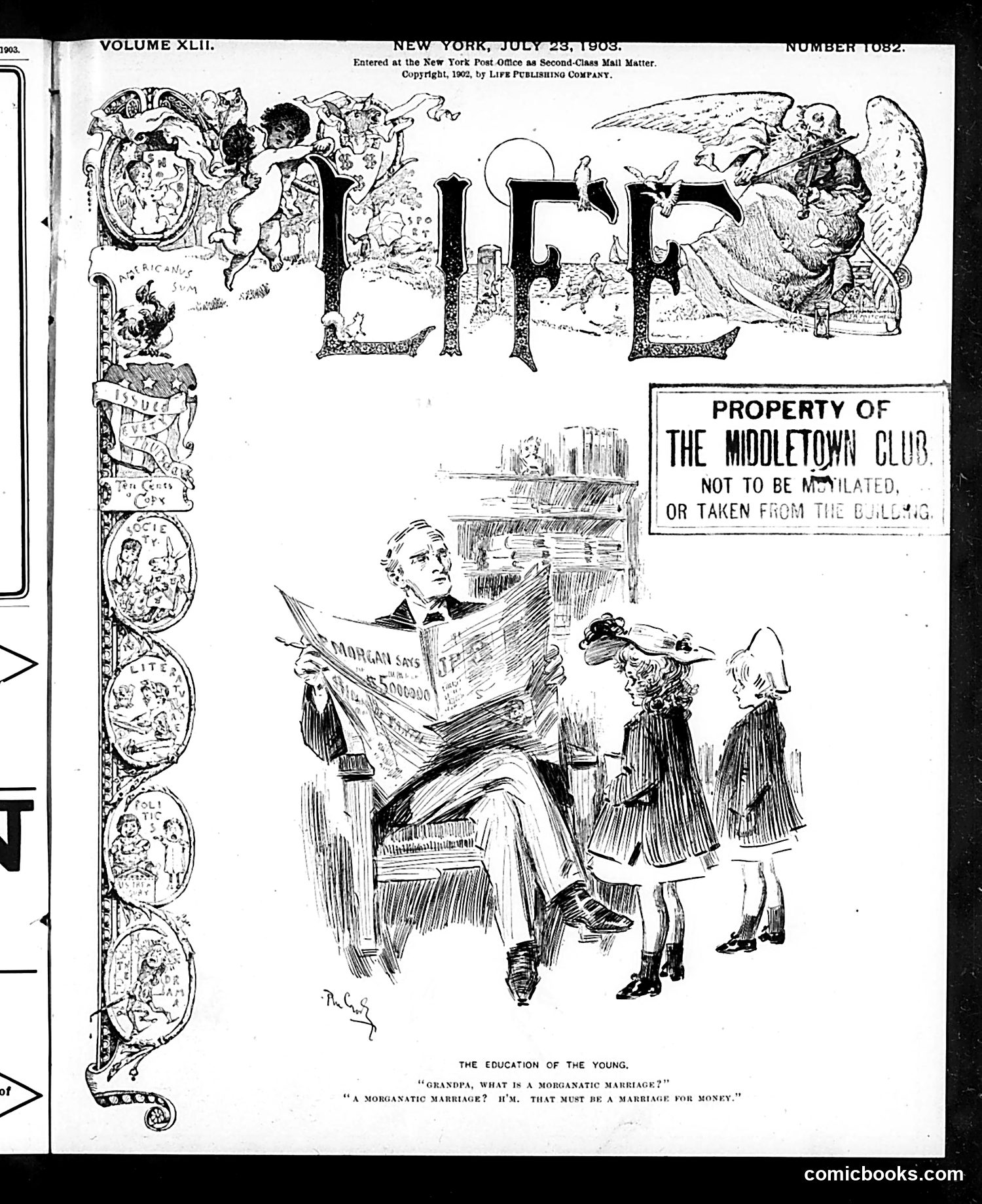
This satirical cartoon titled "The Education of the Young" depicts a well-dressed man reading a newspaper to three children, illustrating the caption's cynical dialogue about marriage. The grandfather figure is teaching the young about "morganatic marriage"—a historical term for marriage between people of unequal social rank. His statement that such a marriage "must be a marriage for money" suggests contemporary anxieties about wealthy families and class mobility. The satire appears directed at Gilded Age social attitudes, where financial considerations dominated marital decisions among the upper classes. The image critiques how parents transmitted materialistic values to children, portraying wealth as the primary qualification for marriage across social boundaries—a pointed commentary on early 1900s American society's mercenary approach to matrimony.
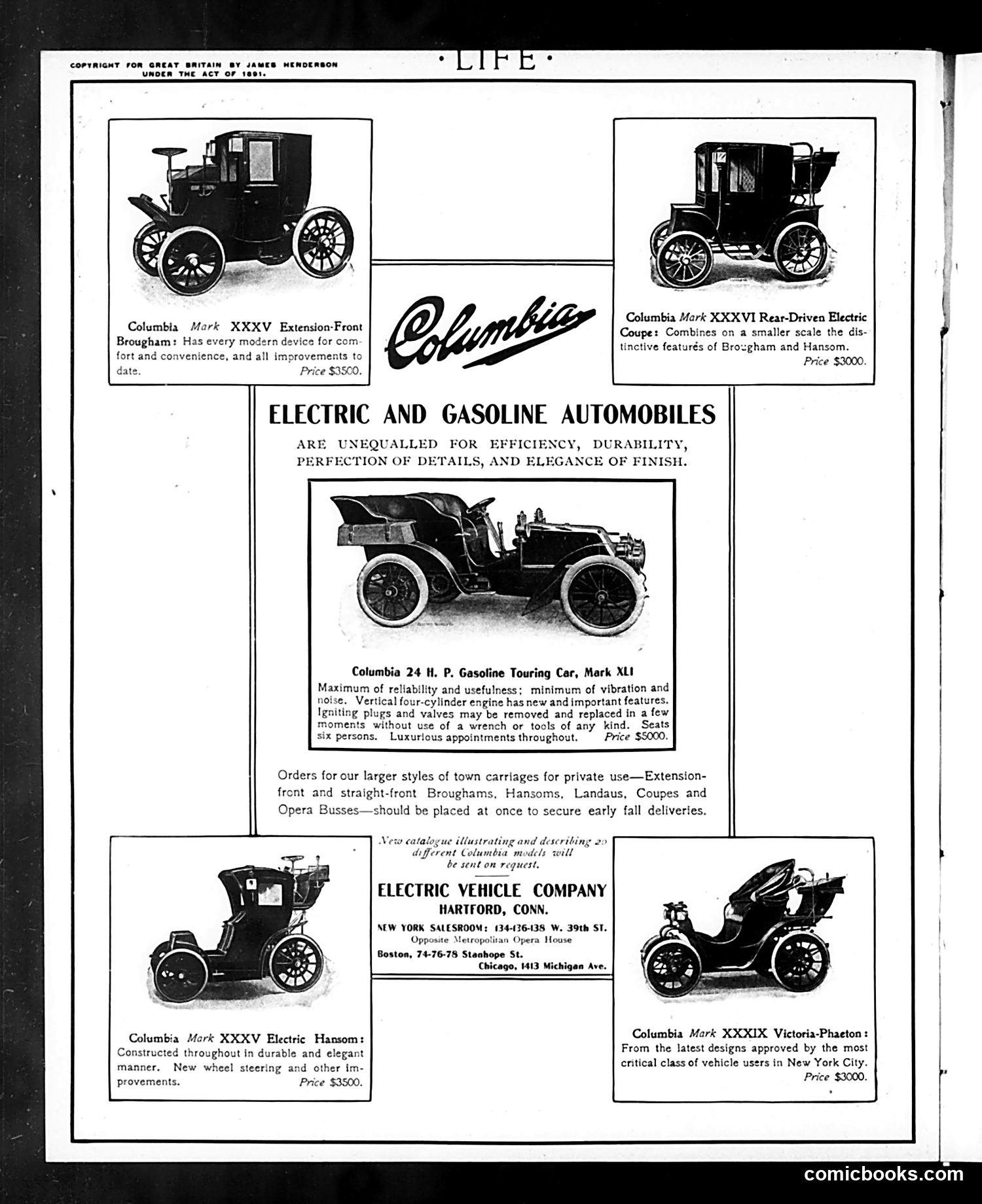
This page is **not a cartoon or satire** — it is a straightforward **automobile advertisement** for Columbia brand vehicles, published in *Life* magazine. The page showcases five different Columbia models: two electric broughams, one gasoline touring car, one electric hansom, and one electric victoria-phaeton. Each includes specifications, features, and prices (ranging from $3,000 to $5,000). The central text emphasizes that Columbia automobiles offer "efficiency, durability, perfection of details, and elegance of finish," comparing electric and gasoline options. The company's headquarters was in Hartford, Connecticut, with salesrooms in New York, Boston, and Chicago. This represents early 1900s automotive marketing, when electric vehicles competed seriously with gasoline cars before eventually losing market dominance.
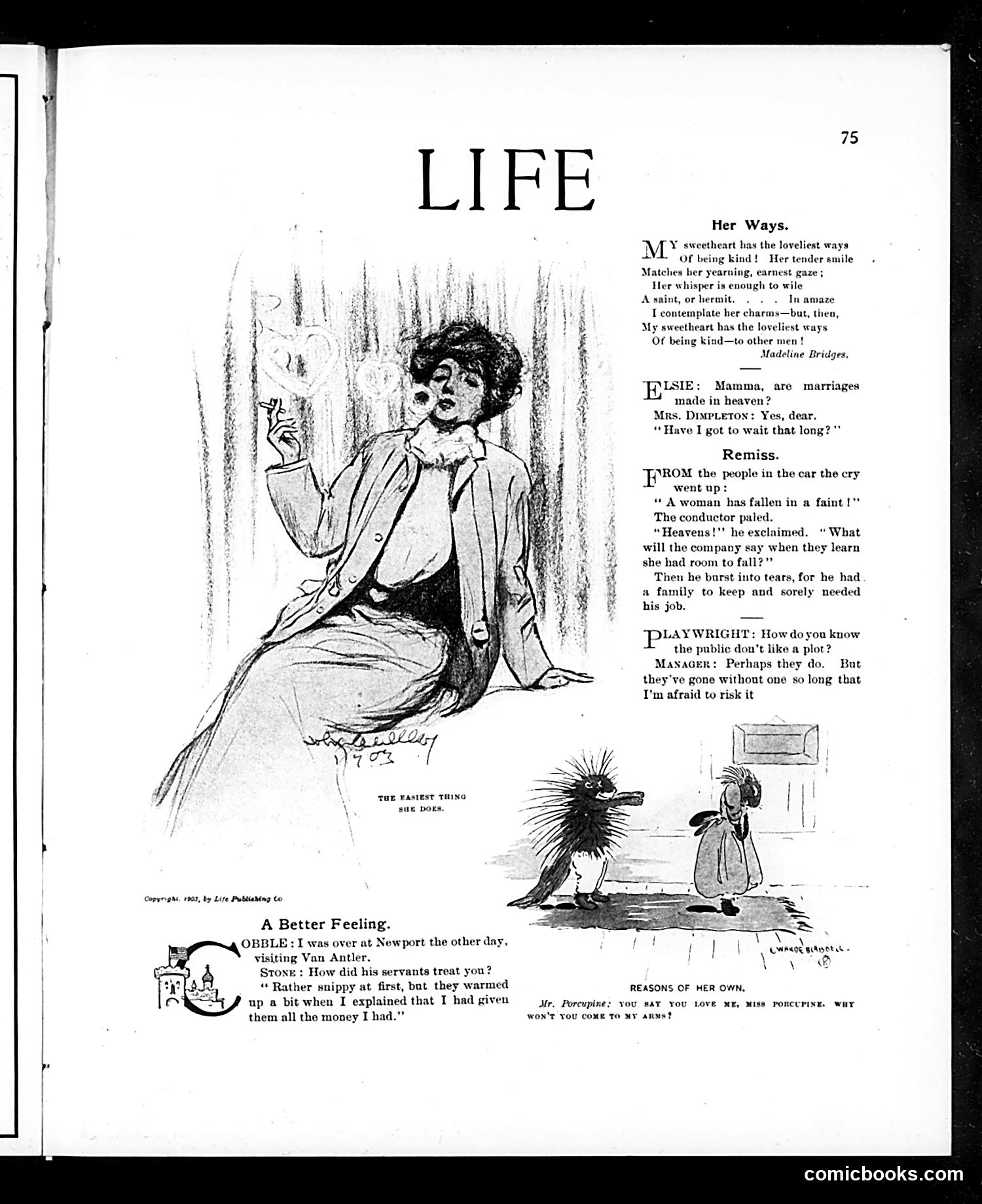
This page from Life magazine (copyright 1903) contains humor pieces and illustrations typical of early 1900s satirical journalism. **"Her Ways"** presents a poem by Madeline Bridges about a sweetheart's kindness, contrasted with a dialogue between Elsie and Mrs. Dimpleton discussing marriages made in heaven. **"Remiss"** jokes about a woman fainting on a streetcar and a conductor's awkward response to the situation. **"A Better Feeling"** depicts a conversation where Stone visits Van Antler and humorously explains that Van Antler's servants initially treated him coldly until discovering he'd paid them money. The illustrations show typical domestic and social scenarios of the era. The humor relies on period-specific social conventions—etiquette, class distinctions, and gender roles—rather than political commentary. The cartoons satirize everyday social interactions and human nature rather than specific public figures or events.
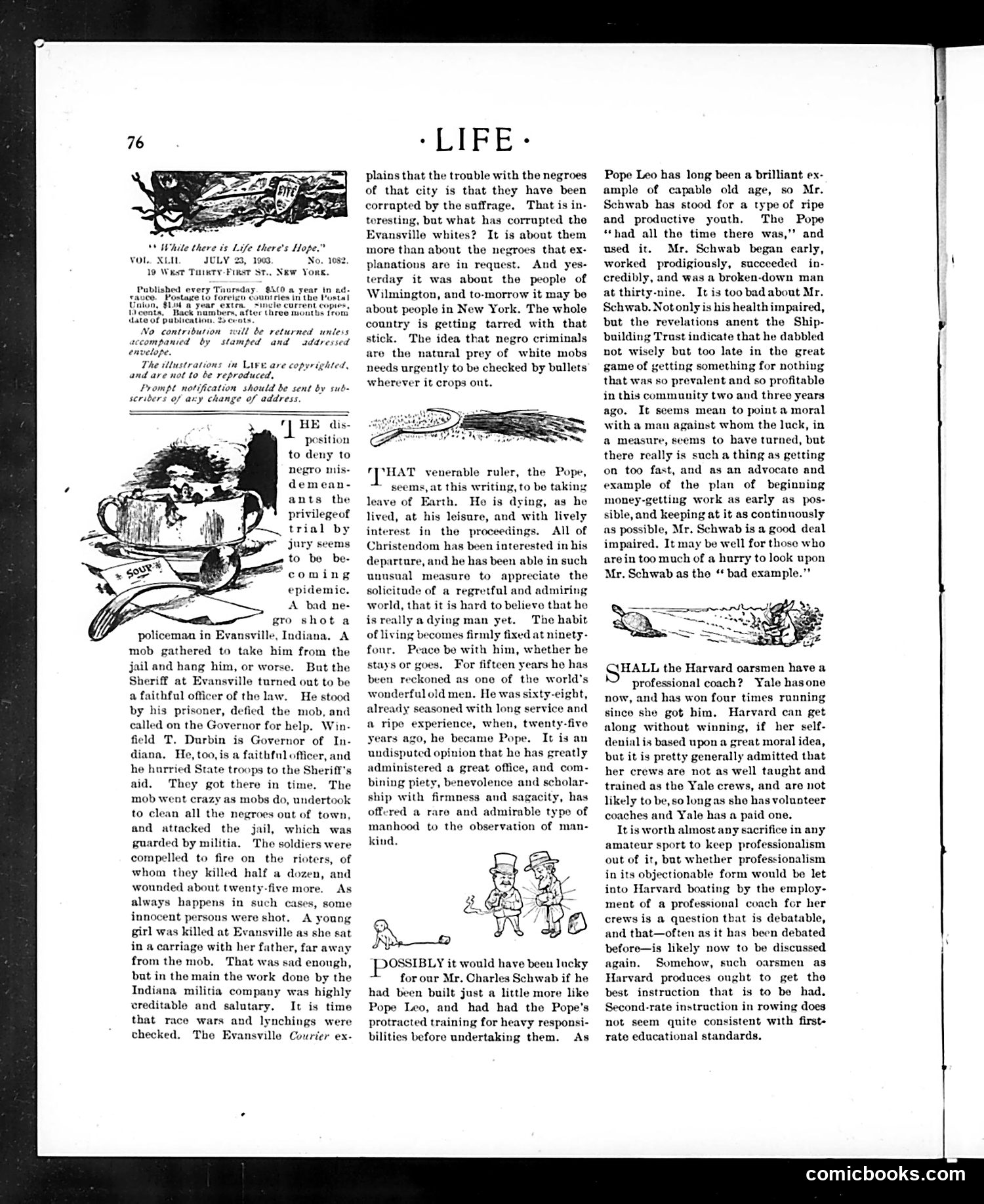
This page contains three distinct editorial cartoons satirizing early 1900s American social issues: 1. **Top cartoon**: Depicts a policeman in Evansville, Indiana during a mob lynching. The text describes how a sheriff was killed by a mob, then the mob murdered innocent people. The cartoon mocks the failure of law enforcement to prevent racial violence. 2. **Middle cartoon**: Shows a figure labeled "SOUP" in what appears to be a commentary on charitable or political corruption—though the specific reference is unclear without additional context. 3. **Bottom section**: Discusses whether Harvard should hire a professional rowing coach, debating whether professionalism compromises amateur sport ideals. The page reflects Life's tradition of satirizing American racial violence, corruption, and institutional hypocrisy during this era.
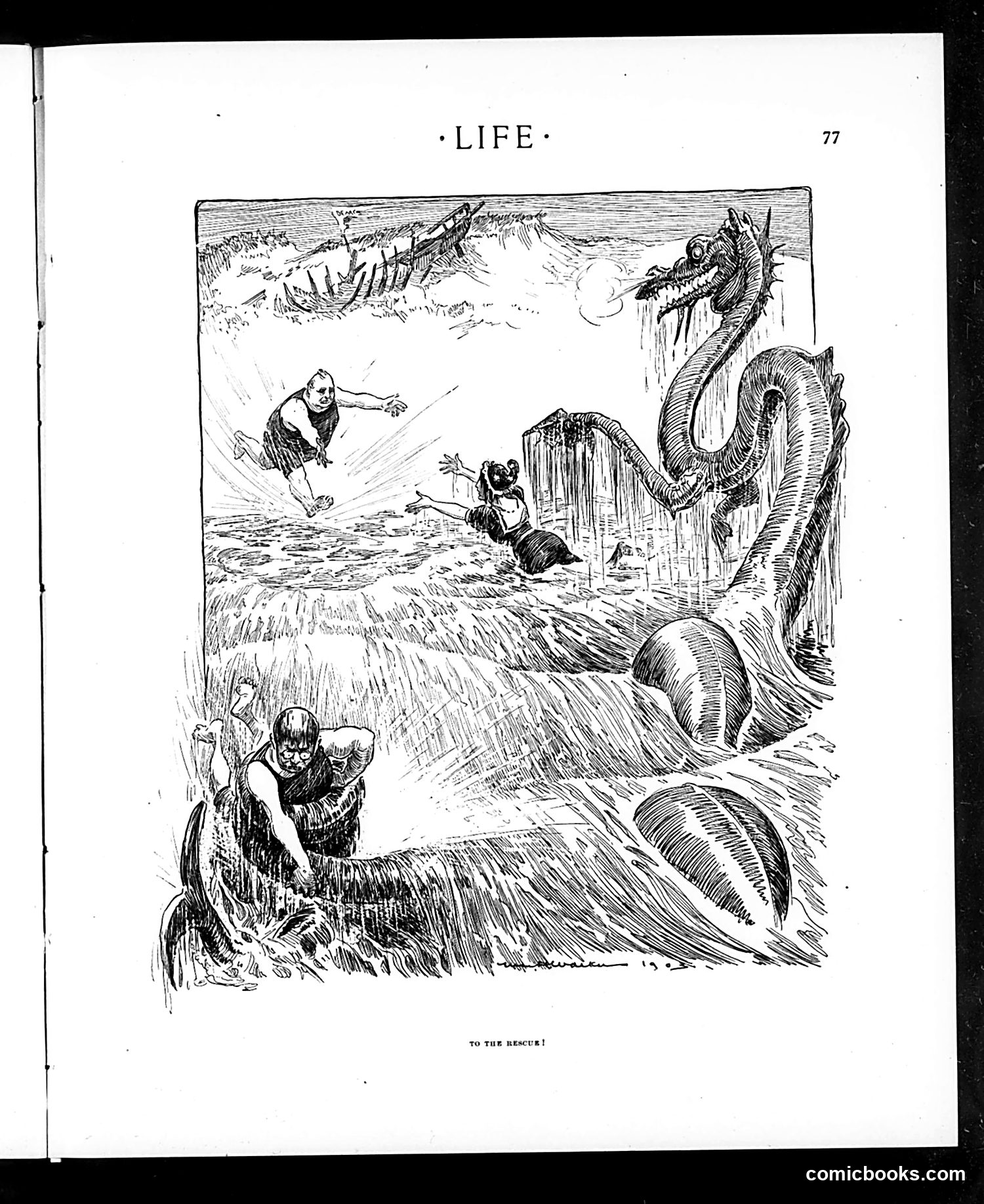
This cartoon depicts a fantastical sea rescue scene. Two figures appear to be swimming or struggling in turbulent water near a beach, while a third person stands on shore gesturing. The dramatic focal point is a large dragon-like sea creature emerging from the water on the right side. The caption "TO THE RESCUE!" suggests ironic commentary—the creature that would normally represent danger is positioned as if coming to help. Without additional context about specific 1920s events or political figures this references, the exact satire remains unclear. It may comment on unexpected alliances, questionable sources of aid, or the absurdity of relying on dangerous forces for assistance. The surreal style is characteristic of Life magazine's humorous editorial cartoons.
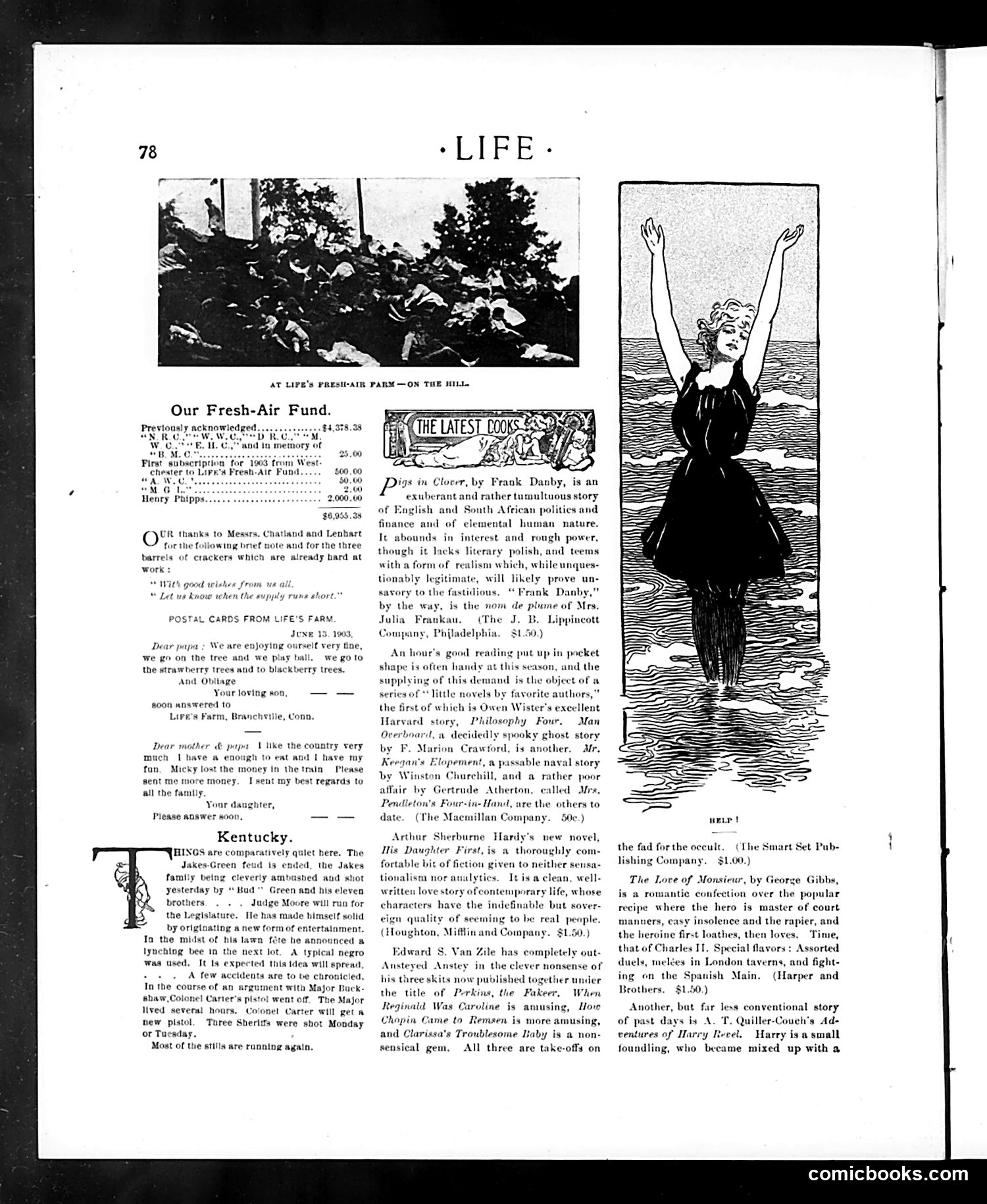
This page contains book reviews rather than political cartoons. The prominent illustration shows a woman in a swimming costume with raised arms, likely accompanying a review of books suitable for summer leisure reading. The text reviews several novels, including works by Frank Danby and Owen Winter. There's a section on "Kentucky" discussing entertainment and social events, mentioning a "typical negro" performance and references to Colonel Carter and various sheriffs. The "Fresh-Air Fund" section at top left documents charitable contributions for sending children to a farm, with postal cards from farm visitors describing their experience. The overall page reflects early 20th-century Life magazine content: literary coverage, social reporting, and philanthropic initiatives, rather than pointed political satire.
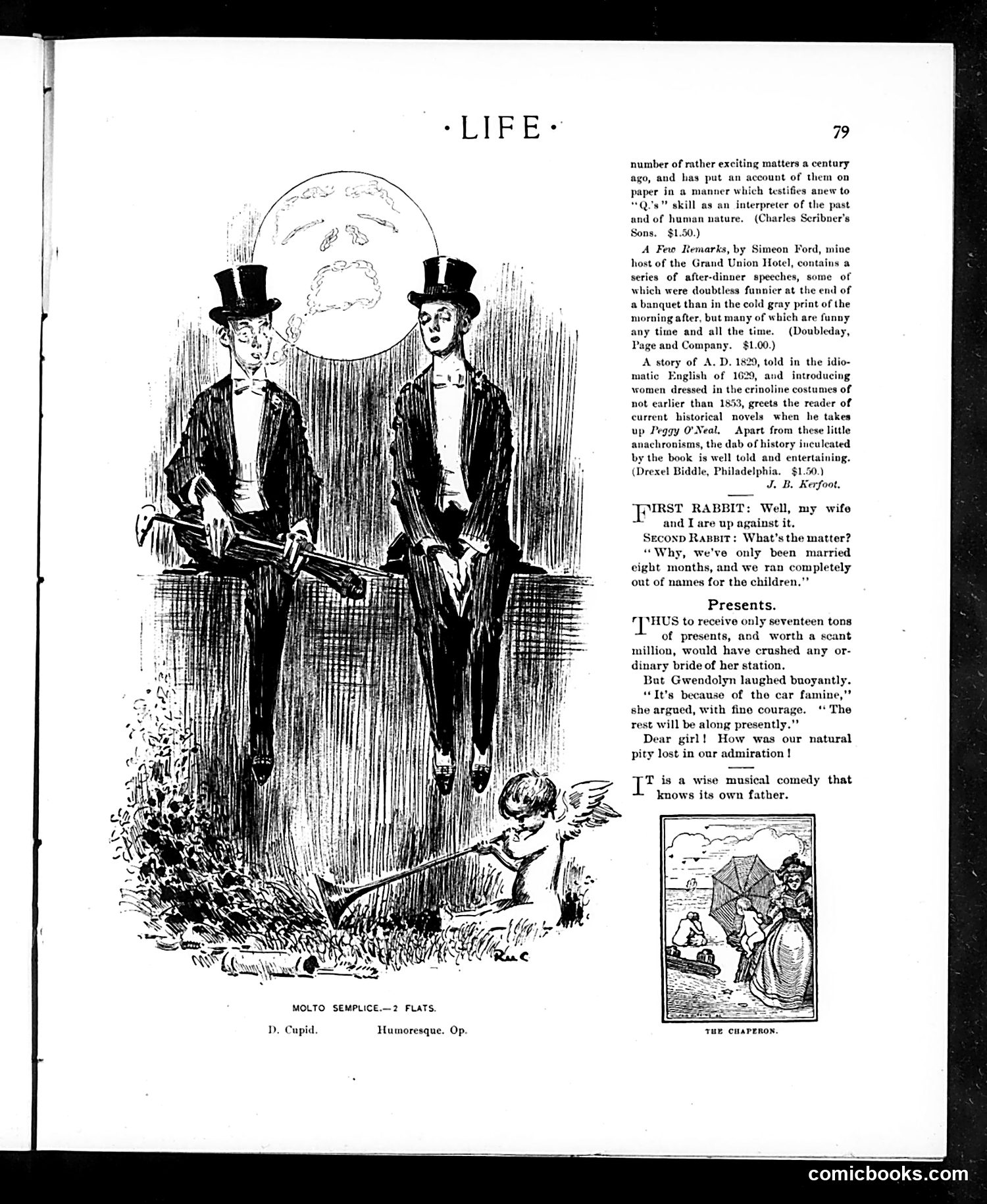
The main cartoon, titled "MOLTO SEMPLICE—2 FLATS" (a musical term meaning "very simply—two flats"), depicts two well-dressed men in top hats standing before a large moon, with a small cupid figure below. The joke appears to be a visual pun on musical terminology. "Two flats" in music refers to the key signature, but the cartoon's title suggests a play on words—likely about residential apartments ("flats"). The cupid and romantic setting suggest this is satirizing something about relationships or marriage, though the specific target is unclear without additional context. The right page contains book reviews and a brief dialogue between two rabbits about being "only been married eight months," suggesting domestic humor was a recurring theme in this issue.
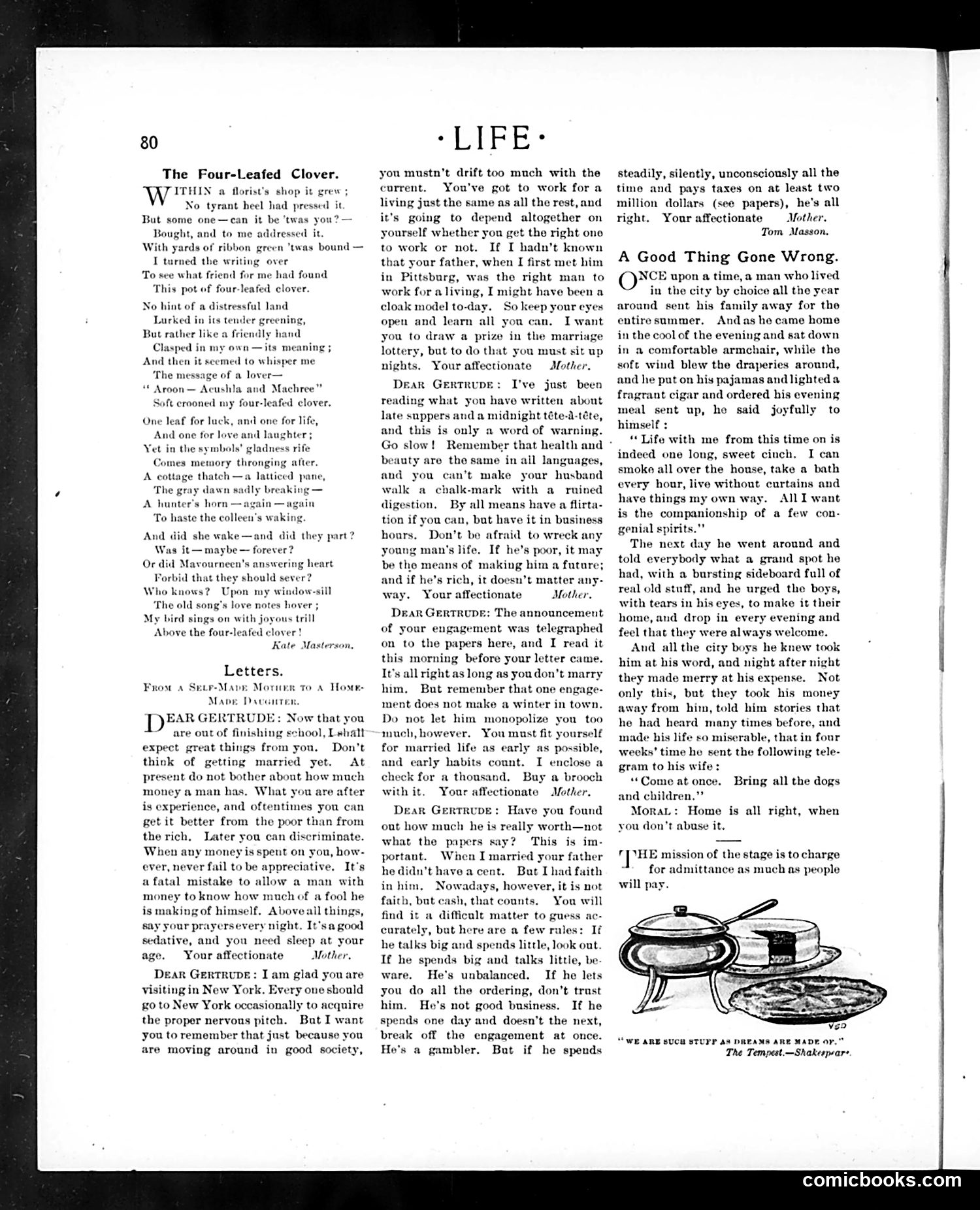
This page contains two distinct sections: a poem titled "The Four-Leaved Clover" and a "Letters" section offering advice to readers. The cartoon at the bottom depicts cookware (pots and pans) with the caption "WE ARE SUCH STUFF AS DREAMS ARE MADE OF"—a Shakespeare quote from *The Tempest*. The visual joke appears to be a pun: treating mundane kitchen items as if they were subjects worthy of philosophical contemplation, mocking the pretentiousness of applying high literary language to everyday domestic objects. This satirizes both overwrought sentimentality and the gap between elevated rhetoric and humble reality—typical of Life magazine's gentle satirical approach to American society and culture.
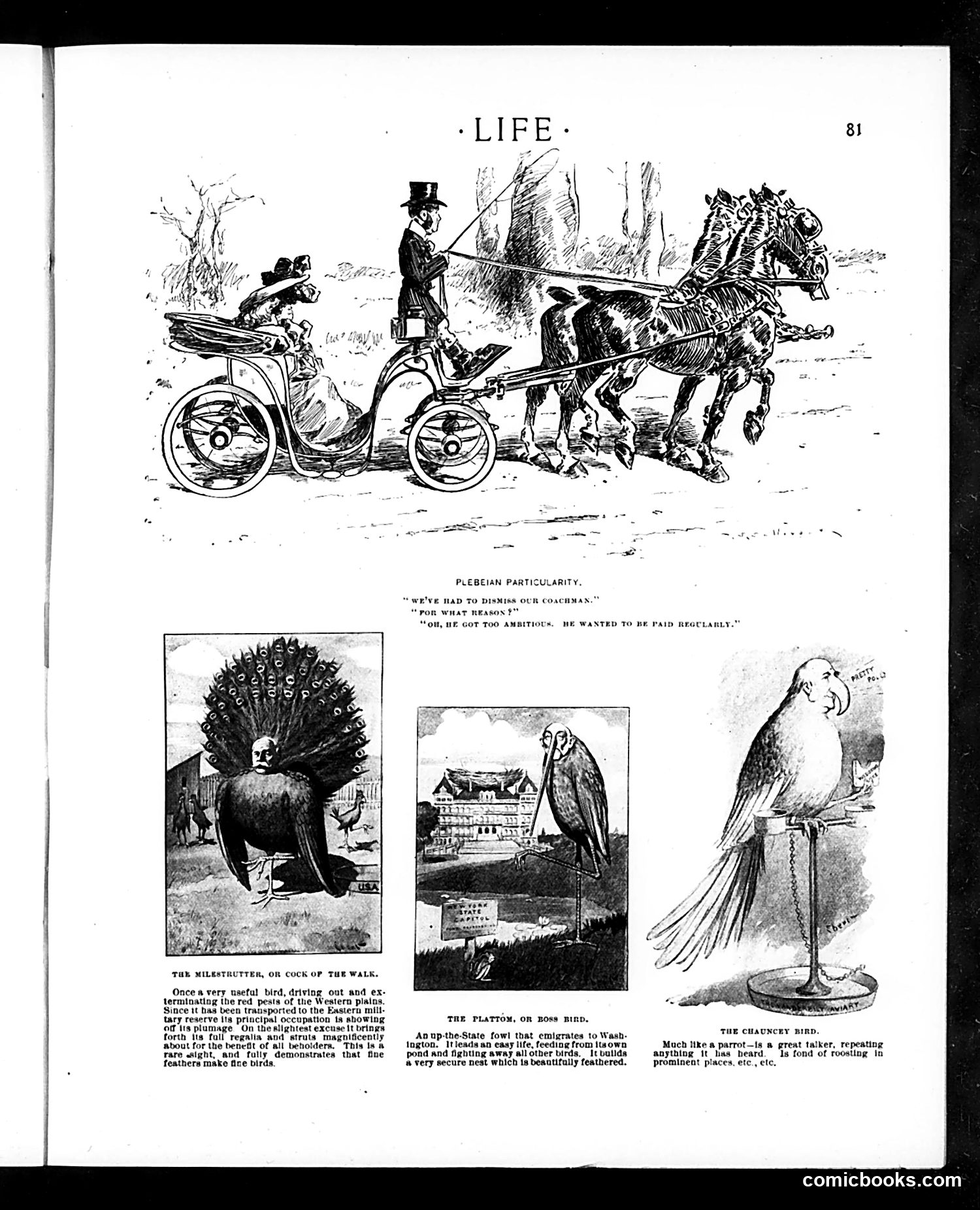
This Life magazine page satirizes social pretension through the story of a dismissed coachman. The top cartoon shows a wealthy gentleman in a carriage pulled by horses, representing upper-class transportation and status. The title "Plebeian Particularity" mocks the coachman's complaint that he wanted "regular" pay—suggesting working-class people are oddly fussy about reasonable wages. The joke targets both class attitudes: the employer's dismissal for the coachman's reasonable demands, and the irony that such modest expectations are labeled "ambitious." The three bird illustrations below appear unrelated editorial content about British fauna (the Milestrutter/Wall cock, Platoon/Ross bird, and Chauncey bird), typical of Life's miscellaneous satirical format.
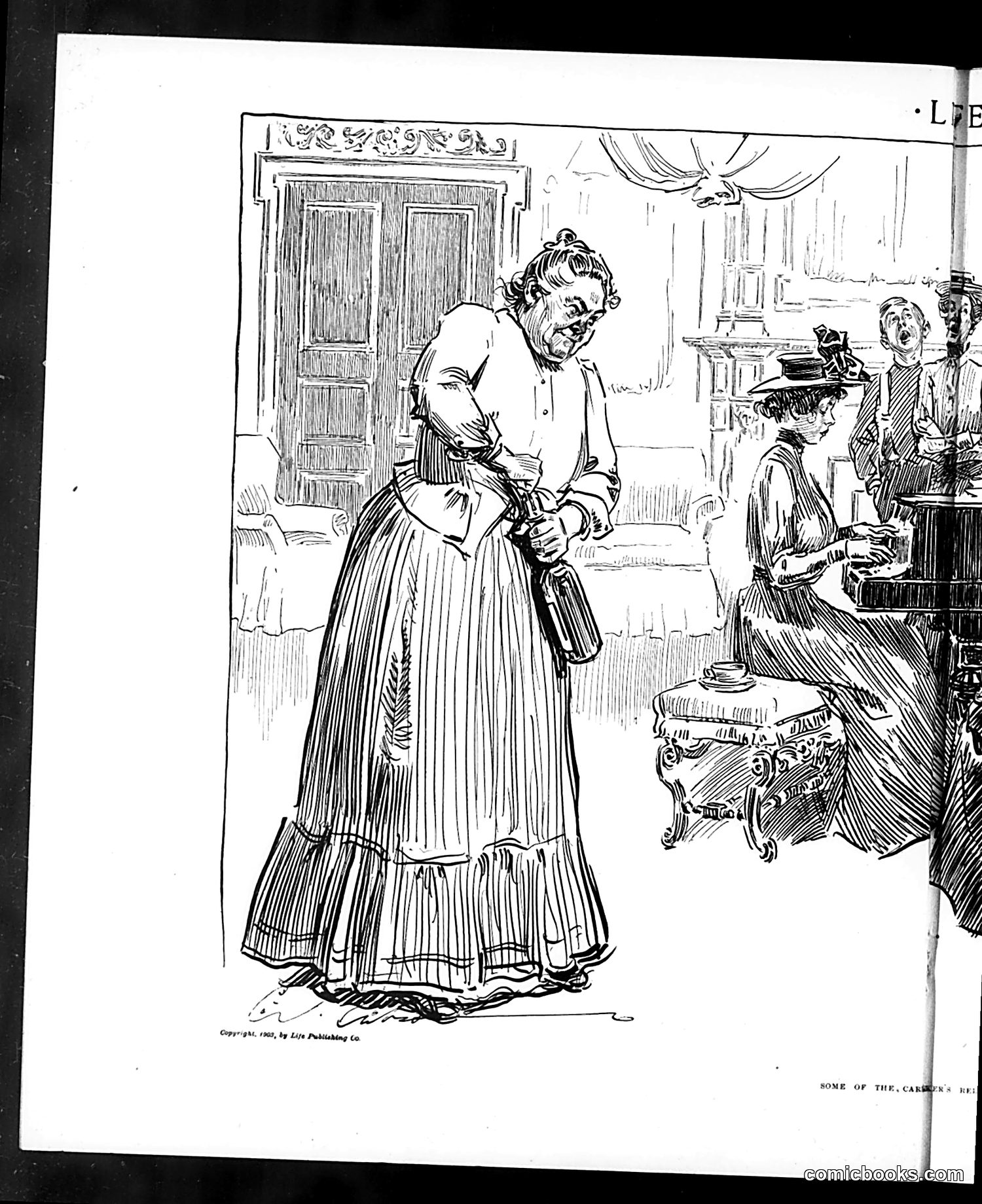
This is a satirical illustration from *Life* magazine showing a woman in Victorian-era dress holding what appears to be a bottle, surrounded by onlookers in an interior setting. Based on the visual composition and the woman's exaggerated facial expression and posture, this appears to be social satire about female behavior or morality—likely targeting either: 1. Women's drinking habits (a temperance-related jab), or 2. A commentary on feminine propriety and social expectations The shocked reactions of the background figures suggest the woman is doing something scandalous or inappropriate by period standards. Without the complete caption or article text visible, the specific target remains unclear, though the illustration's style and *Life*'s known focus on social commentary suggests this mocks either women's liberation movements or violations of Victorian decorum.
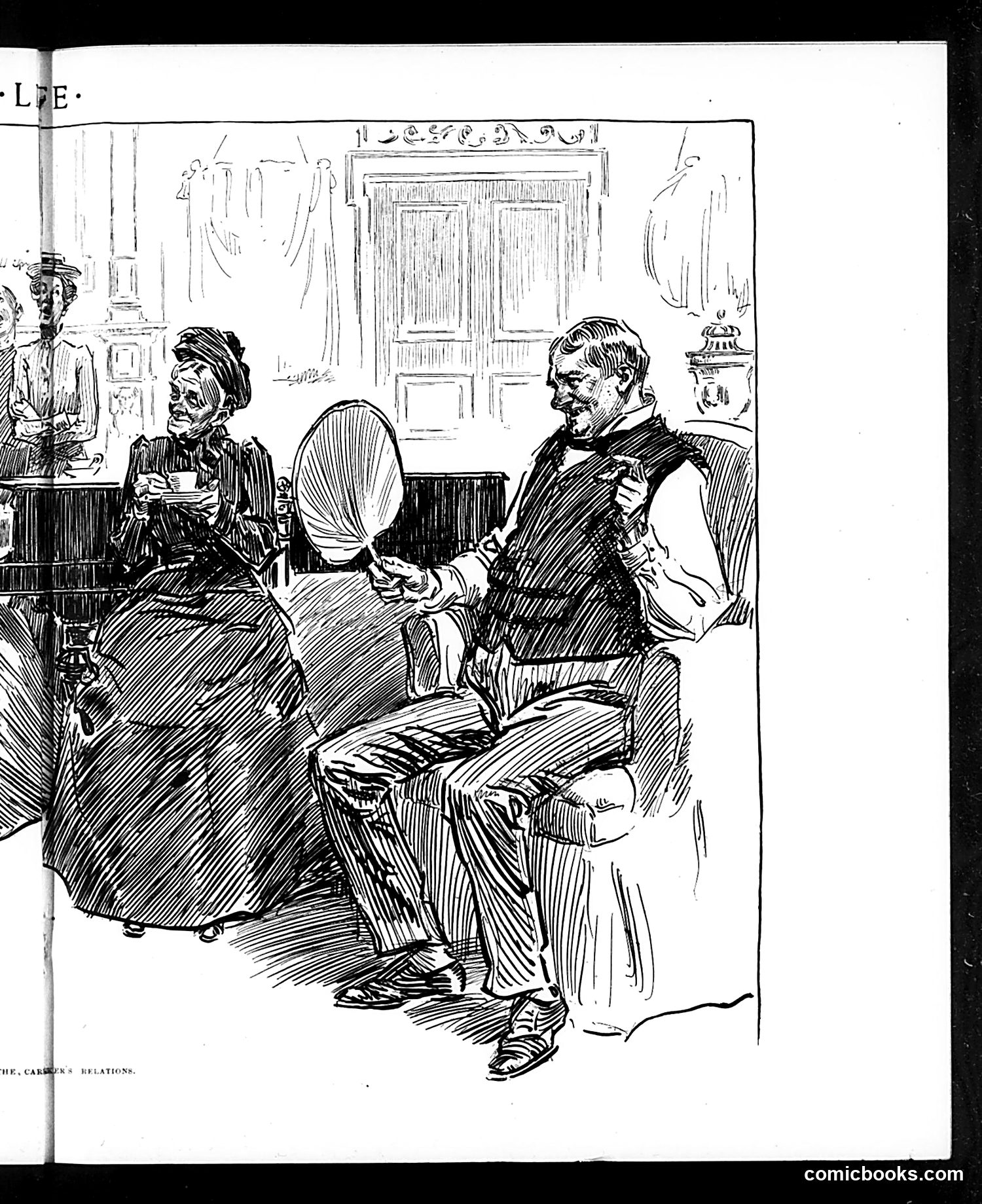
This sketch appears to depict a domestic or social scene in an elegant interior, showing several figures in conversation. A man in a vest sits prominently in the foreground, while women in period dress (appearing to be late 19th or early 20th century based on the styling) are positioned around him. One woman's face is obscured by her bonnet. The partial text visible at bottom reads "...RELATIONS," suggesting this relates to social or domestic relationships—a common satirical subject for Life magazine during this era. However, without clearer text or identifying captions, I cannot definitively identify the specific figures, historical event, or satirical point being made. The cartoon likely mocked contemporary social conventions or a notable scandal, but the precise reference remains unclear from this image alone.
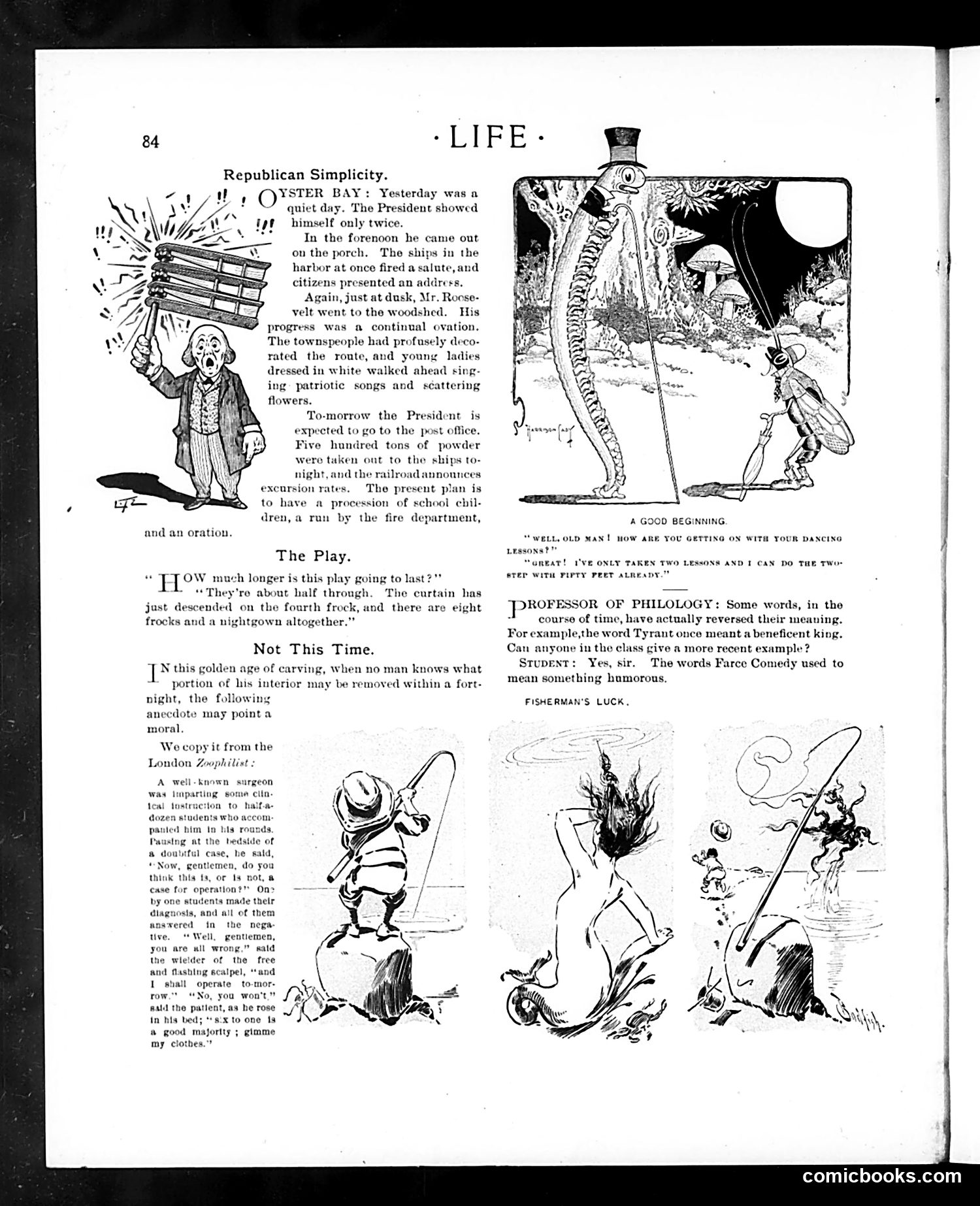
**"Republican Simplicity"** satirizes President Theodore Roosevelt's public relations during an Oyster Bay vacation. The cartoon depicts a figure holding dynamite labeled with exclamation marks—a visual pun on Roosevelt's energetic, explosive personality and his reputation for aggressive "Big Stick" diplomacy. The text mockingly describes how the President's simple day involved ships firing salutes, decorated townspeople, and continuous celebration, suggesting that even his attempts at quiet relaxation generated spectacle and chaos. **"A Good Beginning"** shows a dancing instructor teaching someone to dance on a serpent or rope—apparently a visual joke about attempting an impossible or ridiculous task. The remaining items ("The Play," "Not This Time," "Professor of Philology," "Fisherman's Luck") are separate humorous anecdotes and sketches typical of *Life*'s satirical content.
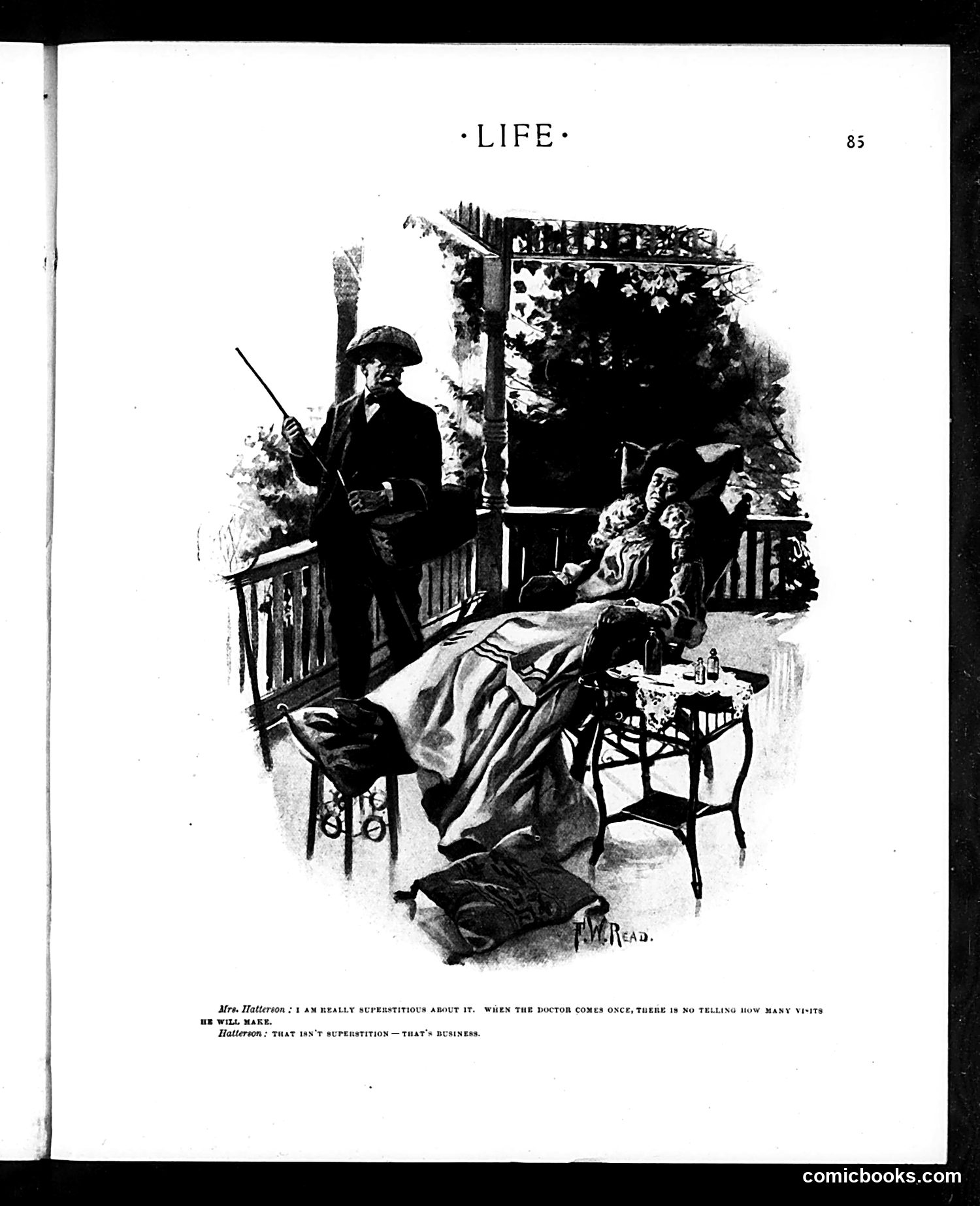
This cartoon satirizes superstitious beliefs about medical care. Mrs. Hatterton expresses anxiety about a doctor's visit, claiming superstition predicts multiple visits once the doctor arrives—suggesting she fears being locked into unnecessary medical treatment. Mr. Hatterton responds pragmatically: superstition isn't the issue; doctors' repeated visits are simply "business"—implying physicians profit from repeat appointments regardless of actual medical necessity. The satire targets two groups: wealthy patients' irrational superstitions about healthcare, and doctors' reputation (in this era) for excessive billing and unnecessary follow-up visits. The humor relies on Hatterton's blunt acknowledgment that medical practice was partly a commercial enterprise exploiting patient vulnerability. This reflects early 20th-century skepticism about medical professionalism and costs.
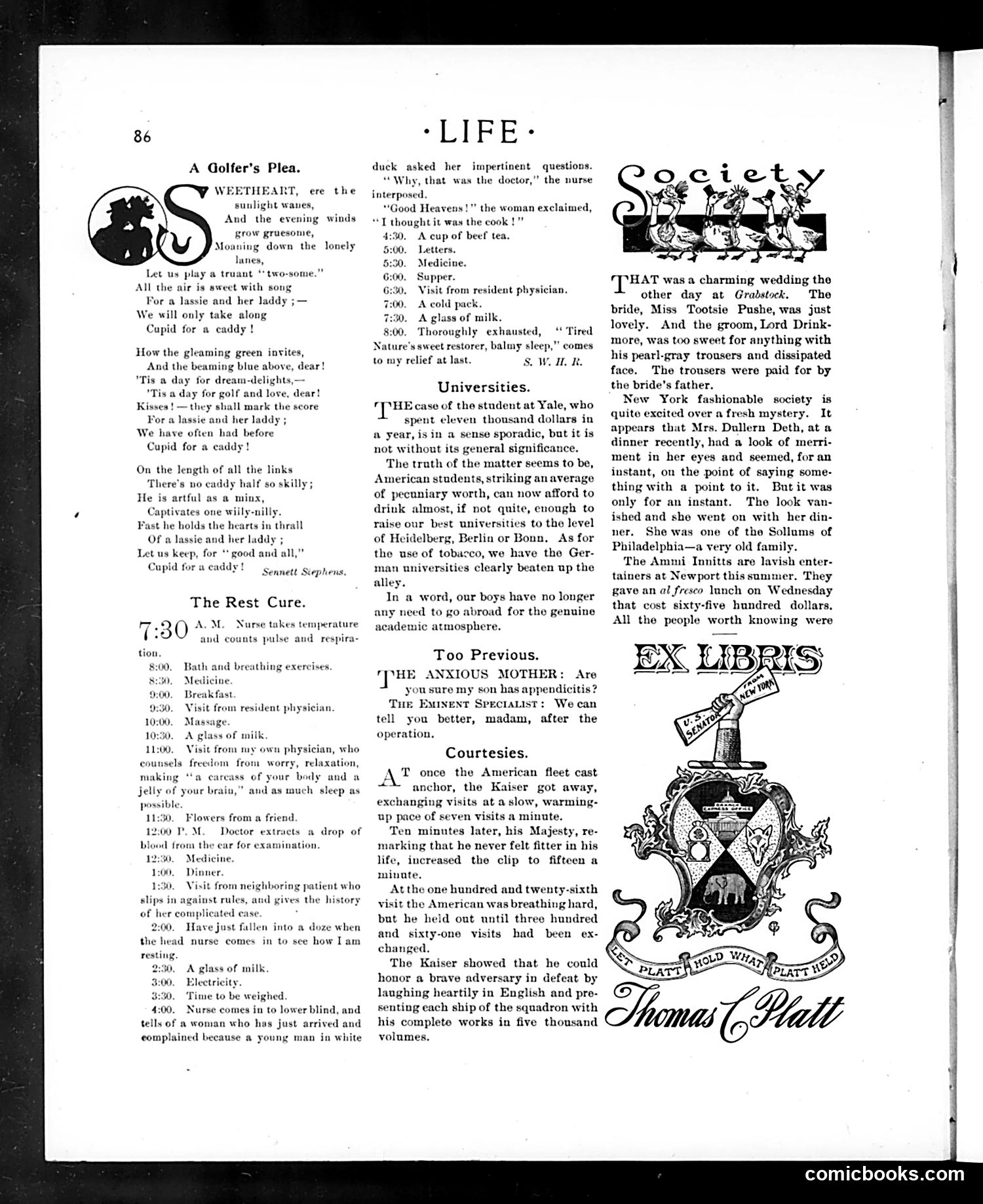
This page contains three distinct pieces of satirical content: **"A Golfer's Plea"** (poem): A romantic verse encouraging a suitor to abandon golf and instead spend time with his beloved, humorously positioning Cupid as a "caddy" (golf assistant). The satire gently mocks the sport's obsessive appeal to gentlemen. **"The Rest Cure"** (schedule): A detailed timeline of a patient's therapeutic regimen, satirizing the elaborate "rest cure" treatment popular in the era—an extreme medical fad involving enforced idleness, frequent meals, doctor visits, and electricity treatments. The monotonous schedule and excessive medical attention parody both the treatment's ineffectiveness and physicians' overconfidence. **"Universities" and "Too Previous"** (short humor pieces): Social commentary on American university students' drinking and tobacco use (comparing them favorably to German universities in excess), and a doctor's evasive response about diagnosing appendicitis. **"Courtesies"**: A satirical anecdote about competitive naval visits between American and German fleets, mocking diplomatic posturing and the Kaiser's ostentatious gestures of respect. The ads for Thomas Platt books appear decorative.
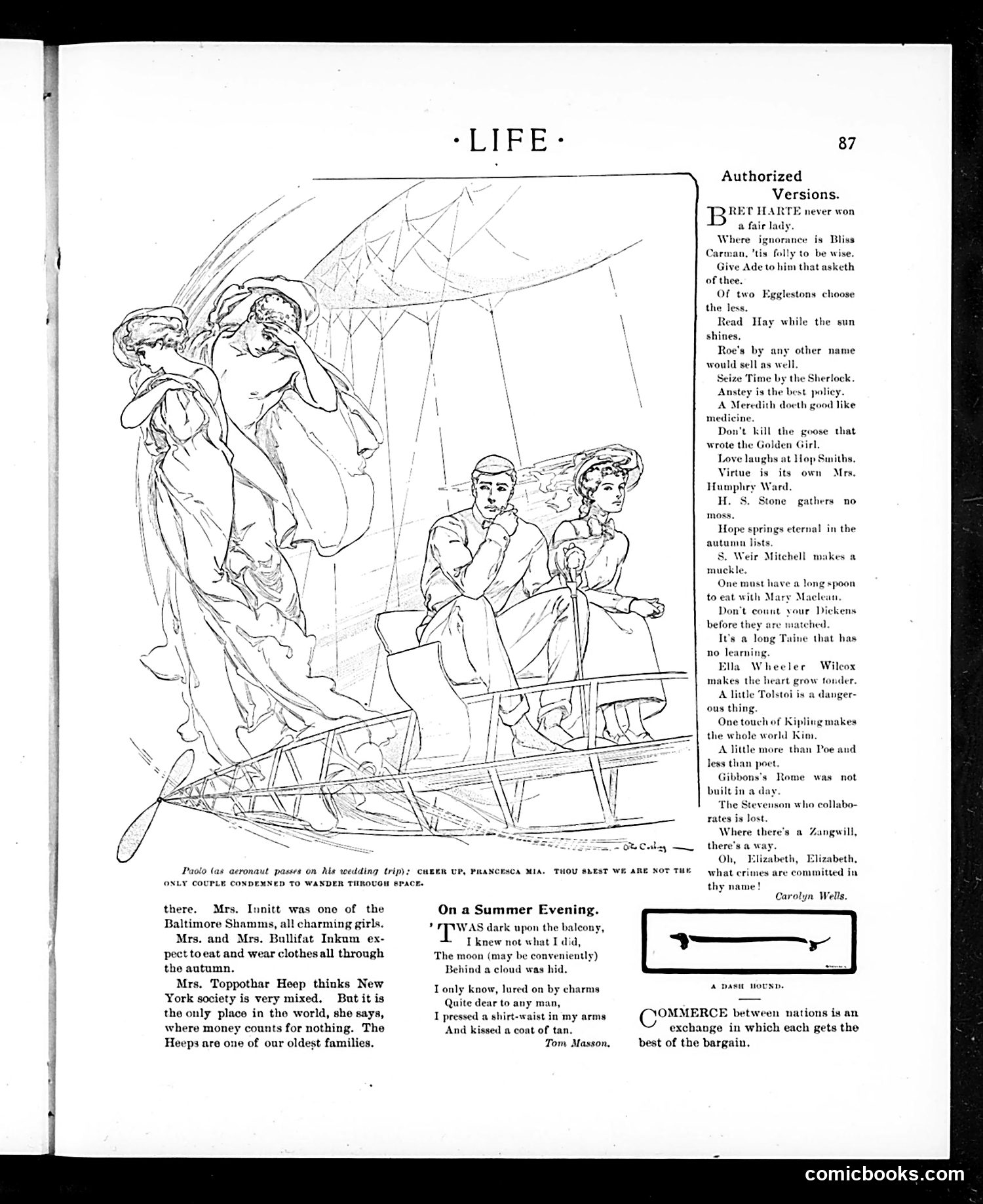
This page from *Life* magazine contains two main satirical pieces: **"Authorized Versions"** (top right): A collection of jokes parodying famous literary and cultural figures by inserting their names into well-known proverbs and sayings. Examples include "One touch of Kipling makes the whole world Kim" (playing on "one touch of nature makes the whole world kin") and "Ella Wheeler Wilcox makes the heart grow fonder" (riffing on "absence makes the heart grow fonder"). The humor relies on readers recognizing these contemporary authors and public figures—Bret Harte, Joel Chandler Harris, O. Henry, Rudyard Kipling, etc.—and appreciating the wordplay that substitutes their names into familiar phrases. **The illustration and accompanying text** show a romantic scene (Paolo and Francesca on a wedding trip) with a joke about couples condemned to wander through space—likely a literary reference contemporary readers would recognize. The remaining brief pieces ("On a Summer Evening," "Commerce") are minor humorous anecdotes typical of the magazine's filler content.
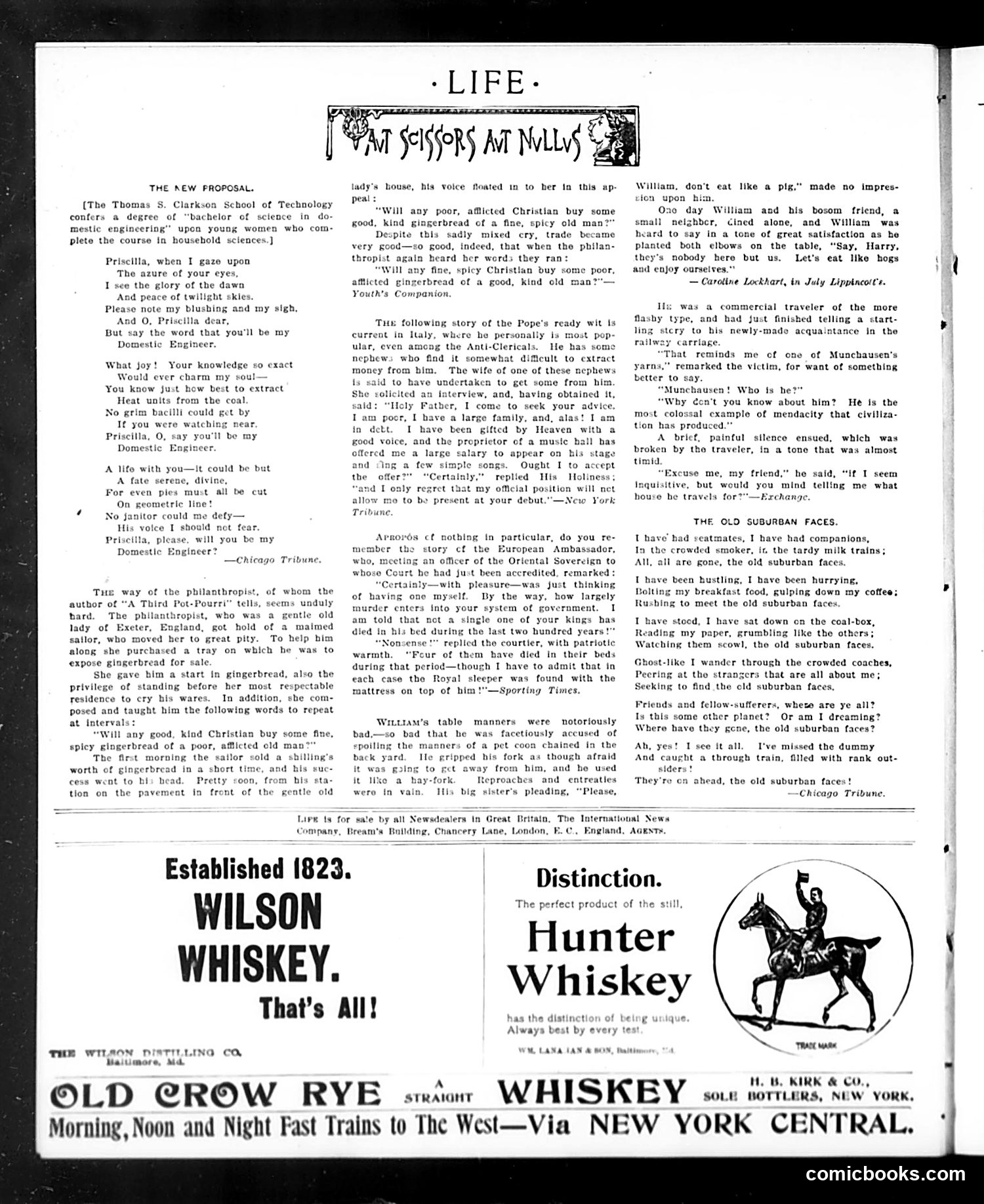
This page from Life magazine (established as a satirical publication) contains three distinct pieces of social commentary: **"The New Proposal"** consists of romantic poetry mocking overly sentimental courtship language, contrasted with practical domestic science. The Thomas S. Clarkson School's new degree in "domestic engineering" is satirized as reducing marriage to household management rather than romance. **"I'm Scissors at Nullus"** and the Pope anecdote mock both religious hypocrisy and commercial dishonesty through humorous tales—one about a gingerbread vendor, another about papal wit regarding nephews seeking money. **"The Old Suburban Faces"** is nostalgic verse about forgotten train companions, capturing turn-of-century commuter life's transience. The advertisements below (Wilson Whiskey, Hunter Whiskey, Old Crow Rye) are period-appropriate commercial messages. The overall page satirizes contemporary American social pretensions—romantic excess, religious manipulation, and commercial artifice—while celebrating practical domesticity and ordinary human experience.
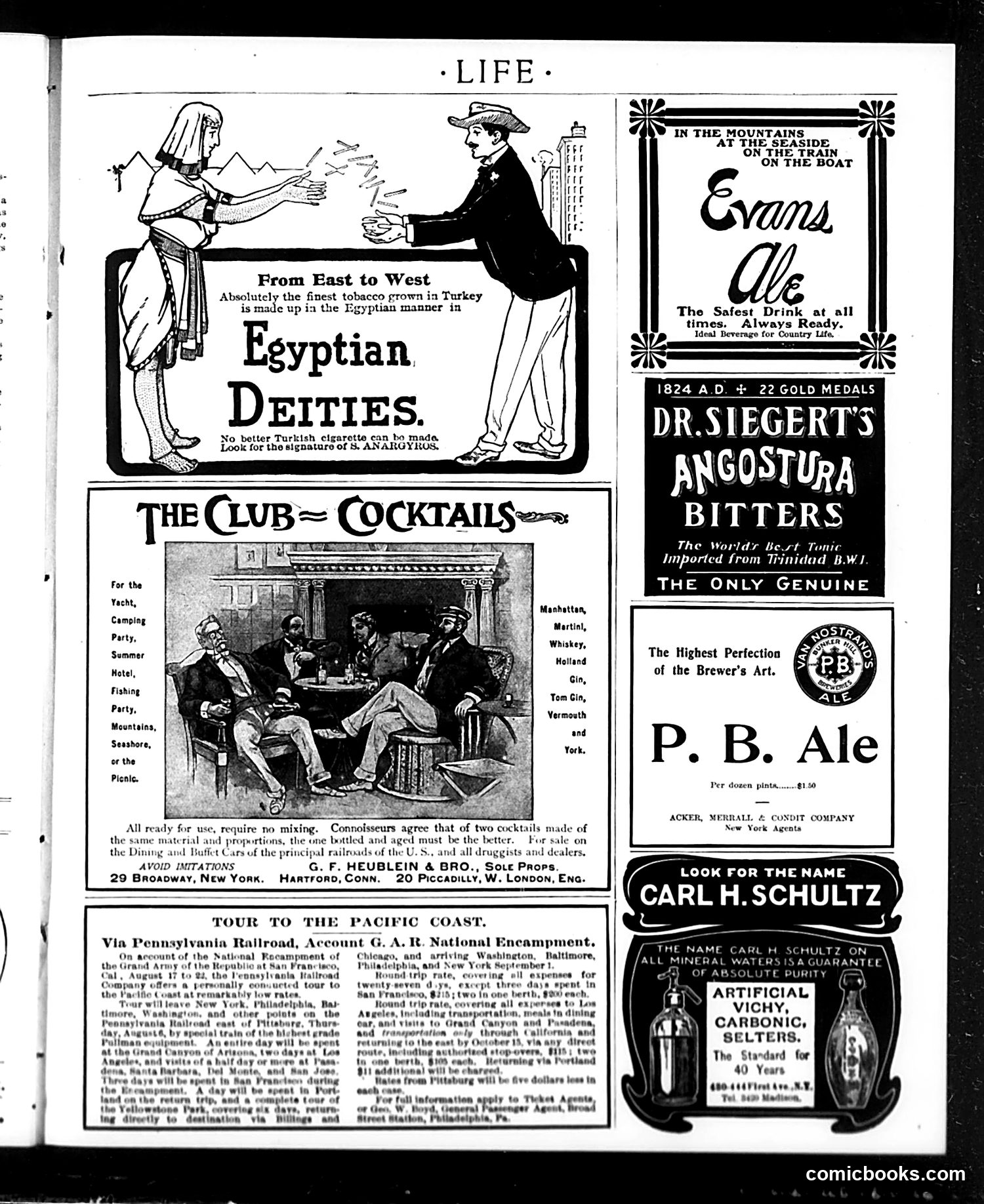
This page is primarily **advertising**, not editorial satire. The single cartoon at top depicts a stereotypical Egyptian woman offering Egyptian Deities cigarettes to a Western gentleman—a common early-20th-century marketing trope exoticizing foreign tobacco products. The rest of the page contains period advertisements for: - **Club Cocktails** (pre-mixed drinks for trains and social occasions) - **Pennsylvania Railroad tours** to the Pacific Coast - **Alcoholic beverages** (Evans Ale, Dr. Siegert's Angostura Bitters, P.B. Ale) - **Mineral waters** and health tonics The repeated references to alcohol and "tonics" reflect an era before Prohibition (1920-1933), when such products were openly advertised in mainstream magazines. The health claims and "safest drink" language typical of this pre-regulation period are now unrecognizable to modern readers. There is no discernible political satire on this page—it's straightforward commercial promotion typical of *Life*'s advertising content.
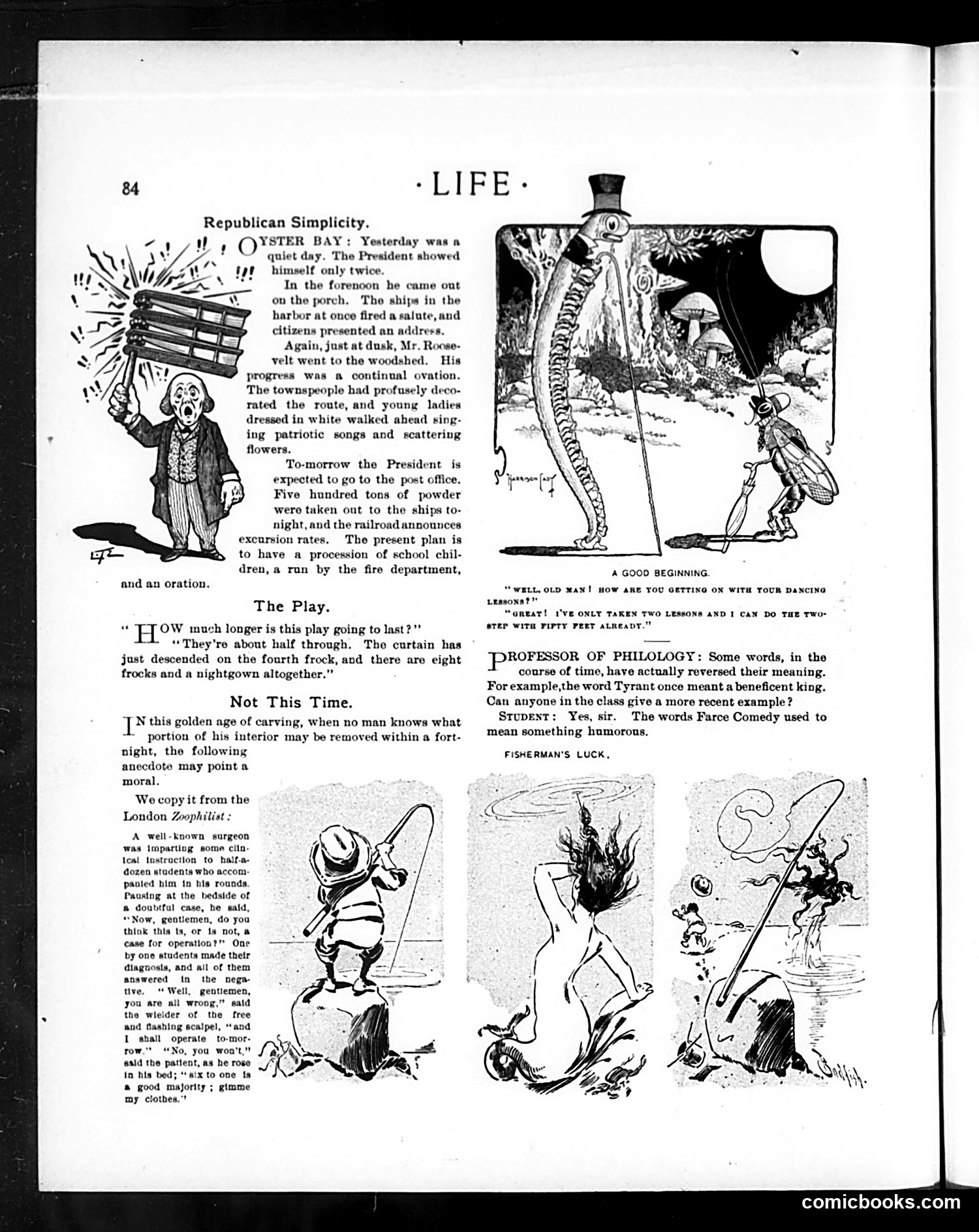
This page satirizes President Theodore Roosevelt's time at his Oyster Bay home. The "Republican Simplicity" section mocks the excessive ceremonial attention given to Roosevelt's mundane activities—a simple porch appearance triggers ship salutes and citizen addresses; a trip to the woodshed becomes a parade with decorated routes and singing girls. The satire suggests Roosevelt's presidency involved overwrought pageantry despite claims of simplicity. The other humor pieces are unrelated: "The Play" jokes about a theatrical production's length; "Not This Time" is a medical anecdote about a patient vetoing surgery by majority vote; "A Good Beginning" puns on dance progress; the philology joke compares how "Farce Comedy" once meant humor but now doesn't; "Fisherman's Luck" shows comic fishing mishaps. The primary political content targets Roosevelt-era excess and spectacle.
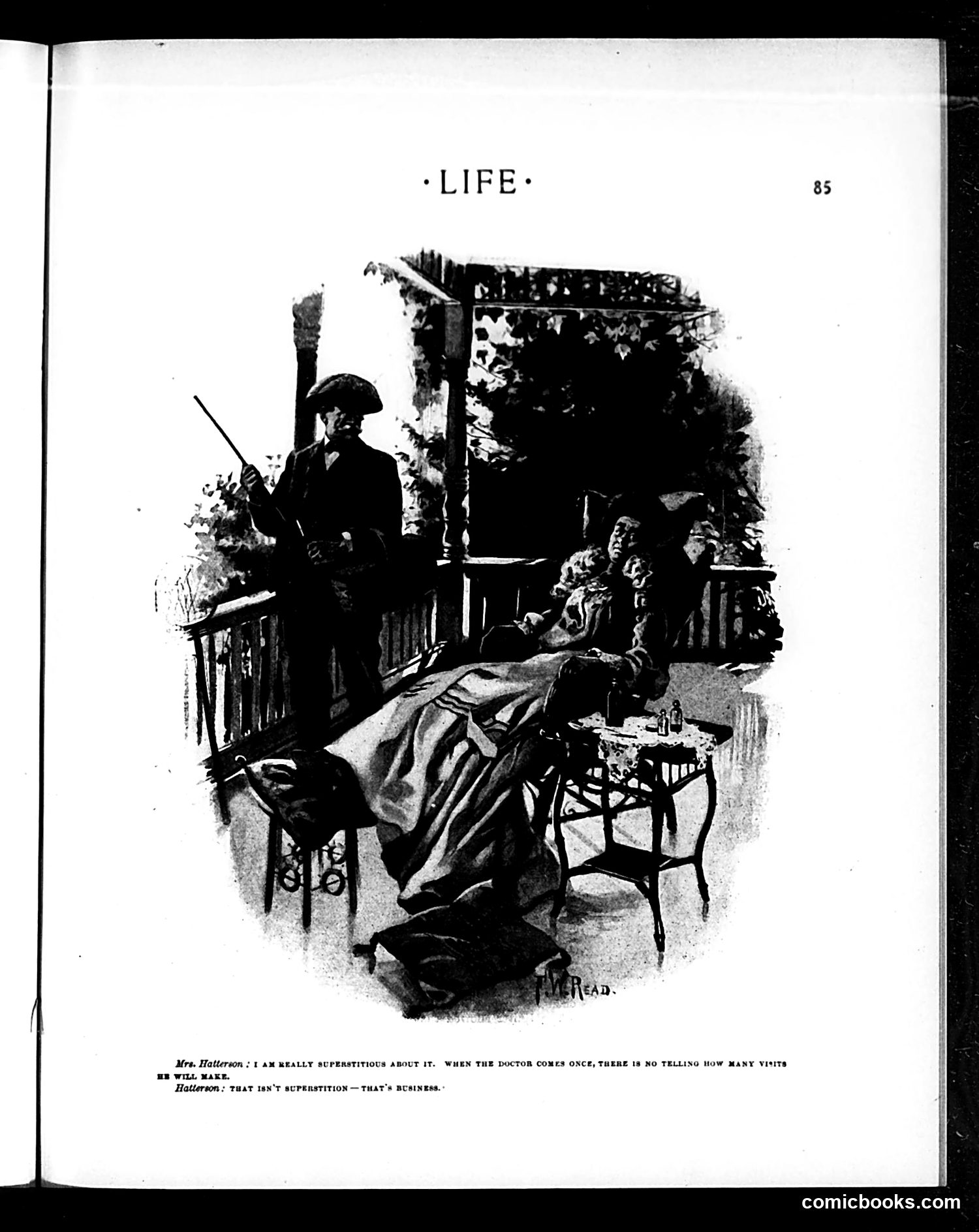
This satirical cartoon depicts a domestic scene where Mrs. Hatlerson expresses superstitious worry that calling a doctor once will lead to many subsequent visits. Her husband corrects her, claiming it's not superstition but rather standard business practice—implying doctors deliberately encourage repeat visits for profit. The satire targets medical professionals' financial motivations, suggesting doctors exploit patients by recommending unnecessary follow-up appointments to increase fees. This reflects early 20th-century anxieties about healthcare costs and professional ethics. The humor relies on the husband's blunt acknowledgment that what appears to be medical necessity is actually a business model designed to maximize revenue at patients' expense.
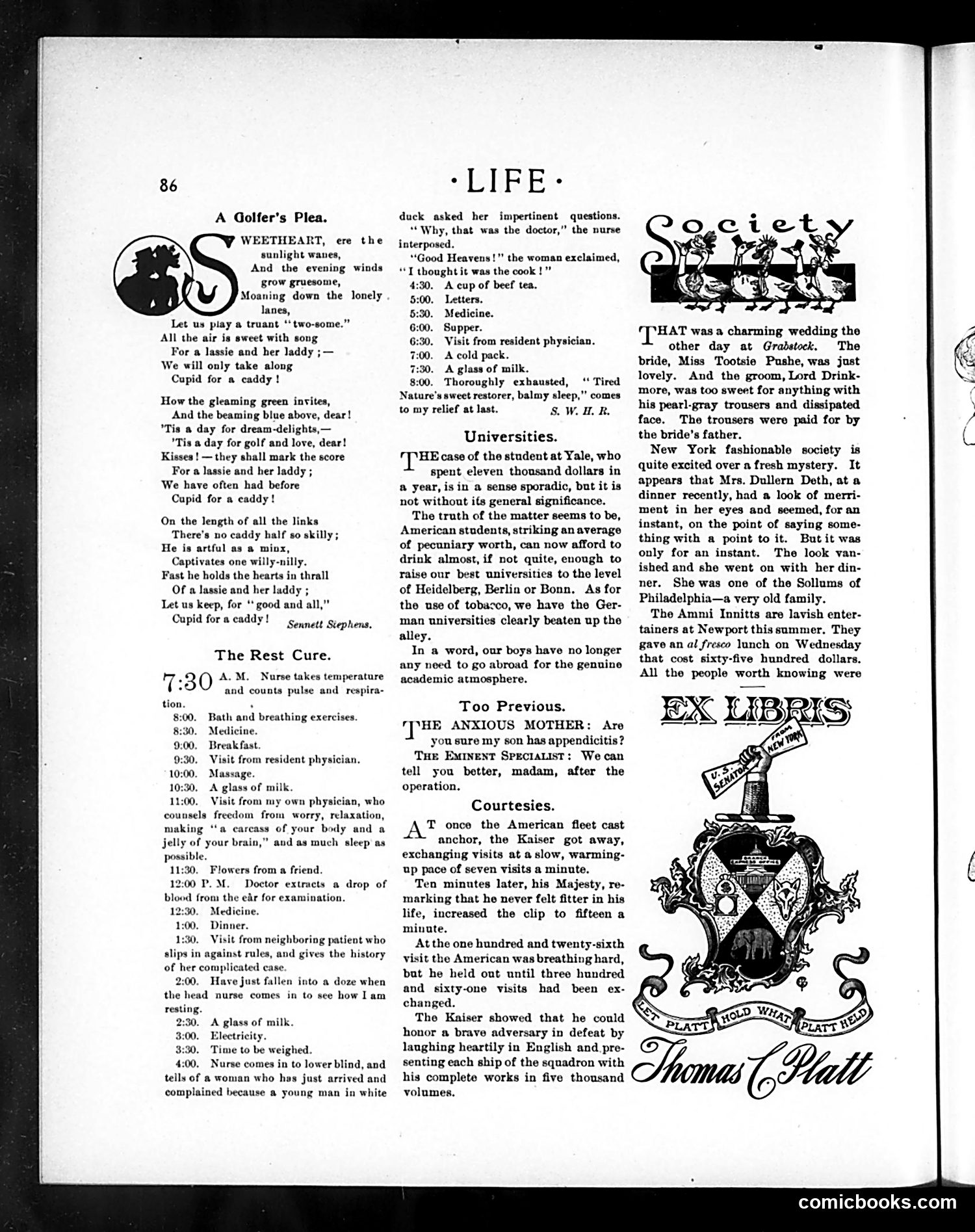
This page contains several satirical pieces typical of early 20th-century American humor: **"A Golfer's Plea"** is a romantic poem romanticizing golf and courtship, using "Cupid for a caddy" as extended metaphor—lighthearted social commentary on leisure activities. **"The Rest Cure"** satirizes the popular "rest cure" treatment for nervous exhaustion by listing an absurdly packed daily schedule (7:30 AM to 8:00 PM) of medical interventions, massages, and visits. The joke: the "cure" provides no actual rest, undermining its medical premise. **"Universities"** mocks wealthy American students (referencing a Yale student spending $11,000 yearly) and suggests American universities now match German ones in students' drinking and tobacco use—ironic social criticism of academic excess. **"Too Previous"** is a brief joke about a surgeon who cannot diagnose appendicitis before operating—satire of medical uncertainty and possibly medical opportunism. **"Courtesies"** describes absurdly escalating diplomatic visits between American and German fleets, mocking formal naval protocol as performative and excessive. The page is primarily satirical social and political commentary wrapped in humor.
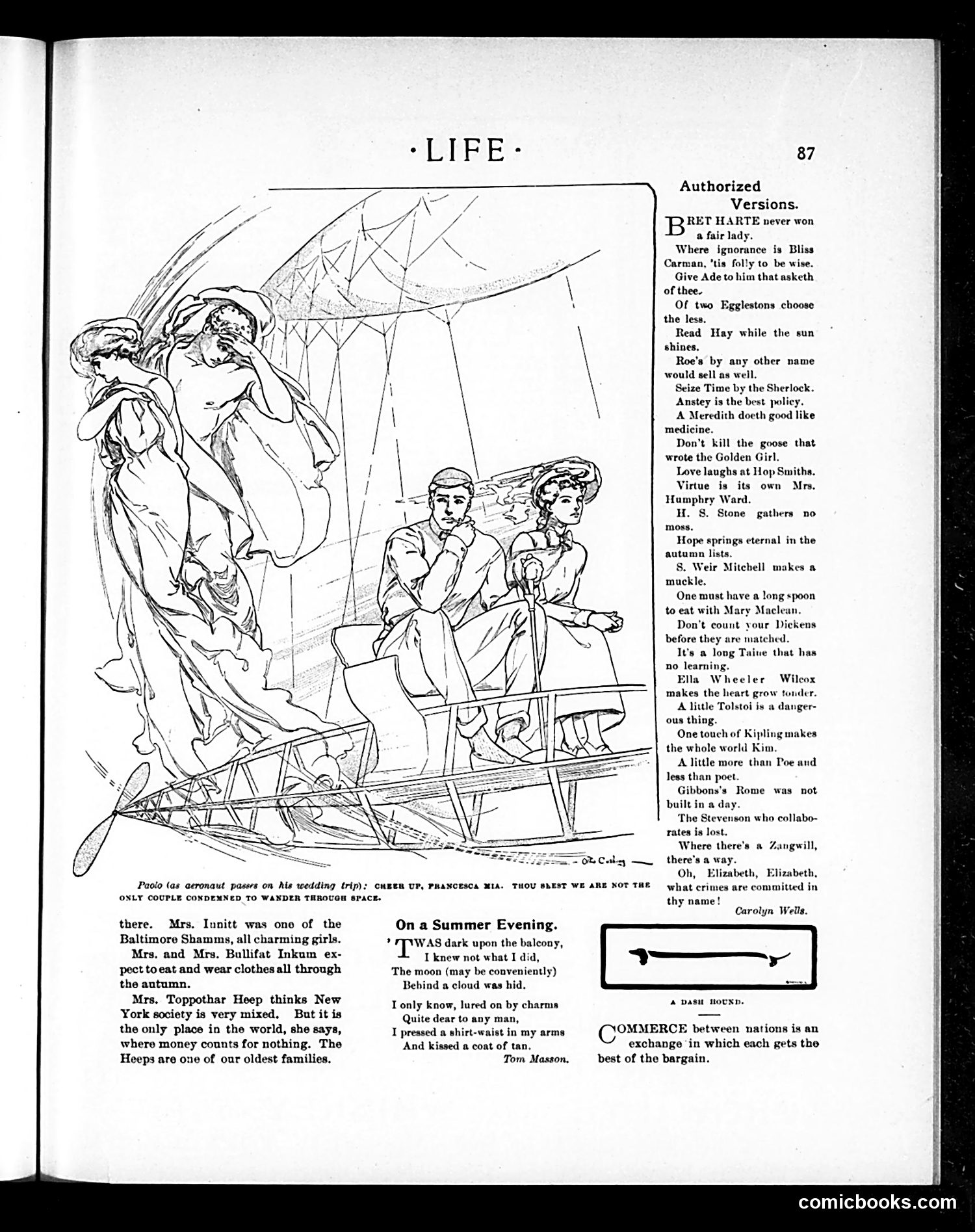
This page contains two distinct satirical pieces from *Life* magazine (likely early 1900s): **Top section ("Authorized Versions"):** A parody of famous proverbs and maxims, where literary authors' names replace key words. For example, "Bret Harte never won a fair lady" plays on "Virtue is its own reward." The joke mocks popular authors of the era (Kipling, Tolstoy, Ella Wheeler Wilcox, etc.) by forcing their names into familiar sayings—treating celebrated writers as interchangeable punchlines rather than serious artists. **Main cartoon:** Shows Paolo and Francesca (tragic lovers from Dante) on a honeymoon airship, with the caption suggesting they're condemned to wander through space—a visual pun on their eternal damnation. It's a lighthearted romantic joke about newlyweds. **Bottom section:** Includes humorous character sketches and brief poems mocking fashionable New York society and literary conventions. Overall, the page satirizes both pretentious literary culture and high society's affectations.
This page from *Life* magazine contains three satirical pieces mocking early 1900s social conventions: 1. **"The New Proposal"** (main cartoon): A poem ridiculing the newly-offered degree of "bachelor of science in domestic engineering" for women. The satire is that a man proposes to a woman by praising her mastery of *household* tasks—extracting heat from coal, removing bacteria, cutting pies on geometric lines—rather than romantic qualities. It mocks both the pseudo-scientific naming of housework and the absurdity of treating domestic servitude as an advanced degree worthy of romantic courtship. 2. **The Sailor's Gingerbread**: A humorous anecdote about a maimed sailor who, given a charitable opportunity, inadvertently corrupts his employer's carefully-worded sales pitch into nonsensical combinations ("spicy Christian," "poor gingerbread"), yet succeeds wildly anyway—satirizing pretension and showing results matter more than propriety. 3. **The Pope's Wit**: An anecdote where a pope's nephew's wife seeks approval for stage singing; the pope sarcastically grants it, implying the church won't attend—gentle satire on clerical attitudes toward entertainment. The page also contains period whiskey advertisements.
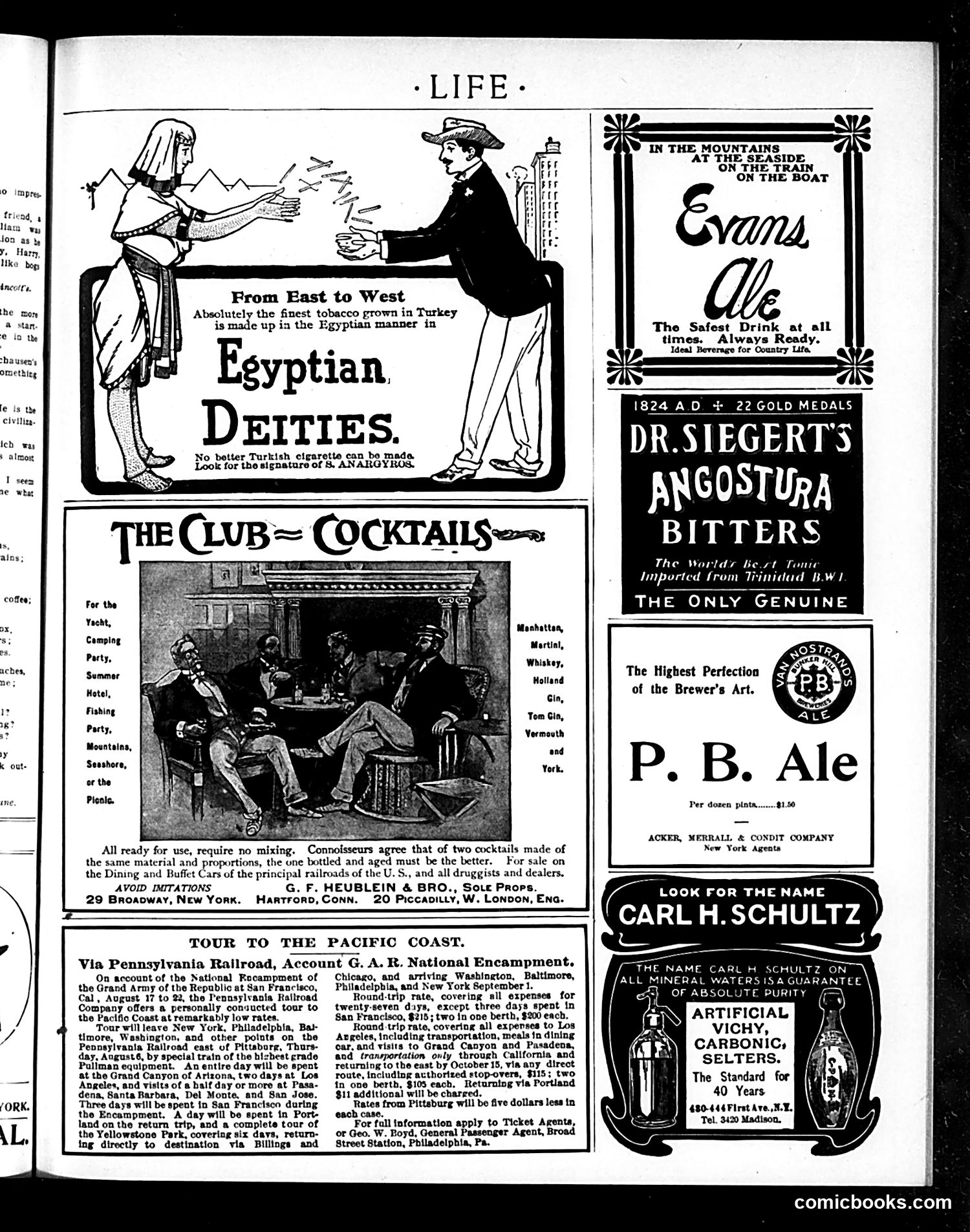
This page is primarily **advertising**, typical of early 20th-century magazine layout. The dominant cartoon—"Egyptian Deities"—depicts a Turkish tobacco seller approaching a Western gentleman, playing on orientalist stereotypes common to the era. The "deity" framing is satirical humor: the ad positions Egyptian cigarette-rolling as exotic craftsmanship worthy of reverence. The other content consists of commercial advertisements for cocktail mixers (Heublein), bitters, ale, mineral water, and a Pennsylvania Railroad tour to the 1896 Grand Army of the Republic (GAR) Encampment in San Francisco. The GAR reference dates this page to that period—a major Civil War veterans' gathering. The satire is mild and commercial rather than political: the page mocks no political figures or movements, instead using light ethnic humor and exotic imagery to sell products. The "deity" joke relies on viewers finding Turkish/Egyptian customs amusingly foreign and worthy of commercialization—reflecting contemporary attitudes toward non-Western cultures.
This page from *Life* magazine is primarily **advertising with humor sidebars**—typical of the publication's format mixing satire with commercial content. The main cartoon (top right) depicts two hands toasting with glasses of Trimble Whiskey, accompanied by the phrase "May Friendship propose the toast and Sincerity drink it." This is **straightforward product advertising**, using sentimentality about friendship and honesty to market spirits. The surrounding text consists of **short satirical jokes** poking fun at contemporary life: a bit about wireless telegraphy replacing birds on telegraph wires, jokes about newlyweds, doctors prescribing climate changes, and a bicycle salesman's card being mistaken for a duel challenge. These are gentle, society-page humor reflecting turn-of-the-century American anxieties about technology and social pretension. The remaining advertisements promote resorts, railroads, and patent medicines (Buffalo Lithia Water for bladder ailments). The page overall reflects the era's blend of genteel humor and medical quackery marketing.
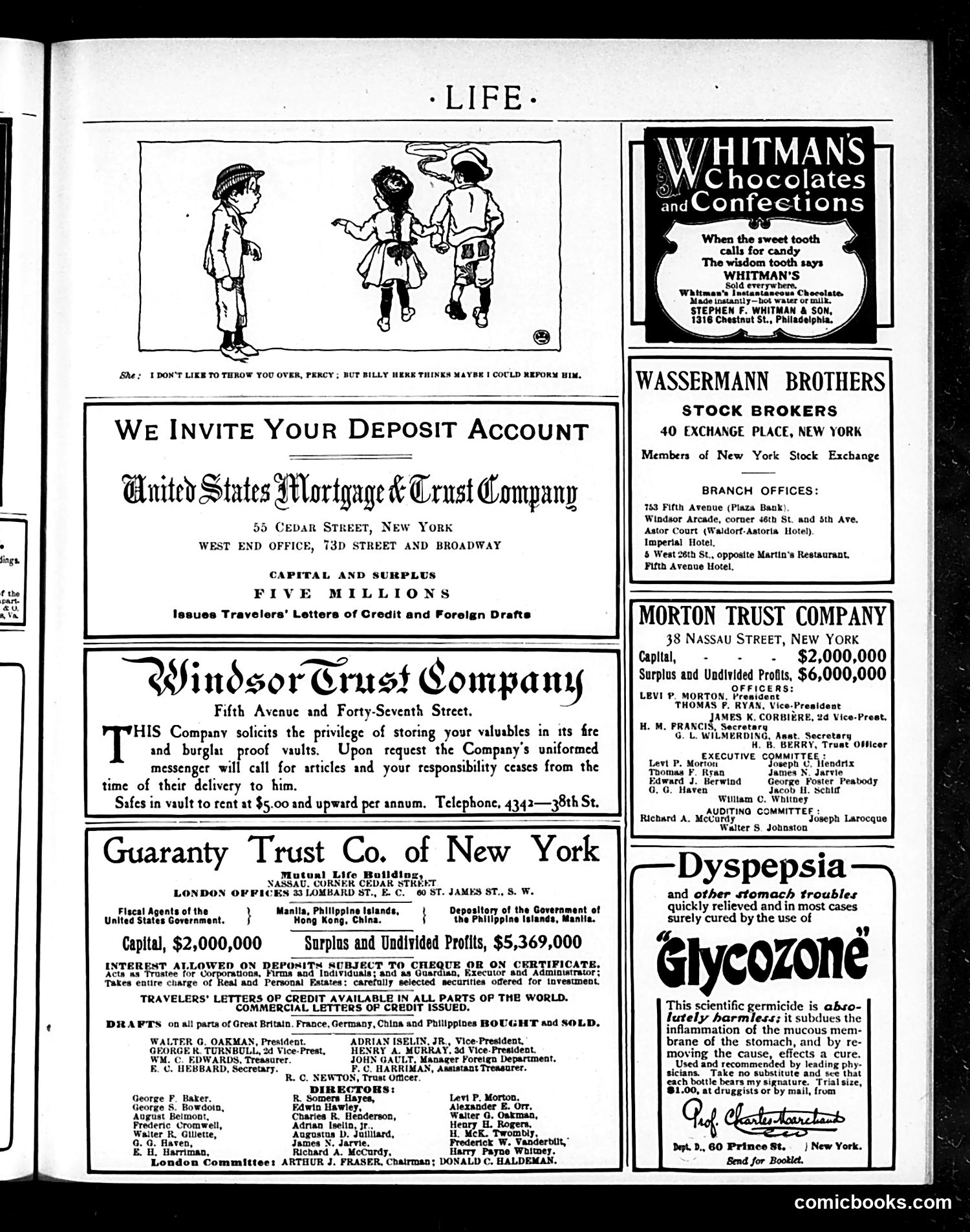
This page is primarily **advertising**, not political satire. It contains a small cartoon at the top and numerous financial/commercial advertisements below. **The Cartoon:** The single illustration shows three children, with one child (on left) appearing to report on two other children playing together. The caption reads: "She: I DON'T LIKE TO THROW YOU OVER, PERCY; BUT BILLY HERE THINKS MAYBE I COULD REFORM HIM." This is a **humorous domestic/romantic joke** about childhood relationships. The girl suggests she might abandon her current suitor (Percy) for Billy, framing it as an opportunity to "reform" him—using language that mimics adult romantic discourse but applied absurdly to children's playground dynamics. The satire targets sentimental Victorian-era rhetoric about women "reforming" men through romance. **The Advertisements:** The remaining content advertises banks (United States Mortgage & Trust, Windsor Trust, Guaranty Trust, Morton Trust), stock brokers, chocolates, and patent medicine (Glycozone for dyspepsia). This reflects early 1900s commercial publishing.
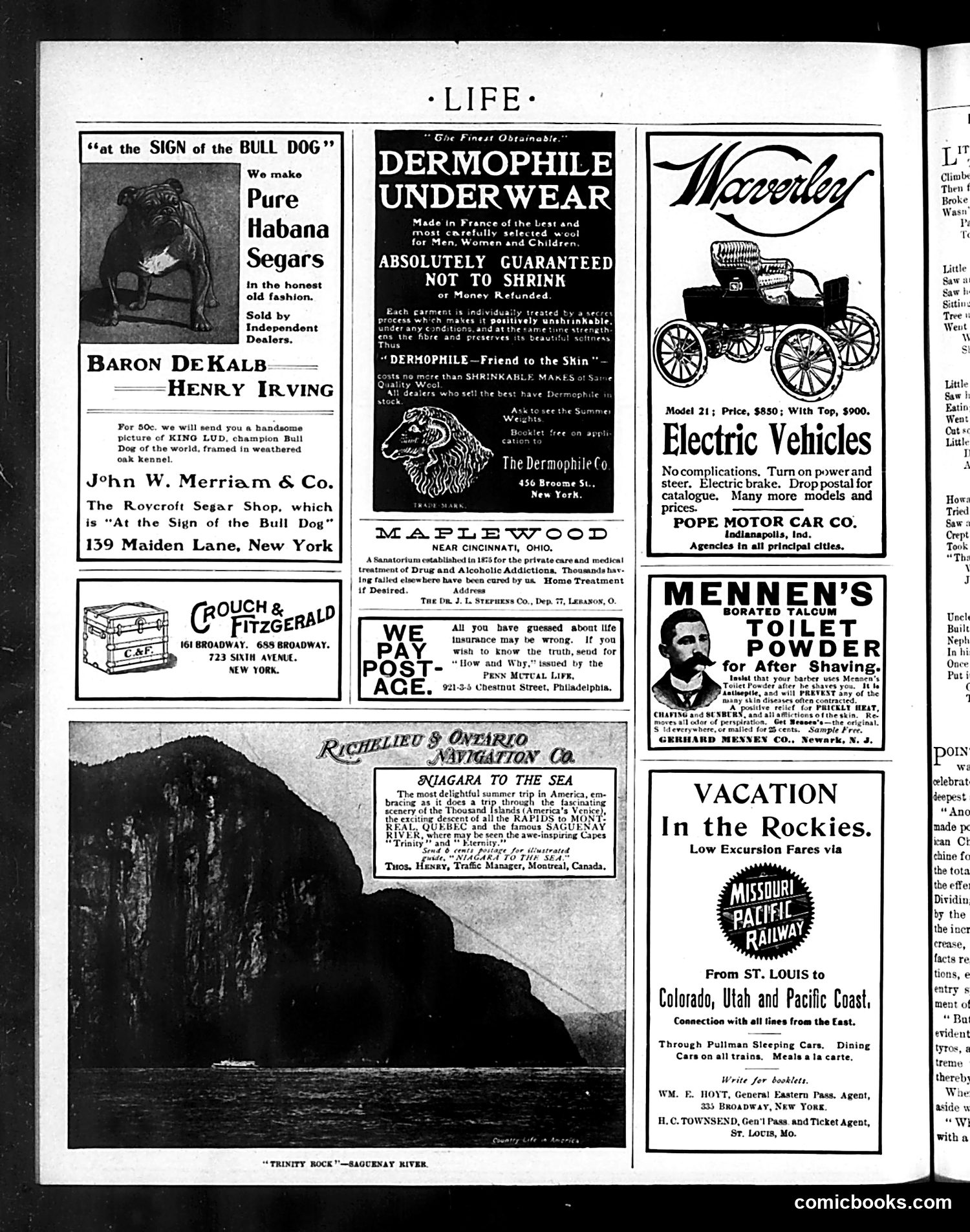
This is primarily an **advertising page** rather than editorial content or political cartoons. The page features various commercial advertisements typical of early 20th-century American publications. Notable ads include: - **Cigars and tobacco products** ("Pure Habana Segars," "At the Sign of the Bull Dog") - **Underwear** (Dermophile brand, emphasizing shrink-resistance) - **Electric vehicles** by Pope Motor Car Co.—notable as these were competing technologies during the automobile industry's infancy - **Maplewood Sanatorium** advertising treatment for "Drug and Alcoholic Addictions"—reflecting the era's approach to addiction treatment - **Mennen's Talcum Powder** for post-shave use - **Travel/tourism** promoting Niagara Falls, the Saguenay River, and Rocky Mountain vacations via Missouri Pacific Railway The large landscape photograph depicts "Trinity Rock" on the Saguenay River, promoting Canadian tourism. There are **no political cartoons or satire** on this page—it's a straightforward collection of period advertising.
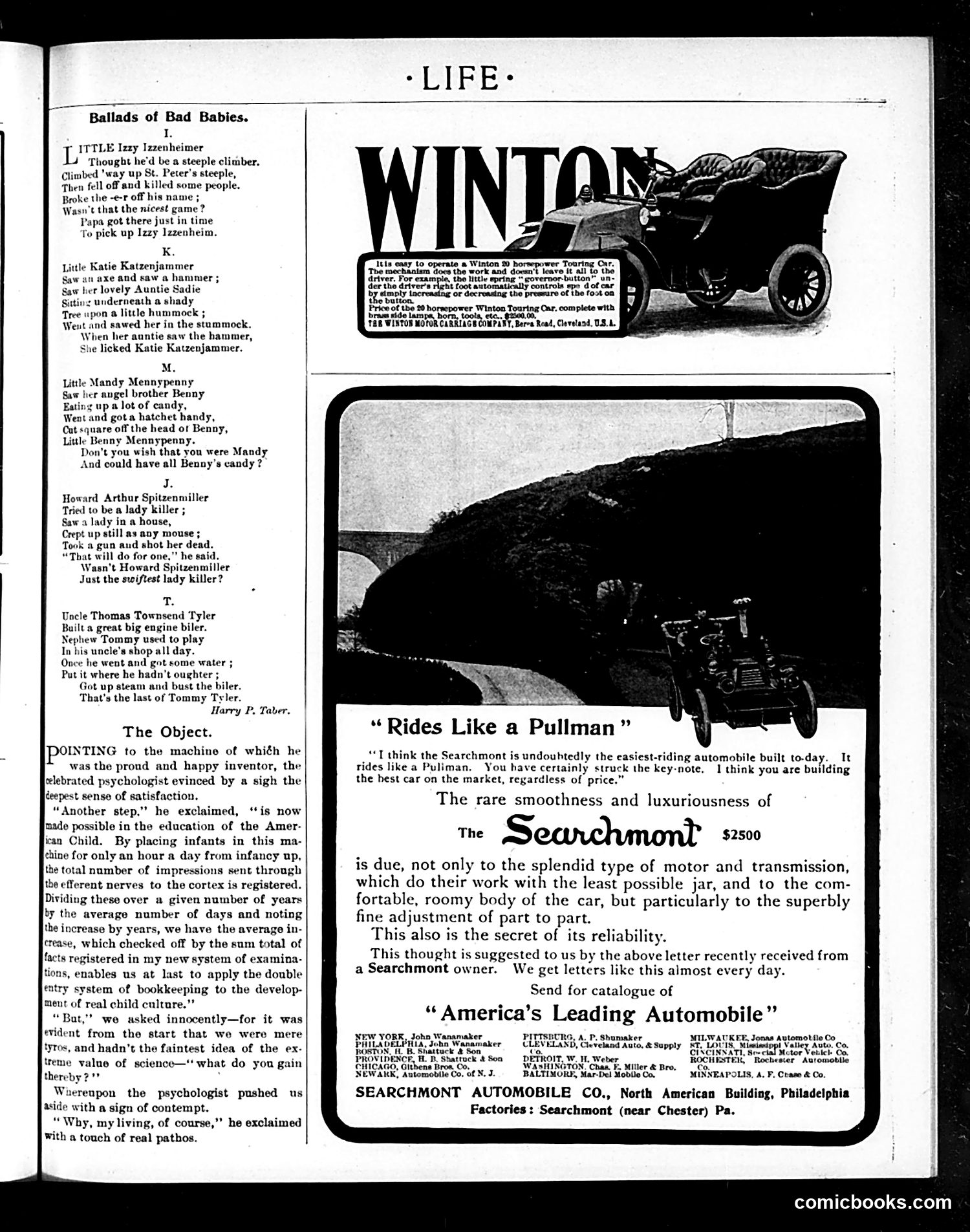
This page contains two distinct elements: **Left side—"Ballads of Bad Babies":** Darkly humorous verses satirizing children's behavior and parental discipline. Written in limerick-like form with ethnic surnames (Izzenheimer, Katzenjammer, Spitzenmiller), these poems describe children committing violent acts—climbing steeples, using axes and hatchets—with casual consequences. The satire mocks both sentimental Victorian children's literature and anxieties about immigrant families and child-rearing. The tone suggests critique of naive educational sentimentality. **"The Object" section:** Satirizes pseudoscientific child-development claims. A psychologist describes a machine measuring children's neural impressions and "registering" development through bookkeeping methods. When asked the practical value, he dismissively replies "my living"—exposing the commercial exploitation behind supposedly scientific educational innovations. **Right side:** Automobile advertisements for Winton and Searchmont cars—standard period marketing using testimonials. The page's satire targets naive scientific optimism about child education and commercialism disguised as progress.
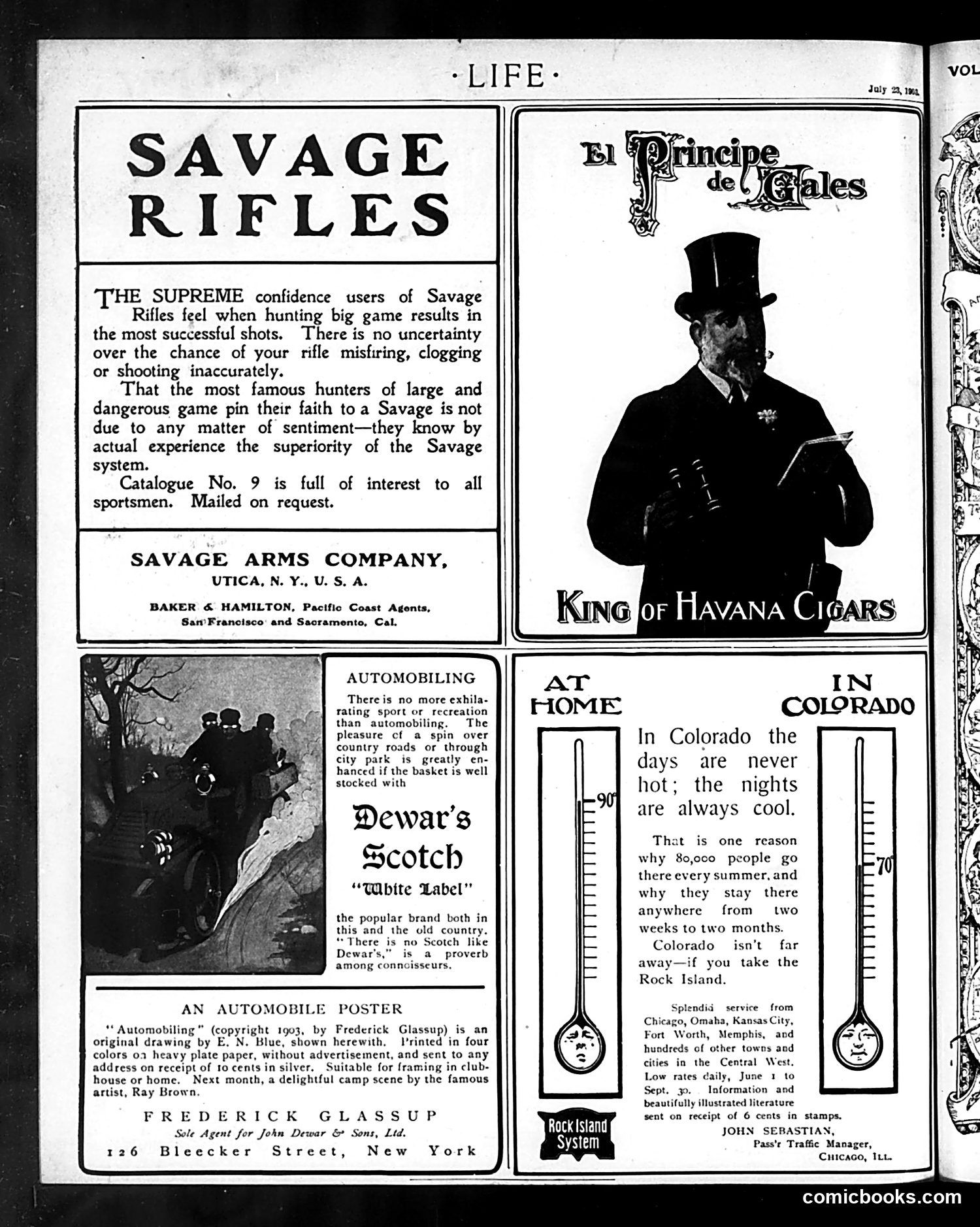
This is primarily an **advertising page** with no political cartoons or satire. It contains four advertisements: 1. **Savage Rifles**: Appeals to hunters with claims of reliability and superiority, citing endorsements from "famous hunters." 2. **Dewar's Scotch Whisky**: Associates the drink with the pleasure of automobiling, a novel luxury activity at the time. 3. **Automobiling Poster**: Offers Frederick Glassup's 1903 illustration suitable for framing—automobiling was still a fashionable recreation for the wealthy. 4. **Rock Island Railroad/Colorado Tourism**: Promotes Colorado as a summer destination with cool weather, offering discounted fares via the Rock Island line. Notes that 80,000 people visit annually. The page reflects early 1900s consumer culture: firearms, luxury spirits, automobiles, and leisure travel targeting affluent readers. No satirical or political content is evident.