
Life, 1903-07-23 · page 8 of 28
Life — July 23, 1903 — page 8: what you’re looking at
What you’re looking at
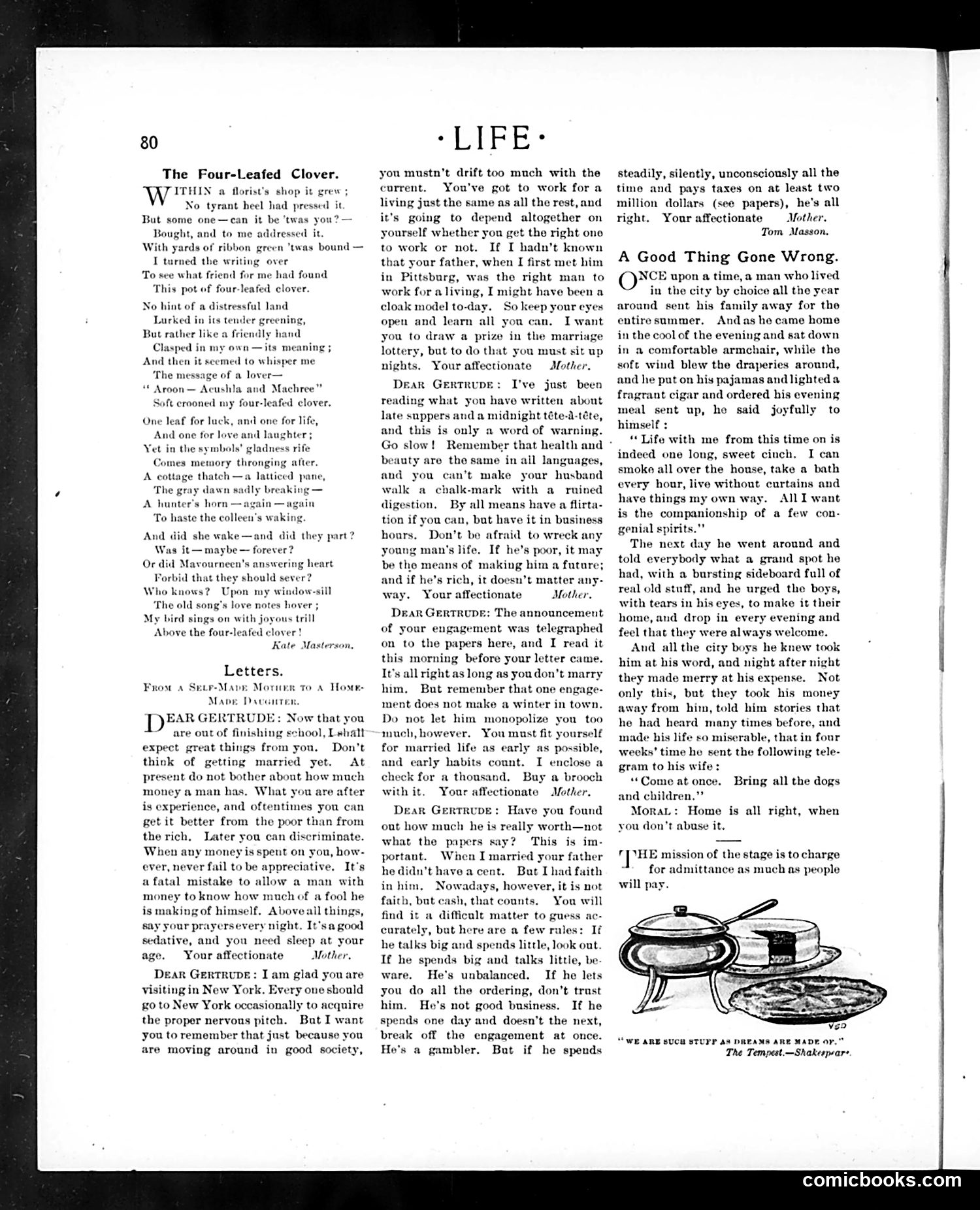
This page contains two distinct sections: a poem titled "The Four-Leaved Clover" and a "Letters" section offering advice to readers. The cartoon at the bottom depicts cookware (pots and pans) with the caption "WE ARE SUCH STUFF AS DREAMS ARE MADE OF"—a Shakespeare quote from *The Tempest*. The visual joke appears to be a pun: treating mundane kitchen items as if they were subjects worthy of philosophical contemplation, mocking the pretentiousness of applying high literary language to everyday domestic objects. This satirizes both overwrought sentimentality and the gap between elevated rhetoric and humble reality—typical of Life magazine's gentle satirical approach to American society and culture.
📄 Transcribed text from this page (OCR, searchable)
Machine-transcribed from the original scan — historical spelling and the odd misread are preserved.
80 The Four-Leafed Clover. wits a florist’s shop it grew No tyrant heel had pressed it But some one—can it be ‘twas you? — Bought, and to me addressed it, With yards of ribbon green ‘twas bound — I turned the writing 0 To see what friend for me ha This pot of four-leafed clover. > hint of a distressful land Lurked in its tender greening, But rather like a friend] Clasped in my own — its meanin And then it seemed to whisper me ‘The message of a lover— “ Aroon— Acushla au ft crooned my four-leafed clover. One leaf for luck, and o 1 one for love and la nthe sym 2 for life, Yet Comes memory thronging after. A cottage thatch —a latticed pane, A hunter's horn —agi To haste the colleen’s wakin And did she wake—and did they part? Was it —maybe— forever? Or did Mavourneen's answering heart Forbid that they should sever? Who knows? Upon my ‘The old song's love My bird sings on with Above the four-leafed clover ! Kate Masterson, window-sill ‘ous trill Letters. a Setr-Mave Moruer to a Howe Mane Dat EAR GERTRUDE are out of finishing s expect great things from you. Don’t think of getting married yet. At present do not bother about how much money a man has, What you are after is experience, and oftentimes you can getit better from the poor than from the rich, Later you can discriminate. When any money is spent on you, how- ever, never fail to be appreciative. It's a fatal mistake to allow a man with money to know how much of a fool he is makingof himself. Aboveall things, say your prayersevery night. It'sa good sedative, and you need sleep at your age. Your affectionate — Mother. Dear Gertrupe: I am glad youare visiting in New York. Every one should 0 to New York occasionally to acquire the proper nervons pitch. But I want you to remember that just because you are moving around in good society, From Te “LIFE* you mustn’t drift too much with the current. You've got to work for a living just the same as all the rest, and it’s going to depend altogether on yourself whether yon get the right ono to work or not. If I hadn't known that your father, when I first met him in Pittsburg, was the right man to work for a living, I might have been a cloak model to- So keep your eyes open and learn all you can. Iwant you to draw a prize in the marriage lottery, but to do that you must sit up nights. Youraffectionate Mother, Deak Gertrupe: I've just been reading w! you have written about late suppers and a midnight téte-a-téte, and this is only a word of warning. Go slow! beauty are the same in ail languages, and you can’t make your husband walk a chalk-mark with a ruined digestion, By all means have a flirta- tion if you can, but have it in business hours. Don’t be afraid to wreck any young man's life. If he’s poor, it may be the means of making him a future; and if he’s rich, it doesn’t matter any- y. Your affectionate Mother. Dear Gertrupe: The announcement of your engagement was telegraphed on to the papers here, and I read it this morning before your letter came. It’s all right as long as youdon’t marry him. But remember that one engage ment does not make a winter in town. Do not let him monopolize you too much, however. You mast fit yourself for married life as early as possible, and early habits count. I enclose a check for a thousand. Buy a brooch with it. Your affectionate Mother. Dear Gertruve: Have you found out how much he is really worth—not what the papers &; This is im- portant. When I married your father hedidn't havea cent. But Thad faith in him, Nowadays, however, it is not faith, but cash, that counts. You will find it a difficult matter to guess a curately, but here are a few rules: If he talks big and spends little, look out. If he spends big and talks little, be ware. He's unbalanced. If he lets you do all the ordering, don’t trast him. He's not good business. If he spends one day and doesn't the next, break off the engagement at once. He’s a gambler. But if he spends Remember that health and © steadily, silently, unconsciously all the time and pays taxes on at least two million dollars (see papers), he’s all right. Your affectionate — Mother. Tom Masson, A Good Thing Gone Wrong. c NCE upon a time,a man who lived in the city by choice all the year around sent his family away for the entire summer. Andas he came home in the cool of the evening and sat down in a comfortable armchair, while the soft wind blew the draperies around, and he put on his pajamas and lighted a fragrant cigar and ordered his evening meal sent up, he said joyfully to himself : “Life with me from this time on is indeed one long, sweet cinch. I can smoke all over the house, take a bath every hour, live without curtains and have things my own way. All I want is the companionship of a few con- genial spirits.” The next day he went around and told everybody what a grand spot he had, with a bursting sideboard full of real old stuff, and he urged the boys, with tears in his eyes, to make it their home, aud drop in every evening and feel that they were always welcome. And allthe city boys he knew took him at his word, and night after night they made merry at his expense. Not only this, but they took his money away from him, told him stories that he had heard many times before, and made his life so miserable, that in four weeks’ time he sent the following tele- gram to his wife: “Come at once. and children.”” Mora: Home is all right, when you don’t abuse it. Bring all the dogs sion of the stage is to charge | YHE mis for admittance as much as people “WE ARE SUCH STUYP As DREAMS ARE MADE OF,” The Tempest.—Shakespears comicbooks.com