
Life, 1903-07-23 · page 18 of 28
Life — July 23, 1903 — page 18: what you’re looking at
What you’re looking at
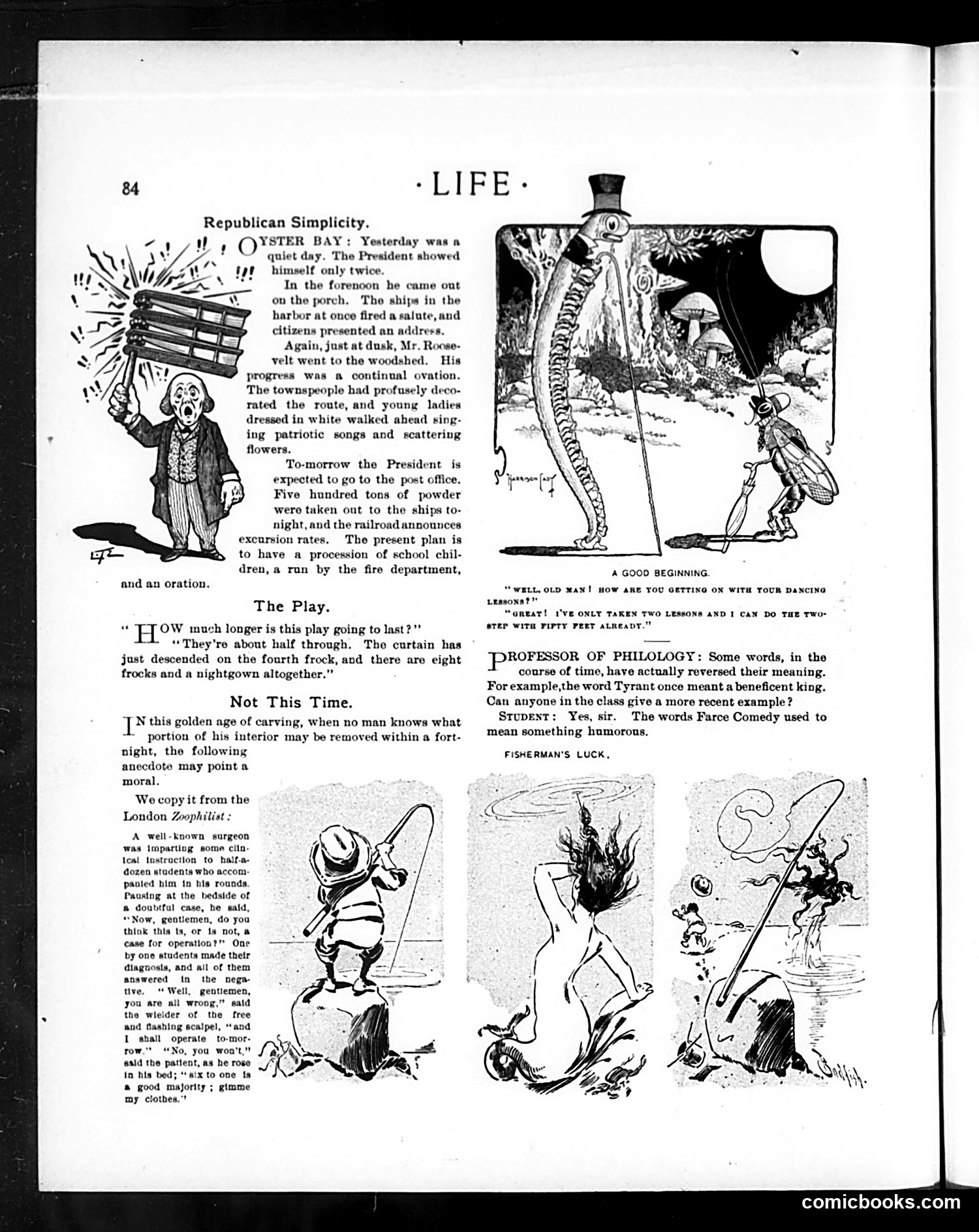
This page satirizes President Theodore Roosevelt's time at his Oyster Bay home. The "Republican Simplicity" section mocks the excessive ceremonial attention given to Roosevelt's mundane activities—a simple porch appearance triggers ship salutes and citizen addresses; a trip to the woodshed becomes a parade with decorated routes and singing girls. The satire suggests Roosevelt's presidency involved overwrought pageantry despite claims of simplicity. The other humor pieces are unrelated: "The Play" jokes about a theatrical production's length; "Not This Time" is a medical anecdote about a patient vetoing surgery by majority vote; "A Good Beginning" puns on dance progress; the philology joke compares how "Farce Comedy" once meant humor but now doesn't; "Fisherman's Luck" shows comic fishing mishaps. The primary political content targets Roosevelt-era excess and spectacle.
📄 Transcribed text from this page (OCR, searchable)
Machine-transcribed from the original scan — historical spelling and the odd misread are preserved.
Republican Simplicity. ' W ’ O*STER BAY: Yesterday was a y ‘ quiet day. The President showed himself only twice. In the forenoon he came out on the porch, The ships in the harbor at once fired a salute, and citizens presented an address. Again, just at dusk, Mr. Roose- velt went to the woodshed. His progress was a continual ovation. ‘The townspeople had profusely deco- rated the route, and young ladies dressed in white walked ahead sing- ing patriotic songs and scattering flowers. To-morrow the President is expected to go to the post office. Five hundred tons of powder were taken ont to the ships to- night, and the railroad announces excursion rates. The present plan is to have a procession of school chil- dren, a run by the fire department, and an oration. The Play. “ #H OW much longer is this play going to last?” “*They’re about half through. The curtain has just descended on the fourth frock, and there are eight frocks and a nightgown altogether.” Not This Time. J N this golden age of carving, when no man knows what + portion of his interior may be removed within a fort- night, the following anecdote may point a moral. We copy it from the London Zoophitist : A well-known surgeon was imparting some clin teal {nstraction to haif-a- dozen students who accom- panied him tn his rounds. Paustng at the bedside of ‘& doubtful case, he sald, “Now, gentlemen, do you think this ts, or 1s not, @ case for operation?” One by one students made their diagnosis, and ail of them answered in the nega- tive, “Well, gentlemen, you are all wrong,” sald the wieider of the free and flashing scalpel, “and I shall operate to-mor- row." “No, you won't,” sald the pattent, as he rose In his bed; “six to one is & good majority ; gimme my ciothes.”’ A GOOD BEGINNING. “WELL, OLD MAN! HOW ARE YOU GETTING ON WITH YOUR DANCING an” GREAT! I'VE ONLY TAKEN TWO LESSONS AND I CAN DO THE TWO ster witu PITY Peet ALREADY.” ROFESSOR OF PHILOLOGY: Some words, in the course of time, have actually reversed their meaning. For example,the word Tyrant once meant a beneficent king. Can anyone in the class give a more recent example? Srupent: Yes, sir. The words Farce Comedy used to mean something humorous. FISHERMAN'S LUCK, comicbooks.com