
Life, 1903-07-23 · page 4 of 28
Life — July 23, 1903 — page 4: what you’re looking at
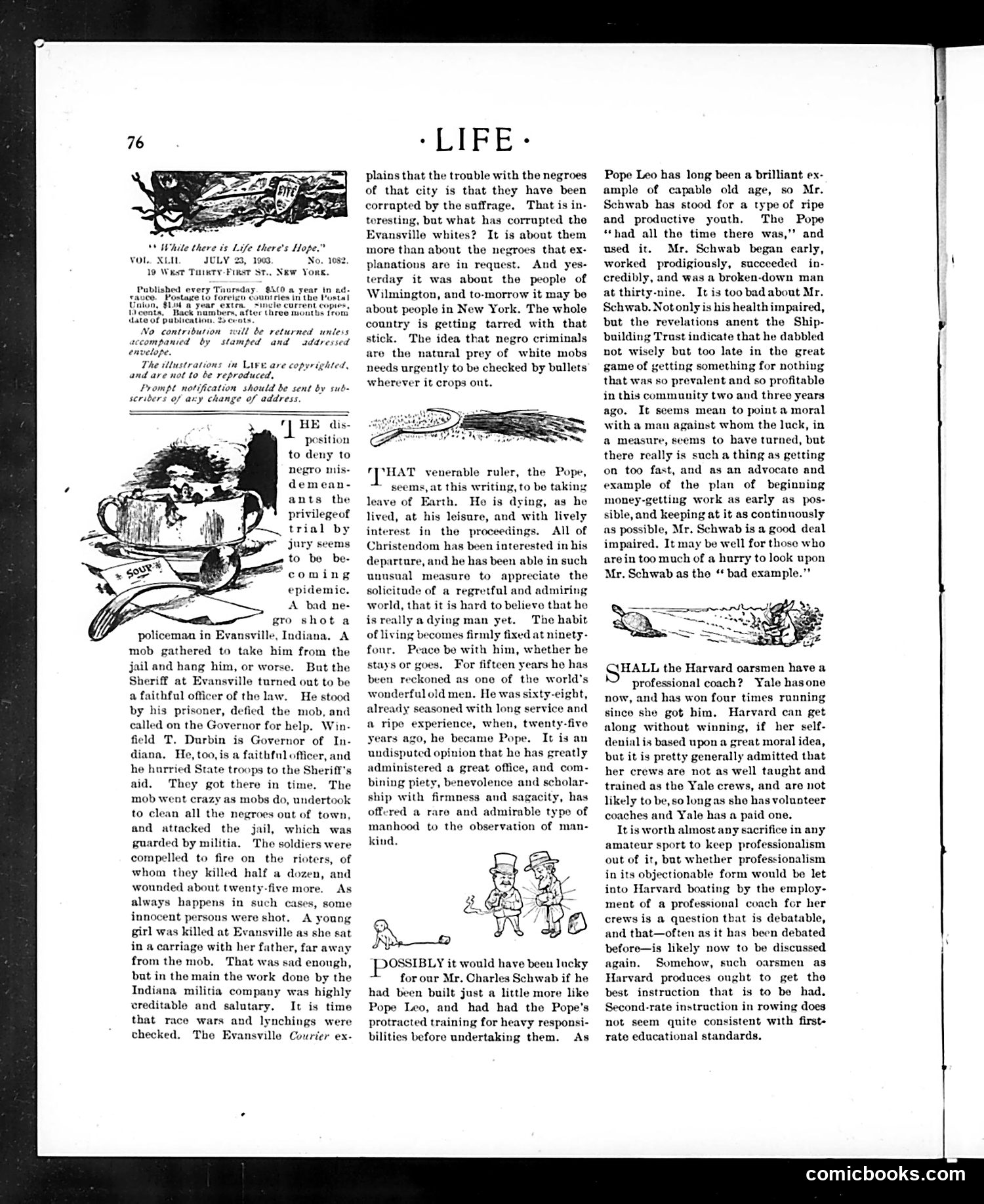
What you’re looking at
This page contains three distinct editorial cartoons satirizing early 1900s American social issues: 1. **Top cartoon**: Depicts a policeman in Evansville, Indiana during a mob lynching. The text describes how a sheriff was killed by a mob, then the mob murdered innocent people. The cartoon mocks the failure of law enforcement to prevent racial violence. 2. **Middle cartoon**: Shows a figure labeled "SOUP" in what appears to be a commentary on charitable or political corruption—though the specific reference is unclear without additional context. 3. **Bottom section**: Discusses whether Harvard should hire a professional rowing coach, debating whether professionalism compromises amateur sport ideals. The page reflects Life's tradition of satirizing American racial violence, corruption, and institutional hypocrisy during this era.
📄 Transcribed text from this page (OCR, searchable)
Machine-transcribed from the original scan — historical spelling and the odd misread are preserved.
‘* While there is Life there's Hope.” VOL. XL JULY 23, 1903 No. 10 19 Wrst Tuiety-Pinst St., New Yous. Published every Taorsday. €4(0 a year in pla 0 Countries in the He Fm . . after three months trom dato of publication. 25 crots No contribution will be returned untess accompanied by stamped and addressed envelope. The illustrations in Live are copyrighted, and are not to be reproduced, Prompt notification should be sent by sub- seribers of any change of address, Al HE dis- position to deny to negro mis- demean- ants the jury seems to be be- coming epidemic. A bad ne- gro shot a ille, Indiana, A policeman in Evans mob gathered to take him from the jail and hang him, or worse. But the Sheriff at Evansville turned out to be a faithful officer of the law. He stood by his prisoner, defied the mob, and called on the Governor for help. Win- field T. Durbin is Governor of In- diana. He, too, is a faithful officer, and he harried State troops to the Sheriff's aid. They got there in time. The mob went crazy as mobs do, undertook to clean all the negroes out of town, and attacked the jail, which was guarded by militia. The soldiers were compelled to fire on the rioters, of whom they killed half a dozen, and wounded about twenty-five more. As always happens in such cases, some innocent persons were shot. A young girl was killed at Evansville as she sat in a carriage with her father, far away from the mob, That was sad enough, but in the main the work done by the Indiana militia company was highly vreditadle and salutary. It is time that race wars and lynchings were checked. The Evansville Courier ex- -LIFE - plains that the trouble with the negroes of that city is that they have been corrupted by the suffrage. That is in- teresting, but what has corrupted the Evansville whites? It is about them more than about the negroes that ex- planations are in request. And yes- terday it was about the people of Wilmington, and to-morrow it may be about people in New York. The whole country is getting tarred with that stick. The idea that negro criminals are the natural prey of white mobs needs urgently to be checked by bullets wherever it crops out. "T=s* venerable ruler, the Pope, seems, at this writing, to be taking leave of Earth. He is dying, as he lived, at his leisure, and with lively interest in the proceedings. All of Christendom has been interested in hi; departure, and he has been able in such unusual measure to appreciate the solicitude of a regretful and admiring world, that it is hard to believe that ho is really adying man yet. The habit of living becomes firmly fixed at ninety- four. Peace be with him, whether he stays or goes. For fifteen years he has been reckoned as one of the world's wonderful old men. He was sixty-eight, already seasoned with long service and a ripe experience, when, twenty-five years ago, he became Pope. It is an undisputed opinion that he has greatly administered a great office, and com- bining piety, benevolence and scholar- ship with firmness and sagacity, has offered a rare and admirable type of manhood to the observation of man- kind. ‘POSSIBLY it would have been Incky for our Mr. Charles Schwab if he had been built just a little more like Pope Leo, and had had the Pope's protracted training for heavy responsi- bilities before undertaking them. As Pope Leo has long been a brilliant ex- ample of capable old age, so Mr. Schwab has stood for a type of ripe and productive youth. The Pope “thad all the time there was,’ and used it. Mr. Schwab began early, worked prodigiously, succeeded in- credibly, and was a broken-down man at thirty-nine. It is too bad about Mr. Schwab. Not only is his health impaired, but the revelations anent the Ship- building Trust indicate that he dabbled not wisely but too late in the great game of getting something for nothing that was so prevalent and so profitable in this community two and three years ago. It seems mean to point a moral with a man against whom the luck, in a measure, seems to have turned, but there really is such a thing as getting on too fast, and as an advocate and example of the plan of beginning money-getting work as early as pos- sible, and keeping at it as continuously as possible, Mr. Schwab is a good deal impaired. It may be well for those who arein too much of a hurry to look upon Mr. Schwab as the “ bad example.” HALL the Harvard oarsmen have a professional coach? Yale hasone now, and has won four times running since she got him. Harvard can get along without winning, if her self- denial is based upon a great moral idea, but it is pretty generally admitted that her crews are not as well taught and trained as the Yale crews, and are not likely to be,so longas sho has volunteer coaches and Yale has a paid one. It is worth almost any sacrifice in any amateur sport to keep professionalism out of it, but whether professionalism in its objectionable form would be let into Harvard boating by the employ- ment of a professional coach for her crews is a question that is debatable, and that—often as it has been debated before—is likely now to be discussed again. Somehow, such oarsmen as Harvard produces ought to get the best instruction that is to be had, Second-rate instruction in rowing does not seem quite consistent with first- rate educational standards. comicbooks.com