
A complete issue · 28 pages · 1900
Life — November 15, 1900
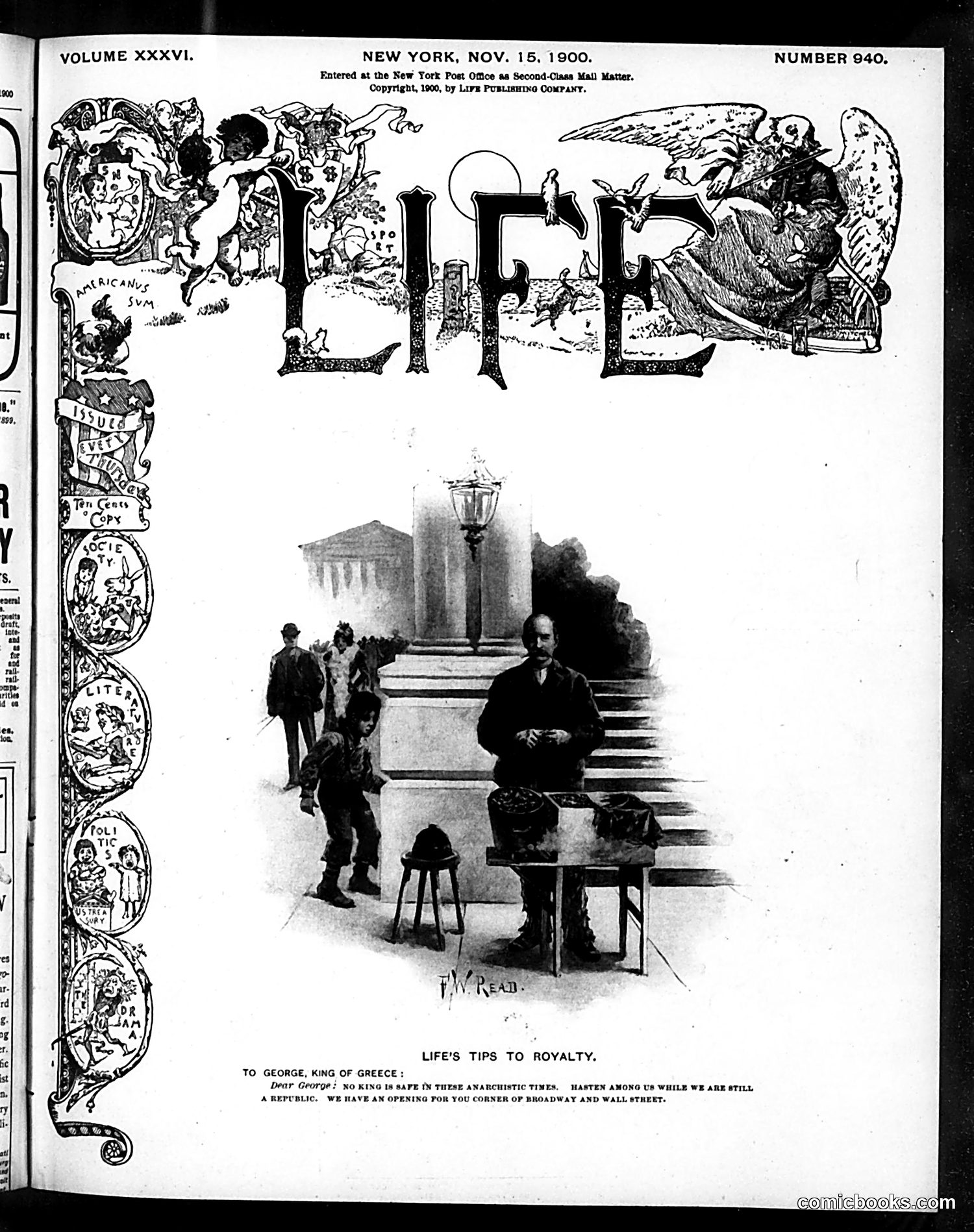
This page contains a satirical cartoon titled "Life's Tips to Royalty," addressed to George, King of Greece. The illustration depicts a street scene where a well-dressed man sits at a table while pedestrians pass by, with classical architecture visible in the background. The accompanying text mocks the Greek monarchy during anarchistic times, suggesting that "no king is safe" and offering sardonic advice about finding refuge—"an opening for you corner of Broadway and Wall Street" (New York's financial district). The satire appears to reference contemporary concerns about political instability and anarchism affecting European royalty around 1900, while simultaneously making a pointed joke about American capitalism as an alternative "safe haven" for displaced monarchs.
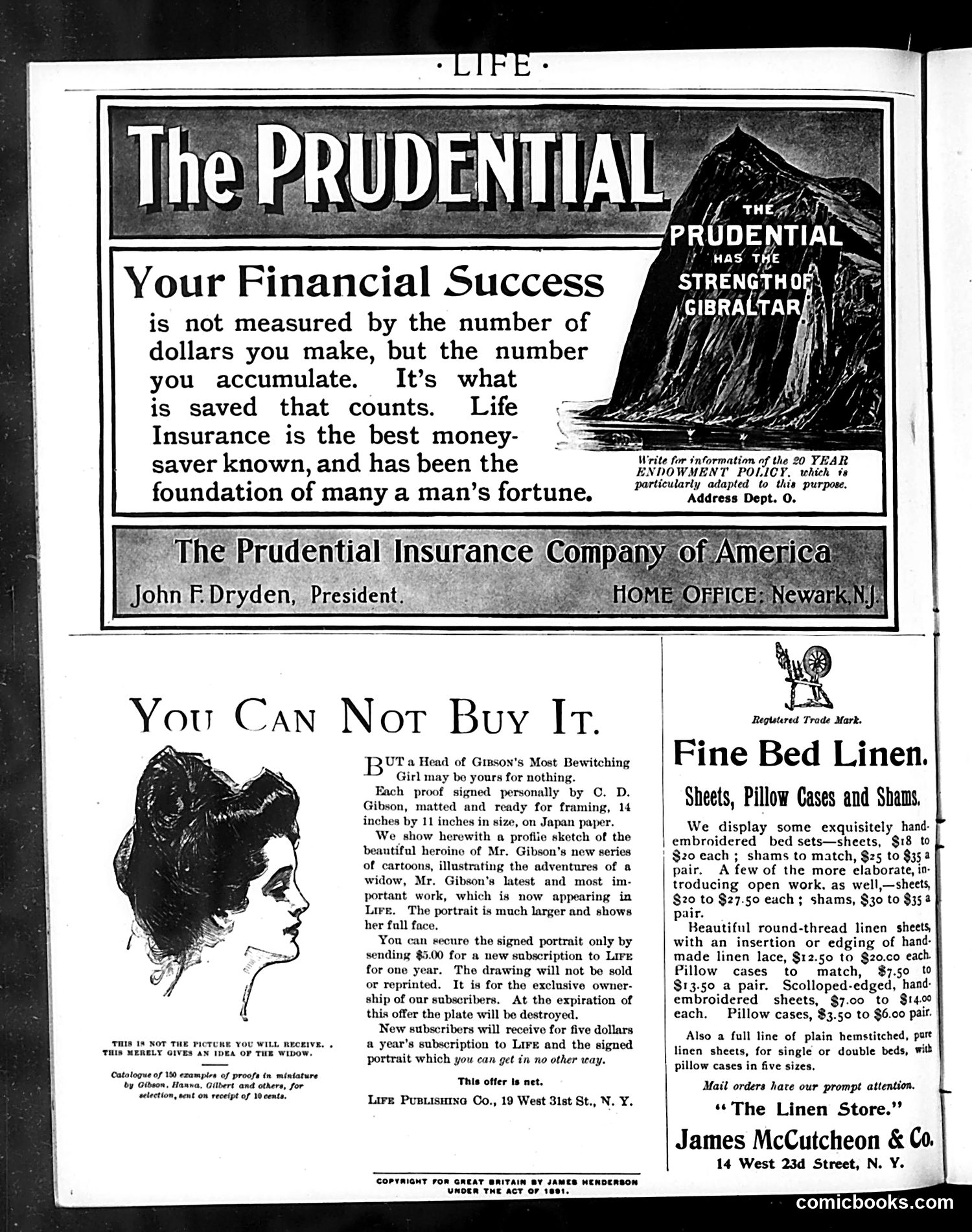
This page is primarily **advertising**, not satire or political cartooning. The top ad for Prudential Insurance uses a metaphor comparing financial strength to Gibraltar—a fortress-like rock—to promote life insurance as a wealth-building tool. The pitch emphasizes savings over income. Below that, a Life Publishing ad promotes a Gibson Girl portrait (a signed drawing by illustrator Charles Dana Gibson). The silhouette shown is the iconic "Gibson Girl"—an early 1900s feminine ideal representing beauty and sophistication. The ad offers this exclusive portrait to new subscribers. The bottom ad promotes fine bed linens and pillowcases from James McCutcheon & Co., emphasizing handwork and quality materials at various price points. The page reflects early 20th-century consumer culture and advertising conventions.
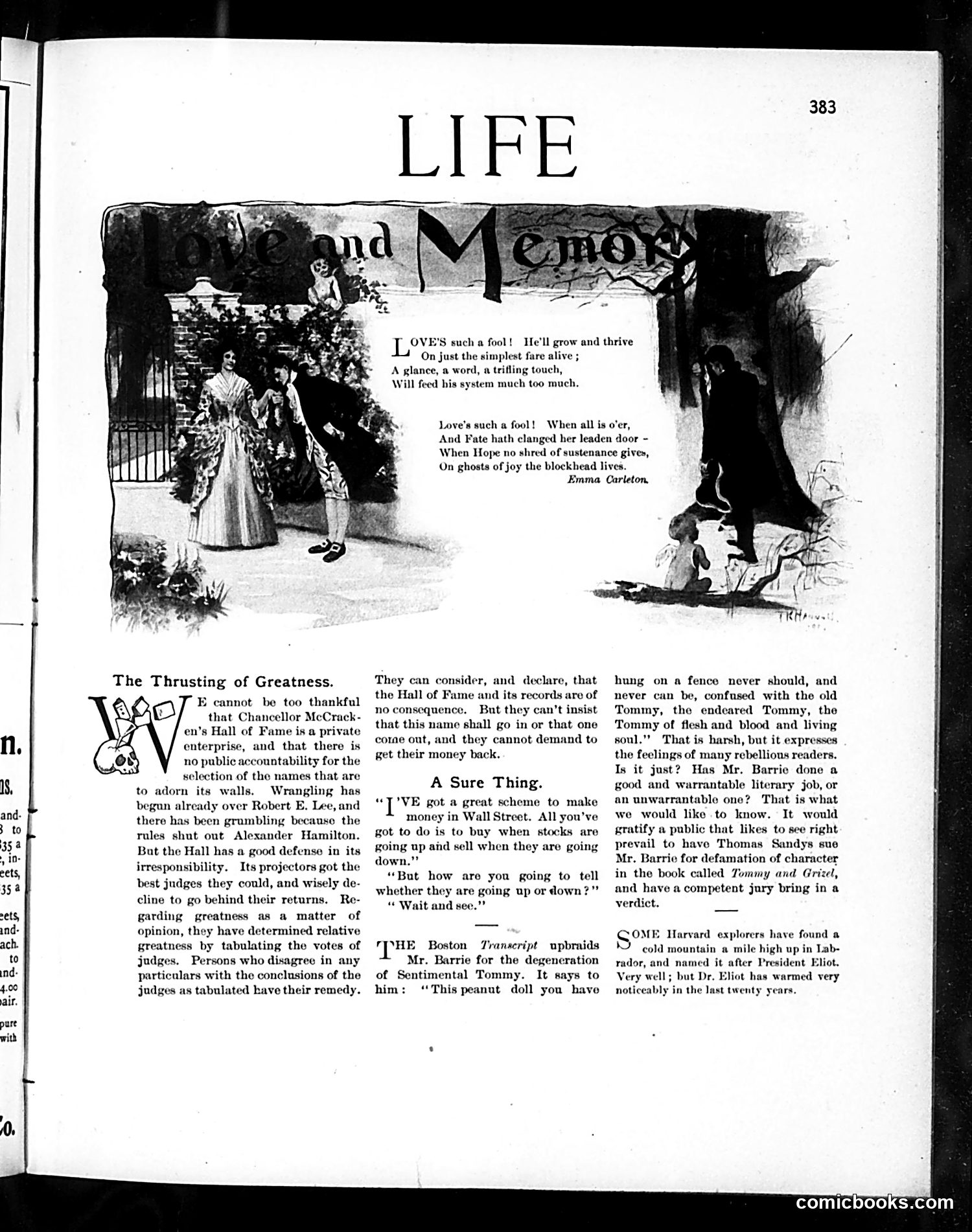
This page contains literary commentary and social satire rather than political cartoons. The main content includes: **"Love's Such a Fool!"** - A poem by Emma Carlisle about love's blindness, accompanied by illustrations of romantic scenes. **"The Thrusting of Greatness"** - Commentary defending the Chamberlin McCracken's Hall of Fame as a legitimate institution despite criticism. The text defends tabulating "greatness" through voting, responding to detractors who dispute this methodology. **"A Sure Thing"** - Dialogue satirizing Wall Street schemes, where one character pitches a stock-buying scam while another questions its legitimacy. **Additional note** regarding Mr. Barrie and "Tommy and Grizel"—likely a literary criticism about characterization. The page is primarily satirical commentary on American institutions (fame-making, finance) rather than political cartooning.
The page contains political editorial commentary rather than cartoons. The text discusses the 1900 U.S. election, specifically addressing voters who supported William Jennings Bryan (the "Free Silver" candidate who lost to McKinley) and Anti-Imperialists. The small illustration at top-left appears to show figures examining or debating something, though details are unclear in reproduction. The editorial argues against Bryan's platform and Anti-Imperialist sentiment, suggesting free silver supporters should accept McKinley's victory. It also discusses Tammany Hall's political influence in New York and references Galveston flood relief efforts. The commentary represents Life's Republican/pro-McKinley editorial stance during the contentious 1900 election featuring imperialism and monetary policy as key issues.
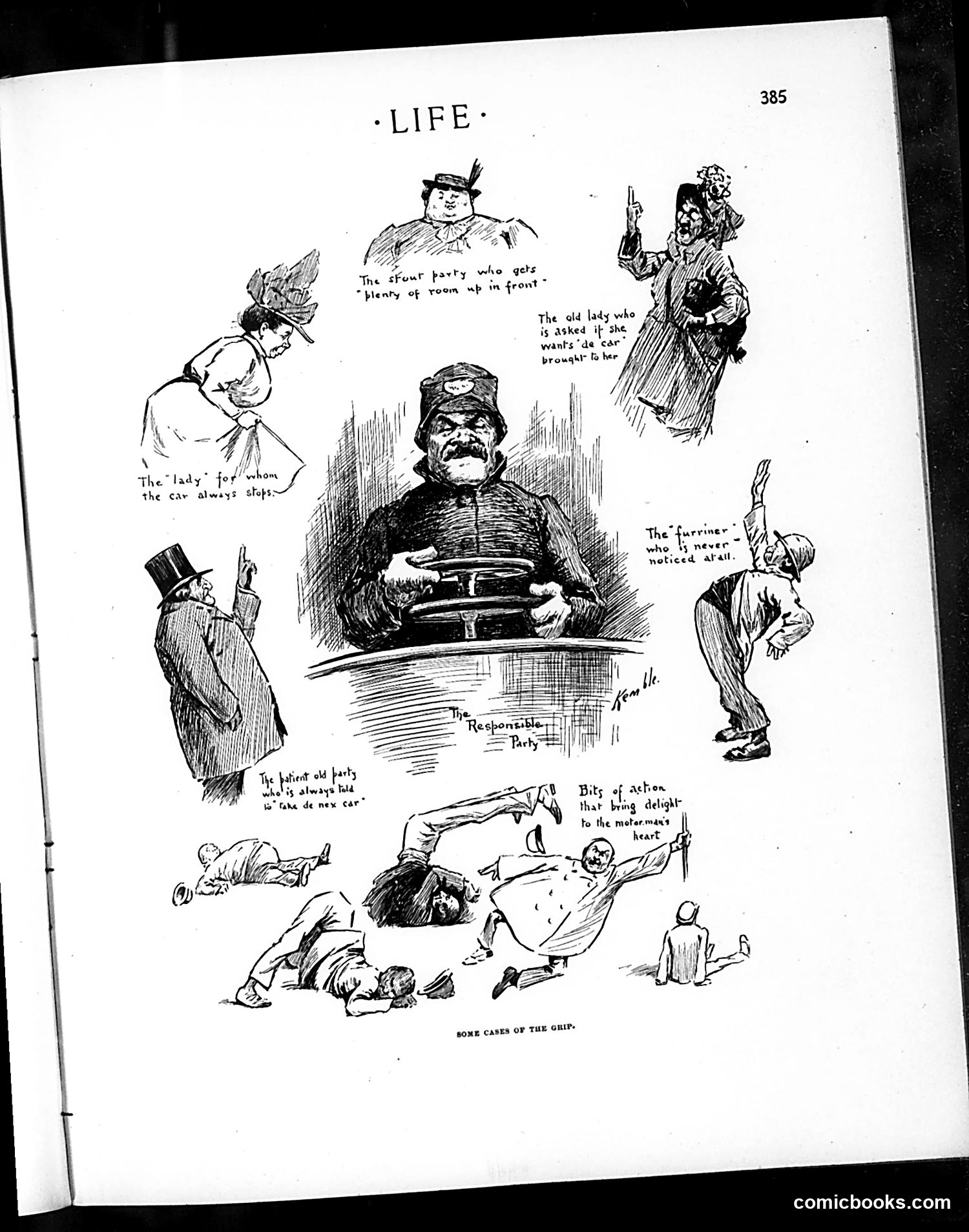
This political cartoon satirizes automotive safety and social responsibility, likely from the early 1900s when cars were new. The central figure labeled "The Responsible Party" is a gruff motorist/chauffeur at the steering wheel, surrounded by vignettes showing various accidents and victims: - "The stout party who gets plenty of room up in front" - "The old lady who is asked if she wants 'de car brought to her'" - "The lady for whom the car always stops" - "The blind old party who is always told 'de new car'" - "The farmer who is never noticed at all" - Bottom scenes show people injured or killed, labeled "Bits of ashes that bring delight to the motorman's heart" and "SOME CASES OF THE GRIP" The cartoon mocks motorists' indifference to pedestrian safety and social inequality in who receives consideration on roads.
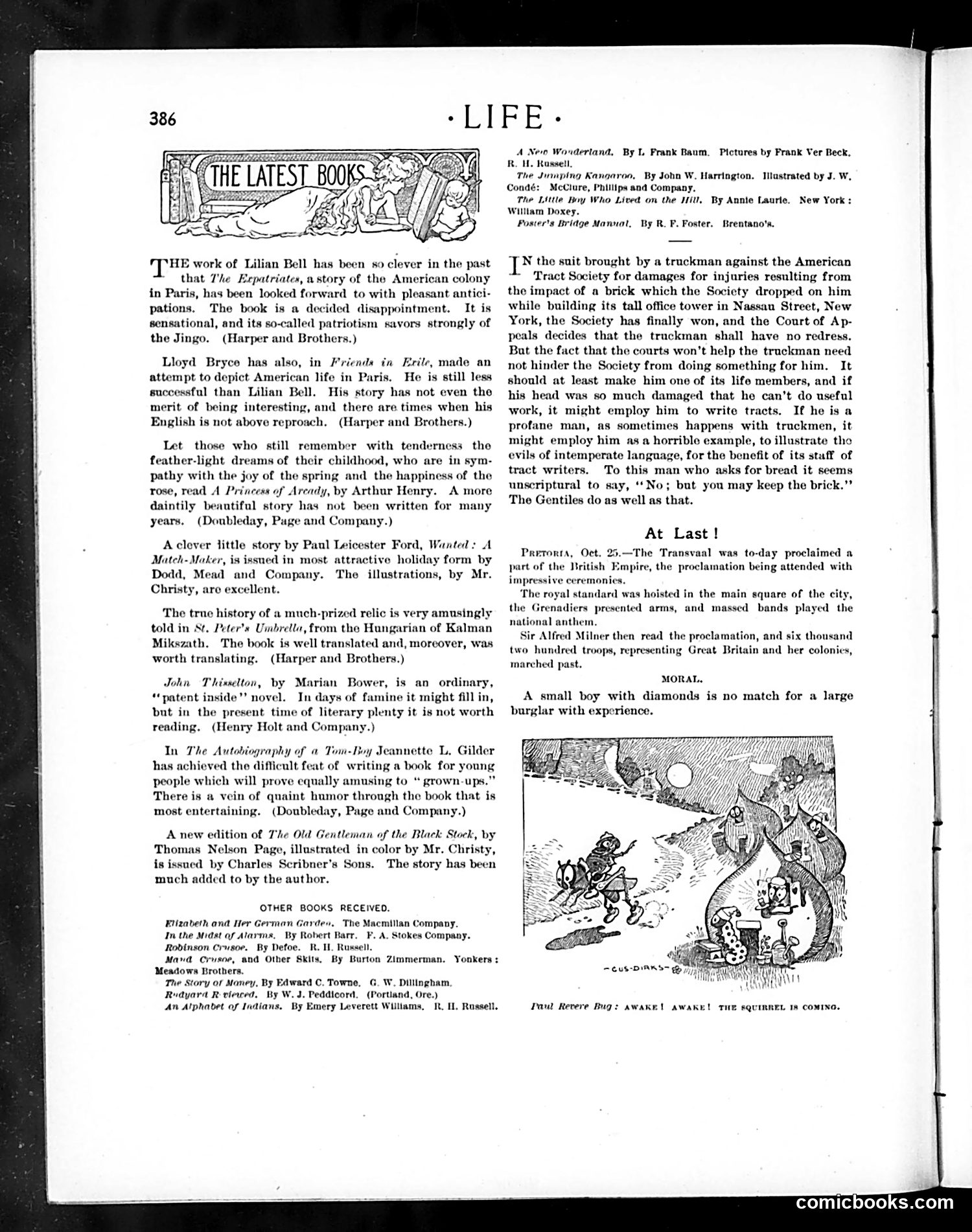
This page is primarily a **book review section** titled "The Latest Books," discussing new publications like *The Expatriates* by Lilian Bell and *Friends in Exile* by Lord Bryce. The only cartoon appears at bottom right, captioned "Two Beaver Bag! AWAKE! AWAKE! THE SQUIRREL IS COMING." It shows two beavers sleeping in their dam while a squirrel approaches—a humorous animal illustration with no apparent political meaning. This appears to be simple comedic content rather than satire. The section also mentions a proclamation in Pretoria regarding the Transvaal being incorporated into the British Empire, suggesting this magazine dates from the Boer War era (around 1900-1902). The book reviews dominate the page's content.
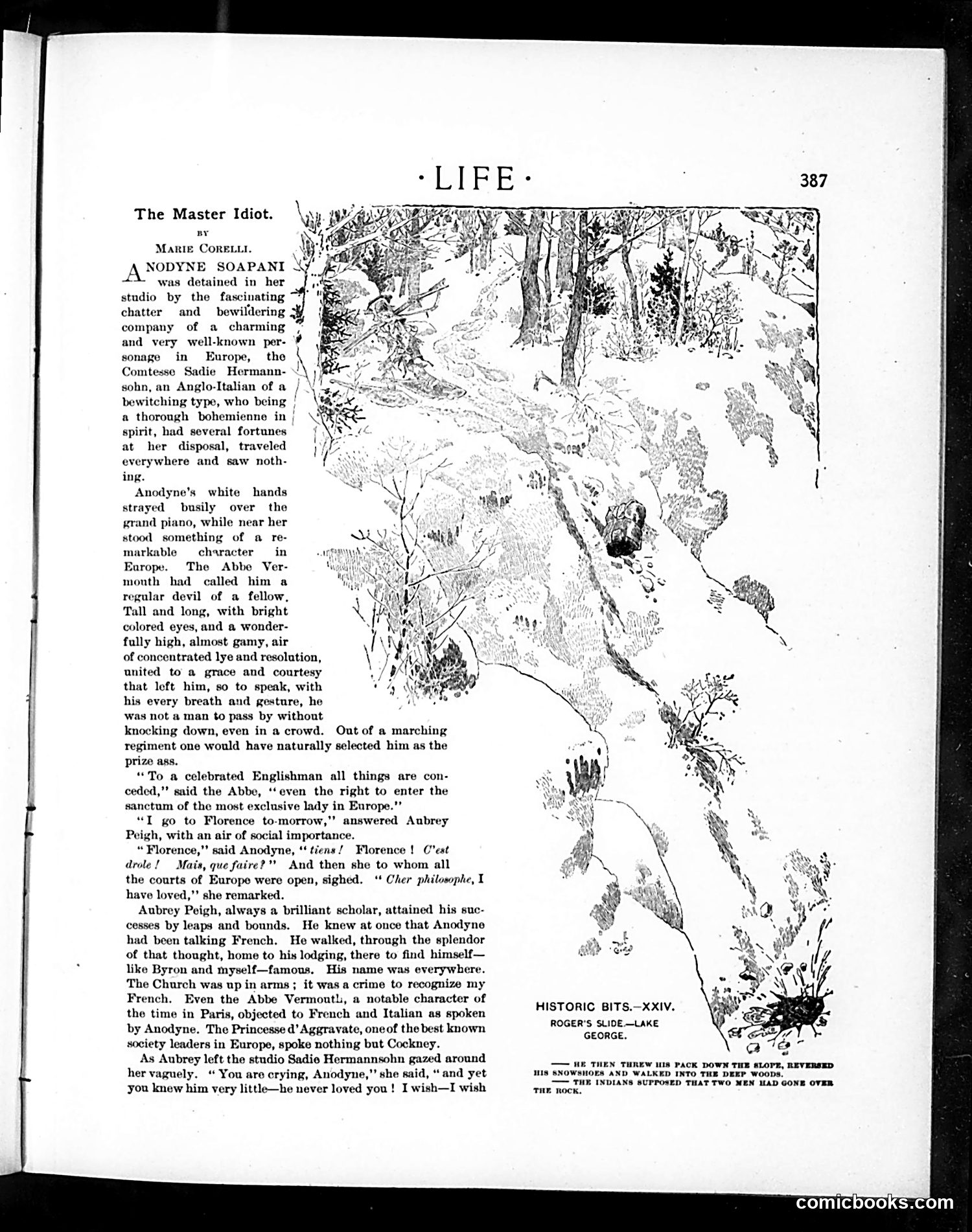
This page presents a literary story titled "The Master Idiot" by Marie Corelli, featuring the character Anodyne Soapani. The bulk of the page is text describing social interactions in a European setting, mentioning Florence, Paris, and various European courts. The illustration labeled "Historic Bits—XXIV" depicts "Roger's Slide—Lake George" and shows a landscape scene with trees and water, apparently illustrating a historical location rather than a political cartoon. There is no clear political satire or social commentary visible in either the text excerpt or the illustration on this page. It appears to be primarily a serialized fiction story with an accompanying landscape illustration—typical magazine filler content rather than satirical editorial material.
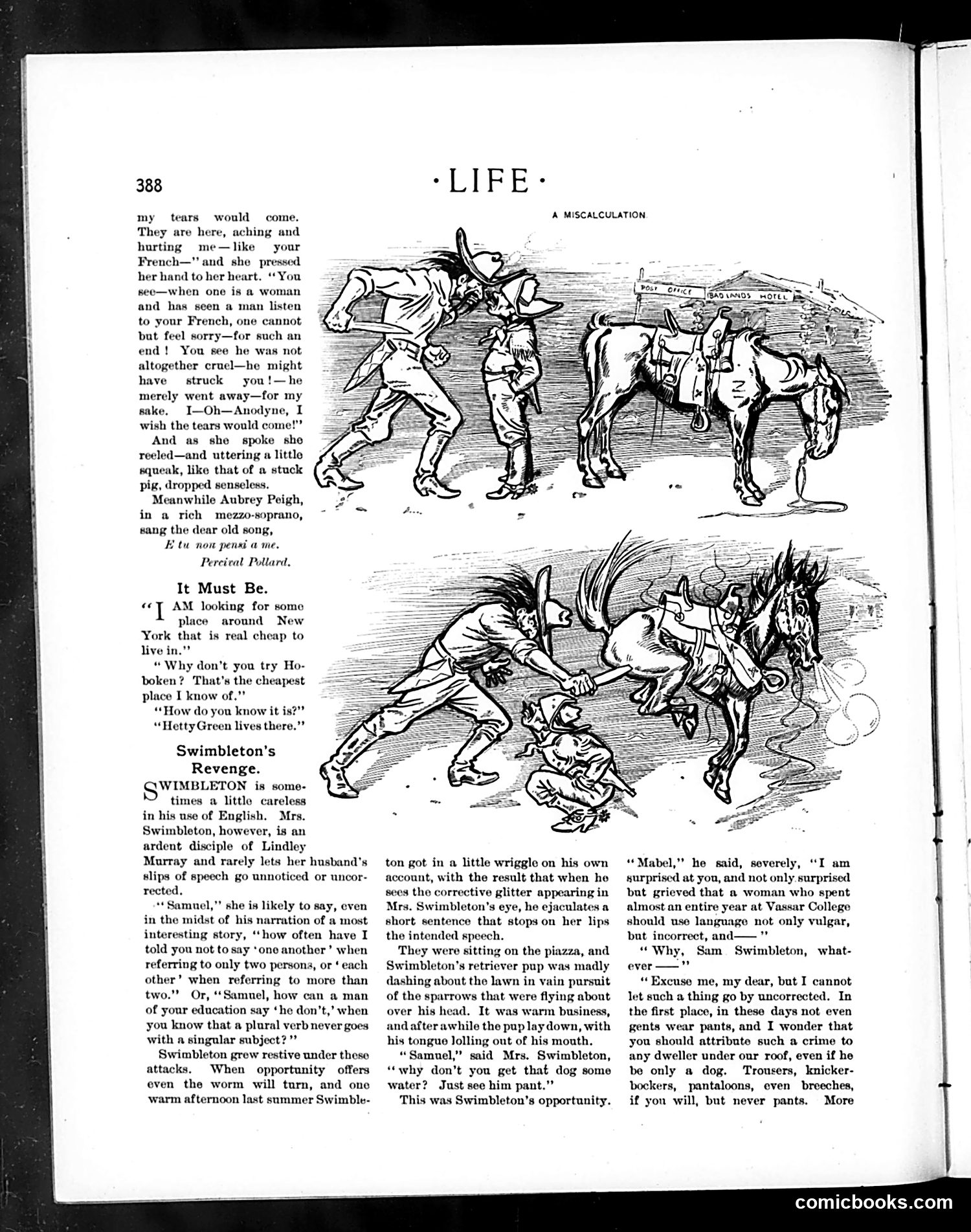
The top cartoon depicts a chaotic scene at what appears to be a post office or hotel, with figures in disarray—likely satirizing some contemporary mishap or bureaucratic bungling, though the specific reference is unclear without additional context. The bottom cartoon illustrates "Swimbleton's Revenge," a humorous domestic story about Mrs. Swimbleton, who is described as a strict adherent to proper English speech. The narrative mocks her excessive correction of her husband Samuel's language, showing him retaliating by deliberately using vulgar or improper speech in response to her pedantic criticisms. The cartoon depicts the physical chaos resulting from their linguistic conflict, satirizing both excessive propriety and marital discord through language battles.
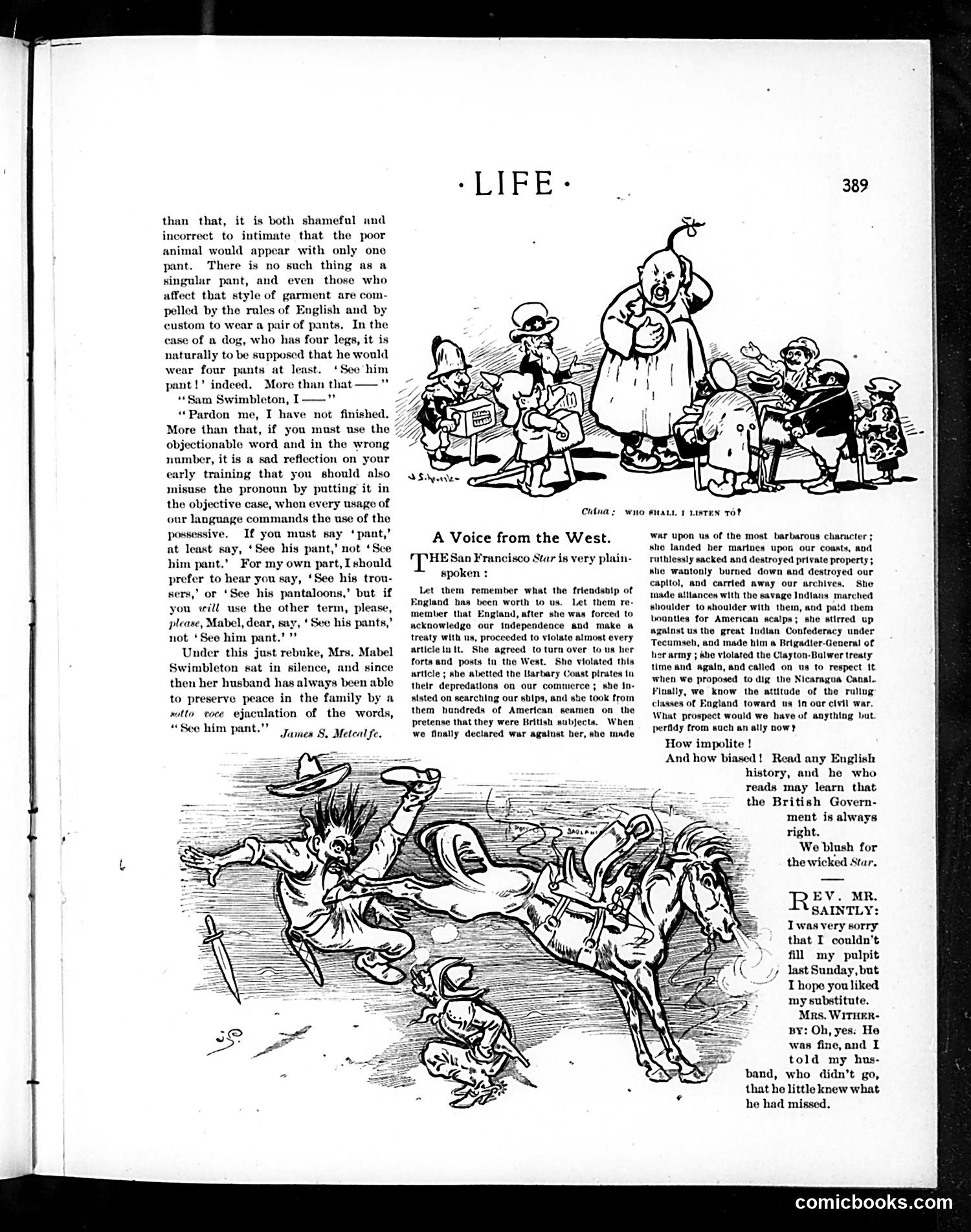
The page contains two distinct editorial pieces criticizing British imperial policy: **Upper cartoon** ("Who Shall I Listen To?"): Shows a woman (representing America or California) surrounded by competing voices—likely representing British interests seeking influence over American affairs. **Lower cartoon & article** ("A Voice from the West"): The *San Francisco Star* editorial denounces British conduct toward America, specifically referencing violations of treaties, destruction of property, and aggressive actions against American interests and Native Americans. The cartoon depicts violent chaos, likely representing warfare or British misconduct. The article criticizes the British Government's "always right" attitude and colonial behavior, expressing American outrage at British imperial overreach. The piece invokes "English history" ironically to suggest Britain's documented pattern of wrongdoing contradicts any moral authority. This appears to be anti-British propaganda from a period of Anglo-American tension, likely early-to-mid 19th century.
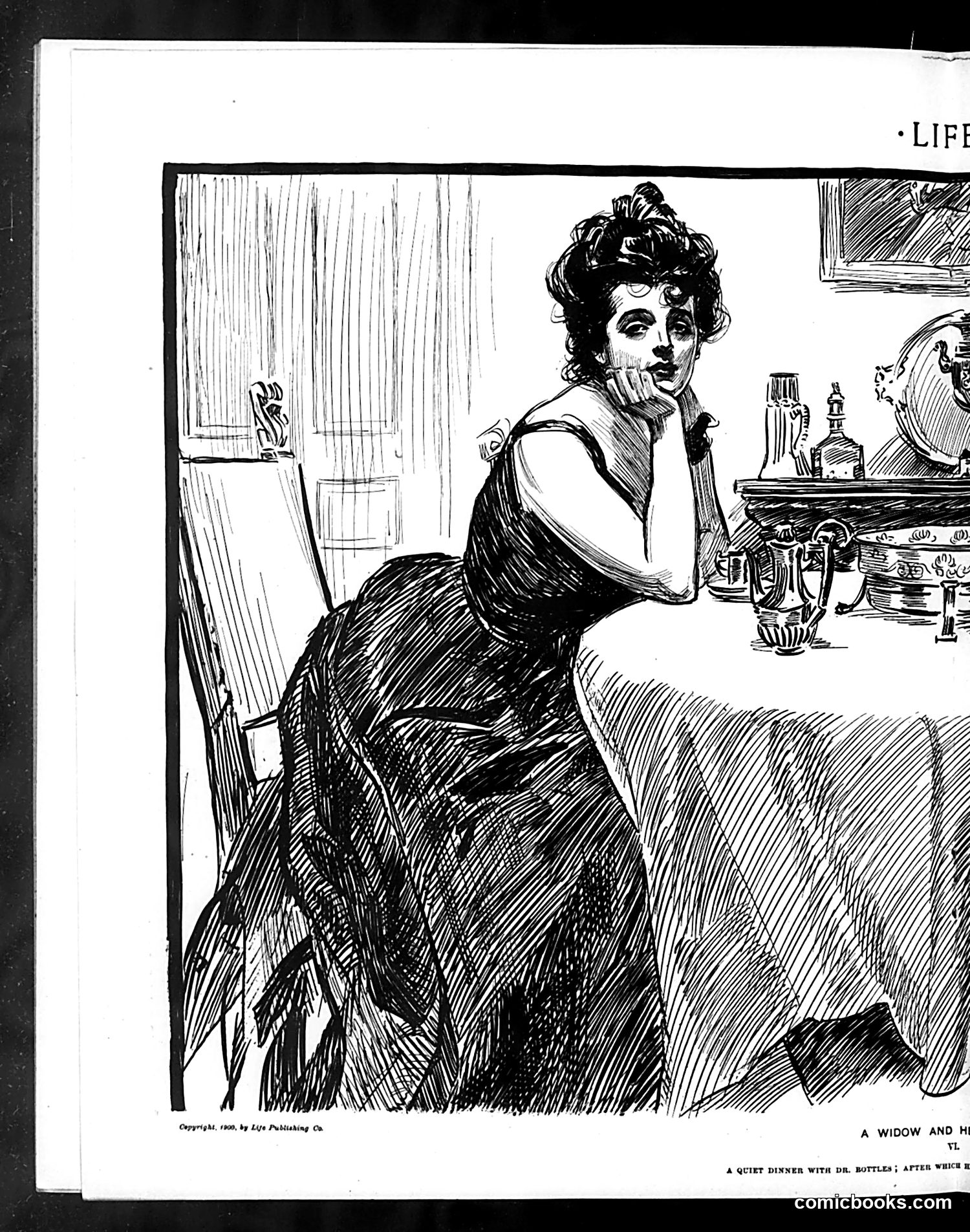
This page appears to show an illustration of a woman at her dressing table, seated and looking back over her shoulder. The drawing style is characteristic of early 20th-century pen-and-ink illustration. The caption references "A WIDOW AND HI[S]" and mentions "A QUIET DINNER WITH DR. BUTTLES; AFTER WHER[E]..." suggesting this illustrates a narrative scene, likely from a story or satirical piece in the magazine. The copyright line shows "1908, by Life Publishing Co." However, without seeing the complete caption and surrounding text clearly, I cannot definitively explain what social or political point this illustration makes. It appears to be domestic or romantic comedy material typical of Life's satirical content from that era, but the specific satire remains unclear from the visible portions.
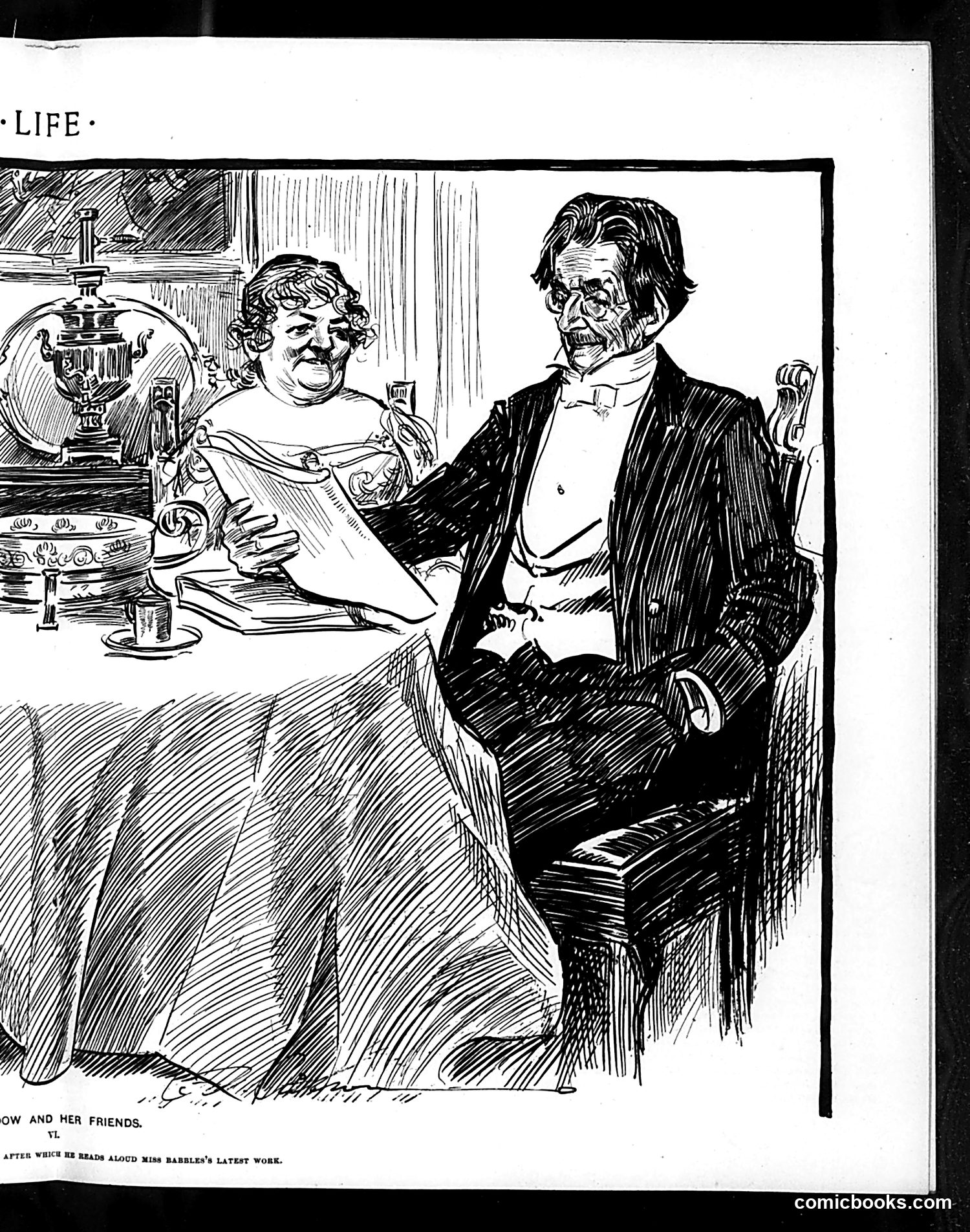
This Life magazine illustration depicts a social scene from what appears to be the late 19th or early 20th century. A well-dressed man in formal attire (tuxedo with bow tie) sits at a dining table, while a woman in elegant dress sits across from him. The setting includes fine dining accoutrements—decorative urns, fine tableware, and what appears to be an upscale interior. The caption references "Miss Babbel's latest work," though the specific identity of Miss Babbel and the exact satirical point are unclear from the visible text. The cartoon likely satirizes either social pretension, literary or artistic circles, or contemporary entertainment figures. Without complete caption text, the precise social commentary remains uncertain, though the formal setting suggests satire of upper-class society or cultural affectation.
This page contains theater criticism rather than political cartoons. The "Ballade of the Modern Play" is a humorous poem mocking contemporary theatrical trends—specifically criticizing how modern plays rely on revivals and spectacle rather than quality writing. The reviews below discuss current productions including "The Belle of Bridgeport" (featuring May Irwin and Peter Dailey), "Arizona," and various other plays. The critics praise performances by May Irwin and Wolf Hopper while noting that some productions sacrifice substance for entertainment value. The decorative "DRAMA" emblem and small illustrations are typical of Life's design aesthetic but aren't satirical cartoons. The page's humor lies in the written commentary on theatrical mediocrity and the absurdities of contemporary stage productions.
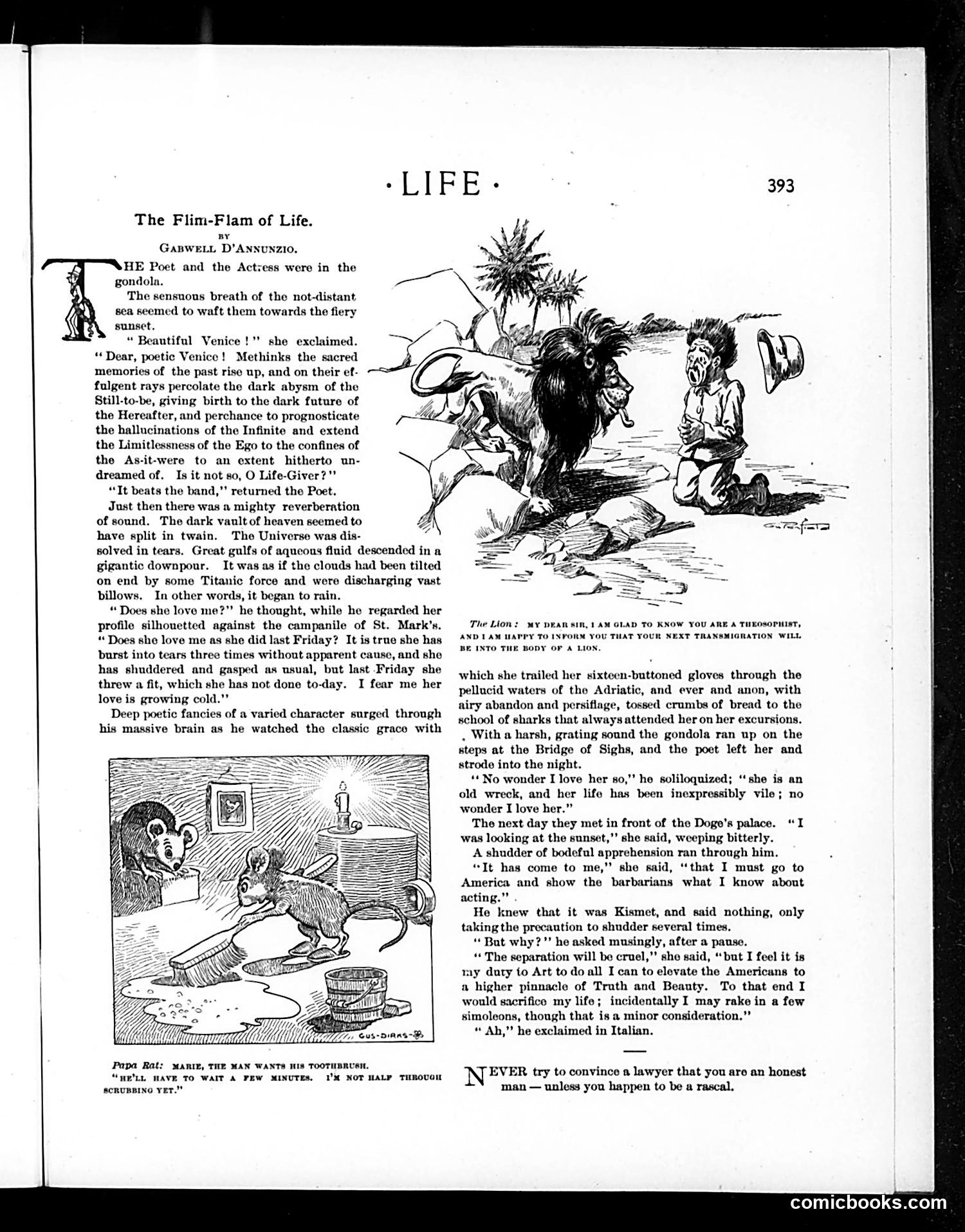
This page satirizes pretentious artistic posturing and romantic melodrama. The main story mocks an overly verbose Poet and affected Actress in Venice, spoofing their flowery, pseudo-philosophical dialogue about love and existence. When the Poet's romantic musings are interrupted by sudden rain, he learns his lover plans to leave for America to educate "barbarians" about acting—conflating her artistic "duty" with mercenary profit ("simoleons"). The humor lies in deflating grandiose Romantic pretension: she claims noble sacrifice while clearly pursuing money; he romanticizes her "vile" life even as the story reveals her shallowness. Two accompanying cartoons reinforce the theme: one shows rats, another depicts a theosophist being told he'll reincarnate as a lion. These mock contemporary spiritual fads and self-importance. The closing aphorism—never convince a lawyer you're honest unless you're actually a rascal—extends the satirical point about society's disconnect between professed values and actual behavior.
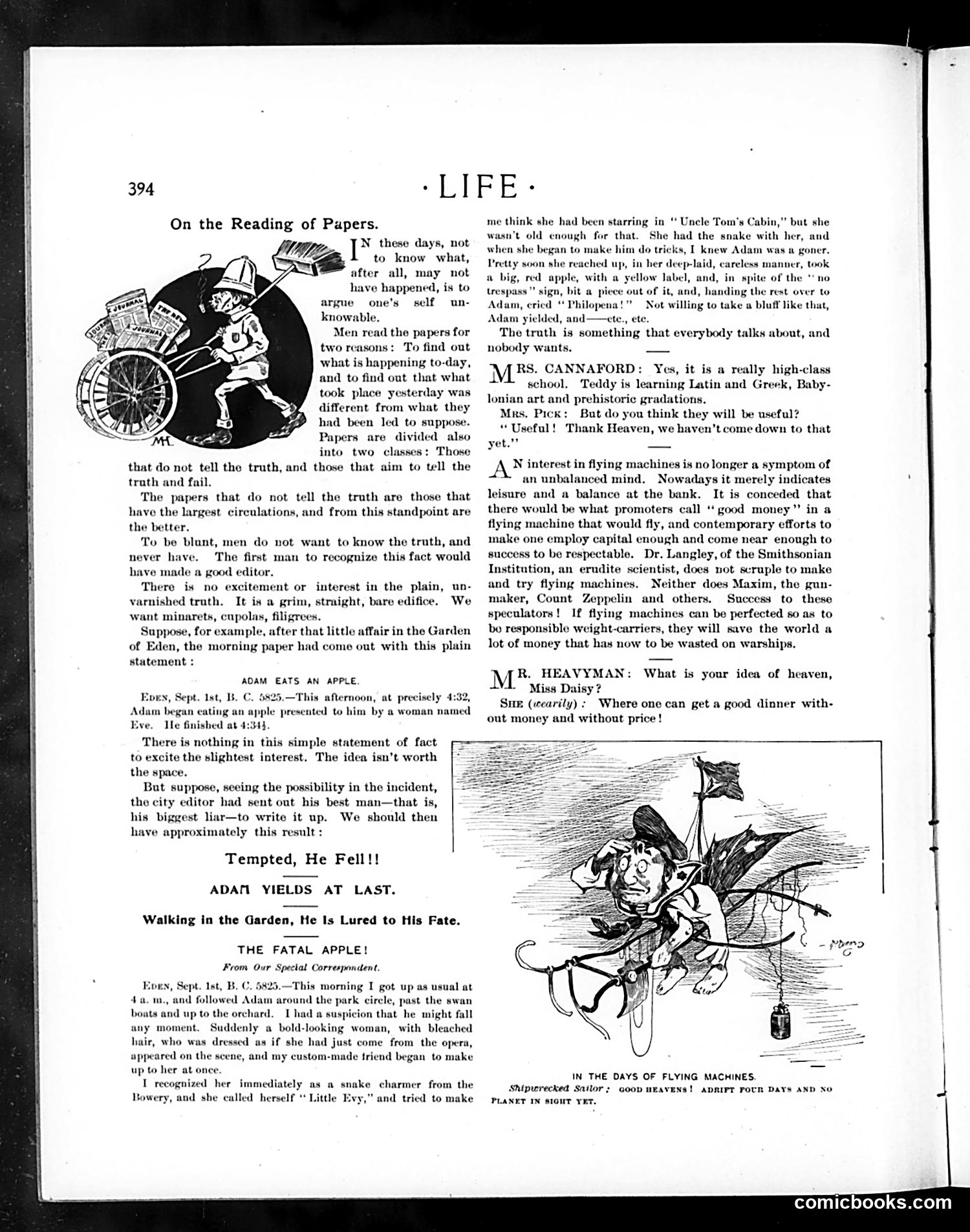
This page satirizes newspaper journalism and public gullibility. The main essay "On the Reading of Papers" argues that newspapers deliberately distort truth because readers want sensational stories, not facts. The Adam and Eve example illustrates this: a factual account ("Adam Eats an Apple") is boring, while a fabricated, melodramatic version ("Tempted, He Fell!!!") generates interest. The cartoon at bottom right mocks flying machine speculation—depicting a charlatan promoting an absurd contraption. The accompanying text suggests that interest in aviation indicates wealth/leisure rather than scientific viability, and notes that speculators like Count Zeppelin are wasting resources that could fund warships. A brief dialogue jokes that "heaven" means affordable dining without expense. **Context:** This reflects early 1900s skepticism toward both sensationalist "yellow journalism" and emerging aviation technologies being promoted as investment schemes.
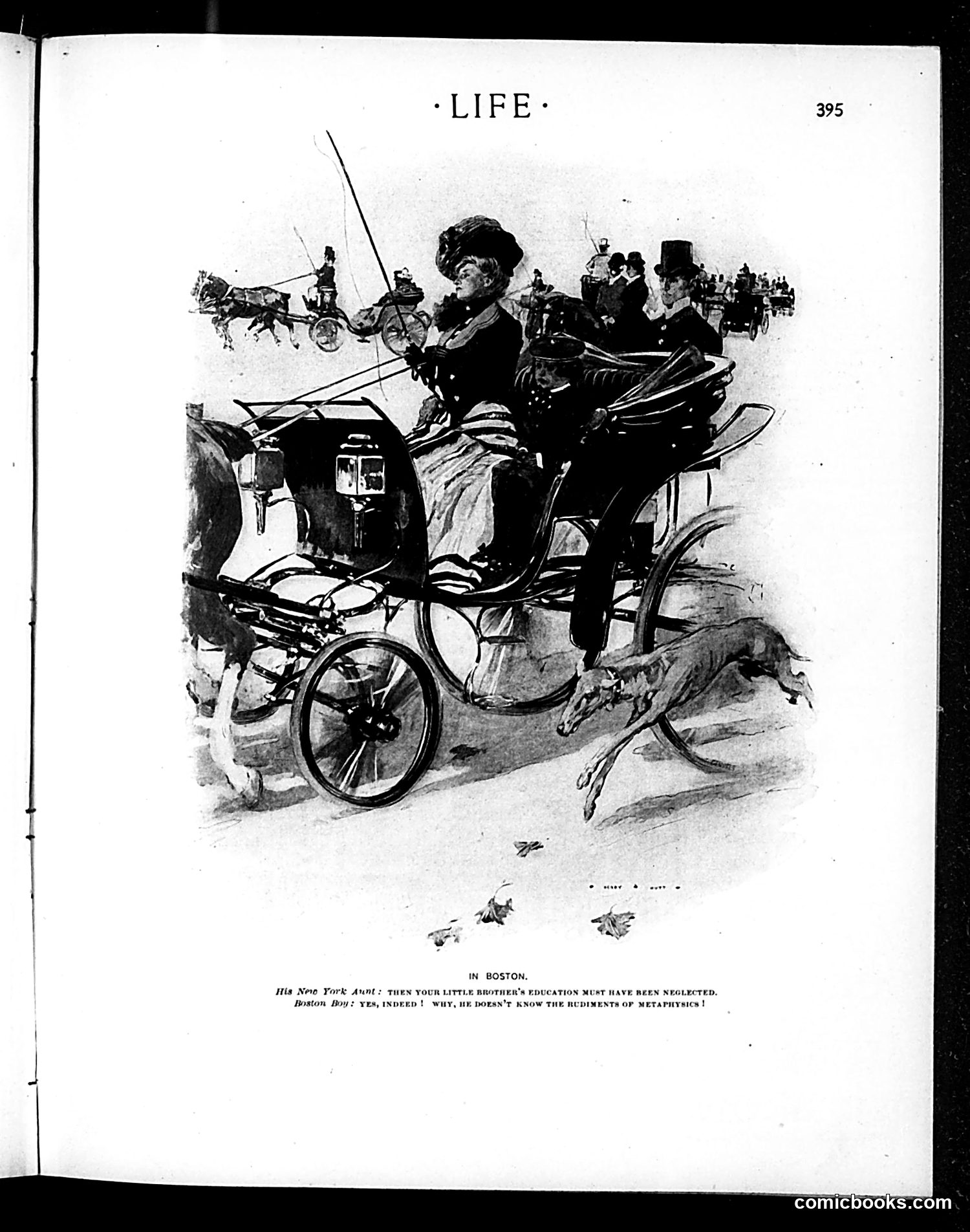
This is a satirical cartoon mocking Boston's reputation for intellectual pretension. A visiting New York aunt criticizes a Boston boy's education, noting his younger brother's ignorance of metaphysics—an absurdly advanced philosophical subject for a child. The joke targets Boston's self-image as America's intellectual hub. By suggesting that even young children should master metaphysics, the cartoon exaggerates Bostonian snobbery and academic pomposity. The aunt's condescending tone toward the "neglected" education highlights how Bostonians were perceived as arrogantly assuming superiority in culture and learning. The illustration shows well-dressed figures in a carriage, emphasizing the upper-class context of this pretentious attitude.
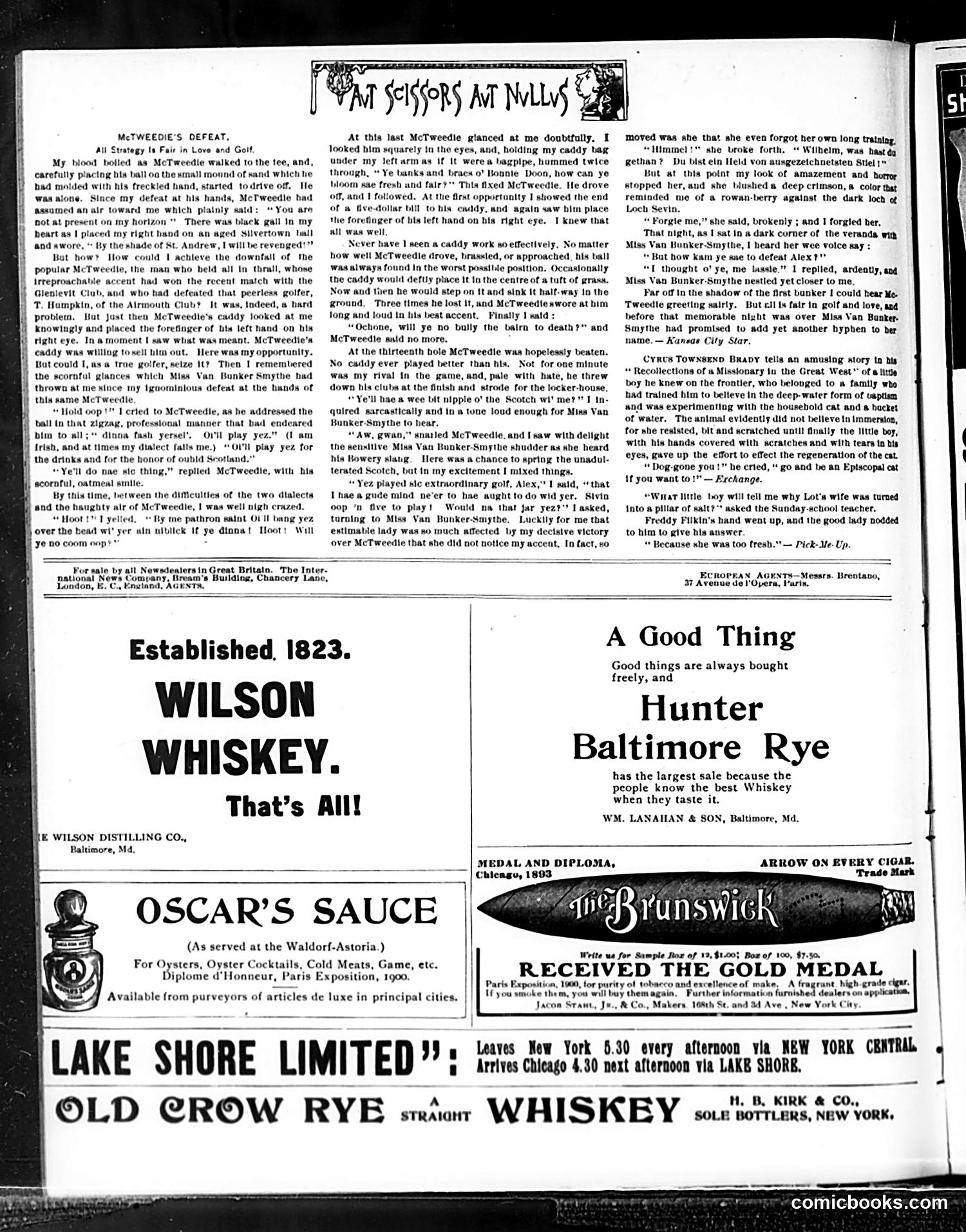
This page presents a humorous short story about golf rivalry and romantic competition, not political satire. The narrator seeks revenge on "McTweedie," a smug Scottish golfer who defeated him and won the attention of Miss Van Bunker Smythe. The humor relies on: 1. **Scottish dialect comedy** — The narrator and characters speak in exaggerated Scots ("dinna fash yersel'," "Ye'll hae a wee bit nipple o' the Scotch"), a common early 20th-century American literary device for comedic effect. 2. **Bribery plot** — The narrator bribes McTweedie's caddy to sabotage his game, placing his ball in difficult positions. This "all's fair" moral inversion drives the story. 3. **Social class** — References to exclusive golf clubs and the pursuit of an upper-class woman suggest satire of genteel pretension, though mildly. The page is primarily **advertising** (whiskey, sauce, cigars, train service), with the story as filler content — typical Life magazine format of this era.
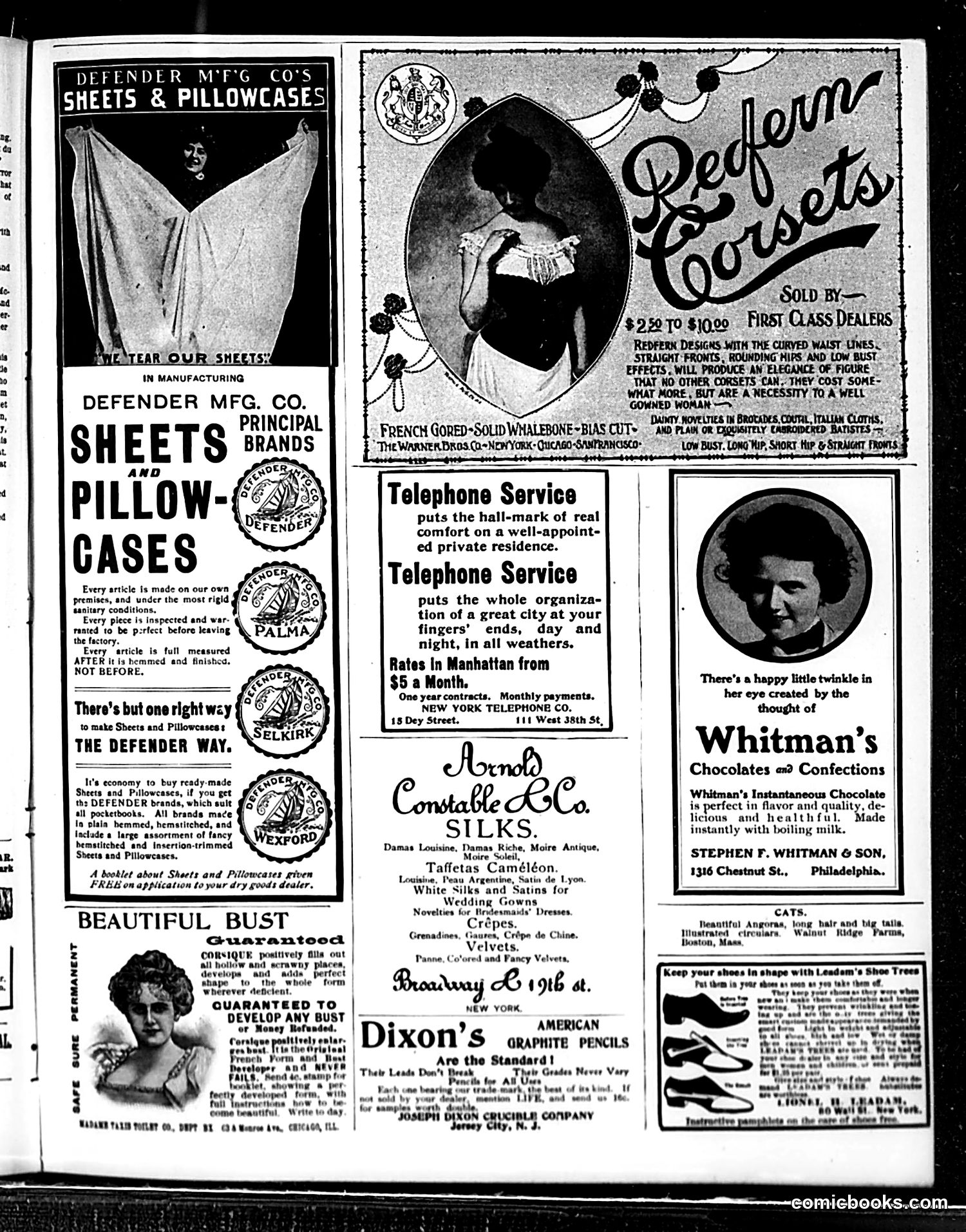
This is primarily an **advertising page** with no political cartoons or satire. The page consists of early 20th-century product advertisements typical of Life magazine's revenue model. Notable ads include: - **Defender Manufacturing**: sheets and pillowcases marketed with quality assurances - **"Redfearn Corsets"**: a corset advertisement emphasizing the curved waistline fashionable at the time - **"Beautiful Bust" corset**: guaranteed to develop or enlarge the bust, or "Money Returned"—reflecting period beauty standards - **Whitman's Chocolates**: positioned as an aspirational luxury good - **Dixon's Pencils** and **Arnold Constable Silks**: standard commercial advertisements - **Telephone Service**: promoting Manhattan telephone service at $5/month The ads reveal **contemporary obsessions**: shapewear, physical development products, luxury textiles, and emerging technologies like telephones. The imagery and copy reflect early 1900s gender expectations and consumer culture, but contain no satirical commentary—this is straightforward commercial promotion.
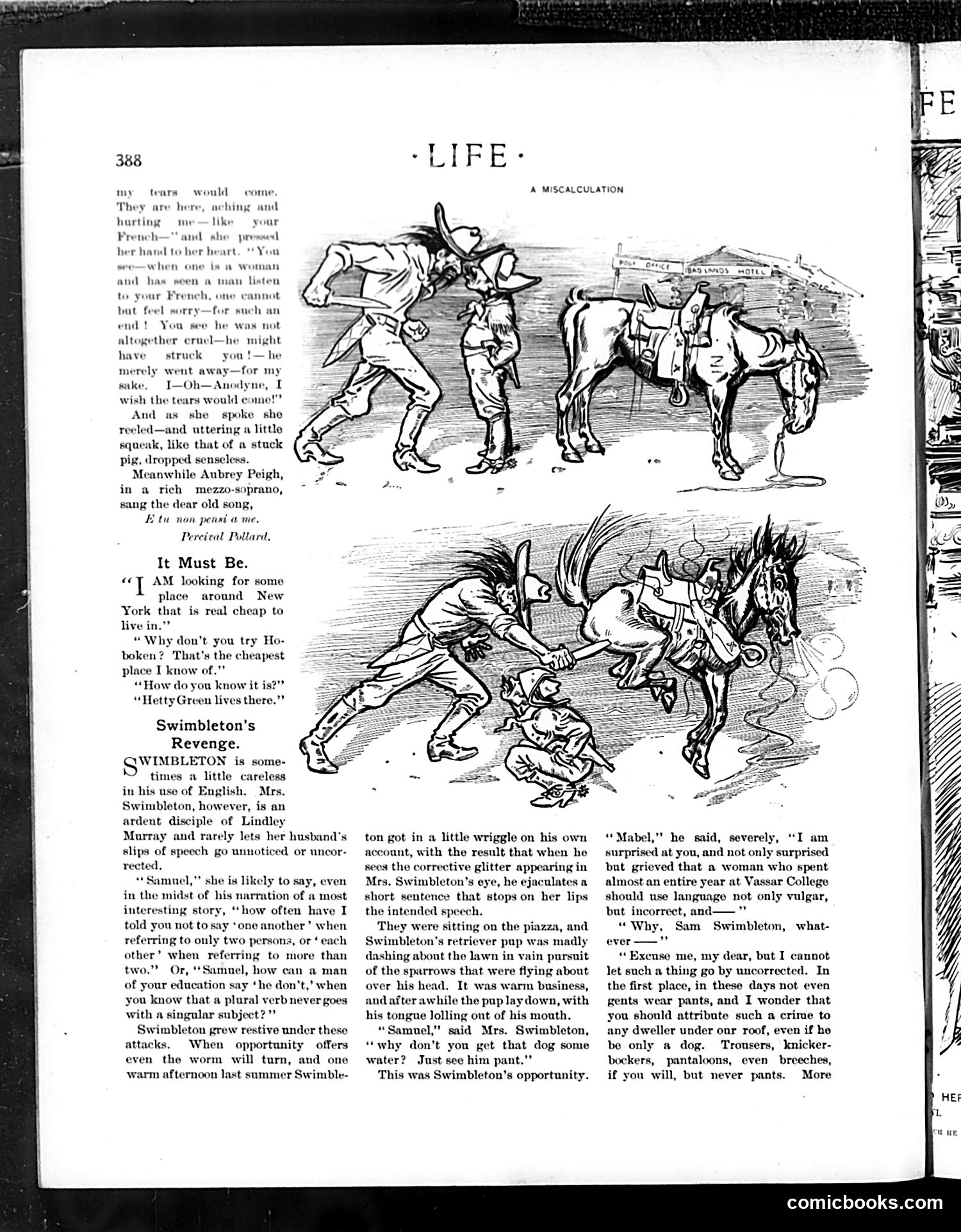
This page contains humorous domestic satire targeting pedantic language correction. The story depicts "Swimbleton," a henpecked husband whose wife, Mrs. Swimbleton (educated at Vassar College), constantly corrects his grammar based on Lindley Murray's rules—a standard 19th-century English grammar authority. The cartoon illustrates Swimbleton's revenge: when his wife uses the colloquial term "pants" (improperly, he claims), he launches an overwrought grammatical lecture, turning her own weapon against her. He argues that "gentlemen" don't wear "pants" but rather "trousers," "knickerbockers," or "pantaloons"—a pedantic gotcha moment. The satire mocks both excessive grammar-policing and the absurdity of rigid formalism. The accompanying illustrations show physical comedy of a retriever and its chaos, contrasting with the intellectual battle over proper English. This reflects period anxiety about correct speech and education among middle-class Americans.
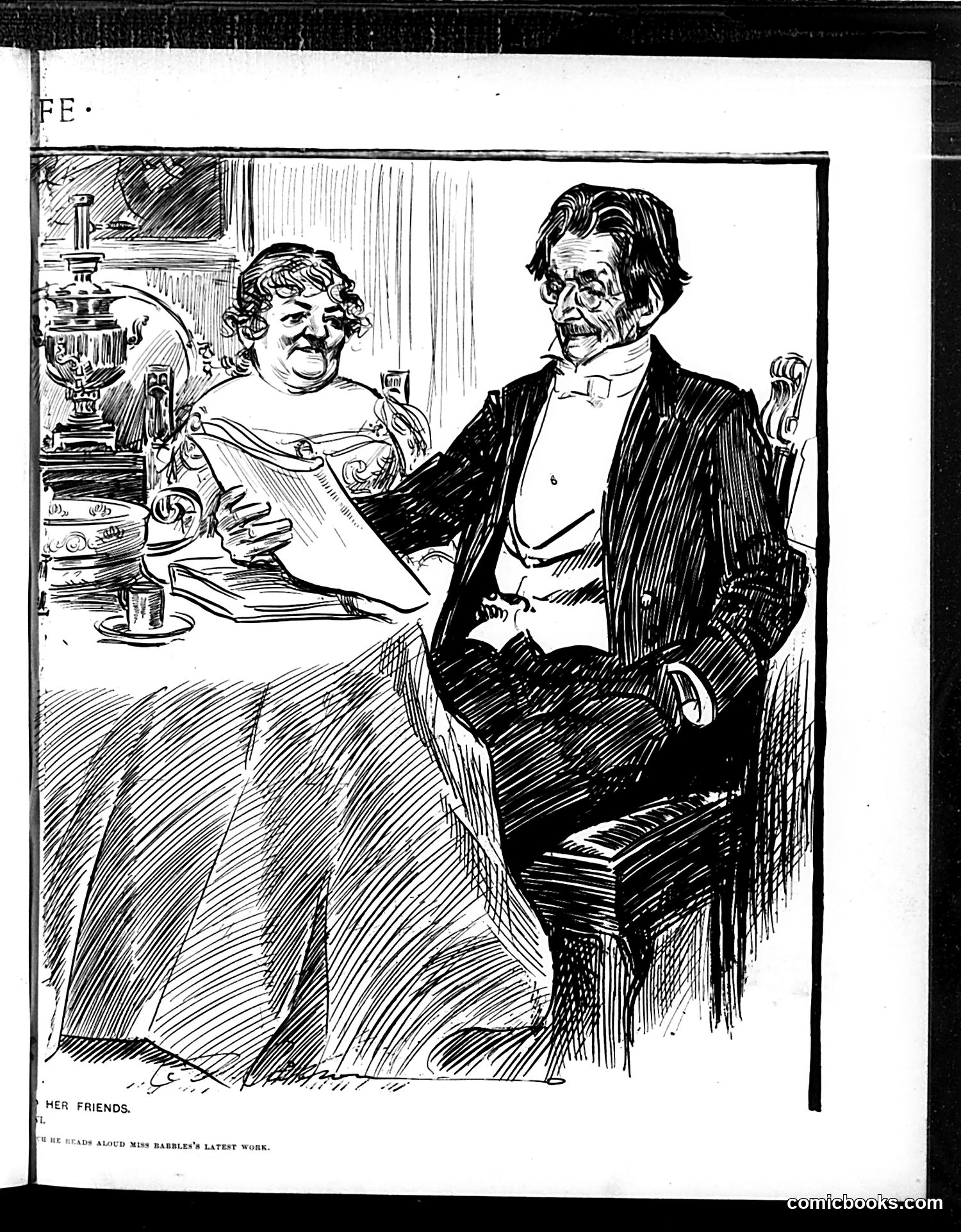
This satirical cartoon titled "Her Friends" appears from a Life magazine page. The illustration shows a dinner scene with a woman and a man in formal attire. Based on the OCR text mentioning "Miss Babbett's Latest Work," this likely satirizes a contemporary female writer or social figure named Babbett. The cartoon depicts what appears to be a social gathering, with the woman displaying animated conversation while the man sits in a more restrained, uncomfortable pose. The satire likely mocks either the pretensions of high society dining, gender dynamics in courtship, or contemporary literary/intellectual trends. The exaggerated caricatural style typical of Life magazine suggests social commentary on the depicted subjects' appearance or behavior during this formal occasion. Without additional context about Miss Babbett specifically, the exact target remains unclear.
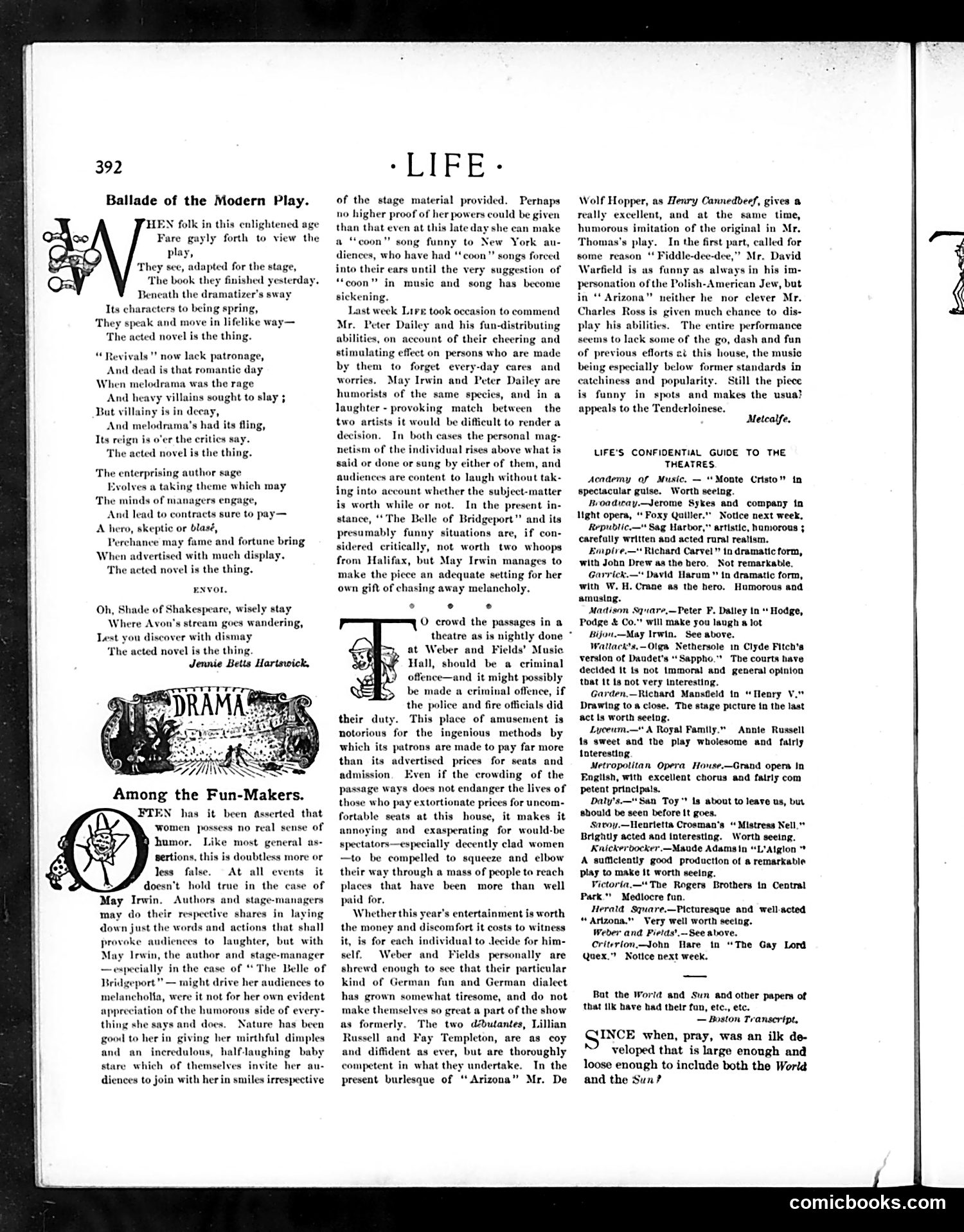
This page from Life satirizes the state of American theater circa early 1900s. **The Poetry**: "Ballade of the Modern Play" mocks the theatrical trend of adapting novels for the stage rather than creating original drama. The refrain "The acted novel is the thing" expresses cynical dismissal—even invoking Shakespeare's ghost to lament that original, ambitious theater (with heroes and villains) has died, replaced by safe, commercially driven adaptations. **The Theater Criticism**: The prose section praises comedians **May Irwin** and **Peter Dailey** for their personal charisma, which elevates mediocre material. Irwin notably makes "coon" songs (racist minstrelsy content) funny despite audiences being exhausted by the genre—her talent transcends bad material. A secondary complaint criticizes **Weber and Fields' Music Hall** for overcrowding passages and charging inflated prices while endangering patrons—especially women forced to squeeze through crowds. **Overall Point**: Theater is driven by commerce and performer personality rather than artistic merit or original writing.
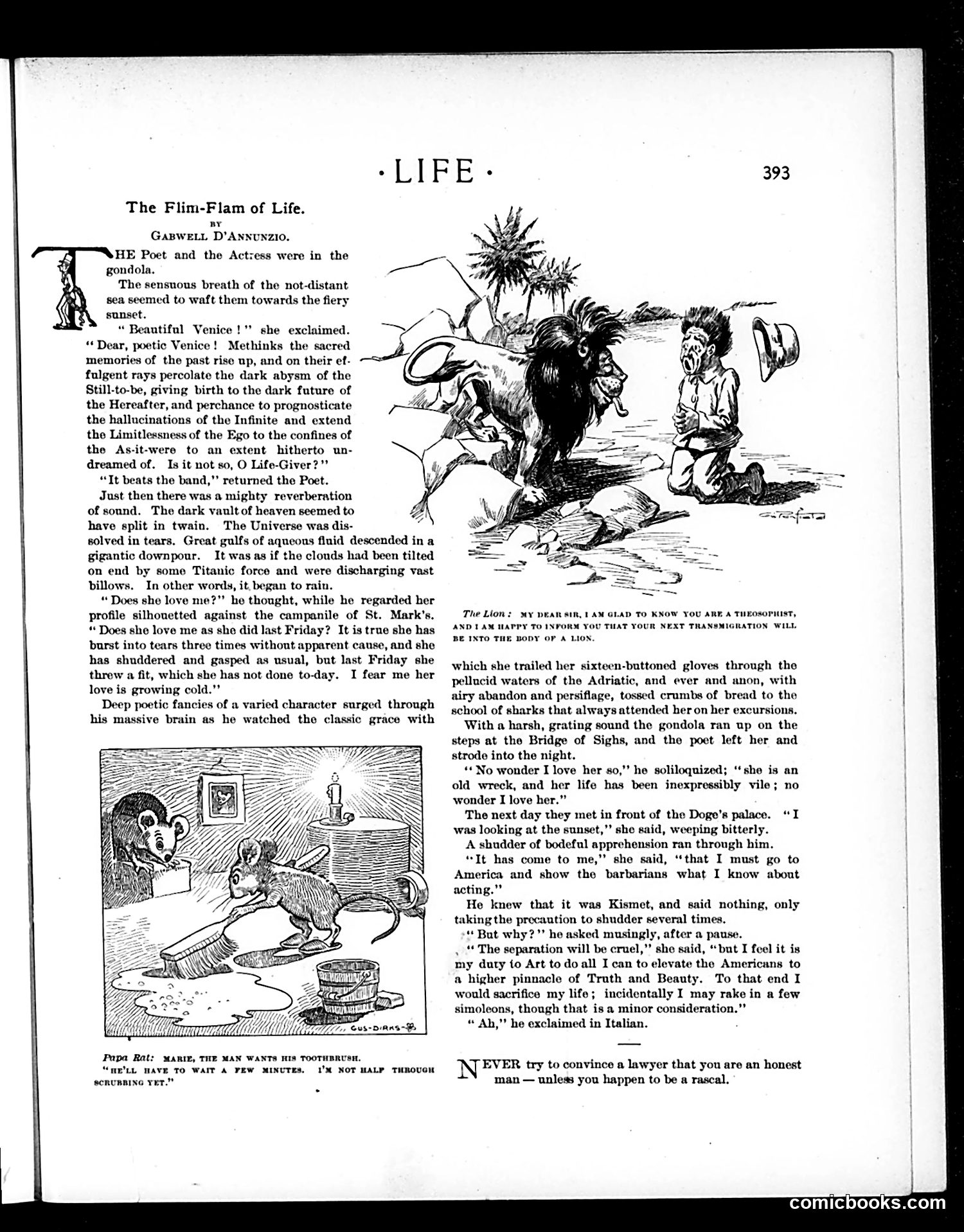
This page satirizes pretentious bohemian romance and artistic affectation. The main story mocks a self-absorbed poet and actress in Venice exchanging overwrought, pseudo-intellectual dialogue ("the dark abysm of the Still-to-be"). When it rains, the poet's romantic musings collapse into banality ("It beats the band"). The satire intensifies when the actress announces she must go to America to "elevate" audiences through her acting, while admitting she'll rake in "simoleons" (money). The poet's acceptance that this is "Kismet" (fate) underscores his own self-deluding passivity. Two smaller cartoons mock other types: one shows a dentist and impatient patient; another depicts a lion telling a theosophist his next reincarnation. The final epigram ridicules lawyers' dishonesty. The piece targets affected artistic pretense, vanity, and the gap between grandiose self-presentation and mercenary reality—common Life magazine targets.
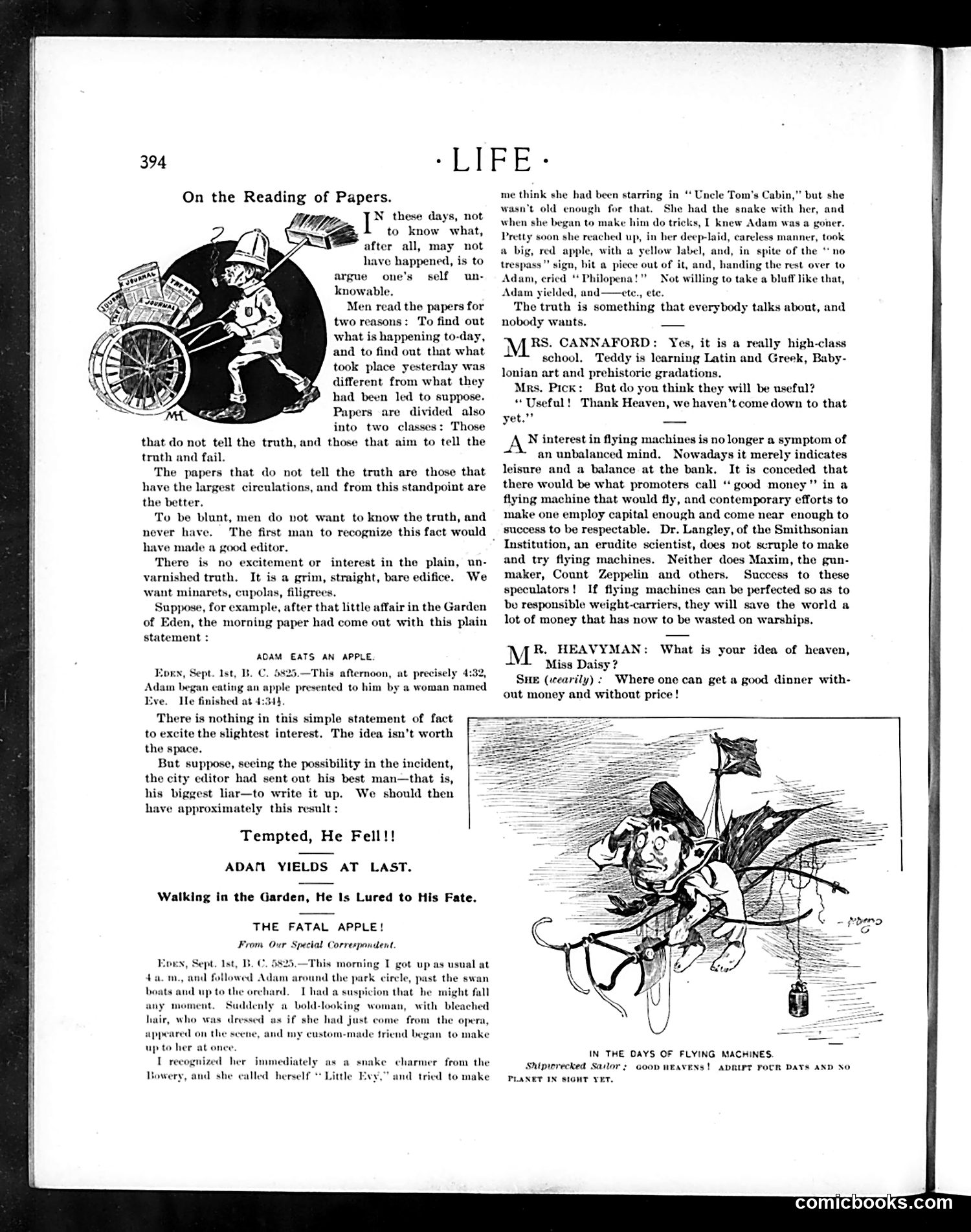
This page satirizes **newspaper sensationalism**. The main essay argues that newspapers deliberately distort truth because readers prefer exciting lies to plain facts. The illustration shows how a trivial event—Adam eating an apple—could be transformed from a boring one-liner into scandalous clickbait by an unscrupulous "city editor" (journalist). The exaggerated account invents lurid details: a mysteriously bleached woman, a snake charmer from "the opera," theatrical dramatics—turning the biblical event into melodrama. The satire criticizes both **tabloid journalism** and **reader appetite for sensationalism**. It suggests major newspapers prioritize circulation over accuracy, and that the public doesn't want truth anyway. Secondary jokes mock educational pretension (teaching "Babylonian art and prehistoric gradations" as useless) and defend **aviation investment** as legitimate (not a "symptom of an unbalanced mind"). The cartoon's title, "In the Days of Flying Machines," suggests aviation has become routine—a sarcastic commentary on early 1900s technological enthusiasm.
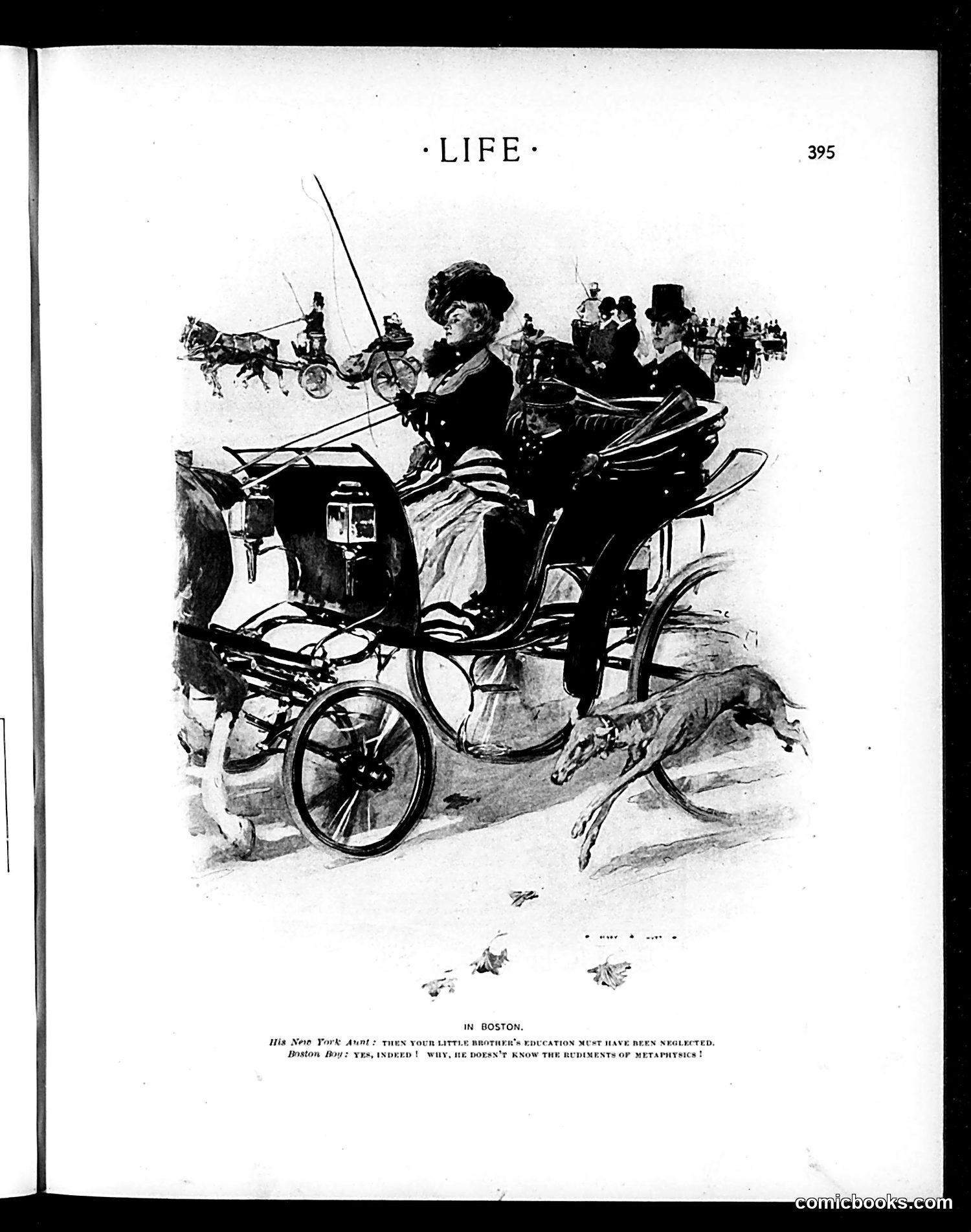
This is a satirical cartoon depicting a social class distinction between New York and Boston. A well-dressed New York aunt visits Boston and criticizes a young Boston boy's education, saying he's "neglected" it. The Boston boy responds that indeed, the New York boy "doesn't know the rudiments of metaphysics." The joke mocks Boston's intellectual pretension and snobbery. While New Yorkers might consider Boston education inadequate, Bostonians counter that New Yorkers lack philosophical sophistication. The cartoon satirizes both cities' regional pride and the era's class-conscious attitudes about education and cultural refinement. The carriage scene and formal dress emphasize the upper-class context of this snobbish exchange.
This page presents "McTweedie's Defeat," a humorous golf narrative satirizing class pretension and competitive duplicity. The narrator, speaking in exaggerated Scottish dialect, seeks revenge against the arrogant golfer McTweedie, who has defeated him and impressed the eligible Miss Van Bunker-Smythe. The satire targets wealthy sportsmen's social climbing: McTweedie affects an "irreproachable accent" and Scottish mannerisms to win status. The narrator's revenge involves bribing McTweedie's caddy to sabotage him—burying the golf ball, losing it, placing it badly—while the narrator himself adopts an even thicker, more theatrical Scottish accent and references to bagpipes. The joke works on multiple levels: the pretentiousness of adopting dialect for social advantage, the corruption inherent in sports competition among the elite, and the narrator's ironic use of the same affectations to outmaneuver his rival. He ultimately wins both the match and impresses Miss Van Bunker-Smythe, suggesting that among the wealthy, authenticity matters less than effective performance.
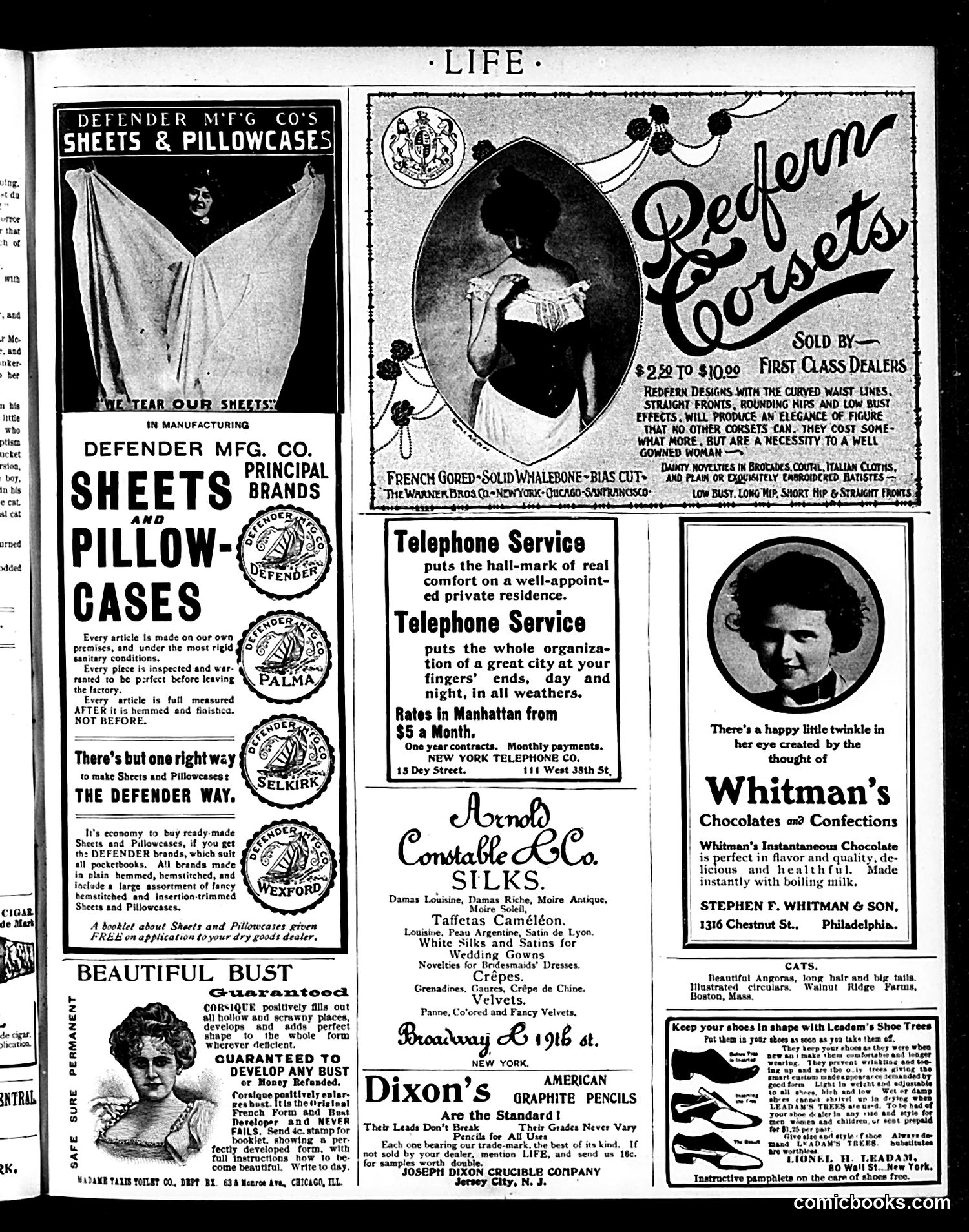
This is primarily a **advertising page** with no political cartoons or satire. The content reflects early 20th-century consumer culture and gender norms. **Key advertisers include:** - **Defender Manufacturing**: Sheets and pillowcases, emphasizing quality control and value - **Corsets** (Redfern and Corsique): Marketed to reshape women's bodies into fashionable silhouettes—a practice modern readers may find shocking. These ads promise to "develop" busts and create specific waist/hip curves - **Whitman's Chocolates**: Positioned as a luxury gift item - **Telephone Service**: Promoted as a sign of modern comfort and urban connectivity - **Dixon's Graphite Pencils**: Marketed as the standard product **Notable for modern readers:** The corset advertisements reveal how aggressively early 1900s fashion promoted body modification as necessary for respectability. The "Beautiful Bust Guaranteed" developer and emphasis on "perfectly developed form" reflect attitudes toward women's bodies that would be considered extreme today.
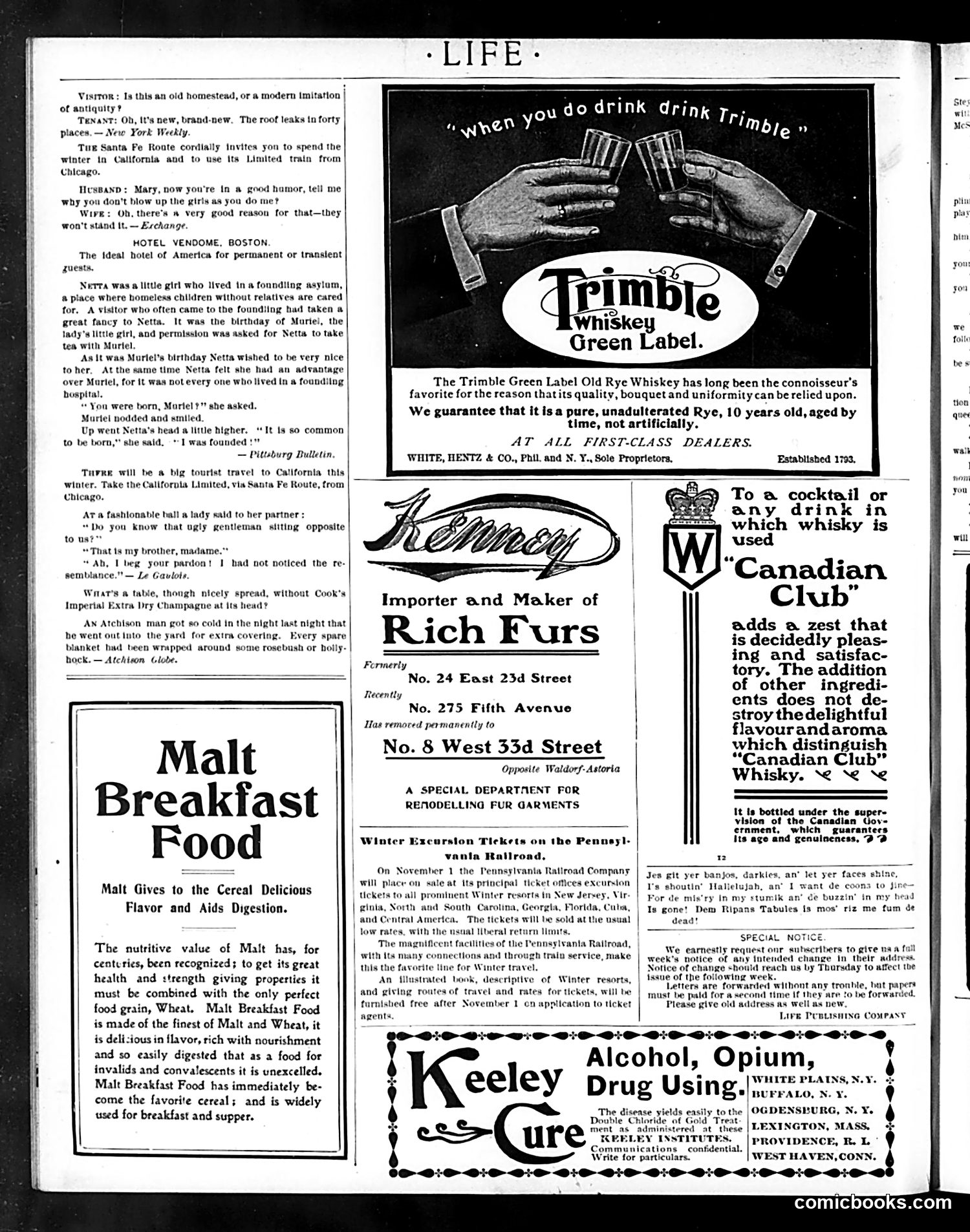
This page from *Life* magazine (early 1900s, based on advertising styles) is primarily **advertising and humor anecdotes**, not political cartoons. The main satirical content includes brief jokes about class distinction and gender roles. One anecdote mocks a foundling-house girl named Netta who condescends to her friend Muriel by boasting that she was "founded" rather than "born"—playing on the shame of illegitimacy or abandonment. The joke inverts expected social hierarchy: the institutionalized child claims superiority through her unusual origins. Another joke depicts a husband asking why his wife doesn't "blow up" (criticize) him as she does their daughters; she responds they "won't stand it"—satirizing marital dynamics and female defiance. The page is dominated by period advertisements for whiskey, fur services, railroad excursions, and patent medicines (notably "Keeley Cure" for alcohol and opium addiction—an ironic placement alongside whiskey ads). The humor is genteel and reflects turn-of-century anxieties about class, legitimacy, and gender relations.
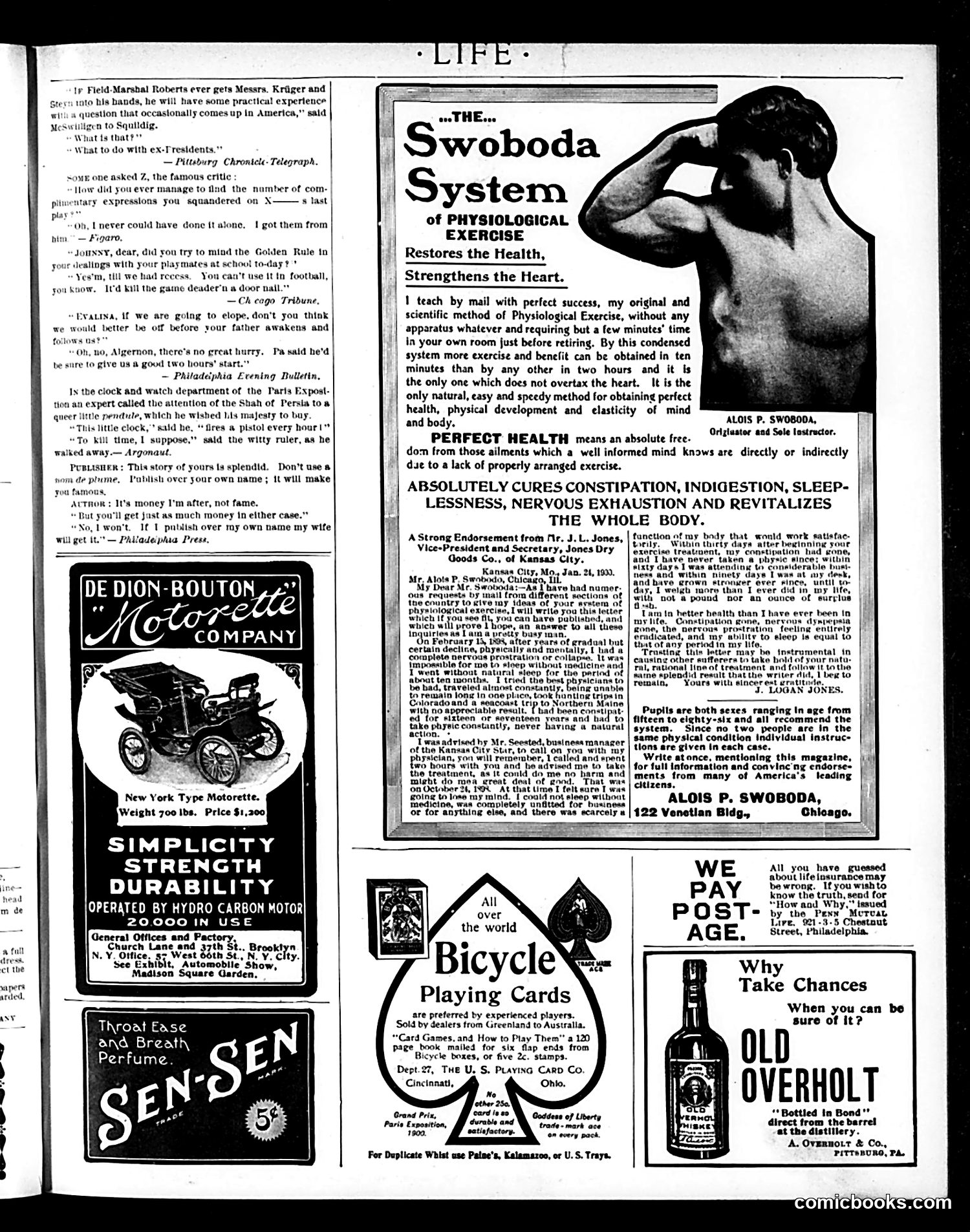
This page is primarily an **advertising and humor magazine** from Life's early period, not a political cartoon page. The bulk consists of advertisements (De Dion-Bouton motorettes, Sen-Sen perfume, bicycle playing cards, Old Overholt whiskey) alongside **humorous anecdotes and jokes**—brief comic dialogues on topics like ex-presidents, playground sportsmanship, parental discipline, and wifely financial motives. These are light social satire rather than serious political commentary. The most substantial non-ad content is the **Swoboda System** testimonial—a mail-order physical exercise program marketed with an endorsement from a Kansas City businessman claiming it cured his nervous breakdown and constipation. This represents typical early-20th-century **dubious health claims**, though presented straightforwardly rather than satirically. The page reflects Life's model of mixing humor, advertising, and lifestyle content for general amusement rather than hard-hitting satire.
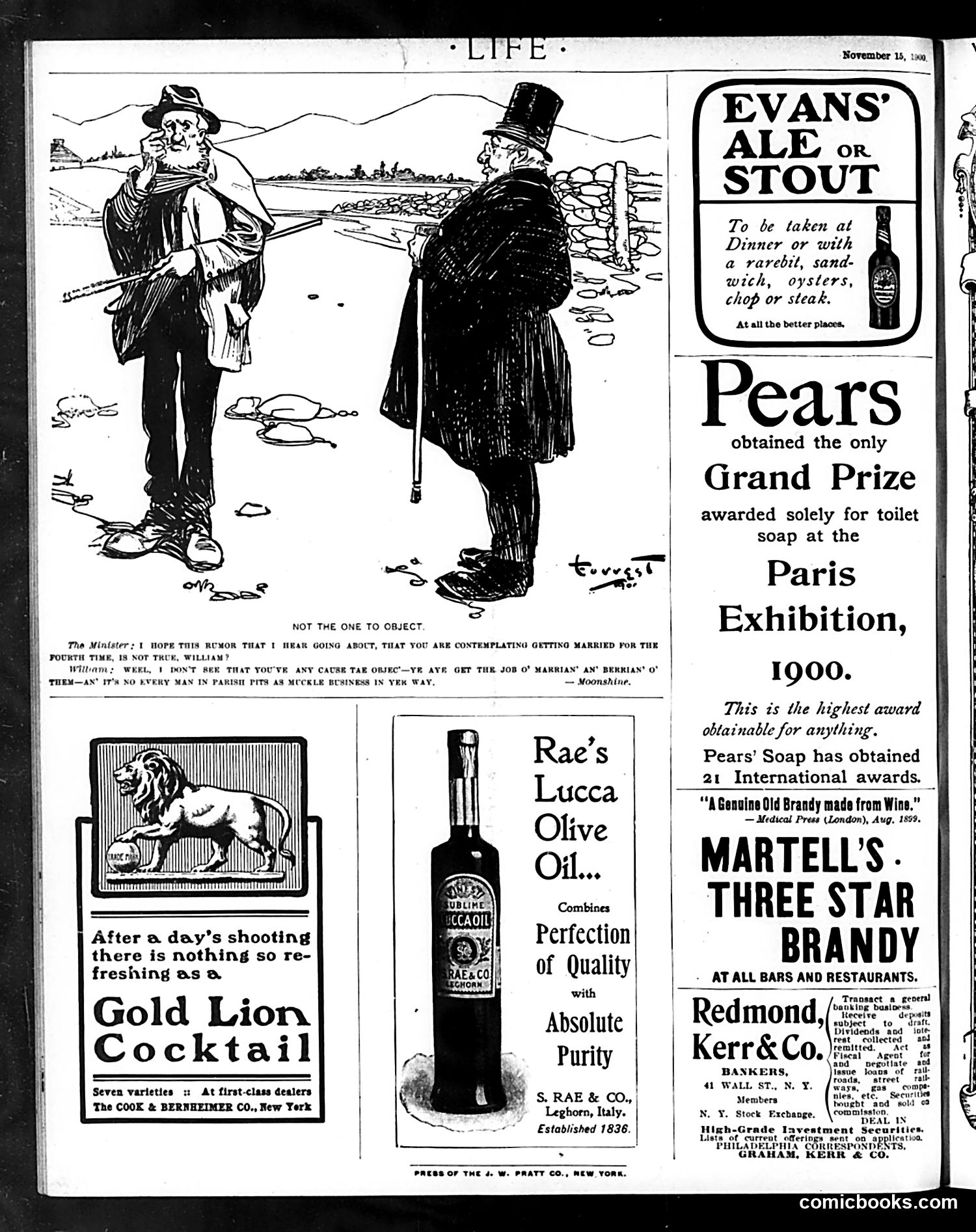
The main cartoon depicts two figures in rural dress discussing marriage. A minister warns "William" that rumors suggest he's contemplating marriage—implying this would be socially questionable or comedically inappropriate for William's station or circumstances. The joke's specific context is unclear today without knowing who "William" represents, though the satire appears to mock either lower-class marriage prospects or a specific public figure's rumored romantic plans. The page is primarily **advertising**, featuring product endorsements for Evans' Ale, Pears' Soap (emphasizing its Paris Exhibition Grand Prize), Rae's Lucca Olive Oil, Gold Lion Cocktail, and Martell's Brandy. These ads reflect early 1900s marketing strategies emphasizing international awards and prestige to appeal to affluent readers. The cartoon's humor relies on period-specific social attitudes about marriage and class that modern readers would need additional context to fully appreciate.