
Life, 1900-11-15 · page 12 of 28
Life — November 15, 1900 — page 12: what you’re looking at
What you’re looking at
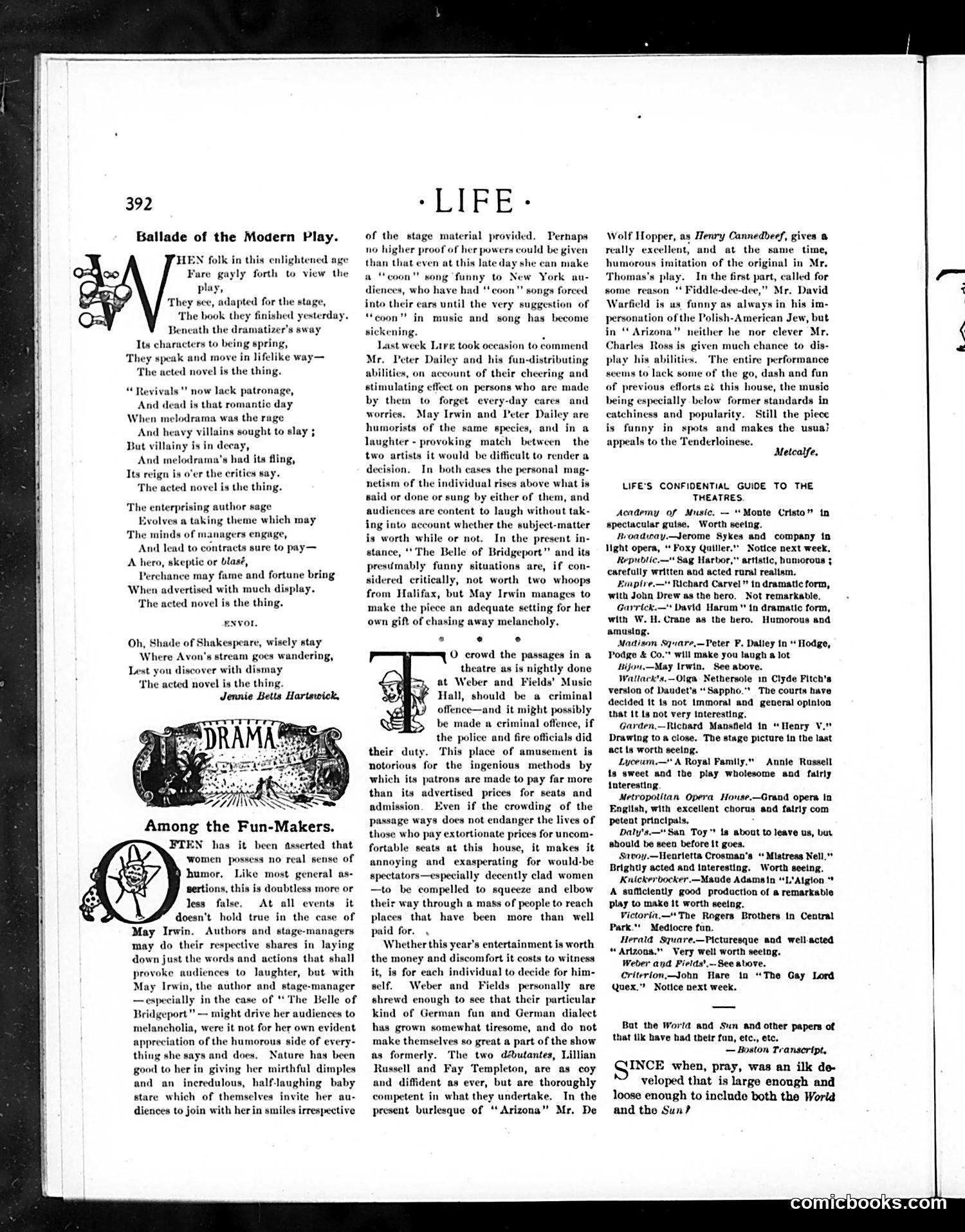
This page contains theater criticism rather than political cartoons. The "Ballade of the Modern Play" is a humorous poem mocking contemporary theatrical trends—specifically criticizing how modern plays rely on revivals and spectacle rather than quality writing. The reviews below discuss current productions including "The Belle of Bridgeport" (featuring May Irwin and Peter Dailey), "Arizona," and various other plays. The critics praise performances by May Irwin and Wolf Hopper while noting that some productions sacrifice substance for entertainment value. The decorative "DRAMA" emblem and small illustrations are typical of Life's design aesthetic but aren't satirical cartoons. The page's humor lies in the written commentary on theatrical mediocrity and the absurdities of contemporary stage productions.
📄 Transcribed text from this page (OCR, searchable)
Machine-transcribed from the original scan — historical spelling and the odd misread are preserved.
392 Ballade of the Modern Play. HEN folk in this enlightened age Fare gayly forth to view the play, They sce, adapted for the stage, ‘The book they finished yesterday. Beneath the dramatizer's sway Its characters to being spring, ‘They speak and move in lifelike way— ‘The acted novel is the thing. “ Revivals" now lack patronage, And dead is that romantic day When melodrama was the rage And heavy villains sought to slay ; But villainy is in decay, ‘And melodramas had its fling, Its reign is o'er the critics say, the acted novel is the thing. ing author sage ‘a taking theme which may ‘The minds of managers engage, And lead to contracts sure to pay— A hero, skeptic or blasé, Perchance may fame and fortune bring When advertised with much display. ‘The acted novel is the thing. ENVOL. On, hakespeare, wisely stay Where Avon's stream goes wandering, Lest you discover with dismay ‘The acted novel is the thing. Jennie Betts Hartmwick, va 77 Among the Fun-Makers. ETEN has it been asserted that Women possess no real sense of b humor, Like most general as- sertions, this is doubtless more or Jess false, At all events it doesn't hold true in the case of May Irwin. Authors and stage-managers may do their respective shares in laying down just the words and actions that shall provoke audiences to laughter, but with May Irwin, the author and stage-manager —especially in the case of “The Belle of Bridgeport" — might drive her audiences to melancholia, were it not for her own evident appreciation of the humorous side of every- thing she says and does. Nature has been good to her in giving her mirthful dimples and an incredulous, half-aughing baby tare which of themselves invite her au- diences to join with her in smiles irrespective -LIFE- of the stage material provided. Pernaps no higher proof of her powers could be given than that even at this lateday she can make a “coon” song funny to New York au- diences, who have had ‘coon’ songs forced into their ears until the very suggestion of “coon "in music and song has become ing. . Last week Lire took oceasion to commend Mr. Pet and his fun-distributing on account of their cheering and stimulating effect on persons who are made by them to forget every-day cares and worries. May Irwin and Peter Dailey are humorists of the same species, and in a laughter - provoking match between the two artists it would be difficult to render a decision. In both cases the personal mag- netism of the individual rises above what is said or done or sung by either of them, and aces are content to laugh without tak- to account whether the subject-matter is worth while or not. In the present in- stance, ‘The Belle of Bridgeport” and its presmably funny situations are, if con- sidered critically, not worth two whoops from Halifax, but May Irwin manages to make the piece an adequate setting for her own gift of chasing away melancholy. ° ° ° © crowd the passages in a theatre as is nightly done ex, at Weber and Fields’ Music . Hall, should be a criminal offence—and it might possibly be made a criminal offence, if the police and fire officials did their duty. This place of amusement is notorious for the ingenious methods by which its patrons are made to pay far more than its advertised prices for seats and admission. Even if the crowding of the passage ways does not endanger the lives of those who pay extortionate prices for uncom- fortable seats at this house, it makes it annoying and exasperating for would-be spectators—especially decently clad women —to be compelled to squeeze and elbow their way through a mass of people to reach places that have been more than well paid for. , Whether this year’s entertainment is worth the money and discomfort it costs to witness it, is for each individual to decide for him- self. Weber and Fields personally are shrewd enough to see that their particular kind of German fun and German dialect has grown somewhat tiresome, and do not make themselves so great a part of the show as formerly. The two débutantes, Lillian Russell and Fay Templeton, are as coy and diffident as ever, but are thoroughly competent in what they undertake. In the present burlesque of “Arizona” Mr. De Wolf Hopper, as Henry Cannedbeef, gives & really excellent, and at the same time, humorous imitation of the original in Mr. ‘Thomas's play. In the first part, called for some reason ‘* Fiddle-dee-dee,”” Mr. David Warfield is us funny as always in his im- personation of the Polish-American Jew, but in “Arizona” neither he nor clever Mr. Charles Ross is given much chance to dis- play his abilities. ‘The entire performance seems to lack some of the go, dash and fun of previous efforts ct this house, the music being especially below former standards in catchiness and popularity. Still the piece is funny in spots and makes the usua? appeals to the Tenderloinese. Metcalfe, LIFE'S CONFIDENTIAL GUIDE TO THE THEATRES. Academy of Music. — “Monte Cristo” in spectacular guise, Worth seeing. Rroadiray.—Jerome Sykes and company tn light opera, “ Foxy Quiller."" Notice next week, Republic.— Sag Harbor,” artistic, humorous ; carefally written and acted rural reallam. Emptre.— Richard Carvel” in dramatic form, ‘with John Drew as the hero, Not remarkable. Garrick." David Haram " in dramatic form, with W.H. Crane as the hero. Humorous and amusing. Madison Square,—Peter P. Dalley in Hodge, Podge & Co.” will make you laugh a lot Bijou,—May Irwin, See above. Wattack's.—Olga Nethersole in Clyde Fitch’s verston of Daudet’s “Sappho.” The courts have decided it 1s not Immoral and general opinion that {t ts not very Interesting. Garden.—Richard Mansfeld in “Henry V." Drawing to a close. The stage picture in the last ‘act ts worth seeing. Lyceum.— A Royal Family." Annie Rassell 1s sweet and the play wholesome and fatrly interesting. Metropolitan Opera House.—Grand opera in Engitsh, with excellent chorus and fatrly com petent principals, Daly's.—" San Toy” is about to leave us, but should be seen before It goes. Savoy.—Henrletta Crosman’s “Mistress Nell,”* Brightly acted and interesting. Worth seeing. Knickerbocker. —Maude Adamstn “L'Atgion ** A suMclently good production of a remarkable play to make it worth seeing, Victoria.—The Rogers Brothers in Central Park." Mediocre fan. Herald Square.—Picturesque and well-acted “ Arizona." Very well worth seeing. Weber and Pields',—-See above. Criterton,—John Hare tn “The Gay Lord Quex.* Notice next week. Bat the World and Sun and other papers of that lik have had thetr fan, etc., etc. — Boston Transcript, GCE when, pray, was an ilk de- veloped that is large enough and loose enough to include both the World and the Sun?