
Life, 1900-11-15 · page 7 of 28
Life — November 15, 1900 — page 7: what you’re looking at
What you’re looking at
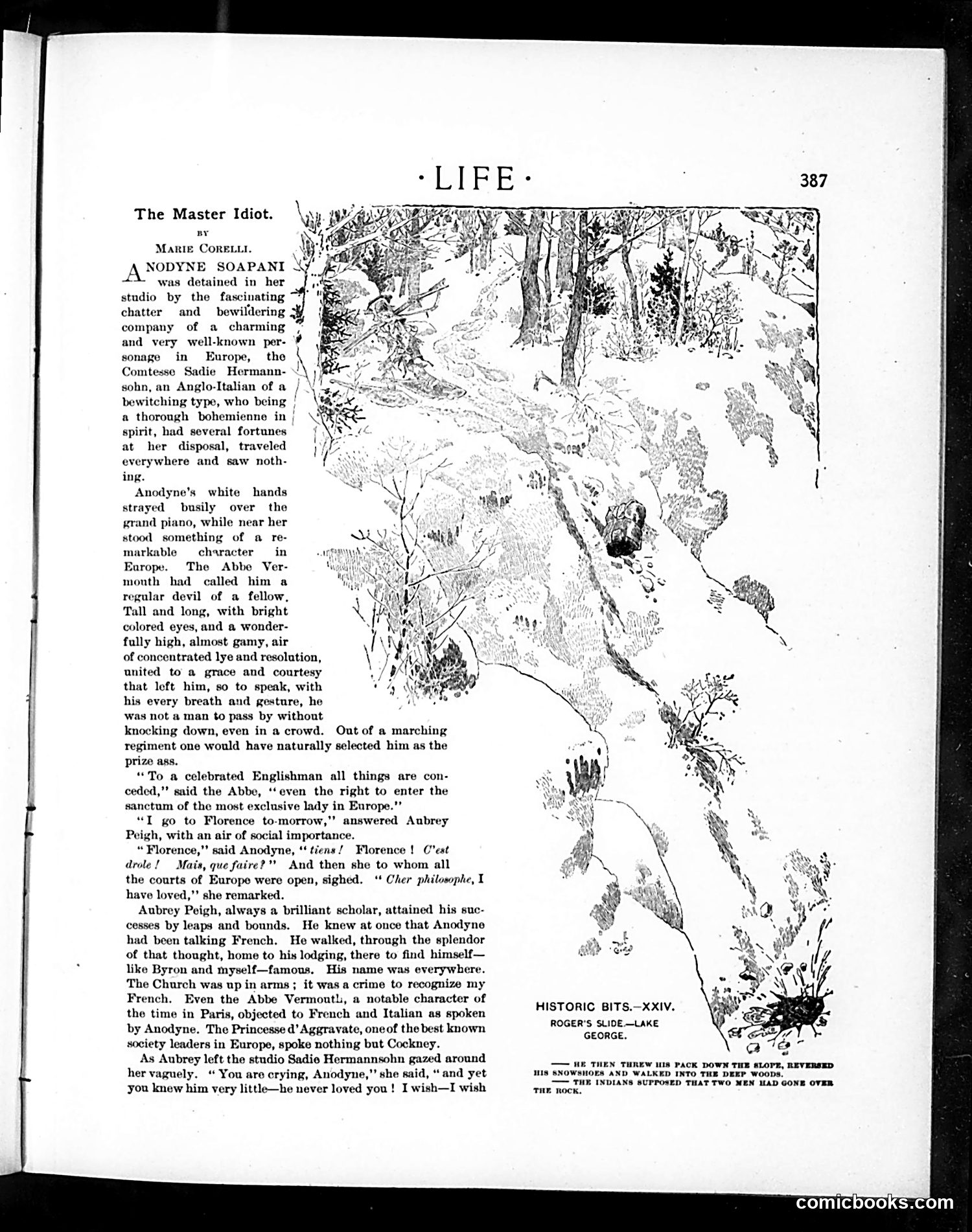
This page presents a literary story titled "The Master Idiot" by Marie Corelli, featuring the character Anodyne Soapani. The bulk of the page is text describing social interactions in a European setting, mentioning Florence, Paris, and various European courts. The illustration labeled "Historic Bits—XXIV" depicts "Roger's Slide—Lake George" and shows a landscape scene with trees and water, apparently illustrating a historical location rather than a political cartoon. There is no clear political satire or social commentary visible in either the text excerpt or the illustration on this page. It appears to be primarily a serialized fiction story with an accompanying landscape illustration—typical magazine filler content rather than satirical editorial material.
📄 Transcribed text from this page (OCR, searchable)
Machine-transcribed from the original scan — historical spelling and the odd misread are preserved.
\ 2 The Master Idiot. Ny BY ny NY ey Marie CoreLLI. iM foe NODYNE SOAPANI LY) fy was detained in her studio by the chatter and company of a charming and very well-known per- * sonage in Europe, the Comtesse Sadie Hermann- sohn, an Anglo-Italian of a / bewitching type, who being | a thorough bohemienne in | spirit, had several fortunes at her disposal, traveled everywhere and saw noth- ing. Anodyne’s white hands strayed busily over the grand piano, while near her stood something of a re- markable character — in Europe. The Abbe Ver- mouth had called him a regular devil of a fellow, Tall and long, with bright colored eyes, and a wonder- fully high, almost gamy, air of concentrated lye and resolation, united to a grace and courtesy that left him, so to speak, with his every breath and gesture, he was not a man to pass by without knocking down, even in a crowd. Out of a marching regiment one would have naturally selected him as the prize ass. “To a celebrated Englishman all things are con- ceded,’ said the Abbe, ‘even the right to enter the sanctum of the most exclusive lady in Europe." “I go to Florence to-morrow,” answered Aubrey Peigh, with an air of social importance. “ Florence,”’ said Anodyne, ‘‘tiens/ Florence! C'est drole! Mais, que faire?” And then she to whom all the courts of Europe were open, sighed. ‘* Cher philosophe, 1 have loved,’’ she remarked. Aubrey Peigh, always a brilliant scholar, attained his suc- cesses by leaps and bounds. He knew at once that Anodyne had been talking French. He walked, through the splendor of that thought, home to his lodging, there to find himself— like Byron and myself—famous. His name was everywhere. The Church was up in arms; it was a crime to recognize my French. Even the Abbe Vermouth, a notable character of the time in Paris, objected to French and Italian as spoken by Anodyne. The Princesse d’ Aggravate, oneof the best known society leaders in Europe, spoke nothing but Cockney. As Aubrey left the studio Sadie Hermannsohn gazed around her vaguely. ‘You are crying, Anodyne,” she said, “and yet you knew him very little—he never loved you ! I wish—I wish | ov HISTORIC BITS.—XXIV. ROGER'S SLIDE—LAKE GEORGE. — HE THEN THREW 118 PACK DOWN THE SLOPE, REVERSED M18 SNOWSHOES AND WALKED INTO THE DEEP WOODS, — THE INDIANS SUPPOSED THAT TWO MEN MAD GONE OVER THE Rock.